My Fantasy World

Millions of anxious fans are now watching their fortunes rise or fall in the annual fantasy football playoffs. Although fantasy competition is based on actual performances in the NFL, it operates in a way that is fundamentally different from real life. In fantasy sports, allegiance to teams means nothing; individual players are all that matter.

In fantasy football each participant creates a roster by selecting individual players from among the NFL’s 32 real teams. So, your quarterback might be from the Green Bay Packers, while your wide receiver is from the Dallas Cowboys. Your score is based on how well each of your players performs in real games, without regard to the final outcome – in this case for the Packers or Cowboys.

The NFL and other major sports leagues love this approach – so much so that most teams actively support, and even invest in, companies that operate fantasy games. Why? Because the leagues are more financially stable and fans are more engaged. Nowadays, the sum of the players is greater than the sum of the teams.

If you are a San Francisco fan, for example, you’ve pretty much lost interest by now in the 49ers’ miserable season, with just three wins and 10 loses. But if you’re lucky enough to have the team’s star tight end George Kittle on your fantasy roster, you’re still engaged, and loving it.

Moreover, many fantasy players bet with their hearts as well as their wallets. If you don’t like the off-field behavior of a particular player, or the politics of a given NFL owner, you can ignore them in your fantasy world.

Donald Trump would not fare well in fantasy sports. He rejects globalism and declares himself a nationalist. He would not want his team to have a running back from Mexico or a place kicker from Haiti. While his goal would be to Make The Trumpsters Great Again, his exclusionary strategy would likely leave him in last place.

If I were making a fantasy political team, I would draft a player like outgoing Arizona Senator Jeff Flake. In real life, however, Flake’s contrary positions on several key issues, such as immigration, made him unwelcome on the Republican team.

I’d include departing Missouri Senator Claire McCaskill, a moderate Democrat who lost her bid for re-election in a state where voters elected Donald Trump by an incredible 19 points. She exits noting that too many of her colleagues have become “poll-driven and scripted.”

I’d probably give a spot on my team to Republican Mia Love, who earned the wrath of Donald Trump and paid the price when Utah voters were unwilling to send her back to the House of Representatives. She warns: “We cannot fall into the trap of thinking that there are Democratic issues and Republican issues.”

My fantasy squad would even dip into the real football world and select Colin Kaepernick as its quarterback. Having committed the sin of dropping to a knee during the national anthem to protest police killings of unarmed black men, Kaepernick has been blackballed by NFL owners for two years. Well, he’s got a spot on my team.

Imagine, as John Lennon might have said, if there were no political parties, no exclusionary clubs, and no sports teams that willingly hire wife-beaters but exile a person for simply taking a knee.

The best part about my team is that it isn’t a team at all. It’s simply a band of solid citizens, willing to put principle before party. Nothing fanciful about that.

A list of Peter Funt’s upcoming live appearances is available at www.CandidCamera.com.

Peter Funt is a writer and speaker. His book, “Cautiously Optimistic,” is available at Amazon.com and CandidCamera.com.Copyright2018 Peter Funt. Columns distributed exclusively by Cagle Cartoons, Inc., newspaper syndicate.
Comments Off on My Fantasy World

A Strategy for Giving

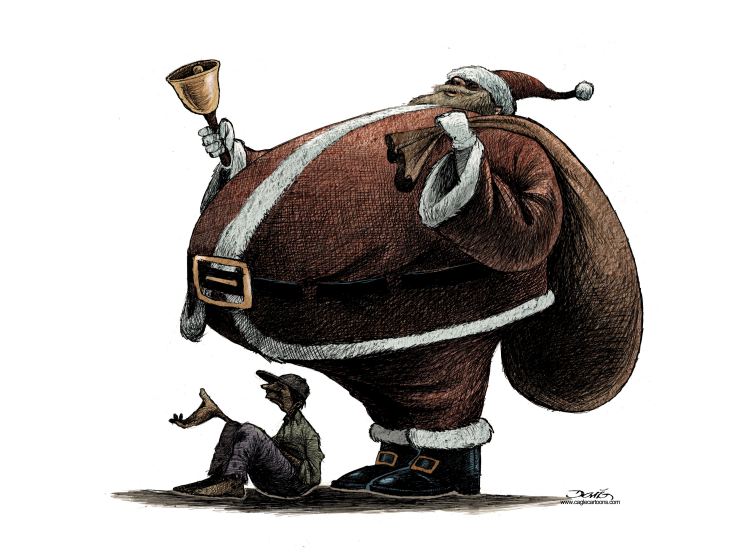
In the emergency room and on the battlefield it’s easy to appreciate the wisdom of a triage system: those with the greatest need are helped first. But few of us, particularly the wealthy, apply that same type of thinking when it comes to making donations to charities.

December marks the height of the charity season, when Americans give the bulk of roughly $290 billion donated annually by individuals. Various studies have pointed to an overall increase in charitable giving in recent years, although new tax laws might adversely affect that trend.

Due to the higher standard deduction fewer Americans will itemize donations and that could lead to the unintended consequence of less money going to charity. Notably, however, the group least affected by the new tax rules is the one that makes the largest contributions: wealthy individuals earning over $200,000 a year.

So, which causes do these affluent folks support, and how do they make their gifting decisions?

The U.S. Trust study, published by Bank of America and Indiana University, reveals several troubling answers. First, roughly half of wealthy donors don’t have a strategy for giving. They are guided by relationships with organizations,’such as colleges, churches and foundations,’and by their own past patterns of giving. That’s understandable, but hardly the definition of a triage system.

Second, nearly half of wealthy people, 46 percent, make no contributions whatsoever to “basic needs” such as food and shelter. Even more concerning, among the 54 percent who did, the amount given represented only 19 percent of the total. In other words, although a majority of rich people see human need as important, they fail to give it the majority of their charity budget.

Statistics show that the poorer you are the more you give, proportionately, to basic needs. Why is that? Is it because poorer people more clearly recognize the plight of those even less fortunate?

Maybe it’s because wealthy Americans believe government is doing enough to aid the hungry and homeless. Perhaps some among the affluent are suspicious of the poor – believing they game the system and don’t take enough responsibility for their plight.

Such thinking only obfuscates the bottom line: despite an improving economy and a drop in unemployment, roughly 40 million Americans live in poverty. The latest figures from the U.S. Census Bureau also show that child poverty remains alarmingly high – due in part to the number of single-parent homes, coupled with the fact that women continue to earn less, on average, than men.

Although poverty figures differ depending on the metrics, there is general agreement that the U.S. has far more poverty than most developed countries such as Canada and in the U.K. How wealthy must we, as a nation, become before this stops?

As I write this at my office in California I’m also overwhelmed by the fact that more than 14,500 of my neighbors to the north have lost their homes and businesses in the Butte County wildfire. And that’s just the latest in a swath of disasters from Puerto Rico to Florida, the Carolinas, Texas and California that have left many people in need.

The U.S. Trust survey says just 1 percent of charitable donations by the wealthy goes to disaster relief efforts.

So, I wonder, is this the best time to write a check to help the school band get new uniforms? For the super rich, does your alma mater really need another building with your name on it?

There are many good causes, no doubt about that, and it would be foolish to cut them out of our charity budgets. But perhaps everyone, especially the wealthiest among us, can make a strategic adjustment so that more money goes where it’s needed most.

As Orwell might have framed it in this season of giving: All charities are equal, but some are more equal than others.

A list of Peter Funt’s upcoming live appearances is available at www.CandidCamera.com.

Peter Funt is a writer and speaker. His book, “Cautiously Optimistic,” is available at Amazon.com and CandidCamera.com.B 0 82018 Peter Funt. Columns distributed exclusively by Cagle Cartoons, Inc., newspaper syndicate.

Comments Off on A Strategy for Giving

Give Trump Credit When Due

Stuck in a hotel room watching CNN the other day, I happened to catch live coverage of Donald Trump’s short speech about the “First Step Act,” concerning criminal justice reforms. I was bowled over. If I had been reading an unlabeled transcript I might have thought the speaker was Barack Obama.

Imbalances and outright abuses in our criminal justice system are a plague on society. And here was Trump, the law-and-order president, urging passage of legislation to limit mandatory sentences, especially for drug offenses, and advocating new funding for sweeping anti-recidivism programs.

Trump also said this: “Today’s announcement shows that true bipartisanship is possible.” Yes! He’s correct – and that’s big news.

I kept expecting Trump to put his foot in his mouth by shifting to “criminals” in the migrant caravan, or ranting about “crimes” he believes were committed in election recounts. He did not. He was entirely reasonable and on message – albeit with a prepared text – about a vitally important issue.

When it ended, however, I had a sinking feeling. What if mainstream media were to under play, or even ignore, this very positive news? After all, members of Trump’s team, most notably Kellyanne Conway, have stated repeatedly that media dwell on Trump’s problems and fail to give appropriate space to meaningful achievements.

In the hours that followed, CNN devoted almost all of its time to “chaos” in the White House – Trump’s mood, Melania Trump’s effort to get a national security deputy fired, and charges and countercharges about the election results. The First Step Act was barely mentioned.

I was able to check two broadcast networks. On NBC’s “Nightly News,” the story was covered reasonably well about eight minutes in. But the “CBS Evening News” never mentioned the story in its half-hour report. Never mentioned it!

The next morning, the story was practically invisible on the nation’s front pages – with no page-one coverage in The Los Angles Times, Washington Post, Wall Street Journal, Chicago Tribune or USA Today.

Only The New York Times, among papers I surveyed, stepped up, making the story its lead of the day, atop page one. In an editorial, The Times added, “In this early test, the president is signaling that he indeed wants to make progress on critical issues that enjoy broad support.”

Meanwhile progressive commentator Van Jones told CNN’s Don Lemon: “I say, the 99 times I don’t agree with the president I’m going to give him hell. But on this one, I’ll give him a salute and applause.”

What followed was a Twitter backlash against Jones from liberals who were troubled by praise, any praise, for Trump. Jones replied via Twitter: “There are 200,000 people behind bars. They have no hope, no help. We haven’t passed a bill to help them in almost two generations.”

The president himself has noted that he could work with the new Democratic majority in the House on many issues, from drug prices, to repairing infrastructure and, yes, on criminal justice reform.

Trump’s opponents along with media who cover the White House objectively must walk a fine line. They should criticize him when he deserves it and must hold him accountable for his many misstatements. But they can’t succumb to temporary blindness when the news is positive.

As the second half of Trump’s term begins, reforms are needed in criminal justice – and also in how politicians and media conduct themselves on the rare occasions when good news happens at the White House.

A list of Peter Funt’s upcoming live appearances is available at www.CandidCamera.com.

Peter Funt is a writer and speaker. His book, “Cautiously Optimistic,” is available at Amazon.com and CandidCamera.com.Copyright2018 Peter Funt. Columns distributed exclusively by Cagle Cartoons, Inc., newspaper syndicate.

Comments Off on Give Trump Credit When Due

Dogs Get Their Day in Florida Voting

FORT MYERS, Fla. – Amid the brouhaha over senate and gubernatorial voting, there was clarity here in the Sunshine State about one thing: Floridians are fed up with the cruel practice of organized dog racing.

There are currently 17 tracks in the U.S. where greyhounds compete, 11 of them in Florida. By a vote of roughly 70 percent to 30 percent, voters passed Amendment 13, which halts the practice by the end of 2020.

Lawmakers chose to include pointed language in the amendment that resonated with voters, saying the “humane treatment of animals is a fundamental value of the people of the State of Florida.”

Some 7,000 greyhounds are needed to support the state’s 11 tracks, where dogs only last about two years before being put up for adoption.

“Because of the decisions of millions of Florida voters thousands of dogs will be spared the pain and suffering that is inherent in the greyhound racing industry,” Kitty Block, acting president of the Humane Society, told the Orlando Sentinel.

Only in 2013 did Florida start requiring records of deaths at a track or racing kennel, with 438 dog deaths reported between May 31, 2013 and Sept. 30, 2017, according to the Tampa Bay Times. There have been over 400 cases in the last decade where drug tests showed dogs had been given cocaine.

The only remaining dog tracks are in Alabama, Arkansas, Iowa, Texas andWest Virginia.

After Florida’s votes were counted, I went over to the Naples-Fort Myers Greyhound Track to see how the news was being received. For starters, the staff refers to dog racing as a “sport,” although I, for one, don’t see it that way.

Workers were busy preparing for next month’s new season, which will go on as planned. The track and grandstand look as if they have seen better days,’which is true, since greyhound racing has been in decline for several years. Still, over $87 million was wagered in Florida in the last fiscal year.

A uniformed employee, who identified himself only as Joe, insisted that voters got it wrong. The dogs are treated very well, he said, just like any other pro athlete. “Why,” he asked, “would an owner mistreat a dog if his livelihood depends on the animal performing well?”

I told Joe maybe it was he who got it wrong. Greyhounds engage in what could be called an athletic endeavor but they are hardly willing professionals. As for the owners, it’s undoubtedly true that they want to protect their property and their chances of winning,’but drugging dogs is abusive, and pushing them beyond natural limits is cruel.

“It used to be,” Joe explained, “if a dog hurt its leg during a race they’d just take it behind the building over there and shoot it in the head. We don’t do that kind of thing anymore.”

Good to know. What’s even better: voters here in Florida decided that it won’t ever have to come to that again.

A list of Peter Funt’s upcoming live appearances is available at www.CandidCamera.com.

Peter Funt is a writer and speaker. His book, “Cautiously Optimistic,” is available at Amazon.com and CandidCamera.com.B 0 82018 Peter Funt. Columns distributed exclusively by Cagle Cartoons, Inc., newspaper syndicate.

Comments Off on Dogs Get Their Day in Florida Voting

Onward to 2020

If you thought the midterms were bad – marked by Trump’s frequent falsehoods, cockamamie claims and rampant racism – you ain’t seen nothing yet. It’s 2020 time.

Like shoppers determined to find Christmas bargains immediately after Halloween, politicians are already angling for votes that won’t actually be cast for another two years.

Too early you say? Hillary Clinton declared her candidacy for 2016 some 19 months before the election. Barack Obama officially threw his hat in the ring 21 months ahead of the 2008 voting. Declarations by Democrats running in 2020 could be just a few months away.

The goal for them, of course, is to oust Donald Trump, perhaps even take over both houses of Congress, and begin the process of restoring civility in government. Finding the right standard-bearer will be tricky.

I believe the successful Democrat will fit this profile: female, under age 60, established but virtually baggage-free, and left of center without being too far removed from the mainstream comfort zone. In other words, a female version of Obama in 2008.

Why a woman? It’s what the country really wants. Hillary Clinton botched it in 2016 because her overwhelming negatives pushed too many voters away from breaking the “glass ceiling.” In 2020, a female challenger will give Democrats the energy that comes with not just undoing Trump, but crossing the sexist divide once and for all.

From a purely strategic perspective: as crude as Trump is likely to be in the 2020 campaign, insults aimed at a female opponent will backfire far more than against a male.

Why under 60? Although we’re all grateful to be living longer, age is an issue in politics. Come November 2020, Joe Biden, perhaps the best known and widely admired Democrat, will be 77. Bernie Sanders, who stirred more passion than Clinton, will be 79. Elizabeth Warren, the most recognizable at this stage among female Democrats, will be 71. Trump will be 74.

The nation wants, and frankly deserves, a somewhat younger perspective. Strategically, a candidate significantly younger than Trump will have an advantage.

What about baggage? Every politician has vulnerabilities, especially in the fast and fact-free digital era. But some issues, such as Warren’s tangled attempts to clarify her Native American heritage, just get in the way. Hillary Clinton, despite significant achievements in government, had more baggage than any presidential candidate in modern times. The party must be more careful.

How far left? Both political parties drift away from center in the primaries and then try to swing back in the general election. But Sanders and Warren, for whom the term “socialist” is frequently invoked, are probably too committed to progressive positions – usually, to their credit – to be relied upon in 2020, when the bottom line is winning.

As we close the book on the 2018 midterms, two Democrats stand out as compelling candidates for 2020: California Senator Kamala Harris, 54, the former state attorney general, and Amy Klobuchar, 58, the senior senator from Minnesota.

Both women have been testing stump speeches in Iowa. Klobuchar, tellingly, has refused to pledge that she would serve out her full senate term.

Right now, voters need a timeout. But for leading Democrats focused on 2020, there’s no time to waste.

A list of Peter Funt’s upcoming live appearances is available at www.CandidCamera.com.

Peter Funt is a writer and speaker. His book, “Cautiously Optimistic,” is available at Amazon.com and CandidCamera.com.Copyright2018 Peter Funt. Columns distributed exclusively by Cagle Cartoons, Inc., newspaper syndicate.

Comments Off on Onward to 2020

How Many Newsletters Do You Receive?

I read the news today, oh boy. And by “read” I mean skimmed. And by “news” I mean aggregates. And by “today” I mean round-the-clock. And by “oh boy” I mean I’m suffering from email newsletter overload.

Pretty much every major news outlet has joined the booming newsletter business. The Washington Post proudly declares that it now publishes 65 – yes, 65 – different newsletters. In fact, the other day I read in a newsletter published by Politico that the Post is looking for a newsletter editor “to support a wide portfolio of editorial products that have become an essential part of the Post’s success in reaching and retaining readers.”

Indeed, most publishers use newsletters as loss leaders to reach and retain – although a few of these missives thrive as profit making, standalone publications. It’s high tide for those who enjoy having news pinged at them relentlessly in numbered and bulleted form.

The modern newsletter era got serious in 2007 when the veteran Washington newshound Mike Allen began emailing his “Politico Playbook.” Allen has a knack for ferreting out the most compelling nuggets in other people’s stories and summarizing them, Walter Winchell-style. Two years ago he moved his newsletter to Axios, while Politico continued to produce “Playbook” – which has mushroomed to 10 different regional editions.

The ability to simply click-to-receive scores of newsletters presents the same sort of problem for me as doughnuts do at an all-you-can-eat breakfast buffet. I start most days with “Morning Briefing” from The New York Times and “The 10-Point” newsletter from the Wall Street Journal. I read Mike Allen plus several editions of “Playbook” along with its sister, “Morning Media,” and its politically-focused cousin, “Morning Score.”

I read the Post’s “Morning 202,” which might be the most wordy newsletter on the market. Then I skim newsletters from a dozen local and regional newspapers before turning my attention to “NFL Daily,” “IP Law360” and a passel of other soft-news newsletters. This continues through afternoon and evening updates, until the day winds down with The Times’ “Evening Briefing” at dinner and CNN’s “Reliable Sources” at bedtime.

I’m embarrassed to say this is by no means my complete list. So what’s happening here, to news organizations and consumers?

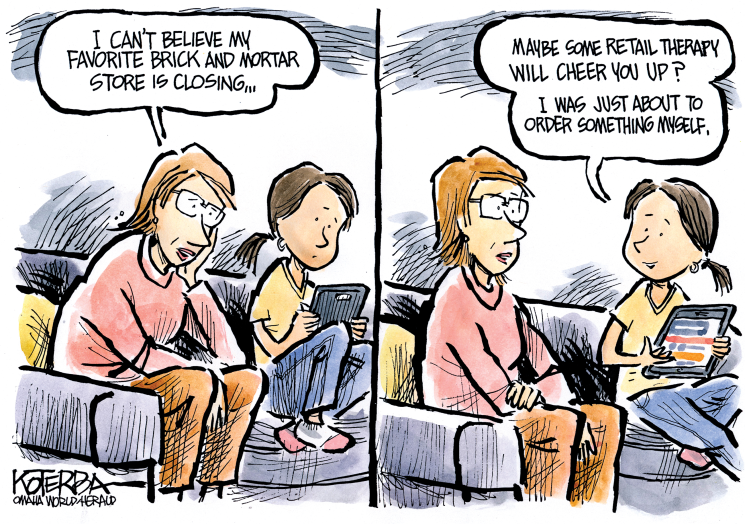
For most publishers, the newsletter gambit is yet another attempt to recover from the ghastly miscalculation decades ago to ignore the Internet’s profit potential. Publishers belatedly erected pay walls, but many readers had already slipped away.

Done right, newsletters are useful marketing tools to entice readers to click their way back to a paying mode. Done wrong, they are just another example of squandering valuable content on an audience of freeloaders.

As I write this, the Boston Globe has announced its “Metro Headlines” newsletter, declaring: “It’s free, just like our other two dozen newsletters.” The New York Times then unveiled its 56th newsletter: “Five Weeknight Dishes,” described as “weeknight recipes for busy people who still want something good to eat.”

Makes sense to me. I’m a busy person because I can’t stop clicking. I could use a daily newsletter aggregating the very best of the day’s newsletters.

A list of Peter Funt’s upcoming live appearances is available at www.CandidCamera.com.

Peter Funt is a writer and speaker. His book, “Cautiously Optimistic,” is available at Amazon.com and CandidCamera.com.Copyright2018 Peter Funt. Columns distributed exclusively by Cagle Cartoons, Inc., newspaper syndicate.
Comments Off on How Many Newsletters Do You Receive?

Arizona Mirrors the Midterm Divide

PHOENIX – The race to pick a new U.S. Senator from Arizona underscores the tenor, tactics and tightness of the 2018 midterm elections.

Two admired congresswomen are neck and neck as they seek to replace retiring Sen. Jeff Flake. Martha McSally, the Republican, and Kyrsten Sinema, the Democrat, are engaged in a high-stakes, high-spending campaign that reflects the nation’s sharp political divide.

Many issues that dominate debate nationally seem intensified here under the hot Arizona sun. Immigration remains a vexing problem in a state that shares a border with Mexico and has a growing Latino population. Health care is uppermost in the minds of those in Arizona’s large retirement community. The economy, booming here as it is nationally, has still left many Arizonans with low-paying jobs that have not kept pace with the cost of living.

The candidates appear to have come from Central Casting. McSally, the first female U.S. fighter pilot to have flown in combat, votes with President Trump 97 percent of the time, according to the website FiveThirtyEight. Sinema, a former Green Party activist, has moderated her views since arriving in Congress and has voted with Trump 62 percent of the time.

Sinema stresses her independence, a useful trait in a state that has not elected many Democrats but does favor mavericks such as John McCain, who cast a critical vote to save the Affordable Care Act, and Flake, who argued against his party to have the FBI conduct an additional investigation of Supreme Court nominee Brett Kavanaugh.

McSally, on the other hand, is straight-line conservative. She told the Arizona Republic newspaper that her philosophy centers on “a strong defense, a limited federal government, that government shouldn’t be solving every problem for you.”

Together, the two candidates are spending nearly $30 million on the campaign, with Sinema holding a slight edge in fundraising. But McSally is playing tough, in the Trump mold, as local columnist E.J. Montini noted the other day:

“The entire strategy of the McSally campaign has been to portray Sinema as a wild-eyed anarchist who, in the latest and most ridiculous campaign mailing would somehow facilitate the obliteration of Phoenix by way of a nuclear bomb.”

Underscoring the importance of the race as Democrats try to flip control of the Senate are visits by Presidents George W. Bush and Donald Trump to campaign for McSally. Yet, Sinema clings to a tiny lead in polling.

Not surprisingly, the number of people newly registered to vote in Arizona this year is more than double that of the last midterm election. And the youngest voting demographic, those aged 18 to 24, has more new voters registered than all other age groups since Jan. 1.

McSally and Sinema have had only one televised debate and it, too, mirrored national themes. In her closing remarks, seemingly out of nowhere, McSally stated she was “sexually abused by a coach as a teenager.” Sad as that may be, it’s hard to see how it constitutes a qualification for national office – except in the currency of the moment.

Arizona has a broiling Senate race in which women are in the forefront, where young voters and Latino voters could hold the keys, and where Trump and his agenda are being tested.

“There’s a lot of fights out there,” said McSally, in an ode to the obvious, “and there’s a lot at stake.”

A list of Peter Funt’s upcoming live appearances is available at www.CandidCamera.com.

Peter Funt is a writer and speaker. His book, “Cautiously Optimistic,” is available at Amazon.com and CandidCamera.com.Copyright2018 Peter Funt. Columns distributed exclusively by Cagle Cartoons, Inc., newspaper syndicate.

Comments Off on Arizona Mirrors the Midterm Divide

It’s News to Me

These are the best of times, and the worst of times, for being well informed.

We have a vast landscape of news sources, yet we tend to view them through a peephole rather than a porthole.

If you believe, as I do, that it is a civic responsibility to stay abreast of current events, consider taking a few steps to be a better news consumer.

– Don’t be screen-centric. TV, computers and phones bring us most of our news, in forms that are fast and convenient. But if you’re among those who never, ever, come in contact with a physical newspaper or magazine, fix that.

More research is needed, but it appears that people absorb content better when read on a printed page, especially with longer articles. Regardless, holding a paper or magazine and scanning each page is distinctly different, and often more enlightening, than scrolling through the same material on a screen.

– Listen to NPR. I got my start in radio at a time when national hourly newscasts were detailed, reliable and easily available across the dial. They are still produced by several networks, but on many affiliated stations they have been truncated or eliminated. The shining exception is National Public Radio.

Driving through Mississippi and Alabama this summer, a regional network of NPR stations proved to be my best connection to news from Washington and the world. NPR’s hourly newscasts are carried by more than 1,000 stations, where they tend to be part of the conversation, not part of the clutter.

– Read e-letters. The newsletter business is booming. Almost every news organization in America, large and small, will send you a daily email summarizing its coverage. E-letters are usually free and, while not a substitute for the full story, provide a useful starting point for catching up on the day’s news.

I recommend one of the original e-letters and still among the best: Politico’s Playbook. Although it has an inside-the-Beltway focus, it is a very readable and nonpartisan digest, delivered for free before 7 a.m. ET.

– Sample Hannity and Maddow. Depending on your political orientation, you probably watch either Sean Hannity on Fox News Channel or Rachel Maddow on MSNBC- but never both! Try crossing over, at least occasionally.

Hannity and Maddow have emerged as the ratings leaders in cable-TV’s nightly effort to dissect the Trump White House. My friends are aghast when I mention watching both. Still, these two thought leaders help set (in Hannity’s case) or reflect (more so in Maddow’s case) the national agenda.

– Go up front. Even if you’re not a news junkie you are likely to enjoy perusing the front pages of hundreds of daily newspapers, online, for free.

The Newseum in Washington (newseum.org) assembles readable PDFs of front pages- from the Daily News-Miner in Fairbanks, Alaska, to the St. Augustine Record in Florida. If it’s true that “all politics is local,” it can be said that all news is too. You’ll be surprised at how dramatically the mood of the nation is reflected on these daily fronts.

– Go long. Too often we rely on summaries of summaries (indeed, the e-letters cited above are part of that). Stretch your mind and your insight by balancing news digests with long-form articles.

Some of the best reporting these days is being done by The New Yorker, The Atlantic and The New York Times Magazine, among others that invest heavily in hiring top writers and giving them the time and space to really drill down.

– Matriculate. Every so often try reading a college newspaper. Hundreds of student publications are produced on campuses around the country, and while some are read by local residents, most are completely invisible to the general public.

A useful list of the top 50 college newspapers, with links, can be found at collegechoice.net. Number 50 is The Bucknellian at Bucknell University in Pennsylvania; number one is the Yale Daily News in Connecticut. You probably have little interest in, say, food complaints at the dining hall, but when, for example, young Yale journalists assess a Supreme Court nominee, it’s intriguing reading.

– Talk about it. Nowadays we are so set in our opinions that we’re afraid to discuss current events with colleagues, friends and family. If they’re in another camp, or have a differing view, the risk of broaching a subject seems greater than any possible reward.

Yet, this very type of discourse is central to the evolution of our own thinking. I’ve found that creating a small email circle is a useful way to bounce thoughts off people I know, without the peril of raised tempers or overly hurt feelings. If you’re brave enough to talk about news at the office or dinner table, my advice is to listen more and pontificate less.

This is, after all, the age of wisdom, and the age of foolishness. We can each do more to promote the former.

A list of Peter Funt’s upcoming live appearances is available at www.CandidCamera.com.

Peter Funt is a writer and speaker. His book, “Cautiously Optimistic,” is available at Amazon.com and CandidCamera.com.Copyright2018 Peter Funt. Columns distributed exclusively by Cagle Cartoons, Inc., newspaper syndicate.

Comments Off on It’s News to Me

Corporate Names Go From Dollars to Donuts

It seems that in the age of abbreviated communication, where “r u ok?” passes for a sentence, and KFC is a place that used to be called Kentucky Fried Chicken, the name Dunkin’ Donuts is simply too big a mouthful.

Come January, the Massachusetts-based doughnut purveyor will be known as just Dunkin’.

The move is not unlike what happened a few years back when the world’s largest seller of pizza decided to remove the key word from its name. Domino’s Pizza became Domino’s.

I’ve always believed it makes good sense for a company’s name to at least hint at what it does. United Parcel Service communicates more than UPS. But WW, what the heck is that? It’s the new slimmed-down name of Weight Watchers.

At least these well-established operations waited until they were successful to begin slashing their names into a single meaningless word or string of letters.

Start-ups, however, won’t wait. A friend of mine got a job at a firm in San Francisco that calls itself Plaid. I assumed it was a clothing manufacturer or perhaps a supplier to the bagpipe industry. Plaid, it turns out, is a tech company that enables applications to connect with users’ bank accounts.

I Googled Plaid and found that it was originally named Silver. It later changed its name to Rambler, before deciding that what would really resonate best in the banking community was Plaid.

Speaking of Google, its name was crafted from the word “googol” – the number 1 followed by 100 zeros – which supposedly conveyed a whole lot of searching. Oddly, founders Larry Page and Sergey Brin originally favored the name BackRub, which apparently had to do with checking back links and not – I repeat not – a service that the bosses provided for each other.

A classic case in the corporate name game occurred in Britain six years ago when a publisher of yellow-page directories called Yell inexplicably changed its name to Hibu. The Daily Mail wrote: “From Yell to Hibu? Online directory service rebrands itself (and even chief executive admits new name is meaningless).”

Speaking of bizarre names in publishing, Tribune Publishing, owners of the Chicago Tribune and other papers, made the baffling decision a few years back to change its name to Tronc. After two years of confusion and ridicule, the old name was restored.

But in the world of meaningless monikers, nothing says “company that sells many products and delivers them right to your door” like “Amazon.” Believe it or not, when founder Jeff Bezos started the company in 1994 he called it Cadabra.

A few months later, Mr. Bezos thought about renaming his company Relentless, but after flipping through a dictionary he settled on Amazon.

If pressed into change-for-change-sake, as happened at Dunkin’, would Amazon ever switch back to its original name? Go online to Relentless.com and see for yourself.

A list of Peter Funt’s upcoming live appearances is available at www.CandidCamera.com.

Peter Funt is a writer and speaker. His book, “Cautiously Optimistic,” is available at Amazon.com and CandidCamera.com.Copyright2018 Peter Funt. Columns distributed exclusively by Cagle Cartoons, Inc., newspaper syndicate.

Comments Off on Corporate Names Go From Dollars to Donuts

Kavanaugh and Beyond

Sadly, the week-long pause in Brett Kavanaugh’s confirmation process is likely to give him the seat on the Supreme Court that he clearly does not deserve.

Only discovery of a true smoking gun – definitive evidence that Kavanaugh sexually abused a young teen while in high school – will dash his hopes. Given the brevity of the new FBI investigation, that is not likely.

What investigators will probably uncover this week is confirmation that Kavanaugh was a party-going teen who caroused with friends, disrespected young women, and then decades later tried to fudge facts under oath before the Senate Judiciary Committee. That alone should be disqualifying.

Instead, it is likely to give dissident Republicans, led by Arizona Sen. Jeff Flake, the cover needed to reluctantly vote in Kavanaugh’s favor. “The FBI was unable to corroborate the accusations made by Christine Blasey Ford,” they could say. “Under the circumstances we cannot deny Judge Kavanaugh his place on the Court.”

With that, everything turns upside down. Ford’s heroic testimony becomes an afterthought, because it wasn’t “proved.” The women who bravely confronted Flake in a Senate office building elevator – along with thousands of others who protested on Friday – discover that the system worked against them.

And the Trump Administration succeeds in placing another conservative, one with tainted character no less, on the Court – affecting our lives and laws for decades to come.

Is there anything positive in this ugly turn of events? Yes.

Jeff Flake, who is retiring from the Senate, could emerge as a Republican challenger to Donald Trump in 2020. During the one-week FBI “pause” Flake will be in New Hampshire – a long way from his home in Arizona, and a place that presidential aspirants like to visit early and often.

Amy Klobuchar, the articulate Senator from Minnesota, who helped force the FBI investigation and who bore the worst of Kavanaugh’s crude and combative testimony – so much so that he apologized to her during the hearing – looks increasingly like a viable Democratic candidate for president.

The midterm elections, now just a few weeks away, could swing even more heavily in Democrats’ favor following an unsavory confirmation of Judge Kavanaugh.

And the sweeping movement to expose past abuses against women and reshape our cultural norms going forward could, after the Kavanaugh setback, gain even more momentum.

So, while the system seems broken, the pendulum is not.

The nation will pay a steep price with the likes of Brett Kavanaugh on its highest court. But his confirmation, if it happens, might actually be a marker for the point in time when things finally began to swing the other way.

A list of Peter Funt’s upcoming live appearances is available at www.CandidCamera.com.

Peter Funt is a writer and speaker. His book, “Cautiously Optimistic,” is available at Amazon.com and CandidCamera.com.Copyright2018 Peter Funt. Columns distributed exclusively by Cagle Cartoons, Inc., newspaper syndicate.

Comments Off on Kavanaugh and Beyond