In Trump We Profit

Les Moonves, the CBS chief toppled by a sexual harassment scandal, will probably be best remembered for what he said in 2016 about Donald Trump’s candidacy: “It may not be good for America, but it’s damn good for CBS.”

Moonves might have added, “And for everyone else in media as well.”

For Rachel Maddow, who specializes in professorial-style takedowns of Trump and his cohorts, the week of Sept. 10 was the best, ratings-wise, in her 10-year run on MSNBC. At the same time, Trump’s most ardent media apologist, Sean Hannity, had roughly the same number of viewers on Fox News Channel.

Hannity’s total viewership trailed Maddow’s slightly for the week, but he still leads overall in TV’s third quarter results.

Meanwhile, Bob Woodward’s book, “Fear: Trump in The White House,” sold more than 1.1 million copies in its first full week on sale, a remarkable achievement for any hardcover title. At the other end of the literary spectrum is the upcoming tell-all by Stormy Daniels, due out Oct. 2.

In “Full Disclosure,” the porn performer, whose real name is Stephanie Clifford, recounts her sexual encounter with Trump in 2006 and his subsequent attempts to keep her from speaking about it. A slew of other Trump books is on the way.

It began with a somewhat shabby effort by a writer with less than stellar credentials – Michael Wolff’s “Fire and Fury” – that managed to sell over 3 million copies. Since then, everyone’s a best-selling author – from Omarosa Manigault Newman of “Apprentice” and West Wing fame, to James Comey, the former FBI director.

CBS is reportedly making a miniseries based on Comey’s book.

Just about every form of media has benefited from the news typhoon about the White House buffoon. I’ve tried to cut back on my own rants about Trump, yet here I go again: getting media mileage simply by tabulating Trump’s enormous impact on media mileage.

The amazing thing about this process is that the more Trump attacks writers and reporters, the more their audience grows and the more handsomely they profit.

Most nights, unless there’s a hurricane, CNN’s prime-time hosts, Anderson Cooper, Chris Cuomo and Don Lemon, abandon most other news in favor of dissecting the latest Trump outrages. It’s not surprising that White House spokespeople, led by Kellyanne Conway, complain that news media, particularly cable-TV, don’t seem to have much time for other stories.

Of course Conway’s plea is for coverage of Trump’s “achievements,” such as they might be, but the real oversights on cable relate more to the basics: covering the environment, the plight of those skipped over in the recent economic uptick, the crumbling infrastructure that Trump promised to fix, and so much more.

Watching a Trump rally – which cable channels still cover for as much as an uninterrupted hour at a time – is like viewing any other showbiz daredevil act. Many in the TV audience are drawn by the possibility that he will fall off the high wire, careen off the road, or utter something that will finally run him out of town.

We in media should concede that Les Moonves was right: Trump’s presidency has boosted audiences and profits. The man who calls news media an “enemy of the American people” and “dangerous and sick” is also their sugar daddy.

Connect these dots: The Emmy telecast Monday night, hosted by performers from “Saturday Night Live” who specialize in lampooning Trump, managed to virtually ignore him for three hours. Trump’s name was never mentioned.

It was the lowest-rated show in the Emmy’s history.

A list of Peter Funt’s upcoming live appearances is available at www.CandidCamera.com.

Peter Funt is a writer and speaker. His book, “Cautiously Optimistic,” is available at Amazon.com and CandidCamera.com.Copyright2018 Peter Funt. Columns distributed exclusively by Cagle Cartoons, Inc., newspaper syndicate.

Comments Off on In Trump We Profit

My Dad Deserved an Emmy

In the history of television, during which thousands of network entertainment programs have come and gone, only one show has produced new episodes in each of the last eight decades: “Candid Camera.” What a remarkable feat.

With the Emmys having been handed out Monday night, and with my father’s birthday anniversary the day before, I’m reminded how unfair it is that the Television Academy has snubbed Allen Funt. He not only created a hit show, he invented a genre. And although he might not have personally enjoyed all the derivative shows, he is the father of “Reality TV.”

Much as I loved my dad, admired his work, and followed in his footsteps, I’m reluctant to use this forum – a coveted spot in your newspaper or on its website – to discuss my family’s TV business. But indulge me just this once because it’s a story worth telling.

It was 70 years ago, in August 1948, that “Candid Camera” had its premiere as the very first show ever telecast by ABC. The network has never acknowledged that fact in its own written history, although I can’t imagine why.

After runs on NBC and in syndication, my dad’s show joined the powerhouse Sunday lineup on CBS in the 1960s, along with “Ed Sullivan” and “What’s My Line?” “Candid Camera” was a smash hit, but when it came time for the Emmys there was no category to accommodate it.

In 1961 the show was nominated in a category known as “Humor.” Other nominees were Bob Hope’s comedy series, Andy Griffith’s sitcom, the animated hit “The Flintstones,” and that year’s winner: “The Jack Benny Show.” Nowadays Emmy categories have been expanded to include a raft of reality shows – some of which I guarantee you’ve never heard of, let alone watched.

During his remarkable career, Allen Funt hosted “Candid Camera” on ABC, NBC, CBS, HBO and Playboy. (I’ve hosted the series on CBS, PAX and TV Land.) We’ve had a 25th anniversary special (ABC); a 35th (NBC); a 40th (CBS) and a 50th (CBS). What other show can say that?

Our vast library of hidden-camera sequences is used by colleges and universities around the world for studying psychology. How rare is that for a TV series?

Our non-profit, Laughter Therapy, distributes “Candid Camera” footage at no charge to critically ill people. As first explained by Norman Cousins in his book “Anatomy of an Illness,” our real-life comedy is uniquely useful in providing pain relief and releasing endorphins.

And yet, the snub of my father and his misunderstood creation continues. When the National Comedy Center opened last month in Jamestown, N.Y., hundreds of performers and programs were showcased. Many of the honorees in the $50 million facility are as obscure as the comedian Moms Mabley, who died in 1975. Remember her?

But when I asked an official at the Center why there is no mention whatsoever of Allen Funt or “Candid Camera” he was at a loss for words.

I wrote to the Television Academy a few months back, suggesting that this year’s 70th anniversary of both the Emmys and “Candid Camera” might be an appropriate time to at least acknowledge my father’s contribution. They couldn’t be bothered.

Back in 1947 when the radio show “Candid Microphone” preceded the TV version, my father did a skit in which he spoke to a man who specialized in organizing testimonials. “Who are we honoring?” asked the guy. “Me,” said my dad.

“OK. What are your accomplishments?”

“I really don’t have any.”

“Well, who are the friends and colleagues who will speak about you?”

“None that I can think of.”

“Then why the heck do you want a testimonial?”

“I’d just like to know what it’s like to be honored.”

In real life, however, my dad didn’t covet honors or recognition by his peers.

The payoff for Allen Funt was simply knowing that as a result of his efforts, so many millions of people were able to smile.

A list of Peter Funt’s upcoming live appearances is available at www.CandidCamera.com.

Peter Funt is a writer and speaker. His book, “Cautiously Optimistic,” is available at Amazon.com and CandidCamera.com.Copyright2018 Peter Funt. Columns distributed exclusively by Cagle Cartoons, Inc., newspaper syndicate.

Comments Off on My Dad Deserved an Emmy

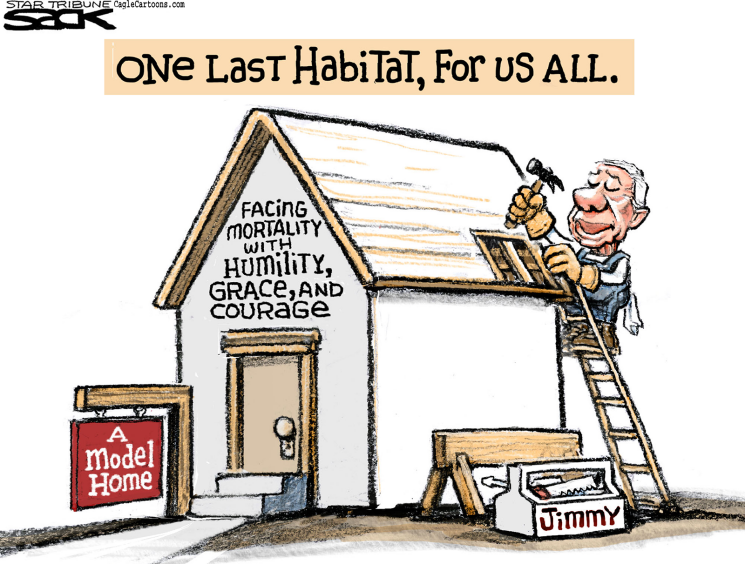
Jimmy Carter’s Uncommon Decency

PLAINS, Ga. – The antithesis of Donald Trump and his administration can be studied, at least for those willing to drive 150 miles south from Atlanta, among magnolias, towering pines and seemingly endless fields of cotton, peanuts – and dreams.

Jimmy and Rosalynn Carter live just a few blocks from the center of Plains, population 700, a town that has become a monument to the former president and his uncommon decency.

Carter, who turns 94 next month, has shunned the trappings and riches that former presidents typically enjoy, preferring to live in the simple ranch house that he and Rosalynn built in 1961. Now free of the melanoma that threatened his life just a few years ago, Jimmy Carter writes books, teaches Sunday school, and never hesitates to shake a hand or pose for a picture during regular strolls along Church Street.

Although he doesn’t inject himself often in the current political scene, the former president spoke recently with The Washington Post about Donald Trump. “I think he’s a disaster,” Carter said bluntly. “In human rights and taking care of people and treating people equal.”

The National Park Service does a marvelous job of maintaining and showcasing venues in Plains that draw some 70,000 visitors each year. The former high school building, where Jimmy and Rosalynn studied, has been made into a museum known as the Jimmy Carter National Historic Site. Its exhibits trace Carter’s life as well as the civil rights movement in fascinating detail.

A few miles down Old Plains Highway, Carter’s boyhood home has been beautifully restored and is open to the public for self-guided tours. On what was once a 360-acre peanut farm, visitors can explore the main house and outbuildings while listening to Carter’s recorded descriptions of life in the 1930s.

The old train depot in the center of Plains is preserved, just as it was in 1976 when it served as Carter’s campaign headquarters. Only the family’s current residence on Church Street, protected by the Secret Service, is not open to the public. It is a modest home with a converted garage in which the former president does woodworking and writing.

What one gets here is a sense of calm and dignity. It’s more than Southern charm; it’s a philosophy of life.

In his memoir, “Back Home,” President Carter summed it up: “We should be seen as the unswerving champions of human rights, both among our own citizens and within the global community. America should be the focal point around which other nations can rally against threats to the quality of our common environment.”

I visited Plains a few days after watching John McCain’s funeral on television. Like so many people, I was moved by the appeals to restore civility in our government and to work for common goals that ought to transcend political differences.

I was reminded of how two genuine heroes, McCain and Carter – so starkly opposed in political views – could set a uniform example of how to conduct our lives and our government.

Visitors fortunate enough to make their way to Plains, Georgia, are bound to be inspired by what they encounter. Some of our better angels are here, working for peanuts.

A list of Peter Funt’s upcoming live appearances is available at www.CandidCamera.com.

Peter Funt is a writer and speaker. His book, “Cautiously Optimistic,” is available at Amazon.com and CandidCamera.com.Copyright2018 Peter Funt. Columns distributed exclusively by Cagle Cartoons, Inc., newspaper syndicate.

Comments Off on Jimmy Carter’s Uncommon Decency

Pre-Mourning Boosts Life Before Death

Social media and digital tools have changed the way we live and, to some extent, the way we die. Increasingly, loved ones and notables are honored through what could be called pre-mourning.

“I love my husband with all my heart,” tweeted Cindy McCain, as it was reported that her husband, Sen. John McCain, would discontinue treatment in his battle with cancer. Daughter Meghan tweeted, “Thank you for all your continued support and prayers.”

The tweets were echoed hundreds of thousands of times in less than 24 hours. The hope, of course, was that heartfelt messages would reach the Arizona senator before his death.

Before Aretha Franklin’s death on August 16, the Queen of Soul was similarly honored by fans via social media. According to CNN’s Don Lemon, a reporter with close ties to Franklin, pre-mourning messages from an adoring public were read aloud to the 76-year-old singer during her final hours.

Back in June, when Charles Krauthammer, the acclaimed conservative columnist learned that he was dying of cancer, he wrote on The Washington Post website that he had only a few weeks to live. His last words soon reverberated on social media.

“I believe that the pursuit of truth and right ideas through honest debate and rigorous argument is a noble undertaking,” he wrote. “I am grateful to have played a small role in the conversations that have helped guide this extraordinary nation’s destiny.”

Like John McCain, Krauthammer received an enormous outpouring of pre-mourning praise from all sides of the political spectrum. Each man was noted for taking a fair and articulate approach to the issues that seem, more than ever, to divide us.

Social media was active in April before the passing of Barbara Bush, the wife of one president and mother of another. The love and respect for Mrs. Bush was immediately apparent in the flood of digital messages – many of which reached her before her death.

Barbara Bush planned every detail of her funeral and burial, but few in modern times have orchestrated a goodbye with such grace, dignity and detail as John McCain.

Some of our public heroes, such as the comedian Robin Williams, for example, are taken from us in such a way that there can be no pre-mourning. But, as McCain demonstrated, when one’s fate is clear there can be no greater source of final satisfaction than to hear and read the messages from those who care so deeply.

“Like most people, I have regrets,” wrote McCain in his farewell. “But I would not trade a day of my life, in good or bad times, for the best day of anyone else’s.”

A grateful nation mourns John McCain now, but was able to reach out before his death through social media and salute him.

A list of Peter Funt’s upcoming live appearances is available at www.CandidCamera.com.

Peter Funt is a writer and speaker. His book, “Cautiously Optimistic,” is available at Amazon.com and CandidCamera.com.Copyright2018 Peter Funt. Columns distributed exclusively by Cagle Cartoons, Inc., newspaper syndicate.
Comments Off on Pre-Mourning Boosts Life Before Death

Truth Will Out

Editor’s Note: This is an updated version of Funt’s column, previously titled “This Column is a Column.”

“Things are seldom what they seem,” the playful lyric in Gilbert & Sullivan’s “H.M.S. Pinafore,” could well be an anthem for the Trump White House.

Tuesday night the president crooned about “beautiful coal” at a rally in West Virginia, never once mentioning the crushing news of the day. Two of his closest advisors, Paul Manafort and Michael Cohen, had just gone through the legal ringer and were each guilty of eight felony charges.

Under oath, Cohen stated that Trump directed him to commit campaign violations. By Wednesday morning Trump was snidely tweeting: “If anyone is looking for a good lawyer, I would strongly suggest that you don’t retain the services of Michael Cohen!”

Trump might just as well have said the same about his current lawyer, the increasingly-hard-to-take-seriously Rudy Giuliani. As the legal noose tightened on Trump, Giuliani flew to Scotland to play golf.

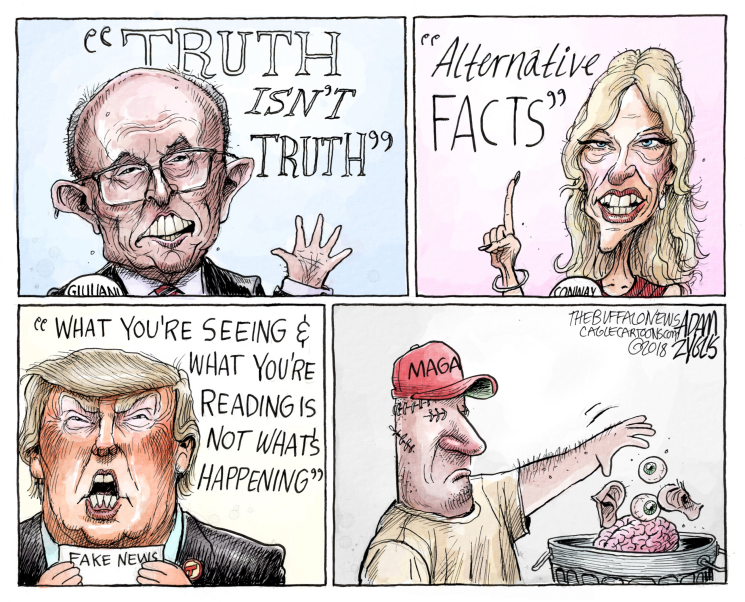
The inexplicable vacation came just after Giuliani made a blithering attempt on NBC’s “Meet the Press” to explain what “truth” is in Trump’s universe. Host Chuck Todd mentioned that Trump should have nothing to fear by being honest in the Russia investigation because, as Todd said off-handedly, “Truth is truth.”

“No, it isn’t truth!” Giuliani shot back. And then he soared past Kellyanne Conway on the Orwellian Hit Parade – where Conway has held the Number One spot for over a year with her classic ditty, “Alternative Facts.”

“Truth isn’t truth,” Giuliani insisted, placing himself atop the chart that features golden oldies such as Bill Clinton’s “It depends upon what the meaning of the word ‘is’ is.”

Trump holds several spots on the Top Ten list, including his remark to a gathering of veterans last month. “Just remember,” he said, “what you are seeing and what you are reading is not what’s happening.”

Thanks to dedicated truth-seekers at The Washington Post we know that President Trump averages seven false or misleading claims per day, perhaps having trained himself as George Costanza did on “Seinfeld.” According to George: “It’s not a lie if you believe it.”

Ah, yes, but as Albert Einstein pointed out: “Whoever is careless with the truth in small matters cannot be trusted with important matters.” What about that?

Trump answered in “The Art of the Deal” by coining the term “truthful hyperbole.” He said that when lies are carefully crafted they become “an innocent form of exaggeration, and a very effective form of promotion.”

Is it any wonder that Giuliani and Trump’s other advisors are scared silly over the prospect of the president testifying under oath in the Mueller investigation? Giuliani, his foot always dangerously close to his mouth, says that Mueller would be setting up a “perjury trap” for Trump.

Such delightful light opera would do Gilbert & Sullivan proud. The President of the United States swears to tell the truth but is foiled when he can’t stop himself from lapsing into truthful hyperbole and alternative facts.

In “Pinafore,” the line about things seldom being what they seem is sung by a character named Buttercup. Wednesday, the attorney for Stormy Daniels, the porn star who Trump and Cohen sought to silence, tweeted a warning to Giuliani: “Buckle Up Buttercup.”

Things aren’t what they seem in the White House, but in the legal arena they are becoming increasingly clear.

A list of Peter Funt’s upcoming live appearances is available at www.CandidCamera.com.

Peter Funt is a writer and speaker. His book, “Cautiously Optimistic,” is available at Amazon.com and CandidCamera.com.Copyright2018 Peter Funt. Columns distributed exclusively by Cagle Cartoons, Inc., newspaper syndicate.

Comments Off on Truth Will Out

This Column Is a Column

“Things are seldom what they seem,” the playful lyric in Gilbert & Sullivan’s “H.M.S. Pinafore,” could well be an anthem for the Trump White House.

The latest bit of Trump Troupe theater occurred on “Meet the Press” as host Chuck Todd interviewed the increasingly-hard-to-take-seriously Rudy Giuliani. Regarding the Russia investigation, Todd noted that President Trump should have nothing to fear by being honest. After all, Todd said off-handedly, “Truth is truth.”

“No, it isn’t truth!” Giuliani shot back. And then he soared past Kellyanne Conway on the Orwellian Hit Parade – where Conway has held the Number One spot for over a year with her classic ditty, “Alternative Facts.”

“Truth isn’t truth,” Giuliani crooned, placing himself atop the chart that includes golden oldies such as Bill Clinton’s “It depends upon what the meaning of the word ‘is’ is.”

Trump holds several spots on the Top Ten list, including his remark to a gathering of veterans last month. “Just remember,” he said, “what you are seeing and what you are reading is not what’s happening.”

Thanks to the dedicated truth-seekers at The Washington Post we know that President Trump averages seven false or misleading claims per day. Perhaps he has trained himself, as George Costanza did on “Seinfeld.” In the world according to Costanza and Trump: “It’s not a lie if you believe it.”

Ah, yes, but as Albert Einstein pointed out: “Whoever is careless with the truth in small matters cannot be trusted with important matters.” What about that?

Trump explained his position in “The Art of the Deal” by coining the term “truthful hyperbole.” He said that when lies are carefully crafted they become “an innocent form of exaggeration, and a very effective form of promotion.”

Is it any wonder that Giuliani and Trump’s other advisors are scared silly over the prospect of the president testifying under oath in the Mueller investigation? Giuliani, his foot always dangerously close to his mouth, says that Mueller would be setting up a “perjury trap” for Trump.

Such delightful light opera would do Gilbert & Sullivan proud. The President of the United States swears to tell the truth but is foiled when he can’t stop himself from lapsing into truthful hyperbole or alternative facts. He is thus forced to, as Hamlet put it, “Hoist with his own petard,” which is to say blow himself up.

But after all, what is truth? What are facts?

And, Kenneth, what is the frequency?

A list of Peter Funt’s upcoming live appearances is available at www.CandidCamera.com.

Peter Funt is a writer and speaker. His book, “Cautiously Optimistic,” is available at Amazon.com and CandidCamera.com.Copyright2018 Peter Funt. Columns distributed exclusively by Cagle Cartoons, Inc., newspaper syndicate.
Comments Off on This Column Is a Column

Baseball’s No-Comfort Zone

In a recent discussion with a Major League pitching coach about scouting opposing hitters, I thought I was being flippant when I asked: “Do you also chart umpires?” His answer surprised me. “Yes.”

As the baseball season grinds on, umpires are taking more liberties with their interpretation of the strike zone. It’s as if they are begging Major League Baseball to once and for all give computers responsibility for calling pitches.

“He favors the low strike,” a TV analyst will typically say. Or, “He waits a long time to make the call, so he’s good with curve balls.” And even, “He starts with a tight zone but it loosens up as the game goes on.”

Part of the problem is that unlike, say, the foul lines or the outfield fence, the strike zone varies from one batter to the next. The rule: “The strike zone is the area over home plate from the midpoint between a batter’s shoulders and the top of the uniform pants – when the batter is in his stance and prepared to swing at a pitched ball – and a point just below the kneecap.”

When measured electronically on TV, the zone that viewers are accustomed to seeing is an approximation. Even the most sophisticated versions of such pitch tracking require a human to establish its vertical boundaries.

Since the zone’s sides are defined by home plate, pitches there should be easier for umpires to judge uniformly. Yet, some umps crouch behind the catcher in such a way that they miss the outside strike. Or, they are fooled by sweeping curves that appear to fall into, or slide across, the zone.

Worse, as the Giants announcer Mike Krukow has said of more than one ump, “He makes you prove you can throw strikes before giving you pitches on the corners.” Really?

Baseball’s strike zone has been defined in essentially the same way since the late 1800’s. A slight adjustment in 1996 changed the bottom of the zone from “the top of the knees” to “just below the kneecap.” Given the widely differing styles of pants players wear nowadays, getting a truly uniform zone would probably require getting a uniform uniform.

An analysis in The Hardball Times confirms that almost every ML–ump calls pitches differently to his right and his left. A study published by the FiveThirtyEight blog reveals that, “In extra innings, umpires will vary ball and strike calls in ways that tend to end the game as quickly as possible.”

The ML–commissioner, Rob Manfred, has said that technology necessary for an electronic strike zone is being quickly developed and is almost at hand. However, it is far from certain that owners and players would sanction its use.

Meanwhile, ML–teams receive daily “heat charts” showing how each umpire interprets the strike zone. Not all pitchers dwell on the data, but most take it into account before throwing a pitch.

It is often said that the best referees in sports are those whose presence seems almost invisible. By personalizing the strike zone, umpires are doing the opposite. More than ever, they seem bent on stealing home.

A list of Peter Funt’s upcoming live appearances is available at www.CandidCamera.com.

Peter Funt is a writer and speaker. His book, “Cautiously Optimistic,” is available at Amazon.com and CandidCamera.com.Copyright2018 Peter Funt. Columns distributed exclusively by Cagle Cartoons, Inc., newspaper syndicate.
Comments Off on Baseball’s No-Comfort Zone

Jamestown Is Now a Very Funny Place

JAMESTOWN, N.Y. – As thousands of tourists crowded into the center of town in search of hearty laughs, I walked over to Lake View Cemetery for a look at Lucy’s grave.

Although Lucille Ball’s cremated remains were originally interred at Forest Lawn cemetery in Hollywood in 1989, they were moved here 16 years ago. Her children, Lucie Arnaz and Desi Arnaz, Jr., wanted Lucy’s final resting place to be in the city where she was born.

They also envisioned making Jamestown the epicenter for celebrating not only the First Lady of comedy, but the art form itself. This month, that dream was realized with the opening of the $50 million National Comedy Center.

The non-profit Center now oversees the Lucille Ball Desi Arnaz Museum as well as the annual Lucy Fest that draws top performers here each August for a week of live comedy. The Center itself is a marvel of both technology and memorabilia – certain to place it among must-visit destinations such as the Baseball Hall of Fame in Cooperstown, some 300 miles to the east.

Curators at the Comedy Center are careful to avoid the term “museum,” preferring to describe their 40,000 square feet of exhibit space as being equally focused on the art as well as the artists. In a small theater, for example, a hologram of the comedian Jim Gaffigan guides visitors through the three-decade long evolution of his stand-up act.

In every corner, the Center has sought to use interactive devices and computer technology to appeal to a new generation of fans, who presumably might have a hard time identifying performers such as Lenny Bruce, Ernie Kovacs or other comedy pioneers.

One nice touch is a follow-up email to each visitor outlining his “Sense of Humor Profile.” Mine proved spot-on, identifying my interests in “wry” and “observational” comedy, which the email described as, “Pointing out the humor or ridiculousness of things deemed ‘normal’ or ‘ordinary’ by society.”

But as the center polishes its act it might want to dial back some of its other tech gimmicks in favor of a more compressive study of the art. It also must refine its display of physical memorabilia which, at the outset, seems to be shaped primarily by what comics and their families were willing to donate to get the facility off the ground.

On balance, the Center is a marvelous show place, well worth your time. Coupled with Lucy’s museum and the annual comedy festival, Jamestown should be bustling and chuckling for years to come – proving that if you build it, they will laugh.

As I walked through the vast Lake View Cemetery, covering 150 acres of towering oaks and a scattering of smaller pines on a gently rolling hillside, Iwas overcome by the tranquility of this beautiful place.

Many tombstones here are quite large and dramatic. But Lucy is interred, along with three family members, beneath a rather simple marker. Standing beside it, you’d almost expect to hear the laughter that came as Lucy stomped grapes or struggled to make candy on an assembly line.

Happily, those laughs, and so many others, are now preserved just a few blocks away from where the words on Lucy’s tombstone read: “You’ve Come Home.”

A list of Peter Funt’s upcoming live appearances is available at www.CandidCamera.com.

Peter Funt is a writer and speaker. His book, “Cautiously Optimistic,” is available at Amazon.com and CandidCamera.com.Copyright2018 Peter Funt. Columns distributed exclusively by Cagle Cartoons, Inc., newspaper syndicate.
Comments Off on Jamestown Is Now a Very Funny Place

News the Numbers

“90% of media coverage of my Administration is negative, despite the tremendously positive results we are achieving.”

No need to check the math in President Trump’s recent tweet. For argument’s sake let’s say he’s correct. Fact is, “negative” reporting about him these days might even be closer to 95 percent.

How could it not be? Anything written about Robert Mueller’s investigation, separating migrant children from their parents at the border, gaffe-plagued meetings with Kim Jong-un and Vladimir Putin, chaos among the White House staff, and worldwide turmoil related to Trump’s tariff policies – to name just a few topics – is by definition negative.

So, yes, virtually 100 percent of what’s reported about those ongoing stories is negative and appropriately so.

The remaining 5 or 10 percent of recent news relates mostly to employment and economic growth statistics, and could be reasonably categorized as “positive.”

But the concern among journalists is not what a scorecard might show about coverage of the Trump Administration. It’s the distorted view among the president and his communications staff that journalism can be measured on a scorecard in the first place.

An acknowledged fan of Fox News, the president undoubtedly embraces its ersatz slogan: “Fair and balanced.” No one would argue against fairness, but “balance” is rarely a part of journalism. Only in certain, limited situations, such as during the run-up to an election, should balance come into play.

Clearly, the president wants his supporters to conflate story selection with story content, and hard news reporting with cable-TV commentary. They are simply not the same.

Depressing as it might be, news tends to be negative. It is newsworthy, for example, that wildfires are ravaging California, but there’s not much news in the fact that Minnesota, at last report, was relatively fire free.

The New York Times has taken to summarizing “The Week in Good News” in its Saturday edition, advising readers that, “it isn’t all bad out there.” Stories covered range from the discovery of water on Mars to the mother duck who cared for 76 ducklings. President Trump should have been pleased with the paper’s page-one lead that day: “Consumers Push Growth to 4.1% in Hot Economy.”

So, it’s not all negative, but when it is don’t fault media.

The president is undoubtedly riled by the volume of negative commentary on MSNBC and, to a lesser extent, on CNN. However, commentary is not news reporting, and shouldn’t be tabulated as such. Besides, for every negative opinion uttered about the administration on MSNBC there are positive spins on Fox News Channel – where “balance” exists only in slogans.

Sadly, we are living at a point in time where 90-plus percent of news about the current administration is, indeed, negative. But the stories aren’t fake, they’re fact.

If the president wants more positive news, he would be wise to make some.

A list of Peter Funt’s upcoming live appearances is available at www.CandidCamera.com.

Peter Funt is a writer and speaker. His book, “Cautiously Optimistic,” is available at Amazon.com and CandidCamera.com.Copyright2018 Peter Funt. Columns distributed exclusively by Cagle Cartoons, Inc., newspaper syndicate.

Comments Off on News the Numbers

Trump’s 27 Loaded Questions

Question 1: “Do you believe that the media purposely tries to divide Republicans in order to help elect Democrats?”

Question 2: When did you stop beating your wife?

The first question is one of 27 in a “Media Accountability Survey” conducted this month by Donald Trump and the Republican National Committee. The second is, of course, a classic example of a loaded question – a key device in the RNC survey.

Sent by email to Trump supporters, but not publicized outside of GOP ranks, the survey is actually a shrewd marketing tool. Similar to “push polls” used in political campaigns, it seeks to foster opinions rather than gather them.

“Why is the mainstream media’s opinion any more important than yours?” Trump asks in the opening of his cover email. In urging his supporters to take the survey, he leaves no doubt about the goal: “To show the media that the American people are fed up with the Fake News Machine.”

Question 23 asks: “Do you believe that the media has been too quick to spread false stories about our movement?”

Donald Trump’s relentless effort to disparage journalists covering his presidency – and in doing so discredit their reports – is not new. But the intensity of his attacks is growing. In his email the president singles out “coastal elitists” in media, who “have used every possible tactic to slander, undermine, and insult our movement.”

Interestingly, the survey mentions only CNN, MSNBC and Fox News by name. It never asks about the national print and digital publications such as The New York Times, Washington Post and Wall Street Journal, which have dug the deepest into Trump’s troubled administration. Nor, for that matter, does it ask about broadcasters CBS, NBC, ABC and NPR – whose newscasts reach more Americans than the cable channels do.

Several questions use the term “movement,” suggesting that respondents are part of a special class, victimized by journalists.

Question 10: “Do you believe the media disdains conservatives?” Question 11: “Do you believe the media dislikes Americans of faith?”

The objective of a push poll is not to find out what you think, it’s to signal you about what you ought to think. A frequently cited example is from George W. Bush’s campaign in the 2000 GOP primaries. South Carolina voters were asked: “Would you be more or less likely to vote for John McCain for president if you knew he had fathered an illegitimate black child?” McCain lost in South Carolina and never recovered.

Six years earlier in the Texas race for governor, Bush’s pollsters asked residents if they would be more or less likely to vote for incumbent Ann Richards if they “knew that lesbians dominated on her staff.” Richards lost the election.

The very morning that Trump’s survey went out he was tweeting as usual about his scorn for media, in this case “Fake News CNN.” Unable to shed his insecurity about losing the popular vote in 2016, Trump blasted CNN, 21 months after the fact, tweeting: “They were sooooo wrong in their election coverage. Still hurting!”

Trump’s alternate universe is one in which his own “hurt” is projected onto CNN and other media. His online survey is a reminder to his base that no matter how bad the news about Trump is in months to come, it’s all fake.

But why would the Trump campaign bother with a survey that essentially asks the choir to vouch for the views of the preacher? Beyond cementing anti-media views, the survey provides insight into which topics are most important to the base.

Question 9: “On which issues does the mainstream media do the worst job of representing President Trump?” The choices are “immigration, economics, radical Islamic terrorism, pro-life values/social issues, religion, health care and Second Amendment rights.” Naturally, no question asks about issues on which media do the “best job.”

After completing the survey, respondents are asked to “go the extra mile and make a contribution to help defend our movement from the outrageous attacks from the media coming our way.”

The $100 box is pre-checked, but $2,700 is offered as an option. Who would give that much? Only someone answering “yes” if asked: “Do you see value in Trump’s blatantly biased surveys?”

A list of Peter Funt’s upcoming live appearances is available at www.CandidCamera.com.

Peter Funt is a writer and speaker. His book, “Cautiously Optimistic,” is available at Amazon.com and CandidCamera.com.Copyright2018 Peter Funt. Columns distributed exclusively by Cagle Cartoons, Inc., newspaper syndicate.

Comments Off on Trump’s 27 Loaded Questions