Hollywood Says Hooray for Mayor Pete

CEDAR RAPIDS, Iowa – Mayor Pete Buttigieg, the Democrats’ wunderkind from South Bend, Indiana, has made only a modest mark in national polls, yet he’s a boffo attraction in Iowa as well as in California, where he’s the favorite among Hollywood’s glitterati.

Watching him in action at the annual Corn Feed, as they’ve named a day of political speeches here in Cedar Rapids, it’s easy to understand Buttigieg’s appeal. He’s closer to the center than many of his opponents and arguably the most articulate among the candidates, yet he rarely raises his voice and he’s not preachy. Ten candidates spoke to this gathering of just over 1,000 people and only Mayor Pete received a standing ovation.

Reflecting Mr. Buttigieg’s ascent is the fact that his campaign raised nearly $25 million in the second quarter of 2019 – more than any other Democrat, including front-runner Joe Biden, who took in $21.5 million. Among California donors giving at least $200, Mr. Buttigieg collected more than the state’s junior Senator Kamala Harris.

In West Hollywood Buttigieg totals are close to the sum collected by all other Democrats combined. Recent donors include Kevin Bacon, Ted Danson, Barbara Streisand, Michael J. Fox, Sharon Stone and Larry David, among others. And the latest to announce a fundraiser for Mayor Pete is Netflix Chairman and CEO Reed Hastings.

Maybe Mr. Hastings envisions a screenplay that seems to write itself: Son of an immigrant father from Malta, Harvard grad, Rhodes scholar, staffer at McKinsey & Company, accomplished pianist, fluent in several languages including Arabic, Mayor of South Bend for eight years and veteran of the war in Afghanistan. Plus he’s gay.

Hollywood is home to a lot of wealthy people with an eye for young talent. They were quick to embrace the nation’s first black president and they’re excited about the prospects of putting the first openly gay man in the White House. If they cared to look at the Buttigieg campaign as they would a showbiz project, they’d be impressed by what’s going on here in Iowa.

The 37-year-old mayor plunges into the crowd as the frenzy around him grows. He’s dressed in skinny jeans with a crisp white shirt, sleeves rolled a few turns in his trademark style. On his wrist is an oversized expensive-looking watch. His traveling press secretary, Nina Smith, surveys the scene with me, explaining, “This all happened so fast. The campaign wasn’t prepared for it.”

Hollywood would love the fact that the mayor’s admirers are spending heavily on branded merchandise – hats, tee-shirts and other “Pete” gear. This is an important indicator: Those willing to wear it tend to swear by it.

Of course, the Republican in the White House is also a star who knows how to excite a crowd, manage media and market his brand. Perhaps Democrats outside of Hollywood and the Northeast will ultimately prefer a candidate with less star power but more political experience. Then there’s the inconvenient truth that no sitting mayor has ever been elected president.

Yet, there is magic in the way Mayor Pete works a crowd. When supporters bring color eight-by-tens, carefully preserved in plastic sleeves, to be autographed, they’re saying something that pollsters find difficult to measure: This guy has a future.

Whether that future arrives in time for the 2020 election depends largely on how fast the crowded field of Democrats is thinned, and whether the early leaders – Joe Biden, Elizabeth Warren, Bernie Sanders and Kamala Harris – can withstand another year of scrutiny.

In Hollywood, meanwhile, the Buttigieg campaign will eventually face the same question asked of all projects: Will it play in Peoria?

A list of Peter Funt’s upcoming live appearances is available at www.CandidCamera.com.

Peter Funt is a writer and speaker. His book, “Cautiously Optimistic,” is available at Amazon.com and CandidCamera.com. © 2019 Peter Funt. Columns distributed exclusively by Cagle Cartoons, Inc., newspaper syndicate.

Comments Off on Hollywood Says Hooray for Mayor Pete

The Mighty Pen Strikes Out

His portfolio of editorial cartoons in hand, Burris Jenkins Jr. arrived for a job interview at The New York American one day in 1931 and mistakenly got off the elevator at the wrong floor. He found himself in the sports department of the rival Evening Journal, where he was hired on the spot as a sports cartoonist.

Four of Mr. Jenkins’ magnificently detailed drawings, completed on deadline in the 1930s, hang in my den – reminders of one of the great sports cartoonists of all time and also that, for this unique style of journalism, time is practically up.

With newspapers fading away, leaving some communities with little or no local coverage – such as next month’s announced closure of the Youngstown Vindicator in Ohio, where a newsroom staff of 44 will be out of work – maybe the passing of a journalistic subcategory like sports cartooning is, sadly, beside the point. That’s too bad, because the artists who attended games and often completed their drawings right in the press box worked magic in fans’ minds far more effectively than today’s daily deluge of Web Gem videos.

Four other originals on my wall are by Willard Mullin, widely considered to have been the dean of sports cartoonists during the craft’s heyday from the 1930s through the 60s. It was Mr. Mullin who, in 1937, invented the unshaven Brooklyn Bum character which stuck as the unofficial mascot of the Dodgers until the team moved to Los Angeles for the 1958 season.

Mullin drawings are notable for the care with which the artist captured athletes’ physiques. The images he conjured were not funny so much as fascinating. One of my favorites depicts players from the Yankees, White Sox and Orioles chasing each other in a tight circle as just two games separated the three teams battling for the 1964 American League pennant.

Mr. Mullin’s distinctive signature consisted entirely of vertical lines, like blades of outfield grass. Each drawing has a note in the lower corner – unseen by readers – underscoring the tight deadline: “5 a.m. Sports,” meaning a messenger had to get the artwork to the offices of the New York World-Telegram in time for the paper’s first edition.

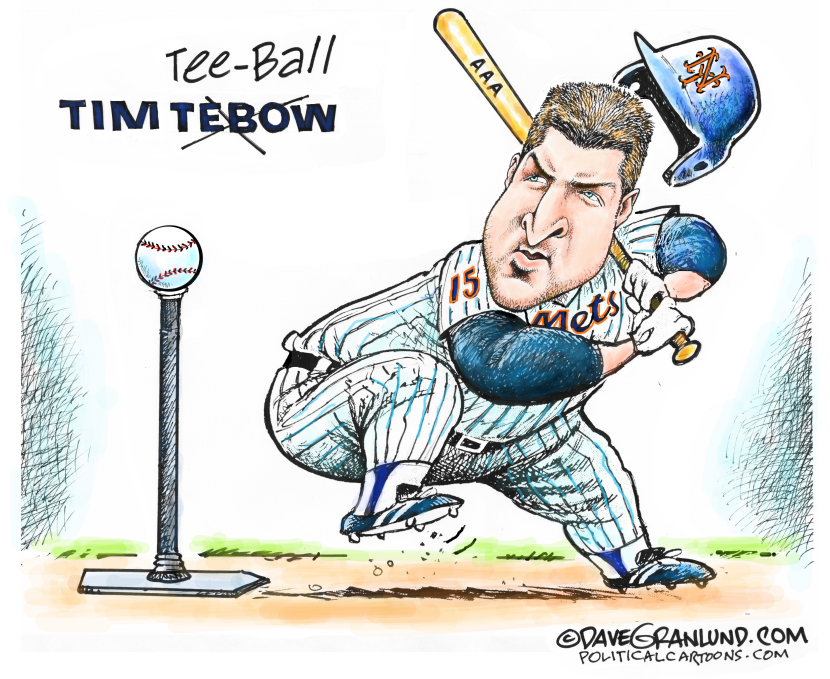
What little remains of this dying art is practiced by only four newspaper sports cartoonists whom I know of. Drew Litton in Denver used to draw for the Rocky Mountain News and has been syndicated since the paper’s death in 2009. Jim Thompson at the Los Angeles Times, Mike Ricigliano of the Baltimore Sun and Rob Tornoe with the Philadelphia Inquirer round out what’s left of the roster.

But none of today’s sports cartoonists does daily game drawings as Mr. Mullin and Mr. Jenkins did, or like the late Bill Gallo of the New York Daily News, a 50-year legend and inventor of the Mets’ washerwoman fan, Basement Bertha. That sort of deadline drawing was depicted in the 1984 film “The Natural,” in which Robert Duvall’s character, Max Mercy, creates press box art with sly captions such as “Is (Roy) Hobbs going from leader to goat?”

Most newspapers have chopped away at the space given to sports coverage, leaving little room for cartoons. Moreover, with reporting staffs being slashed, it is unthinkable to pay a full-time salary to an artist whose entire daily output is a single drawing. And with 24/7 game coverage on cable and the internet, sports cartoons seem as old fashioned as courtroom art became the moment TV cameras were allowed at trials.

For me, sports is as much an emotional experience as a physical event. That’s where the great cartoonists entered the game, capturing on the printed page what so many diehards were feeling.

Fans will continue to wonder if anyone will ever hit as many homers or sink as many baskets, but it’s no use debating whether anyone will ever draw as well as Jenkins and Mullin, because that game is over.

A list of Peter Funt’s upcoming live appearances is available at www.CandidCamera.com.

Peter Funt is a writer and speaker. His book, “Cautiously Optimistic,” is available at Amazon.com and CandidCamera.com. © 2019 Peter Funt. Columns distributed exclusively by Cagle Cartoons, Inc., newspaper syndicate.
Comments Off on The Mighty Pen Strikes Out

NBC’s Debatable Debate Coverage

Among the losers in the Democrats’ opening presidential debate was NBC News. Faced with an unmanageable number of candidates, an awkward format, and miscast moderators – not to mention serious technical glitches – the network took a difficult situation and made it worse.

Lester Holt, NBC’s highest ranking journalist, was forced to split time in the opening hour with Savannah Guthrie and Jose Diaz-Balart. Then, after all three were replaced mid-debate by Rachel Maddow and Chuck Todd, Holt was relegated to standing in the audience for a few seconds to read from social media. It underscored how poorly NBC managed its talent roster as well as the folly of using viewer questions in a presidential debate – the first night from “John in New York,” the second night from “Kathleen in Oregon.”

NBC’s most egregious unforced error was in failing to establish cohesiveness in the moderators’ questions. For example, Guthrie’s opening query to Elizabeth Warren concerned Warren’s legislative agenda, but Guthrie’s first question to Cory Booker was about, of all things, Sen. Warren’s position on breaking up big corporations. With 10 candidates and limited time for each, cornering one candidate right out of the box with a question about his opponent was inappropriate.

At another point Wednesday the candidates were engaged in a lively exchange about gun rights. Yet, Maddow abruptly changed the subject to the Supreme Court, prompting Sen. Booker and Mayor Bill de Blasio to ignore her and address the gun issue anyway.

The moderators’ failure to curb interruptions by de Blasio and a few others the first night predictably led to an even more undisciplined display on night two. Thursday’s first half hour was so chaotic – Sen. Harris called it a “food fight” – that after 27 minutes social activist Marianne Williamson had still not uttered a word.

As in any debate, moderators needed a pre-game strategy for the style of questions: Would they be general (“How would you secure the border with Mexico?”) or would they be pointedly aimed at the record of each candidate? For the most part, the questions were generic, yet after Rep. Tulsi Gabbard waited patiently for a chance to speak, Chuck Todd took an odd turn and asked her to defend a remark she once made concerning gay rights. Such scattershot questioning pushed the already-strained first night off the rails.

Similarly on Thursday candidates were asked a generic questions until, at the start of the second hour, Maddow pointedly asked Pete Buttigieg about his handling of the recent shooting of a black man by a white cop in South Bend, Indiana. A fair question? Yes, but only if all candidates were likewise put on the spot. Joe Biden, for example, wasn’t asked by moderators about his recent comments concerning collaborating with segregationist colleagues in the Senate – it only came up when Sen. Harris confronted Biden about it.

In its self-promotional quest to represent its various news units – NBC News, MSNBC, The “Today” show, “Meet the Press” and Telemundo – NBC managed to leave one of its best players, Brian Williams, on the sidelines for pre- and post-debate analysis. Williams, a veteran who shines in this type of special coverage, was demoted four years ago after twisting facts his role in covering news stories. He currently anchors the 11 p.m. ET hour but no longer gets the big network assignments.

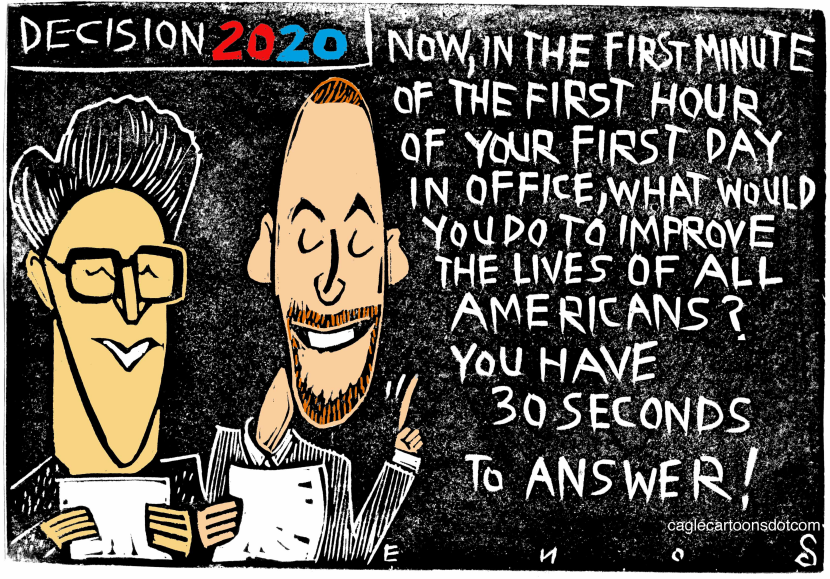
NBC’s decision to crowd the moderators desk was driven by marketing and promotional considerations. Its five hosts were in an untenable situation, seeking to be fair but tough, and thorough yet brief, while herding 20 cats.

Taking stock after the second night, Ms. Maddow had an answer that was better than any of her questions. Moderating such an event was, she conceded, “not a thing that humans can do, and we should never do it again.”

A list of Peter Funt’s upcoming live appearances is available at www.CandidCamera.com.

Peter Funt is a writer and speaker. His book, “Cautiously Optimistic,” is available at Amazon.com and CandidCamera.com. © 2019 Peter Funt. Columns distributed exclusively by Cagle Cartoons, Inc., newspaper syndicate.

Comments Off on NBC’s Debatable Debate Coverage

I’m Sorry Joe Biden Sends So Many Emails

Silly me. I thought one advantage of having a 76-year-old Democrat running for president is that his campaign would be refreshingly old school: a few lawn signs, a bus trip across Iowa and an occasional postcard to supporters through the U.S. Mail.

But, no. While Donald Trump holds the record for tweets by a politician, Joe Biden is on his way to setting the all-time mark for emails by a candidate. At the rate he’s going, millions of voters will each receive thousands emails from “Joe” before Election Day.

I get it. The Biden campaign has plenty of money and the email strategy – first developed by Howard Dean and then used effectively by Barack Obama – brings results. But is there no point of diminishing returns? I’d rather not “unsubscribe” to the Democratic National Committee’s list, which Biden’s team apparently uses, but after only a few months of the Biden campaign my delete button is worn out.

Here’s an actual log of Biden emails from a single five-day period:

June 18 (9 a.m.) “Sorry to email. We need your help.”

June 18 (4:09 p.m.) “We’ll keep this quick.”

June 19 (5:10 a.m.) “Don’t miss your chance to win!”

June 19 (10:12 a.m.) “Please answer this poll before midnight.”

June 19 (5:01 p.m.) “We don’t mean to alarm you.”

June 20 (11:17 a.m.) “We need your help to hit our goal.”

June 20 (2:10 p.m.) “Can we count on you to host a watch party?”

June 21 (6:45 a.m.) “We created a new survey.”

June 22 (7:10 a.m.) “Hosting a watch party is fun and easy!”

June 22 (11:44 a.m.) “I want to make sure the entire country is accurately represented.”

June 22 (3:08 p.m.) “We just don’t have the staff to handle the influx of support.”

There’s an interesting bit of fine print at the bottom of every Biden email: “We know we send a lot of emails, and we are sorry about that. The reason? We are relying on grassroots supporters like you (we’re serious!).”

Below that is an option to click for “fewer” emails, which leads to: “Thank you for making the decision to only receive our most important emails. You won’t regret it!”

Looking at my five-day log I’m wondering which email would have been deemed “most important”? Was it the “Sorry to alarm you” note? Or the “Sorry to email” item?

Of course, if like me you’re also on the Republican National Committee’s list you’re inundated with emails from the Trump Campaign – a “campaign” that began virtually the day Trump took office. While Biden’s missives are relentless, at least they are polite. Trump uses emails to spew hate. The president also favors unscientific push polls – surveys with loaded questions designed to elicit specific answers.

For instance, a recent Trump email asked, “Should President Trump and his campaign do more to hold the Fake News media accountable?” The choices were “yes,” “no” and “undecided” – but all answers presuppose that there is such a thing as “Fake News media.”

The email, signed “Donald J. Trump, President of the United States,” included: “While the many socialist Democrat campaigns are taking their cues from liberal elites and Hollywood megadonors, our campaign is driven by YOU.”

Well, not ME, I can assure you of that.

I do wish Joe Biden would spend more time on the campaign trail and at televised town halls, and less time writing emails to his choir. I’ll give him this much: At least the former veep has the class to say he’s “sorry” about the email barrage – something no Trump email would ever declare.

As the noted political observer Elton John once observed, “Sorry seems to be the hardest word.”

A list of Peter Funt’s upcoming live appearances is available at www.CandidCamera.com.

Peter Funt is a writer and speaker. His book, “Cautiously Optimistic,” is available at Amazon.com and CandidCamera.com. © 2019 Peter Funt. Columns distributed exclusively by Cagle Cartoons, Inc., newspaper syndicate.
Comments Off on I’m Sorry Joe Biden Sends So Many Emails

I’d Trade 23 Candidates for One Sure Winner

Is the bulging field of Democrats seeking the 2020 presidential nomination a sign of strength? Or is it a troubling indication that wresting the presidency from Donald Trump won’t be as easy as it ought to be?

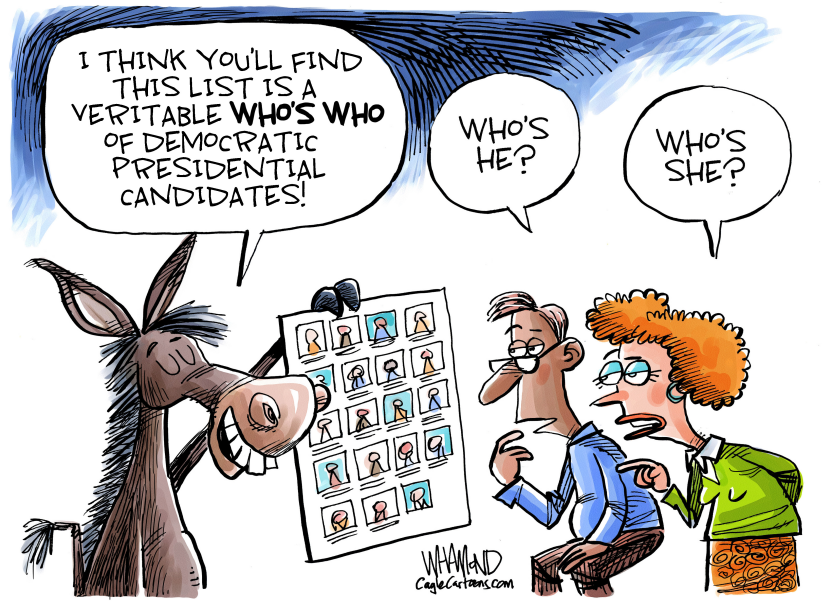
At last count there were 23 “major” candidates including seven senators, four members of Congress, three mayors, two governors and a clutch of other hopefuls. The field has something for everyone: young, old, male, female, black, white, Latino, Asian, gay and straight. They have robust resumes, promising platforms and meaningful messages. And, believe it or not, there are 142 other Democrats who have filed as presidential candidates with the Federal Elections Commission, among them 89-year-old Mike Gravel, the former senator from Alaska.

So what’s the problem? Some Democrats think the field is too large, even for this early stage. In Iowa, where the actual process of selecting a nominee begins for real with the caucus Feb. 3, three out of four Democrats planning to participate believe some candidates should drop out now, according to polling by the Des Moines Register.

As I see it, only three – Joe Biden, Bernie Sanders and Elizabeth Warren – have a real chance at the nomination. Five others – Cory Booker, Pete Buttigieg, Kamala Harris, Amy Klobuchar and Beto O’Rourke – have long-shot status. The rest are just sucking up oxygen.

This wouldn’t be so bad if one of the three top candidates had the “it” factor of Barack Obama. Yes, Hillary Clinton was loved by her supporters in 2016, but she was widely disliked as well. Her only real challenger, Sen. Bernie Sanders, faced the same love-him or hate-him division. And the others? A dollar says you can’t conjure up the names Lincoln Chafee, Martin O’Malley and Jim Webb.

This time around, thinning the roster from 23 to, say, 10, would make it easier to debate – and free up space for lawn signs across Iowa – but it wouldn’t change the bigger problem. The Democratic field is both crowded and flawed.

Joe Biden is the early frontrunner but you have to wonder if that will hold considering age (he’ll be 77 next year), baggage (his positions have changed on key issues over the course of a lengthy career, most recently on the Hyde amendment which bars the use of federal funds for all but a few abortions) and the gaffe gene (he is, after all, Joe being Joe). Bernie Sanders, who usually polls second, is a year older than Biden. He has also shifted on some issues such as gun control, and would spend half his time in a general election campaign explaining what it means to be a “democratic socialist.”

Sad to say, both “Sleepy Joe” and “Crazy Bernie” present soft targets for Donald Trump. A Biden campaign boils down to “Make America Normal Again,” while the Sanders angle is “Make America More Liberal Again.” These are not broad-based themes, and neither moves the presidency away from the control of aging, white males.

Elizabeth Warren is a policy wonk, maybe to a fault, but her passion is unmistakable. Yet, she is not particularly effective on the stump, often getting bogged down in her own position papers. She could find herself with the type of negative polling that dashed Clinton’s hopes.

On my scorecard, the next five Democrats have equal or better profiles but lesser chances. Amy Klobuchar is tough, experienced and fluent on the issues. Pete Buttigieg is a genuine star, super slick in interviews and probably the most inspirational Democrat since Obama. Kamala Harris is charismatic and has broad support among black voters. Beto O’Rourke and Cory Booker have sparked pockets of interest with their high-energy stump styles.

Still, the odds don’t favor this group. Buttigieg is probably eight years away from a real shot at becoming the nation’s first openly gay president. Harris has equivocated badly on straightforward questions, leaving some to wonder if she has the depth at this stage of her career to be president. Klobuchar, Booker and O’Rourke can’t seem to find a lane that could carry them through the primary process.

Which brings us back to the top three, any one of whom would make a fine president and all of whom should be able to defeat Trump. Then again, no Democrat in memory had a better chance of winning the presidency than Clinton, who was Trumped in the Electoral College.

Democratic voters might hope that the first debates next week will clarify things. That’s doubtful. Debating could speed the exit of some candidates who never really had a chance, but it’s unlikely to change things at the top. As Republicans proved in 2016 with a field of 17, swaying opinion is difficult on an overcrowded stage, and this month’s monstrosity will involve 20 of the 23 candidates plus five moderators.

If you’re worried about a repeat of 2016 and, like me, long for someone with more charisma and fewer drawbacks, then you’re stuck with the words of Iowa playwright Meredith Willson in “The Music Man”: “Ya got trouble, my friend.”

A list of Peter Funt’s upcoming live appearances is available at www.CandidCamera.com.

Peter Funt is a writer and speaker. His book, “Cautiously Optimistic,” is available at Amazon.com and CandidCamera.com. © 2019 Peter Funt. Columns distributed exclusively by Cagle Cartoons, Inc., newspaper syndicate.

Comments Off on I’d Trade 23 Candidates for One Sure Winner

FDR in 2020

Modern politics can be summed up this way: Republicans frequently refer to Ronald Reagan, while Democrats prefer to conjure memories of Franklin Roosevelt.

Roosevelt’s New Deal rescued the nation from the Great Depression with economic reforms and bold individual measures including Social Security. But it was FDR’s unfinished business 75 years ago that profoundly inspires Democrats now seeking the presidency.

In his State of the Union message on Jan. 11, 1944, Roosevelt outlined what he called a Second Bill of Rights, “under which a new basis of security and prosperity can be established for all regardless of station, race or creed.” Among the provisions: “the right to adequate medical care,” “a good education,” “the right to a useful and remunerative job” and “the right of every family to a decent home.”

For Democrats in the current campaign these are bedrock themes. Sen. Bernie Sanders has reissued his Medicare for All plan, with the support of Senators Kamala Harris, Kirsten Gillibrand, Cory Booker and Elizabeth Warren. “Health care is a human right,” Warren and Sanders declare in their standard stump speeches, echoing the sentiments of FDR.

“I am running to declare education is a fundamental right,” said Harris, joining a field that widely supports one form or another of free or low-cost college, universal pre-K, and better pay for teachers.

Booker has introduced legislation to establish a federal jobs guarantee program. He believes every American has the right to a job “and that right has only become more important” in today’s marketplace, he maintains, where unemployment is low but many Americans still struggle to make ends meet.

The other day Bernie Sanders gave a speech in Washington in which he called for a “21st century economic Bill of Rights” that would ensure the right to health care, higher education, a decent job and affordable housing. It was pure FDR. “Together with organized labor, leaders in the African-American community, and progressives inside and outside the party,” Sanders recalled, “Roosevelt led a transformation of the American government and the American economy.”

Sanders was three years old when Roosevelt outlined his Second Bill of Rights. He’s been championing such programs since entering public office in 1981 as mayor of Burlington, Vermont.

The only thing separating Sanders from FDR – and the 22 other Democrats running for president – is the single word “socialism.” Sanders calls it “democratic socialism” and says it is “the unfinished business of the Democratic Party.” He’s right. Yet, it is also the crux of how conservatives seek to stir fear and confusion about progressive policies.

Sanders reminds us of words President Harry Truman once spoke: “Socialism is the epithet they have hurled at every advance the American people have made in the last 20 years.”

Hours after Sander’s speech Republican Sen. Marco Rubio released a video saying democratic socialism “is incompatible with our American values.” The GOP National Committee fired off emails titled “Bernie [hearts] socialism,” ending with the line “so do his 2020 comrades.”

The eventual Democratic nominee would probably be wise to avoid the term socialism, made toxic by Donald Trump and his enablers – not because it’s wrong, but because it’s a distraction.

Roosevelt, who was elected president four times, noted in 1944 that liberties enumerated in the Bill of Rights “proved inadequate to assure us equality in the pursuit of happiness.” The nation will be best served if FDR’s vision for expanded economic rights is finally approved by voters in 2020.

A list of Peter Funt’s upcoming live appearances is available at www.CandidCamera.com.

Peter Funt is a writer and speaker. His book, “Cautiously Optimistic,” is available at Amazon.com and CandidCamera.com. © 2019 Peter Funt. Columns distributed exclusively by Cagle Cartoons, Inc., newspaper syndicate.
Comments Off on FDR in 2020

What I Learned from One Busy Mom

I’ve been thinking about the concept of universal child care ever since a chance encounter with a mother I’ll refer to as Suzy and her youngster whom I’ll call Blake.

A quote from Sen. Elizabeth Warren lingers in my mind. “Not just the children of the wealthy, not just the children of the well-connected, but every one of our children is entitled to good child care,” she said. And now I wondered if Suzy, who to my knowledge had never in her life asked for a handout, saw it that way.

As I pulled out of our driveway headed to work I was startled to see Blake sitting by the side of the road. The baby had a delightful smile, big brown eyes, and an expression of complete trust. However, Blake was unable to speak.

Standing in the road, motioning at passing cars to slow down and steer clear, I wondered what to do. I phoned a local nonprofit. A kind woman asked if there was any sign of blood, which there was not. Then she made a remark that was surprisingly perceptive: “Does the baby by any chance have a brown coat with white spots?”

Well, yes! Apparently the authorities were aware of Blake’s situation.

The woman on the phone went on to say that this pattern is all too common. Busy mothers, with overwhelming burdens, often drop off their babies in a safe spot. Usually the youngster is too weak to keep up with the mother as she goes through her busy day. The mother will return at dusk to pick up the baby.

For the rest of the day my wife Amy kept an eye on Blake, who wisely moved onto the driveway closer to our house. At about 3:30, Amy texted a photo showing that Suzy had returned and all was apparently well. Still concerned, I rushed home.

Suzy was just leaving our driveway as I pulled in, with Blake now back on the side of the street, perilously close to passing cars. I found a few orange traffic cones and I placed them on the pavement in such a way that motorists would have to steer well to the left of the baby.

At 5:15 another mother, with two youngsters at her side, came up our street, apparently having finished their day’s chores. They looked at Blake but then scurried off. Where was Suzy?

By 7:30 I had completed preparations to bring Blake into our garage for the night. Just then, Suzy returned. Blake bounded over, seemed to kiss her face, and off they went.

I was briefly proud of myself for providing the care that a busy mother like Suzy clearly required. Then I realized it wasn’t me, it was nature – a system that values day care so much it ensures that many creatures are instinctively able to arrange it.

Clearly there’s more to this than I realized – for people as well as for the family of deer in my front yard.

A list of Peter Funt’s upcoming live appearances is available at www.CandidCamera.com.

Peter Funt is a writer and speaker. His book, “Cautiously Optimistic,” is available at Amazon.com and CandidCamera.com. © 2019 Peter Funt. Columns distributed exclusively by Cagle Cartoons, Inc., newspaper syndicate.

Comments Off on What I Learned from One Busy Mom

We’re All Seeking Sanctuary

MARYVILLE, Tenn. – Lawmakers in this rural corner of Tennessee near Knoxville passed an interesting resolution the other night, making Blount County a sanctuary.

Sanctuary municipalities are generally places where local law enforcement agencies decline to furnish information about undocumented immigrants to federal authorities. President Trump vehemently opposes such policies and has threatened action, such as withholding federal funds, to punish offending jurisdictions.

But what does the national debate over immigration have to do with the 125,000 residents of Blount County? Very little, actually. The resolution passed here makes Blount a “Second Amendment Sanctuary.” By a 15-4 vote, commissioners decreed that they will not tolerate new state or federal laws that affect gun ownership. Nearby Polk County passed a similar measure last month.

This comes at a time when many state and local governments are wrestling with sanctuary policies. According to the National Conference of State Legislatures, more than 30 states have bills pending relating to sanctuary statutes.

The Tennessee resolutions are largely symbolic, designed to make a political point. But what is the underlying message? Is it that states can undercut federal law? That cities and counties can undercut state law? And then, what? That neighborhood associations can refuse to obey town law?

The sanctuary movement is growing in America – although not always with the “sanctuary” label. Alabama might as well call itself a sanctuary for anti-abortion zealots after passing a law that bans virtually all abortions, even in cases of rape and incest.

You might say that Florida is a sanctuary, as one of several states providing a home to people who don’t care to pay state income tax. Nevada is a sanctuary for gamblers. Arizona is a sanctuary for those who don’t believe in Daylight Savings Time.

Nothing underscores the folly of sanctuary policies more than blue laws governing the sale of alcohol – and no state serves as a better example of this mishmash than Arkansas. The state put blue laws on its books in 1837 and basically repealed them in 1982. However, localities in Arkansas continue to make their own laws regulating alcohol.

Thirty-five of the state’s 75 counties prohibit the sale of alcohol. Yet, in eight of the 40 “wet” counties, individual towns, townships, wards or precincts have voted to outlaw alcohol sales. Thirty-three of the “wet” counties don’t allow liquor to be sold on Sunday. It’s not a sanctuary so much as it is a nonsensical mess.

When it comes to states’ rights, conservatives generally favor giving more power to state and local governments while liberals advocate stricter federal controls. With modern travel and technology serving to shrink our borders, and with commerce crisscrossing state lines, the conservative argument makes less sense than in the past. Yet, as sanctuary policies demonstrate, the movement to strengthen local controls is growing.

Oddly, 11 conservative states have banned sanctuary cities, with Florida about to become number 12. They are, in effect, outlawing the very concept they believe in – that is, returning more power to local government.

So, how will Republicans like Donald Trump react to little Blount County declaring itself a Second Amendment Sanctuary? Will they support the pro-gun movement, or oppose the sanctuary policy?

It seems that nowhere in America can you find sanctuary from partisan politics.

A list of Peter Funt’s upcoming live appearances is available at www.CandidCamera.com.

Peter Funt is a writer and speaker. His book, “Cautiously Optimistic,” is available at Amazon.com and CandidCamera.com. © 2019 Peter Funt. Columns distributed exclusively by Cagle Cartoons, Inc., newspaper syndicate.

Comments Off on We’re All Seeking Sanctuary

Cable Hosts Get The Memo

Bill O’Reilly, once the most powerful voice on cable-TV, has been largely absent from public view for two years following revelations that he paid some $50 million to settle sexual harassment lawsuits. Yet, O’Reilly’s signature – a segment he called “The Memo” – continues to have an unfortunate impact across the cable dial.

O’Reilly began his nightly Fox News Channel program with commentary, not news. His conservative “Memo” was delivered in compelling style, yielding high ratings for the show and power for its host.

In his wake, cable’s big three channels – FNC, CNN and MSNBC – have gradually allowed similar commentary segments to dominate their prime-time programs. Under a rock somewhere O’Reilly must be chuckling because attempts to copy his act are, for the most part, boring wastes of airtime.

For talented journalists such as CNN’s Don Lemon, the added burden of doing nightly commentary is an unfortunate example of the Peter Principle. As Lawrence J. Peter explained in his 1969 book, people tend to be promoted in business to their “level of incompetence.” Lemon is a skilled newsman and interviewer but as a pundit he’s miscast.

O’Reilly’s FNC replacement, the conservative Laura Ingraham, begins with commentary she labels “The Angle.” Sean Hannity’s show has long been laced with the host’s opinions but now, lest there be any misunderstanding his mission, Hannity brands his opening monologue the “Opening Monologue.”

Cable’s commentary overload is apparent at MSNBC, where Rachel Maddow and Lawrence O’Donnell devote enormous amounts of time – and verbiage – to opining. Their skill and intellect are not in doubt, but the nightly professorial-style lectures they favor tend toward tedious.

The worst example of the trend happens on CNN when Chris Cuomo wraps up his show and introduces Don Lemon for a split-screen exchange of opinions. Then Cuomo launches into his own solo commentary, branded “The Argument.” At the top of the hour, it’s back to more split-screen opining between Cuomo and Lemon. For anyone still awake, Lemon then delivers his own lengthy commentary known as “Don’s Take.”

How cable channels conduct themselves is more important than ever as the 2020 presidential campaign unfolds. Programs hosted by Brian Williams on MSNBC, Anderson Cooper on CNN, and Shepard Smith on FNC leave most commenting to guests, creating a more effective journalistic blend.

But too many cable hosts follow the opinion matrix. Part of the problem is due to the medium’s increased role in reinforcing opinions among viewers – often derided as an echo chamber. Those trusting Sean Hannity, for example, rely on regular doses of his personal views. The fact that he flogs the same points night after night hasn’t hurt his ratings – especially with his number one fan, Donald Trump.

Hannity has compared his program to a newspaper in which both hard news and commentary exist harmoniously. But the Fox host and many cable producers overlook the fact that no newspaper invites a single journalist to write both the top story on page one and also the day’s lead editorial.

Memo to Chris Cuomo, Don Lemon and the others: Refocus on what you do best and spend less time on the opinion page.

A list of Peter Funt’s upcoming live appearances is available at www.CandidCamera.com.

Peter Funt is a writer and speaker. His book, “Cautiously Optimistic,” is available at Amazon.com and CandidCamera.com. © 2019 Peter Funt. Columns distributed exclusively by Cagle Cartoons, Inc., newspaper syndicate.

Comments Off on Cable Hosts Get The Memo

Are Democrats Eating Their Own?

With a luxury of riches in the crowded presidential field, Democrats find themselves in a quandary: How far should they go in probing differences among the candidates without damaging their overarching goal of winning in 2020?

Some voters and party leaders are so concerned that they’re embracing phrases such as “circular firing squad” and “eating their own” to describe intraparty debate.

Speaking recently in Berlin, former President Barack Obama said he worries about “a certain kind of rigidity” among progressives. He cautioned against creating a circular firing squad in which “you start shooting at your allies because one of them is straying from purity on the issues.” The risk, he said, is that “the overall effort and movement weakens.”

Next month Democrats will begin head-to-head debates, with 17 candidates already qualified to take part under the party’s ground rules. How will they manage to stand out? And what direction will moderators from NBC News take to aid that process?

Is it reasonable to ask Elizabeth Warren about her Native American roots? Joe Biden about age? Bernie Sanders about becoming a millionaire? Amy Klobuchar about being tough with her staff? Pete Buttigieg about his sexuality?

Each of these questions has been asked numerous times on the campaign trail. Yet many people, myself among them, believe they are not appropriate in a national debate that should focus on issues directly affecting our future.

One such issue is climate. If, for instance, moderators ask about the Green New Deal, they invite general agreement about the problem and vagueness about solutions. Perhaps they should be more specific, by asking about, say, nuclear power, which remains a controversial part of the climate debate. But if candidates agree there is a climate crisis yet differ on nuclear are they eating their own?

What about reparations? Every candidate wants to do something, even if it’s just having a committee study the matter. So is it appropriate to demand greater specificity – such as making one-time cash payments to all black Americans?

On immigration, there are only so many ways Democrats can say, “strengthen the border without a wall and also create a path to citizenship for 11 million undocumented people already living here.” In separating 17 well-intentioned candidates, there’s no there there.

Bernie Sanders cooked up a tasty opportunity for Democrats to eat their own when he spoke recently about allowing prison inmates to vote. Most progressives are sympathetic on that issue, but Sanders was cornered at a CNN town hall when asked if he would allow the Boston Marathon bomber to vote. Determined to stand on principle, he said “yes.” Other Democrats later distanced themselves from Sanders, but the topic is not one that would move the needle in a debate.

As next month’s event is likely to show, the 2020 Democratic candidates have strikingly similar views on most major issues. But if voters conclude that this bumper crop of candidates is essentially all the same, what’s left? Women supporting women? Blacks supporting blacks? Midwesterners supporting Midwesterners?

Democrats have no choice but to drill down to find meaningful policy disagreements. They should do it respectfully. And, lest they devour their own, they should ignore distinctions without a difference.

A list of Peter Funt’s upcoming live appearances is available at www.CandidCamera.com.

Peter Funt is a writer and speaker. His book, “Cautiously Optimistic,” is available at Amazon.com and CandidCamera.com. © 2019 Peter Funt. Columns distributed exclusively by Cagle Cartoons, Inc., newspaper syndicate.

Comments Off on Are Democrats Eating Their Own?