This Debate Was a Moderated Mess

The latest Democratic presidential debate was disappointing. Not because the participants weren’t articulate – in fact, many of their answers were excellent – but because the DNC and the networks can’t seem to figure out how to conduct a meaningful competition that will actually help voters determine how the candidates differ on key issues.

Wednesday night’s debate in Atlanta was scattered. At times it seemed as if questions for each candidate were being randomly picked from a hat rather than coordinated in a way that would give each competitor a chance to speak about the most controversial topics. Ten candidates might be too many to have a meaningful debate, but four moderators, freelancing with no apparent coordination, only made it worse.

Consider the issue of climate change, viewed by many as one of the most serious problems facing the planet. It only came up when Mayor Pete Buttigieg mentioned it in answer to a question about farming, opening the door to a brief series of climate-related questions. Even then, only half the candidates were allowed to speak on this vitally important issue. Not a word about climate was solicited from Senators Elizabeth Warren, Cory Booker, Amy Klobuchar, Kamala Harris or businessman Andrew Yang.

The questioning was conducted by Rachel Maddow, Andrea Mitchell and Kristen Welker of NBC News, along with Ashley Parker of the Washington Post. Although they did an effective job of clock management and refereeing, they failed miserably in giving each candidate a chance to be heard. The issue of abortion and reproductive rights was debated by four senators – Warren, Booker, Klobuchar and Bernie Sanders – while the six other candidates were excluded. The topic of paid family leave was presented to only Klobuchar, Harris and Yang.

Real-time tweets from some viewers praised the four female moderators for bringing up, at long last, these two important matters. What a shame that the two questions were answered by so few participants.

Voting rights was discussed by five of the candidates. White nationalism was debated by only Yang and Rep. Tulsi Gabbard. An interesting question about whether more Americans should participate in military service was asked, inexplicably, of only Sen. Warren – even though two recent veterans, Buttigieg and Gabbard, were standing, silently, nearby. Sen. Booker, for some reason, was the only candidate asked if he would tweet as much as Donald Trump.

“I’d like to go back to something I wasn’t included in,” said Booker after being ignored during a discussion about appealing to black voters. He quipped, “I’ve been one since I was 18.”

Clearly, with so many candidates it is difficult to give each equal opportunity. Warren, who got the most time, spoke twice as long as Yang, who received the least time. In fact, during the first half hour Warren was allowed to give five answers before Yang, Gabbard and businessman Tom Steyer had spoken a single word. But the greater failure was that some candidates were given obscure questions while being left out entirely on the major issues. Ashley Parker asked Yang if elected what would he say in a phone call to Vladimir Putin. What kind of question is that? To Yang’s credit his answer was far better than the question: “I’d say, ‘I’m sorry I beat your guy.’”

In her closing statement, Sen. Warren chided the moderators: “We should have talked about gun violence.” She was right. Despite recent shootings, and frequent criticism that the nation has a shamefully short memory about such horrors, the issue of guns was missing from the debate.

It’s unfortunate that the DNC rejected suggestions to devote one or more of the debates to a single topic such as climate change. Such an approach would at least ensure that the participants and moderators would stay on point, while viewers could make meaningful distinctions about the candidates’ views.

When it was over, MSNBC anchor Brian Williams praised his colleagues as he gushed that the debate “was superbly moderated,” adding, “these four should be permanent moderators.”

That’s not how I saw it. Apparently it wasn’t even Rachel Maddow’s view. “I’m just glad we survived,” she said, before calling it a night.

A list of Peter Funt’s upcoming live appearances is available at www.CandidCamera.com.

Peter Funt is a writer and speaker. His book, “Cautiously Optimistic,” is available at Amazon.com and CandidCamera.com. © 2019 Peter Funt. Columns distributed exclusively by Cagle Cartoons, Inc., newspaper syndicate.

Comments Off on This Debate Was a Moderated Mess

Trump’s Tweet Sets a Dangerous Precedent

We interrupt this impeachment hearing to bring you a message from Donald Trump: “Everywhere Marie Yovanovitch went turned bad.”

That tweet, read on live television by House Intelligence Chairman Adam Schiff, was shocking because it sought to affect the testimony of a key witness in an impeachment hearing as she spoke. Moreover, it marked what may be a first – and potentially devastating turn – in American history. As described by Schiff, it was: “Witness intimidation in real time by the president of the United States.”

Yovanovitch, whose testimony was calm, considered and effective, was explaining how Trump and his facilitators sought to smear her as she served as the U.S. ambassador to Ukraine. She said she was “shocked” when she learned that Trump called her “bad news” in his controversial phone call last July with Ukraine’s president. As she spoke Friday morning, Trump took to Twitter and his reelection campaign sent out an email.

With the subject line, “Impeachment Hearing BS,” Trump emailed his supporters that the hearings were “fake” and a “witch hunt trial.”

As is often the case in matters regarding Trump’s malfeasance, the most useful insight comes from those courageous journalists at Fox News who are willing to criticize the president. Bret Baier stated that Trump’s tweet raised the real possibility of an additional impeachment charge against Trump for “witness tampering or intimidation.”

Baier’s colleague Chris Wallace added: “If you were not moved by the testimony of Marie Yovanovich, you don’t have a pulse.”

Clearly, Trump was moved, so much so that he tweeted about Yovanovitch during her live testimony. Apparently he couldn’t help himself – after telling reporters earlier in the week that he wasn’t even watching the impeachment hearings.

As fascinating as the first two days of hearings have been – with even more critically important testimony scheduled for next week – Trump has shifted the focus to the crime of witness tampering. By blasting Yovanovitch in real time was the president hoping to silence her? Or, more likely, was he sending a thinly-veiled message to future witnesses that if they testify they risk public humiliation?

This behavior, made possible by digital access to tens of millions of Americans with a single click, never existed during the impeachment hearings involving Nixon and Clinton. Trump is acting in uncharted territory. His tweets reach roughly 20 percent of all Americans with Twitter accounts.

Speaking of developments in real time, less than an hour after Trump’s attempt to intimidate those who would testify against him in a Congressional hearing, his associate, Roger Stone, was convicted of lying to Congress to protect Donald Trump.

What drama. Trump signals witnesses that they should fear testifying against him. And a court underscores the fact that lying to Congress can lead to a lengthy prison sentence.

When digital malfeasance by the Russians came up in the 2016 election, then-candidate Trump said, “It also could be somebody sitting on their bed that weighs 400 pounds, okay?”

Friday, there was digital interference that was equally troubling. It was by somebody sitting, possibly on their bed at the White House, that weighs 240 pounds. Clearly, not okay.

A list of Peter Funt’s upcoming live appearances is available at www.CandidCamera.com.

Peter Funt is a writer and speaker. His book, “Cautiously Optimistic,” is available at Amazon.com and CandidCamera.com. © 2019 Peter Funt. Columns distributed exclusively by Cagle Cartoons, Inc., newspaper syndicate.

Comments Off on Trump’s Tweet Sets a Dangerous Precedent

This World Series Has Real Gamers

MARYVALE, Ariz. — After 49 years, Bill Lee is pitching again in the World Series.

Last time around, Lee, known in baseball circles as “Spaceman,” was a brash 28-year-old lefty for the Boston Red Sox as they faced the Cincinnati Reds. Now, a few months short of his 73rd birthday, his opponents are among the 325 teams competing in the Men’s Senior Baseball League World Series in Arizona.

While his amateur team, also known as the Red Sox, was at bat in the sixth inning the other day, Lee slumped on the ground in a small patch of shade behind the dugout, breathing heavily in 97-degree heat as he spoke with his wife Diana. She: “Are you drinking enough water?” He: “I never should have thrown that guy a change-up.” She: “Your face is quite red, Bill.” He: “He lined it up the middle! I should have stuck with the curve.” She: “But you’re winning.” He: “Right. Three more innings. I’ve got this!”

It’s mildly interesting that this septuagenarian is able to play competitive hardball. It’s far more intriguing to ask why. Why pay an entry fee to be in a game you used to earn money playing (the Red Sox paid him $45,000 in 1975)? Why risk injury and embarrassment?

His answer sounds well rehearsed but rings true. “When I’m on the baseball field, time seems to stand still. For two or three hours I feel like I’m 12 years old. Why would you stop doing something that makes you feel that way?”

But studying Bill Lee on the diamond as he teaches and often berates his teammates, you realize there is more to it. Competition is in his blood. He has the rare ability to elevate everything he does to the maximum level and to thrive on it. The amateurs around him are occasionally hurt by his harsh criticism but more often they are in awe.

Also, there’s the fact that the Spaceman has a seemingly limitless supply of stories. For instance, he speaks of the time in 1976 when the Red Sox and Yankees got into an on-field brawl during which, as Lee recounts it, Yankees infielder Craig Nettles wrestled him to the ground, separating his shoulder, and outfielder Mickey Rivers sucker-punched him in the face. After months on the disabled list, Lee returned to find a package from the Yankees manager Billy Martin containing three dead mackerel along with a threatening note. By comparison, the amateur games in Arizona are quite the picnic.

As Lee wrapped up his complete game victory in Maryvale, a team known as the LS Warriors was celebrating a win at a field in Tempe. The Warriors, sponsored by the Louisville Slugger bat company, play with the same gusto that Bill Lee exudes. To them, every baseball game is a celebration of how good it is to be alive.

They are wounded Warriors, the nation’s only nationally sponsored amputee baseball team. As Army veteran Carlo Adame explains it, “This team means a lot more to me than just playing baseball. I get a chance to play baseball at an elevated level alongside brothers that have fought a lot of the same physical and mental battles as I have.”

On this day the Warriors defeated the Pirates from Washington, D.C. by a score of 25-0 — a feat aided by modern prosthetics and an old fashioned love of the game.

More than the great American pastime, baseball remains the great American metaphor. It’s message, sometimes lost on the high-paid superstars taking the field in the Major League World Series: Do the best you can for as long as you can and, win or lose, be grateful for that.

A list of Peter Funt’s upcoming live appearances is available at www.CandidCamera.com.

Peter Funt is a writer and speaker. His book, “Cautiously Optimistic,” is available at Amazon.com and CandidCamera.com. Copyright 2019 Peter Funt. Columns distributed exclusively by Cagle Cartoons, Inc., newspaper syndicate.

Comments Off on This World Series Has Real Gamers

Waking Up to Smarter School Scheduling

California Gov. Gavin Newsom, father of four young children, has signed a landmark bill that should serve as a wake-up call for educators and lawmakers across the nation.

The measure addresses sleep deprivation among youngsters by forbidding high schools from starting classes before 8:30 a.m., and middle schools before 8.

Inadequate sleep among students is a serious global problem. California lawmakers responded to data from the American Academy of Pediatrics and the Centers for Disease Control showing that later start times for secondary students not only improve learning, but decrease health challenges like obesity and mental illness.

California’s first-in-the-nation legislation puts student sleep requirements alongside a growing array of issues – such as children’s vaccinations – for which settled science isn’t as persuasive for many Americans as it ought to be.

Newsom’s predecessor Jerry Brown vetoed a similar bill, calling it a “one size fits all approach.” He said school schedules were better left up to local school districts, thus dodging a matter so divisive in California that the state’s Parent Teacher Association supports the law while the Teachers Association opposes it.

Critics of the bill, which takes effect in 2022, tend to focus on non-medical concerns, such as commuting schedules for parents and disruption of after-school sports. They also cite the costs local school districts could face in adjusting teachers’ hours and modifying bus schedules.

However, “Early start times are having detrimental and adverse effects on our students’ health, stifling academic performance and putting our children in serious risks,” wrote State Sen. Anthony Portantino, the Democrat behind the bill. He added that suicides and car accidents are reduced when school start times are shifted later.

When I interviewed a nationally renowned expert on sleep, Dr. James Maas, at his home in Fort Worth, Texas, he explained that for full alertness a high school student requires 9.25 hours of sleep a night. Anything less has immediate and easily measurable consequences. Maas and colleagues at Cornell University found a significant correlation between total amount of sleep and academic performance.

At Harvard University, Dr. Charles Czeisler has outlined how the teenage brain is biologically wired to fall asleep between 2 and 3 a.m., and to awaken sometime after 11 a.m. This, he notes, is why 80 percent of teens are sleep deprived and why 43 percent say they feel sleepy all day.

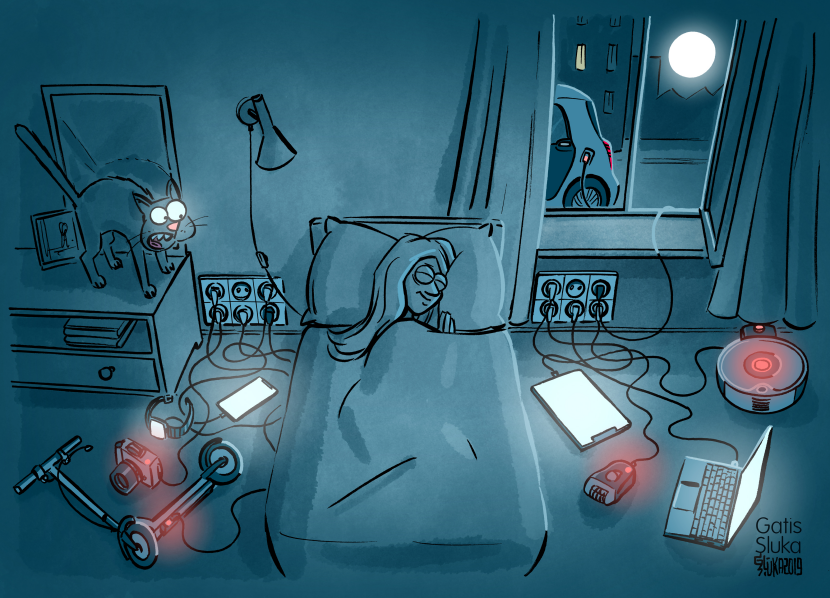
The increased use by teens of blue light-emitting screens – tablets, smartphones, TVs, etc. – compounds the problem. The light temporarily cuts down the body’s release of melatonin, the hormone that signals it’s time to sleep.

In China, a report by the nation’s Sleep Research Society warned of serious medical risks to Chinese youngsters, especially those between ages 13 and 17. Eighty-one percent of students in that group get fewer than 8 hours of sleep a day – part of a global trend over the past decade.

The American Academy of Pediatrics recommends that middle and high school students begin classes no earlier than 8:30 a.m. However, according to the most recent federal figures, published in 2014, 93 percent of U.S. high schools failed to meet that standard.

As Dr. Maas ticks off the factors relating to sleep, it’s hard to imagine why any responsible school system would insist that students report at 7 a.m. and, in a few locales, even earlier. “Alertness, concentration, memory, productivity, perception and the ability to think critically are all impacted by lack of sleep,” Maas explains.

California’s government, controlled by Democrats, is often in the vanguard of progressive legislation. Sleep deprivation might not be as well publicized as, say, climate change, or as urgent as gun control, but it’s critical to the well-being of millions of teens.

I find it baffling that some otherwise responsible adults balk at having their children vaccinated, fail to demand better protection for student athletes on the football field, or downplay the risks of sleep deprivation. What’s with them? Were they asleep during science class?

A list of Peter Funt’s upcoming live appearances is available at www.CandidCamera.com.

Peter Funt is a writer and speaker. His book, “Cautiously Optimistic,” is available at Amazon.com and CandidCamera.com. © 2019 Peter Funt. Columns distributed exclusively by Cagle Cartoons, Inc., newspaper syndicate.
Comments Off on Waking Up to Smarter School Scheduling

Litter to the Auditor

MARINA, Calif. – Lawmakers in California have littered their desks with measures designed to eliminate plastic products, such as bags and even straws. But in failing to provide an adequate system for recycling these items – along with glass, metal and paper – they have created an environmental mess and a socio-economic dilemma.

At the public park I frequent several times a week for baseball practice, I can pretty much set my watch by the arrival of Samuel, toting two or three bulging trash bags. He deftly lifts the lids on garbage bins and rummages a bit, looking for plastic bottles and aluminum cans. He also picks up what’s on the ground, leaving the park considerably tidier than he found it.

His scavenging brings him roughly $60 a week he told me, or at least it used to. Locating a recycling center where he can sell his scrap for cash has become increasingly difficult. This month California’s largest recycling operator, RePlanet, closed all of its 284 locations, pushing the state’s deeply flawed recycling system closer to chaos.

Redemption and recycling of bottles and cans, which came on the scene some 50 years ago, is based on a beautifully simple system. Consumers pay a nickel deposit – a dime for larger items – at the time of purchase, and get the money back when they return the empties. For consumers who can’t be bothered, most municipalities offer curbside collections of recyclables. California also has subsidized redemption depots, where folks like Samuel trade trash for cash.

Today, every aspect of California’s system is in disarray. Many stores simply ignore their obligation to take back empties; others prefer to pay a daily fine of $100 to be spared the hassle. Curbside collections, in which various recyclable products are commingled in a single truck, are yielding contaminated trash that increasingly winds up in landfills. Meanwhile, the global market for recyclables is shrinking, with buyers such as China paying less and demanding cleaner materials.

State auditors have repeatedly identified fraud in California’s system among retailers and recycling companies. And, when it comes to cash deposits, there’s the fact that a nickel doesn’t incentivize today’s consumers as it did half a century ago.

The nonprofit Consumer Watchdog organization notes that more than 40 percent of California’s redemption centers have closed in the last five years. Without changes in how the state subsidizes and regulates these businesses, the group concludes, “the recycling centers that are the centerpiece of the state’s bottle deposit law are doomed.”

Only 10 states have redemption programs for bottles and cans, with no states added to the list since Hawaii launched its program in 2005. However, six other state legislatures are now considering “Bottle Bills,” which is a hopeful sign, despite California’s recent struggles.

Here on the Monterey Peninsula in Central California, there is only one remaining redemption facility to serve seven cities and towns, with a combined population of 170,000, spread over 853 square miles. This “Buy Back Center,” operated by local government, was built years ago near the municipal dump. “It was designed to serve 10 or 20 customers a day,” explains Tim Flanagan, the general manager. “Today, we’re getting eight times that many people, some of whom arrive on bicycles or by foot on a road that wasn’t designed for public access, it was designed for garbage trucks. It was never intended that people would walk to get here.”

Flanagan says all of California faces “a total disconnect with recycling. The cost of labor and transportation are up, while state subsidies for recycling facilities have not kept pace.”

Gov. Gavin Newsom needs to take immediate action to clean this up. Requirements for retailers to participate in recycling must be enforced. Recycling centers must be adequately subsidized to reflect fluctuations in the world scrap market. Residents should be educated about which materials are appropriate for curbside collections. Deposits paid by consumers should be raised to 10 cents for smaller bottles and cans – as is the case in Michigan, where the results are impressive.

Because of its size, California’s failures – as well as its achievements – are magnified. With a vast coastline and natural wonders it should be a model for efficient recycling, not the poster state for environmental mismanagement and malfeasance.

Recycling empty bottles and cans isn’t rocket science. It’s actually one of the simplest things we can do to keep the planet clean, as explained to me at the park the other day by the guy with bags of bottles and cans, who was willing to stoop to conquer.

A list of Peter Funt’s upcoming live appearances is available at www.CandidCamera.com.

Peter Funt is a writer and speaker. His book, “Cautiously Optimistic,” is available at Amazon.com and CandidCamera.com. © 2019 Peter Funt. Columns distributed exclusively by Cagle Cartoons, Inc., newspaper syndicate.

Comments Off on Litter to the Auditor

1. Make Lists. 2. Read Lists. 3. Make More Lists.

Here are my five favorite things about this sentence: (1) It grabs your attention, (2) It keeps you guessing, (3) It’s not overly wordy, (4) It’s something you might forward to friends, (5) It’s part of the list-making trend that just keeps growing.

The New York Times sent subscribers an email on August 11 promoting “12 new books our editors liked” and “10 best new recipes.” There was also a report on “the 50 best TV shows on Netflix right now.” 50! That’s quite a list. I expect a follow-up in which editors select “the 10 best TV shows on our list of Netflix’s 50 best TV shows.”

The very same day:

The Boston Globe continued its obsession with sports lists: “Eight takeaways from the Patriots’ time in Michigan.”

The Washington Post offered, “Eight non-culinary tools you can use in the kitchen.” (Spoiler: one is a blow torch.)

The Chicago Tribune: “10 summer care tips for curly hair.” Parade magazine: “20 songs Joni Mitchell Wrote About Men.”

So, yes, it seems we’re all drawn to lists. And, clearly, editors have figured that out.

The Internet’s clickosphere contributes to it. Just Google “Top 10 Lists” and you’ll be amazed. A few of my favorites: “Top 10 Researchers Who Experimented on Themselves” and “10 People Who Gained Genius from Brain Damage.”

I blame David Letterman for this. His Top 10 lists were delicious late-night snacks, with entries such as: “Top 10 Things That Sound Cool When Said by Snoop Dogg.”

Of course, Dave is now off in semi-retirement, trying desperately to come up with a list of 10 good reasons not to shave his beard, and undoubtedly laughing over the fact that editors can’t resist his fun-with-lists gimmick.

There’s an actual Wikipedia section titled “List of lists of lists.” How detailed is it? It includes “List of Tamil films of the 1940s” and “Lists of ‘Dungeons & Dragons’ monsters.”

Buzzfeed has popularized the term “listicle,” which is any article in the form of a list – and Buzzfeed’s listicles get millions of views!

So, my Top Five reasons for writing this: (5) I will presumably be paid, (4) It required little thinking, (3) It’s summer, after all, (2) Readers love lists, and (1) It serves to remind us that lists, while sometimes engaging, should never be confused with actual writing.

A list of Peter Funt’s upcoming live appearances is available at www.CandidCamera.com.

Peter Funt is a writer and speaker. His book, “Cautiously Optimistic,” is available at Amazon.com and CandidCamera.com. © 2019 Peter Funt. Columns distributed exclusively by Cagle Cartoons, Inc., newspaper syndicate.

Comments Off on 1. Make Lists. 2. Read Lists. 3. Make More Lists.

I’ll Bet on News Over Views

Back when I was a rookie editor in ABC’s Manhattan newsroom we used to place bets – actual cash wagers – on how the New York Times would design the next day’s front page.

Rather than wait until morning for results we gathered around a radio to savor the 9 p.m. broadcast on WQXR, which began: “Front Page! Tomorrow’s New York Times! What will it look like?” A fellow named Bill Blair dutifully described every inch of page one, reading each headline and explaining how it was positioned.

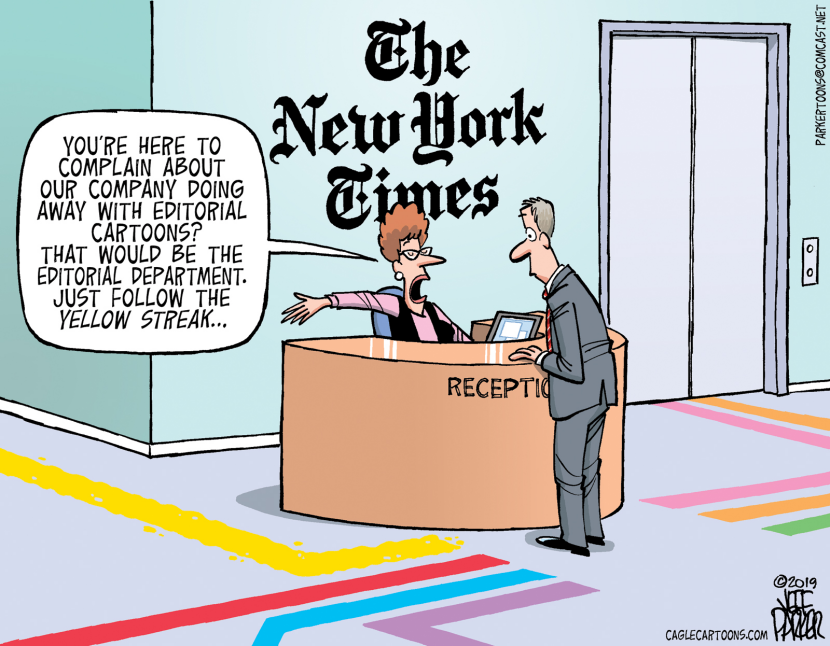
Though the radio program is long gone, some news executives still play the game using digital images. But here’s a news flash: Among them are the Times’s top editors. Many of the people who used to spend hours planning the page now check an email or tweet at 9 p.m. to see what it looks like. For them, the print edition has taken a backseat to the company’s various digital products.

This resulted in quite a fuss the other day when the Times’s print headline as of 9 p.m. read, “TRUMP URGES UNITY VS. RACISM.” A tweet of the page brought an angry response from those who felt the wording, while accurate, failed to contextualize the president’s remarks in the wake of shootings in Texas and Ohio. The headline was changed in subsequent editions to, “ASSAILING HATE BUT NOT GUNS.”

My take on all this is twofold. First, the Times’s front page, much like its tabloid cousins in New York, The Daily News and The Post, has impact as an information snapshot that extends beyond actual print circulation. Second, and far more important, journalists are on dangerous ground when they shift too heavily from reporting the news to analyzing and interpreting it outside of carefully labeled “opinion” columns.

The Wall Street Journal’s page-one headline that day, for example, was bland but straightforward: “Trump Speaks Out as Death Toll In Two Shootings Climbs…”

Few stories frustrate journalists – and those who second-guess them – as much as mass murders across this nation. They are covered in print and on television in a predictable pattern: anxious eyewitnesses and grieving relatives speaking to shirtsleeved reporters, along with streams of politicians who appear genuinely concerned but also aware of a prime-time opportunity to be seen and heard.

Nothing changes, prompting some to blame the messenger. If only, they argue, journalists went beyond the facts and called for action to restrict guns and curb hate crimes. A sad take along those lines comes from a former editor at Denver’s defunct Rocky Mountain News, who guided award-winning coverage of the 1999 school massacre at Columbine.

Under the headline, “I’ve seen the limits of journalism,” John Temple writes in The Atlantic that the ritual of how mass murders are covered hasn’t changed much in two decades. “I am forced to ask why journalists are doing this work in this way,” he concludes, “and whether in the end it’s worth it.”

Keeping the public informed is, indeed, worth it. People in Colorado aren’t disadvantaged because coverage follows predictable patterns so much as they are that The Rocky’s closure made Denver a one-paper town.

The more politically divided the nation becomes, the greater the thirst for news coverage that reinforces thinking rather than inspires it. At the same time, the shift from print to digital platforms makes opining easier, opening the door for the oxymoronic endeavor known as advocacy journalism.

If the Times erred in judgment it was probably by placing the President’s remarks too high on the page. There was nothing wrong with what the original headline said, only with the thinking of critics whose 9 o’clock bet would have been for something that more matched their opinion.

A list of Peter Funt’s upcoming live appearances is available at www.CandidCamera.com.

Peter Funt is a writer and speaker. His book, “Cautiously Optimistic,” is available at Amazon.com and CandidCamera.com. © 2019 Peter Funt. Columns distributed exclusively by Cagle Cartoons, Inc., newspaper syndicate.
Comments Off on I’ll Bet on News Over Views

Democrats Are Strangely Quiet About Guns

Thoughts and prayers, we are often reminded, only go so far. And politicians’ attention spans are alarmingly short.

On July 31, just three days after four people died in Gilroy, California, and three days before at least 31 more would be killed in El Paso, Texas, and Dayton, Ohio, none of the 10 Democrats on the debate stage in Detroit said a word about gun violence. And none of CNN’s three moderators bothered to ask about what is unquestionably a national nightmare.

The prior night, Don Lemon directed one question about guns to South Bend, Indiana, Mayor Pete Buttigieg. Several other candidates then made brief remarks on the subject, but over the two nights, there was not a syllable about guns from: Elizabeth Warren, Joe Biden, Cory Booker, Julian Castro, Michael Bennet, Kirsten Gillibrand, Kamala Harris, Andrew Yang, Tulsi Gabbard, Jay Inslee, Tim Ryan, John Delaney and Bill de Blasio.

Gun control should be a central issue for Democrats in 2020. Congress might be paralyzed but voters want action. More than 60 percent of Americans, according to Gallup research, favor stricter gun control – above 85 percent among Democrats. Other polls reflect roughly the same percentages.

Over two nights of debating among 20 Democrats in Detroit, the word “health” (as in health care) was spoken 183 times, “Plan” was said 153 times, “tax” 58 times. “Gun” was said just 15 times on night one, and zero times on night two.

Lemon asked Sen. Warren about the related matter of white nationalism. “We need to call out white supremacy for what it is: domestic terrorism,” she said. “And it poses a threat to the United States of America.” She then shifted broadly to “environmental racism, economic racism, criminal justice racism, health care racism.” And, without interruption she went on to outline her plan for “universal, tuition-free college.”

Voters who have been sitting through the seemingly endless presidential campaign that still has nearly 15 months to go should be incensed that Democratic candidates spend so little time addressing gun violence and the scourge of white nationalism. CNN’s moderators should be taken to task for virtually ignoring the issues, while finding time to drill down about such things as lead poisoning in New York City and the drinking water in Flint, Michigan, as important as those topics might be.

Democrats have managed to divide themselves on health care, the main issue that united the party in the 2018 midterms. They have squabbled over decriminalizing illegal immigration. Some have even taken to attacking the record of President Obama. But when it comes to gun control – about which they could come together – they remain relatively quiet on the problem and generally uninspired in finding solutions.

In 2018 Mr. Trump said he favored action on universal background checks, but the next day backed away. The House has passed two bills to deal with it but Senate Majority Leader Mitch McConnell has refused to schedule a vote. Shouldn’t that be a major theme for Democrats?

During the weekend of bloodshed there was, of course, a stampede to the microphones, as members of both parties eagerly spoke up during the media’s brief window of intense interest. On Monday morning President Trump said, “We will never forget.”

For now, gun violence and white nationalism are once again talking points. That’s better than silence, but it’s cheap.

A list of Peter Funt’s upcoming live appearances is available at www.CandidCamera.com.

Peter Funt is a writer and speaker. His book, “Cautiously Optimistic,” is available at Amazon.com and CandidCamera.com. Copyright 2019 Peter Funt. Columns distributed exclusively by Cagle Cartoons, Inc., newspaper syndicate.

Comments Off on Democrats Are Strangely Quiet About Guns

Forgive Me. This Is Cold.

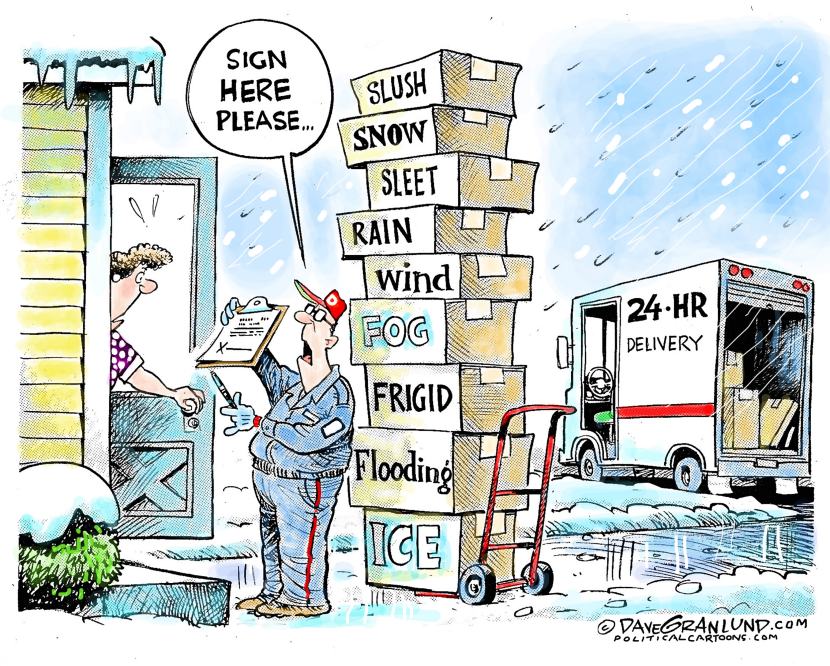
MONTEREY, Calif. – Here’s the weather summary, as printed the other day on the front page of the San Francisco Chronicle: “Hot and sunny. Highs from 65 to 105.”

A 40-degree swing? On a single day? All within a tiny geographic zone? What’s with that?

Those of us who live along the sliver of California coast where temperatures are usually at – or below – the lower “high” noted above, wear hooded jackets and sweaters in mid-summer. It’s downright embarrassing. How can I complain to my relatives back East about the uncomfortable chill while they’re soaked with perspiration after a one-block walk from subway to office?

Don’t get me wrong: I’m plenty worried about global warming and the manifestations of climate change. I’m concerned when I see news coverage of visitors at the Eiffel Tower plunging into the Trocadero fountain to escape record heat of 109 degrees. Still, the variations in temperature I deal with daily leave me cold.

A few nights ago in San Francisco the Giants won a thrilling baseball game and yet TV reporter Amy Gutierrez, bundled in a winter coat as she stood shivering near the dugout, couldn’t keep from complaining about “freezing.” That must not have sat well with viewers just a few miles inland where air conditioners were struggling to cut through the heat.

A weather buff back East with whom I correspond regularly notes that Maine has a similar condition in which offshore Atlantic winds frequently cause a 10 to 20 degree differential with adjacent inland. But a 40-degree variance? Not likely.

“June Gloom,” as they call it here on the Monterey Peninsula, is actually a summer-long condition, lasting until after Labor Day. I don’t know of any home with air conditioning. The community swimming pool is heated in August. The ocean is unthinkably cold, entered only by the bravest of souls in wet suits. Lobby fireplaces at local hotels roar throughout summer.

The oddest thing about California is that we often record the nation’s high and low temperature on the same day. The state has the most variable climate in North America. The other afternoon it was 114 in Palm Springs, 105 in Bakersfield and 56 in my driveway.

For those of us in the Sunless Belt, global warming is an abstract condition that we accept on faith, sort of like the Earth’s roundness.

That said, I’m genuinely sorry to be fretting about shivering while so many of you are shvitzing. Seems the weather is always better on the other side of the map.

A list of Peter Funt’s upcoming live appearances is available at www.CandidCamera.com.

Peter Funt is a writer and speaker. His book, “Cautiously Optimistic,” is available at Amazon.com and CandidCamera.com. © 2019 Peter Funt. Columns distributed exclusively by Cagle Cartoons, Inc., newspaper syndicate.
Comments Off on Forgive Me. This Is Cold.

Mueller’s Real Warning

There was a clear message in Robert Mueller’s testimony last week before two House committees, but it wasn’t just about the danger Russia poses to our elections. It was the risk that aging presents for our public servants.

Mr. Mueller has had an illustrious career as a faithful public servant – one of the few things Republicans and Democrats were wholeheartedly able to agree upon. Some argued that his 488-page written report should have been allowed to speak for itself.

Instead, the report’s author – or, more accurately, its executive producer – appeared on television for roughly seven hours in a feeble, often painful, display. Those who have observed Mr. Mueller in prior appearances before Congress say he has lost more than a few feet off of his fastball, unable to remember basic details and frequently asking that questions be repeated.

Mr. Mueller turns 75 next month. He’s unlikely to ever again take on the task of special counsel, nor, for that matter, will he ever run for president.

But as this septuagenarian steps aside, two men who are each his senior are seeking the Democratic nomination for the nation’s most demanding office. On Inauguration Day in 2021, Bernie Sanders will be 79 and Joe Biden 78. Even their relatively youthful opponent Elizabeth Warren will be 71. Donald Trump: 74.

The average age of U.S. presidents at inauguration in the last half century is 56.5.

People generally live longer nowadays and remain productive later in life. One’s age should not be an issue, especially in the workplace – until the day arrives when it is. If, on that day, you’re a special counsel, maybe you find an apartment in the Sun Belt and write a memoir. However, if you’re performing heart surgery or about to sit down with Kim Jong Un, it’s likely to be a more serious concern.

In Iowa I recently watched several of the Democratic contenders, including Mr. Biden and Mr. Sanders, participate in town halls sponsored by the AARP. Understandably, aging was a central topic. Everyone, including Pete Buttigieg, the 37-year-old mayor from South Bend, Ind., railed against age discrimination. The candidates all agreed that employers should not be allowed to ask an applicant’s age – which played well for this crowd but struck me as too broad, even in PC times.

Much has been written about how Ronald Reagan, who was 73 when he began his second term as president, suffered some degree of cognitive impairment while in the White House. Still, it wasn’t until he had been out of office for six years that he was officially diagnosed with Alzheimer’s disease.

Whatever President Trump’s critics dish up, it’s never about his vigor. Like seniors Bernie Sanders and Elizabeth Warren, he bounds from one event to the next with seemingly limitless energy. On the other hand, Joe Biden, whom the president slyly refers to as “Sleepy Joe,” does not appear as sharp on the campaign trail or in debates.

What would happen if any of these politicians had a Mueller Moment? For a candidate it would be devastating; for a president it would present an almost unthinkable crisis in government and on the world stage.

In the estimation of some experts, President Trump has already exhibited early stages of dementia. Last year 70 health professionals signed a letter urging a thorough neurological exam for Mr. Trump, citing “declining faculties for complex thought.” “failure to recognize old friends” and “markedly declining vocabulary in recent years.” One member of the group, the psychologist John Gartner, wrote in USA Today four months ago, “The need (for an exam) is more screamingly obvious now than it was when we first called for it over a year ago.”

Asked about age in an interview with New York Magazine last fall, Mr. Sanders said, “What people have a right to know: Is the candidate healthy? Does he or she have the energy to do what is a very stressful and difficult job?”

Quite possibly when Robert Mueller was appointed special counsel two years ago, the answer to both questions was “yes.” But what we saw on Capitol Hill the other day would seem to indicate a change.

There is an undeniable risk that comes with placing older people in high positions for fixed terms. Voters might choose to look past this but they should at least, in the words of one senior citizen, “Take the question.”

A list of Peter Funt’s upcoming live appearances is available at www.CandidCamera.com.

Peter Funt is a writer and speaker. His book, “Cautiously Optimistic,” is available at Amazon.com and CandidCamera.com. © 2019 Peter Funt. Columns distributed exclusively by Cagle Cartoons, Inc., newspaper syndicate.

Comments Off on Mueller’s Real Warning