Well-Organized Sanders Revolution Poised for Iowa Win

AMES, Iowa – Bernie Sanders supporters like to think of themselves as revolutionaries, but what worries Democratic opponents is their more important skill: organizing.

The Feb. 3 Iowa caucuses are too close to call, with different front-runners as each poll comes along, but Vermont Sen. Bernie Sanders has the best shot at winning. That would boost his chances in New Hampshire’s Feb. 11 primary and in the Nevada caucuses Feb. 22. (South Carolina’s primary on Feb. 29 seems locked for former Vice President Joe Biden.)

Sanders v. Trump in November frightens more Democrats than it pleases, but it could happen.

Iowa voters have been subjected to over a year of relentless campaigning, exceeding all previous elections. More ads than usual flood the airwaves, more signs clutter the roadsides, and more events are scheduled across the state each day and night. Most Iowans, no matter whom they support, will tell you that the Sanders team makes the most calls and knocks on the most doors.

Remember, they’ve been organizing here for over four years. In the 2016 caucuses Sanders came within a whisker of beating Hillary Clinton: she got 49.9% of the vote, and he got 49.6. Since that day, Sanders diehards have focused on a first place finish in 2020.

Only two current presidential candidates can pack arenas in Iowa for full-blown rallies. One is the master, Donald Trump, who parachuted in for a rally four days before the caucuses. The other is the democratic Socialist, Bernie Sanders. Others, like Massachusetts Sen. Elizabeth Warren, Minnesota Sen. Amy Klobuchar, and former South Bend, Indiana Mayor Pete Buttigieg, hold town halls, sometimes with standing-room crowds but rarely totaling more than a few hundred. Former Vice President Joe Biden stages some hybrid events that come closer to a rally, but they are a far cry – in size and raw enthusiasm – from what Sanders regularly mounts.

Bernie Sanders, with his celebrity road show and slick organization, has events like the one I attended at the City Auditorium in Ames. All 900 seats were filled and so many people stood in the aisles that Sanders had to quip that he hoped the fire marshal wasn’t paying attention. Hundreds more people listened to an audio feed in an overflow room, bringing the attendance to about 2,000 on a frigid night.

Grammy winning band Portugal. The Man provided entertainment, Oscar winning filmmaker Michael Moore delivered a funny and energizing speech, and Congressional superstar Rep. Alexandria Ocasio-Cortez of New York positively wowed the crowd with lines like, “True democracy has been purchased by the powerful.” The antidote, she reminded the faithful, is “sustained organizing – electorally and beyond.”

By the time 78-year-old Sanders, who began his day at the impeachment hearings on Capitol Hill, stepped on stage, the crowd was more than ready to salute. He congratulated them for participating in the largest outpouring of individual campaign contributions in American history, averaging $18.50 per person, another benefit of organizing.

His organization is envied by some, but resented by others. Staffers in other campaigns have told me the Sanders team doesn’t always cooperate with statewide party planning and is overly protective of its voter lists and data. Nationally, warnings are issued with regularity by some pundits and Democratic voters about the peril of a Sanders candidacy.

Yet, other candidates in the still-crowded Democratic field face an enthusiasm gap. The front-runners, other than Sanders, have eager supporters and passionate crowds. But, thinking back to the way Barack Obama electrified audiences – and the way President Trump energizes his base – only Bernie Sanders comes close.

I’m reminded of a scene in “The Godfather,” in which Michael Corleone speaks with Hyman Roth about the Cuban revolution. “A rebel was being arrested by the military police,” says Michael, “and rather than be taken alive, he exploded a grenade hidden in his jacket. He killed himself and took the captain of the command with him.”

“What does that tell you?” Roth asks.

“They could win.”

A list of Peter Funt’s upcoming live appearances is available at www.CandidCamera.com.

Peter Funt is a writer and speaker. His book, “Cautiously Optimistic,” is available at Amazon.com and CandidCamera.com. © 2020 Peter Funt. Columns distributed exclusively by Cagle Cartoons, Inc., newspaper syndicate.

Comments Off on Well-Organized Sanders Revolution Poised for Iowa Win

Surrogates Carry the Ball in Iowa

DES MOINES, Iowa – In tonight’s performance of the presidential campaign, the role of Massachusetts Sen. Elizabeth Warren will be played by her husband, Bruce Mann.

With three of the leading Democratic contenders stuck in Washington, 1,000 miles from the frozen cornfields, understudies – or, surrogates as they’re called in politics – are being shoved on stage, as the Feb. 3 caucuses draw near. This unexpected twist could make a mess of things for Democrats in a state where folks take pride in meeting candidates in person and many voters delay their decision until the last minute.

Along with Sen. Warren, Minnesota Sen. Amy Klobuchar and Vermont Sen. Bernie Sanders are MIA. Colorado Sen. Michael Bennet is also serving impeachment duty but his candidacy is barely alive, and he has switched his focus to New Hampshire, where the primary takes place Feb. 11.

Sen. Klobuchar’s lead surrogate so far has been her 24-year-old daughter Abigail Bessler, a New Yorker who works for the City Council by day and dabbles in stand-up comedy by night. In Iowa, her specialty is what the campaign calls “house parties” – gatherings in which several dozen curious Democrats chat over a potluck meal.

“I would never try to play my mom’s part,” Bessler told me. “I just talk about things she’s done and what she will accomplish as president.”

Sen. Sanders, by comparison has big guns, with the Oscar-winning filmmaker Michael Moore and the ultra-progressive New York Rep. Alexandria Ocasio-Cortez touring Iowa on his behalf. When the first week of the impeachment hearing ended early last Saturday, Sanders was able to join his two surrogates at a packed rally in Ames. But by the time the 78-year-old candidate ambled on stage, at the end of a long day that began on Capitol Hill, the crowd was in such a frenzy over speeches by Moore and Ocasio-Cortez, that he seemed upstaged by his understudies.

The Sanders crew is atypical. Most surrogates are welcomed politely, but their ability to change minds and win votes is limited at best. That has opened the door for other candidates in Iowa, where each poll seems to have a different front-runner.

Former Vice President Joe Biden and former South Bend, Indiana Mayor Pete Buttigieg have a free shot at Iowans. During the first week of the Senate trial, Biden held five public events in Iowa, while Buttigieg held eight. Businessman Andrew Yang, trailing but gaining in the polls, conducted a remarkable 23 live events in Iowa cities and towns.

Louise Esveld, a college administrator living in Pella, is typical of Iowans who have made a point of hearing the presidential candidates in person. “I found Yang to be very impressive,” she said. “The impression you get is much different from what you see on TV. I came away with a lot more understanding of his views.”

Yang is scurrying across the state trying to win over that very type of voter. Biden, on the other hand, has always favored a somewhat less hectic campaign schedule, but even he is stepping up his pace during the Senate trial. He finds himself in an unusual spot – trying to meet Iowans in person and ignoring impeachment, while nonstop television coverage of the trial contains constant references to him and his son, Hunter.

In week two, with the senators back in D.C., former Housing Sec. Julian Castro, himself a former candidate, stepped in for Warren. Also holding events was Warren’s husband Bruce Mann, a Harvard law professor. He’s articulate, although not one to rouse a crowd Michael Moore-style.

Castro and Mann were upstaged by another Warren surrogate who seems to attract enthusiastic crowds wherever he goes. He’s Bailey, the senator’s Golden Retriever. The other day at Drake University, Bailey held his own campaign event, hosted on campus by the school’s bulldog mascot, Griff.

Every Iowa surrogate, it seems, has his day.

A list of Peter Funt’s upcoming live appearances is available at www.CandidCamera.com.

Peter Funt is a writer and speaker. His book, “Cautiously Optimistic,” is available at Amazon.com and CandidCamera.com.©2020 Peter Funt. Columns distributed exclusively by Cagle Cartoons, Inc., newspaper syndicate.

Comments Off on Surrogates Carry the Ball in Iowa

Iowa’s Stubbornness Makes Caucuses Hard to Predict

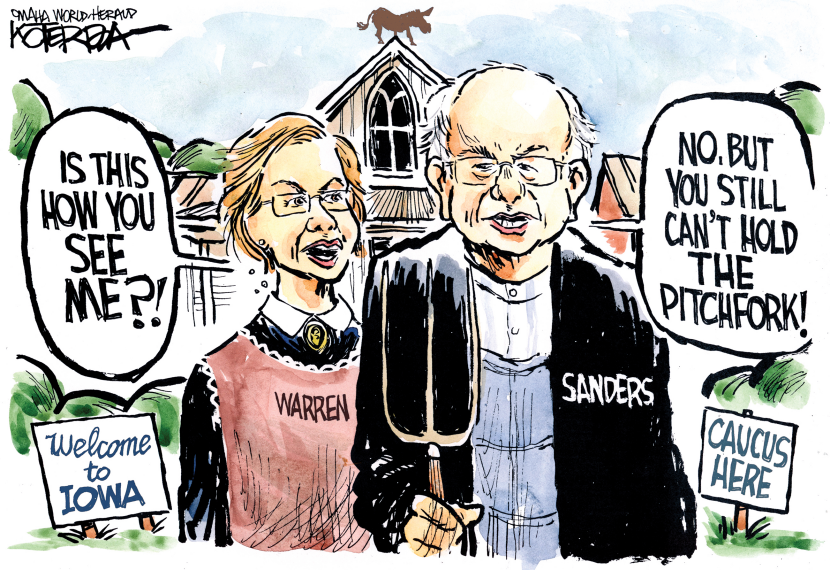
AMES, Iowa – In “The Music Man” which, happily, returns to Broadway this fall, there’s a tune called “Iowa Stubborn,” written in 1957 by Mason City native Meredith Willson. It muses that folks in the Hawkeye state “could stand touchin’ noses for a week at a time and never see eye to eye.”

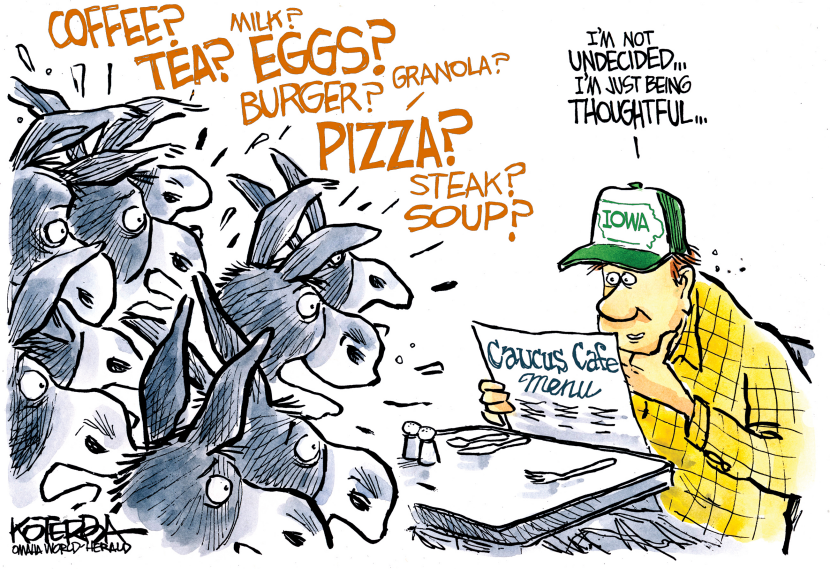
There’s a “chip on the shoulder attitude,” the song says, perfectly describing how Iowans feel about their Feb. 3 presidential caucus. It also explains why, after more than a year of unparalleled opportunity to evaluate candidates up close and personal, the outcome among Democrats remains difficult to predict.

“I’m trying to decide between (Elizabeth) Warren and Bernie (Sanders),” said Ria Keinert, a physical therapist, as she waited for a Sanders rally to begin. “I’ve seen most of the candidates; Bernie three times. But I’m still not sure who I’m caucusing for.”

According to this month’s Des Moines Register/CNN Iowa poll, 45 percent of Democrats said they could still be persuaded in the closing weeks to pick a different candidate. The latest New York Times poll similarly showed 40 percent willing to shift their support.

The last four Register surveys confirmed the volatility. Last summer, former Vice President Joe Biden held a commanding lead. In September, Massachusetts Sen. Elizabeth Warren climbed to the top. Two months later, now-former South Bend, Indiana mayor Pete Buttigieg was number one, but this month Vermont Sen. Bernie Sanders vaulted to the lead.

In Iowa’s land of retail presidential politics most voters take their responsibility seriously. It’s difficult for other Americans – especially those outside of early-voting states like Iowa, New Hampshire, Nevada and South Carolina – to fully comprehend what Iowans mean when they tell you they won’t caucus for a presidential candidate they haven’t spoken with personally. Personally! To a resident of, say, midtown Manhattan, that’s surreal.

During my visit to Iowa last summer, I wrote that the state’s mostly white and largely rural population might not make it the best place to conduct what is unquestionably the nation’s most lengthy presidential screening test. That remains true. But there’s more to it, and it becomes clear in speaking with Iowans as their big day draws near.

Colin Burczek, a clerk at the Des Moines Hilton, said he has narrowed his choice to Minnesota Sen. Amy Klobuchar and businessman Tom Steyer. Burczek has met most of the Democrats, and the metrics he and many Iowans use to pick a candidate differs from what most Americans are able to glean from cable-TV and social media.

“You get a vibe,” Burczek said. “You get to see who they are as an actual person.”

Karen Kellogg of Ames told me at the Sanders rally that she had spoken personally with Biden and was planning to see Klobuchar in the morning. “It’s a privilege to participate in the Iowa caucus,” she said, “and Iowans have a responsibility to know the candidates.”

Iowans put stock in the broadness of a smile and a the firmness of a handshake, but there’s another factor complicating things in the caucuses. A candidate must reach a 15 percent threshold in a precinct in order to be awarded any delegates to the national nominating convention. Supporters of candidates who fall short will shift to someone else on subsequent ballots, creating a form of ranked voting in which second choices are important.

On that score, my anecdotal evidence reveals something interesting about Sen. Klobuchar: She’s not often cited as a first choice, but she’s frequently mentioned as number two. Does that make her a future vice president? Time, and months more of grueling campaigning will tell.

What’s decided in Iowa is nationally significant, but it’s conducted with an unmistakably local approach – what Meredith Willson called being stubborn.

I asked Kurt Paeper, a volunteer at a Buttigieg town hall in Fort Dodge, about that. “I don’t think we’re all stubborn,” he said, sounding rather stubborn about it. “I just know we’re fortunate to be able to look these candidates in the eye.”

A list of Peter Funt’s upcoming live appearances is available at www.CandidCamera.com.

Peter Funt is a writer and speaker. His book, “Cautiously Optimistic,” is available at Amazon.com and CandidCamera.com. © 2020 Peter Funt. Columns distributed exclusively by Cagle Cartoons, Inc., newspaper syndicate.
Comments Off on Iowa’s Stubbornness Makes Caucuses Hard to Predict

I Can’t Endorse the Times’s Approach

The New York Times provided lessons in both journalism and television Sunday night, by way of bad examples.

First: If a newspaper believes in making political endorsements it shouldn’t balk when a tough call comes along, leaving voters more mystified than before. Second: The ingredients that create a compelling reality-TV show (“The Apprentice” comes to mind) are not the same as those that make for honest political opining.

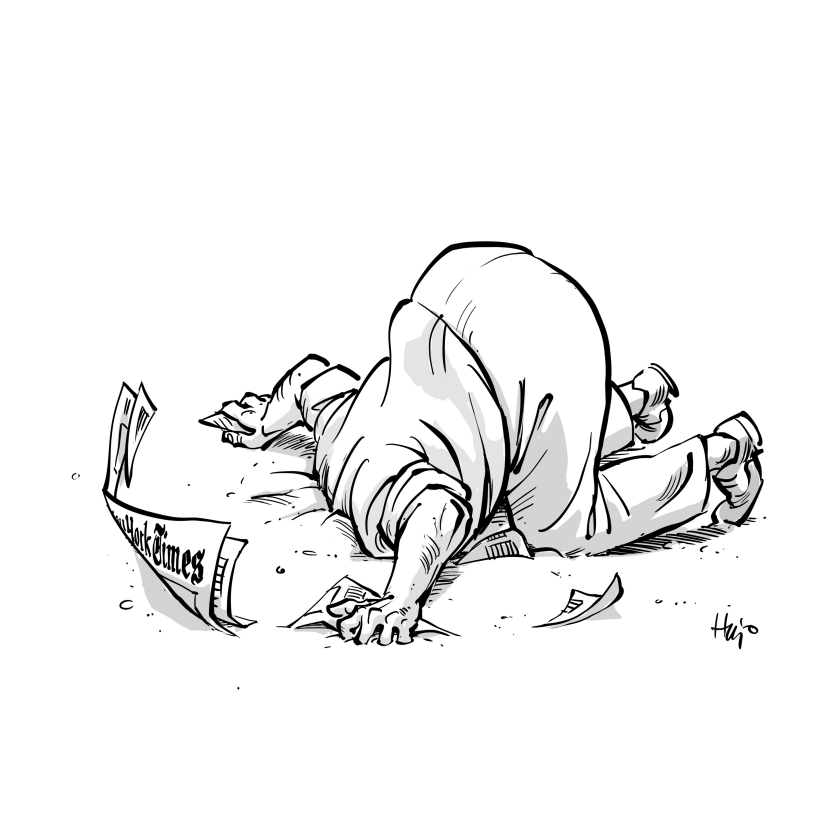
After spending “more than a dozen hours” interviewing most of the major candidates seeking the Democrats’ nomination for the presidency, the Times declared itself unable to choose between Senators Elizabeth Warren of Massachusetts and Amy Klobuchar of Minnesota, so it endorsed both. Readers were advised to deal with it “in the privacy of the voting booth.”

That, of course, is the essence of the argument many publishers use to explain why they do not make political endorsements in the first place. The Times, however, has a long history of issuing pointed recommendations – going back to 1860 when it endorsed Abraham Lincoln.

More troubling, however, is the way the paper unveiled its non-endorsement in a competition-style episode of the television series it produces for FX, known as “The Weekly.” Much like “Shark Tank,” the long-running ABC series in which contestants are interviewed by a panel of successful business tycoons for a chance to make a deal and become wealthy, the Times’s program faced a common dilemma. Should hours of material be edited for insight and clarity – fair but often dry – or should the producers go for pacing and entertainment value?

The episode of “The Weekly” went heavily for the latter, as best illustrated by the clips selected for the segment on businessman Andrew Yang. Although the full transcript of Yang’s interview, published by the Times, shows a reasonable depth of thinking on pressing issues of the day, he was asked on the TV show “what government secret” he would like to know (UFO evidence, he said with a laugh). And he was asked which of his opponents “understands the internet” (answer: none).

In his few edited minutes, Yang was given what a former guru of schlock-TV, Chuck Barris, liked to call the “zonk” treatment. Former South Bend, Indiana Mayor Pete Buttigieg got a taste of it as well when confronted with the fact that some trolls of social media refer to him as “Mayo Pete,” an apparent reference to either his whiteness, or blandness, or both.

Just about every twist from the reality-TV handbook was employed, from hearing the editorial board members offer unkind jabs after candidates left the room, to having secret ballots written on slips of paper as a means of whittling the decision down to the final four (Warren, Klobuchar, Buttigieg and Sen. Cory Booker, who has since dropped out of the race). Then, a pause for a commercial while Kathleen Kingsbury, the paper’s deputy editorial page editor, mulled.

In the past, these Times interviews with candidates were off the record – at least to the extent that full transcripts were never released and TV cameras were not present. In an admission that those of us who work in television understand all too well, Kingsbury told the Washington Post, “The reality is when you bring TV cameras into any meeting, people’s behavior changes. I’m still wondering if we should have done this on TV or if we should have just released the transcripts.”

If the Times’s goal was to boost ratings for its TV show, the endorsement competition probably succeeded. However, to the extent the paper was out to guide Democrats, who will begin the long voting and caucusing process on Feb. 3 in Iowa, the dual recommendation was little more than frustrating.

The 2020 election and the presidency itself have already been stained by a reality-TV mentality, along with the distortions that come with abbreviated takes on social media, and the form-over-substance nature of cable-TV.

When the New York Times emulates such things it loses my vote.

A list of Peter Funt’s upcoming live appearances is available at www.CandidCamera.com.

Peter Funt is a writer and speaker. His book, “Cautiously Optimistic,” is available at Amazon.com and CandidCamera.com. © 2020 Peter Funt. Columns distributed exclusively by Cagle Cartoons, Inc., newspaper syndicate.
Comments Off on I Can’t Endorse the Times’s Approach

Snubbed

Snubbing season is in full swing.

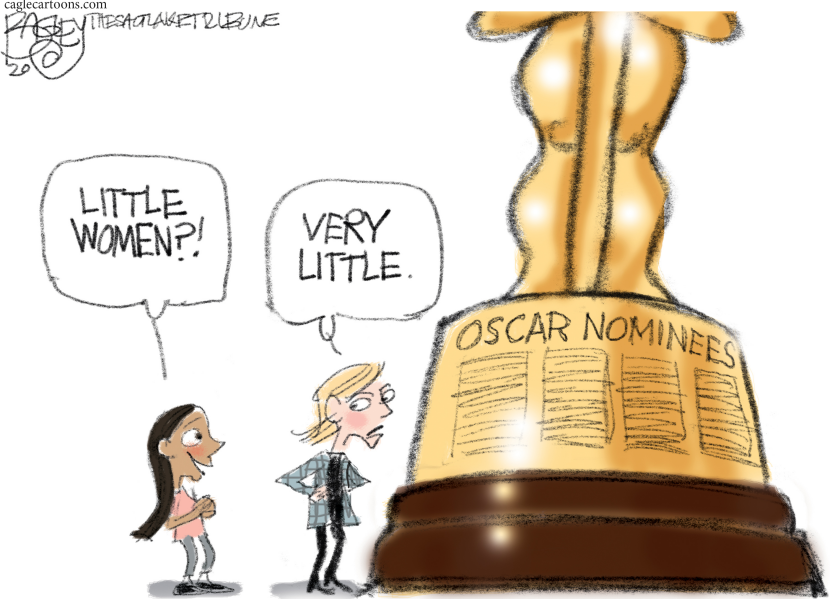
Oscar snubs went to acclaimed actors Robert DeNiro (“The Irishman”), Jamie Foxx (“Just Mercy”), Taron Egerton (“Rocketman”), Christian Bale (“Ford v Ferrari”), Eddie Murphy (“Dolemite Is My Name”), and Adam Sandler (“Uncut Gems”) to name just a few. Sandler immediately tweeted that he could stop wearing suits now that his award campaign had officially failed.

Meanwhile, the very day that Oscar snubs were revealed, Sen. Cory Booker announced that he had been officially snubbed by Democrats and was ending his presidential campaign. He joined other recent dropouts including Julian Castro, Kamala Harris and Marianne Williamson. Seems all of these candidates were brazenly snubbed by pollsters and donors. 

Soon after this news broke, I checked Google and found that “about 44,800,000 results” had been recorded for the word “snub.” I also learned that the verb snub can mean controlling movement of things such as horses and boats, usually with a rope tied to a post. And I discovered that in geometry snub is “an operation applied to a polyhedron,” but I confess to snubbing the remainder of that definition.

Personally, I’ve been well snubbed by teachers, would-be girlfriends, sports coaches and potential employers. More than one maitre d’ has snubbed me – presumably due to feeling snubbed by my meager tip the last time I asked for a window table.

Getting back to a hectic week of international snubbing, Britons were in a tizzy over news that Prince Harry and Meghan Markle were snubbing the royal establishment by stepping away from their senior roles. The Daily Express newspaper used the phrase “Royal Snub” on at least three different stories – including one that said Meghan was snubbing President Trump by refusing to relocate in the U.S. until he was out of office.

While that snubbing was underway, Mr. and Mrs. Trump marched to the 50-yard line at the college football championship game in New Orleans, no doubt wondering if the crowd was in a snubbing mood. Last fall, you’ll recall, fans in Washington, D.C., snubbed the president at Game 5 of the World Series. This time he was greeted mostly with innocuous chants of “U.S.A.”

More than ever we dwell on stock tables, box-office charts, TV ratings and election polls. At the close of each year we fixate on the ten best of this and the ten best of that. Ostensibly this is because we love winners. In fact, our greater curiosity is about losers.

Few of us can relate to being honored, but we all know how it feels to be snubbed.

A list of Peter Funt’s upcoming live appearances is available at www.CandidCamera.com.

Peter Funt is a writer and speaker. His book, “Cautiously Optimistic,” is available at Amazon.com and CandidCamera.com. © 2020 Peter Funt. Columns distributed exclusively by Cagle Cartoons, Inc., newspaper syndicate.
Comments Off on Snubbed

Debate Fatigue

Tuesday’s event was supposed to be the big one, the final showdown before actual voting begins. If, like me, you’ve watched every minute of every Democratic debate so far – and here’s wishing we’d all get a life – you know the unfortunate truths:

– The candidates are what they have become. There’s not a scintilla of insight regarding the front-runners that wasn’t clear after the first debate last June.

The Democrats’ debate performance looks increasingly like a traveling road show – meant to be sampled by curious crowds at each stop, but not by the same TV audience over and over. The actors know their lines. They’ve polished and trimmed. A few players have left the cast and one new billionaire recently stepped in, but for the most part it’s a pat performance.

– The basic format is fine for one or two debates, but it doesn’t deliver month after month. The Democratic National Committee has fixated on the rules for qualifying but ignored the need for alternative formats.

A single-topic debate was considered but rejected by the DNC. Other changes have been floated – including a few by me in this space – but party leaders won’t budge. That’s unfortunate because voters would benefit by seeing if these candidates can go off-script, if they can sing as well as dance.

– Aggression pleases commentators but not voters. After earlier debates there was a lot of pundit-speak about who delivered meaningful blows and who was able “to take a punch.” It’s an ugly way of describing Democratic politics, plus it doesn’t work. The hardest hitter, California Sen. Kamala Harris, has quit the race. Hawaii Rep. Tulsi Gabbard was another early aggressor, as was former New York City Mayor Bill de Blasio. He’s out and she’s fading away.

The four front-runners wisely mind their manners. Former Vice President Joe Biden saves his aggression for the end of each debate when he bellows at the audience, “This is America!” (Sounds like Eddie Murphy, “I’m Gumby, damn it!) Massachusetts Sen. Elizabeth Warren lets facts, figures and a plethora of plans do her talking. Former South Bend Mayor Pete Buttigieg is an articulate choir boy. Only Vermont Sen. Bernie Sanders is a bit gruff – but he’s not nasty. He’s more like a lovable uncle.

– Defeating Trump is important, dwelling on how is not. The most overworked and bankrupt line of questioning in each debate is some variation of “Why are you the best candidate to beat Trump?” The answer, to the extent there is one, will be found in the sum of everything said in all debates, on the campaign trail and, ultimately, at the polls. But there is no way whatsoever to meaningfully address the question in a single debate-stage statement.

Yet, the question keeps getting asked. It forces Buttigieg to remind us he’s a Midwesterner who served in Afghanistan; Biden to note that he’s experienced and sat at Obama’s side; Warren to point out that she and Klobuchar have won every election they’ve been in; Sanders to restate the need for sweeping social and political change. Truth is, they can each beat Trump but only one will get to show us how it’s done.

– Rooting for gaffes isn’t fun, or particularly useful. At one point on the stage in Des Moines, Minnesota Sen. Amy Klobuchar couldn’t quite recall the name of Kansas Gov. Laura Kelly. After the debate, Massachusetts Sen. Elizabeth Warren appeared to rebuff Vermont Sen. Bernie Sanders’ offer to shake hands. So what?

The night’s Big Deal was supposed to be whether Sanders did or did not once tell Warren that a woman couldn’t be elected president. If ever there was an inconsequential he said/she said issue, this is it. Suffice it to say, Sanders and Warren are friends and, yes, a woman can and will be elected president – in 2020 or soon thereafter.

– Moderators keep messing up. Right near the top, CNN’s Wolf Blitzer asked Sanders about “attacking” Biden over his voting record on Iraq. Moments later Blitzer asked Klobuchar about why she has “publicly questioned Mayor Buttigieg’s experience.” These are not appropriate debate questions, they are transparent attempts to bait the candidates. Moderators have persisted in this for seven straight debates.

One bright spot this time was the valiant effort by Abby Phillip of CNN and Brianne Pfannenstiel of the Des Moines Register to control the clock. Since June the candidates have deliberately stretched their answers and squeezed more time, despite the presence of warning lights on stage and gentle pleas from moderators. Klobuchar is one of the biggest abusers; Biden is the most respectful of the rules limiting time. The interruptions by Phillip and Pfannenstiel might have annoyed some viewers, but they had no choice. These Demo-cats have proved hard to herd.

The best that can be said for the seven debates is that the whole might prove to be greater than the sum of its parts. Perhaps the grind – as redundant as it’s been in some ways, yet incomplete in others – is necessary to confirm who is best able to go all the way to November. Maybe the best we could have expected from the debates so far was that a huge field, that reached 25 at one point, would be cut to a more manageable roster of four or five for the next rounds.

But after seven debates Democrats have pretty much given us a Peggy Lee: “Is that all there is?”

A list of Peter Funt’s upcoming live appearances is available at www.CandidCamera.com.

Peter Funt is a writer and speaker. His book, “Cautiously Optimistic,” is available at Amazon.com and CandidCamera.com. © 2020 Peter Funt. Columns distributed exclusively by Cagle Cartoons, Inc., newspaper syndicate.

Comments Off on Debate Fatigue

Democrats’ Do Not Do List

Here are 10 things Democratic presidential candidates should avoid saying Jan. 14 in the year’s first debate:

10 – “Everyone on the stage tonight would be a better president than Donald Trump.”

That crowd-pleaser is usually said by a candidate who has been attacked and doesn’t have a good answer. Let’s stipulate that a potted geranium would be a better president than Trump and move on.

9 – “Just this morning/yesterday/last week, I met a woman/man/child, who was worried about healthcare/employment/student loan debt…”

First-person anecdotes, which proved so useful in previous campaigns, now seem tired and predictable. Maybe that’s because social media provides so much tonnage about what average folks have on their minds. Or, perhaps it’s that every candidate has a such a stock of these tales that they all cancel out, as does…

8 – “My parents were immigrants and dad had to work long hours at the mine/factory/gas station to put food on our table.”

Here’s the deal: After Americans elected a billionaire reality-TV performer whose father gifted him a fortune, the humble roots thing lost much of its value.

7 – “Here’s the deal.”

6 – “By fighting among ourselves we’re playing into the hands of Republicans.”

Whenever two or more candidates tussle, another will invariably step in to say it’s exactly what Trump and his enablers want. Maybe. But Democrats need to pick a nominee who can be tough and win an argument. The time for unity comes after the convention.

5 – “I have a plan.”

Sen. Elizabeth Warren leads the field in planning. A close second is Sen. Amy Klobuchar who published 100 plans for her first 100 days in office. Alas, voters have pretty much figured out that, (a) every candidate has a team of planners, (b) most plans will be forgotten/voted-down/ignored after the inauguration and (c) the only plan Democrats should worry about is one that sends Trump on a permanent golf vacation.

4 – “It’s unfortunate that Kamala Harris and Julian Castro had to abandon their campaigns.”

Come on. Harris and Castro are among several early casualties who simply couldn’t connect with enough voters or donors. That’s how primaries work. Remaining Democrats should cut the crocodile tears and stop pretending that what the race needs is an even bigger clog of also-rans.

3 – “I’ll answer that, but first I have to go back to…”

No! If you’re in a debate, follow the rules and answer the question. Voters are exhausted by debates in which candidates dodge questions and push talking points on other topics.

2 – “Go to blahblahblah.com.”

When did plugging a website become the requisite closer in debates? Probably when the DNC decided that fundraising would be a way to qualify. Still, there’s something undignified about the dot-com pitch. Maybe just, “As much as I’d welcome your money, what I really want is your vote.”

1 – “Wine cave.”

A list of Peter Funt’s upcoming live appearances is available at www.CandidCamera.com.

Peter Funt is a writer and speaker. His book, “Cautiously Optimistic,” is available at Amazon.com and CandidCamera.com. © 2020 Peter Funt. Columns distributed exclusively by Cagle Cartoons, Inc., newspaper syndicate.

Comments Off on Democrats’ Do Not Do List

Democrats’ 2020 Outlook Is Hardly 20/20

With former housing secretary Julian Castro departed, the oversized Democratic presidential field reaches a critical point: More candidates have dropped out than remain in the race. But that still leaves 14 – a bulky ballot as the marathon moves closer to actual primaries and caucuses beginning next month.

It’s to Democrats’ credit that the race started with so many compelling candidates: Senators Kirsten Gillibrand and Kamala Harris, Washington Governor Jay Inslee, New York City mayor Bill de Blasio, former Rep. Beto O’Rourke, and Castro, to name just a few notable dropouts. Thinning the field is essential, of course. Yet, rather than providing clarity, each withdrawal highlights vital questions facing Democrats.

• Who can win in November? From the start, Democrats seemed to be fielding candidates who might govern well as a committee. The progressive left is well represented by Senators Elizabeth Warren and Bernie Sanders; the center of the liberal spectrum has former Vice President Joe Biden, Senators Amy Klobuchar and Cory Booker, plus former South Bend, Ind. mayor Pete Buttigieg. Each has strengths, yet none has emerged as the type of campaigner who could individually survive a battle with Trump.

Biden: Older, sometimes unsteady, haunted by GOP criticism of his son’s business ventures in Ukraine. Sanders: Older, doggedly pursuing an unattainable socialist agenda. Warren: Scary for Wall Street, frightening to those who like their current health insurance. Klobuchar: Stuck in second gear, seemingly destined for the ticket’s number two spot. Buttigieg: Young, lacking governing experience. Booker: High on charm but low on charisma, dangerously close to joining the list of dropouts.

Two latecomers, former New York City Mayor Michael Bloomberg and former Massachusetts Governor Deval Patrick, have compelling resumes, but neither has a clearly defined lane to the nomination, let alone the time to find one.

• Is the field diverse enough? With the departure of Castro, who is Latino, and Harris, who is black, complaints are mounting that what began as a richly diverse roster is devolving toward a more predictable group of white candidates. Castro did the party no favor by criticizing the DNC’s debate rules, suggesting they discriminated against candidates of color. The process isn’t perfect but its main fault isn’t about race, it’s that it rewards fundraising, allowing candidates like Bloomberg and businessman Tom Steyer to buy their way into a more favorable position.

It should be noted that poorer people understandably don’t contribute as much to campaigns as wealthier people do, and to some extent that can result in a bias against candidates of color.

> What if the early states split? Buttigieg could easily win in Iowa, Sanders in New Hampshire and Biden in South Carolina. Nevada also seems headed Biden’s way, but if he slips Warren could be the winner there. Then what?

That guarantees at least four Democrats remaining in the race – and probably three or four other contenders – until Super Tuesday, March 3. The largest prize that day, California, is virtually deadlocked in early polling, with Biden, Sanders and Warren at the top. It’s possible that no one will emerge from the primary voting with a lock on the nomination, bringing us to the convention in Milwaukee, beginning July 13.

This year rules have been changed to curb the power of so-called superdelegates, those delegates not selected via the primary process. Their role at Democratic nominating conventions has long confused many voters and angered several candidates, such as Bernie Sanders whose candidacy in 2016 was made more difficult by Hillary Clinton’s command of superdelegates.

This year 3,836 “pledged” delegates will vote on the first ballot, with 758 “automatic” or superdelegates voting only on second ballots and beyond. The prospect that a dark-horse might emerge – remote but more possible than in previous years – will likely keep a few marginal candidates, like Klobuchar, and wealthy candidates, like Bloomberg, hanging on.

• How will impeachment affect the race? Senators Warren, Sanders, Klobuchar and Booker will likely be diverted from the campaign trail to participate in a Senate trial for President Trump. (For the record, Sen. Michael Bennet remains in the race as well.) That could affect results in the early states, and would seem to favor those who have raised the most money, including Buttigieg and Bloomberg, while hurting candidates who have relied more on retail politics, such as Klobuchar and Booker.

Once Trump escapes impeachment without losing his job, which seems certain, the question becomes: how will it affect the election? In my view it helps Trump, who will conflate a Senate “victory” (which will be true) with actual “vindication” (which will be false).

It’s been roughly a year since the 2020 campaign began in earnest. Those who expected clarity by now had either too much wishful thinking, or a cracked crystal ball.

A list of Peter Funt’s upcoming live appearances is available at www.CandidCamera.com.

Peter Funt is a writer and speaker. His book, “Cautiously Optimistic,” is available at Amazon.com and CandidCamera.com. © 2020 Peter Funt. Columns distributed exclusively by Cagle Cartoons, Inc., newspaper syndicate.

Comments Off on Democrats’ 2020 Outlook Is Hardly 20/20

Democrats’ Debates Aren’t Helping Much

Maybe it’s campaign fatigue or the time of year, but TV ratings for the Democrats’ last two debates fell precipitously and the prospects for improvement in the Dec. 19 event are dim. Part of the problem is process. As Republicans learned in 2016, crowded debate stages and uneven moderating are frustrating to viewers – and candidates.

So far this year, nearly 15 hours of debating among Democratic contenders has been largely unsatisfying. It’s a difficult, imperfect process, but it can be better. Here’s how:

– Use fewer moderators. While much is said about the crowd of candidates on stage, little is discussed regarding the number of moderators, which has proved to be a major problem. The first DNC debate back in June had five; last month’s had four, as will the upcoming event in Los Angeles, which makes absolutely no journalistic sense. One or two moderators is ideal, but networks insist on squeezing more into each event simply to showcase their talent.

An analysis of the transcripts shows that bouncing from one questioner to the next invariably means an abrupt change of topic, denying some candidates the opportunity to speak about the most important issues. For instance, when climate change came up last month only five of the 10 candidates were called upon; the topic of paid family leave was discussed by only four. Sen. Cory Booker chided moderators for leaving him out of a discussion about African American voters, noting, “I’ve been one since I was 18.”

The upcoming event will have seven candidates and four moderators. That’s more like a press conference than a debate.

– Allow an undercard. The DNC wisely sought to avoid the mess Republicans created in 2016 when 17 candidates took part in a single debate. But Democrats rejected the GOP’s solution which split the field into upper and lower tiers based on polling, with the lower-ranking candidates having their own separate debate. Although derided by some as a “kiddie table,” the arrangement gave marginal candidates, such as business executive Carly Fiorina, a chance to be heard and climb to the top group.

A debate among second-tier Democrats would be useful. Voters might be interested to hear what recent entrants former Massachusetts Gov. Deval Patrick and former New York City Mayor Michael Bloomberg have to say – and they shouldn’t have to travel to Iowa or New Hampshire to hear them say it. If low ratings are the problem, so what? Run the secondary debate online if necessary, but at least allow it.

– Vary the format. I’d like to see Democrats try a debate in which candidates come on stage one at a time, in an order determined by random draw, with the others waiting backstage in a sound-proof area. Each candidate is given the same three pointed questions concerning, say, tax policy, health care and climate. This approach allows everyone to address the main topics, without benefit of hearing what the others said. The questions should be framed to avoid stock answers. For example, rather than asking, “What should be done about climate change?” the question could be, “Do you favor a tax on carbon, and if so how would you distribute the revenue?”

Once all candidates are on stage, the second segment could be a more free-wheeling discussion in which each candidate is asked about things the others said.

– Dive deeper. Back in August the DNC voted against having any debates devoted to a single issue, a big mistake. If such an approach is too radical for Chairman Tom Perez and his committee, then why not try a debate with each half hour devoted to a major topic. That would allow some depth, force candidates to stay on point, and prevent moderators from drifting into meaningless questions.

In last month’s debate, businessman Andrew Yang was asked: “If elected, what would you say in a phone call to Russian President Vladimir Putin?” Really? Yang got less time than any other candidate and then he’s given that? His quick quip: “I’d say I’m sorry I beat your guy.”

– Try fact-checking. It’s too late to cut the number of moderators for this debate, but how about giving two of them new assignments? Start out with two moderators asking questions and the other two backstage doing fact-checks. For the final half hour these two journalists would come on stage to confront each candidate with their inaccurate or misleading statements.

– Ban Hand-Raising. Granted, raising one’s hand is more polite than raising one’s voice out of turn, but it’s a distraction and candidates should be cautioned against doing it. In the last debate, Sen. Elizabeth Warren was called on to speak five times before three of her competitors had uttered a single word.

Until the general election when debates will be one-on-one, the process will never be perfect. But changes are needed at this stage to help, as pundits like to say, move the needle. On Dec. 19 I’d like each candidate take a crack at this question: What, specifically, should the DNC resolve to do in the New Year to make debates more informative and compelling?

A list of Peter Funt’s upcoming live appearances is available at www.CandidCamera.com.

Peter Funt is a writer and speaker. His book, “Cautiously Optimistic,” is available at Amazon.com and CandidCamera.com. © 2019 Peter Funt. Columns distributed exclusively by Cagle Cartoons, Inc., newspaper syndicate.

Comments Off on Democrats’ Debates Aren’t Helping Much

Ho, Ho, the Mistletoe

During the Holiday Season, which now stretches from Autumnal Equinox to New Year’s Day, it’s nearly impossible to turn on the radio or walk through a shopping mall without hearing the rich, mellifluous voice of Burl Icle Ivanhoe Ives. Few people can place his name but in the coming weeks millions will sing along or tap their toes to the improbable holiday hit he recorded in November 1964.

Ives, who died in 1995, compiled a remarkably diverse showbiz resume. Yet, while memories of his noteworthy accomplishments have faded, his sappy little tune remains as popular as ever. Last Christmas, more than half a century following its release, the song ranked among Billboard’s top 10. Coming 109 years after his birth, the achievement made Ives the oldest artist, living or deceased, to have a top-40 hit.

Burl Ives began performing at age 4 in rural southern Illinois and by his teens he sang professionally in venues described by one obituary writer as: saloons, parks, churches, hobo jungles, lumber camps, prize fights, steel mills, cattle ranches and fishing wharfs. He twice enrolled in college and twice dropped out, preferring the life of a rail-riding, singing vagabond.

Rotund and bearded, Ives looked to be a jolly sort of fellow, yet on stage he rarely cracked a smile. Although known primarily as a folk singer, he won an Academy Award in 1959 for his performance in the film “The Big Country,” one of 32 movies in which he appeared. He won wide praise for his stage performance as Big Daddy in Tennessee Williams’s “Cat on a Hot Tin Roof,” one of his 13 Broadway roles. He had his own TV series, “The Wayfarin’ Stranger,” on CBS, and he released over 100 record albums.

In the midst of this acclaimed career as an actor and balladeer, Ives was hired as the narrator for NBC’s 1964 animated special, “Rudolph the Red-Nosed Reindeer.” Music for the special was composed by Johnny Marks, who 15 years earlier had written the classic Christmas tune of the same name, an enduring hit for singing cowboy Gene Autry. Marks, a Jew who made a fortune writing Christmas songs, would compose “Rockin’ Around the Christmas Tree” for Brenda Lee, “I Heard the Bells on Christmas Day” for Bing Crosby, and “Run Rudolph Run,” recorded by Chuck Berry.

For the NBC program, Marks picked a schmaltzy and forgotten tune he had written a few years earlier for a group known as The Quinto Sisters. Ives, cast as narrator Sam the Snowman, was not supposed to sing in the show, but the network decided he should be given Marks’ little ditty, running all of two minutes and 15 seconds.

No Christmas songs made Billboard’s Hot 100 list for 1964, dominated as it was by nine hits featuring The Beatles. In fact, the Marks-Ives record did not officially make the chart until digital downloads were tabulated, after which it placed #46 in 2016, #38 in 2017, and #10 in 2019.

Inexplicably, the song has grown in popularity. It’s message, certainly appropriate in these tense times: “Say hello to friends you know and everyone you meet.”

And, of course, “Have a holly, jolly Christmas.”

A list of Peter Funt’s upcoming live appearances is available at www.CandidCamera.com.

Peter Funt is a writer and speaker. His book, “Cautiously Optimistic,” is available at Amazon.com and CandidCamera.com. © 2019 Peter Funt. Columns distributed exclusively by Cagle Cartoons, Inc., newspaper syndicate.

Comments Off on Ho, Ho, the Mistletoe