Will Rogers knew Congress too well

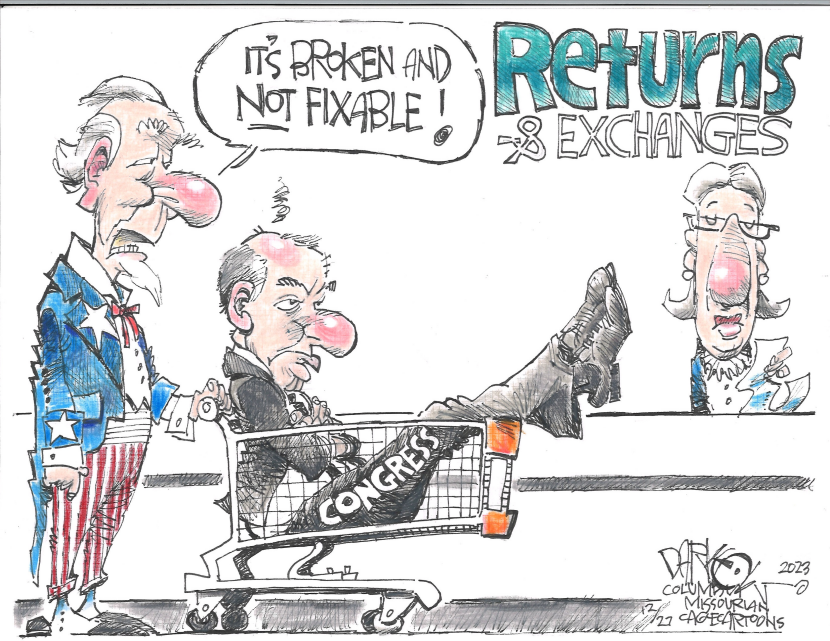
As we head into the New Year, the approval ratings of the U.S. Congress are still at historic lows. After bottoming out at 12% last February, Congressional approval is now hovering at a sorry 17%.

The timeless wit and political wisdom of Will Rogers explains why:

“Congress is so strange; a man gets up to speak and says nothing, nobody listens, and then everybody disagrees.”

“We all joke about Congress, but we can’t improve on them. Have you noticed that no matter who we elect, he is just as bad as the one he replaces?”

“When Congress makes a joke it’s a law, and when they make a law, it’s a joke.”

Rogers — America’s first great Mister Rogers — spoke these words in the 1920s and 1930s, but they’re just as true now. When voters gave Republicans the majority in the Senate in November, they voted for change. They want an end to massive bills that are packed with ridiculous spending.

Regrettably, according to Rogers, there’s nothing new about the shenanigans of Congress:

“We cuss Congress, and we joke about ’em, but they are all good fellows at heart, and if they wasn’t in Congress, why, they would be doing something else against us that might be even worse.”

“Never blame a legislative body for not doing something. When they do nothing, they don’t hurt anybody. When they do something is when they become dangerous.”

Rogers saved some of his best barbs for the Senate, the allegedly august body of distinguished minds that is supposed to snuff out bad ideas and bills the House passes and advance good ones. But even during Rogers’ time, things hardly ever turned out that way:

“About all I can say for the United States Senate is that it opens with a prayer and closes with an investigation.”

“Senators are a never-ending source of amusement, amazement and discouragement.”

“The Senate just sits and waits till they find out what the president wants, so they know how to vote against him.”

That’s what is most agitating about our current Congress. Too many members on both sides of the aisle are narrow-minded, partisan and looking to advance their self-interests.

The average American doesn’t like that. The average American knows that the country is facing giant challenges — entitlement programs that are going broke faster than we can fund them and massive $2 trillion federal budget deficits that must be tamed.

The average American wants these problems to be solved by people who are interested in the good of their country — not Republicans and Democrats interested in the good of their parties.

It’s no wonder we are disgusted. But according to Rogers, that’s nothing new either:

“It’s getting so if a man wants to stand well socially, he can’t afford to be seen with either the Democrats or the Republicans.”

“There is something about a Republican that you can only stand him just so long; and on the other hand, there is something about a Democrat that you can’t stand him quite that long.”

We can only hope our 2025 Congress begins to comprehend what the American people have been trying to tell it — that it needs to get in step with the wisdom and will of the people.

Because, as the wise and witty Mr. Rogers said, “Our country is not where it is today on account of any one man. It’s here on account of the real common sense of the Big Normal Majority.”

Copyright 2024 Tom Purcell, distributed exclusively by Cagle Cartoons newspaper syndicate.

See Tom Purcell’s syndicated column, humor books and funny videos featuring his dog, Thurber, at TomPurcell.com. Email him at [email protected].

Comments Off on Will Rogers knew Congress too well
Our national debt is beyond comprehension

The U.S. Debt Clock says our country is in hock for more than $36 trillion.

How massive is a trillion dollars? Consider this comparison from ThoughtCo — if you earn $45,000 a year, it would take you:

– 22 years to amass $1 million dollars
– 22 thousand years to amass $1 billion dollars
– 22 million years to amass $1 trillion dollars

Heck, I remember the good old days when a billion used to be a number so big nobody could comprehend it.

President Reagan’s deficit spending brought a change to that. On October 22, 1981, the U.S. debt surpassed $1 trillion.

Now we spend that much each year just to service our massive debt — a debt that has been growing at $2 trillion per year.

Still struggling to understand how big a trillion is?

Consider: One trillion is equal to one thousand billion. If you had $1 trillion in cash in 2017, reports econ4u.com, you could buy 282 billion Big Macs, or 3.1 million Ferrari 599 GTBs, or 769 new Yankee Stadiums, or 28,571 flights into space as a tourist, or 66.7 billion copies of Oliver Stone’s “Wall Street.”

If you had $1 trillion in debt and paid it back at the rate of $10 million a day, it would take you 273 years — assuming the loan is interest-free.

Our federal deficit has been growing by the trillions since the economic crisis of 2008. Our politicians love crises because they can jack up spending and debt all the more.

Unfortunately, though, our federal tax receipts during 2024 totaled about $5 trillion, spending was almost $7 trillion. It’s why even after the huge spending splurges during the pandemic have stopped, our federal debt is still growing so fast.

Still not comprehending how much $1 trillion is? Then you’ll like this description by Bill Bryson, one of my favorite authors, from his book “Notes from a Big Country.”

Bryson asks his readers to guess how long it would take to initial and count a trillion $1 bills if you worked without stopping.

If you initialed one dollar per second, he writes, you would make $1,000 every 17 minutes.

After 12 days of nonstop effort, you would acquire your first $1 million. Thus, it would take you 120 days to accumulate $10 million and 1,200 days to reach $100 million. After 31.7 years you would become a billionaire. But not until after 31,709.8 years would you count your trillionth dollar.

We all understand that very large numbers are OK so long as they add up. So long as we have trillions of dollars coming into the government to balance out the trillions of dollars we have going out, we should be OK — but we haven’t been OK.

Regardless of what you think about President-elect Donald Trump and our new, Republican-controlled House and Senate, you’d better hope their policy changes unleash economic growth.

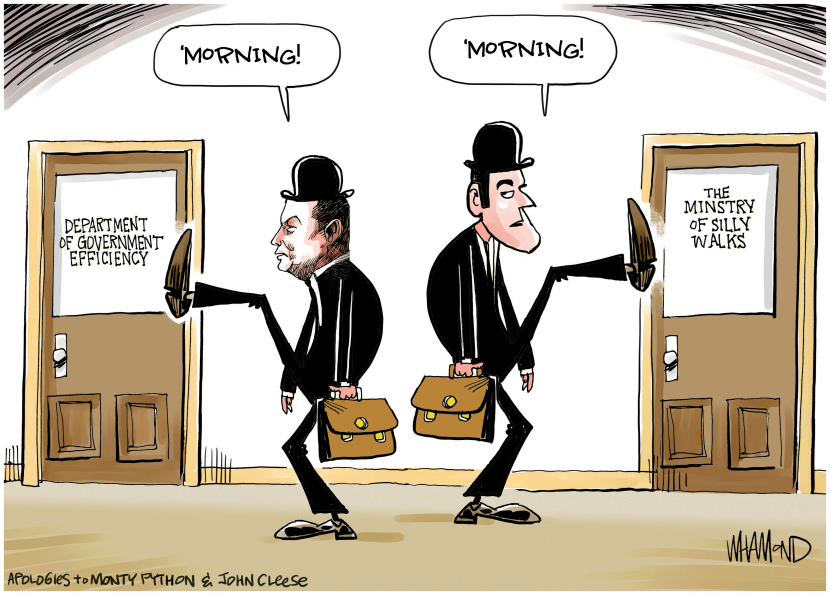
You better hope that President Trump’s Department of Government Efficiency (DOGE) can truly reduce our spending and slow down the growth of our debt.

Hey, our national debt is more than $36 trillion, for goodness’ sake — that’s 36,000 billion dollars.
If you still can’t comprehend how big a number that is, consider this slightly modified illustration from econ4u.com:

If the U.S. government printed $1-million bills, “a whole bathtub’s worth of them wouldn’t equal a trillion dollars.”

And 36 bathtubs full of $1-million bills still wouldn’t be enough to cover our national debt.

Copyright 2024 Tom Purcell, distributed exclusively by Cagle Cartoons newspaper syndicate.

See Tom Purcell’s syndicated column, humor books and funny videos featuring his dog, Thurber, at TomPurcell.com. Email him at [email protected].

Comments Off on Our national debt is beyond comprehension

Memories of a 1970s Christmas

Why do Christmas memories from 50 years ago still hold so much power over me? I think I know now.

Christmas was a huge event for our family.

At St. Germaine School, we’d sell items to raise money for the needy, create decorations, practice for Christmas plays and concerts (we’d sing “Silent Night” and “Hark the Herald Angels Sing”) and attend a million Advent ceremonies.

The preparation and ceremony filled us with a sense that something big was under way, and it was.

We were just as busy at home. My father and I visited several Christmas-tree lots in search of the perfect tree. We’d carefully assess several before making our pick.

Once we men had the platform set up and the lights strung, my sisters were called to the living room and everyone in our family decorated the tree.

The sun soon would go down and the light of our Christmas-tree bulbs reflecting off the tinsel would transform our living room into a brilliant glow of colors dancing on the walls and ceiling.

Christmas specials on TV were also family events. We’d pack into the living room and plug in the tree. We’d turn off all the lamps so that the Christmas lights would shine extra bright.

We’d wait with great anticipation for “The Grinch that Stole Christmas,” “Rudolph the Red Nosed Reindeer,” “A Charlie Brown Christmas” and a dozen others.

Even the Christmas commercials — I remember the clay animation of Santa gliding through the snow on a Norelco electric razor — now fill me with nostalgia.

Finally, Christmas Eve would arrive.

We’d light the candles in the luminaria that lined our street — all our neighbors had luminaria, and our streets glowed for several blocks.

Our next-door neighbors, the Kriegers, would visit for a few hours, filling our house with festivity.

Then off we went to bed.

My father would stack the old stereo console with every Christmas record we owned — “Holiday Sing-Along with Mitch Miller,” “Christmas with the Chipmunks,” “Snoopy vs. the Red Baron” and Bing Crosby singing “White Christmas.”

As the scratchy old records played — as my mother and father assembled and wrapped gifts in the living room below — I was so filled with excitement I could never sleep.

I’d finally nod off only to wake at 5 a.m. I’d jump out of my bed and run around, waking my five sisters.

We’d rush down to the living room and open our gifts and laugh as our dog Jingles dived into the piles of wrapping paper.

My father would make a breakfast feast and we’d sit around laughing and talking, as we whiled the morning away.

Then we’d arrive at church to find that the stragglers, who only went to Mass on Christmas and Easter, had taken our seats, forcing us to stand in the aisle.

This simple Christmas experience may sound uneventful, but it was a huge event to me and millions of other American kids who were blessed to have a similar experience.

My fondness for this time was marked by a total sense of security — a total sense of being loved by a mother and father who were doing their best to provide for their children.

That’s why Christmas memories from 50 years ago hold such power over me still.

Copyright 2024 Tom Purcell, distributed exclusively by Cagle Cartoons newspaper syndicate.

See Tom Purcell’s syndicated column, humor books and funny videos featuring his dog, Thurber, at TomPurcell.com. Email him at [email protected].

Comments Off on Memories of a 1970s Christmas

Advice for federal teleworkers

Hey, federal teleworkers, your days of working from home appear to be numbered.

According to the New York Post, only 6% of federal employees work in the office full time and more than a third work from home full time.

Before the Covid pandemic, only 3% of the federal workforce worked from home.

These are the findings from a scathing report by Sen. Joni Ernst that identifies a number of government inefficiencies, including various abuses among unsupervised teleworking employees.

One employee posted a video of himself taking a bubble bath during work hours.

Others conduct “meetings” from the beach or the golf course.

One clever teleworker held two full-time government jobs with two different agencies and neither agency was the wiser.

Such discoveries do not bode well for some federal employees who work from home.

That’s because President-elect Donald Trump has created the Department of Government Efficiency (DOGE).

Led by billionaire businessman Elon Musk and former Republican presidential candidate Vivek Ramaswamy, DOGE is determined to end wasteful government spending and inefficiency — and make teleworking employees return to the office.

As a long-time teleworker in the private sector, let me offer government teleworkers some advice.

The only difference between me and federal teleworkers is that all my clients are driven to make a profit, which places a lot of pressure on me.

If my clients don’t find value in my work — if my marketing content doesn’t help them grow their business — I don’t get more work and I go broke.

But in the public sector, where there are no profits and the goal is to increase annual funding so you get paid more money, it’s best that you and your work skills remain unnoticed.

Please allow me to explain.

Look, government spending has grown unchecked for years.

You don’t spend $2 trillion a year more than the government takes in, as we’ve done the past few years, without some effort.

You don’t grow the national debt to more than $36 trillion without growing multiple government agencies, many of which are unnecessary.

Sure, there are essential government organizations tasked with defending our freedom, ensuring the rule of law and protecting our rights.

Then again, why, reports Reader’s Digest, did our government spend $500,000 to study how cocaine affects the sexual behavior of Japanese quails?

In any event, if the DOGE team is successful in shutting down unnecessary government activities, job terminations will happen.

That means the DOGE people are likely to ask you to justify your position.

You must ignore them.

Because it is the invisible federal teleworker — the one who produces no reports and never visits the office — who will survive.

Why? Because our government is so massive and disorganized — the Pentagon recently failed its 7th audit — that nobody really knows where the money is going or who is doing what.

Remember that several presidents have tried to tame government waste, but nobody has been very successful at bringing it under control.

Hopefully, for the sake of the country, the DOGE team will finally succeed. But in the meantime, hide!
Do not answer your phone or reply to work-related emails. Just disappear.

They can’t terminate you if they can’t find you.

You’ll be especially hard to find if you hide below the bubbles in your taxpayer-funded bathtub.

Copyright 2024 Tom Purcell, distributed exclusively by Cagle Cartoons newspaper syndicate.

See Tom Purcell’s syndicated column, humor books and funny videos featuring his dog, Thurber, at TomPurcell.com. Email him at [email protected].
Comments Off on Advice for federal teleworkers

Sign me up for cursive

The death of cursive handwriting reared its ugly head during the recent presidential election.

Since 2010, according to Yahoo News, many states have dropped cursive writing from their curricula as they shifted to Common Core State Standards for English.

As a result, many Gen Z Americans lack a distinctive cursive signature, which posed a problem for Gen Z voters who used mail-in ballots last month.

Since officials had great difficulty matching Gen Z mail-in-ballot signatures to the signatures the government had on file for them, many of their ballots were tossed.

This problem has renewed interest in the cursive debate.

As it goes, the origin of cursive dates back centuries. It was the result of technological innovations in writing — inkwells and quill pens made from goose feathers.

Since the ink dripped when you lifted the quill from the paper, it made sense to connect letters and words together in one flowing line — and cursive writing was born.

My mother and father were taught to master cursive in the 1940s. Both mastered incredibly elegant handwriting.

I grew up in the 1970s, the era of Bic ballpoint pens. Such pens didn’t leak and, technically, didn’t require cursive writing. But the good nuns of St. Germaine Catholic School made us master it anyway.

They’d be horrified to see the chicken scratch I write now, though I have an excuse.

I am a product of the electronic era. I do all my writing on a computer. I’ve become very fast at keying-in my thoughts.

When I write by hand, though, I am so agitated by the slowness, I rush it along. My dad joked that I should have been a doctor!

In any event, with such modern technological innovations, some argue that cursive is no longer needed and is also costly and time-consuming to teach.

Curses to that, say others.

More than a decade ago, Katie Zezima argued in The New York Times that if people are not taught cursive, they’ll be more at risk of forgery; printing in block letters is much easier to replicate.

And the development of fine motor skills will be thwarted, she added.

Besides, she asked, how will people unfamiliar with cursive read important documents, such as the Declaration of Independence and the U.S. Constitution?

To be sure, it has become such a growing problem that the government is spending taxpayer money to transcribe historical cursive documents, so that Gen Z can read them.

I’m certainly a proponent of moving forward with innovation. I’m able to run a communications and video-production business from anywhere on Earth without any need for cursive handwriting.

Then again, I wonder that in our eagerness to advance, we tossed out the baby with the bath water.

The mail-in-ballot issue certainly should make us see the need for distinct cursive signatures, but there’s a human element to keeping cursive, too.

One of my most prized possessions is a letter written by my father’s father in 1924 consoling a woman whose mother had just died. He wrote the letter when he was 21.

I was given the letter in 1997 by the son of the woman my grandfather wrote the letter to. I was struck by how similar my grandfather’s writing style was to my father’s — how similar his writing style was to mine — and I was moved by the beauty and artfulness of his signature.

I can’t imagine a world in which letters written in cursive are no longer left behind for future generations to cherish.

Copyright 2024 Tom Purcell, distributed exclusively by Cagle Cartoons newspaper syndicate.

See Tom Purcell’s syndicated column, humor books and funny videos featuring his dog, Thurber, at TomPurcell.com. Email him at [email protected].

Comments Off on Sign me up for cursive

Why kids can’t walk alone

A story from my childhood came to mind as I read a recent ABC News report about a mother who was arrested after her son was seen walking alone to the Dollar Store a half mile away from his home.

Brittany Patterson of Mineral Bluff, Ga., was at a doctor’s appointment with her other child when her nearly 11-year-old boy left his house and was spotted by himself.

Somebody alerted the police who took the boy home.

A few hours later, the cops went to Patterson’s address, cuffed her in front of her kids, dragged her off to the police station for a mugshot and charged her with willingly and knowingly endangering “her juvenile son’s bodily safety.”

The Division of Family and Child Services demanded that Patterson comply with its safety plan, which required her to download a GPS app to track her son’s location.

She refused, God bless her. And it wasn’t long before her “crime” and the debate over “free-range children” became a hot topic on social media.

As a columnist, I’ve reported for 30 years on the evolution of the growing — and unjustified — fears parents have about the safety of their children.

More and more, “free-range” parents who attempt to give their kids some of the freedom they had as children face the wrath of family, neighbors and local authorities.

When I was a kid in the ‘70s it was much different — and much better.

I was free to go all over the place on foot or on my bike, just so long as I got home on time for dinner and arrived home at night when the streetlights came on.

We kids were on our own all the time and our parents weren’t terrified if we were out of their sight.

When I was just 6, I disappeared from my house and took off alone to a mom-and-pop convenience store three blocks away.

My older sisters Krissy and Kathy, 7 and 9, respectively, were supposed to be watching me while my mother was downstairs doing laundry.

But to get me out of her hair, Krissy gave me a coin she’d made from a piece of cardboard and told me I could get candy with it at the little store.

Naturally, my mother was upset when she saw I was missing. But I was found in short order and no neighborhood worrywart ratted out my mom to the cops.

That was because back then there were only three network television channels and parents’ fears weren’t being stoked 24/7 by sensationalistic news stories about kidnapped children on cable news channels.

Despite today’s increased parental paranoia, being kidnapped is no more likely for kids now than it was in the ‘50s, ‘60s and ‘70s.

Consider: There are roughly 40 million elementary-school-age children in America today.

Each year, about 115 children are kidnapped, according to Child Watch of North America — whereas nearly 140,000 are injured in car wrecks every year.

In spite of that reality, our TV and cable news media have spent decades exaggerating and inflaming fears about the safety of our children — and pretty much anything else that gets ratings.

Thus, we’ve evolved into a fearful culture that’s afraid to allow our children the freedom to roam and discover and learn on their own.

God help any parent today whose 6-year-old might slip out of the house with a paper coin his sister made for him!

Copyright 2024 Tom Purcell, distributed exclusively by Cagle Cartoons newspaper syndicate.

See Tom Purcell’s syndicated column, humor books and funny videos featuring his dog, Thurber, at TomPurcell.com. Email him at [email protected].

Comments Off on Why kids can’t walk alone

Why I still love “The Waltons”

One of the great benefits of streaming TV is that I’m able to watch old network shows that I enjoyed while growing up in the 1970s.

One of my favorite shows was “The Waltons.”

When I was 11 years old, that prime-time show was a central part of my weekly ritual.

Every Thursday, after dinner, my father and I boarded our Plymouth Fury station wagon and headed to the Del Farm grocery store located in a small suburban plaza one mile from our home.

I pushed the cart as I helped my father work through the long shopping list my mother provided. Though cookies and potato chips were never on my mother’s list, on a good night my father would be feeling generous.

He’d buy a box of Del Farm’s freshly baked oatmeal and chocolate chip cookies and a bag of Snyder of Berlin potato chips, onion dip (my mother’s favorite) and a wooden case of Regent soda pop.

When we finally pulled the loaded-down station wagon into the garage, everyone in the house was alerted and the massive unloading process began. We usually got everything packed away by 8 p.m., just in time to turn on “The Waltons.”

I’d bring a bowl of ice to the family room, open some bottles of Regent soda pop, pour the Snyder of Berlin chips into a couple of bowls and soon my sisters, parents and I would be enjoying the newest episode of one of our family’s must-see shows.

I think I loved “The Waltons” so much because it mirrored the stable family experience my sisters and I were living.

There were lots of imperfections in my family, to be sure — there will always be conflict and drama when six children and their mother and father are living together in a modest-sized home.

But, like the parents on “The Waltons,” our mom and dad were committed to each other and to us.

They put our needs ahead of their own. They gave us an incredible sense of security and wellbeing. They taught us right and wrong — we all went to Catholic school and attended Mass every Sunday — and they drove us to become good, productive citizens.

Thanks to them, all of my sisters and I are flourishing as adults.

Interestingly, nobody expected “The Waltons” to succeed when it first aired in 1972.

The ‘70s was a turbulent and cynical era, after all. The Vietnam war was still raging, Watergate dominated the news.

According to Patheos, a non-partisan online media company that provides religious and political information and commentary, the social changes of the ‘60s had paved the way to the disco hedonism of the ‘70s.

So why was a wholesome drama about a rural American family from Virginia such a hit?

In 2012, Earl Hamner, who created the show based on his book, “Spencer Mountain,” explained why.

He said in the 1970s there was a yearning to see “people trying to make decent lives for themselves and their children.”

When you get down to it, that’s really all anybody wants.

All I know is, I’m greatly enjoying “The Waltons” half a century after it originally aired.

That’s because it fills me again with the incredible sense of security and love I knew as a boy, when my mother and father put us first.

Copyright 2024 Tom Purcell, distributed exclusively by Cagle Cartoons newspaper syndicate.

Find Tom Purcell’s syndicated column, humor books and funny videos of his dog, Thurber, at TomPurcell.com. Email him at [email protected].

Comments Off on Why I still love “The Waltons”

Celebrating Our Great Americans

When he was told he had only weeks to live, his response was telling. He was calm and at peace. At 82, he told his children, he had lived much longer than he expected.

He had fought in World War II, after all — the “big one” as he called it. He had survived four amphibious invasions. He described the terror he felt wading onto the beaches of Sicily as gunners tried to mow him down.

While driving a munitions truck along the sand one day, a German fighter pilot targeted him. He jumped behind his .50-caliber machine gun and began firing at the plane. He hit it — he saw its windshield shatter — but the pilot managed to release his payload.

The bomb was headed right at him. When it detonated, he knew it would ignite the munitions he was hauling. The explosion would be spectacular.

But he didn’t panic — didn’t yell or scream. He thought only of his mother — the agony she would experience when she learned her son had died in battle.

But the bomb was a dud. Recounting the story years later, he laughed at how it soaked him when it hit the surf. He laughed at how he’d survived his first scrape with death.

He survived three other invasions in Europe. In one, he took shrapnel to the back of his knee. He plucked out the hot metal and kept moving.

On the way to another, a truck mount broke. The cannon the truck had been towing thrust backward, pinning his knee against a hillside, crushing it. That injury would nag him the rest of his life, but on that day he continued to move along.

At one point during the war, he was put in charge of a prison camp. Escape attempts were common, and in the process German POWs would routinely slit the throats of their captors.

But he had treated his prisoners with dignity — even offering them cigarettes.

While off-duty and sleeping one night, a German escaped. The prisoner chose to treat him with dignity, too, sparing his life.

After cheating death during the war, he did what many GIs did. He dove headfirst into life.

In Pittsburgh he resumed work as a carpenter, while studying engineering at night. He married, bought a home, started a family. His legacy includes 10 grandchildren and 11 great grandchildren.

In time, he rose through the ranks in his union, the Carpenters District Council of Western Pennsylvania. He became its leader, improving working conditions and pay. He established pension funds. He fought for the dignity of thousands of tradesmen.

He won the respect of many in the process. He befriended business leaders, congressmen and senators. He judged men by their actions. He was a man of faith, supported charities and served on many non-profit boards.

Like so many World War II veterans, he never spoke much about his remarkable wartime experiences and accomplishments. It wasn’t until he died in 2007 that they began to fully emerge.

His name was Robert P. Argentine. Like so many of the men and women who risked their lives for their country in time of war, he left the world a much better place than he’d found it.

His example inspires us still and he is one of the millions of great Americans we should remember and celebrate on Veterans Day and beyond every year.

Copyright 2024 Tom Purcell, distributed exclusively by Cagle Cartoons newspaper syndicate.

See Tom Purcell’s syndicated column, humor books and funny videos featuring his dog, Thurber, at TomPurcell.com. Email him at [email protected].
Comments Off on Celebrating Our Great Americans

Dying makes life worth living!

Get this: life expectancy has apparently hit its peak.

According to msn.com, a recent study published in the journal Nature Aging finds that, barring any major medical breakthroughs, “people will top out at a maximum average age of around 87 — 90 for women, 84 for men.”

This news runs counter to numerous more optimistic studies I’ve written about the past 20 years.

Back in 2003, I wrote about futurists who strongly believed that advances in cell and gene manipulation and nanotechnology would allow humans to live up to 180 years — and maybe even into the 500s.

Good God, do we really want to live until we’re 500?

Do we really want “Me Generation” Baby Boomers to have 430 years to vote government benefits for themselves after retiring?

Do we really want to encourage our younger generations, notorious slackers, to keep putting off adulthood? (Mother to son in year 2125: You’re a century old, when are you going to go out and get a job?)

I don’t want to be a killjoy, but there are downsides to living long.

Sure, I’d love to have my parents around forever. It would be great if Dave Chapelle could keep telling jokes, or someone like Elon Musk could keep advancing rocket science.

But the rest of us?

I’m 62 already and have no desire to live for 100 years. In my experience so far, life is made up of colds, bills, speeding tickets and people who let you down.

These experiences are connected by a series of mundane tasks we must complete to sustain ourselves — like working in an office with people we loathe.

This daily drudgery is occasionally visited by an exciting and enjoyable moment, but do we really want to live 500 years like that?

Besides, how would we pay for it all? Living is expensive. Are we going to work full-time for 40 years, retire, burn through our nest eggs, then sling hamburgers at McDonald’s for hundreds of years?

Anyway, it’s dying that makes life most worth living!

Consider, would you enjoy a movie if you knew it was going to last for 24 hours? No, what makes the movie enjoyable is its ending.

The key to human happiness, you see, is not an abundance of a thing, but the shortage of it.

Doesn’t pie taste better when we know it’s the last slice?

Doesn’t a football game capture our attention more when it is the last of the season with only a few minutes left — the final game that determines who goes out the winner and who goes out the loser?

And isn’t a comedian funnier when he exits the stage before we want him to go?

Hey, futurists, we don’t want to stick around on Earth too long. If you believe in God, as I do, life is just a testing ground anyhow.

This life is just practice. It’s like two-a-day football drills. We must first prove ourselves during the agony of summer practice to earn our rights to play in the big game in the autumn.

Do you really want to spend half a millennium running wind sprints in summer practice?

I surely don’t.

Besides, if I only live until 84, I still have to suffer through five more presidential elections.

When you consider the misery of that, pushing up daises in a quiet field suddenly doesn’t seem so bad!

Copyright 2024 Tom Purcell, distributed exclusively by Cagle Cartoons newspaper syndicate.

See Tom Purcell’s syndicated column, humor books and funny videos featuring his dog, Thurber, at TomPurcell.com. Email him at [email protected].

Comments Off on Dying makes life worth living!

After Saudi visit, ‘freedom’ just another word for home sweet home

Like millions of Americans, I often took my incredible freedoms for granted — until I visited Saudi Arabia.

For years, I’ve done marketing communications work for technology companies. About a decade ago, a client asked me if I was interested in joining her on a project in the kingdom.

“Heck, yeah,” I responded. How often does one get to visit the Middle East, all expenses paid?

No sooner had our Saudi Arabian Airlines plane lifted off from Dulles International Airport in Virginia, however, than I got a quick taste of how limited my freedoms suddenly were: Alcohol is banned on Saudi flights, as it is throughout Saudi Arabia.

I don’t enjoy flying’s cramped unpleasantness. A few snorts of Irish hooch always calm my nerves. But I was out of luck.

“No problem,” I thought — “I’ll watch American movies.” I’d been bumped into first class and had my own monitor. But several scenes were edited out. These included any scene depicting a scantily-clad Hollywood starlet, an actor cussing or anything that the Saudi’s considered wrong.

Since most of the movies were unwatchable, I had to pass the longest 14 hours of my life watching “Cats & Dogs” — five times.

Going through customs in the Jeddah airport, I became instantly self-conscious. My sport coat, slacks and large, pale Irish-German-American noggin shouted “American.”

It was worse for my female colleague. She wore a headscarf so big — we call them “babushkas” in Pittsburgh — she could have pitched it as a tent.

At the time, Saudi Arabia’s notorious religious police wouldn’t have allowed her — or any other woman — to drive from the airport. I used the opportunity to demand that she increase my hourly rate — or I’d tell the police she planned to drive from the airport.

Most Saudis I met during our time there loved America and Americans. But I knew that 15 of the 9/11 hijackers came from Saudi Arabia. I noted that some Saudis I met loathed Americans — and I immediately sensed that my customs agent was among them.

I sensed that if we’d been in a free country, such as America, this guy — knowing he’d be presumed innocent until proven guilty, and likely to get just a slap on the wrist if found guilty — would have tried to knock my teeth out.
But in Saudi Arabia, there is no presumption of innocence.

Consider the infamous murder of Saudi Arabian journalist Jamal Khashoggi at the Saudi consulate in Istanbul. He made the mistake of exercising free speech by writing columns critical of the kingdom.

Consider Mujtaba’a al-Sweikat. This young man was on his way to enroll in Western Michigan University in 2012 when he was detained at King Fahd International Airport. Alleged to have participated in a pro-democracy event, he was arrested, tortured and sentenced to beheading.

In any event, I spent most of my time in Saudi Arabia safe within the fortress walls of King Abdullah University of Science and Technology — where the kingdom’s strict laws are relaxed — and met many wonderful, brilliant people from all over the world.

Nonetheless, my month in Saudi Arabia gave me a brief taste of life in an authoritarian country — where absolute power typically corrupts absolutely.

The kingdom is so authoritarian that Freedom House essentially ranks the country as “not free,” with low to no political or civil-liberty rights, especially the right to speak freely.

When we landed back in Virginia — after enduring “Cats and Dogs” five more times — I kissed the ground, then went to the nearest pub to enjoy a badly needed snort of my fully restored freedoms.

Copyright 2024 Tom Purcell, distributed exclusively by Cagle Cartoons newspaper syndicate.

See Tom Purcell’s syndicated column, humor books and funny videos featuring his dog, Thurber, at TomPurcell.com. Email him at [email protected].

Comments Off on After Saudi visit, ‘freedom’ just another word for home sweet home