Restoring our Irish sense of humor

St. Patrick’s Day couldn’t come soon enough this year.

Half the country is giddy as the Trump administration undoes our reckless spending and $2 trillion annual deficits, which have resulted in a frightening $37 trillion national debt.

But the other half of the country is mortified by Trump’s bull-in-a-China-shop approach to government and foreign policy. They’re angrier than a colony of ground bees after a landscaper’s blade ripped through their nest.

We must learn from the Irish that neither overconfidence nor overreaction is a good idea — that the only way to successfully navigate our lives and our politics is to maintain a healthy sense of humor.

The Irish have endured famine, oppression and war. Rather than succumbing to these miseries, they defied pain and suffering through their legendary wit.

In response to famine: “We had three meals a day — one on Monday, one on Wednesday and one on Sunday.”

On British occupation: An English general was asked, “What was the biggest problem fighting the Irish?” He sighed and said, “Bullets? We had plenty. Bombs? No shortage. But the Irish? They had something far deadlier… a sense of humor.”

On war: An English officer asked an old Irishman, “How did you fight off so many invaders?” The Irishman smiled, “Simple. We invite them in for a drink, and by the time they sober up, they’ve forgotten why they came.”

According to author Bob Callahan in Salon, the Irish influence on American culture is sizable. Nearly 40 million Americans have Irish ancestors.

Irish vaudevillians, masters of knockabout physical comedy, influenced early Hollywood filmmaking and even gave birth to the newspaper comic strip.

But it is the mischievousness of the Irish spirit and wit — the “hard-boiled, darkly humorous, racetrack-bitten” language of the Irish — that has really benefited America.

Irish spirit and wit were the precursors to “brilliant, wisecracking Irish-Americans,” who were precursors to the gregarious American spirit and sense of humor.

But are we losing the gift of humor?

In these highly partisan times, when our candidates lose, we get lost in the narrowness of our own point of view — or we get cocky when our candidate wins.

The Irish know better than to get too comfortable with success — they know that triumph and disaster are just different stops along the same road.

As the Irish say, “Don’t break out the good whiskey just yet — wait until the bill is paid.”

Here are some Irish lessons on how we can restore a healthy sense of humor:

First, we must laugh at ourselves. The Irish love self-deprecating humor because it’s disarming and likable, as shown in this joke:

“I’m not saying I’m unlucky, but if I bought a cemetery, people would stop dying.”

Second, we must turn frustrations into funny stories, as this classic joke illustrates:

An impatient man said, “Excuse me, how do I get to Dublin?”

“Are ye walking or driving?” said the Irishman.

“Driving,” said the man.

“Well, that’s the quickest way then!”

Third, don’t take life so seriously. Don’t sweat the small stuff, because life is hard enough already, as this joke reveals:

An old Irishman was asked, “What’s the secret to happiness?”

He pondered for a moment, then said, “A short memory and a long laugh.”

To be sure, America could use a short memory and a long laugh as we celebrate St. Patrick’s Day this year.

Copyright 2025 Tom Purcell, distributed exclusively by Cagle Cartoons newspaper syndicate.

See Tom Purcell’s syndicated column, humor books and funny videos featuring his dog, Thurber, at TomPurcell.com. Email him at [email protected].

Comments Off on Restoring our Irish sense of humor

How not to name a puppy

If you think that people are disagreeable these days about politics and culture, you can’t imagine how heated people got when I asked for suggestions on what to name my yellow Labrador puppy four years ago.

Blame social media.

My puppy’s breeders, Mike and Maryanne, named each pup based on its behavior. They called my pup “Willy,” which was a great choice.
While some of the pups were bossy and way too energetic, my guy was silly and laid back.

“Willy” suggests playfulness and a lack of self-importance. That name suited my puppy well, and I strongly considered keeping it.

However, I had long thought that if I ever got a dog, I would name him “Thurber” after the dog-loving humorist James Thurber, whose hilarious essays appeared in The New Yorker between the 1920s and 1940s.

In the 10th grade, you see, my best friend Ayresie and I found a tattered copy of his 1945 book A Thurber Carnival on a bookshelf in Ayresie’s basement.

While thumbing through Thurber’s collection of humorous essays and cartoons at the library, we laughed so hard, the librarian threatened to kick us out.

One essay, “The Dog That Bit People,” introduces a surly dog named Muggs, who bit and terrorized everyone except family members — who he only bit occasionally!

That moment in the library inspired me to become a writer. And it left me with one other thought: If I ever get a dog, I will name him Thurber.

I shared these thoughts on Facebook and asked for insights and recommendations.

“Thurber! You can’t name him Thurber!” shouted my otherwise soft-spoken sister, who had named her own dog Snowball.

“What the heck kind of name is Thurber?” said my friend Griff, who has a Jack Russell named Chip.

“You need to name him something short and manly like Sam or Butch or anything but some odd name like Thurber,” chimed in a stranger on Facebook.

“Muggs,” the actual name of “the dog that bit people,” was one I considered.

“Now you’re talking,” said some other Facebook stranger. “Muggs is the way to go.”

“Muggsie!” said another person. “You have to name him something cute, and Muggsie is perfect.”

I share this example to illustrate how opinionated and forceful people have become in the era of social media, in which everyone has a platform and a voice.

Psychology Today says that a simple “lack of eye contact” is what is driving increasingly nasty tweets and posts, making rudeness in our society “our new normal.”

My puppy-naming situation became such a hullaballoo — culminating in late-night phone calls, rude emails and increasingly angry posts — I eventually had to shut down what I intended to be a friendly, playful exercise and cease talking to anyone about the name I would eventually choose.

I named my wonderful puppy Thurber, the perfect name for such a joyful, hilarious soul. He makes me laugh harder than any of James Thurber’s wonderful essays ever could. (See my dog’s funny videos at YouTube.com/@ThurbersTail.)

I learned recently that one of the world’s most beloved singers also named her dog Thurber.

Lucky for her, she did so in the 1960s — long before social media could cause her any issues.

Her name was Janis Joplin.

Copyright 2025 Tom Purcell, distributed exclusively by Cagle Cartoons newspaper syndicate.

Find Tom Purcell’s syndicated column, humor books and funny videos of his dog, Thurber, at TomPurcell.com. Email him at [email protected].

Comments Off on How not to name a puppy

Dreaming of tax simplification

I can’t help but dream this time of the year.

It’s the thick of winter, you see, which means I’m spending hours huddled in my home office getting a million tax details in order for my CPA.
And I’m dreaming of tax simplification.

President Trump has shared a bold vision to potentially replace the income tax entirely in favor of tariffs.

Though I can’t imagine that ever happening, he has also promised to simplify tax filing to such a degree that “nine out of 10 Americans will be able to file their taxes on a single, little, beautiful sheet of paper.”

Could tax filing become as simple as it was for my father in 1959?

My dad kept a work draft of his return that he filled out in pencil, then completed the final version in ink before sending it to the IRS.

I still can’t believe how simple his tax form was.

In 1959, he paid a measly 5 percent in federal taxes.

Though the top income tax rate was 91 percent that year — President Kennedy would slash rates a few years later — deductions were many.

Even middle-class people like my dad enjoyed their share of perks.

A heavy smoker then — who wasn’t? — he was able to deduct his cigarette taxes.

He deducted every penny he paid in gasoline taxes, too.

Were I able to do that now, with gasoline federal and state taxes totaling 77 cents a gallon in Pennsylvania, I’d be able to write off about $800 on the 1,000 or so gallons I use every year.

He took a $600 tax deduction, or $1,200 total, for each of his two dependents, my sisters Kathy and Krissy — that would be $10,000 in today’s dollars.

However, since 1997, the deduction for dependents was replaced with a child tax credit of $2,000 per child.

A deduction of $10,000 off of your taxes — say you are in the 22 percent tax bracket — would save you $2,200, but a tax credit would net you a tax savings of $4,000.

Incidentally, Vice President JD Vance is proposing that the tax credit per child be increased to $5,000.

For the most part, however, my dad paid significantly lower taxes than we pay now.

Here’s another item that caught my attention: In 1959, he paid only 1.25 percent of his income toward FICA (then, Social Security only, but now Social Security and Medicare), and his employer also paid 1.25 percent for a total FICA tax of 2.5%.

Today, the average working American pays 7.65 percent in FICA taxes and his or her employer kicks in another 7.65 percent (15.3 percent total).

I, being self-employed, have the pleasure of paying the full 15.3 percent myself.

If one makes $175,700 in income — the point at which only the 2.9 percent Medicare tax continues to apply because the Social Security tax is capped — he ends up paying nearly $27,000 in FICA taxes, not including federal, state and local taxes.

In any event, my father had his fair share of simple deductions in 1959, which helped offset his federal taxes. That is how he was able to keep his total federal tax tab at a measly 5 percent.

Better yet, his tax form was one sheet of paper printed on both sides. He had no calculator, nor did he need one. He always got a refund.

Then again, the federal tax code was about 15,000 pages then. Today, it is more than 70,000 pages.

Which is why I dream of the tax simplicity my dad enjoyed way back in 1959.

Copyright 2025 Tom Purcell, distributed exclusively by Cagle Cartoons newspaper syndicate.

See Tom Purcell’s syndicated column, humor books and funny videos featuring his dog, Thurber, at TomPurcell.com. Email him at [email protected].

Comments Off on Dreaming of tax simplification

Why fewer Americans are moving

We sold my mom and dad’s dream home last autumn — the Frank Lloyd Wright-inspired mid-century modern house they called home for 25 years.
Staying put is becoming more commonplace in America.

According to The Atlantic, America, once the most mobile society in the world, has become increasingly stagnant, with fewer people moving between cities, states and even neighborhoods.

The American Economic Association’s research finds that internal U.S. migration is at a 30-year low.

The Atlantic argues that declining mobility leads to fewer economic opportunities, more social division and greater political polarization.

Why?

Strict zoning laws and environmental restrictions prevent affordable housing from being built in cities with strong economies. That’s why job-rich places, such as San Francisco, have some of the highest home prices in the country.

The mortgage rate “lock-in effect” is another reason homeowners are staying put. Those with a 2% or 3% mortgage rate are reluctant to move and take on a new loan at 6% or higher.

The Atlantic says that one regrettable result of Americans staying put is a reduction in economic and cultural mixing between different groups, which increases political tribalism, making compromise and shared experiences rarer.

Moving certainly benefited me.

I moved from Pittsburgh to Alexandria, Va., in 1998 and lived in the D.C. area nearly eight years. It proved to be a great place to land good-paying communications clients.

As an adult, I never stayed anywhere long — until returning to Pittsburgh in 2011 to renovate and move into a property I’d rented out for years.

Though I agree that American mobility has long been one way for Americans to get ahead, there are some upsides to families staying put.

For 35 of my first 37 years, my mother and father resided in a two-story, four-bedroom home that was typical of 1960s suburbia.

My father remodeled the basement into a family room. And when my baby sister, Jennifer, expanded our household to eight, my parents added a fifth bedroom onto the first floor — where they were able to enjoy peace and quiet for the first time in their parental lives.

That house was a hub for many!

The door was never locked and aunts, uncles, friends and neighbors regularly stopped in to say hello. We have hundreds of photos of holiday parties, baptisms, confirmations, graduations and the weddings of all five of my sisters.

To accommodate our expanding clan, my parents moved to a larger, contemporary house in 1999 — a scandalous affair to my sisters and me, because Pittsburghers aren’t supposed to move from homes that hold so many memories for their kids.

It was designed and built by a family that was inspired by Fallingwater, Frank Lloyd Wright’s masterpiece 70 miles south of Pittsburgh.
That spacious house allowed even larger gatherings — and a happy and stable place for frequent movers like me to return to for holidays and family events.

The hope is that political leaders will remove the impediments to affordable housing, so that more Americans are free to move about the country in pursuit of their own economic happiness.

But I also hope that everyone has one home in their extended families that brings them as much peace and happiness as my parents’ two homes brought to my family.

Copyright 2025 Tom Purcell, distributed exclusively by Cagle Cartoons newspaper syndicate.

See Tom Purcell’s syndicated column, humor books and funny videos featuring his dog, Thurber, at TomPurcell.com. Email him at [email protected].

Comments Off on Why fewer Americans are moving

The history of executive orders

What do the Peace Corps, desegregation of the military, and the internment of Japanese Americans during World War II have in common?

They were all established by presidential executive orders, or EOs.

Executive orders are all over the news of late, as President Trump uses his presidential authority to undo many of President Biden’s EOs and to establish a slew of new ones.

Paris Climate Agreement? His EO pulled the U.S. out of that.

Gender transitions for minors under the age of 19? His EO banned those.

Birthright citizenship? His EO says that children of undocumented immigrants born in the U.S. shall no longer become U.S. citizens.

Though the term “executive order” is not in the U.S. Constitution, Article II, Section 1 grants the president executive power, but does not define it in detail, and Article II, Section 3 requires the president to “take care that the laws be faithfully executed.”

These clauses provide the legal foundation for executive orders, allowing presidents to direct government operations.

It’s important to note, however, that EOs must be based on existing laws or constitutional authority to be legal — a president cannot create law, only the Congress can do that.

Thus, if an executive order oversteps legal boundaries, it can be challenged in court or overturned by Congress through legislation.

Which brings us to the very first EO ever issued by a president.

That was signed by George Washington in 1789 to direct federal agencies on how to handle official correspondence.

For the most part, early presidents rarely issued executive orders, and their EOs were generally issued to bring routine changes to government operations.

Franklin Delano Roosevelt sure did change that tradition!

As he expanded the federal government massively — and later as America entered World War II — he used his EO authority to implement New Deal programs, economic reforms and war mobilization directives.

In 1933, he issued an EO to confiscate the American people’s gold. You could keep $100 worth of it, but, with few exceptions, you had to turn the rest of your gold over to the government in exchange for cash.

In 1935, he used an EO to create the Works Progress Administration, one of the largest government job programs in U.S. history.

And in 1942, he issued one of the most controversial EOs in history. That order demanded that 120,000 Japanese-Americans (70,000 of them citizens) be forcibly rounded up and relocated to camps in the desert — camps surrounded by barbed wire and staffed with armed guards.

From 1933 to 1945, he issued a whopping 3,721 executive orders!

How do recent presidents compare?

Trump has issued 53 EOs in his second term — so far. During his first term he issued 220.

Ronald Reagan issued the most EOs with 381. Bill Clinton had 364. George W. Bush issued 291. Barack Obama issued 276. George H.W. Bush issued 166. And Biden issued only 162.

That brings us to the boldest executive order in history: The Emancipation Proclamation, signed by Abraham Lincoln on Jan. 1, 1863.

Using his war powers as commander in chief, he freed all enslaved people in Confederate states.
His reasoning was that it was a military necessity that would weaken the Confederacy.

Lincoln’s proclamation did not permanently end slavery — that required the 13th Amendment, which was ratified in 1865 — but it was still one of the greatest EOs in U.S. history.

Copyright 2025 Tom Purcell, distributed exclusively by Cagle Cartoons newspaper syndicate.

See Tom Purcell’s syndicated column, humor books and funny videos featuring his dog, Thurber, at TomPurcell.com. Email him at [email protected].

Comments Off on The history of executive orders

NASA stranded in mediocrity

International Space Station (ISS): Hello, Houston, Starliner crew Butch Wilmore and Sunita Williams here. Any word on when we can return home?

Houston: Hey, guys. We know you set out on an eight-day mission in June 2024 and, because of some issues with our Boeing-built Starliner spacecraft, you’ve been stranded for nearly nine months. Just know we’re working hard to get you home, over!

ISS: “Issues,” Houston? What issues are setting us back this time, over?

Houston: Nothing to worry about, guys. Something about helium leaks in the propulsion system and malfunctions with the control thrusters. Hey, you wouldn’t happen to have any duct tape on board, over?

ISS: Houston, in 2014 NASA awarded Boeing $4.2 billion to develop Starliner — a LOT of money — yet it’s been a disaster from the start, over.

Houston: That’s regrettably true, guys. In 2019, Starliner’s first mission failed to reach the ISS due to a software glitch that caused fuel to burn incorrectly. NASA called it a “high-visibility close call” — almost a near disaster! Hey, do you have any twine on board, over?

ISS: You’re killing us, Houston. NASA should be embarrassed that we can’t come home because Starliner has problems yet again. These ongoing issues illustrate too well how NASA has become an ineffective bureaucratic mess, over!

Houston: That is regrettably true, too, guys. In the early days of space exploration, NASA was the pinnacle of innovation and risk-taking. We pulled off incredible missions to the Moon with computers less powerful than a modern calculator. NASA scientists and engineers were competent and courageous. Hey, you wouldn’t happen to have any Gorilla Glue up there, over?

ISS: Houston, I suppose NASA just evolved the way all government programs do. As it succeeded, its budget grew. It attracted more bureaucrats and government oversight. Before long, it was bogged down by lots of committees, regulations and layers of management. Its culture of innovation and problem-solving gave way to a culture of worry and risk avoidance, over.

Houston: That happened to Boeing too, guys. It was once an engineering powerhouse run by engineers who produced numerous aerospace innovations. Today, it’s a bloated, bureaucratic mess, struggling with failed projects, safety scandals and a total dependence on government money. You wouldn’t happen to have any twist ties up there, over?

ISS: I suppose it’s inevitable that innovative new private companies, such as SpaceX, Blue Origin and others, are the true aerospace stars now. They’re making spaceflight faster, safer and more innovative for a fraction of the cost of the legacy contractors, over.

Houston: You got that right, guys. In fact, since it doesn’t appear we have a clue how to fix Starliner —unless you can find some rubber bands — Elon Musk and his company SpaceX will bring you home in their Crew Dragon capsule this March. Crew Dragon has been flying successful missions since 2020, over.

ISS: Hallelujah, Houston! I guess the mantle has been passed. The era of government-backed aerospace bureaucracy is over. The era of private companies competing to advance space innovation is underway, over.

Houston: We had a good run while it lasted, guys. One last thing: You wouldn’t happen to have a rusty old coat hanger up there, over?

Copyright 2025 Tom Purcell, distributed exclusively by Cagle Cartoons newspaper syndicate.

See Tom Purcell’s syndicated column, humor books and funny videos featuring his dog, Thurber, at TomPurcell.com. Email him at [email protected].

Comments Off on NASA stranded in mediocrity

We need Punxsutawney Phil

Hey, Punxsutawney Phil, we sure need some of your levity right now.

It’s so cold, Republicans switched their slogan to “Make America Warm Again.”

It’s so cold, Democrats have started lobbying for global warming.

Three weeks ago, I wrote a column about my love of snow. That hasn’t aged well.

Walking to my mailbox has become an Olympic luge event. My 4×4 truck — I nearly slid over the hillside yesterday — is useless on my icy private road.

I’ve got cabin fever so bad my AI apps have turned on me.

Alexa told me she needs some “alone time” — that she likes me only as a friend.

ChatGPT suggested I talk to the snowblower.

It turns out that what I love most about the snow is when it isn’t snowing.

Which is why I’m eager for the playful distraction Punxsutawney Phil provides.

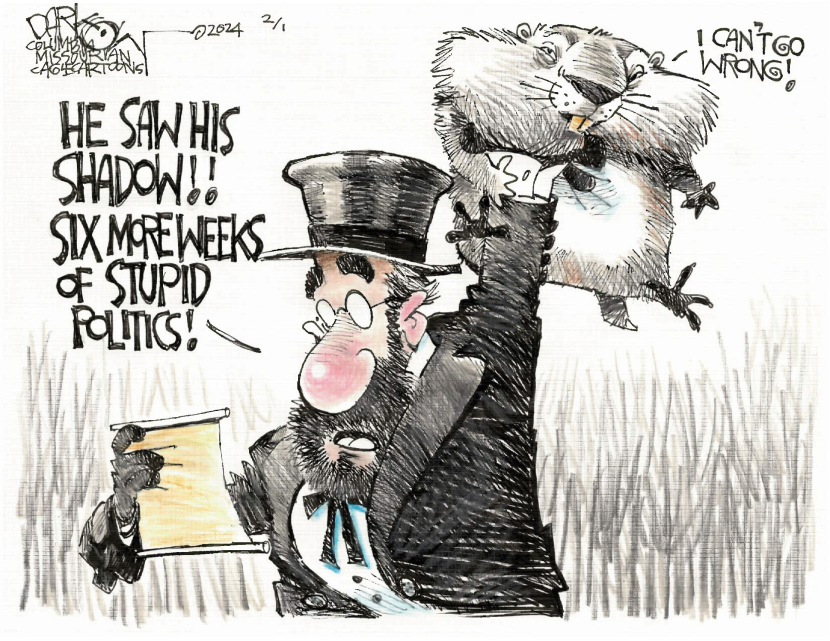
Groundhog Day 2025 is upon us, and you know the program: Every February 2, Phil emerges from his burrow in Punxsutawney, Pa. If he sees his shadow, there will be six more weeks of winter. If not, spring is just around the corner.

Groundhog Day – the holiday, not the 1993 Bill Murray movie — evolved from Candlemas Day, a Christian holy day commemorating the purification of the Virgin Mary.

In Germany, it grew into a tradition predicting weather, eventually involving a hedgehog. German immigrants brought it to Punxsutawney in 1887.

I have a special affection for Punxsutawney because it’s where my yellow Labrador, Thurber, was born four years ago.

As a dog lover and fan of all critters — except deer ticks, gosh, I hate deer ticks! — I think People for the Ethical Treatment of Animals (PETA) is overplaying its hand again.

PETA annually argues that dragging Phil from his burrow under bright lights in front of a crowd disrupts his hibernation and stresses him out.

Their solution? Replace Phil with an AI-powered animatronic groundhog, a weather-reveal cake, whatever that is, or a simple coin flip.

I told Thurber about PETA’s thoughts — being from Punxy, he, too, has Phil’s special powers — and he said he’d happily dress up as a groundhog if it meant he could enjoy Phil’s perks and royal lifestyle.

“I may get overly excited around people and crowds, but I’d only work one day a year and live a life of luxury the rest of the time,” Thurber told me.

To be sure, the Inner Circle — the local dignitaries plan the events every year and are responsible for the feeding and care of Phil — provides him with climate-controlled accommodations at the Punxsutawney Memorial Library, plus a gourmet diet and top-notch veterinary care.

He’s even provided with three female companions to keep him company.

That’s right, ladies and gentlemen, Inner Circle members are so committed to Phil’s happiness, they’re even willing to traffic in “woodchucks of the night.”

Critics such as PETA question Phil’s captivity, but the Inner Circle argues he enjoys a pampered, celebrity life that most woodchucks can only dream of.

PETA does some good work addressing serious animal-abuse issues. But I hope it focuses its full attention on those and leaves Phil alone, so he can live out his days like a prince and help us survive this unpleasant winter with his entertaining folklore.

Because it’s so cold outside, Thurber has stopped fetching his ball and only retrieves firewood.

Copyright 2025 Tom Purcell, distributed exclusively by Cagle Cartoons newspaper syndicate.

See Tom Purcell’s syndicated column, humor books and funny videos featuring his dog, Thurber, at TomPurcell.com. Email him at [email protected].
Comments Off on We need Punxsutawney Phil

Why skilled trades are safe from AI

Here’s the bad news: many jobs are going to be eliminated by artificial intelligence, and, with the speed at which AI is evolving, it’s going to happen sooner rather than later.

Here’s the good news: In 2025 many more young people are choosing careers in the trades — jobs that AI will never be able to replace.

When I was in college in the early ’80s, a bachelor’s degree was the ticket into the corporate world, where “the good jobs were.”

At that time, few people were able to get their foot in the corporate door without first earning that diploma.

Now, however, with a glut of liberal arts majors out there, even getting a toe in any corporate door is harder than ever.

Certifications in IT or cybersecurity are the way into a good corporate job now and you don’t need a university degree to get them.

Thus, it’s making less sense to borrow tens of thousands of dollars to fund a degree that may not lead to an entry-level corporate job — not one that isn’t likely to be outsourced to AI in the near future, in any event.

But it IS making a lot more sense to master a skilled trade.

Look, as millions of skilled tradespeople from the baby boomer generation retire, there’s a massive shortage of workers with the skills needed to replace them.

According to the Bureau of Labor Statistics, there are currently more than 8 million job openings for the trades — jobs such as electricians and plumbers that can pay well over $100,000 a year once a tradesperson is established.

That’s leading more college-educated people to give up white-collar, paper-pusher jobs to get into the trades.

As reported in the Washington Post, one 29-year-old in D.C. — with a degree from Notre Dame — considered going to law school, like many others in that lawyer-saturated town.

After watching his friends work long hours as paralegals — and watching his lawyer pals sign their lives over to their big firms — he did something sensible. He became an electrician’s apprentice.

He wasn’t alone. The Post said many more 20-somethings are forgoing the white-collar world to become plumbers, electricians, mechanics and carpenters — all highly satisfying careers that can pay seasoned tradespeople six-figure incomes.

I think it’s great.

Don’t we already have too many paper-pushers and useless office types whose only skill is excelling at office politics and kissing the boss’s boots?

We need people with real skills — skills that AI can never replace.

AI will be used in the trades to enhance a tradesperson’s skills, say, to conduct better analytics to identify the cause of a specific challenge. But it will never replace the human who is highly skilled using the AI tools.

Besides, a skilled tradesperson can earn more than many lawyers do — and likely enjoy the highly satisfying hands-on work more.

My father would be 91 were he with us today. And in his infinite wisdom, he saw the “master-a-trade” trend coming long ago.

When I was a 19-year-old college sophomore in 1982, he was so worried that I was an English major destined to a life of paper-pushing misery that he made sure I chose a practical minor that would always be there to help me pay the bills.

To this day, I am the only person ever to graduate from Penn State with a major in English and a minor in air-conditioning/heating!

Copyright 2025 Tom Purcell, distributed exclusively by Cagle Cartoons newspaper syndicate.

See Tom Purcell’s syndicated column, humor books and funny videos featuring his dog, Thurber, at TomPurcell.com. Email him at [email protected].
Comments Off on Why skilled trades are safe from AI

Unknown Civil Rights Hero Paved the Way for MLK

I can’t believe Denzel Washington hasn’t played one particular early civil rights hero in a movie yet.

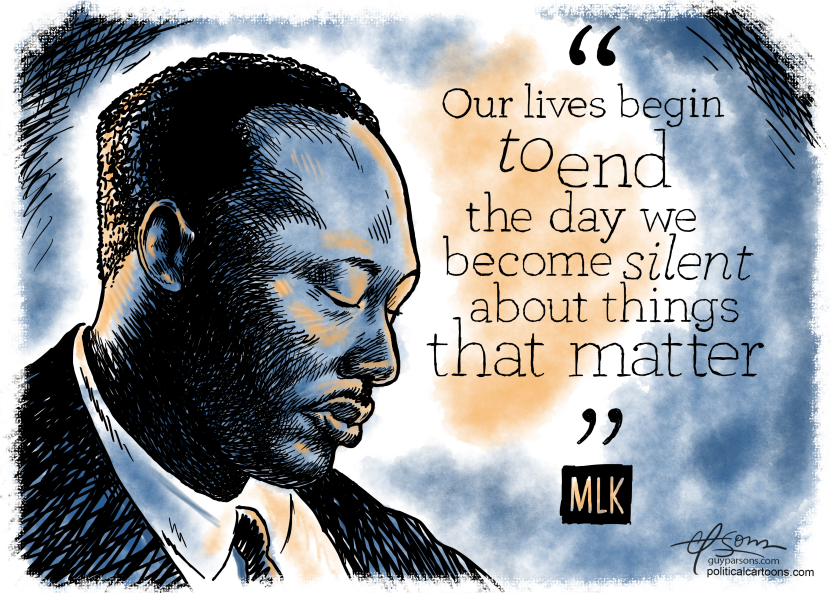
I also can’t believe how few people know about this unknown hero’s incredible accomplishments — achievements that paved the way for Martin Luther King Jr. and others to dismantle Jim Crow, the South’s legalized system of racial injustice.

So respected was this great American that MLK Jr. delivered the invocation at his funeral, and Supreme Court Justice Thurgood Marshall served as a pallbearer.

His name is John Wesley Dobbs.

Though his amazing life is documented in two low-selling history books and the New Georgia Encyclopedia, Dobbs has received no attention from the national media and remains largely unknown to the general public.

Born into poverty in 1882 in rural Kennesaw, Georgia, Dobbs’ parents were former slaves — his mother’s biological father was a slaveowner.

Smart and driven, Dobbs educated himself by reading constantly. Though he attended college briefly, he had to drop out to care for his ill mother, and never earned a college degree.

In his early 20s he passed the federal civil service exam and became a railway clerk for the U.S. Post Office.

For 32 years, he sorted mail overnight on trains from Atlanta, armed with a pistol. Rising to the position of supervisor — a remarkable feat for a black man in the Jim Crow era — he earned enough to support his family of six daughters as he gained respect in Atlanta’s African American community.

A gifted orator who memorized hundreds of poems and Shakespearean lines, Dobbs believed the best way to end Jim Crow was through the ballot box.

He tirelessly worked to register thousands of black voters in Atlanta and used his growing influence with the white Democratic power structure to get the city to hire its first black policemen.

It was in 1948 — at age 66 — that Dobbs risked his life to bring national media attention to the injustice 10 million blacks were suffering daily under Jim Crow.

Up North, a Pulitzer Prize-winning journalist from the Pittsburgh Post-Gazette named Ray Sprigle decided to go undercover as a light-skinned black man in the Jim Crow South for a month.

Teamed up with Sprigle by the NAACP, Dobbs guided and protected Sprigle during their 3,000-mile car journey. He introduced Sprigle to sharecroppers, lynching victims’ families and local leaders. They visited segregated schools and stayed in the homes of black farmers and doctors.

Sprigle, deeply moved and angered by what he saw and experienced, said he was ashamed to be an American.

As Bill Steigerwald details in “30 Days a black Man,” his powerful 2017 book about Sprigle’s mission, Sprigle’s powerful newspaper series shocked white readers in the North.

Time magazine praised Sprigle’s series. So did national black leaders and Eleanor Roosevelt. It was syndicated to about a dozen major newspapers from New York to Seattle — but nowhere in the South.

To protect Dobbs, Sprigle never mentioned him by name. The general public never found out about what Dobbs did until Steigerwald wrote about his story for the Post-Gazette in 1998.

Dobbs died in 1961 — the same week that Atlanta’s public schools were integrated. By that time all six of his daughters had graduated from Spelman College and gone on to become college professors, educators and community leaders. One of them, Mattiwilda, became a famous opera singer in Europe.

But Dobbs’ legacy extended even further: In 1974 his grandson, Maynard Jackson Jr., became the first black mayor of Atlanta.

It’s a shame few people are aware of the incredible accomplishments of this civil rights pioneer.

Like I said, I can’t believe Denzel Washington hasn’t played John Wesley Dobbs in a movie yet.

Copyright 2025 Tom Purcell, distributed exclusively by Cagle Cartoons newspaper syndicate.

See Tom Purcell’s syndicated column, humor books and funny videos featuring his dog, Thurber, at TomPurcell.com. Email him at [email protected].

Comments Off on Unknown Civil Rights Hero Paved the Way for MLK

The simple joy of snow

I love the snow.

I love how it forces us to slow down and take pause.

I especially love how a good snowfall puts Washington, D.C. into panic mode, as it has again this week, causing federal office buildings to shut down.

I lived in the D.C. region for about eight years and the response to snow in the nation’s capital was way different from how it is in places like Pittsburgh.

You see, Washington, D.C. is full of self-appointed experts who are eager to tell the rest of us how to live.

These uber-smart people can’t stop meddling with our appliances, furnaces, air conditioners and water heaters — they keep driving up the cost of every one of them with their never-ending mandates.

But when a few flakes of snow fall on the ground, they fall to pieces.

That’s because they lack the common sense of people from the Midwest — what they refer to as “Flyover Country.”

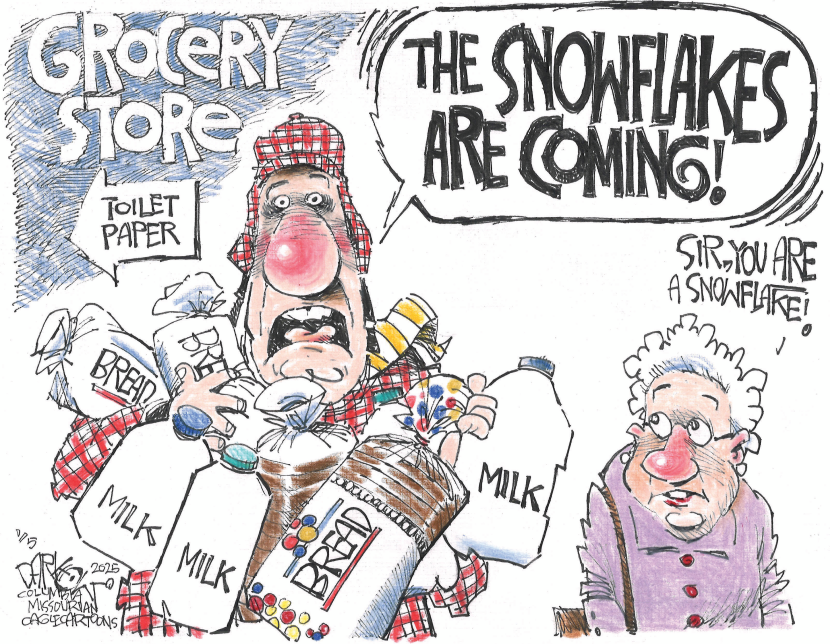
And so it is that the same people who tell us that toilet paper and bottled water are ruining the environment flock to supermarkets to hoard toilet paper and bottled water.

Washingtonians aren’t used to having to deal with reality.

In Washington, a lobbyist can make a fine living by spewing out bogus numbers and arguments to convince policymakers to write laws that favor the organizations he represents.

Our government doesn’t care much for reality, either. If it needs more money, it just prints more.

When our lawmakers gave us an ethanol-subsidies program that screwed up our corn market and drove up food costs, were there consequences?

Nope, just a couple of shoulder shrugs and some comments about their intentions being good.

Outside of Washington, D.C., however, people have no choice but to live in reality.

When record snows fall in the heartland of America, a person’s first instinct is to do what he must to keep the snow from affecting his family’s wellbeing.

We Pittsburghers know we can’t control the cold and snow, but we can control how we respond to them. And we respond with joy.

Our kids immediately appear atop the steepest hills with a variety of sledding devices, then spend many hours letting nature whip them down the slope.

Our grownups happily abandon their typical routines to clear the driveways of our elderly neighbors or bring them a pot of soup.
Then we clear our sidewalks and driveways so the postal carrier or Amazon driver doesn’t fall.

We are invigorated by the crisp air and a good sweat. We rarely miss the opportunity to engage in snowball contests, no matter our age.

We do this because the snow brings out the best in us.

As I write this column, my entire yard, and all of the woods that surround it, are coated with a thick layer of snow.

My four-year-old labrador, Thurber, is happy to go outside and play on any occasion, but there is something about the snow that brings out even more joy in him — an infectious joy that makes me laugh out loud.

And since I planned ahead for the realities of winter — my snowblower is tuned and my 4×4 Toyota truck eats snow-covered roads for lunch — I haven’t a worry in the world.

Now if you’ll excuse me, it’s time for this snow-loving Midwesterner to go outside and toss my dog his favorite ball!

Copyright 2025 Tom Purcell, distributed exclusively by Cagle Cartoons newspaper syndicate.

Find Tom Purcell’s syndicated column, humor books and funny videos of his dog, Thurber, at TomPurcell.com. Email him at [email protected].
Comments Off on The simple joy of snow