Good Grief! Critics Miss Christmas Specials’ Points

Good grief!

With everything in everyday American life politicized, count on someone, somewhere, being offended by something, anything – even classic Christmas TV specials.

A recent Huffington Post tweet promoting a video about a holiday classic says “‘Rudolph the Red-Nosed Reindeer’ is seriously problematic.”

Why? Because Rudolph’s father, Donner, verbally abuses him for being different; because Santa is a bigot who mocks Donner for having an odd son; because the school coach encourages the other reindeer to bully Rudolph; and because Donner is a sexist who tells his wife she can’t search for the missing Rudolph because it’s man’s work.

One commenter’s tweet in the video sums the criticisms up well: “Yearly reminder that #Rudolph the Red-Nosed Reindeer is a parable on racism & homophobia w/Santa as a bigoted exploitative (expletive).”

It’s unclear whether the video was intended as satirical or serious, but at this time of constant outrage, nobody would be surprised if it’s an actual criticism.

Because recent criticisms of “A Charlie Brown Thanksgiving” – some charge racism because black character Franklin sits alone on an old lawn chair at one side of the table – are not satire.

Such criticisms miss the point.

According to The Atlantic, the story of “Rudolph the Red-Nosed Reindeer” was created in 1939 by retailer Montgomery Ward, which featured Rudolph in promotional coloring books.

In 1949, the story became the basis for a hit song that transformed Rudolph from “misfit to hero.”

In 1964, when the stop-motion animation Christmas special was first broadcast, a whopping 50 percent of the American viewing audience watched it.

Why? Because “Rudolph” is the ultimate underdog story.

We all know, of course, that Rudolph’s “very shiny nose” makes him different; that the other reindeer call him names; and that he triumphs over adversity.

He proves his many naysayers were wrong to try to make him conform. He demonstrates that what others saw as his biggest weakness was in fact his biggest strength.

To be sure, Rudolph’s hero journey should be celebrated, and it is, by millions of viewers – many of whom posted sensible tweets showcasing why the HuffPo video so woefully missed his story’s point.

Which brings us to Franklin in “A Charlie Brown Thanksgiving.” Charles Schulz introduced Franklin Armstrong in his “Peanuts” comic strip in July 1968.

“At the time, the United States was struggling with desegregation, and while the country had taken several steps to integrate the population, issues about having black and white people attend the same schools, use the same bathrooms, or appear in the same comic strips were still matters of substantial controversy,” reports Snopes.com.

In other words, Schulz took a big chance by introducing a black “Peanuts” character. Correspondence with Harriet Glickman, a teacher in Los Angeles, explains why.

According to NPR, Glickman wrote Schulz a letter explaining why a black Peanuts character “could play a small part in promoting tolerance and interracial friendship.”

Schulz wrote back, explaining that he considered her suggestion, but “he worried that if he created such a character, black parents might think he was condescending to their families.”

Nonetheless, despite backlash from some newspaper editors and other naysayers, Schulz introduced Franklin, using “Peanuts” to help, as best he could, quell our divisions.

Schulz was courageous, not racist.

That such context must be provided to counter critics of America’s long-beloved Christmas specials makes me want to say one thing.

Good grief!

Copyright 2018 Tom Purcell. Tom Purcell, author of “Misadventures of a 1970’s Childhood,” a humorous memoir available at amazon.com, is a Pittsburgh Tribune-Review humor columnist and is nationally syndicated exclusively by Cagle Cartoons Inc. For info on using this column in your publication or website, contact [email protected] or call (805) 969-2829. Send comments to Tom at [email protected].

Comments Off on Good Grief! Critics Miss Christmas Specials’ Points
Concierge Doc Shows Way to Lower Health-Care Costs

As physicals go, it was the most thorough I’d ever gotten.

My new primary care doctor is a “concierge” doctor. Much like small-town doctors years ago, he isn’t paid by a third-party insurance firm. He’s paid by me, directly, at a reasonable $115 monthly.

If I get a cold, sprain an ankle or have any kind of issue, he’s a phone call, email or text message away. He isn’t just a doctor. He’s a knowledgeable collaborator guiding me to my very best health.

He’s saving me a lot of money by guiding me to other cash-only services. I paid about $100 for a CT heart scan, $150 for a detailed scan of my arteries and bones, and another $100 to a large clinical laboratory for an exhaustive review of my blood (cholesterol, etc.) that would have cost hundreds if I’d attempted to pay the lab directly.

For $350, I was able to have a thorough evaluation of my body – and discover it’s in pretty good shape – which is something everyone 50 or older should be able to do.

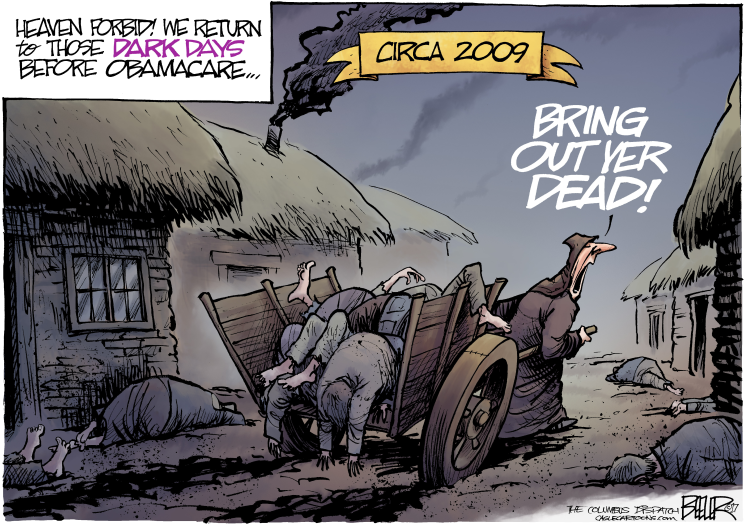
More doctors are going the concierge route – to their benefit and patients’ benefit alike. They’re doing so because our health-insurance system is a giant mess – a giant cost mess, to be precise.

As a self-employed writer, I’ve seen my premiums soar. My “bronze” policy cost me nearly $500 a month, and I had to pay the first $6,000 in costs before the insurance kicked in. Millions who purchase individual insurance have experienced similar pain.

So I dropped the health-insurance policy and weaved together a different strategy.

First, to protect against a catastrophic incident, I joined a Christian health-cost-sharing service. Such services are growing in popularity. The “Gold Plan” costs $150 monthly. If I need hospital care, I pay the first $500, then the service negotiates the rest of the tab with the hospital. Its 400,000 members pay monthly to share medical bills.

This is not health insurance – it has limitations and doesn’t cover costs for “non-Christian” behaviors, such as alcohol abuse or drug use. Note that many scammers come out of the woodwork this time of the year, so do your homework. (During open enrollment this year, I’m also reviewing low-cost, high-deductible catastrophic health-insurance options made available by the Trump administration; I may replace the Christian plan with a catastrophic insurance plan.)

To round out my health-care strategy, I purchased two insurance policies that will pay me a nice chunk of cash if I suffer a debilitating injury and cannot work, or if I’m hospitalized. These policies, in addition to the health-cost-sharing service, should cover my bills if something bad happens.

In any event, my total monthly cost for my concierge doctor, health-cost-sharing service and insurance policies is just north of $300. I’d prefer an affordable, low-deductible “Cadillac” policy like I had six or seven years ago, but no such policies exist.

Regrettably, cost is the biggest health-care issue. Reforms are badly needed – but none are on the immediate horizon. That leaves millions to string together novel health-care strategies, as I have attempted to do, turning to concierge doctors who can help us navigate health care’s high cost.

Copyright 2018 Tom Purcell. Tom Purcell, author of “Misadventures of a 1970’s Childhood,” a humorous memoir available at amazon.com, is a Pittsburgh Tribune-Review humor columnist and is nationally syndicated exclusively by Cagle Cartoons Inc. For info on using this column in your publication or website, contact [email protected] or call (805) 969-2829. Send comments to Tom at [email protected].
Comments Off on Concierge Doc Shows Way to Lower Health-Care Costs

Give More Thanks – It’s Good for You

“Thanksgiving is the time of year when we reflect on our incredible blessings, but many Americans aren’t feeling very thankful?”

“That’s what an interesting Harris poll survey conducted a few years ago for American Greetings found. Psychotherapist Amy Morin reported in Forbes that three in five Americans would ‘rather do something else rather than reflect on what they’re thankful for on Thanksgiving.'”

“But we have so much to be thankful for. Our economy is booming. Our standard of living, the world’s best, is improving. Could we so take our blessings for granted that we forget how good we have it?”

“It appears that far too many Americans are doing just that. Cafehayek.com argues that a typical middle-class American today lives better than billionaire John D. Rockefeller did 100 years ago. As rich as Rockefeller was, he didn’t have air conditioning; sophisticated medicine (my grandfather died in 1937 at age 34 from strep throat because penicillin hadn’t been discovered yet); safe, fast travel; limitless dining and entertainment options; and many other wonderful things that we have.”

“To be sure, 2018 is the best time in history to be alive – and not just for Americans.”

“That’s absolutely true. In Time magazine last year, Bill Gates reported global improvement across several indicators. Childhood deaths fell from 12 million in 1990 to 5 million in 2017. More than 90 percent of children now attend primary school. The proportion of people living in extreme poverty declined from one-third in 1990 to one-tenth in 2017. Gates reported that 2017 was the greatest year in human history, but 2018 has been even better!”

“I get that America has its share of problems and challenges – like every country, it’s a continuous work in progress – but why can’t we kick back on Thanksgiving and be thankful for what we’re doing right? A little gratitude isn’t going to hurt anyone!”

“Science says gratitude is good for us. In another Forbes piece, Morin identifies seven scientifically proven benefits of gratitude. For starters, gratitude – showing appreciation – helps us win new friends. Morin writes that ‘whether you thank a stranger for holding the door or you send a quick thank-you note to that co-worker who helped you with a project, acknowledging other people’s contributions can lead to new opportunities.'”

“It certainly feels good to be cordial to and appreciative of strangers!”

“You speak the truth. Science says gratitude improves our physical and psychological health. Simply put, being grateful makes you feel better. It ‘reduces a multitude of toxic emotions, ranging from envy and resentment to frustration and regret,’ reports Morin. And it enhances our empathy and sensitivity, which helps us understand and sympathize with our fellow human beings!”

“In these divisive times, we could certainly use more empathy toward those with whom we may disagree!”

“Morin reports that grateful people sleep better, have higher self-esteem and enjoy increased mental strength. That makes perfect sense. When you’re grateful, you see, you simply have a better sense of well-being. But when you’re resentful or pessimistic, you’re trapped in the narrowness of your grumpiness.”

“Grumpiness makes me grumpy!”

“It sure does. Look, despite our ongoing challenges and disagreements, we have an incredible bounty to be thankful for. There has never been a better Thanksgiving to show our gratitude, and that’s what we should do because gratitude is good for us!”

Copyright 2018 Tom Purcell. Tom Purcell, author of “Misadventures of a 1970’s Childhood,” a humorous memoir available at amazon.com, is a Pittsburgh Tribune-Review humor columnist and is nationally syndicated exclusively by Cagle Cartoons Inc. For info on using this column in your publication or website, contact [email protected] or call (805) 969-2829. Send comments to Tom at [email protected].

Comments Off on Give More Thanks – It’s Good for You

Effective Wit a Dying Art in Politics

Among today’s most regrettable trends is the dying art of effective humor and satire in politics.

During 1984’s second debate between President Reagan and Democratic nominee Walter Mondale, moderators rightfully asked Reagan, then 73, if he had enough stamina to carry out his duties.

Reagan answered, “I will not make age an issue of this campaign. I am not going to exploit, for political purposes, my opponent’s youth and inexperience.”

Nearly everyone, even Mondale, laughed. Reagan’s humor reassured America that he had his wits about him. He defeated Mondale in a landslide.

Humor, well executed, is a powerful thing.

A well-designed joke can cut to the heart of the matter better than any speech or law or government policy – slicing through political divisions and uplifting and uniting us like no other form of communication.

The art of political humor is faring poorly of late. No longer are we seeing the stylish political barb.

President Lincoln, possibly the best-spoken American politician ever, cut one opponent to the quick by saying, “He can compress the most words into the smallest ideas better than any man I ever met.”

In 1985, Jack Kemp, seeking to brand his political opponent as ill-informed and unfit for the highest office, said, “In a recent fire Bob Dole’s library burned down. Both books were lost. And he hadn’t even finished coloring one of them.”

During her 1998 Democratic National Convention keynote address, then-Texas Gov. Ann Richards, trying to discredit Republican candidate George H.W. Bush by highlighting his upper-crust upbringing and tendency for political gaffes, said, “Poor George. He can’t help it. He was born with a silver foot in his mouth.”

Now, the blunt insult has replaced the stylish political barb.

“Crooked Hillary,” “Lyin’ Ted” and “Crazy Bernie” are among President Trump’s nicknames for his opponents. Though his supporters welcome his boldness against his political foes, it alienates independents and those who do oppose his policies.

Trump has the world’s largest platform. His choice of words sets the tone of “humor” in the country more than anyone else’s.

Regrettably, our professional comedians and humorists are following suit.

During less partisan times, libertarian humorist P.J. O’Rourke said, “The Democrats are the party of government activism, the party that says government can make you richer, smarter, taller, and get the chickweed out of your lawn. Republicans are the party that says government doesn’t work, and then get elected and prove it.”

O’Rourke’s “light-touch” humor clearly illustrates that Democrats vs. Republicans isn’t the challenge. It’s us vs. our politicians, and we must get past partisan silliness to keep them honest.

In contrast to O’Rourke, too many of our late-night comedians have gone hyper-partisan. They use their platforms to self-righteously mock Americans who think differently than they do about politics – which further widens our divisions.

“As Americans, we must ask ourselves: Are we really so different?” says humorist Dave Barry. “Must we stereotype those who disagree with us? Do we truly believe that ALL red-state residents are ignorant, racist, fascist, knuckle-dragging, NASCAR-obsessed, cousin-marrying, roadkill-eating, tobacco juice-dribbling, gun-fondling, religious fanatic rednecks; or that ALL blue-state residents are godless, unpatriotic, pierced-nose, Volvo-driving, France-loving, left-wing communist, latte-sucking, tofu-chomping, holistic-wacko, neurotic, vegan, weenie perverts?”

The answer is that most of us do not. The trick is to get our politicians and comedians to embrace this truth and restore the art of effective humor and satire in politics.

Copyright 2018 Tom Purcell. Tom Purcell, author of “Misadventures of a 1970’s Childhood,” a humorous memoir available at amazon.com, is a Pittsburgh Tribune-Review humor columnist and is nationally syndicated exclusively by Cagle Cartoons Inc. For info on using this column in your publication or website, contact [email protected] or call (805) 969-2829. Send comments to Tom at [email protected].

Comments Off on Effective Wit a Dying Art in Politics

Smaller American Towns Connect in Ways Washingtonians Don’t

After living in Washington, D.C., for nearly 8 years, I love being back home in Pittsburgh.

I met many interesting people in the D.C. region, but one thing was missing there that’s common in places such as Pittsburgh: a basic connection among people.

I remember visiting Pittsburgh one Saturday morning while I lived in D.C. As I walked to a downtown coffee shop to meet some friends, a short, elderly Pittsburgher shouted at me.

“Hey, pal, your wallet is about to fall out of your pocket!”

I explained that my wallet was long and designed for the vest pocket of a sport coat. It appeared to be falling out of my pants’ pocket, but wasn’t. I thanked him and began walking away.

“But, pal,” he said, “a dollar bill is showing at the top of your wallet. Flip it around.”

I continued walking, smiling at him.

“I said flip it around,” he shouted.

In Pittsburgh, you see, people are outgoing and concerned about their fellow man. The kindly old Pittsburgher didn’t want someone to swipe my wallet (though the odds of that in Pittsburgh are much lower than in D.C.).

Pittsburghers hold doors open for strangers. They politely wave your car ahead in traffic. They don’t hesitate to help in your time of need – as they demonstrated when thousands of Pittsburghers came together in response to the horrible Tree of Life synagogue shooting a few weeks ago.

I remember when a hurricane-like burst – a macroburst – hit just blocks from my mom and dad’s house one Sunday morning. It toppled large trees in a 10-block area, blocking roads. Within minutes, people in their Sunday clothes were getting soaked by rain as they directed traffic around downed trees, helped clear roads and kept others away from downed power lines.

I hate to say it, but such a response likely wouldn’t happen in the D.C. region. People connect with each other in the Pittsburghs of the world, but there’s a lack of connection among people in Washington. Walk down a D.C. street and people go out of their way to avoid eye contact. Strangers don’t often hold doors open for others. And good luck if you break down on the highway.

According to the Brookings Institution, the 53 largest U.S. metropolitan areas, with populations over 1 million, are experiencing significant growth, while smaller metro areas, with fewer than 250,000 people, are shrinking.

I wonder how this trend will affect our country’s “friendliness factor.”

As we get farther away from our roots and hometowns, will we become less friendly and less concerned for our neighbors, as I experienced in Washington?

Will people become more generic and bland and less like the many colorful characters who are common in Pittsburgh? As we move to larger areas of sprawl, will we lose our sense of place and home? Will we begin to care less?

There’s a story about a large Pittsburgher visiting D.C. He’s in a bar, watching the Steelers play. A Washingtonian shouts, “There are only two types of people in Pittsburgh – prostitutes and football players!”

The large Pittsburgher grabs the Washingtonian by the shoulder.

“My mother is from Pittsburgh!” he says.

“What position did she play?” says the Washingtonian.

You’ve got to love a town that creates colorful characters who care so much!

Copyright 2018 Tom Purcell. Tom Purcell, author of “Misadventures of a 1970’s Childhood,” a humorous memoir available at amazon.com, is a Pittsburgh Tribune-Review humor columnist and is nationally syndicated exclusively by Cagle Cartoons Inc. For info on using this column in your publication or website, contact [email protected] or call (805) 969-2829. Send comments to Tom at [email protected].

Comments Off on Smaller American Towns Connect in Ways Washingtonians Don’t

After Pittsburgh’s Synagogue Tragedy, Start with Mister Rogers

Saturday morning is normally my favorite morning of the week.

Usually, I sit in a festive coffee shop near downtown Pittsburgh, working on a novel, a love story, I’m eager to complete.

Last Saturday morning, I heard police cars and ambulances racing past the coffeehouse – headed, I now know, to the tragic scene at the Tree of Life Synagogue just 4 miles away, where innocents were targeted as they worshiped.

It’s the latest in a series of tragedies in which powerful weapons were used to slaughter defenseless people.

My first impulse was incredible sadness. I pray for the victims and their families.

My next impulse was anger. Why aren’t we moving faster to keep weapons out of would-be killers’ hands? Why are too many political leaders, on both sides, so carelessly ginning up anger, even violence, with their poor choice of words?

My anger isn’t unique. But some are exploiting this horrible event to attack political opponents, call them names, even blame them for directly inspiring this apparently unhinged man to come out of the woodwork and strike.

We will never solve this incredible shooting problem – the causes go deep and the solution will require multiple thoughtful actions by many people – if we let it pull us apart rather than bring us together.

PittsburghBeautiful.com suggests we heed Mister Rogers’ kind and loving words. I couldn’t agree more.

Ironically, the studio where Fred Rogers recorded “Mister Rogers’ Neighborhood” is only a few neighborhoods away from Tree of Life – making one scratch his head that a place that cultivated so much love and kindness for so many years could be so near a place where such an act of hatred would occur.

Here, from “The World According to Mister Rogers,” is a fine Fred Rogers quote to begin:

“When I was a boy and I would see scary things in the news, my mother would say to me, ‘Look for the helpers. You will always find people who are helping.'”

God bless the courageous police officers who risked their lives to confront the shooter. Four were wounded. Two face long-term recoveries. God bless the many first responders who cared for the wounded. And God bless the hundreds of Pittsburghers who waited in long donation lines well after blood banks’ normal closing hours.

“We live in a world in which we need to share responsibility,” Fred Rogers also said. “It’s easy to say, ‘It’s not my child, not my community, not my world, not my problem.’ Then there are those who see the need and respond. I consider those people my heroes.”

We all must never accept the shedding of innocents’ blood as “the new normal.” We all must become heroes and use all the tools available to us – political, scientific, technological, personal – to inform ourselves, escape the narrowness of our political inclinations, bridge our divides and agree on a unified solution that will stop these shootings from being so sickeningly commonplace.

Our work is cut out for us. The only way we will successfully resolve this problem is to ratchet down the angry rhetoric and thoughtfully and intelligently address its complexity.

The first step to success is to follow Mister Rogers’ sage advice:

“There are three ways to ultimate success – The first way is to be kind, the second way to be kind and the third way is to be kind.”

Copyright 2018 Tom Purcell. Tom Purcell, author of “Misadventures of a 1970’s Childhood,” a humorous memoir available at amazon.com, is a Pittsburgh Tribune-Review humor columnist and is nationally syndicated exclusively by Cagle Cartoons Inc. For info on using this column in your publication or website, contact [email protected] or call (805) 969-2829. Send comments to Tom at [email protected].

Comments Off on After Pittsburgh’s Synagogue Tragedy, Start with Mister Rogers

After Saudi Visit, ‘Freedom’ Just another Word for Home Sweet Home

Like millions of Americans, I often took my incredible freedoms for granted – until I visited Saudi Arabia.

For years, I’ve done marketing communications work for technology companies. Four years ago, a client asked me if I was interested in joining her on a project in the kingdom.

“Heck, yeah,” I responded. How often does one get to visit the Middle East, all expenses paid?

No sooner had our Saudi Arabian Airlines plane lifted off from Dulles International Airport in Virginia, however, than I got a quick taste of how limited my freedoms suddenly were: Alcohol is banned on Saudia flights, as it is throughout Saudi Arabia.

I don’t enjoy flying’s cramped unpleasantness. A few snorts of Irish hooch always calm my nerves. But I was out of luck.

“No problem,” I thought – “I’ll watch American movies.” I’d been bumped into first class and had my own monitor. But, I quickly noticed, every scene depicting a scantily-clad Hollywood starlet was cut or blurred.

Since most of the movies were unwatchable, I had to pass the longest 14 hours of my life watching “Cats & Dogs” – five times.

Going through customs in the Jeddah airport, I became instantly self-conscious. My sport coat, slacks and large, pale Irish-German-American noggin shouted “American.”

It was worse for my female colleague. She wore a headscarf so big – we call them “babushkas” in Pittsburgh – she could have pitched it as a tent.

At the time, Saudi Arabia’s notorious religious police wouldn’t have allowed her – or any other woman – to drive. I jokingly whispered to her that if she didn’t increase my hourly rate, I’d tell the police she planned to drive from the airport.

Most Saudis I met during our time there loved America and Americans. But I knew that 15 of the 9/11 hijackers came from Saudi Arabia. I noted that some Saudis I met loathed Americans – and I immediately sensed that my customs agent was among them.

I sensed that if we’d been in a free country, such as America, this guy – knowing he’d be presumed innocent until proven guilty, and likely to get just a slap on the wrist if found guilty – would have tried to knock my teeth out.

But in Saudi Arabia, there is no presumption of innocence.

Consider the recent murder of Saudi Arabian journalist Jamal Khashoggi at the Saudi consulate in Istanbul. He made the mistake of exercising free speech by writing columns critical of the kingdom.

Consider Mujtaba’a al-Sweikat. This young man was on his way to enroll in Western Michigan University in 2012 when he was detained at King Fahd International Airport. Alleged to have participated in a pro-democracy event, he was arrested, tortured and, as of 2017, sentenced to beheading.

In any event, I spent most of my time in Saudi Arabia safe within the fortress walls of King Abdullah University of Science and Technology – where the kingdom’s strict laws are slightly relaxed – and met many wonderful, brilliant people from all over the world.

Nonetheless, my month in Saudi Arabia gave me a brief taste of life in an authoritarian country – where absolute power typically corrupts absolutely. The kingdom is so authoritarian that in its 2018 “Freedom in the World” report, Freedom House ranked Saudi Arabia seventh among the world’s 20 least-free countries.

When we landed back in Virginia – after enduring “Cats & Dogs” five more times – I kissed the ground, then went to the nearest pub to enjoy a badly-needed snort of my fully restored freedoms.

Copyright 2018 Tom Purcell. Tom Purcell, author of “Misadventures of a 1970’s Childhood,” a humorous memoir available at amazon.com, is a Pittsburgh Tribune-Review humor columnist and is nationally syndicated exclusively by Cagle Cartoons Inc. For info on using this column in your publication or website, contact [email protected] or call (805) 969-2829. Send comments to Tom at [email protected].

Comments Off on After Saudi Visit, ‘Freedom’ Just another Word for Home Sweet Home

Dietary Scientists, Make up Your Minds!

Say it ain’t so: Alcohol in moderation is bad for us again!

According to a recent study published in the journal Alcoholism, low-level alcohol use – one or two snorts of hooch on occasion – may benefit cardiovascular disease, but it increases the risk of cancer.

To which I respond: Oh, c’mon!

I don’t know if our scientists have noticed, but our country is politically and culturally divided. Our people are agitated and angry. Life’s simple pleasures are among the few things about which we have any consensus these days.

Yet for years, our simple pleasures have been under scientific assault.

Back in the ’90s, a series of alarming reports told us that movie-theater popcorn would congest our arteries worse than eating Crisco right out of the can.

Then we learned that Chinese food would fatten us, and that a hearty fast-food breakfast could be so risky we might not make it to lunch.

For years, we were told that red meat is bad for our hearts. But now, we’re being told that it is also causing climate change – so we need to start eating bugs instead!

Look, too few Americans are aware of where our food comes from and what is in it – which partly helps explain our obesity epidemic. But it’s awfully frustrating that our scientists can’t seem to make up their minds.

For years, they told us coffee was bad for us – before deciding that, in moderation, it stimulates our arteries, and protects against Parkinson’s disease, type 2 diabetes and liver disease. Coffee certainly makes my noggin sharper as the workday begins!

For years, scientists told us to avoid fat and carbs. Now, they tell us to limit carbs and that proper fats are essential to good health – that some people don’t have enough fat in their diets!

For years, scientists told us alcohol was bad. Then they told us that, in moderation, it prevents heart disease, reduces the chance of ischemic stroke and possibly reduces the risk of diabetes!

But now, alcohol in moderation is bad for us again? Regrettably, the issue remains unsettled.

According to The Washington Post, the alcohol-in-moderation issue was supposed to be clarified by a 10-year, $100 million Moderate Alcohol and Cardiovascular Health trial sponsored by The National Institute on Alcohol Abuse and Alcoholism, part of the National Institutes of Health (NIH).

But the study’s credibility collapsed, The Post reports, when an “internal NIH investigation found that researchers had engaged in extensive communication with industry representatives before the government’s approval of the trial.”

Thus, it was canceled. Which puts us right back at square one!

Some scientists, including an epidemiologist cited by The Post, say “drinkers should drink a little bit every day, without any days off, because alcohol makes blood platelets less sticky and keeps other clotting factors low.”

But another scientist told The Post: “The burden of evidence is toward alcohol having a detrimental effect on heart disease, even in small quantities.”

As a result, millions of average Americans are in a constant state of confusion and debate about many things scientific – while they’re also in a constant state of confusion and debate about many things political and cultural.

One solution? Embrace the witty wisdom of Irish poet and playwright Oscar Wilde: Enjoy “everything in moderation, including moderation.”

Copyright 2018 Tom Purcell. Tom Purcell, author of “Misadventures of a 1970’s Childhood,” a humorous memoir available at amazon.com, is a Pittsburgh Tribune-Review humor columnist and is nationally syndicated exclusively by Cagle Cartoons Inc. For info on using this column in your publication or website, contact [email protected] or call (805) 969-2829. Send comments to Tom at [email protected].

Comments Off on Dietary Scientists, Make up Your Minds!

Failing U.S. Citizenship

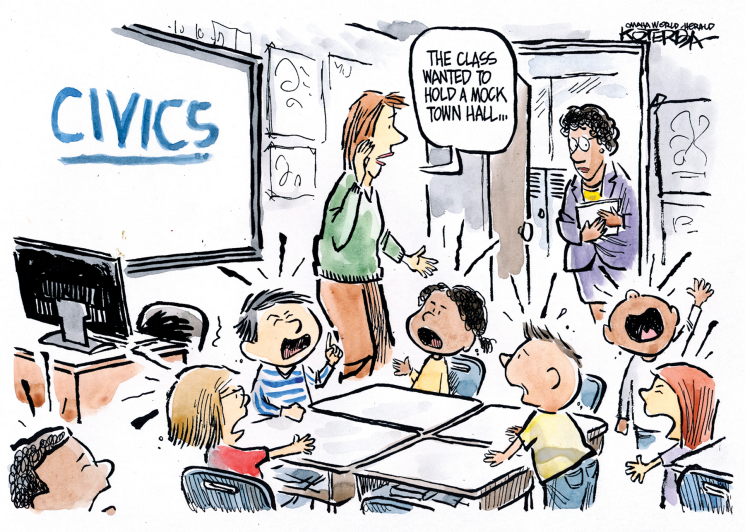
“If younger generations don’t know why and how America is such a great nation, we are doomed!”

“Ah, you speak of the recent Woodrow Wilson National Fellowship Foundation survey that finds only one in three Americans can pass the U.S. Citizenship Test.”

“You got that right. Two-thirds of Americans failed the 10-multiple-choice-question test even though they only needed six correct answers to pass.”

“That is troubling. The foundation says, ‘Only 13 percent of those surveyed knew when the U.S. Constitution was ratified.’ It says: ‘More than half of respondents (60 percent) didn’t know which countries the United States fought in World War II. And despite the recent media spotlight on the U.S. Supreme Court, 57 percent of those surveyed did not know how many Justices actually serve on the nation’s highest court.'”

“What are these people being taught in high school and college?”

“A better question is what are they NOT being taught? As the foundation notes, ‘It would be an error to view these findings as merely an embarrassment. Knowledge of the history of our country is fundamental to maintaining a democratic society, which is imperiled today.””

“Just for the heck of it, I took the test. The questions aren’t so difficult. How can so many Americans not answer at least six correctly?”

“The foundation reports that 72 percent of respondents weren’t sure about or misidentified the 13 original states, and just 24 percent ‘could correctly identify one thing Benjamin Franklin was famous for, with 37 percent believing he invented the lightbulb'” – the same percentage who ‘knew the correct answer as to why the colonists fought the British.'”

“Yeah, and I’m especially worried about the 2 percent who thought climate change was the cause of the Cold War!”

“The survey also found that younger generations are especially ignorant of the American system. Americans age 65 or older ‘scored the best, with 74 percent answering at least six in 10 questions correctly.’ But only 19 percent of those under 45 passed, ‘with 81 percent scoring a 59 percent or lower.'”

“That means older generations, who understand the importance of checks and balances to restrict each government branch’s power – and the triumph of our free-market system over socialism and communism – will eventually give way to younger generations who don’t understand these basic concepts.”

“Yes, that’s our greatest worry. Per Chicago Tribune columnist Steve Chapman, the University of Chicago’s GenForward Survey of Americans age 18 to 34 finds that 62 percent of them think ‘we need a strong government to handle today’s complex economic problems,’ but only 35 percent say ‘the free market can handle these problems without government being involved.’ What’s worse: 61 percent of millennial Democrats – and 25 percent of millennial Republicans – have a positive view of socialism.”

“As I said, we’re doomed!”

“Not if we heed the words of President Abraham Lincoln: ‘America will never be destroyed from the outside. If we falter and lose our freedoms, it will be because we destroyed ourselves.’ We have our work cut out for us, but we must teach the young why and how America became so great.”

Copyright 2018 Tom Purcell. Tom Purcell, author of “Misadventures of a 1970’s Childhood,” a humorous memoir available at amazon.com, is a Pittsburgh Tribune-Review humor columnist and is nationally syndicated exclusively by Cagle Cartoons Inc. For info on using this column in your publication or website, contact [email protected] or call (805) 969-2829. Send comments to Tom at [email protected].
Comments Off on Failing U.S. Citizenship

Jokes Abound, But Political Divide No Laughing Matter

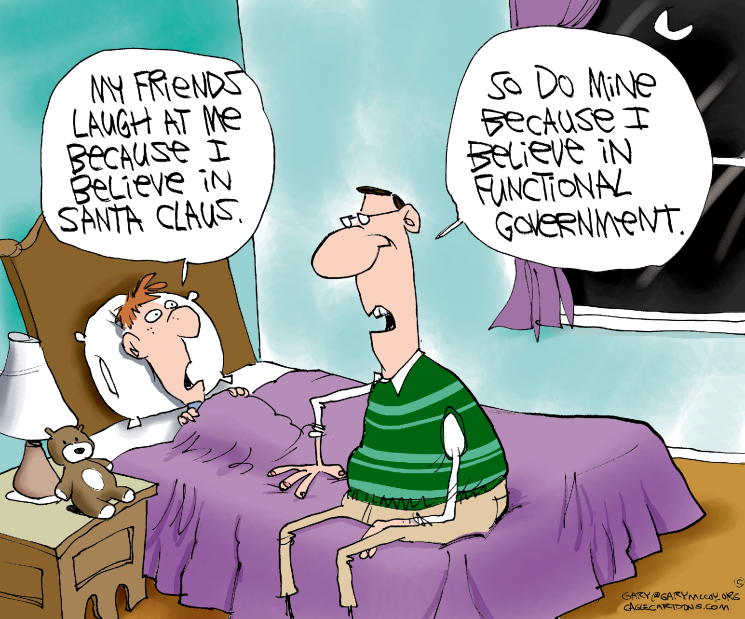
With all the vitriol in our politics – with all the disagreement that is tearing our country apart – we could all use some levity about now.

Here’s one joke I think we can all agree with:

A man wearing a ski mask jumped into the path of a well-dressed man and stuck a gun against his ribs.

“Give me your money,” said the mugger.

“You can’t do this,” said the well-dressed man. “I’m a U.S. congressman!”

“In that case,” said the mugger, “give me MY money!”

Being a parent is more challenging than ever. We live in a time when parents must censor C-SPAN!

Which reminds me of the one about the father who used the never-ending shenanigans in Washington to teach his son an important lesson.

“Son, you should never steal, lie or cheat.”

“Why, Dad?”

“Because the government hates competition!”

The U.S. Senate is agitating millions of Americans. The allegedly august body of distinguished minds is supposed to give thoughtful pause to our political process – but is giving us a Jerry Springer show instead.

That’s why the words of legendary humorist Will Rogers are truer today than when he spoke them during the Great Depression:

“The Senate just sits and waits till they find out what the president wants, so they know how to vote against him.”

“About all I can say for the United States Senate is that it opens with a prayer and closes with an investigation.”

“Senators are a never-ending source of amusement, amazement and discouragement.”

With our senators being held in such low regard, this joke will resonate with many:

A minister goes to a barbershop on Capitol Hill. The barber, thanking him for his service, says “No charge.” The next morning, the barber finds a thank-you note from the minister.

A few days later a police officer gets his hair cut. The barber, thanking the officer for his service, says “No charge.” The next morning, the barber finds a thank-you note from the police officer.

A few days after that, a senator gets his hair cut. The barber, thanking the senator for his service, says “No charge.” The next morning, as he arrives at his shop, a dozen senators are waiting on the stoop.”

Public discourse is suffering in our country right now – one could argue it is non-existent, which is a dangerous turn for our country.

According to dictionary.com, “discourse” is “communication of thought by words; talk; conversation.”

Thoughtful conversation is how we arrive at political consensus – how we vote for political leaders, make our laws, pick our judges.

Thoughtful conversation – not shouting and name-calling – is the only way to iron out disagreements in both our personal and public lives.

Thoughtful conversation – thoughtful public discourse – is the bedrock of an orderly, well-functioning republic.

God knows we’re short on thoughtful conversation at this moment – at our own peril.

To that end, I hope we can all agree on this one:

A couple was touring the capitol in Washington, and the guide pointed out a tall, benevolent gentleman as the congressional chaplain. The lady asked, “What does the chaplain do? Does he pray for the Senate or House?”

“No,” said the tour guide. “He gets up, looks at both houses of Congress, then prays for the country!”

Copyright 2018 Tom Purcell. Tom Purcell, author of “Misadventures of a 1970’s Childhood,” a humorous memoir available at amazon.com, is a Pittsburgh Tribune-Review humor columnist and is nationally syndicated exclusively by Cagle Cartoons Inc. For info on using this column in your publication or website, contact [email protected] or call (805) 969-2829. Send comments to Tom at [email protected].
Comments Off on Jokes Abound, But Political Divide No Laughing Matter