Time to Embrace Cursive Handwriting Again

While organizing my home office a few weeks ago, I came across a letter my grandfather wrote back in 1924.

He wrote that eloquent letter to his best friend’s wife, consoling her on the loss of her mother. His cursive handwriting was artful – perfect penmanship.

He wrote the letter when he was 21. Since he died at 34, when my father was only 3, it is among the most cherished items I have from a grandfather I never got to meet.

Such is the power of the handwritten letter, an art that has died along with the art of cursive handwriting.

You see, many American schools have phased out lessons in cursive. There is a waning need for it in the modern era, some argue, and the classes take too much time.

Cursive originated centuries ago. It’s the result of technological innovations such as inkwells and quill pens made from goose feathers.

Because ink dripped when the quill was lifted from the paper, it made sense to connect letters in words together in one flowing line – and the art of cursive writing began.

Cursive became less necessary with the invention of the ballpoint pen, which does not leak and, technically, does not require cursive writing.

Changing technology, which led to electronic documents completed on computers, has also contributed to less need for handwritten signatures.

As a result, millions of younger Americans have not been taught cursive penmanship. But that’s being rethought by no small number of educators.

Fourteen states have passed laws mandating that students become proficient in cursive writing.

Proponents of cursive argue that it must be taught for several practical reasons.

How can someone who can’t read cursive read and appreciate a handwritten note from Grandma – or original, historic documents such as the U.S. Constitution?

Proponents also argue that students who take notes using longhand, rather than a keyboard, are more likely to master subjects.

In Psychology Today, William Klemm, Ph.D., a senior professor of neuroscience at Texas A&M University, argues that cursive writing “helps train the brain to integrate visual, and tactile information, and fine motor dexterity… To write legible cursive, fine motor control is needed over the fingers. You have to pay attention and think about what and how you are doing it. You have to practice. Brain imaging studies show that cursive activates areas of the brain that do not participate in keyboarding.”

There are other important reasons to carry on the art of cursive handwriting – and the art of the handwritten letter.

When was the last time you received a handwritten letter? The last time you wrote one?

Is there anything more wonderful than opening your mailbox to find an envelope with your name and address, and a friend or family member’s name and return address, handwritten on it?

I hate to admit it, but the last time I received such a letter was years ago, when my sisters and I sent our newly retired parents on a trip to Florida. Each day that week, our mother wrote a letter and mailed it to one of us.

She and my father both have impeccable penmanship. Her letters look more like art than a form of communication. My sisters and I spent hours sharing those letters and laughing out loud.

We still have those letters, and they still make us laugh out loud.

That’s the power of a letter handwritten in cursive.

Copyright 2019 Tom Purcell. Tom Purcell, author of “Misadventures of a 1970’s Childhood,” a humorous memoir available at amazon.com, is a Pittsburgh Tribune-Review humor columnist and is nationally syndicated exclusively by Cagle Cartoons Inc. For info on using this column in your publication or website, contact [email protected] or call (805) 969-2829. Send comments to Tom at [email protected].

Comments Off on Time to Embrace Cursive Handwriting Again

Tech Making ‘Car Guys’ Endangered Species

My Uncle Jimmy would’ve hated the late-model SUV I rented for a recent trip to New Jersey. I sure did.

You see, this modern SUV boasted “smart” technologies designed to keep me safe and happy.

It made me miserable.

Every time I switched lanes, the white stripes on the pavement triggered safety sensors, sending annoying vibrations to the steering wheel. It felt like the struts had just blown out.

Hey, automakers! I don’t need alerts every time I change lanes. And while we’re at it, I know when to turn my windshield wipers on (when rain starts) and off (when rain stops) – so I don’t need your computer deciding that for me.

Same goes for high beams. I don’t need your computer for that, because I already have a powerful one: When I’m on a dark road, my retinas send signals to my optic nerves, telling my brain to tell my left hand to flick on the brights.

And what’s with your center-console touch screens? I had to pull that SUV over twice to figure out how to play music – because some “safety” sensor shut me down for trying to play music with the car moving.

Maybe you “modern” automakers have forgotten this, but for years, cars had a brilliant system for playing music: left knob for volume, right knob for radio stations. The knobs worked even if I had gloves on, and I didn’t need to take my eyes off the road to use them – unlike touch screens.

You automakers are overthinking cars. And in these divisive times, I fear that yet another fault line is forming – between those who love driving and want complete control over cars, and those who see cars as just another app (Uber, self-driving cars, etc.).

That brings us back to Uncle Jimmy.

Jimmy, like me, was a “car guy.” He loved building and talking about cars. He understood cars’ unique contribution to American culture and history.

A few years before he left us a decade ago, Jimmy spent five years restoring a 1968 Plymouth Barracuda fastback. He even upgraded it with a monster Hemi engine. Restoring cars was his art.

And boy, did he love that Barracuda, his dream car as a 1960s teen. That Barracuda helped him relive his youth. To him, it symbolized freedom – the ability to go anywhere, become anything. And he enjoyed nothing more than driving that car after restoring it with his own hands.

Sadly, “car guys” like Uncle Jimmy are a dying breed.

The Atlantic says fewer people – especially younger people – are getting driver’s licenses. In 1983, nearly half of teens had a license. Today, fewer than a quarter do.

The Chicago Tribune explains why younger Americans are falling out of love with cars. One big reason, particularly when they have massive college-loan debt, is the expense of buying and maintaining cars.

Another reason is the easy accessibility of ride-sharing options such as Uber.

What it comes down to is that fewer young people are “car people.” They just don’t enjoy driving. They’d rather do something else, such as run apps on their smartphones.

I was lucky to attend a few car meets with my Uncle Jimmy. Dozens of car lovers would arrive in their classic rides, mingle, sip cold beer and talk about the artfulness of classic American cars.

I can’t imagine people ever getting together to do likewise at “smartphone meets.”

Copyright 2019 Tom Purcell. Tom Purcell, author of “Misadventures of a 1970’s Childhood,” a humorous memoir available at amazon.com, is a Pittsburgh Tribune-Review humor columnist and is nationally syndicated exclusively by Cagle Cartoons Inc. For info on using this column in your publication or website, contact [email protected] or call (805) 969-2829. Send comments to Tom at [email protected].
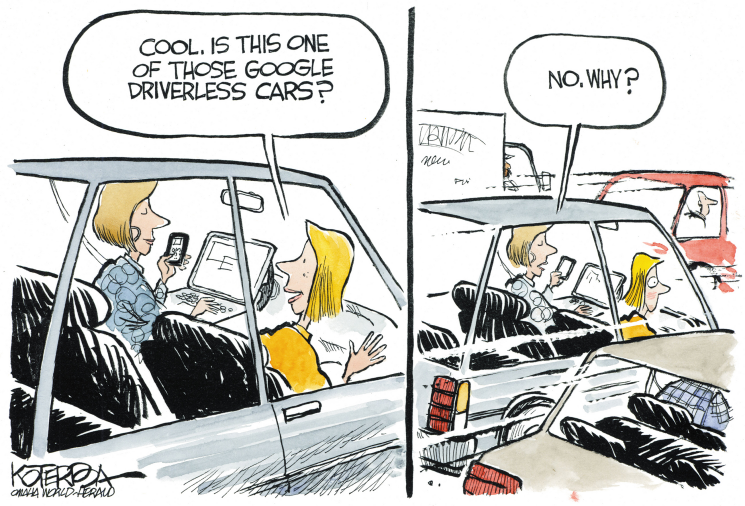
Comments Off on Tech Making ‘Car Guys’ Endangered Species

Relax, People! They’re Just Cookies!

Relax, People! They’re Just Cookies

Just as my annual diet has begun showing promise, my greatest obstacle to success is upon me: Girl Scout Cookie season has begun.

My problem with Girl Scout Cookies is personal. But, like everything else in our culture, some people have moral or political problems with them.

Some nutritionists say the cookies are unhealthy, so it’s immoral for Girl Scouts to promote these sugary, fatty treats to a nation struggling with an obesity epidemic.

Some conservatives say Girl Scouts openly promote progressive values and praise prominent progressive women, so purchasing Girl Scout Cookies is tantamount to supporting progressives’ politics.

Some progressives are still smarting because Girl Scouts marched in President Trump’s inaugural parade – even though Girls Scouts have marched in every presidential inaugural parade.

And some particularly anti-capitalist progressives are unhappy that cookie sales teach Girl Scouts the art of commercialism.

Hey, people, relax! They’re just cookies!

Still, these cookies present two primary challenges to so many of us.

First, they’re addictive. I’ve been known to consume entire sleeves of Thin Mints in one sitting, washing them down with a bucket of ice-cold whole milk – none of that 2-percent nonsense!

Second, everywhere we turn, someone, often a Girl Scout’s parent, is pressuring us to place an order.

This has become the season to “hide” from friends and relatives on Facebook, sneak out of church extra early (et tu, Deacon Brown?) and dodge multiple colleagues at work.

The best story about Girl Scout Cookie pressure in the workplace that I’ve heard happened last year at the Pentagon. An Air Force general was reprimanded, reports USA Today, “for encouraging a subordinate to retrieve boxes of Trefoils and Tagalongs from the general’s car for a display in the office.” I can imagine how it went from there:

“Sergeant, I’d consider it a personal favor if you ordered a dozen boxes from my daughter,” said the general.

“Sir, yes, sir!” the sergeant replied.

Look, the Girl Scouts organization was founded in 1912 to help girls develop physically, mentally and spiritually. The annual cookie sale, which originated in 1917, was designed to help teach girls new skills and responsibilities – not to have parents micro-manage those responsibilities for them.

I understand that we live in a time when parents are afraid to allow children to sell cookies door-to-door or to leave them unattended at a booth in front of a supermarket.

While it’s OK for parents to assist, Girl Scout leaders recommend that parents not sell cookies on their daughters’ behalf.

Here’s why, according to the Girl Scouts website: “Every time you buy a box, you help girls learn five essential skills – goal setting, decision making, money management, people skills, and business ethics – all while helping them better themselves and their communities.”

So long as you buy that box directly from a Girl Scout.

Some Girl Scouts have mastered new skills quickly.

One enterprising young lady, reports The Huffington Post, sold 117 boxes in two hours by setting up shop outside a legal medical-marijuana dispensary in San Francisco.

Some Girl Scouts in Los Angeles persuaded actor Tom Hanks to use his social media platforms to promote their cookie stand.

And in 2014, one young lady in Oklahoma City broke the record for Girl Scout Cookies sold in a year: more than 21,000 boxes. During her Girl Scout career, she sold more than 100,000 boxes.

The regrettable part of her success? I was her only customer.

Copyright 2019 Tom Purcell. Tom Purcell, author of “Misadventures of a 1970’s Childhood,” a humorous memoir available at amazon.com, is a Pittsburgh Tribune-Review humor columnist and is nationally syndicated exclusively by Cagle Cartoons Inc. For info on using this column in your publication or website, contact [email protected] or call (805) 969-2829. Send comments to Tom at [email protected].
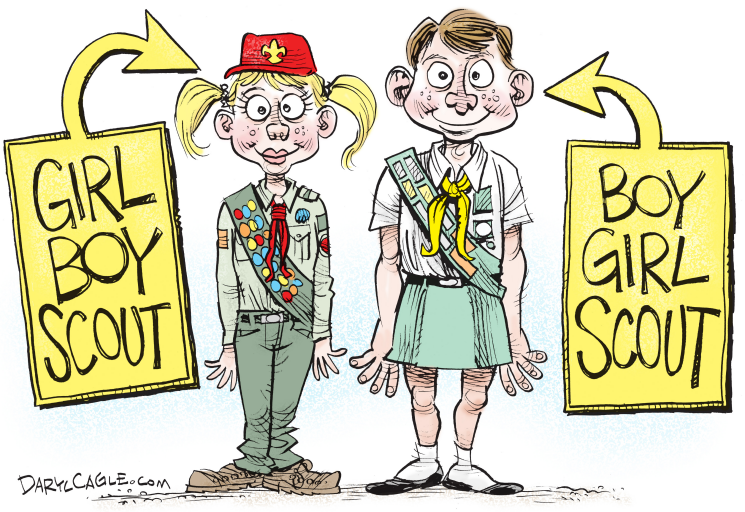
Comments Off on Relax, People! They’re Just Cookies!

It’s Up to Us to Realize Dr. King’s Dream

We’ll celebrate Dr. Martin Luther King Jr.’s birthday and legacy next week. In these angry and divisive times, we all could benefit by reminding ourselves of his words’ truth, civility and wisdom.

Too many of us are consumed with hatred and anger, which have reared their ugly heads in our public discourse lately. Dr. King, who endured hatred so ugly and excessive that it led to his assassination, spoke often of the futility of hating anyone or anything – of how hating harms the hater than the hated: ,

“Darkness cannot drive out darkness: Only light can do that. Hate cannot drive out hate: Only love can do that.”

“I have decided to stick to love … . Hate is too great a burden to bear.”

“Let no man pull you so low as to hate him.”

Our political leaders’ courage has always been in regrettably short supply. If only those leaders – who are more concerned with partisan interests than with our country’s many challenges – would heed these words from Dr. King:,

“The ultimate measure of a man is not where he stands in moments of comfort and convenience, but where he stands at times of challenge and controversy.”

“There comes a time when one must take a position that is neither safe nor politic nor popular, but he must take it because his conscience tells him it is right.”

“A genuine leader is not a searcher for consensus but a molder of consensus.”

Pride, the worst of the seven deadly sins, blinds us and holds us back. Dr. King taught us that forgiveness is the way to defeat pride:,

“Forgiveness is not an occasional act; it is a constant attitude.”

“Forgiveness means reconciliation, a coming together again.”

“We must develop and maintain the capacity to forgive. He who is devoid of the power to forgive is devoid of the power to love. There is some good in the worst of us and some evil in the best of us. When we discover this, we are less prone to hate our enemies.”

Something my father did in the military in the 1950s still makes me proud. He was raised in Pittsburgh in an era when he had limited interaction with the African-American community. In the Army, however, he became best friends with an African-American who was being harassed by another fellow solely because of his skin color.,

My father, a large, powerful man, used his fists to put an end to the harassment. His friend went on to become a physician. My father says of him, “He was the finest man I ever met.”

Dr. King understood that each of us walks the same path – that only a lack of good communication is holding us back:,

“People fail to get along because they fear each other; they fear each other because they don’t know each other; they don’t know each other because they have not communicated with each other.”

Dr. King’s dream was that his “four little children will one day live in a nation where they will not be judged by the color of their skin, but by the content of their character.”

My dream is that one day, we’ll get there – that one day, we’ll realize Dr. King’s wisdom, fully embrace it and act on it, fulfilling his dream and America’s promise of equality for all.

Copyright 2019 Tom Purcell. Tom Purcell, author of “Misadventures of a 1970’s Childhood,” a humorous memoir available at amazon.com, is a Pittsburgh Tribune-Review humor columnist and is nationally syndicated exclusively by Cagle Cartoons Inc. For info on using this column in your publication or website, contact [email protected] or call (805) 969-2829. Send comments to Tom at [email protected].
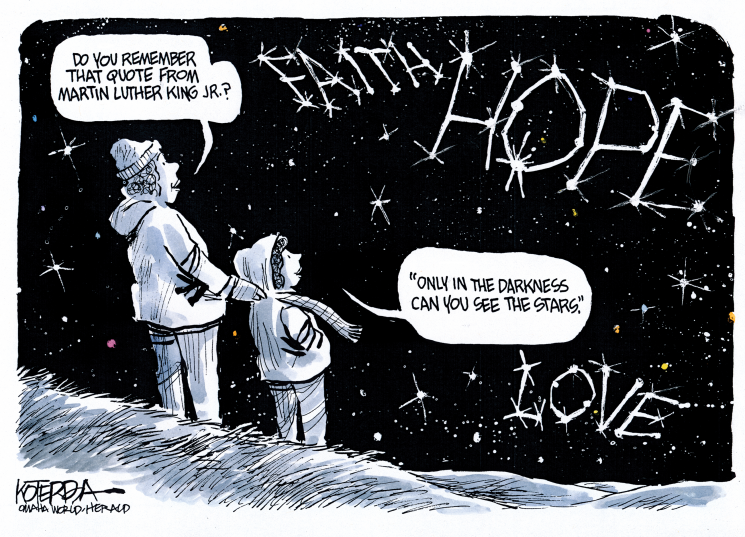
Comments Off on It’s Up to Us to Realize Dr. King’s Dream

Alexa, Why Won’t You Reply to My Father?

Is technology innovation doing us more harm than good? My family offers proof that it is.

My parents recently got Amazon’s supposedly “intelligent” personal assistant, Alexa.

Ask Alexa to play a song and she will (through her speaker).

Ask her to turn the lights on or off, and, if they’re plugged into a “smart” device, she’ll do that, too.

Ask her about the weather, news, traffic or sports and she’ll search the internet for answers.

But Alexa is causing incredible turmoil at my parents’ house.

“Amanda,” said my father the other day, “can you turn down the music?”

“Her name is Alexa,” said my mother, oddly protective of her new virtual friend. “If you don’t call her ‘Alexa,’ she won’t respond.”

“AlexIS,” said my father, “stop playing music so loudly!”

“Alexa!” said my mother.

“That’s what I said!” shouted my father.

“Sorry,” said Alexa. “I don’t know what you’re referring to.”

“I said turn down the damn music!” said my father.

“Don’t talk to her like that!” said my mother, pointing her finger at him.

“For God’s sake, Betty,” said my father, storming off in search of his print newspaper, “AlexIS ignores me worse than you do!”

My parents also recently installed a home video-surveillance system that my sisters and I monitor on our smartphones.

The other morning, the system notified us that someone was on my parents’ front porch. Opening the app, I saw a man, about 40, pounding on the door.

He wore a flannel shirt, dirty pants and scuffed boots. He had bags under his eyes and was fidgety.

“Let me in!” he said in a raspy, demonic whisper. “Let … me … in!”

Alarmed, I activated the intercom.

“May I help you?” I said forcefully through the system’s outdoor speaker. He muttered something, then turned away.

“What do you want?” I shouted.

He ran down the steps.

I called my parents’ house. Nobody answered. I called my oldest sister. She answered immediately.

“A drug addict is trying to get inside Mom and Dad’s house!” she shouted.

“I’m calling the cops!” I said, then did as I jumped into my truck and floored it.

Arriving a few minutes later, I discovered that the “drug addict” was actually a plumber my father had hired.

The plumber wanted to get inside the house because he was cold. He ran down the steps because my father had just opened the garage door to let him in.

After apologizing to the police for all of the hullabaloo – they were surprisingly polite to the latest idiot to overreact to his video-surveillance powers – I slunk back to my truck and got the heck out of there.

In this era of nasty tweets and Facebook insults, reports Psychology Today, technology is making us ruder. But it’s not just that.

Social media, according to various studies, is making us more isolated, more depressed and less connected with our fellow human beings. But it’s not just that.

Facebook, Google and Alexa know way more about us than most people are aware. But it’s not just that, either.

It’s that, despite technology’s many benefits, we now know way too much about way too many things. As my family shows, our massive daily information flow is causing us more grief than benefit.

Don’t believe me? Ask Alexa.

And don’t call her “AlexIS!”

Copyright 2019 Tom Purcell. Tom Purcell, author of “Misadventures of a 1970’s Childhood,” a humorous memoir available at amazon.com, is a Pittsburgh Tribune-Review humor columnist and is nationally syndicated exclusively by Cagle Cartoons Inc. For info on using this column in your publication or website, contact [email protected] or call (805) 969-2829. Send comments to Tom at [email protected].
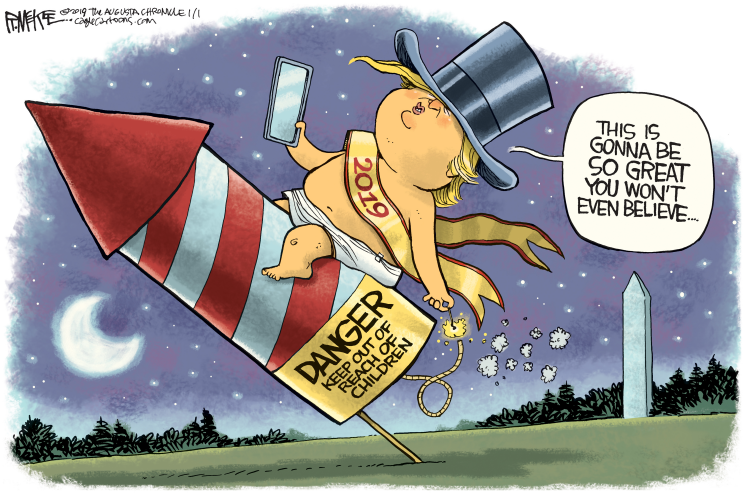
Comments Off on Alexa, Why Won’t You Reply to My Father?

Resolutions Our Politicians Won’t Keep

Celebrating the holidays with friends and family the past few weeks was great, but I m tired, bloated and crabby.

The New Year is upon us! What a great opportunity to start fresh and resolve to do great things in 2019.

How about I share some resolutions I hope our political leaders will keep. Here s one: Federal government, please stop spending so much!

Spending is certainly out of control. Federal debt is up nearly $1.4 trillion the past year. That’s nearly $11,000 in debt per American household – nearly $4,200 per person. And as interest rates rise, the payments on our debt are skyrocketing.

I ll tell you what else is skyrocketing: my family s health insurance premiums. My deductibles are so high, we’ll end up in the poorhouse if any of us gets sick. Hey, Democrats and Republicans, can you resolve to come up with a bipartisan solution for the massive cost of health insurance?

Regrettably, such reforms are not likely to occur. There is a growing chasm between Republicans and Democrats. As Republicans hope to undo Obamacare in the courts, more Democrats are supporting a single-payer government program. As more families suffer from high premiums and high deductibles, more Americans, according to Bloomberg, are warming to a Medicare for All concept.

They are?

Bloomberg says a Kaiser Family Foundation survey found last March that 59 percent of Americans favor the Medicare for All concept. Even when it was defined as a single-payer, federal program, 53 percent favored it. Some 75 percent favor a Medicare for All option if it lets people who have coverage keep their plans.

The way Obamacare allowed people to keep their plans? OK, if it’s unrealistic for our political leaders to spend less and improve health care, can they at least resolve to improve our public discourse?

Everyone has been hoping for that. Trump s supporters wish he would cool it with some of his tweets and his opponents are throwing around some heated language, too. With divided government in 2019, it appears discourse is going to get worse, not better.

Look, so much is at stake. We want our political leaders to work with each other to address our problems. We want them to end this silly government shutdown. Don t all of us, Republicans and Democrats alike, want them to knock off the nasty politics and address our spending, health care, infrastructure and immigration reform challenges?

I wish that were the case. USA Today reports that the only thing all Americans can agree upon is that our country is incredibly divided. Our politicians reflect our division. Again, look at health care. Republicans want market-based reforms that they hope will drive insurance premiums down. Democrats want the polar opposite: more government control. Or look at the Trump investigations. A majority of Republicans want them to end, but a majority of Democrats want the incoming House-majority Democrats to investigate more! Government gridlock, here we come!

For goodness’ sake!

It s a bit odd that so many Americans are so unhappy about so many things when a lot of things are going very well for our country. The economy is doing well. Wages are rising. Sure, we ve got challenges, but it s too bad we can t count some of our blessings as we address them.

Sure, we re blessed, but after chatting with you I feel even more tired, bloated and crabby.

Copyright 2019 Tom Purcell. Tom Purcell, author of “Misadventures of a 1970’s Childhood,” a humorous memoir available at amazon.com, is a Pittsburgh Tribune-Review humor columnist and is nationally syndicated exclusively by Cagle Cartoons Inc. For info on using this column in your publication or website, contact [email protected] or call (805) 969-2829. Send comments to Tom at [email protected].
Comments Off on Resolutions Our Politicians Won’t Keep

Joy, Wonder, Laughter Children’s Christmas Gifts to Adults

I love Christmas.

I love it because my mother has worked hard to make the day magical and eventful for her family for more years than she will permit me to share!

My mother has six children, 17 grandchildren and nine great-grandchildren – and counting. Every Christmas, we, along with a mix of cousins, aunts and uncles, gather in my parents’ home.

After we enjoy a Christmas feast – our dining room table abuts two folding tables borrowed from a local church – we enjoy coffee and desert as we talk about everything and nothing at all and marvel that another year has passed so quickly.

And then it’s time for the best part of our annual gathering: the gift exchange.

We retire to the family room in the basement, the only room big enough to hold everyone. My siblings and I helped my father remodel it into a family room years ago, and my mother’s elaborate Christmas decorations fill it with a warm glow.

My mother plays the very Christmas albums, scratches and all, that we listened to as children 40-plus years ago. These include “Holiday Sing-Along with Mitch Miller,” “Snoopy vs. the Red Baron” and Bing Crosby’s “White Christmas.”

We adults usually do a modest grab-bag swap, but the gift ritual isn’t for us. It’s for the youngest family members in the room.

Our large, extended family has suffered its share of loss over the years. We are filled with grief as our older family members pass on to the next life, leaving a huge hole in our hearts.

But our grief is eased by the energetic young souls who are born into our family – souls filled with boundless joy and wonder as they bask in the love of their extended family on Christmas.

There are few things more rewarding than to see the excitement and happiness in a young child’s eyes when she opens a gift you got just for her – there are few words more satisfying than “I love it, Uncle Tom!”

We must learn from our children – we must remember the truths we knew so well when we were their age.

Children are curious. “Why?” is the question they ask over and again. Their minds are wide open, trying to understand the world – not closed and judgmental, certain that their positions are correct and their opponents are fools.

Children are filled with love. Much of the evil in our world is caused by hatred. Hatred is a learned behavior that some adults pass down to their children. Love is innate. Adults must remember how to embrace love.

Children know how to laugh. Laughter is a cure for multiple ills, in particular stress. Laughter helps us escape the narrowness of our limited points of view – helps us escape self-importance. Remember how easily laughter came as a child? Adults must remember to laugh.

I hope the eventfulness of my parents’ family room on Christmas will be a memory our youngest family members will cherish for the rest of their lives.

They have no idea how much their presence and excitement fills us adults with boundless joy.

How much better the world would be if we adults became more curious and loving and laughed more as we navigate the complexity of the adult world.

That’s why I love Christmas – and wish you, dear readers, and your families an uplifting holiday season!

Copyright 2018 Tom Purcell. Tom Purcell, author of “Misadventures of a 1970’s Childhood,” a humorous memoir available at amazon.com, is a Pittsburgh Tribune-Review humor columnist and is nationally syndicated exclusively by Cagle Cartoons Inc. For info on using this column in your publication or website, contact [email protected] or call (805) 969-2829. Send comments to Tom at [email protected].
Comments Off on Joy, Wonder, Laughter Children’s Christmas Gifts to Adults

All Along, Google’s Been Googling Me

I thought Facebook knew too much about me, but it turns out Google is even worse.

Google, like Facebook, makes its money by targeting ads at us that reflect our interests and needs. The more both know about us, the better they’re able to target us with ads we’re likely to click.

But Google knows a lot more about me than I thought – plenty more than Facebook.

Since I created a Google account – I use Gmail and Google Docs for my rental-property business – I have freely provided Google with lots of personal information.

I’ve told Google my name, birthday and gender. It knows my phone number and password. It tracks my email correspondence, photos or videos I’ve saved, documents I’ve created in Google Docs, any calendar events I’ve noted, any contacts I’ve added.

But Google also collects lots of data that I didn’t know I was providing.

“When you use our services – for example, do a search on Google, get directions on Maps, or watch a video on YouTube – we collect data to make these services work better for you,” reports Google on its “Data Transparency” page.

That’s where things get a little bit creepy.

Not only does Google keep extensive data on the searches you’ve conducted and the websites you’ve visited, it likely knows where you are at this moment – and everywhere you’ve been.

I discovered this when I reviewed some of the data Google has collected about me.

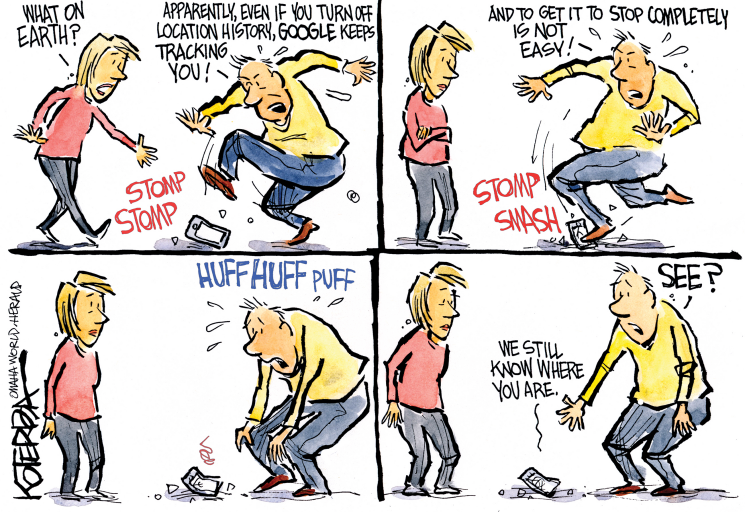
My Android smartphone, I now know, has been sending Google my location data – incredibly detailed location data – for a very long time. I found this information on my personal Google Location History page.

Curious, I clicked on “Saturday, December 15.” A map displayed the entire route I drove that day.

At 9 a.m., Google knew that I left my house and drove to a diner; it knew the name and address of the diner.

It knew that I spent 25 minutes in the diner – I had breakfast with two hired hands who would help me that day – then arrived at U-Haul at 9:38 a.m. I left U-Haul with a box truck at 9:51 a.m. and arrived, at 10:33 a.m., at a private home to pick up some furniture I purchased from the owner. I left at 10:42 a.m. and drove to a consignment store to pick up more furniture.

Google knows everywhere I went that day. In fact, Google knows everywhere I’ve been – and how much time I spent there – every moment of every day since I began using my Android years ago.

“Google promises that it keeps all of this data safe during transit between your computer or smartphone and its servers,” reports CNBC. “It also says that its cloud infrastructure protects that data, and that it doesn’t give governments ‘direct access’ or ‘backdoor access’ to any information.”

Why am I not comforted by this promise?

It’s true that Google gives individuals the option of adjusting privacy settings. On Google’s Activity page, I can turn off location tracking and stop Google from tracking the devices I use, the YouTube videos I watch, my website activity and more.

Still, it’s unsettling that anyone, let alone one of the biggest companies on Earth, knows so much about me – and about so many of us.

Google it? With what I know now, it seems more like Google is Googling me.

Copyright 2018 Tom Purcell. Tom Purcell, author of “Misadventures of a 1970’s Childhood,” a humorous memoir available at amazon.com, is a Pittsburgh Tribune-Review humor columnist and is nationally syndicated exclusively by Cagle Cartoons Inc. For info on using this column in your publication or website, contact [email protected] or call (805) 969-2829. Send comments to Tom at [email protected].
Comments Off on All Along, Google’s Been Googling Me

I’m Dreaming of a Debt-Free Christmas

Merry debt-fueled Christmas, America!

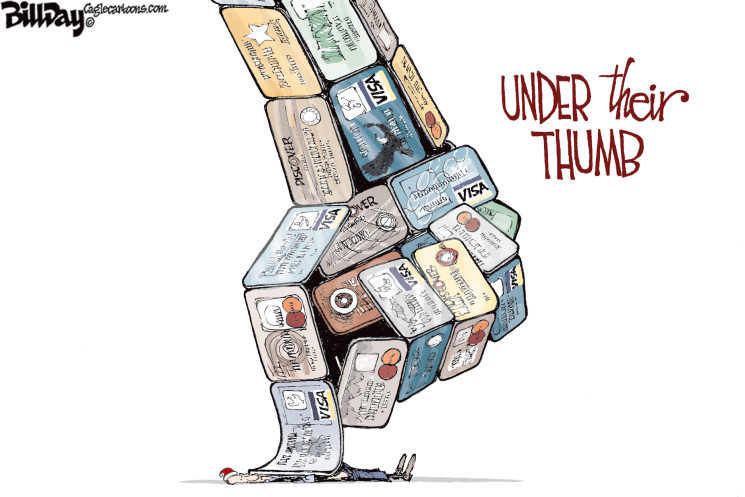
According to a recent NerdWallet study, nearly 40 million Americans are still struggling to pay off credit-card debts from last Christmas.

Here’s what’s worse: NerdWallet finds that this Christmas, “American consumers plan to spend more, charge more to credit, and take a longer time to pay it all off.”

Good grief!

The grand irony is that the gifts we go in hock to give our kids and each other are often forgotten before the debt is paid off.

I was a kid in the ’70s. But aside from a Huffy “Spyder” bike I got when I was 10, I can’t remember a single gift I received – though I vividly remember the extraordinary blessings my parents bestowed on me.

I remember going from lot to lot with my father in search of the perfect Christmas tree. We’d bring it home and set it on a sturdy plywood platform he built. We’d decorate the tree as a family, and my mother would explain the history of antique ornaments handed down by family members no longer with us.

I remember that our next-door neighbors, the Kriegers, would always visit on Christmas Eve. Tremendous festivity would fill the air. Donny Krieger, the big brother I never had, would make me laugh out loud (and would be taken from this Earth far too early).

I remember that sleeping on Christmas Eve would be nearly impossible. My father would stack the old stereo console in the dining room with every Christmas record we had – Mitch Miller, the Munchkins, Snoopy and the Red Baron, and Bing Crosby’s “White Christmas.” The scratchy old records would finally lull me to sleep.

I remember it suddenly would be morning. I’d jump out of bed and run around, waking my sisters. Opening our gifts, torn wrapping paper would fill the living room. We’d laugh out loud as Jingles, our beloved mutt, rolled around in it.

But I don’t remember the gifts.

I remember my five sisters, my parents and I were together and happy and healthy. All family conflicts and disputes were set aside on Christmas morning. My father would make a massive breakfast and we’d sit around, laughing and talking for an hour or more. Then, despite his repeated warnings that we’d better arrive at church early, we’d stand in the aisle because some once-a-year churchgoing family would be sitting in our regular seats.

Aside from the spiritual element, memories are what Christmas is most about. My Christmas memories are about togetherness, joy and gratitude for my family’s many blessings – things that cannot be acquired through credit-card debt.

Which makes our growing debts all the more ridiculous.

By the end of 2018, American debt will exceed $4 trillion for the first time – $1 trillion in credit-card debt, $1.5 trillion for auto loans and other debts that do NOT include mortgage debt, and $1.5 trillion in student-loan debt that is wreaking havoc on the average millennial’s cash flow.

We should spend less on Christmas, not more. We should give more of our time and love, and be charitable, with some of the limited funds we have, to those in greater need.

We certainly should not borrow money we don’t have to purchase things that will soon be forgotten.

All I want for Christmas this year, and every year, is the health and happiness of my loved ones – and more memories, of course.

Copyright 2018 Tom Purcell. Tom Purcell, author of “Misadventures of a 1970’s Childhood,” a humorous memoir available at amazon.com, is a Pittsburgh Tribune-Review humor columnist and is nationally syndicated exclusively by Cagle Cartoons Inc. For info on using this column in your publication or website, contact [email protected] or call (805) 969-2829. Send comments to Tom at [email protected].
Comments Off on I’m Dreaming of a Debt-Free Christmas

Good Grief! Critics Miss Christmas Specials’ Points

Good grief!

With everything in everyday American life politicized, count on someone, somewhere, being offended by something, anything – even classic Christmas TV specials.

A recent Huffington Post tweet promoting a video about a holiday classic says “‘Rudolph the Red-Nosed Reindeer’ is seriously problematic.”

Why? Because Rudolph’s father, Donner, verbally abuses him for being different; because Santa is a bigot who mocks Donner for having an odd son; because the school coach encourages the other reindeer to bully Rudolph; and because Donner is a sexist who tells his wife she can’t search for the missing Rudolph because it’s man’s work.

One commenter’s tweet in the video sums the criticisms up well: “Yearly reminder that #Rudolph the Red-Nosed Reindeer is a parable on racism & homophobia w/Santa as a bigoted exploitative (expletive).”

It’s unclear whether the video was intended as satirical or serious, but at this time of constant outrage, nobody would be surprised if it’s an actual criticism.

Because recent criticisms of “A Charlie Brown Thanksgiving” – some charge racism because black character Franklin sits alone on an old lawn chair at one side of the table – are not satire.

Such criticisms miss the point.

According to The Atlantic, the story of “Rudolph the Red-Nosed Reindeer” was created in 1939 by retailer Montgomery Ward, which featured Rudolph in promotional coloring books.

In 1949, the story became the basis for a hit song that transformed Rudolph from “misfit to hero.”

In 1964, when the stop-motion animation Christmas special was first broadcast, a whopping 50 percent of the American viewing audience watched it.

Why? Because “Rudolph” is the ultimate underdog story.

We all know, of course, that Rudolph’s “very shiny nose” makes him different; that the other reindeer call him names; and that he triumphs over adversity.

He proves his many naysayers were wrong to try to make him conform. He demonstrates that what others saw as his biggest weakness was in fact his biggest strength.

To be sure, Rudolph’s hero journey should be celebrated, and it is, by millions of viewers – many of whom posted sensible tweets showcasing why the HuffPo video so woefully missed his story’s point.

Which brings us to Franklin in “A Charlie Brown Thanksgiving.” Charles Schulz introduced Franklin Armstrong in his “Peanuts” comic strip in July 1968.

“At the time, the United States was struggling with desegregation, and while the country had taken several steps to integrate the population, issues about having black and white people attend the same schools, use the same bathrooms, or appear in the same comic strips were still matters of substantial controversy,” reports Snopes.com.

In other words, Schulz took a big chance by introducing a black “Peanuts” character. Correspondence with Harriet Glickman, a teacher in Los Angeles, explains why.

According to NPR, Glickman wrote Schulz a letter explaining why a black Peanuts character “could play a small part in promoting tolerance and interracial friendship.”

Schulz wrote back, explaining that he considered her suggestion, but “he worried that if he created such a character, black parents might think he was condescending to their families.”

Nonetheless, despite backlash from some newspaper editors and other naysayers, Schulz introduced Franklin, using “Peanuts” to help, as best he could, quell our divisions.

Schulz was courageous, not racist.

That such context must be provided to counter critics of America’s long-beloved Christmas specials makes me want to say one thing.

Good grief!

Copyright 2018 Tom Purcell. Tom Purcell, author of “Misadventures of a 1970’s Childhood,” a humorous memoir available at amazon.com, is a Pittsburgh Tribune-Review humor columnist and is nationally syndicated exclusively by Cagle Cartoons Inc. For info on using this column in your publication or website, contact [email protected] or call (805) 969-2829. Send comments to Tom at [email protected].

Comments Off on Good Grief! Critics Miss Christmas Specials’ Points