Our National Debt Is Out of Control, But Nobody Seems to Care

[cwrtoon id=”221816″]

Breaking news: Federal spending is out of control.

I’m kidding, of course. Spending, deficits and debt have been out of control for years. It’s just that last week we broke yet another record.

For the first time in our nation’s history, federal spending topped $3 trillion in a fiscal year’s first eight months, according to last week’s Monthly Treasury Statement.

How much is $3 trillion? According to Kiplinger, $3 trillion would pay the salaries of every member of the U.S. Congress for the next 32,336 years.

Of course the issue isn’t just what the U.S. government spends. It’s what the government spends relative to the tax revenue it takes in. In that regard, there’s some good news and some bad news.

The good news: The economy is doing well, causing tax revenue to swell. During this fiscal year’s first eight months, federal tax revenues were the second highest ever collected (they were down slightly from last year’s record amount).

The bad news: Our government continues to spend way more than it takes in – about $800 billion more during this fiscal year’s first eight months, despite tax revenue pouring in.

That $800 billion adds to our national debt, which now stands at a whopping $22 trillion.

How much is $22 trillion? If you were to repay $22 trillion at $220 million every day, it would take 273 years to pay off the balance – on an interest-free loan!

In other words, we have a massive a spending, deficit and debt problem, but few people seem to worry about it anymore.

A recent Wall Street Journal article, “How Washington Learned to Love Debt and Deficits,” sheds light on the regrettable lack of interest in taming our growing debt.

“In theory, an increased supply of government bonds – sold to raise funds when spending exceeds revenues – should increase government borrowing costs,” write Kate Davidson and Jon Hilsenrath. “Theory also says big deficits crowd out business borrowing and increase private borrowing costs, too. The opposite has happened.”

What has happened is that the economy expanded by a robust 5.2 percent last year while the cost of government borrowing remained relatively low – one reason why immediate concerns over spending, deficit and debt concerns have waned.

How long we can get away with heavy borrowing is anyone’s guess. As baby boomers retire in big numbers, the costs of Social Security, Medicare and other government programs will soar. We already are NOT able to pay our bills. The Congressional Budget Office estimates we will begin falling $1 trillion short in 2022 and keep falling short by that amount annually through 2029.

Even this English major can calculate that our national debt may stand at $33 trillion or more by 2030.

How much is $33 trillion? It’s $30 trillion more than the debt was in 1989, $28 trillion more than it was in 1999, $21 trillion more than it was in 2009 and $11 trillion more than it is now.

It worries me that I’m one of the few Americans left who worries that our deficits, spending and debt are out of control.

So I may as well have some fun with the subject.

If the U.S. government printed $1 million bills, a whole bathtub’s worth of them wouldn’t equal $1 trillion. And 33 bathtubs full of $1 million bills won’t be enough to cover our national debt in 2030.

Copyright 2019 Tom Purcell. Tom Purcell, author of “Misadventures of a 1970’s Childhood,” a humorous memoir available at amazon.com, is a Pittsburgh Tribune-Review humor columnist and is nationally syndicated exclusively by Cagle Cartoons Inc. For info on using this column in your publication or website, contact [email protected] or call (805) 969-2829. Send comments to Tom at [email protected].
Comments Off on Our National Debt Is Out of Control, But Nobody Seems to Care

My Remarkably ‘Unremarkable’ Father

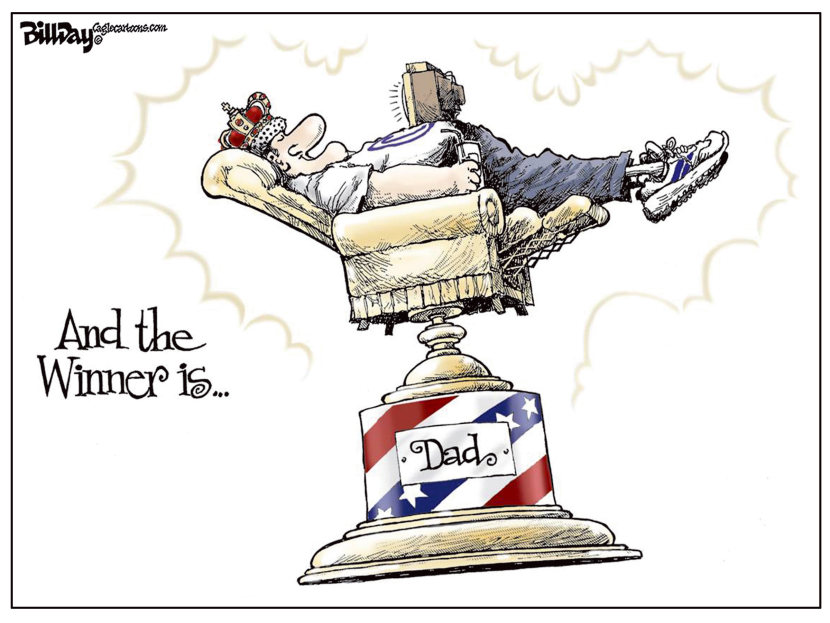
My dad turns 86 next month. He never thought he’d live so long – or see as many Father’s Days as he has – because his parents both died far too young.

A stroke claimed his mother when she was 69 – the same night Pittsburgh Pirates great Roberto Clemente’s hurricane-relief plane went missing.

It was the first time I’d ever heard my father sob.

My dad’s father was only 34 when he died in 1937. My father, then just 3, lost half of his universe. His dad had a great job as an accountant for the Mellon family. His early death greatly altered my father’s future.

My dad’s mother had to work full-time to make ends meet, leaving him to fend for himself on city streets.

Often unsupervised, he got into some trouble – once, a stone he set on the tracks nearly derailed a trolley car – but sports saved him.

His high school football coach shaped him into a championship running back – while serving as the father figure he ached for.

And then, after a baseball game he’d played, my father met my mother.

When their eyes met on that afternoon 68 years ago, it was lights out for him.

Their 1950s courtship was not unlike those in the 1970s sitcom “Happy Days.”

When football scholarship offers rolled in, my father couldn’t bear the thought of four long years away from my mother.

Not even Chuck Noll, then captain of the University of Dayton football team – who’d coach the Pittsburgh Steelers to four Super Bowl wins – could persuade my dad to leave her behind.

My dad never desired great fortune or fame. He didn’t need to be a corporate executive or public figure. All he wanted was to be with my mother, start a family with her and build a life.

He worked hard for Bell Telephone for nearly 40 years. He and my mother would be blessed with six children, 17 grandchildren and nine great-grandchildren – and counting! – amid the many ups and downs that a long marriage and a large, extended family bring.

He’d tell you his life is unremarkable – that lots of men made the choices he made. But I disagree.

Never a man big on words, his actions always have spoken loudly.

He worked long hours to support us, but never kept more than $5 a week for himself – to buy a couple of cups of coffee.

He made clear his devotion to our mother, and to us. He and my mother gave us a deep sense of security that he never had as a child.

His five daughters all married men with the same sort of character and integrity that still guide his existence, and their children have embraced these important traits, too.

My dad still pays his bills and his taxes on time. He never took a loan he didn’t repay. He coached baseball and served his church.

And all along, he desired only his family’s love and well-being – and a few ice-cold Pabst Blue Ribbons – as rewards.

Fathers like my father make magnificent contributions to their families and our world. Great civilizations are built on their shoulders.

Yet they see their selfless support, guidance and nurturing of their families as “unremarkable” – which makes them all the more extraordinary.

That’s why, this Father’s Day, I want my father to know just how remarkably “unremarkable” he is.

Copyright 2019 Tom Purcell. Tom Purcell, author of “Misadventures of a 1970’s Childhood,” a humorous memoir available at amazon.com, is a Pittsburgh Tribune-Review humor columnist and is nationally syndicated exclusively by Cagle Cartoons Inc. For info on using this column in your publication or website, contact [email protected] or call (805) 969-2829. Send comments to Tom at [email protected].
Comments Off on My Remarkably ‘Unremarkable’ Father

Time to Retire Social Security Numbers

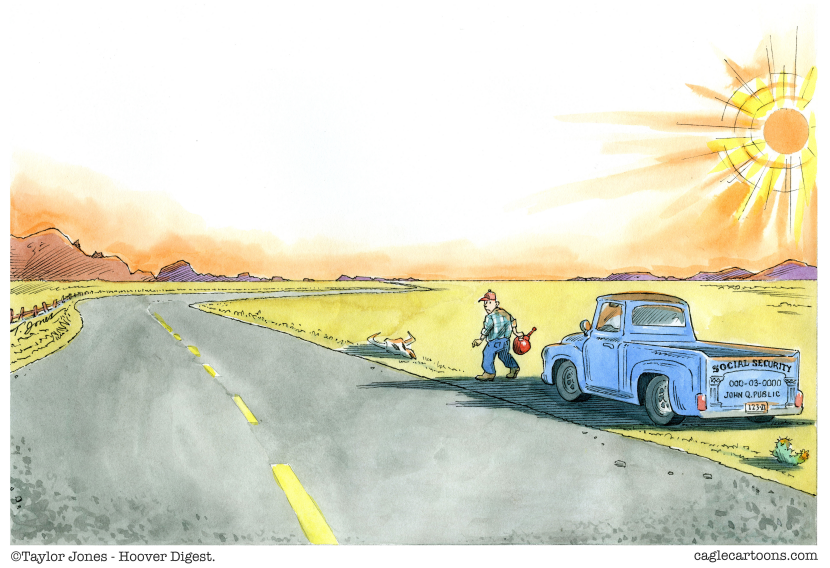
Like most people, I didn’t think much about my Social Security number – until I got a bizarre call from a total stranger.

“Hello?” I answered suspiciously, because I saw “restricted” on my smartphone screen.

“Hello, Tom.”

“Who is this? What do you want?”

“Who I am isn’t important. I called to thank you for working hard and paying your bills on time. Your excellent credit was just what I was looking for when I borrowed your Social Security number.”

“You WHAT?”

“It was easy, Tom. Maybe I sifted through your garbage, or bought it from a hacker, or got you to click on a link in a fake email that gave me access to your computer. Opportunities to get Social Security numbers are endless these days!”

“What did you do with mine?”

“I went on a spending spree, Tom! See, when Social Security numbers were created in the 1930s, they had one and only one job: to enable the Social Security Administration to track the lifetime earnings of individual workers.”

“What’s your point?”

“Just that Social Security numbers were never intended to become personal identification numbers – but that’s what happened! Wired says they’re now used ‘both as identifiers to link people to their data, and as authenticators to prove that people are who they claim.'”

“So, once you get my Social Security number, you can access my records, assume my identity – and commit fraud.”

“You catch on fast, Tom. Social Security numbers now have dozens of congressionally approved uses. You can’t drive, vote, apply for a job, buy a new cellphone or get a credit card without one. Once I had yours, I was off to the races!”

“Ah, your spending spree.”

“I spent thousands of dollars with credit cards in your name, Tom! I’m sitting in a new Jacuzzi, sipping 20-year-old bourbon and talking to you on a new smartphone!”

“You dirty ROTTEN …”

“Whoa, Tom – it’s nothing personal! I’ll be doing this to someone else tomorrow. And every day until the Social Security number is replaced by modern personal-identification methods.”

“You’d hate that, wouldn’t you?”

“I sure wouldn’t like biometric security processes based on unique voice characteristics or your eye’s iris or retina pattern. I’m already not fond of smartphones that need a fingerprint to unlock.”

“Sounds more secure to me.”

“It’s good for me that America’s behind, Tom. I read in Forbes that in Estonia, which uses a cryptographic-number approach, ‘every citizen is issued a smartcard (and optional secure mobile SIM) tied to a public key infrastructure that can be used to securely identify the user to most government services as well as conduct any number of business transactions … .'”

“Yeah, well, I’m sure the U.S. will come up with a replacement for Social Security numbers soon!”

“But Tom, there are all those worries about privacy considerations. Americans want a new approach that would make it easier for individuals to keep government officials and others from tracking their activities.”

“So?”

“Any change will be a massive effort too, Tom, affecting millions of people! The government will have to lead. The Trump administration has ordered federal departments to explore alternatives. Congress needs to hold hearings to move things along. That’s GREAT news for me, Tom!”

“How so?”

“Because by the time our politicians stop calling each other names long enough to address a real challenge like this, I’ll be a VERY rich man – thanks to fine, upstanding citizens like you!”

Copyright 2019 Tom Purcell. Tom Purcell, author of “Misadventures of a 1970’s Childhood,” a humorous memoir available at amazon.com, is a Pittsburgh Tribune-Review humor columnist and is nationally syndicated exclusively by Cagle Cartoons Inc. For info on using this column in your publication or website, contact [email protected] or call (805) 969-2829. Send comments to Tom at [email protected].

Comments Off on Time to Retire Social Security Numbers

Honor the Fallen by Hiring Veterans

With your military service complete, you’re eager to return home and get on with life in the private sector.

Surely, in a booming economy, you’ll have your pick of jobs?

Your training is extensive, after all – the U.S. military’s technology training and educational advancement is among the world’s very best.

Maybe you were a squad leader in the infantry, routinely making more important decisions – life-and-death decisions – than a large global corporation’s CEO makes.,

Nobody questions your passion to succeed. Your record of accomplishments is long. Few can match your work ethic.,

But transitioning to private employment proves to be far more difficult than you expected.,

Your military promotions were based on your merits – your smarts and ability to make split-second decisions under incredible duress.

Never once did you have to prepare a resume, interview, schmooze at networking events or tell potential new bosses why you should be their choice for a job.

In the military, you were a member of a team, living for your brothers and sisters and they for you, with continuous personal and professional support.,

But upon retirement, only disabled vets receive ongoing support from the Department of Veterans Affairs and other government agencies.

You’re on your own – and you need “soft skills” to prepare for job interviews and translate your considerable military credentials into a winning resume.,

The numbers bear out your challenge: In some regions, the unemployment rate among veterans is considerably higher than among non-veterans – up to 2.5 percent higher in Pittsburgh’s Allegheny County, for example.

Jack Wagner, a Marine Corps veteran, Purple Heart recipient and longtime local and state public servant, saw the need to address your challenge.,

“Every veteran and spouse of a veteran is guaranteed a burial spot, but not a job,” he says. “We teach veterans how to take off in terms of training them in the military, but we don’t teach them well how to land when they come back to civilian life.”

In 2016, he led an effort with other concerned veterans to establish Pittsburgh Hires Veterans (PHV), a private, nonprofit organization that provides free one-on-one counseling and support to veterans and their spouses, including the National Guard and Reserves.,

PHV’s approach is based on each individual’s unique needs and challenges. PHV’s team of four guided a highly credentialed personnel officer from months of unemployment into a human resources position with a global corporation.

PHV helped one long-unemployed young man attain the skills and mindset he needed to land a solid, livable-wage job – helping him address issues resulting from his traumatic brain injury.

PHV helped another young man move from an indoor job he disliked, occupational therapist, to an outdoor job he loves, assistant grounds superintendent at a large, historic cemetery.

PHV currently serves 200 veterans – double the number a year ago – and each of us can help PHV find them gainful work.

If you’re an employer, share your job opportunities. PHV is your gateway to veteran talent.,

If you’re an individual, financial donations are welcome. PHV gets by solely on private funds. But you can

also tell veterans looking for work that PHV is eager to help (be sure to “like” PHV on Facebook).

If you’re with a government agency or nonprofit helping transitioning veterans in other states, collaborate with PHV to support veterans moving between regions or to simply share notes.,

Memorial Day is upon us – the one day a year when we honor the men and women who made the ultimate sacrifice serving our country.

What better way to serve veterans transitioning to private life than by doing our small part to help them find meaningful employment?

Visit PHV at, www.PittsburghHiresVeterans.org., ,

Copyright 2019 Tom Purcell. Tom Purcell, author of “Misadventures of a 1970’s Childhood,” a humorous memoir available at amazon.com, is a Pittsburgh Tribune-Review humor columnist and is nationally syndicated exclusively by Cagle Cartoons Inc. For info on using this column in your publication or website, contact [email protected] or call (805) 969-2829. Send comments to Tom at [email protected].

Comments Off on Honor the Fallen by Hiring Veterans

‘Do Over’ Proms Pursue Perpetual Adolescence

Prom season is upon us. We all know what that means: More American adults are doing their proms all over again.

A New York Times headline about a growing number of adults says they are taking “A Second Shot to Have the Best Night of their Lives.”

And carry on like a bunch of retrograde adolescents.

The modern prom, reports Slate, “may be traced to the Ivy League and the annual tradition of a ‘presentation week,’ during which formal dress and dancing accompanied a promenade concert.”

Not content with only the well-to-do experiencing the awkwardness and misery of the prom, high schools across America embraced it, particularly after World War II. Now the prom is a rite of passage for American teens everywhere, with many blowing thousands of dollars on their big nights.

But I certainly wouldn’t want to do my prom over.

I didn’t know my date very well. She was in my photography class, very pretty and, more importantly, still available.

When she agreed to go with me, she greatly disrupted the Bethel Park High School prom-date pecking order. Whereas my date greatly raised my social status – even my friends and family were shocked she’d go with me – I lowered hers.

She was awfully sore about it.

“I heard about you,” she told me at our pre-prom date. “A regular class clown! You better not show up in a limo, wear a top hat or cane or do anything else to embarrass me!”

That set the tone for an incredibly unpleasant weekend.

We got lost on the way to the prom, lost on the way to my friend Cook’s cabin in Ohio and lost on the way home. My first foray into the adult world was rough, to be sure – a precursor, regrettably, of many more unpleasant adult experiences to come.

Similarly awkward prom experiences may motivate the growing number of adults trying to “get it right” during a second round.

But there are no “do overs” in life. Didn’t novelist Thomas Wolfe make it clear that we “can’t go home again”?

The prom is supposed to be a teen’s first foray into the adult world, not an adult’s eager return to adolescence.

That’s not stopping ever more “adults” from trying. Too many are not just doing their proms over, they’re doing summer camps over, too – another hot trend.

To be sure, a growing desire for perpetual adolescence among today’s “adults” is revealing itself all over the place – from delaying moving out of their parents’ homes to delaying marriage and parenthood. That same desire leads Hollywood to keep recycling favorite movies and TV shows from their adolescence.

Look, if you had an unpleasant prom experience when you were 18, as I did, those are the breaks.

I wrote an earlier, light-hearted newspaper column about my experience. It was published all over the country.

After that piece ran, I bumped into my old prom date at the grocery store. She still looked great, but, boy, she was really sore now.

It turns out her husband was so delighted by her rare rude behavior – so delighted, for once, that she, not he, was the one deserving a lecture – he carries the column around in his wallet, showing it enthusiastically to total strangers.

The joy I get from that story almost makes my lousy prom experience worthwhile – but certainly not enough to make me want to do the prom all over again.

Copyright 2019 Tom Purcell. Tom Purcell, author of “Misadventures of a 1970’s Childhood,” a humorous memoir available at amazon.com, is a Pittsburgh Tribune-Review humor columnist and is nationally syndicated exclusively by Cagle Cartoons Inc. For info on using this column in your publication or website, contact [email protected] or call (805) 969-2829. Send comments to Tom at [email protected].

Comments Off on ‘Do Over’ Proms Pursue Perpetual Adolescence

Why I Hope to Become Just Like My Ma

I hope to be just like my mother one day.

Now in her eighth decade, my ma has arrived at a coveted place: Her “filter” is pretty much gone, and she has no problem telling anyone what’s on her mind.

“Ma, please don’t tell us any more details,” my five sisters and I beg her, when she shares “way too much personal information” about her 63 years of marriage to my father.

“Cowards,” she says with a snort.

My ma’s passion is to teach the youngest members of her large clan the most important things in life (family, charity, doing unto others as you would have them do unto you) and to waste as little time as possible on the least important things (money, selfishness, giving too much weight to what others think of you).

And she voices these opinions loud and strong.

“Ma, you can’t post that on Facebook,” we tell her, mortified, when she responds to a post she adamantly disagrees with.

“Then unfriend me!” she says with a defiant laugh.

“Ma, you can’t pressure wash and paint the deck anymore and neither can Dad!” we plead with her.

“Worry about your own silly deck,” she says, supremely confident she and my father will get the project done without help, as they’ve done dozens of times before. “And while you’re up, get me another glass of wine!”

I can’t blame her for thinking as stubbornly as she does. She’s proved naysayers wrong for most of her adult life.

The oldest of six siblings, she spent her early life caring for her young sisters and brothers. Her mother relied heavily on my ma to run their home.

At 19, just a year after graduating from high school, my ma got sick – very sick.

She was engaged to my father when it happened, but he was serving in the military in faraway Texas. Mortified that she hadn’t been writing him or accepting his phone calls, he dispatched his mother to make sure she was OK.

She wasn’t. Rheumatic fever nearly claimed her life. Doctors would tell her that her heart was damaged by a serious murmur – that she should never bear children and would be lucky to live into her 40s.

My mother’s response: “To heck with that!”

She had six children and now has 17 grandchildren and nine great-grandchildren.

When she and my father retired more than 20 years ago, did they downsize to a smaller home, as sensible people do?

Nope.

They bought a large fixer-upper with a great big living and dining area that could seat up to 40 people at three or four tables for holiday dinners. Our extended clan enjoyed many events at that wonderful home.

And now, as spring blossoms, are my mother and father touring retirement homes, as their more sensible friends are doing?

Nope.

They are at the hardware store as I write this column, picking out deck paint so they can get their home in order before the next family gathering – which, fittingly, will be on Mother’s Day.

My ma’s unflinching devotion to all things good and true – a strong sense of family, charity and doing unto others – has been passed on to her extended clan.

Her spirit certainly lives in my youngest sister, Jennifer, and Jennifer’s three sons. Last week, my nephew Carson made sure that a shy, autistic classmate was recognized on his birthday with a proper celebration.

That is the “power of mothers,” the caretakers of empathy, beauty and all of the most important things in life.

My fearless, filterless mother is driving my sisters and me buggy in so many ways, if you want to know the truth.

I hope to be just like her one day.

Copyright 2019 Tom Purcell. Tom Purcell, author of “Misadventures of a 1970’s Childhood,” a humorous memoir available at amazon.com, is a Pittsburgh Tribune-Review humor columnist and is nationally syndicated exclusively by Cagle Cartoons Inc. For info on using this column in your publication or website, contact [email protected] or call (805) 969-2829. Send comments to Tom at [email protected].

Comments Off on Why I Hope to Become Just Like My Ma

Doggone Discourse Better Focused on Real Problems

Boy, is our political discourse going to the dogs.

The Washington Post reports Donald Trump is the first U.S. president in 100-plus years not to have a dog -though others, including Ronald Reagan, didn’t have dogs until their second terms.

During a February rally, reports The Post, Trump said “he doesn’t have a dog because the idea of getting one seems ‘phony’ to him.”

Using presidential pets to score political points is not without precedent. The Hill says “avid dog lover” Herbert Hoover was among the first to do so, while running for the nation’s highest office.

“Following campaign advice, with hopes of shaping his image into something warmer and more charismatic, he released a photograph of himself with his German Shepherd, King Tut,” says The Hill.

King Tut helped Hoover win the White House, but after he presided over the 1929 stock-market crash, Hoover was routed by FDR in the 1932 presidential election.

According to The Hill, some suggested Bill Clinton got Buddy, his beloved chocolate Labrador, to help his image at the peak of the Monica Lewinsky scandal. Maybe so, but photos clearly show Clinton enjoyed Buddy’s company.

George H.W. and Barbara Bush had Millie, an English springer spaniel who famously birthed six White House puppies. Millie’s book was a huge seller. Their presidential son had a dog, too.

“President George W. Bush’s Scottish terrier Barney became a celebrity in his own right, appearing in more than 10 films while he was at the White House,” says The Hill.

The Obama family chose Portuguese water dogs Bo and Sunny, in part because Malia Obama required a hypoallergenic breed. The canines brought joy to the Obama family and were a delight at various White House events.

But no dog for the Trumps?

“Ever since President William McKinley’s administration -which began in 1897 -every single occupant of the White House, save for Trump, has had a dog at some point,” reports The Post.

Trump said he’d feel odd walking a dog on the White House lawn and just doesn’t have the time to do so.

And that resulted in a loud negative response, in these over-charged times, that the current occupant of the White House loathes all things canine.

“WHY DOES PRESIDENT DONALD TRUMP HATE DOGS?” asks Newsweek.

“Instead of having dogs, which tend to crave attention and often are scene stealers where photography is involved,” Newsday columnist Anne McFeatters tells us, “Trump frequently calls women he disdains ‘a dog.'”

In a New York Times column, Timothy Egan writes: “We know that Donald Trump, the first president without a pet since James K. Polk, appears to hate dogs.”

The “Trump hates dogs” narrative got to a point in which it prompted fact-checking website Snopes to investigate whether Trump’s critics are barking up the wrong tree.

Snopes’ conclusion?

“The claim that he ‘hates dogs’ appears to be based on shaky logic … and relatively scant evidence … . It is also contradicted by photographic evidence and first-hand accounts of Trump’s cheerful demeanor around dogs.”

Like or dislike Trump -goodness knows he evokes powerful passions among supporters and opponents alike -it’s troubling to me that so much ink and bandwidth would be spent on so trivial a subject, when so many matters of larger importance are begging for our attention.

Just another sign that our political discourse is really going to the dogs.

Copyright 2019 Tom Purcell. Tom Purcell, author of “Misadventures of a 1970’s Childhood,” a humorous memoir available at amazon.com, is a Pittsburgh Tribune-Review humor columnist and is nationally syndicated exclusively by Cagle Cartoons Inc. For info on using this column in your publication or website, contact [email protected] or call (805) 969-2829. Send comments to Tom at [email protected].

Comments Off on Doggone Discourse Better Focused on Real Problems

Irish Stereotypes No Joking Matter

Ah, St. Patrick’s Day is upon us – which means it’s time for retailers, and too many other Americans, to perpetuate the “drunken Irishman” stereotype.

Here’s what three typical St. Patrick’s Day T-shirts available at Amazon.com say:

“Half Irish, Half Drunk”

“Irish Today, Hungover Tomorrow”

“I’m So Irish, I Bleed Whiskey”

IrishCentral reports there are more than 1,000 items on Amazon that “perpetuate the offensive defaming stereotype of conflating being Irish with drunk.”

The Ancient Order of Hibernians, America’s oldest and largest Irish-Catholic organization, takes issue with that.

Amazon recently removed items considered offensive to Muslims – an action that AOH praises – but has ignored repeated AOH requests to remove items that denigrate Irish-Americans.

This is rife with irony, because few enjoy a good joke or self-deprecating barb as much as the Irish – and goodness knows we all could benefit from a better sense of humor in these angry and divided times.

My father, whose grandfather came over from Ireland, and my Uncle Mike, whose mother was born in Ireland, loved sitting on the back porch on Sunday afternoons swapping Irish jokes, such as this one that my father particularly enjoys:

A German spy sent to Ireland during World War II is instructed to meet an Irish spy named Murphy and confirm Murphy’s identity by saying, “The weather could change by Tuesday.”

After the German parachutes into Ireland, he sets off for town. Along the way, he asks a farmer where to find a man named Murphy.

“Well, sir, it all depends on which Murphy,” says the farmer. “We have Murphy the doctor, Murphy the postal carrier, Murphy the stonemason and Murphy the teacher. As a matter of fact, I, too, am Murphy, Murphy the farmer.”

The German gets an idea.

“The weather could change by Tuesday,” he says.

“Aye,” says the farmer, “you’ll be wanting Murphy the spy.”

In any event, when does an attempt at humor cross the line into boorishness and offensive stereotype? Are these three Amazon T-shirt sayings in any way humorous, or merely rude?

“Kiss Me, I’m Irish, or Drunk or Whatever”

“Irish I Were Drunk”

“Today’s a Good Day to Get Drunk”

The first St. Patrick’s Day parade was held in Boston in 1737 for Irish immigrants to celebrate their heritage. Today, St. Patrick’s Day is widely celebrated, in part to recognize the many contributions the Irish have made to American culture.

But coarse T-shirt sayings and the propensity to drink excessively are no joking matters – nor do they reflect one of the greatest Irish contributions to American culture, a mighty sense of humor.

To be sure, with the world in such a tizzy – with so many people ready to shout, argue and poke each other in the eye – I can’t think of a better time to embrace Irish gaiety.

Which reminds me of the time St. Patrick walked into an Irish pub.

Donovan, McNalley and Finnegan saw him and each bought him a pint. Before leaving, St. Patrick shook Donovan’s hand. Donovan said, “My arthritis! St. Patrick, your touch has cured it!”

St. Patrick shook McNalley’s hand, and McNalley said, “My blind right eye! St. Patrick, you’ve cured it!”

St. Patrick went to shake Finnegan’s hand. Finnegan shouted, “Get away from me, St. Patrick. I’m on disability!”

Copyright 2019 Tom Purcell. Tom Purcell, author of “Misadventures of a 1970’s Childhood,” a humorous memoir available at amazon.com, is a Pittsburgh Tribune-Review humor columnist and is nationally syndicated exclusively by Cagle Cartoons Inc. For info on using this column in your publication or website, contact [email protected] or call (805) 969-2829. Send comments to Tom at [email protected].

Comments Off on Irish Stereotypes No Joking Matter

Living the Cord-Cutting Dream

I’m so unhappy with my cable TV and internet services that I’m going to do what I’ve long dreamed of doing: Cancel my subscription!

I’m not alone in my unhappiness.

Consumer Reports says cable providers “have consistently rated below average among services we cover.”

A 2014 Consumer Reports survey of 81,848 customers “found almost universally low ratings for value … especially for TV and Internet.”

What’s worse, the costs of those services keep going up!

In 2014, reported the Mintel Group, home cable TV and internet services’ average cost was $154 monthly – or $1,848 yearly, more than that year’s average household spent on clothing, furniture or electricity.

Consumer Reports says cable prices have risen faster than inflation, despite some competition from fiber-optic and satellite providers.

BGR reports cable giant Comcast boosted fees for 2019, which means “some plans under Comcast’s Triple Play Package branding … will cost as much as $215 a month ($2,580 over the course of a year) once the promotional offer ends.”

Ah, the old “promotional offer” tactic! Big Cable likes locking us into long-term contracts with discount packages that keep our monthly bills down for a while. But when those discounts expire, our bills soar. This recently happened to me – again.

I was paying about $155 a month – at least I think I was. I’d need a busload of Harvard lawyers and CPAs to understand all the charges.

When my bill shot well past $200 a month, I called the cable provider. A customer service rep essentially told me to “either sign on for another two years or Vinny the Cable Guy will introduce your kneecaps to a Louisville Slugger.”

Cable providers weren’t always so universally disliked.

Consumer Reports says the “industry began in the late 1940s as ‘community antenna television,’ or CATV,” capturing good reception of over-the-air TV broadcasts and distributing the signals where reception was poor. “Since then cable has evolved from a small, localized service into a gigantic industry … .”

That industry’s big providers have gobbled up smaller ones, limiting competition – which enables them to get away with poor service and increasing costs.

Free-market advocacy organization capitalism.com says another reason competition is so limited is big cable providers’ powerful lobbyists have persuaded legislators to create laws and regulations that “limit market entry for smaller, more affordable competitors.”

A quick search of broadbandnow.com shows the limited options in my ZIP code: a giant cable company and a giant fiber optic company. They’re the only viable options, because while satellite services are available, too, big trees around my house likely would interfere with reception.

So what am I going to do? What thousands of other agitated cable customers are finally doing. I’m cutting the cable cord!

Since the only customers Big Cable and Big Fiber treat well are new customers, I’ll cancel cable and subscribe to fiber-optic internet service for about $40 a month.

I’ll get a digital TV antenna to watch local channels – no fees! And I’ll subscribe to a no-contract internet streaming service to watch other channels – for another $40 a month.

I was an English major, but even I can tell that $80 a month is a lot less than the $200-plus that a cable behemoth demands for essentially the same channels.

I’ve been dreaming of this moment for years, and it’s finally at hand – the moment when I tell that cable behemoth to go pound salt!

Copyright 2019 Tom Purcell. Tom Purcell, author of “Misadventures of a 1970’s Childhood,” a humorous memoir available at amazon.com, is a Pittsburgh Tribune-Review humor columnist and is nationally syndicated exclusively by Cagle Cartoons Inc. For info on using this column in your publication or website, contact [email protected] or call (805) 969-2829. Send comments to Tom at [email protected].

Comments Off on Living the Cord-Cutting Dream

Sunday Set to Remind: ‘Be Kind’

In these heated, divisive times, all of us sure could use more kindness. This coming Sunday, Feb. 17, offers us a reminder to embrace kindness.

Feb. 17 is Random Acts of Kindness Day 2019. It’s a day when humans around the world pay homage to the simple art of being kind to their fellow humans.

Unexpected kindness is one of my favorite forms of that art.

In Pittsburgh, land of the kindest, most polite people on Earth, strangers love to hold the door open for you at the supermarket or post office. They wave you ahead of them in traffic. They tell you your taillight is out and you’d better get it fixed so “the cops don’t write you up!”

Greek storyteller Aesop said that “no act of kindness, no matter how small, is ever wasted.”

That’s certainly true. Several people and organizations have offered wonderful ideas for acts of kindness, large and small.

If it’s snowing and you see an elderly person shoveling his or her driveway, introduce yourself and shovel it for him or her.

Give $100, or whatever you can afford, to a local charity. Or call your local food bank and ask what it needs. Then, go to the store, spend what you can on those needed items and donate those items to the food bank.

You can volunteer. Lots of organizations need assistance and will treasure your help. The Little Sisters of the Poor in Pittsburgh’s North Side is one of many amazing groups that will never turn down willing volunteers.

The truth about kindness is that it benefits those who practice it as much as, or more than, those who receive it.

One of my favorite diners is frequented by older individuals who get tired of cooking for themselves and eating alone. Among them are widows, widowers and many proud veterans, some in wheelchairs.

I’d like to pull the waitress aside and pay for a proud veteran’s meal without the proud veteran knowing that I’m paying for it. I’d be sure to leave the waitress a nice tip while I’m at it. Try to tell me that this wouldn’t be the most joyful 20 bucks I’d ever spend!

There’s a saying widely attributed to Mark Twain. It says that “kindness is a language which the deaf can hear and the blind can see.”

Kindness is contagious, after all. It brings out the best in us. When someone does something kind for you, aren’t you inspired to do something kind for someone else?

Likewise, a lack of kindness bring outs the worst in us. Lately, we’re experiencing way too much rudeness, anger and incivility, which are as contagious as kindness is.

Kindness is a choice, you see. We can choose to be friendly, civil and genuinely concerned for others’ well-being. Or we can choose to belittle, mock and demonize those with whom we disagree.

Let’s choose kindness!

Hold the door open for a stranger. Buy the person behind you at the drive-thru a cup of coffee. Give whatever you can afford to the Salvation Army. Take an elderly relative or neighbor to lunch.

The opportunities for acts of kindness, small and large, are endless!

It’s a shame that we need a special day to remind us to be kind. But Random Acts of Kindness Day is a start.

Hopefully, it inspires us to be more kind every day.

Copyright 2019 Tom Purcell. Tom Purcell, author of “Misadventures of a 1970’s Childhood,” a humorous memoir available at amazon.com, is a Pittsburgh Tribune-Review humor columnist and is nationally syndicated exclusively by Cagle Cartoons Inc. For info on using this column in your publication or website, contact [email protected] or call (805) 969-2829. Send comments to Tom at [email protected].

Comments Off on Sunday Set to Remind: ‘Be Kind’