Curing our loneliness epidemic

There is a loneliness epidemic in the United States, but there are some simple ways we can address it.

A few weeks ago, the U.S. Surgeon General released a report titled “Our Epidemic of Loneliness and Isolation.”

The report found that even before the covid lockdowns chased us into months of isolation in our homes about half of U.S. adults reported experiencing measurable levels of loneliness.

Loneliness brings with it considerable health implications.

When a human lacks connection with other humans, his risk of premature death is comparable to someone who smokes 15 cigarettes a day, according to the U.S. Surgeon General.

This translates into a 29% greater risk of heart disease, a 32% increased risk of strokes and, for older adults, a 50% increased risk of developing dementia.

Surgeon General Dr. Vivek Murthy shared with NPR some of the reasons for our increased loneliness:

“In the last few decades, we’ve just lived through a dramatic pace of change,” he said.

“We move more, we change jobs more often, we are living with technology that has profoundly changed how we interact with each other and how we talk to each other.”

It’s no secret that young people aged 15-24 have 70% less face-to-face interaction with their friends than other age groups.

Dr. Murthy notes that the number of connections you have with other people is not so important as the quality of those connections and high-quality connections require regular face-to-face interactions.

I suppose, too, our isolation is a result of our economic success that allows many people to live alone.

I always loved when elderly family members, most of them now gone, told me stories of growing up during the Great Depression.

Their houses in the 1930s were filled with grandparents, aunts, uncles and cousins because many families were unable to afford their own home.

Today, the reverse is true. Many people are alone far too often. Many are socially impoverished.

So what can we do about it?

The Surgeon General’s advisory suggests we embrace a culture of connection that includes everything from strengthening social infrastructure by increasing public activities at parks and libraries to studying and reforming our digital environments to address the effect social media is having on our wellbeing.

It’s important for government to play a role in curbing this public-health epidemic, but it is even more important that individuals step up.

We can reach out more often to elderly neighbors who live alone, dropping by for a visit or to drop off a meal — or inviting them to participate in family functions, such as summer barbecues.

One friend of mine loves to cook and he and a few other friends make dinners once a week that they drop off to a growing list of mostly elderly people who live alone.

But here’s another solution: do what I did and get a pet.

During covid many people took pets into their homes. Regrettably, as some went back to work they decided they no longer wanted their dog or cat and turned them back in to a rescue — so many pets are available and eager to come home with you.

These wonderful creatures fill homes with laughter and joy and, according to Time, science says they are good for our health — and taking the edge off of loneliness.

My 2½-year-old yellow Labrador, Thurber, certainly has brought added joy to my life! If you decide to adopt a pup, be sure to connect with me and send me a photo!

Copyright 2023 Tom Purcell, distributed exclusively by Cagle Cartoons newspaper syndicate.

Purcell, creator of the infotainment site ThurbersTail.com, which features pet advice he’s learning from his beloved Labrador, Thurber, is a Pittsburgh Tribune-Review humor columnist. Email him at [email protected].

Comments Off on Curing our loneliness epidemic

A good day to celebrate an extraordinary mother

She was only 18 when rheumatic fever damaged her heart.

The doctors said she’d be lucky to live into her 40s — that she was no longer strong enough to bear children.

Lucky for my five sisters and me, she ignored them!

When we were babies in her womb she never took so much as an aspirin for a headache. She never put anything into her body but the nutrients that would help us flourish.

As a child, my world was rock solid because of her. Her devotion filled me with an incredible sense of security that is with me still.

She loved us without condition. I was so unaware of the fear and pain less fortunate children suffer that I wouldn’t know for years that such concepts existed.

She was extraordinarily moral. I still can’t tell a fib, thanks to her, and I even blush when I’m innocent and people think I’m fibbing.

The only thing she hated more than dishonesty was phoniness. She made sure we were, above all, authentic — a task made easier for us because our father was one of the most authentic men on the planet.

She prized graciousness and friendliness. She taught us to treat everyone the way we wanted to be treated.

She is still full of incredible compassion and understanding. The phone still rings constantly at her apartment, people calling for consolation, reassurance or just to be cheered up on a down day.

She taught us to enjoy the little things. The smell of a flower could send her into fits. The silliness of a child could make her laugh for days.

Laughter was one of her most important lessons. We laughed constantly growing up, and I was drawn to friends who all have an incredible sense of humor. Nobody makes me laugh harder than my family and my friends.

Yet the laughter is not so common now that she lost her husband of 66 years last August.

That big authentic man left a massive void that can never be filled. My mother struggles with this loss every moment of every day — struggles to be cheerful, happy and hopeful, her natural state for all the years I have known her.

When others look at my mother and father, they probably see good, ordinary people who were blessed with a nice family, a long marriage and good health for most of their lives.

When I examine my mother’s and father’s lives and marriage, I see two ordinary people who have lived extraordinary lives.

They lived extraordinarily right. They were the good citizens, good neighbors and decent, generous, hardworking people who are the heart of all great civilizations.

Their legacy is the six children, 17 grandchildren and 10 great grandchildren — the most recent, Mia, joining us just a few weeks ago — who are all good citizens, or will be, and who are all out in the world doing good deeds.

I know my mother will be reunited with my father in time, but I pray that in the here and now she may enjoy easily again the sweet smell of flowers and laugh out loud at the silliness of a child.

It is all I wish for this extraordinary human being who I am incredibly blessed to have as my mother.

Happy Mother’s Day, Mom!

Copyright 2023 Tom Purcell, distributed exclusively by Cagle Cartoons newspaper syndicate.

Purcell, creator of the infotainment site ThurbersTail.com, which features pet advice he’s learning from his beloved Labrador, Thurber, is a Pittsburgh Tribune-Review humor columnist. Email him at [email protected].

Comments Off on A good day to celebrate an extraordinary mother

The incredible life of bees

It’s an excuse I’ve been dreaming of: A reason to NOT mow my lawn.

A “No Mow May” movement is afoot to nurture our bee population for a good reason: bees are incredibly important to our own survival.a

According to Bee City USA, an initiative of the Xerces Society for Invertebrate Conservation, bees are highly important pollinators whose busy work enables the creation of one third of the food and drink we consume.

Here’s how bees work: They are drawn to plants for their sweet nectar, which they use to produce honey, which they store to survive the winter months.

Well, nectar contains male pollen, which bees and other pollinators unwittingly transfer to the female organs of plants.

Yes, plants do have a sex life and bees are an essential part of it.

Specifically, bee pollination “is the act of transferring pollen grains from the male anther of a flower to the female stigma,” reports the U.S. Forest Service.

And our economy depends on pollination because the “value of crop pollination has been estimated between $18 and $27 billion annually in the U.S.,” reports Bee City USA.

Simply put, if pollination does not happen, plants do not thrive. Which means that if key pollinators, such as bees, do not thrive, fruits and crops of every kind will suffer.

And our bees have been struggling.

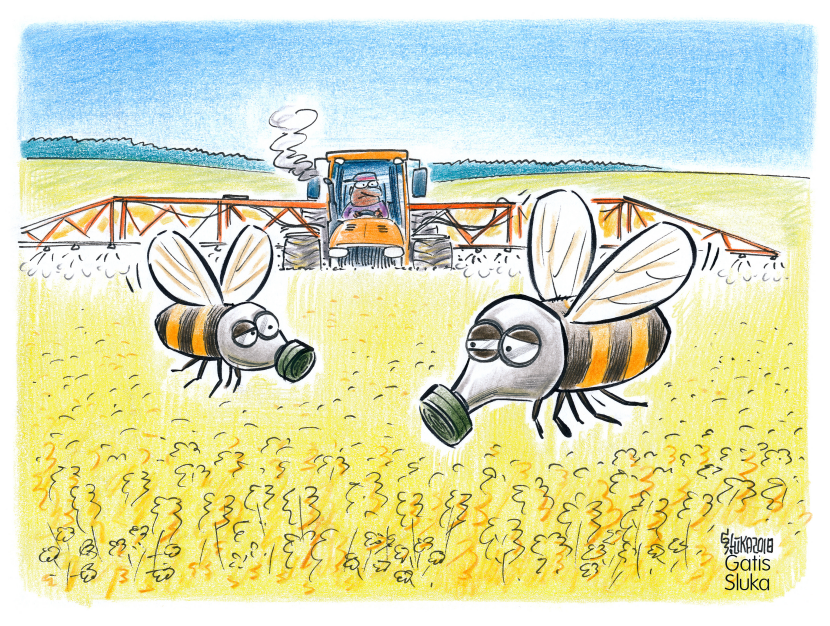
“Research has shown significant declines in native pollinator population sizes and ranges globally,” reports Bee City USA. “In fact, up to 40% of pollinator species on Earth may be at risk of extinction in the coming years as a result of habitat loss, pesticide use and climate change.”

Which brings us back to delaying lawn mowing in the spring.

During May, as the weather warms, newly emerged native bees get busy. But floral resources are not yet at full bloom and may be hard for bees to find — especially in urban and suburban areas.

Bee City USA recommends a few things that each of us can do to nurture good bee health.

It says that our lawns “cover 40 million acres, or 2%, of land in the US, making them the single largest irrigated crop we grow.”

The first thing we can consider, then, is to let our grass grow taller than normal — and let flowers such as white clovers and violets flourish in our yards — if we are able.

Bee-lawn grass mixes give us another alternative. They include a blend of low-growing flowers and turf grasses that offer ample foraging and nesting places even when the grass is cut at about 3 inches — and bee lawns flourish without the chemical weed treatments that are especially harmful to bees.

Another thing each of us can consider is to grow and nurture more native flowers and other plants.

If you can replace sections of your lawn with native wildflowers, shrubs and trees, you’ll have a beautiful flower garden, less lawn to cut and the happiest bees in the neighborhood.

Lucky for me, my yard is large and I don’t have any neighbors close enough to complain about tall grass, so I’m able to let my grass grow a little taller than normal — even though it will take time to gradually and safely trim it back down.

I’ve only begun studying the incredible lives of bees and how they help our farmers produce the food we need, so I’m willing to do my small part to help nurture them each spring.

Copyright 2023 Tom Purcell, distributed exclusively by Cagle Cartoons newspaper syndicate.

Purcell, creator of the infotainment site ThurbersTail.com, which features pet advice he’s learning from his beloved Labrador, Thurber, is a Pittsburgh Tribune-Review humor columnist. Email him at [email protected].
Comments Off on The incredible life of bees

A taxing ‘Take Our Daughters and Sons to Work Day’

“Junior, this year to prepare for ‘Take Our Daughters and Sons to Work Day’ I want to teach you about all the taxes that you’ll have to pay as a working adult.”

“What are taxes, Dad?”

“Taxes are what the government will take out of your paycheck, and will tack onto almost everything you will purchase, to fund lots and lots of programs, Junior — many of which are unnecessary.”

“Unnecessary, Dad?”

“Junior, when our country was founded in 1776, our founders believed in limited government and they knew from history that the bigger and stronger any government gets, the more it inhibits the freedoms of its citizens.”

“OK, Dad.”

“The founders worried that our republic, which is governed by the people, would only thrive as long as the people were wise and always concerned about their government getting too big and strong. But too few people today have any such concern. And that is why our country is out of control.”

“Out of control, Dad?”

“Our national debt has ballooned to $31 trillion, Junior — And climbing. Since lots of people and their cronies in Washington benefit from reckless spending — and politicians get elected by bribing citizens with their own money — few are serious about reigning it in. There are lots of incredible examples of waste.”

“Can you share some, Dad?”

“Take the Department of Defense, Junior. We all agree that a key role of government is to protect its citizens. However, the DOD is so poorly managed, a recent audit cannot account for 60% of its assets. It looks like we’ll spend nearly $900 billion a year to fund the DOD this year, yet we have little idea where all of that money is going?”

“I am learning from you and Mom to be careful managing money.”

“One of the greatest tragedies in recent years is the $8 trillion we spent in Iraq and Afghanistan. We lost 7,057 service members in the process and tens of thousands of lives were lost in both countries. So many of our service members who served there are forever damaged by their experience. What a tragic waste.”

“You are making me feel sad, Dad.”

“Well, let’s see if I can make you laugh, then, Junior. Readers Digest shares a list of some very silly government-funded activities. Did you know that for more than 20 years, Northwestern University researchers received a total of $3 million in government funds to inject hamsters with steroids, then watch them fight!”

“Those poor little hamsters!”

“The researchers stopped that study when animal activists learned of it. Here’s another one: Every single day the government prints out the Federal Register at a cost of $1 million a year and delivers it to every member of Congress. But the Federal Register is available online for free.”

“That doesn’t sound very smart, Dad.”

“Junior, my heart breaks when I think of the high taxes your generation is going to have to pay to cover all the reckless spending our government is doing now. You are very young, but it’s never too early to introduce you to these harsh realities. Next April, I’ll introduce you to the cost of onerous government regulations!”

“Great, Dad. I can’t wait until next year, when I turn 5!”

Copyright 2023 Tom Purcell, distributed exclusively by Cagle Cartoons newspaper syndicate.

Purcell, creator of the infotainment site ThurbersTail.com, which features pet advice he’s learning from his beloved Labrador, Thurber, is a Pittsburgh Tribune-Review humor columnist. Email him at [email protected].

Comments Off on A taxing ‘Take Our Daughters and Sons to Work Day’

Thurber’s Tail: Play it safe on National Lost Dog Awareness Day

When I was 10 my family’s beloved dog Jingles ran off one summer day. My sisters and I cried our eyes out, certain she was gone forever.

Jingles was part Collie with a touch of Irish Setter and goodness knows what else. She barked like a howling coyote.

Though she never got treats from the gourmet pet aisle at the supermarket, as my 28-month-old Labrador Thurber does often, she loved her daily can of Ken-L Ration and the occasional leftover burger.

She also enjoyed a freedom that few pets ever get to know, which afforded her the freedom to run away.

Why Our Dogs Feel the Need to Run Away

I know now that there are many reasons a dog may feel the need to run away.

Fear and anxiety can cause them to run. Some are scared by thunderstorms or other stressful events, such as fireworks.

But the most common reason involves boredom and a need for exercise and mental stimulation.

A dog who is left alone too long without attention — one with pent up energy — may find an escape into the woods, which is filled with exciting new smells and sounds, too great to pass up.

Pets.Webmd.com offers additional reasons why dogs run away.

In Jingles’ case, my father was adamant that she never be chained. We taught her the boundaries of our yard well enough, but every so often she felt the need to set off for the woods.

Then my father had to drive our station wagon all over the place until she heard his booming voice calling for her, which prompted her to come home.

But when Jingles ran off on that summer day long ago my father couldn’t find her.

How Dog Owners Should Prepare for a Lost Dog

I would be beside myself if my yellow Labrador Thurber were to ever attempt to run off.

Sure, I have trained him well and he is never chained, but I keep a close eye on him in our big yard when we are playing or he is tending to his business.

Still, there are steps all of us should take to prepare for the unlikely event our beloved pets might stray from our homes this National Lost Dog Awareness Day:

ID tags are an obvious first step. Name, phone number and address can help anyone who finds your pup promptly return him to you.

I had Thurber microchipped during a routine visit to his veterinarian. This involves implanting a small chip under your dog’s skin that contains contact information. Most veterinarians have the ability to read these chips.

Dog GPS collars are gaining popularity and a fence or wireless dog fence, though pricey, will give you added peace of mind.

However, if your dog were to run off, contact your animal shelter immediately. Provide recent photos and details about any medications your pet may be taking.

Do likewise on social media. Neighborhood sites, such as NextDoor.com, are very helpful in getting folks near your home to keep a look out for your pet.

Last, drive around your neighborhood calling for your pet, using a sound familiar to him or her or a standard dog whistle, which I use with Thurber if he’s too focused on something that smells good in the woods bordering our yard.

We Were Lucky with Jingles

By the third day of Jingles’ absence in 1974, a tremendous funk settled over our home.

As I lay in bed sobbing that night, I heard the faucet dripping in the kitchen, a couple squabbling a few blocks away and Johnny Carson’s monologue on someone’s television over the next hill.

Then I heard a far-off dog howling like a coyote!

I jumped out of bed and raced out the front door. I met Jingles in front of the Kerns’ house. I was crying as I held her in my arms, the two of us rolling around under the street lamp.

Soon the rest of my family was awake and outside hugging her, overcome with incredible relief.

I never want to have such an experience with Thurber, and hope the plans and preparations I’ve made will prevent that from ever happening!

Have an inspirational story about an amazing pet? Email details to [email protected]. See pics of Jingles, Thurber and funny pet videos at ThurbersTail.com!

Copyright 2023 Tom Purcell, distributed exclusively by Cagle Cartoons newspaper syndicate.

Tom Purcell is creator of ThurbersTail.com, which shares helpful pet-care tips and funny stories and videos featuring Tom’s beloved Labrador, Thurber. Email Tom at [email protected].

Comments Off on Thurber’s Tail: Play it safe on National Lost Dog Awareness Day

What we need this Earth Day is more green thumbs

Earth Day is coming April 22, and I can’t think of a better opportunity for Americans to get their hands dirty.

When Earth Day became an annual event in 1970 its purpose was to demonstrate support for protecting the environment.

Today, more than 1 billion people in almost 200 countries will celebrate with events coordinated globally by EarthDay.org.

One of the most common activities — one that I am thinking of doing myself this year — is to plant a garden.

If you can grow and harvest tomatoes and cucumbers in your own backyard, after all, you won’t need to buy these items in a store — items that have to be transported through the burning of fossil fuel.

I’m in favor of anything that can help all of us be better stewards of the environment, but I see additional psychological benefits from gardening that our country desperately needs.

To wit: we need to become more “down to earth,” a term that is not used much anymore.

According to Merriam-Webster, “down to earth” is defined as “demure, humble and unpretentious.” It also means “earthy,” which Merriam defines as “plain and simple in style.”

The origin of these terms is not clear, but the act of getting our hands dirty in garden topsoil sure does have the effect of making you more humble and unpretentious.

I grew up in the suburbs with a large yard. We grew tomatoes every summer and they were much larger, redder and sweeter than anything bought at the store.

Our neighbor, Mr. Bennet, had a magnificent garden that was 12×30-feet big.

He grew such an abundance of beautiful lettuce, tomatoes and zucchinis that he often shared his bounty with us and we enjoyed the most delicious salads you will ever enjoy.

Managing a garden of that size required quite a commitment.

Mr. Bennet toiled every day to nurture his vegetables. He had to pluck the weeds to protect his prized plants and he built a fence to keep the deer out.

His toil and the sweat — and the lessons he learned from nature to help his plants flourish — connected him to the realities of the natural world and brought him a peace and calm that only gardeners can know.

That is to say, Mr. Bennet was down to earth!

Unfortunately, though, as Americans have moved from the countryside to large metros, millions of us have lost any sensual connection with topsoil and nature — but even a small garden on your apartment building rooftop can fix that.

Wherever or however we can, let’s all start gardening this year.

Taking care of even a few plants will humble us, and the sounds, smells and other realities of nature will bring us back to our “common senses.”

The people who founded our country and crafted our Constitution were farmers who were closely aligned with the realities of nature — what they called the Natural Law. It is no accident that our Constitution is “plain and simple” in style.

They knew they had to understand the basic, unforgiving realities of nature if they wanted to keep their crops and animals from dying — and to help them all survive and flourish.

Down-to-earth people truly in touch with nature enjoy the gift of common sense or “horse sense”— something our country is running short of these days.

So this Earth Day, let’s begin to address this important matter — and bring calm to our souls — by planting a garden!

Copyright 2023 Tom Purcell, distributed exclusively by Cagle Cartoons newspaper syndicate.

Purcell, creator of the infotainment site ThurbersTail.com, which features pet advice he’s learning from his beloved Labrador, Thurber, is a Pittsburgh Tribune-Review humor columnist. Email him at [email protected].

Comments Off on What we need this Earth Day is more green thumbs

Will’s wit soothes a taxing time

Tax returns are due next week and many Americans are surely stressed out as they scramble to get their financial records in order.

I can’t think of a better time to revisit the wit and wisdom of Will Rogers.

Rogers was a famous American humorist, actor and social commentator who lived from 1879 to 1935, when he died in a plane crash.

He was known for his folksy wit and common-sense observations, which he published in his syndicated newspaper column — observations such as these:

“The only difference between death and taxes is that death doesn’t get worse every time Congress meets.”

“If you make any money, the government shoves you in the creek once a year with it in your pockets, and all that don’t get wet you can keep.”

“The crime of taxation is not in the taking it, it’s in the way that it’s spent.”

Will, your words still hold true some 90 years after you spoke them.

Taxes are going up.

Millions are taking a bath in the creek as our government empties our pockets.

And not only do I not like the way our tax money is being spent, I especially dislike the way politicians are spending the trillions we keep borrowing and adding to the national debt.

When you consider how bad the national debt has gotten — it’s approaching $32 trillion — this Rogers’ quote was right on the money:

“Alexander Hamilton started the U.S. Treasury with nothing, and that was the closest our country has ever been to being even.”

Here’s another Rogers observation worth revisiting:

“People want just taxes more than they want lower taxes. They want to know that every man is paying his proportionate share according to his wealth.”

Americans are not paying taxes in a manner that is proportionate to their wealth, however.

The very wealthy pay very low income taxes because they pay taxes on gains in their investments, not on the money they earn from being a working stiff, what the government calls “earned income.”

It’s the modestly well-to-do — workers who make high earned incomes — who pay most of the income taxes.

“In 2018, the top 1% of income earners made nearly 21% of all income but paid 40% of all federal income taxes,” according to David Harsanyi in Real Clear Politics. “The top 10% earned 48% of the income and paid 71% of all federal income taxes.”

Meanwhile, Americans on the lower end of the income scale, pay few, if any, federal income taxes.

“Americans making less than $75,000 are projected to have, on average, no tax liability after deductions and credits,” writes Harsanyi.

“More than 61% of Americans — around 107 million households — owed zero federal income taxes for the year 2020.”

Americans may not know who is paying the lion’s share of taxes, but most agree on one point: complying with our federal tax code is not for the faint of heart.

When the income tax became law in 1913 — in Will Rogers’ 34th year — the tax code could be printed on one page. It’s currently about 10,000 impenetrable pages long.

If Rogers were still alive, he’d surely have a joke about our tax code’s regrettable size — maybe something like this:

“Our tax code is so big it’s good for only one thing: If any of our enemies give us trouble, we can threaten to drop it on them.”

Copyright 2023 Tom Purcell, distributed exclusively by Cagle Cartoons newspaper syndicate.

Purcell, creator of the infotainment site ThurbersTail.com, which features pet advice he’s learning from his beloved Labrador, Thurber, is a Pittsburgh Tribune-Review humor columnist. Email him at [email protected].

Comments Off on Will’s wit soothes a taxing time

Hey, Medicare, I’m counting on you

I will qualify for Medicare coverage in five years and, much to my surprise, I can’t wait to get government health coverage — because my current coverage is pricey.

I recently finished a consulting assignment, which provided me full health benefits. To maintain my health insurance policy through Cobra, I must pay $750 a month.

I also have to cover the first $3,300 of costs before full coverage kicks in.

That means that if I go to the hospital with a bad flu — which I did for the first time in my life recently — I’ll receive a giant bill to pay for my deductible.

My total health care costs for the year, give or take, would be $13,000 — almost $1,100 per month.

Considering my current costs, Medicare coverage is a bargain.

Medicare became law in 1965 and is now offered in four parts to Americans over the age of 65:

Medicare Part A covers inpatient hospital care, skilled nursing facility care, hospice care and some home health care. Most people do not pay a premium for Part A, as they paid into the program for years as taxpayers.

Medicare Part B covers doctor visits, outpatient services, preventive care and some medical equipment. The standard monthly premium for Part B in 2021 was $148.50, but higher-income earners may pay more.

Medicare Part C, also known as Medicare Advantage, is an alternative offered by private insurers to supplement A and B with additional benefits.

Medicare Part D helps pay for the cost of prescription drugs. Its average cost in 2021 was about $33 a month.

Medicare sounds almost too good to be true, which brings us to its greatest challenge: how do we pay for it as America ages and millions more begin receiving benefits?

Initially, there were many more people paying into the fund than using it — five people paid in versus one person who received benefits — but with baby boomers retiring in big numbers, that is no longer the case.

When Medicare began in 1965, Americans 65 and older made up only 10% of the population. Today, Americans over the age of 65 account for about 17% of the U.S. population.

Here’s another worrisome detail: Medicare payroll taxes are only paying for about 62% of the program’s annual $800-plus billion cost. The balance is paid for from the general U.S. cash register — which is running a trillion and a half short every year.

The way things are going, the Medicare fund is on track to run a $1 trillion annual shortfall in only 10 years.

The Biden administration is mostly offering a typical non-solution to Medicare’s financial challenges: tax the rich.

But taxes alone will not solve this challenge. Comprehensive reform is the only solution.

The solution requires a thoughtful, bipartisan approach and will likely include some pain, such as cutting some benefits and extending the age of eligibility from 65 to 67 or so.

Will our politicians summon the courage to deal with this very real challenge — or will they chase cheap votes by telling elderly Americans the other party is trying to take their health coverage away?

I have my worries.

I’m in no hurry to become 65, but the only saving grace I hope 65 will bring is for Medicare to relieve me of the 1,100 bucks a month I currently pay for basic health care.

Copyright 2023 Tom Purcell, distributed exclusively by Cagle Cartoons newspaper syndicate.

Purcell, creator of the infotainment site ThurbersTail.com, which features pet advice he’s learning from his beloved Labrador, Thurber, is a Pittsburgh Tribune-Review humor columnist. Email him at [email protected].

Comments Off on Hey, Medicare, I’m counting on you

Dumbing America down — digitally?

IQs have dropped for the first time in American history, and the experts aren’t quite sure why.

According to Neuroscience News, a new Northwestern University study finds that our average IQ scores have decreased in three out of four cognitive measures.

The study found that “scores of verbal reasoning (logic, vocabulary), matrix reasoning (visual problem solving, analogies) and letter and number series (computational/mathematical) dropped during the study period .…”

The only IQ measure to increase was 3D rotation (spatial reasoning), which, ironically, could be due to the proliferation of video gaming.

The country’s IQ drop is a drastic reversal of the “Flynn effect,” a phenomenon in which “IQ scores have substantially increased from 1932 through the 20th century, with differences ranging from three to five IQ points per decade.”

Elizabeth Dworak, the study’s author, says the findings do not mean Americans are necessarily getting less intelligent.

“It could just be that they’re getting worse at taking tests or specifically worse at taking these kinds of tests,” she says.

Perhaps.

Or perhaps our outdated and dumbed-down approach to learning and teaching are making us duller.

When my parents graduated high school in the 1950s, they were well prepared to read, write clear and coherent letters (what we call “content” today), do basic math and manage their checkbooks.

That was a different era, to be sure.

But here we are, more than 60 years later, still running our kids through a creaky education model that seems more interested in promoting peripheral cultural shifts than in teaching the rigors of reading, writing and arithmetic.

Is it any wonder that the cognitive skills of American kids fall well below kids in 25 other developed countries, according to The Discovery Institute?

Meanwhile, as our kids spend eight hours a day on social media, their attention spans and ability to concentrate are being compromised, The Guardian reports, to no one’s surprise.

How can they ever learn to read and understand long essays or make a detailed, reasoned argument if they cannot focus and concentrate on anything more complicated than a text message?

Another key driver of the country’s declining cognitive abilities could be that our Digital Age kids no longer spend hours outside playing.

Richard Louv, author of “Last Child in the Woods,” says our kids are suffering from “nature deficit disorder,” which he argues is a direct cause of attention deficit hyperactivity disorder (ADHD) and other learning maladies in children.

Simply put, our kids spend too little time climbing trees, building forts and having all five of their senses engaged and unleashed by the wonders of playing in the woods.

“We don’t yet know why it happens,” says Louv, “but when all five of a child’s senses come alive, a child is at an optimum state of learning. Creativity and cognitive functioning go way up.”

And conversely, as our kids spend more time indoors on social media, their creativity and cognitive functioning go way down.

All of this IQ decline is putting our country at a crossroads.

As our Digital Kids become adults, their votes are increasingly replacing those cast by the common-sense high-school grads of the 1950s.

To maintain a stable and prosperous republic, and to thwart the silver-tongued politicians who push their expensive and foolish government policies, we will need voters with sound reasoning abilities.

That’s one more good reason why we must reform our education system — and moderate the impact of social media on our kids — to re-reverse the Flynn effect while we still can.

Copyright 2023 Tom Purcell, distributed exclusively by Cagle Cartoons newspaper syndicate.

Purcell, creator of the infotainment site ThurbersTail.com, which features pet advice he’s learning from his beloved Labrador, Thurber, is a Pittsburgh Tribune-Review humor columnist. Email him at [email protected].

Comments Off on Dumbing America down — digitally?

Let’s get our kids behind the wheel

The sun is shining today and Spring is upon us.

Such days remind me still of the excitement I knew when I turned 16 in April and was finally able to get my driver’s license — a wondrous rite of passage fewer and fewer teens choose to experience today.

According to a 2019 article in The Wall Street Journal, in the 1980s half of all 16-year-olds were driving. But by 2020 it was just 25 percent.

Why?

Driving tests began getting stricter and more challenging in many states in the mid-1990s — though passing my test in a 1976 “Starship-Enterprise-sized” station wagon was no easy feat.

The cost of cars has risen and today’s teens are able to get around easily enough using ride-sharing services.

But the biggest reason is simply that many teens have zero desire to drive on their own — because the hunger to get out of the house and socialize is no longer a big incentive.

A study by Common Sense Media finds that teens are spending an average of 8 hours a day on social media apps.

They may think their online habits are enabling them to socialize with “friends,” but several studies, including a 2021 Journal of Adolescence study, see a clear correlation between the explosion in social media in 2012 and increasing isolation, depression and anxiety in teens.

A 2020 Netflix documentary, “The Social Dilemma,” explains in detail how the nature of social media encourages teen isolation and depression.

When you’re online, powerful artificial intelligence tools — algorithms — monitor everything you do. Plus, the tools know your full name, marital status, gender, age, birthday, political views and several of your interests.

Every time you “like” an item, click on a news story or interact with other users, you help these AI tools determine precise personal details, such as who you are dating and whether you are lonely or sad.

The more these tools know about your private life, the more money advertisers will pay to custom-tailor precise ads that will appeal to you or shape your opinion on everything from what kind of socks are cool to the political candidate they want you to vote for.

The more they know about you, the more often items will appear in your newsfeed that are designed to give you dopamine spikes and keep you online as long as possible — so their advertisers have never-ending access to sell to you.

As you spend time online with social media apps, you are constantly being psychologically manipulated — constantly comparing your looks to famous people, constantly seeking praise and “likes” from strangers or suffering deeply if someone online in any way mocks or criticizes one of your posts.

It’s pretty clear that young people, whose brains are still developing, are being profoundly impacted by social media in many important and trivial ways we don’t fully understand yet.

Which brings us back to driving. Instead of becoming excited at age 16 that they can learn to drive a car and come and go freely, too many kids are content to sit alone in their rooms endlessly texting each other or consuming TikTok.

It’s too bad. Kids today don’t know how much fun, freedom and real social interaction they’re missing without cars.

Cruising the park in a 1972 VW Beetle with my friends is one of the best memories I have of my teen years.

I know the social media challenge is complex, but here’s a good start:

Hey, kids, the weather is breaking. Get your license, turn off our phones and go for a cruise in the park!

Copyright 2023 Tom Purcell, distributed exclusively by Cagle Cartoons newspaper syndicate.

Purcell, creator of the infotainment site ThurbersTail.com, which features pet advice he’s learning from his beloved Labrador, Thurber, is a Pittsburgh Tribune-Review humor columnist. Email him at [email protected].

Comments Off on Let’s get our kids behind the wheel