Come on, Amazon, Make Service a Prime Concern

Dear Jeff Bezos:

Here’s what Amazon emailed me after a relatively small matter developed into a giant headache: “Your feedback is helping us build Earth’s Most Customer-Centric Company.”

That’s a heck of a line, and until now I thought it was true.

I’ve written columns praising your company for its top-notch customer service when, for many businesses, it’s a lost art. Ever try to reach a human being at Facebook? I did after my account was pilfered by Vietnamese hackers, and it took two months to get it back. There’s simply no way to speak to anyone at Facebook and, frankly, I think they prefer it that way.

Amazon, on the other hand, is one of the few mega-businesses that actually seems to care. Yes, I wish you paid your warehouse workers a little more, but as I wrote at the height of the pandemic, Amazon’s quick and efficient deliveries really saved us. My job is to write about things I run across — good and bad, big and small — not so much for my own satisfaction but to alert readers and, occasionally, bring about change.

So, here’s what happened. For my son’s fiancee, Sally, I ordered an Echo Dot smart speaker and a one-year Amazon Prime membership which, as you know, includes music she can access with the Dot.

Alas, I forgot that Danny and Sally already have Prime, and the last thing they need is another $128 subscription. I tried to cancel online but couldn’t. I phoned customer service and spoke with “Edi” and “Christine” and “Suzanne” and “Amber” and several managers, each time being told, “We can’t cancel or refund a Prime gift membership.”

Wait, what? Danny and I each have Prime memberships, we don’t need a third. The gift won’t even be “delivered” by email from Amazon until Sally’s birthday in three days. All you have to do is cancel it and reverse the charge to my credit card, after which I’ll happily order something else.

The more I asked your otherwise kind folks to explain why this bit of rocket science couldn’t be accomplished the more they insisted, “We just can’t do it.”

As you know, Mr. Bezos, Amazon takes back all sorts of things, no questions asked, as part of that customer-centric stuff. In this case, we’re not talking about a physical item, like a tennis racquet, nor are we dealing with a third-party vendor. This is just digital code from your own company! You “can’t” undo that three days in advance?

Last year I wrote in The Wall Street Journal: “Before the pandemic I would have made a Saturday-morning project of driving to Griggs Nursery to buy tomato plants and a variety of herbs such as basil, sage and parsley. The other day they arrived, no worse for the wear, in a carton from Amazon. Delivery was free, as it was for my bicycle seat cover and the 8.7-ounce bottle of Shout Advanced Ultra Concentrated Gel Set-In Stain Brush Laundry Stain Remover.”

I lavished praise on your company for fast and efficient service during sheltering, when we needed it most. (Okay, I blanched at finding that three rolls of toilet paper went for $38, but that was quickly corrected.)

You’re the largest e-retailer in the nation, with close to $386 billion in sales last year. It’s embarrassing for those of us who support Amazon to find you being petty and close-minded.

I’m tempted to close by threatening to take my e-business elsewhere, but we both know I won’t stop using Amazon. (Besides, you sell my new book, “Self-Amused.”)

Just fix this for me and millions of other customers who truly want to believe Amazon is customer-centric, not egocentric.

Yours in responsible retailing,

Peter Funt

Copyright 2021 Peter Funt distributed by Cagle Cartoons newspaper syndicate.

Peter Funt’s new memoir, “Self-Amused,” is now available at CandidCamera.com.

Comments Off on Come on, Amazon, Make Service a Prime Concern

Pay or Punish the Un-Vaxed?

When society seeks to influence behavior, is it better to pay people to act a certain way, or to penalize them if they don’t? The pandemic and the urgent need for COVID-19 vaccinations brings the question into focus.

American Airlines offers employees an extra day of paid vacation if they get the shots. Delta Airlines, on the other hand, warns employees they will be charged a $200 monthly penalty on their health plan if they don’t get jabbed.

Kroger, the nation’s largest supermarket chain, gives employees $100 for proof of vaccination. But professional basketball players employed by the New York Knicks, Brooklyn Nets and Golden State Warriors learned recently they will not be allowed to play in home games this season if unvaccinated, and face possible fines or loss of pay.

A few companies are literally trying it both ways. Walmart, the nation’s largest private employer, will require employees at its corporate offices to be vaccinated, while making it optional for in-store workers — but offering them $150 if they choose to get the shots.

Much as I applaud the intentions of businesses and governments that offer monetary inducements for getting the shots, I think it’s unwise. We don’t pay motorists to stop at red lights, we fine them if they don’t. Companies don’t give bonuses to employees who refrain from harassing coworkers, they discipline the offenders.

Research into behavioral economics does show that incentives work in some cases. A study conducted by the Mayo Clinic found that participants in a weight-loss program lost more and stayed with the program longer when paid to do so. Researchers at Harvard Medical School got similar success in getting people to quit smoking.

In Canada a few years ago, private business partnered with government to operate “Carrot Rewards,” a program that essentially paid people to walk more. It utilized an app that measured steps and issued payoffs in the form of points used for merchandise. People walked so much that the funding ran out and the program folded.

For the most part, however, these reward-based programs are conducted among folks who wanted to change; the money reenforces their views rather than modifying them.

During the pandemic, government efforts to pay the unvaccinated have had only modest success. Ohio’s “Vax-a-Million” lottery was among the more effective programs, at least for a few weeks, but other state and local payoffs have not fared as well.

One of my concerns with behavioral economics — whether orchestrated by business or government — is that such programs exert disproportionately greater pressure on the poor. Walmart is essentially conceding that by offering $150 to its lower-paid workers, while issuing a vaccination mandate to higher-salaried employees for whom a cash inducement might be easier to ignore.

When it comes to encouraging COVID vaccinations, perhaps the ends justify almost any means. But since governments and businesses have the absolute right to require certain behavior — from paying taxes to wearing seat belts — there shouldn’t be a need for bribes, or for cowardice among lawmakers and employers. Make the rules and enforce the penalties.

As more COVID variants emerge, there is reason to believe that one or two shots won’t be enough. Annual boosters might be necessary. So then what? Employees who were paid to comply this year demand another dose of cash, or threaten to strike for higher vaccination pay?

Unfortunately, it will never be right to pay people to stop being wrong.

Copyright 2021 Peter Funt distributed by Cagle Cartoons newspaper syndicate.

Peter Funt’s new memoir, “Self-Amused,” is now available at CandidCamera.com.

Comments Off on Pay or Punish the Un-Vaxed?

Big Memories of Little League

The thwack of a baseball colliding with a bat and the thump of a folded newspaper landing on a porch are sounds I cherish. They’re rewinding for me this month while watching the Little League World Series.

As a kid, I played for four years on a team in Croton-on-Hudson, N.Y. Our ballpark didn’t have much green; it was more of a weedy brown. The field sat alongside the town dump on Croton Point, where gulls ate dinner and then flew over to watch our games. We were good, but we never made it to the World Series.

This month, 16 teams from across the U.S. are competing for the championship in South Williamsport, Pa. Because of the pandemic, which forced cancellation of the tournament last summer, the event is limited to domestic teams, with attendance restricted to families and friends of the players.

The first Little League game was played in Pennsylvania in June, 1939. It was hardly a nail-biter, as Lundy Lumber defeated Lycoming Dairy, 23-8. The World Series was inaugurated in 1947, immediately occupying just about every boy’s dreams.

One of them was Jim Barbieri of Schenectady, N.Y., whose team won the 1954 tournament. Six years later he was signed by the Los Angeles Dodgers, and six years after that became the first person to have played in both the Little League and Major League World Series.

In 1974 Little League began a concurrent girls softball tournament in Greenville, North Carolina. Girls are allowed in the hardball event as well, but few have participated since 1984 when Victoria Roche from Belgium became the first to give it a try.

In my new book, “Self-Amused,” I discuss how for kids like me in the 1960s, the intertwining of baseball and newspapers made perfect sense. These were All-American entities, allowing us to work hard and play hard in pursuit of our dreams.

I peddled a weekly with the unusual name “Grit.” Dubbing itself “America’s Greatest Family Newspaper,” Grit was started in 1882 when a German entrepreneur named Dietrick Lamade bought the name and converted the paper to an independent tabloid serving rural America. Lamade advised his staff to “avoid printing those things which distort the minds of readers or make them feel at odds with the world.” Typical was a 1965 story headlined, “Americans With Warm Hearts Help Needy Mexican Peasants.”

By 1932 Grit’s circulation stood at 400,000; in the mid-fifties it reached 700,000, and in 1969 circulation topped out at 1.5 million. More impressive than its popularity was the fact that Grit was sold almost entirely by kids like me—some 30,000 of them at the paper’s zenith. Lugging canvas bags with GRIT in bright red letters, we learned a lot about the game of business.

Today, Grit survives only as a bimonthly magazine.

George R. Lamade, who followed his father as Grit’s publisher, and his brother Howard, a vice president in the company, believed in helping kids. They donated land in South Williamsport on which was built a genuine Field of Dreams.

When the Little League champs are crowned on August 29, it will happen on a diamond where memories of playing ball and delivering papers intersect. At Lamade Stadium.

Copyright 2021 Peter Funt distributed by Cagle Cartoons newspaper syndicate.

Peter Funt’s new memoir, “Self-Amused,” is now available at CandidCamera.com.
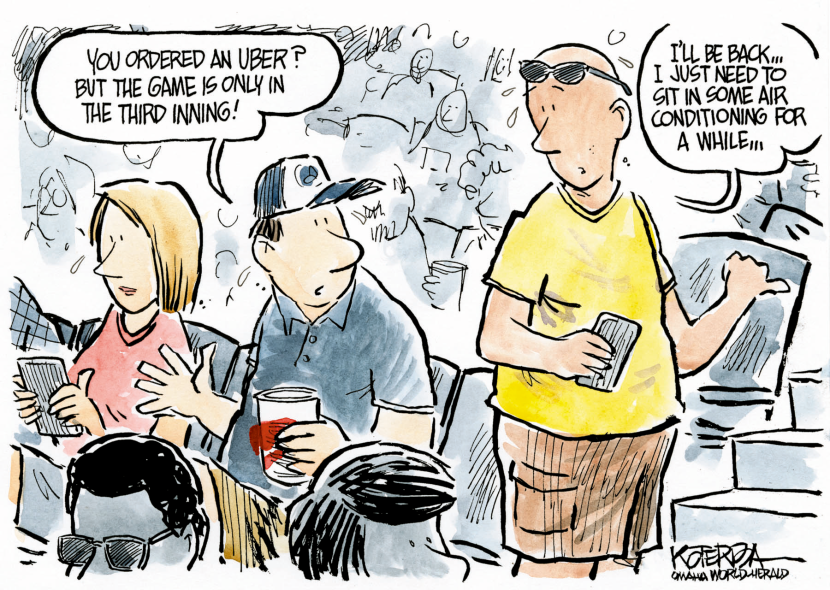
Comments Off on Big Memories of Little League

73 Years of Smiles and Insights

It was 73 years ago this month that my dad, Allen Funt, brought “Candid Camera” to television. Remarkably, between his career and mine we hold a record with the only entertainment show to have produced new episodes in eight different decades.

I still don’t have all the answers, but I’ve heard most of the questions.

Are people harder to fool these days? No! Folks are easier to fool. That may seem counterintuitive, but I’m certain it’s true. Much of it has to do with multitasking. When my father did the show he had to work at distracting people. These days they do it to themselves. Many people we now encounter are fiddling with personal devices, tackling routine activities with less-than-full focus. That makes them easier targets for our little experiments, but also more vulnerable to mishaps and genuine scams.

Is the show really real? Of course. The entire concept—and our reputation—is based on making “Candid Camera” real. Some competitors have faked hidden-camera scenes. Not us. Frankly, much of our material is only funny because it is spontaneous and unrehearsed.

As part of our birthday celebration I’ve written a book called “Self-Amused,” drawing upon many of our adventures and insights.

In doing recent versions of our show I worried briefly that people are now so tech-savvy that some of our props and fake setups wouldn’t be believed. Instead, we found that the omnipresence of technology has reached a point where people will now accept almost anything.

We showed customers at a salon an “un-tanning machine” that ostensibly sucked off dark pigment in seconds. We notified residents in a Denver suburb that they would be getting mail delivery via drone. We told patients at a dentist’s office that they’d now be performing a DIY dental exam. In each case, just about everyone bought in. At the dental office, several people were even prepared to give themselves a shot of Novocain before we intervened.

I don’t necessarily believe 21st-century Americans are more gullible, but they tend to give that impression by protesting life’s little insults without taking time to fully digest the situation.

For instance, we told shoppers in Seaside, Calif., they would be charged a “$10 in-store fee” for not buying online. We told customers at a New York City food store that to pay with a credit card they would need “three forms of photo ID.” We hired a cop in Scottsdale, Ariz., to enforce a “2 m.p.h. pedestrian speed limit.”

Most people took these propositions to be true. They shot back quickly at big government, big business or any other entity that seemed to have too big a role in managing their lives.

We tried a few political experiments and the results were predictable. We showed New Yorkers petitions to recall state officials, but the names were all fictitious. Many people supported the effort, among them a lawyer who carefully explained that one should never sign anything without complete knowledge of the facts, and then signed anyway. In California, our fake candidate obtained dozens of campaign signatures without ever stating a position, a party or even her full name.

In Arizona, we hired two actors to portray “illegal immigrants.” One played a well-dressed gentleman from England, the other a blue-collar worker from Mexico. The British fellow got plenty of signatures to “vouch for good character,” while the Mexican guy had difficulty just getting people to stop and listen.

Much hasn’t changed over the years. For example, I expected to encounter more profanity in everyday conversation, but it’s really not there. I also wondered whether young people would be less spontaneous and engaged when caught in our scenarios, yet there’s no hint of that whatsoever. I thought in these litigious times fewer people would sign a waiver to appear on our show, but the percentages have stayed about the same over the years.

I do note that today more people step out in public looking a bit disheveled and unkempt and are then hesitant to sign because they’re not happy with their appearance. Fortunately for our show, people are still, for the most part, willing to engage a stranger and to smile when a little joke is revealed.

One more question I’m often asked: How many Emmy awards has “Candid Camera” won?

None. No Emmy, Golden Globe or Peabody. We haven’t even received a TV Guide viewers’ honorable mention certificate. We did, however, win one special award. A national plumbing supply company gave us a trophy because our slogan—”Smile, you’re on Candid Camera”—was found to be the most popular graffiti above restroom urinals.

Copyright 2021 Peter Funt distributed by Cagle Cartoons newspaper syndicate.

Peter Funt’s new memoir, “Self-Amused,” is now available at CandidCamera.com.

Comments Off on 73 Years of Smiles and Insights

Taking Time to Think About Time

We’ve often heard that time is money, but in these stressed-out days it’s more than that. Time is increasingly a key to well-being, creatively and emotionally.

My sister, Juliet, has taken the time — a lot of it in recent years — to study the topic and has written a book with her insight and advice, called “A Minute to Think.”

The problem is real. She cites a Gallup poll showing that 23 percent of workers feel burnt out more often than not, with another 44 percent experiencing it occasionally. Deloitte, the global professional services company, found that two-thirds of today’s employees feel “overwhelmed” and 80 percent of men would like to work fewer hours.

In Japan, Microsoft conducted a study and found that a four-day work week resulted in 40 percent more productivity and, as a bonus, overhead dropped by nearly 25 percent. Juliet’s conclusion: “Less can be the new more if we give it a chance.”

Research shows that by putting more pauses in our day — “white space,” as Juliet refers to these breaks — thinking improves. I was surprised to read that MRI scans during a person’s quiet pauses show complex activity in the default neural network of the brain — activity that has been linked to insight, introspection, memory and creativity.

As with every form of self-improvement — diet, exercise and such — improving our time management is no easy task. Moreover, no matter how comprehensive, no book can provide guaranteed instructions for saving ourselves by saving time. But with compelling anecdotes and eye-opening data, “A Minute to Think” could help clear mental clutter.

Juliet suggests addressing four questions. Is there anything I can let go of? Where is “good enough,” good enough? What do I truly need to know? What deserves my attention?

I’ve heard it said that if you want something done you should ask a busy person. The point, of course, isn’t that such people have more time than the rest of us, but that they know how to make better use of their time.

Back in 1929 Coca-Cola came up with the tag line, “The pause that refreshes.” Today we’ve learned to eschew sugary drinks, but we could all benefit from a refreshing pause.

Copyright 2021 Peter Funt distributed by Cagle Cartoons newspaper syndicate.

Peter Funt’s new memoir, “Self-Amused,” is now available at CandidCamera.com.

Comments Off on Taking Time to Think About Time

All the Presidents’ Teeth

Now that Joe Biden doesn’t have to wear a mask in public, I’m back to staring at his teeth.

Fact is, the last three presidents have elevated dental awareness to unprecedented levels. Whether cosmetically altered, artificially whitened or just naturally dynamic, teeth displayed by Obama, Trump and Biden have been downright mesmerizing.

In their official portraits, none of the first 39 presidents revealed a single tooth. This was partly due to dental crookedness and discoloration, but also because portraits and photos were usually viewed as serious business, resulting in somber, tight-lipped poses.

The painting of Ronald Reagan, completed in 1991, is the first to show teeth — or, for that matter, any hint of a smile.

As for actual photographs, there is a famous shot of Teddy Roosevelt flashing two wide rows of teeth. Some called Roosevelt “The first president who smiled,” but he’s not smiling on the White House website. Images there show John Kennedy as the earliest president to bare his teeth, with chompers that look cartoonishly large. Jimmy Carter’s upper incisors were a magnet for cartoonists — among them four-time Pulitzer winner Herblock (Herbert Block), who famously drew Carter as the Cheshire Cat with a massive toothy grin.

Bill Clinton and both Bushes had teeth that appeared natural, or at least believable, and so for two decades the nation’s attention was diverted from matters dental.

But with President Obama we began wondering if anyone could possibly be blessed with such perfect pearls. In the White House photo gallery Obama’s teeth are so prominent you hardly notice his ears.

Donald Trump and Joe Biden caused dental fixations to soar. With smiles sparkling and eye-catching, each man has been accused in news reports of having dentures — and faulty ones at that. Trump gave a speech in December, 2017, that prompted New York Magazine to report: “It seems like he is trying to talk around his teeth while they slip from his gums.” During the presidential campaign in September, 2019, the New York Post said in a headline: “Joe Biden struggles to keep his teeth in his mouth during Democratic debate.”

Dr. Joseph Mitchell, a Palm Beach dentist, has studied the Biden smile and concludes that the president’s restorations are in need of “more definition between the teeth; what we call ‘embrasures.’” He also suggests “more translucency at the edges, not opaque porcelain.”

Trump’s front teeth were analyzed by Dr. Jake Bateman of Kingsport, Tennessee. “I would guess the majority of them are veneers,” he explained. “The giveaway is how white and uniform the teeth are.”

Presidents have always had a thing about teeth. Myth has it that George Washington’s false teeth were made of wood, but in fact they were fashioned from ivory and other precious materials. Lyndon Johnson gave away electric toothbrush sets with the presidential seal on them. Herbert Hoover had a dental exam room installed in the White House, which remains to this day.

Fastidious dental care might be the only remaining thing about which presidents from both parties agree. That’s something for pundits to chew on.

Copyright 2021 Peter Funt distributed by Cagle Cartoons newspaper syndicate.

Peter Funt’s new memoir, “Self-Amused,” is now available at CandidCamera.com.

Comments Off on All the Presidents’ Teeth

The Memoir Pandemic

I figured that nine months after the pandemic began, sheltered and cooped up Americans would be creating a baby boom. It never happened. In California, for example, births in 2021 are expected to be about 50,000 fewer than in 2020.

There was, however, a boom in books.

According to Publishers Marketplace, which tracks book deals, memoir acquisitions were up about 9 percent in 2020. Among the first to land contracts were actors Michael J. Fox, Billy Dee Williams and Hayley Mills. Soon, PBS reporter Yamiche Alcindor and retired Nascar driver Bill Lester had sold their stories, as had country music superstar Dolly Parton. Willie Nelson got deals for two memoirs. As the pandemic wore on, former National Football League coach Bill Cowher signed a memoir deal, as did actors Stanley Tucci and Julianna Margulies.

Alone at my kitchen table day after day, I decided to give it a try. I found the notion of putting my life into a book so totally amusing that I titled it “Self-Amused.” Then, as I pushed ahead I discovered there was too much to cover, so I subtitled it, “A Tell-Some Memoir.” Voila!

My first draft didn’t get far with family and friends who found it to be “in the weeds,” which is a publishing term meaning “boring.” Apparently few people care how I rate breakfast cereals, the fact that at age 12 I decided my favorite color was green rather than navy blue, or that after spending thousands on golf lessons I still have a wicked slice.

I read a quote from a publishing “guru” — loosely defined as someone who is not very good at writing but loves to talk about books — that you should stick to things you know best. For me, that’s the TV series “The Office,” and my own show. Realizing that several books have already been written about Michael Scott and Dunder Mifflin, I settled on “Candid Camera.”

As luck would have it, I’ve done some pretty incredible things, like hanging from a 10-foot ceiling to create the impression of an “upside down room,” to putting airline passengers through an X-ray machine and then getting sued and having to defend myself in Los Angeles Superior Court while on Court TV. I also hit the actress Cybill Shepherd in the face with a birthday cake, and sat next to Clint Eastwood on his private jet as he cuddled a baby pig.

I was fortunate to make a good living doing “Candid Camera,” but managed to lose most of my money with oddball business ventures. I printed daily news on restaurant placemats, sold dried weeds to florists, and spent five years delivering newspapers while being chased by the mob.

“Self-Amused” is now on sale, yet I’m not urging you to buy it, which confirms my lack of business skill. I’m reminded that when Abbie Hoffman wrote his memoir back in 1971 the title was, “Steal This Book.” Please don’t do that.

Here’s my offer: If you, too, wrote a memoir during the pandemic, I’ll buy yours if you buy mine. You go first.

Copyright 2021 Peter Funt distributed by Cagle Cartoons newspaper syndicate.

Peter Funt’s new memoir, “Self-Amused,” is now available at CandidCamera.com.

Comments Off on The Memoir Pandemic

Political Emails Reach New Lows

With Joe Biden’s presidency nearing the six-month mark, the Republican National Committee sent out a “Biden Report Card”—a poll in which Biden’s performance is graded from A to F.

The RNC email begins, “Friend, Let’s be clear. Joe Biden is a FAILURE.” It goes on: “Biden is out of touch and out of control, which is why we’re turning to YOU to get your unfiltered opinion on Biden’s performance by completing the Official Biden Report Card.” I have no idea what the “results” were, but the set-up seemed certain to create a real nail-biter.

The next day the Democratic Governors Association sent an email with a banner that flashed in bright red and white, URGENT POLL. The message read, “Tell us before midnight: Do you approve of Biden and Harris?” The voting options were “yes” and “no”—and, just to make it more scientific, the word yes was on a red button while no was on pale gray.

Nonstop campaigning isn’t new, it’s a sad fact of politics. What’s changing is intensity and relentless messaging.

Modern media, both professional and social, were supposed to create a better informed electorate and a rich diversity of political opinion. Instead, our tools are used to build barriers. Email is worst. At least when campaigning via regular mail or with paid ads in print and on television, out-of-pocket costs force some limits.

Political emails are ridiculously rigid: Even 42 months before the next presidential election there is no middle ground, no semblance of open-mindedness. As an experiment, I submitted contrary votes in both “polls,” giving President Biden an “A” in the RNC survey and a “No” in the Democratic poll. It didn’t matter. Both of my votes opened pages that pushed toward the same pre-determined conclusions.

“Are you concerned that Donald Trump will run for president again?” was the follow-up query in the Democrats’ Biden poll. “Will you invest $100 to help Democratic governors stop Trump’s hateful agenda?”

The Republican survey wasted little time getting to its point: “Please contribute any amount right now to directly fund our efforts to defeat Biden!” (Remember, I had just voted to give Joe Biden the highest possible grade.) The suggested donations were $45 to $2,900.

A simple course for those of us who hate this email nonsense would be to “unsubscribe.” But concerned voters understandably want to hear what their party has to say. I don’t want to cut off my nose just to stop the stink of foolish emails.

Both parties shamelessly use whatever hook they can find to ask for personal information and money. “You may not know me yet,” began an email from Marie Boyd, “but you do know my husband, DNC Chair Jamie Harrison, which is why I have a special request for you. Jamie is so fired up about this grassroots team and the future of the Democratic Party—so I want to surprise him with a card signed by incredible supporters like you this Father’s Day.”

I discovered that the digital card for Harrison could not be submitted without my cell number. Really? And, of course, the message contained a request for money—with $2,000 among the suggested sums.

Just a few days earlier, a GOP email solicited signatures on “President Trump’s ONLY surprise birthday card.” This pitch also asked for a phone number, as well as an email address and, of course, a donation of up to $2,900.

Political emails are giving spam a bad name. And relentless off-season badgering for cash undoubtedly leaves many civic-minded citizens with headaches.

The Democrats’ email containing the Biden approval poll said its purpose was to help “heal our democracy.” Reading bogus surveys and email blather from both parties, I have to say healing is not what comes to mind.

Copyright 2021 Peter Funt distributed by Cagle Cartoons newspaper syndicate.

Peter Funt’s new memoir, “Self-Amused,” is now available at CandidCamera.com.

Comments Off on Political Emails Reach New Lows

There’s Too Much Breaking News to Bear

Lost in the press of recent world events was news from Washington state about a dramatic jury trial resulting in the conviction of a 77-year-old Ilwaco woman, who now faces a maximum penalty of 90 days in jail and/or a fine of up to $1,000.

Doris Parks pleaded not guilty, just as she did back in 2014 when tried on similar charges. That trial was interrupted when prosecutors offered a deal, resulting in a $500 fine but no jail time.

The latest case hinged on gripping testimony from officer Paul Jacobson. Acting on a tip from a neighbor, Jacobson conducted extensive video surveillance. Despite objections from defense attorney Killian Dunkeson, the footage was played for the six-member jury, accompanied by testimony by an expert witness, Scott Harris, a wildlife biologist.

A turning point came during officer Jacobson’s testimony about surveilling the Parks’ home. He told Judge Nancy McAllister that he saw a bear walk up Parks’ driveway and onto her deck.

Although Jacobson conceded under cross-examination that he never saw Parks feeding bears, he said the animals he observed were obese.

Officers had been alerted by a neighbor, Gerry Douglas, who testified that he compiled more than 60 video clips of bears on Parks’ property. Asked by defense lawyer Dunkeson if he had ever personally witnessed Parks feeding a bear, Douglas conceded he had not. However, he told the court, “I have seen the door open up there, on the patio, and I have seen a hand with food slide out.”

Biologist Harris told the court that he examined the video evidence and concluded that some bears in the footage appeared “huge” considering that it was spring and the bears had only recently emerged from hibernation. He said he was “kind of amazed” that the bears returned to the same place so often.

Testifying in her own defense, Parks said she only feeds raccoons and birds, noting that raccoons “have very good manners.” She added that she is cautious around bears, but “I have never seen a bear hurt anyone.”

The jury took only 30 minutes to deliver its verdict, finding Doris Parks guilty of “intentionally feeding, or attempting to feed, large wild carnivores or intentionally attracting large wild carnivores to land or a building.” Sentencing is due later this month.

I’d like to thank reporter Brandon Cline of the Chinook Observer for his close-up coverage of the trial. It’s a shame that in these tense and troubled times, so much breaking news is easily overlooked.

Copyright 2021 Peter Funt distributed by Cagle Cartoons newspaper syndicate.

Peter Funt’s new memoir, “Self-Amused,” is now available at CandidCamera.com.


Comments Off on There’s Too Much Breaking News to Bear

Abnormality Has Its Virtues

It’s normal these days to applaud the return to normality. But I’m going to miss some of the abnormal stuff we’ve been doing during the pandemic. The Top 10 things I hate to lose:

10 – Home Haircuts. For a year my wife Amy has been cutting my hair, but now that we’re both vaccinated she’s making unsubtle suggestions that it’s time for me to go back to Al, whose shop is a 30 minute roundtrip from our house. Al is a nice guy who keeps me waiting, talks too much, and often nicks my ear. For this I pay 25 dollars plus a 10-dollar tip.

9 – Quiet Ballgames. I loved last year’s fan-free games on television. I could have done without the cardboard cutouts but nothing beats watching a TV game without incessant cutaways to rowdy fans with funny hats, silly signs and spilled beers.

8 – No-Contact Takeout. Isn’t it amazing how quickly restaurateurs arranged hassle-free takeout when they had to? You order online, pay in advance, and pop your trunk for the food without saying a word. Why would we ever want to give that up?

7 – Zooming. Sure, some business meetings work better when participants are all in the same room. But with Zoom, OMG, no commuting, no waiting, no schmoozing. And, no shoes? No problem.

6 – Excuses. There will never be a better excuse than the pandemic. “Sorry, I can’t come over to see how well your herb garden is doing.” “No, I can’t go shopping for patio furniture.” “Alas, I can’t schedule that colonoscopy right now.” It’s not me, it’s the pandemic.

5 – Sweatpants. The last time I bothered with zippered pants was March 6, 2020.

4 – No traffic. If by chance you had to drive somewhere during sheltering, what a breeze it was! To my utter astonishment, a two-hour drive to San Francisco during the pandemic took…two hours.

3 – Grazing. When you’re cloistered at home, three meals a day can easily become five or six. Nothing takes your mind off not having anything to do like a second lunch, and a third Bloody Mary.

2 – Amazon. The Bezos behemoth isn’t going away, but during the pandemic it was a lifeline to everything from electronics to groceries to over-priced toilet paper. How Amazon cajoled the Postal Service to deliver on Sunday, I’ll never know.

1 – Masks. OK, masks are a nuisance and, for some, a political distraction. But like the Lone Ranger, many of us enjoyed hiding some emotion behind a mask. No smiles. No frowns. And, when my dentist told me I needed a new tooth I worried about having a gaping hole for a few weeks. “No one will ever know,” he said. “Just wear a mask.”

I hope whatever the next normal is like, it retains some of what we came to enjoy during the recent normal.

Peter Funt’s new book, “Self Amused,” will be published this summer.

Copyright 2021 Peter Funt. Columns distributed exclusively by Cagle Cartoons, Inc., newspaper syndicate.

Comments Off on Abnormality Has Its Virtues