Democrats should be Iowa stubborn

Democrats are wasting time by kicking the can down the campaign trail before deciding which states will go first in 2024’s presidential primaries. The 16 states, plus Puerto Rico, vying for early spots won’t know which get the prize positions — worth millions for local businesses — until after the November midterms.

Here’s my vote: Fix the formats that have made caucuses confusing, but keep the order as it was in 2020 — Iowa, New Hampshire, Nevada and South Carolina. And here’s my pitch: In early states, demographics are important but logistics matter too. Iowa isn’t as diverse as Democrats would like, but it’s an ideal laboratory for testing candidates.

In 2019 and 2020 I spent weeks trudging around Iowa and Nevada covering the Democrats. Iowa’s population of about 3.2 million, its layout of easily accessible urban and rural settings, and its media mix provide a comfortable and affordable structure for early-stage presidential campaigns. Iowa is as well suited to retail politics as Arizona and Florida are to spring training baseball.

The biggest problem in Iowa wasn’t lack of diversity, it was the convoluted caucus process that went amok, confusing voters and confounding candidates. That’s been replaced for 2024 by a two-week voting period, with clear cut results to be released on Election Day. Nevada is going further, switching from caucusing to a conventional primary.

Understandably, the DNC wants to showcase diversity and punish election bungling, but obtaining lengthy applications from 17 locales seeking to go first is mostly theatrical. Some states, such as Texas, Georgia, Illinois, Michigan and Washington are just too big. Their media costs would be prohibitive for early candidates hoping to gain traction. Others, such as Delaware, Connecticut, Maryland and New Jersey are within the orbit of larger markets, making intimate campaigning unrealistic.

The DNC has stressed that it wants more diversity in early primary voting, which is why in 2008 it allowed Nevada, with 29% Hispanic population, and South Carolina, with 25% Black population, to move up on the calendar. By adding these states to Iowa and New Hampshire — each over 80% white — Democrats achieved a mix that provides both equality and utility.

But making further changes simply to send a message about diversity seems strategically unwise. In the 2020 general election 92% of Black votes went to Joe Biden. The Hispanic vote, although more divided, also went for Biden. No such support should be taken for granted, but if the point of primaries is to test candidates for the general election, then Democrats don’t need to do more testing among Blacks and Hispanics, they need to determine who would do best among the most significant swing group: white suburbanites.

Donald Trump won this group by 16% in 2016. Four years later he still carried the category, though Biden cut his margin to 4%. So which Democrat will do best in the white suburbs in 2024? Pete Buttigieg and Bernie Sanders finished strong in Iowa and New Hampshire in 2020, leaving Biden far behind. Sanders won Nevada, with twice as many votes as Biden. But in South Carolina Biden solidified support among Blacks that would propel him to the nomination and ultimately a November victory that was more about removing Trump than voter diversity.

According to Pew research data, white non-college voters represented 42% of the total electorate in 2020, and Trump won among this group with 65%. Again, wouldn’t a goal for Democrats in early primaries be to see which candidates could do best to correct this weakness? That answer might be found in Iowa, where the U.S. Census data show that 71% of people over 25 don’t have a bachelor’s degree or higher.

Iowa’s lack of diversity didn’t hurt a Black newcomer, Barack Obama, who won the state’s 2008 caucus handily; a woman, Hillary Clinton, who won in 2016; nor an openly gay man, Pete Buttigieg in 2020. Indeed, all were helped by speaking with voters face-to-face, sometimes in small groups, as part of a grueling process that lasts for over a year.

It’s possible that the DNC will add a fifth state to 2024’s “early roster” — which is to say, before Super Tuesday. That could be one of three states that have good arguments for moving up, unless diversity is the metric, since Colorado’s population is 65% white, Michigan’s 73% and Minnesota’s 76%.

One of the best arguments I heard for Iowa’s early position came from former Maryland Rep. John Delaney who, like Klobuchar, campaigned in all 99 counties. “What happens here in Iowa,” he told me, “is a counterbalance to the social-media primary that doesn’t properly reflect the nation or the Democrats.”

Though he didn’t get many votes, Delaney remained firm in his view. “We need a place where candidates can be vetted on a personal level,” he said. “A state that’s not too big. Otherwise, cable television will determine the nominee.”

Copyright 2022 Peter Funt distributed by Cagle Cartoons newspaper syndicate.

Peter Funt’s new memoir, “Self-Amused,” is now available at CandidCamera.com.

Comments Off on Democrats should be Iowa stubborn

Make national parks free for all

For just one day this summer — and if you’re planning a vacation, it’s Thursday, August 4 — entrance fees are waived at the 110 national parks that normally charge admission. These include top tourist favorites such as the Grand Canyon, Yellowstone and Zion National Park, each of which collects $35 per vehicle or $20 per pedestrian.

With so many Americans eager for post-pandemic travel, but with gasoline prices damnably high, wouldn’t this be a great time to give citizens free access to the parks that they do, after all, own? And not just on one weekday in August, but all summer long?

To be clear, the nation’s national parks need all the money they can get. Most locations have what the Parks Service calls an “extensive maintenance backlog,” with repairs and upgrades deferred year after year. The annual budget for all 423 park properties is a modest $3.5 billion — and the contribution from entrance fees is a pittance, totaling less than $250 million a year.

Visits to national parks fell slightly during the pandemic, but are expected to surge this summer. While $35 per car doesn’t seem like a lot, it’s a regressive fee whose greatest impact is on those least able to afford it. Waiving admission these fees — at least during this period of economic, medical and emotional stress — would boost Americans’ spirits while also stimulating business.

New government figures indicate that in 2021 park visitors spent $20.5 billion in communities within 60 miles of the venues. The lodging sector gained $7 billion while restaurant operators took in $4.2 billion. It’s estimated that these expenditures directly supported a total of 190,700 full and part-time jobs.

Not surprisingly, half of all visits to national parks occur at the 25 most popular locations, and that’s where the highest admission prices are charged — with one notable exception.

The most popular national park, according to 2021 statistics, is Great Smoky Mountains National Park, stretching through portions of Tennessee and North Carolina, with just over 14 million admissions last year. Yet, this spectacular park charges no entry fee — not because the Parks Service doesn’t want to, but because a tangle of local and federal laws prohibits it. The facility manages just fine, contributing $1.3 billion to the local economy.

This would seem to confirm the eagerness of Americans to visit a major park if no fee is required. When fees are charged, attendance drops dramatically. The next most popular location is Zion National Park in southwest Utah, which had roughly 5 million admissions last year.

Admission to all national parks is free for active U.S. military and their dependents as well as for veterans. Fees are also waived for the disabled. Seniors over age 62 can purchase a $20 annual pass or an $80 lifetime pass and, in an interesting educational program, all fourth grade students may enter for free. For the rest of us, the best deal is an $80 annual pass.

There are only five fully free days each year. In 2022 the dates are Jan. 17 (MLK Day); April 16 (the start of National Park Week); Aug. 4 (anniversary of the Great American Outdoors Act); Sept. 24 (National Public Lands Day), and Nov. 11 (Veterans Day).

I find visiting National Parks not only breathtaking but also inspirational. If we really want people to love and appreciate our country, making it easier for them to visit its vast natural treasures seems like a no-brainer.

The tab for annual free admissions would be under $250 million. By way of comparison: This year the federal government is spending $250 million on something called The Restoring Brand USA Act. Its goal is to attract international visitors and support local tourism businesses. Sounds like a nifty program.

But I can’t think of a better way to spend that $250 million than by throwing open the gates at our national parks and saying, “Come on in. This land is your land.”

Copyright 2022 Peter Funt distributed by Cagle Cartoons newspaper syndicate.

Peter Funt’s new memoir, “Self-Amused,” is now available at CandidCamera.com.

Comments Off on Make national parks free for all

When it comes to water, we Californians are brown with envy

I knew I was in trouble when the dollars needed to water my grass each month exceeded the square footage of my lawn. For me, in Central California, that number is 1,400.

Here, as in many parts of the drought-stricken West, water is the new gold. And lawns, which occupy roughly 4 million acres in California, soak up a lot of it. According to state calculations, an average lawn in the cooler, foggy parts of the state needs about 22,000 gallons of water a year. In the hottest, driest areas — Palm Springs, for example — the same size lawn requires over 60,000 gallons to keep green.

An alarming study published in “Nature Climate Change” indicates that the Western megadrought is now the worst since the year 800.

This month I shut off the sprinkler system and let my lawn go brown. The woman across the street took a different approach, installing bright green artificial turf. I’ve always hated that stuff, which I equate with fake Christmas trees and plastic flamingos. But maybe she’s looking at my pathetic patch of brown and having a hearty laugh.

Most high schools and colleges here have covered their athletic fields with synthetic turf. It’s not cheap — a baseball field costs several million dollars. My amateur team now plays on this type of surface: There are fewer bad hops, no mud in your spikes, and no stains on your pants. But I miss the smell of a freshly mown infield.

I grew up earning money by cutting grass. My parents were fond of lawn sports such as badminton and croquet. My dad used to bound across the lawn whenever he spotted a dandelion, determined to dig it out before its seeds could spread.

A few weeks ago California ordered businesses and local governments to stop watering “nonfunctional turf,” in areas such as office parks and highway medians. The state hasn’t forced residents to stop irrigating their lawns — although soaring water bills are doing a pretty good job of that. “If everybody took out half their lawn,” water expert Jeff Mount told the Sacramento Bee, “you would create enough water for the indefinite future.”

Nevada’s water woes are also growing. That state’s new Nonfunctional Turf Removal Advisory Committee is charged with seeing to it that all nonfunctional grass areas (places like golf courses are considered “functional”), that are not single-family homes, are grass-free by the end of 2026.

Several homeowners in my neighborhood have replaced their lawns with so-called drought-resistant plants. Such transformation is costly and, alas, not necessarily deer-resistant. Still, Southern California has had some success with lawn removal. The water district serving 26 municipalities says rebate programs have led to eradication of 200 million square feet of grass, saving enough water to serve 62,000 homes annually.

I don’t know if it’s my exorbitant water bill or my earnest concern about the environment, but this summer I’m making more adjustments. I keep a bucket in the kitchen sink to collect “gray water” that then goes on the tomato plants outside. I have no idea how much water I’m saving but if nothing else it makes me feel better.

While looking out at my brown front yard the other day I stumbled across a story in the New York Times about “peecycling.” Apparently urine is useful for hydrating and fertilizing many types of vegetation.

While I hope none of my neighbors saw the article, I suppose it helps explain that old saying: The grass is always greener around fire hydrants.

Copyright 2022 Peter Funt distributed by Cagle Cartoons newspaper syndicate.

Peter Funt’s new memoir, “Self-Amused,” is now available at CandidCamera.com.

Comments Off on When it comes to water, we Californians are brown with envy

Hollywood, like society, has trouble with the truth

We’re living in gray times, bobbing in a sea of information where there is no longer much black or white. We have access to more content than ever — plus raging uncertainty about how much is fact or fiction.

Some folks are convinced they can’t trust politicians or news reporters or even medical experts, and it often seems that no amount of Googling gets us to the truth of many matters. Which brings me to Hollywood and its current crop of films and quasi-documentaries.

Example: Paramount+ is running a 10-part series called “The Offer,” about the making of 1972’s mob epic “The Godfather.” It’s riveting and made all the more compelling by the implication that this is the real backstory of Francis Ford Coppola’s classic. Turns out screenwriter Michael Tolkin got rather carried away in inventing plot lines. He’s been quoted as saying he prefers to forget what’s real and what’s not and “just write.”

Consider the recent Netflix multi-parter “Inventing Anna,” about the con artist who called herself Anna Delvey. The series is based on a well-reported piece in New York magazine, but by the time it was massaged by Hollywood — and padded to fill nine installments — it required the snarky on-screen disclaimer: “This whole story is completely true, except for all that parts that are totally made up.”

Maybe Hollywood needs some parameters, like the kind used for peanut butter and jelly. Federal law says a product must have 90 percent peanuts to be called peanut butter, while jelly requires at least 45 percent actual fruit. So what about movies — especially the supposedly fact-based kind that are popular these days on streaming services? What percentage of facts should a film have to be considered true?

Hollywood has a long history of altering details to fit the screen. But today’s streaming services have expanded the market for content loosely based on real people or real events. It comes at a time when Americans are already struggling to separate truth from lies in cable-TV news coverage. And it plays into the muddle of semi-truths on social media.

HBO recently wrapped up a multi-part series about the Los Angeles Lakers called “Winning Time,” but complaints about accuracy of the production are far from over. The real-life Magic Johnson, Kareem Abdul-Jabbar and Jerry West have all complained bitterly about how they were depicted. Abdul-Jabbar wrote last month that the series was “deliberately dishonest,” adding that the show replaced “solid facts” with “flimsy cardboard fictions.”

This is an era some observers are calling Peak TV, but one that might also be termed Bloated TV. Stories that might have made tidy two-hour films are being stretched into multiple installments to accommodate marketing needs of streaming services. Also concerning is the rise of what are loosely called “documentaries” — a genre that once implied journalistic accountability but currently includes a wide range of fictionalized and romanticized treatments.

Showtime’s 10-part drama “The First Lady” examines the historically-significant lives of Michelle Obama, Betty Ford and Eleanor Roosevelt. The producer, Cathy Schulman, described the creative task as ”imagining the kind of conversations – and arguments – that must have happened inside those White House walls between these events we all know.”

Aaron Sorkin squeezed several year’s worth of occurrences in the lives of Lucille Ball and Desi Arnaz into a single dramatic week in Amazon’s “Being the Ricardos.” In one pivotal scene, FBI boss J. Edgar Hoover is heard on the telephone declaring that Lucy is “100% cleared” of being a Communist — a call that never actually happened.

Sorkin’s film provides a good example of the struggle viewers face nowadays in seeking out the truth. A few months after its release, Amazon presented a documentary called “Lucy and Desi,” directed by Amy Poehler, which takes a more fact-based look at the showbiz couple. Watching both productions is almost like switching between Tucker Carlson and Anderson Cooper in search of accurate news.

If it’s true that art imitates life, then producers are inadvertently doing a bang-up job of mimicking what’s so confusing these days in news and politics. Hollywood needs to cut back on what Trump aide Kellyanne Conway famously called “alternative facts.”

Copyright 2022 Peter Funt distributed by Cagle Cartoons newspaper syndicate.

Peter Funt’s new memoir, “Self-Amused,” is now available at CandidCamera.com.
Comments Off on Hollywood, like society, has trouble with the truth

Players cling to baseball’s unwritten rules

While Major League Baseball fiddles with its rules — such as adding designated hitters in the National League, and limiting the ways defenses can shift — players seem more preoccupied than ever with the game’s unwritten rules.

This was on vivid display the other day in the final inning of play between the Washington Nationals and visiting San Francisco Giants. With a 7-1 lead in the top of the ninth, the Giants’ Thairo Estrada attempted to steal second base as batter Brandon Crawford blooped a single to left. Estrada was thrown out at home, ending the inning, but leaving the Nationals angry nonetheless. Why? Because an unwritten rule says players should not attempt to steal with a significant lead. Such action is perceived as “showing up” the other team.

As they left the field, two Nats’ players, Victor Robles and Alcides Escobar, took a detour toward the Giants’ side on the third-base line and appeared to exchange words with some San Francisco players. The Giants were annoyed. Why? Because another unwritten rule says players should not step toward the other team’s dugout, lest it be interpreted as a threat requiring retaliation, such as throwing a pitch at a batter.

The most ridiculous and comical behavior nowadays concerns decorum by hitters after launching homers. Some pitchers object when the batter stands for a moment admiring the hit, or flips his bat in a macho gesture, or glares at the pitcher. Back in 2013 Carlos Gomez of the Milwaukee Brewers paused ever so slightly after smacking a homer and then, in the opinion of many members of the opposing Atlanta Braves, dawdled as he rounded the bases. Both benches cleared and several players, including Gomez, were ejected.

A game in 2020 between the San Diego Padres and Texas Rangers was a comical classic of its kind. Leading 10-3 in the eighth inning, the Padres’ Fernando Tatis Jr. hit a grand slam to make the score 14-3. When the next batter stepped up, the Rangers’ pitcher threw a fastball behind his back in anger. Why? Because Tatis had swung at a 3-0 pitch, another no-no in lopsided games.

The Texas manager, Chris Woodward, said later, “There’s a lot of unwritten rules that are constantly being challenged in today’s game.”

There are, indeed. For instance, opposing players shouldn’t walk across the mound, which is seen as sacred ground by pitchers. Or, don’t bunt against a pitcher who is throwing a no-hitter. Also, opposing batters shouldn’t walk in front of the catcher. And, a runner must not yell at a fielder while he’s attempting to make a catch.

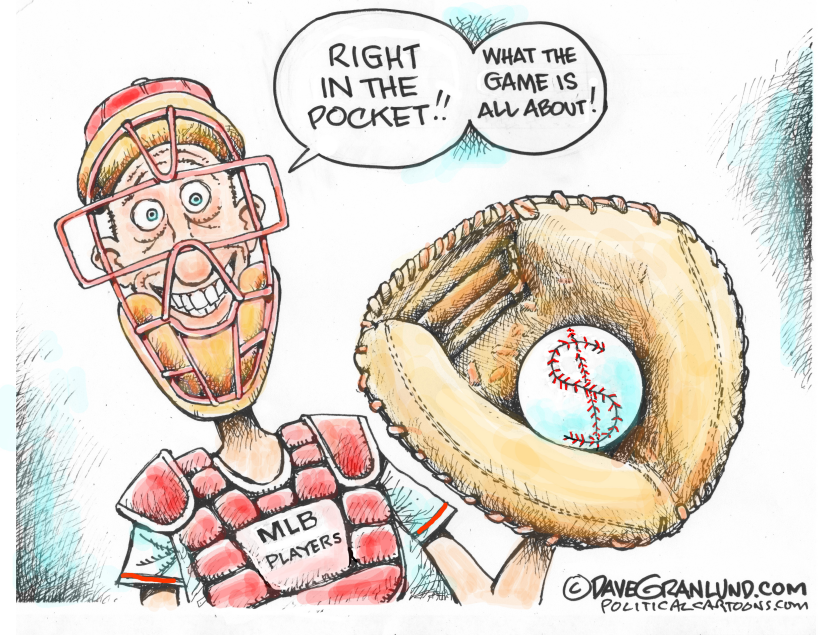
Much of this unwritten stuff is hard to fathom, except to note that as players’ wallets have fattened over the years, their skins seem to be getting thinner.

Copyright 2022 Peter Funt distributed by Cagle Cartoons newspaper syndicate.

Peter Funt’s new memoir, “Self-Amused,” is now available at CandidCamera.com.
Comments Off on Players cling to baseball’s unwritten rules

$ong sung green as music sales boom

Nathaniel Adams Coles was 15 when he dropped out of Wendell Phillips Academy in Chicago to pursue a career in music. Three years later, in 1937, he managed to sell his first song, a catchy tune called “Straighten Up and Fly Right,” for fifty dollars. Coles died of cancer in 1965, but just the other day his daughters completed a sale of his music catalog to Iconic Artists Group for a sum believed to be in the multi-millions.

Though Nat King Cole, as he was known professionally, had uncommon musical success—with more than 150 singles on the Billboard charts — his posthumous good fortune is surprisingly routine. Dozens of artists and their estates are selling catalogs in what has become an unprecedented stampede.

Six days earlier, Hipgnosis Song Management announced the acquisition of 278 songs by Leonard Cohen, who died in 2016, including “Hallelujah,” the moving pop canticle that has been covered over 300 times. The week before, Neil Diamond sold his catalog featuring “Sweet Caroline,” “Song Sung Blue,” and other hits to Universal Music Publishing Group. Terms of these mega-deals were not reported, but a few recent transactions have been eye-opening.

In December, Sony Music paid a reported $500 million for Bruce Springsteen’s catalog (“Born in the U.S.A.,” “Born to Run”). The sale surpassed the $400 million Universal paid for Bob Dylan’s library (“Like a Rolling Stone,” “The Times They Are A-Changin’”). The trade publication Music Business Worldwide estimated that over $5 billion changed hands through music rights acquisitions last year.

Such deals are windfalls for rights holders, but are they good business for media companies? Billboard estimates that Springstein’s catalog earns about $15 million per year, making the price paid by Sony a 33x multiple. Clearly, prices are being driven, at least in part, by competition, ego and nostalgia.

In February Universal paid Sting (“Roxanne,” “Every Breath You Take”) an estimated $300 million for his personal catalog along with music by the rock band The Police. Sony has purchased the work of dozens of artists, including Paul Simon (“The Sound of Silence,” “The Boxer”), who received $250 million.

One of the earliest music speculators was Paul McCartney. When the Beatles lost control of their publishing company Northern Songs in 1969, McCartney set out to acquire other catalogs including the music of Buddy Holly (“That’ll Be the Day,” “Peggy Sue”), which he purchased in 1976.

Nine years later, McCartney’s own music was swept up by Michael Jackson who bought the Beatles catalog for $47.5 million. In 2013, those assets were included in a sale by Jackson’s estate to Sony/ATV for $750 million. McCartney, meanwhile, pursued copyright claims relating to his material. In 2017 he reached a settlement with Sony/ATV and reacquired rights to the Beatles catalog, now said to be worth $1 billion.

In the 1990s, as the internet began to disrupt music royalties that had flowed fairly consistently from play on radio stations, David Bowie (“Starman,” “Let’s Dance”) took the unusual step of working with a Wall Street firm to create what were known as Bowie Bonds. Investors were guaranteed 7.9 percent return on the catalog, while Bowie himself received a payout of $55 million — for rights he took back 10 years later.

Bowie died of cancer in 2016. In January of this year, his estate completed a catalog sale to Warner Chappell Music for $250 million. For heirs, as well as for singers and songwriters who are late in life, such sales provide a huge lump payout, while eliminating the need to manage complex music portfolios.

While it lasts, it is, according to the title of a memorable Nat King Cole hit, “Too Marvelous for Words.”

Comments Off on $ong sung green as music sales boom

We Don’t Want Blood-Stained Oil

Dear President Biden:

Many of us feel helpless — overwhelmed, actually — about the catastrophe in Ukraine, wishing we could do more to show support for that nation’s brave people. Moreover, we want to pitch in.

We’re giving money to organizations providing aid to the more than one million refugees, most of them women and children, who have already fled the war. There are many good charities. My choice is Save the Children’s Ukraine Crisis Relief Fund, whose volunteers are working heroically in the border nations of Poland, Romania and Hungary. They’re offering food, transportation and shelter — as well as tiny touches like a stuffed animal for kids uprooted from their families and homes in the dead of winter.

I understand that your hands are tied militarily, not wanting to risk direct confrontation of Russia by U.S. or NATO forces. We all fear the possibility of nuclear war, given the unhinged behavior of Vladimir Putin. I listened carefully to your State of the Union remarks about “powerful economic sanctions,” including cutting off Russia’s largest banks from the international financial system and “choking off Russia’s access to technology that will sap its economic strength and weaken its military for years to come.”

And yet, Mr. President, you continue to send an estimated $22 million a day to Russia for its oil. Let me repeat that number, computed by Sen. Tom Cotton (R-Ark): twenty-two million dollars every day!

I know you are concerned about soaring gas prices. Indeed, you mentioned the problem three separate times in your speech to Congress. In Central California where I live, gas has jumped above $5 a gallon. That hurts, no doubt about it.

But you know what? Most Americans will pay more at the pump if it were carefully explained that this is a way to help stop Putin and save Ukrainian lives.

Your Secretary of State, Antony Blinken, said recently that halting the purchase of Russian oil would do more harm than good. But then Sunday he flipped and indicated you are seriously considering it. What has changed, other than political headwinds?

Many of your top Democratic allies, including House Speaker Nancy Pelosi, want to stop the flow of oil money into Putin’s war chest. “I’m all for that,” she said last week. “Ban it.”

We all understand, Mr. President, that you and your party fear losing ground in next November’s midterm elections. You don’t want folks blaming you for sky-high gas prices, while we’re also recovering from the pandemic and worrying about the rising cost of other goods and services. But here’s the deal: Voters are already upset about gas prices. You could turn that into a positive by giving it meaning.

During World War II, President Roosevelt created the Office of Price Administration to oversee rationing staples such as butter, sugar, milk — and, yes, gasoline — to support the war effort. Americans stepped up, with pride, to do their part at home while fighting raged thousands of miles away. We’re ready to support you now.

You’re helping by tapping our federal oil reserves. And maybe, if needed, there’s a way to temporarily encourage increased oil production at home without too much environmental impact. Perhaps you and various governors could provide short-term relief from gasoline taxes.

Whatever happens in this war, Americans want to feel they did everything they could, right now, to help the brave people of Ukraine. And they want to know that you did everything in your power at as well.

Please act, President Biden. Stop buying Russian oil.

Copyright 2022 Peter Funt distributed by Cagle Cartoons newspaper syndicate.

Peter Funt’s new memoir, “Self-Amused,” is now available at CandidCamera.com.

Comments Off on We Don’t Want Blood-Stained Oil

Don’t Throw Away Your Mask

Five years ago a sports injury forced me to wear a light brace on my knee. Within a few months the joint was fine, yet to this day I continue to wear a brace on both knees when on the field. I feel there is prophylactic value, but also a sense of comfort and security.

Perhaps that helps explain why, as mask mandates are being relaxed, I find myself in a minority that welcomes being masked — at least in certain situations.

In other countries, principally in Asia, masks were worn routinely in public before COVID came along. Often it was to avoid the effects of severe air pollution, but also to be respectful about transmitting disease. There’s no reason why Americans, having become comfortable with masking during the pandemic, couldn’t be more conscientious going forward.

A survey last fall by USC Annenberg found that 46% of respondents favored wearing masks in stores and other indoor locations outside the home, even after the pandemic passes. Personally, I might stick with masking in crowded subways, concerts — any indoor space where strangers are packed together.

One benefit of voluntary masking would be to reduce the impact of seasonal flu. Before the pandemic, in the 2017-2018 flu season, there were an estimated 41 million cases in the U.S. resulting in 710,000 hospitalizations and 52,000 deaths.

Where else might the lessons of COVID improve our health awareness going forward?

Consider the protocol for food preparation at, say, a Subway shop. It wasn’t long ago that wearing disposable gloves became the norm — a simple way to keep employees from accidentally transmitting germs. Doesn’t it also make sense for food-handlers to wear masks, as they have been during the pandemic?

How about hospital visitors? It seems logical that everyone entering a hospital should don a mask, not just because of COVID but because hospitals are filled with sick people who could infect others, or who are at risk of serious consequences if they become infected by germs brought in from outside.

Should pharmacists wear masks? I think so. Masking should also be urged for customers picking up prescriptions.

The pandemic has provided other lessons about behavior modification. Logically, we should pretty much eliminate all hand shakes. It really makes no sense to walk into a meeting room, for example, and immediately shake the hands of a dozen strangers. Or, when my friends and I play amateur baseball, the notion that after the game 15 or more players from each team shake hands now seems crazy. An elbow bump would be fine.

Politicians learned long ago to discreetly use sanitizer during and after hand-shaking sessions. Indeed the State Department’s Protocol Reference document recommends that hot towels or hand sanitizer be available on receiving lines.

How about sneezing into your elbow? Shouldn’t that become the norm? Sneezing into your hand — the one you’ll use later to shake — is ridiculous.

But the focus going forward should be on voluntary masking when it makes sense. High-traffic locations such airports, supermarkets and movie theaters ought to have permanent signs advising: “If you’re feeling sick today or have active cold or flu symptoms, please wear a mask.”

Once freed of social and political stigmas, it would be nice if common sense took over.

Copyright 2022 Peter Funt distributed by Cagle Cartoons newspaper syndicate.

Peter Funt’s new memoir, “Self-Amused,” is now available at CandidCamera.com.

Comments Off on Don’t Throw Away Your Mask

Bingeing New TV Shows Won’t Last Long

Nine years ago this month Netflix changed how we watch television. The streaming service released an entire season of its political drama “House of Cards” at once, enabling viewers to binge on 13 episodes.

Consumers were torn over whether bingeing was a luxury or, as with a gallon of ice cream or a fifth of vodka, too much of a good thing. Regardless, the scheduling tactic helped Netflix’s profits soar. Now, with a raft of new streaming services competing for subscriber dollars, binge scheduling might soon face cancellation.

A new report from the research firm Antenna showed that many customers sign up when a major movie or series comes along, then unsubscribe a short while later. This customer turnover, or “churn,” is beginning to worry streaming services, just as it has plagued premium cable-TV outlets such as HBO and Showtime over the last five decades. Deloitte Global predicts that at least 150 million streaming subscriptions will be canceled worldwide in 2022.

TV programmers learned long ago that nothing keeps viewers engaged over time like a hit weekly series. Unfortunately, binge scheduling defeats that, allowing viewers to watch and run, just as they might with a major movie.

Here’s what a recent consumer column in the New York Times suggested: “When an entire season of a show that you want to watch becomes available, you can join the appropriate streaming service, watch it for a month, then cancel — and sign up again later if something else catches your fancy.” That’s the very thing that has streaming services rethinking the binge strategy.

Apple TV+, for example, had great success with the quirky comedy “Ted Lasso” by releasing it in traditional weekly episodic style, with an audience building through word of mouth. Thanks to streaming’s technological advantage for on-demand library viewing, “Ted Lasso” latecomers could easily catch up.

Even Netflix is modifying its binge-style scheduling. When the hit crime thriller “Ozark” began its fourth and final season last month, many viewers were surprised that only half of the 14 episodes produced were made available. Netflix customers will have to wait — and presumably maintain their subscriptions — until the remaining seven shows are offered.

The scheduling challenge comes at a time when programming is growing at a remarkable pace. In 2021, streamers and cable services combined to release 1,923 original series episodes, according to analysis by Variety, an increase of 22 percent in just one year. This is in addition to movies, many of which have gone straight to streaming during the pandemic, and off-network reruns, such as “Seinfeld” and “Friends,” that have found new popularity in streaming without commercials.

Bingeing a large library of reruns is a great benefit of streaming. However, as streaming services assess marketing needs, it’s likely that the opportunity to watch entire seasons of new series marathon style won’t last much longer. The strategy that helped Netflix build a streaming empire is falling apart, like a house of cards.

Copyright 2022 Peter Funt distributed by Cagle Cartoons newspaper syndicate.

Peter Funt’s new memoir, “Self-Amused,” is now available at CandidCamera.com.

Comments Off on Bingeing New TV Shows Won’t Last Long

Washington Football Team goes for super blah

The Washington Football Team claims to have received 40,000 suggestions, and the best the former Redskins could settle on for a new name is “Commanders.”

“Our task was less of a marketing endeavor and more about finding a cross section of unity,” said Jason Wright, the team’s president. I say, “Meh.” My vote was for something that captures the times, our politics, and the unpredictability of football games. The WFT should have become the Washington Variants.

Last July Cleveland’s baseball team enlisted none other than Tom Hanks to announce its new name. “We are a city of fire and water, of trees and towers,” Hanks said in a sappy video before proclaiming, “We are all Cleveland Guardians.”

The WFT missed an opportunity to enlist an even bigger celebrity for its grand announcement: Dr. Anthony Fauci.

“We are a city of political division and constant bickering,” he might have said. “Of monuments and hyperbole.” And then, with reporters ready to pounce no matter what the name turned out to be, Dr. Fauci would have winked and lowered his mask to declare, “We are all Washington Variants.”

The beauty of Variants is that it also captures the vagaries of naming sports teams. Back in 2013 the Redskins owner, Daniel Snyder, famously told a reporter, “We’ll never change the name. It’s that simple. NEVER — you can use caps.” But in years to follow, Mr. Snyder’s corporate sponsors were flooded with demands to drop their support unless the name was dumped. Nike pulled its gear from the team’s website, and FedEx, which holds naming rights for the team’s stadium, threatened to remove its signage at a cost to the team of about $45 million. Not long after that, the name Redskins was scuttled.

Commanders is a timid choice. But there’s just too much money in branding and merchandising to risk another name-related fiasco. Pro football should take a page from minor-league baseball, where the stakes are lower so the names tend to be whackier.

The Los Angeles Angels Double-A team calls itself the Rocket City Trash Pandas. The Cleveland Guardians have an affiliate named the Akron RubberDucks. The Arizona Diamondbacks team in Texas is called the Amarillo Sod Poodles. I’ve always had a fondness for the Phillies squad known as the Lehigh Valley IronPigs.

Football just doesn’t get it. The new United States Football League kicks off April 16 with the Birmingham Stallions facing the New Jersey Generals. Really? The Harlem Globetrotters play a fake team called Generals – a name picked to mock bland sports monikers.

Other USFL teams are named Panthers, Gamblers, Maulers, Breakers, Bandits and — most creative of all — the Philadelphia Stars.

Then again, what’s in a name? Few Nationals fans wish the baseball team was still called the Expos. And there’s little nostalgia for the Baltimore Bullets, which became the Capital Bullets, and then the Washington Bullets, before rebranding themselves in 1997 as the Washington Wizards.

When the Commanders decide to change the name again, perhaps they could borrow from the Seattle Mariners Class-A team in Modesto, California. The squad has a name that captures what Modesto and Washington, D.C. both have in abundance.

It’s called, simply, the Nuts.

Copyright 2022 Peter Funt distributed by Cagle Cartoons newspaper syndicate.

Peter Funt’s new memoir, “Self-Amused,” is now available at CandidCamera.com.

Comments Off on Washington Football Team goes for super blah