Latest Fake Immigration Crisis: No Chefs!

March is too early to drag out that old, long-ago discredited “crops are rotting in the field” canard as an excuse to push for agricultural amnesty (or any amnesty, really). Instead, immigration expansionists have trotted out a somewhat new approach: the U.S. suffers from a skilled kitchen worker shortage that’s poised to cripple the food services industry.
Expansionists claim, myopically, that the only solution is more immigration.

Nearly five years ago, The Washington Post published an alarmist story titled, “The Crippling Problem Restaurant-Goers Haven’t Noticed, but Chefs are Freaking Out About.” Similar stories ran bemoaning how the alleged “dire” chef shortages will drive up restaurant meals to unaffordable levels. Congress must, the flawed argument goes, loosen the guidelines that govern non-immigrant visas like the J-1 and establish a larger H-1B visa cap, currently set at 85,000.

As the tortured logic goes, using the O-1 visa might be a novel idea. Keep in mind that the O-1 visa is reserved for “the individual who possesses extraordinary ability in the sciences, arts, education, business, or athletics or who has a demonstrated record of extraordinary achievement in the motion picture or television industry and has been recognized nationally or internationally for those achievements,” according to the definition of the U.S. Citizenship and Immigration Services. Under no stretch are chefs included in the O-1 category.

The latest push for an immigration fix to end the imagined chef and food services crisis, that also includes an agricultural worker scarcity, originates with an MSNBC special five-part series, “What’s Eating America,” where globalist host Andrew Zimmern injected scare talk about Immigration and Customs Enforcement swooping up otherwise innocent workers. Readers curious about ICE’s true mission – removing dangerous criminals – should visit the agency’s website.

Although MSNBC viewers would never know it, domestic culinary schools in New York, San Francisco, Los Angeles and other major metroplex areas offer diplomas that lead aspiring American chefs toward employment in quality restaurants as line cooks, pastry chefs and bread bakers. Community colleges, trade schools, high schools and prisons have developed food science courses that graduate thousands of qualified apprentices annually. Hiring Americans, providing on-the-job training to young Americans in a well-paying career with upward mobility, and giving a second chance to the deserving doesn’t fit the agenda of immigration advocate Zimmern.

The MSNBC mini-series made no mention of lasting solutions – like farm mechanization – that has transformed agriculture and is successful with domestic crops, including blueberries and tomatoes. In the 1960s, tomato growers insisted that the Bracero guest worker program was absolutely essential to their industry’s survival. Nevertheless, Congress discontinued the Bracero program. Growers then invested in new mechanized innovations. The result: Tomato production increased several-fold over the following decades, and real prices fell.

Not coincidentally, the MSNBC program came on the heels of the Zoe Lofgren (D-Calif.) bill, the Farm Workforce Modernization Act of 2019, H.R. 5038, that passed the House of Representatives in December. If signed into law, the bill would include lifetime valid employment authorization documents, Green Cards and a path to citizenship for up to 1.5 million illegal aliens who have been employed – or claim they’ve been employed – in agriculture at least part-time during the last two years.

Weekend-only field work would qualify. Amnesty would also be granted to the workers’ family members. Agricultural worker shortages have been claimed since at least 2007 when Calif. Sen. Dianne Feinstein insisted that more liberal guest worker legislation is “a top priority” without which “many of our farms would not survive.” More than 13 years later, farming is still alive and well. Being more wrong than Feinstein is impossible.

Since robotics means agricultural work can be performed 24/7, often faster, more efficiently and without the potential physical or emotional drawbacks that humans bring, the industry should embrace it. Equally important, Congress should reject bills like H.R. 5038, and instead demand that big ag get its act together, and invest in the industry’s future – automation.

The Senate, wisely, has not taken up the bill, effectively killing it. All future agricultural amnesties deserve the same – DOA.

Joe Guzzardi is a Progressives for Immigration Reform analyst who has written about immigration for more than 30 years. Contact him at [email protected].

Comments Off on Latest Fake Immigration Crisis: No Chefs!

Spring Training from Yesteryear

From the late-1880s through the mid-20th century, more than 300 Major League players trained in Hot Springs, Ark., to benefit from the city’s thermal waters, a cure for the winter’s excessive food and alcohol consumption.

Cap Anson, Chicago White Stockings’ Hall of Fame first baseman from 1876 through 1897, was one of the first to enjoy the waters’ remedy. Others HOFers who passed through Hot Springs included Cy Young, Jackie Robinson, Ty Cobb, Honus Wagner, Rogers Hornsby and Hank Aaron. Babe Ruth, then with the Boston Red Sox, stamped his indelible mark on Hot Springs when he hit a 573-foot grand slam home run before 18,000 delirious fans.

Sam “Wahoo” Crawford is another dead ball era HOFer whose outstanding career is sadly lost in the sands of time. Crawford, who answered to “Wahoo” as a nod to his Nebraska hometown, was quirky but between 1899 and 1917 a dominant power slugger, mainly for the Detroit Tigers. The lefty hitting Crawford led the league in triples six times, and established the still-standing MLB career record for three-baggers, 309. To put Crawford’s record in perspective, consider that Willie Mays in his 22-year career hit 140 triples.

Crawford ended up with 2,961 hits and a .309 batting average, and in 1901 and 1908 was the first and second player to lead both the American League and the National League in home runs. From 1907 through 1909, Crawford manned center with Ty Cobb in left to lead the Tigers to three consecutive pennants. In 1916, Baseball Magazine wrote that “if we were looking for a model for a statue of a slugger, we would choose Sam Crawford.”

Wahoo Sam tore up the Pacific Coast League for the Los Angeles Angels, and in 1919 and 1920 led the league in hits and triples. After a brief period when he grew walnuts commercially, Crawford from 1924 to 1929 became the University of Southern California’s head baseball coach. Finally, between 1935 and 1938, Crawford signed on as a PCL umpire.

But as “Glory of Their Times” author Lawrence Ritter found out when he set out to interview him for his classic 1966 book, Wahoo Sam was a tough guy to find. Ritter tracked Wahoo Sam to what he thought was Crawford’s Los Angeles residence. But when Crawford’s wife Mary opened the door, she told Ritter her husband didn’t live in Los Angeles.

When Mary was prodded for specifics, she expressed reluctance to say more. Sam might, Mary feared, get angry if she revealed her reclusive husband’s address. Finally, under duress, Mary grudgingly said that Sam lived somewhere north of Los Angeles but south of San Francisco. Mary added, none too helpfully, that Sam could see the Pacific Ocean from his front porch.

Undeterred by Mary’s scant information, Ritter, who logged 75,000 road miles to compile his book, pressed northward, and stopped at post offices and realtors to pick up Crawford’s trail. Finally, Ritter stopped at a Baywood Park laundromat and asked a gentleman doing his wash if he knew Sam Crawford’s whereabouts. “I should,” came the answer, “I’m Sam Crawford.”

Crawford told Ritter that he hated Los Angeles, and complained that he “couldn’t even get a loaf of bread without standing in line.” Los Angeles had, Crawford continued, too many people, too much smog and too many crowds that distracted him from his reading, mostly his favorite author Honore de Balzac.

Crawford didn’t own a phone, and although friends gave him a television set, he never watched. Crawford refused to read newspapers because, since they were “nothing but trouble” with their “big headlines about bombs, war and misery,” they invariably “spoiled his day.”

When Ritter asked Crawford to pick his era’s best players, he named Pittsburgh Pirates’ Honus Wagner over his teammate Ty Cobb, and the Washington Senators’ Walter Johnson as best pitcher.

Crawford, whose peak salary was $7,500, died at age 88.

Fans who want to relive Wahoo Sam’s Hot Springs experience can take the Historic Baseball Trail, and also soak in one of its thermal water bath houses.

Joe Guzzardi is a Society for American Baseball Research and an Internet Baseball Writers’ Association member. Contact him at [email protected]..

Comments Off on Spring Training from Yesteryear

Mulvaney: U.S. ‘Desperate’ for More People

If there’s one thing you can depend on from Capitol Hill, it’s the desire to import more overseas workers and push for amnesty for the millions of unlawful aliens in our country (including lifetime valid work permits).

Annual congressional attempts to pass immigration legislation that expands the workforce – and greatly increases the nation’s population – are as certain as rain. The strategy, so far unsuccessful, is for a prominent Republican to endorse the proposed bill. With Republicans on board, the media can then label the legislation bipartisan, a helpful tool in selling the bill to unsuspecting, under-informed readers.

See the roll call of prominent Republicans who have been all-in on the worst of bad immigration bills over the last 15 years:

– The 2005 McCain-Kennedy bill was obviously pushed by John McCain.

– The 2013 Gang of Eight bill included McCain, Marco Rubio, Jeff Flake and Lindsey Graham.

– The I-Squared Act, championed by former Senate Judiciary Chair Orrin Hatch, would have increased the H-1B visa cap by 110,000.

– The 2019 Fairness for High-Skilled Immigrants Act would eliminate the per-country numerical cap for employment-based immigrants, which Utah’s Mike Lee heartily backs.

Invariably, the Republicans joined with the most pro-immigration Democrats to support the expansive immigration bills. In 2005 it was Ted Kennedy, while in 2013 it was Richard Durbin, Chuck Schumer, Robert Menendez and Michael Bennet. Kamala Harris filled the role in 2019.

This year, the most prominent and loudest cheerleader for more immigration is former South Carolina representative and current acting White House Chief of Staff Mick Mulvaney. Before a private UK audience, Mulvaney said: “We are desperate – desperate – for more people. We are running out of people to fuel the economic growth that we’ve had in our nation over the last four years. We need more immigrants.”

Today’s specific amnesty agenda calls for the Senate, in a push that current Senate Judiciary Chair Graham is spearheading, to adopt an upper chamber version of Zoe Lofgren’s (D-Calif.) agriculture amnesty, the Farm Workforce Modernization Act. It’s a cheap labor, indentured servitude bill that would allow an estimated 1.5 million aliens access to Green Cards in exchange for their labor for a fixed period, between four to ten years.

The federal government has not given the slightest indication that it can properly manage any immigration bills, let alone a farm worker amnesty. In 1986, President Ronald Reagan’s Immigration Reform and Control Act included the Special Agricultural Workers (SAW) provision. SAW was a disaster, so bad that The New York Times wrote that it was “one of the most extensive immigration frauds ever perpetrated against the United States government.”

Mulvaney’s comment that the country is in dire need of more people is a complete lie. Ask commuters driving to work if the nation needs more people. More to the point on employment, despite the rosy reporting on jobs, data from the Bureau of Labor Statistics shows that millions of prime working-age people continue to be unemployed or under-employed. Nevertheless, every year more than 1 million legal immigrants get work permits, and about 750,000 guest workers receive employment-based visas. Then, there are the tens of thousands of workers who come unlawfully.

The unasked and therefore unanswered question in the Mulvaney mystery is whether President Trump encouraged his chief of staff to promote immigration. President Trump has made several references to his expansive immigration vision, including his State of the Union bombshell that he wants the “highest [immigration] numbers ever.”

For months, the president’s son-in-law Jared Kushner has been touting an immigration bill that would, among its other anti-American worker features, increase high-skilled labor or so-called “merit-based” immigration – a terrible outcome for U.S. tech workers that would flood the market with cheap labor.

If President Trump wins re-election, in his second term he’d be unencumbered by his campaign pledge to “hire American” that helped put him in the White House. Depending on whether Trump decides to defend American workers or cave to demands from big business for low-cost labor, the next four years could signal an immigration apocalypse.

Joe Guzzardi is a Progressives for Immigration Reform analyst who has written about immigration for more than 30 years. Contact him at [email protected].
Comments Off on Mulvaney: U.S. ‘Desperate’ for More People

Buttigieg’s Bad Immigration Idea

Correction: The total population of the United States has been corrected to 329 million people. 

Pete Buttigieg, one of the surviving Democratic presidential candidates, goes from up to down to sideways in his pursuit of the elusive 2020 nomination. The former South Bend mayor was up in Iowa and New Hampshire but is struggling in South Carolina and Nevada.

When candidates are trying to separate themselves from the pack, they’ll throw out ideas – often half-baked – to see what might stick. During a stop in Merrimack, New Hampshire, Buttigieg provided a great example of concept-testing – in this case, a bad immigration proposal.

At an American Legion hall, Buttigieg suggested that the federal government create a new visa to fast-track legal immigrants into communities that need to stimulate their population growth. Community renewal visas would, Buttigieg said, go “to those who are willing to be in those areas that maybe are hurting for population but have great potential.”

Buttigieg didn’t explain what would happen once those immigrants arrive. They’ll need to find increasingly scarce jobs, secure ever-more expensive housing, compete in overcrowded classrooms for educations, and access the other services that are synonymous with a relatively smooth transition into a new American lifestyle. Making those services available is costly, and the fiscal burden would fall in large part on the existing municipalities and their residents.

If history is our guide, the feds never ask municipalities or residents their feelings about adding more foreign-born residents. For years, the federal refugee resettlement program sent refugees into cities without forewarning locals that a new populace would soon be settling into their towns.

Merrimack is a curious place for Buttigieg to introduce his radical community renewal visa. Like most established communities, the majority of residents would oppose more traffic and sprawl, two guaranteed disruptive outcomes from relentless population growth. Developers, bankers and retail businesses, however, have a different viewpoint. More immigration means a bigger customer base, and therefore higher profits.

The mantra among Buttigieg and his Democratic rivals is that more immigration is unequivocally good, and must be presented in solidly positive terms. Bernie Sanders, Joe Biden, Amy Klobuchar and Buttigieg ignore Census Bureau projections that immigration-driven population growth will drive up our total population from 329 million to over 400 million by 2060.

Although Congress refuses to acknowledge the solution, reducing immigration by half would make a dramatic difference in the country’s future. Assuming the status quo remains unchanged, U.S. population will add 75 million people over the next 40 years. On the other hand, a 50 percent cut would mean that only 25 million people would be added, a much better outcome.

Congress has plenty of room to cut immigration. Roughly two million legal, illegal and temporary guest workers come to the U.S. each year. Not only is the country adversely affected by the impacts of such tremendous growth, but for U.S. workers, the economy suffers. Although the unemployment rate is a low 3.6 percent, there still are millions of American workers who want but cannot find full-time jobs. Immigration hurts job-seeking minority workers who don’t have a college education. Real wage growth remains where it’s been for decades – stagnant.

President Trump is also a culprit in the steady erosion of Americans’ hopes for commonsense immigration. During Trump’s first two years in the White House, the average number of Green Cards issued has been higher than the average number of Green Cards issued annually during each of President Obama’s eight full years in office.

Immigration, Capitol Hill-style, helps the monied class. Other Americans, victims of endless growth, pay a heavy price. Buttigieg’s community renewal visa would be another step away from immigration policies that benefit Americans, and toward rewarding the wealthy.

Joe Guzzardi is a Progressives for Immigration Reform analyst who has written about immigration for more than 30 years. Contact him at [email protected].

Comments Off on Buttigieg’s Bad Immigration Idea

Nearly All Our Presidents Were Big Baseball ‘Bugs’

Out of all our presidents, not many are suspected of being indifferent to baseball. The most notable is probably Thomas Jefferson, who no doubt considered games that involve balls frivolous, and would distract him from his multiple intellectual pursuits.

Many of our presidents were big baseball “bugs,” the early 20th century word that meant fan. In their book, “Baseball: the President’s Game,” authors William Mead and Paul Dickson share presidential vignettes, and explain how the chief executives became hooked on baseball.

At Valley Forge, George Washington and his soldiers played an early form of baseball called British rounders. Andrew Jackson played one-old-cat, another baseball variation that John Adams also enjoyed. In 1860, a Currier and Ives drawing depicted Abraham Lincoln holding a baseball bat as he promised to hit a “home run” with voters in his reelection bid.

Warren G. Harding twice owned shares in the minor league team in his hometown of Marion, Ohio. Franklin Roosevelt famously allowed baseball to continue during World War II. In his green light letter to MLB Commissioner Judge Kenesaw Mountain Landis, Roosevelt said that the moral support baseball provided to wary Americans far outweighed any negatives.

Ambidextrous Harry Truman kept fans guessing which hand he would toss out the ceremonious Opening Day pitch. Dwight Eisenhower played semi-pro ball as a center fielder under the assumed name Wilson, because playing professionally would have cost Eisenhower a chance at his West Point scholarship. Lyndon Johnson, the Pride of the Pedernales, was a sandlot backstop at the tender age of 15.

In 1965, Hall of Fame pitchers Robin Roberts and All-Star pitcher Bob Friend urged Duke Law School graduate Richard Nixon to lead Major League Baseball Players Association. Nixon, sensing that the presidency might still be in his future, declined. Instead, the players picked Marvin Miller, and are today the wealthier for their choice. George H. W. Bush, a Yale first baseman and on the Eli’s College World Series team, kept his glove well-oiled in his Oval Office desk.

Of all the presidents who loved baseball, the one whose fandom lasted the longest, spanning 80 years, was Herbert Hoover, who served during, and was blamed for not ending, the Great Depression and for supporting prohibition. An undeterred Hoover attended ball games even though the cranks fiercely booed him, and yelled, “We want beer.” Hoover was so unpopular that the New York Yankees’ Babe Ruth, who voted for Democrat Al Smith in the 1928 election, chided the president. When told that his $100,000 salary was greater than the president’s, Ruth said, “I know but I had a better year than Hoover.”

Ruth may not have liked Hoover, but Ted Williams spoke glowingly of him. When Williams managed the Washington Senators from 1969 to 1971, play-by-play announcer Shelby Whitfield asked him who he considered the world’s greatest leader. Williams replied: “Not Lincoln, not Washington…not Jefferson, Wilson, and not even FDR…but Herbert – by God – Hoover!” Williams admired Hoover’s refusal to complain about being scorned for the depression and prohibition. Subconsciously, Williams may have been partial to Hoover because of the president’s speech to baseball writers where he suggested that batters get four strikes instead of three. Imagine Williams getting four strikes!

Hoover’s baseball romance began as a rural Iowa youngster. By 1895, Hoover had enrolled in Stanford University where he was part of the inaugural graduating class. Hoover played shortstop for the university. The mind struggles to conjure up an image of the conservative, staid Hoover scooping up smoking-hot grounders and making the double play pivot. Hoover is, after all, the president who went fishing dressed in a suit, vest and tie.

Still attending games late into his life, Hoover died at 90. When the Cincinnati Reds still played at Crosley Field, a plaque in center field featured a Hoover statement that ended with this sentence: “Baseball is the greatest of American sports.”

Joe Guzzardi is a Society for American Baseball Research and Internet Baseball Writers Association member. Contact him at [email protected].

Comments Off on Nearly All Our Presidents Were Big Baseball ‘Bugs’

Trump Misses Opportunity During State of the Union

A triumphant but low-key President Trump took to center stage Tuesday night at the U.S. Capitol to deliver his third State of the Union address.

The president had recently returned from maligned Iowa where, in the Republican caucus, he smothered his two GOP challengers, former U.S. Representative Joe Walsh and former Massachusetts Governor William Weld. President Trump received 97 percent of the vote. And with his Senate acquittal a forgone conclusion, President Trump, in buoyant spirits, touted the economy, low unemployment rates and his successful U.S.-Mexico-Canada trade agreement.

The policy that President Trump can’t get right, and which could be his strongest hand, is immigration. During his address, President Trump stayed on safe ground regarding his immigration achievements and future hopes. The president praised Immigration and Customs Enforcement, and slammed sanctuary cities. He pushed for a new law that would ban providing medical benefits to illegal aliens. And President Trump endorsed a merit-based immigration system, a view he and his advisors – daughter Ivanka and son-in-law Jared Kushner – have previously promoted.

But imagine if President Trump had deviated from safe terrain and instead relied on the last 55 years of immigration history and its consequences to make his case for sensible legal immigration reductions, and for stricter border and interior enforcement.

Beginning in 1965, Presidents Lyndon Johnson, Ronald Reagan and George H.W. Bush signed into law three major immigration acts: the Immigration and Nationality Act of 1965, the Immigration Reform and Control Act of 1986 and the Immigration Act of 1990.

The collective and inarguable results of those three laws have been significant increases in immigration that’s contributed to U.S. population growth, and a huge bump in the numbers of employment-based temporary visas issued that have displaced American workers. Illegal immigration has also spiked, reaching a total of anywhere from 11 to 22 million. Yale University and Massachusetts Institute of Technology researchers found evidence that 22 million is accurate, and discredited the conservative 11 million.

A Pew Research analysis reported that the U.S., despite repeated allegations of being anti-immigrant, has more immigrants than any other country in the world. More than 44 million U.S. residents were born abroad, slightly fewer than one in seven among the overall population. The Migration Policy Institute documented that, as of 2017, more than 18 million children with at least one immigrant parent were born in the U.S.

Since 1965, the number of immigrants in the U.S. has quadrupled. Assuming the status quo remains unchanged, the Census Bureau projects that by 2065 immigrants and their children will represent 88 percent of U.S. population growth when the population will exceed 400 million. The dramatic level of population growth that immigration contributes to is unsustainable, and worthy of an intelligent congressional debate that the president could, and should, insist on.

As for immigration’s effect on jobs, the more than 1 million immigrants that enter the U.S. annually receive lifetime-valid employment authorization documents. Piling on, the Immigration Act of 1990 created the U.S. tech workers’ biggest nightmare, the H-1B visa, and the shameful citizenship for sale visa, the EB-5. Immigration, especially in such high numbers, means looser labor markets, the exact opposite of what U.S. workers deserve.

Finally, for reasons known only to President Trump, he again studiously avoided mention of E-Verify, the federal program that helps ensure that only citizens and legally present immigrants can hold U.S. jobs. By an 81 percent majority, Americans support E-Verify because, among its other benefits, it will help working-age blacks and Hispanics without a college degree find employment.

If President Trump truly wanted to help “flourishing families” and to sustain the “blue-collar boom” – two phrases he used in his address – he would vocally advocate for less immigration. which would translate into more available jobs and higher wages.

Immigration helped carry President Trump to the White House, and he once endorsed lower immigration levels. President Trump could distinguish himself from his Democratic presidential opposition which favors open borders, and gutting interior enforcement.

The president’s moment to make a strong, fact-based immigration reduction argument in his SOTU address has passed, but it’s not necessarily gone forever. President Trump’s 2020 reelection campaign should reinforce the lower immigration levels that Americans want.

Joe Guzzardi is a Progressives for Immigration Reform analyst who has written about immigration for more than 30 years. Contact him at [email protected].

Comments Off on Trump Misses Opportunity During State of the Union

Unraveling California’s Quick But Complete Demise

Through incredibly good fortune, I’ve been unable to watch the tedious impeachment trial. I’m traveling and my destinations don’t have television.

I can’t report having the same luck with the daily immigration news. Bulletins pour into my email inbox, and since immigration has been my journalism beat for more than 30 years, I’m professionally obligated to keep current. The news is relentlessly dreary, and reflects how far from the rule of law in California has drifted.

In its story “This Immigration Lawyer Understands Her Clients; She’s Undocumented,” the Los Angeles Times was almost giddy over illegal alien Lizbeth Mateo and her representation before the Executive Office for Immigration Review (EOIR) of a fellow illegal alien. Let that sink in: an illegal alien lawyer defending an illegal alien in a U.S. Court.

According to a former legacy Immigration and Naturalization employee, no one can serve as an attorney or be a member of the state bar if they are criminals – Mateo entered and reentered the United States illegally. Nor are they eligible to represent an alien before the EOIR since their immigration status conflicts with the laws at issue.

Instead of focusing its story on the absurdity and legal questionability of an illegal immigrant subject to immigration laws representing another illegal immigrant, the Times instead referred to Mateo as “polished, savvy” which may be true but is also incomplete. Mateo is certainly savvy. Several years ago, she and eight other activists, known collectively as the The Dream 9, traveled to Mexico, then demanded and received reentry permission so they could protest what they perceived as President Obama’s harsh immigration policy.

That California would be the epicenter of such an outrageous immigration failure surprises no one. In 2013, as it began its slide into the depths of incomprehensible catering and entitlement-dole-out to unlawfully present migrants, then-Gov. Jerry Brown signed legislation that allowed illegal aliens who passed the California bar to receive law licenses.

During the same week, Brown also approved state-issued drivers licenses for aliens. A boastful Brown said, “While Washington waffles on immigration, California’s forging ahead, I’m not waiting.” One year later, Brown signed more expansive legislation that ordered the 40 licensing boards to accept applications regardless of immigration status. To replace the previously required Social Security number on all professional license applications, aliens could substitute the easily acquired federal Individual Taxpayer Identification Number.

Brown was correct, but not in the way he imagined, when he called Washington an immigration waffler. In the nearly seven years that have passed, Congress has done little to end privileges awarded to illegal immigrants like driving, sanctuary city protection, and access to lower in-state university education fees.

As a California native and long-time immigration analyst, the question I’m most often asked is: What happened to the Golden State? In recent memory, California was a conservative bastion under Sen. Richard Nixon and Governors Ronald Reagan and Pete Wilson.

But then, as president, Reagan went rogue and signed the Immigration Reform and Control Act of 1986. During the ensuing years, tens of thousands of legal and illegal immigrants arrived. The legal immigrants and their children who came of age in the late 1990s and early 2000s favor higher immigration levels, self-define as Democrats and vote accordingly. Among the illegal alien contingent that came to California, many have remained, and some have received amnesty and voting rights. They too support immigration expansion.

Today in California, as the EOIR example proves, federal immigration laws are meaningless. If they’re willing to objectively study California’s immigration history, other states could learn an important lesson. Too much identity politics accelerates great states’ declines and fall.

In about a half-century, California went from being America’s most coveted destination to today’s societal mess from which residents with options can’t flee fast enough.

Joe Guzzardi is a Progressives for Immigration Reform analyst who has written about immigration for more than 30 years. Contact him at [email protected].

Comments Off on Unraveling California’s Quick But Complete Demise

A Rare Display of Nonpartisanship on Immigration

In what has become an annual display of businesses’ addiction to cheap labor, commerce leaders are lobbying the acting Department of Homeland Security Secretary, Chad Wolf, to increase the H-2B visa cap. The H-2B is a seasonal, temporary, nonagricultural visa with a current 66,000 cap, and is frequently used in landscaping, hospitality and construction industries – blue-collar jobs where wages have been stagnant for years. Last year, the cap was increased by 30,000 visas.

Adding foreign-born workers to an economy that President Trump touts as the greatest in America’s history would be counter-productive and hurtful to middle-class U.S. workers who are just starting to benefit from a tight labor market. A record-high 158.8 million Americans are currently employed.

The H-2B visa has a long history of being used by employers to pass over qualified Americans and, under the false labor shortage narrative, hire instead cheap, pliant foreign-born labor. A U.S. Government Accountability Office report confirmed that multiple employers in numerous states violated wage, housing and documentation standards among H-2B workers. And a Buzz Feed News expose based on Labor Department statistics and titled “All You Americans Are Fired” found that “many businesses go to extraordinary lengths to skirt the law, deliberately denying jobs to American workers so they can hire foreign workers….”

Last week, the Congressional Budget Office reported that mass immigration, which the U.S. has experienced for decades, adversely affects the wages of Americans who compete directly with new immigrants for employment. Expansionists argue that immigration grows the economy, a half-truth. More people mean a bigger economy, but per capita income suffers.

From the CBO: “And there are many new immigrant workers to compete with. Immigrants account for about half of all newcomers to the workforce each year.” The CBO concluded that wages are negatively affected in whatever category in which American workers must compete in a labor market artificially inflated by mass immigration.

The degree to which Americans have suffered because of a surfeit of immigrant labor is eye-opening. Census Bureau data from the first quarter of 2019 show that 5 million adult immigrants without a bachelor’s degree have been allowed to settle in the country just since 2010. As a result, wages have stagnated or declined for the less educated. Since 2000, the bottom quarter of earners saw just a 4.3 percent real-wage increase – equivalent to an annual raise of just 0.2 percent. An immigrant labor overage most adversely affects teenagers, U.S.-born blacks and other minorities.

Despite pleas from big business that H-2B visa hikes are necessary to offset an acute labor shortage, and even avoid bankruptcy, numerous nonpartisan studies find no evidence of scarcity. Among other respected bipartisan organizations, the Economic Policy Institute, a liberal, pro-immigration, Washington, D.C.-based research firm found “no evidence at all of labor shortages in the labor market.”

The H-2B visa has been so flawed for so long, and has been so harmful to American workers, that even hard-core pro-immigration Democratic senators have written to Wolf and Labor Secretary Eugene Scalia urging them to reject corporate crocodile tears about worker shortages.

Calif. Sen. Dianne Feinstein, Conn. Sen. Richard Blumenthal and Ill. Senator Richard Durbin, all of whom throughout their long congressional careers have consistently voted in favor of more employment-based visas, joined their Republican colleagues Iowa Sen. Charles Grassley and Ark. Sen. Tom Cotton to object to increases in the existing 66,000 cap. In their letter to Wolf and Scalia, the senators asserted that the H-2B visa incentivizes employers to hire foreign nationals and pass over qualified Americans.

President Trump is the wild card in the equation. From time to time, the president has demonstrated an understanding about how excessive immigration hurts American workers. But President Trump’s recent comments about the need for more skilled immigration, talking points taken straight from the Chamber of Commerce’s playbook, have the pro-American labor lobby on edge.

As is often said around Capitol Hill, when it comes to President Trump’s thinking, no one ever knows.

Joe Guzzardi is a Progressives for Immigration Reform analyst who has written about immigration for more than 30 years. Contact him at [email protected].

Comments Off on A Rare Display of Nonpartisanship on Immigration

Focus on Birthright Citizenship (and its Cousin) Long Overdue

Amidst Washington, D.C.’s impeachment hysteria, the Trump administration has taken aim at the lowest hanging fruit among immigration abuses – birth tourism. It’s an underground cottage industry, often criminal, where unscrupulous hotel owners that cater to specific ethnicities advertise abroad to entice women (at the cost of tens of thousands of dollars) to travel to the U.S. to give birth to an American citizen baby.

In a long overdue action, federal authorities recently charged 20 Chinese operators of “You Win USA” that brought hundreds of women to Irvine, Calif., at costs that ranged from $40,000 to $80,000 to deliver a U.S. citizen. Indictments filed in U.S. District Court charged the perpetrators with immigration fraud, money laundering and identity theft. Lying on a visa application, which the hotel proprietors encouraged, is a crime that makes the petitioner inadmissible. Predictably, many of the indicted fled back to China.

During the last 15 months, President Trump announced he’s considering issuing an executive order that would ban awarding citizenship to children whose mothers are in the U.S. illegally or are noncitizens. The U.S. and Canada are the only two advanced nations that grant automatic citizenship to children born on their soil regardless of the parents’ immigration status. To discourage birth tourism, Australia, France, Germany, Ireland, New Zealand, South Africa and the United Kingdom have modified guidelines by mandating that at least one parent be a citizen of the country or a legal permanent resident who has resided locally for several years. Various bills which Congress introduced in past years with similar requirements went nowhere.

The lax policy in the U.S. is easily abused. Thousands of women, late in their pregnancies, come to the U.S. each year from countries as distant as South Korea or as close as Mexico to give birth. Some arrive legally as temporary visitors, but with the intent of giving birth to an American baby. Others enter illegally. Once the child is born, he or she receives a U.S. birth certificate and qualifies for a passport. The parent and child’s futures are linked irreversibly to the U.S.

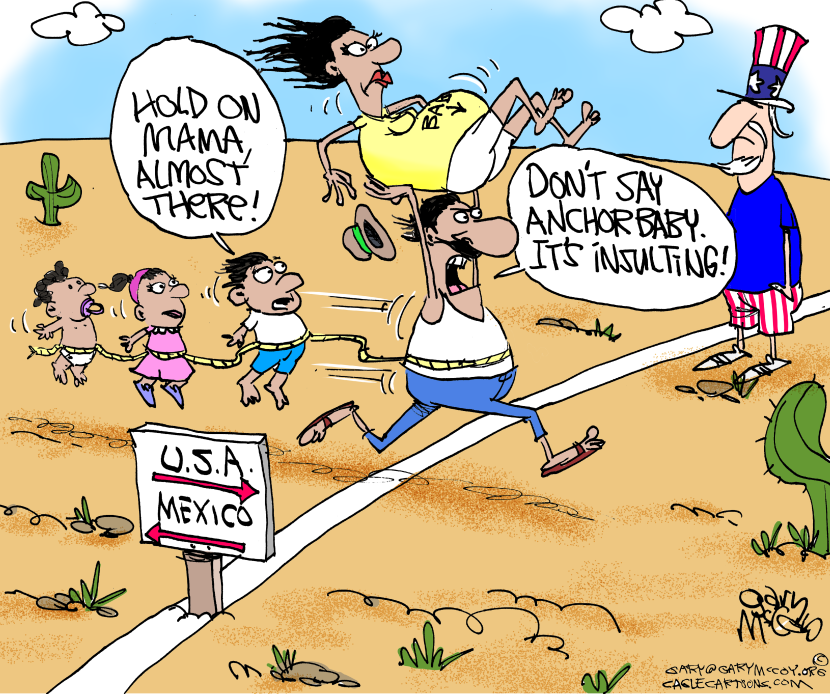
From this process sprang the term “anchor baby,” meaning that the child’s citizenship status anchors his parents to the U.S.

For decades, controversy has swirled around birthright citizenship. At the ongoing debate’s core is the U.S. Constitution’s 14th Amendment, Section 1 provision: “All persons born or naturalized in the United States, and subject to the jurisdiction thereof, are citizens of the United States and of the State wherein they reside.” Illinois Sen. Lyman Trumbull, one of the 14th Amendment’s principle authors, said that “subject to the jurisdiction of the United States” meant subject to its “complete” jurisdiction, and therefore “not owing allegiance to anybody else.”

Whether a foreign national either illegally present or present on a temporary, nonimmigrant visa is subject to U.S. jurisdiction is a point worth debating, and one that the Supreme Court may ultimately have to decide. In the meantime, birth tourism is thriving.

No one knows exactly how many American citizen births to tourists or illegally present migrants occur annually. One study found that about 35,000 birth tourism babies are delivered on U.S. soil each year. Additional research showed that each year about 40,000 annual births come from legally present guest workers, students and exchange visitors.

Birthright citizenship serves no legitimate purpose, endangers national security and hurts Americans. The children get Social Security numbers, access to 13 years of free public education, low in-state university tuition and employment privileges. Eventually, they can petition their extended families to enter legally which would significantly accelerate population growth and job competition.

Immigration advocate and former U.S. Immigration and Nationalization Service director Doris Meissner acknowledged birthright citizenship’s pitfalls. Meissner told The Wall Street Journal, “As long as you have birthright citizenship, it’s true this is something that can be exploited.”

President Trump is right to push to end birthright citizenship, and equally correct to criticize birth tourism. U.S. citizenship should be treasured, not handed out like a door prize to disingenuous individuals who’ve figured out how to exploit the U.S., and its generosity.

Joe Guzzardi is a Progressives for Immigration Reform analyst who has written about immigration for more than 30 years. Contact him at [email protected].

Comments Off on Focus on Birthright Citizenship (and its Cousin) Long Overdue

The Two Baseball Players Who Paved the Way For Integration

For most baseball fans, the season ends when the World Series final putout is made. But in 1946, the lucky residents of Pittsburgh, Youngstown, Cleveland, Cincinnati, Kansas City, Des Moines, Denver, San Diego, Fresno, Sacramento, Los Angeles, San Francisco and, finally, Long Beach had the once-in-a-lifetime chance to see Satchel Paige’s Negro all-stars play against Bob Feller’s white all-stars.

The barnstorming tour, organized by Feller and conceived on his long, dangerous shifts manning anti-aircraft guns on the USS Alabama during World War II, began immediately after the regular season ended. Topflight players participated. Feller’s team included Hall of Famers Phil Rizzuto, Bob Lemon, Stan Musial, batting champion Mickey Vernon, and three-time twenty-game winner and three-time twenty-game loser Bobo Newsom.

Paige’s squad had Negro League greats like Buck O’Neil, Sam Jethroe and Hank Thompson. For the Negro League players, the barnstorming exhibitions gave them a rare opportunity to showcase their skills, but only north of the Mason-Dixon line.

Each team traveled on its own DC-3 and played 34 games within about a month before sellout crowds. Feller, who in 1946 completed 36 of 48 starts, tossed 371 innings, 10 shutouts and set the then-modern-day record for single season strikeouts with 348, said that the tour drew “huge crowds,” an estimated 250,000 total.

Blunt in his evaluation of what the tour represented, Feller said that it was a friendly but racial rivalry and a money-making proposition. Feller: “I wasn’t doing it for my health.” Monte Irvin, New York Giants’ Hall of Famer who to his regret passed up the tour, said that Paige and Feller earned a remarkable-for-the-era $100,000 each with the players receiving about $5,000. Feller spared no expense. He hired a trainer, a doctor, a lawyer and a public relations specialist.

Paige, by then at least 40, matched up with the fire-balling Feller, 25, for the first couple of innings before giving way to relief pitchers. Feller, the greatest pitcher Ted Williams said he ever faced, had tested his fastball’s speed against a speeding, 86-MPH Harley-Davidson motorcycle. On a sunny summer day in Chicago’s Lincoln Park, the Harley had a 10-foot head start before Feller released the baseball. The ball broke the paper bull’s eye target well ahead of the motorcycle. MLB announced that Feller’s pitch hit 104 miles per hour.

Feller, financially astute even at a young age, took note of how popular interracial barnstorming was during the 1930s when a Dizzy Dean-led white team took on Paige’s black lineup. One afternoon in 1934, Dean and Paige were all business. They traded 13 scoreless innings at Wrigley Field in Hollywood, Calif., before Paige eked out a 1-0 win.

In 1946, the Negro Leaguers finished with five wins and 15 losses, not their desired outcome, but scoring 63 runs compared to the major-leaguers’ 91 showed white owners that blacks could compete. But when the Sporting News asked Feller if black players were potential big leaguers, he said that he hadn’t “seen one, not one,” with the possible exception of a young Paige. Years later, after being charged with racism, Feller changed his tone. In his “Bob Feller’s Little Black Book of Baseball Wisdom,” Bullet Bob wrote that Paige “could spot a hitter’s weaknesses very quickly, quicker than anyone I ever knew.”

The Feller-Paige exhibitions helped advance MLB’s integration. The games proved that black players had the necessary skills, and that most Americans appreciated quality baseball regardless of skin color. On Opening Day April 15, 1947, less than a year after the barnstorming tour ended, Brooklyn Dodgers’ manager Burt Shotton, dressed in street clothes as was his practice, penciled Jackie Robinson into the No. 2 spot in the batting order against the Boston Braves. In his debut, Robinson played first base.

Paige didn’t reach the big leagues until 1948 when he joined Feller in the World Series champion Cleveland Indians. Paige’s record, 6-1, proved that, all along, he deserved to be in the big leagues.

Joe Guzzardi is a Society for American Baseball Research and Internet Baseball Writers Association member. Contact him at [email protected].
Comments Off on The Two Baseball Players Who Paved the Way For Integration