Congress Wants More Green Cards, Economy be Damned

No matter how beaten down American workers are or how dim their employment prospects, the White House and Congress continue their relentless insistence on importing hundreds of thousands more foreign-born workers. At the same time, legal immigration remains mostly unchanged, and annually adds more than one million lifetime work authorized immigrants to the labor pool.

The U.S. economy is in a calamitous free fall. In the last seven weeks, approximately 33 million Americans have lost their jobs. As grave as this is, the Economic Policy Institute estimates that the COVID-19 pandemic may have prevented 30% to 40% of qualified applicants from claiming unemployment benefits. In addition, EPI analysts calculate that since March 15, between 8.9 and 13.9 million people that could have filed for unemployment didn’t. Many economists project that before the pandemic ends, the U.S. unemployment rate will reach 30%, exceeding the Great Depression’s peak of 25%.

Everyone is suffering, but millennials – adults between 20 and 40 years old – are the hardest hit. A Data for Progress report found that a staggering 52% of people under age 45 have lost a job, been furloughed, or had their hours reduced. Since the average immigrant is 31 years old, they’ll compete head-to-head with struggling millennials for rapidly vanishing jobs, especially in the leisure industry. Given the dire economy, no intelligent argument can be proffered that persuasively supports more immigration.

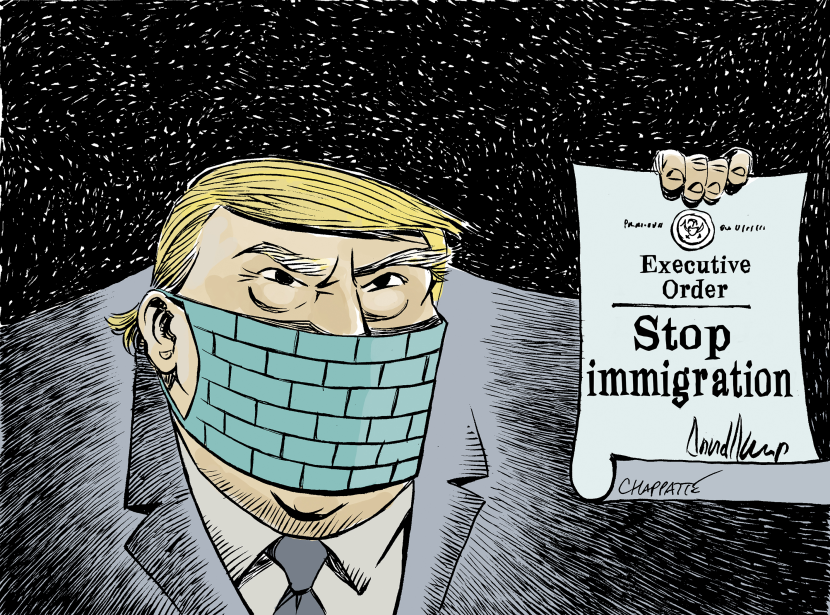
Last month, President Trump signed an executive order that temporarily suspended some immigration. Because it stated an intention to “protect our great American workers,” it generated an immediate buzz among lower-immigration level supporters. But Trump’s commitment to defend Americans turned out to be hollow . The number of immigrants his order would affect over its initial 60-days is between 5,000 and 80,000, a tiny fraction of the one million-plus foreign nationals the U.S accepts every year.

Also left unchanged in the order are the multiple destructive-to-American workers guest worker programs. In 2019 nearly one million employment-based visas were granted. The visa break-down: 205, 000 H-2A agricultural workers, 97,000 H-2B non-agricultural workers, 188,000 H-1B tech workers, 77,000, L-1 international transfers, and 353,000 J-1 cultural exchange workers.

But that’s not where the bad news ends. H-4 work permit visas are still being doled out to visa holders’ spouses, and the Optional Practical Training (OPT) program, which grants three-year valid work permits to foreign nationals graduating from U.S. colleges, is still in effect. In 2018, 145,000 foreign graduates received OPT work authorization.

At a time when Trump and Congress should demand a prolonged immigration pause, the executive and legislative branches are not only maintaining the status quo, they are pressing for more overseas labor.

Two recent congressional actions show how dedicated the White House and Congress are to maintaining immigration at its historically high peak.

The first: Instead of announcing that more tech workers, mostly Indian and Chinese nationals, would be denied entry, the government is poised to let the H-1B visa process continue as usual. Last year the H-1B lottery approved 85,000 new employment visas and, for more than a decade, non-partisan studies have proven that H-1B visas are unnecessary and serve only to sate tech moguls’ cheap labor addiction.

Second, a group of senators led by Illinois high-immigration advocate Dick Durbin introduced legislation that would grant 40,000 green cards to international health care workers. Yet today, more than 20,000 U.S. medical school graduates who were unmatched to a residency program are available to go to work, immediately. Moreover, the quality of the medical education that international doctors possess is an unknown variable. American doctors must come first.

Congress’ unyielding devotion to excessive immigration proves that it is anti-U.S. worker and indifferent to Americans’ will. According to a Washington Post/University of Maryland poll, 65% of Americans want legal and illegal immigration to end. Let’s listen to them.

Joe Guzzardi is a Progressives for Immigration Reform analyst who has written about immigration for more than 30 years. Contact him at [email protected]

Comments Off on Congress Wants More Green Cards, Economy be Damned

Long Ago, Cubs Trained on California’s Catalina Island

For 30 years between 1921 and 1951 (with the exception of two years during World War II) the Chicago Cubs trained and frolicked on Catalina Island, a jewel located 26 miles off the Los Angeles coast.

Catalina Island is such a glorious spot that the Four Preps, who, during their heyday, charted 11 gold records, memorialized it in “26 Miles,” a paean about “the island of romance, romance, romance.”

The story behind the Cubs’ arrival on Catalina is a tribute to team owner William Wrigley, Jr. On a 1919 visit, the soap turned chewing gum potentate’s wife, Ada, woke, looked out her hotel window, gazed across the Pacific, and declared that she wanted to make Catalina her home. Wrigley quickly concurred, and two years later bought the island.

Wrigley’s investment paid off handsomely for the owner, the Cubs’ players, its fans, its broadcasters and the Catalina Chamber of Commerce. For the Cubbies, Catalina was a lark. After morning practice, the players were free to fish, hunt, horseback ride, play golf, barbecue and swim in the Pacific. The bravest Cubs roped and wrangled in a Wrigley-organized rodeo.

Players stayed at the exclusive St. Catherine’s Hotel, where they dined on braised oxtail and Catalina headcheese. Unattached Cubs made new friends among the Hollywood starlets who traveled on the S.S. Catalina from Los Angeles to enjoy an afternoon of baseball. One ingenue was Norma Jeane Mortenson, aka Marilyn Monroe. Others were Betty Grable and Grace Bradley, the future Mrs. Hopalong Cassidy.

During the Cubs’ three decades on Catalina, the team won four National League pennants. Among the most well-known Hall of Famers are rotund RBI record holder Hack Wilson, pitcher Jay Hanna “Dizzy” Dean, 373 game winner Grover Cleveland Alexander (who once hurled 16 shutouts in a single year), and taciturn slugger Rogers Hornsby, who between 1922 and 1925 hit over .400 three times. When Hornsby join the Cubs, he took his place in the batting order with sluggers Wilson, Kiki Cuyler and Riggs Stephenson to form a home-run-hitting quartet with the wonderful nickname, “The Four Bludgeoneers.”

WHO broadcaster Ronald “Dutch” Reagan provided the Cubs fans back home in frigid Chicago with the spring training games’ details. Like the Wrigleys, Reagan quickly fell in love with Catalina. On the 1937 day that Reagan arrived, Catalina was a balmy 82 degrees. Reagan, an unsuspecting Illinois native, ran to the pier, dove in and immediately learned that the water temperatures were often a frigid 40 degrees. Jokingly, Reagan claimed in order to avoid hypothermia, he walked “on top of the waves.”

Wrigley created the now common spring training, all-inclusive package deal. The owner’s slogan for Catalina was: “In all the world, no trip like this.” Soon, posters that pictured three bear cubs tossing a ball under the bright California sun lured Chicago’s winter-weary fans: “The Cubs are here! Why don’t you come, too?” By 1929, Wrigley’s public relations campaign increased the island’s tourism from 90,000 to 750,000 travelers.

By 1952, however, the Cubs moved to the more easily accessible Arizona where other major league teams also trained. From time-to-time, Cubs old timers returned to Catalina for reunions. Baseball is still played there – the Avalon High School Lancers play their games at the old ballpark. But today, Catalina’s 4,000 permanent residents are suffering from California’s statewide shutdown order.

Visitors to Catalina, once welcomed by the Cubs during the island’s glory days, and which pre-COVID-19 drew about 1 million tourists annually, have been asked to stay away.

When the island reopens, make sure to plan a stop at the Catalina Museum, which offers exhibits featuring the celebrated Cubs era.

Joe Guzzardi is a Society for American Baseball Research and Internet Baseball Writers Association member. Contact him at [email protected].

Comments Off on Long Ago, Cubs Trained on California’s Catalina Island

Explained: Why Trump Backpedaled on His Immigration Order

Just hours after President Trump announced an executive order that would pause most immigration to the U.S. during the current high unemployment period, he abruptly shifted gears.

Under a revised order, employment-based visas will be issued as per usual, a devastating blow to the 26 million Americans who have lost their jobs. In less than two months, COVID-19 has wiped out all of the 23 million jobs created after the 2007-2009 recession ended. The real unemployment rate soared past 20 percent, and is expected to push upward toward 30 percent over the coming weeks.

To the enormous disappointment of Trump’s base, and many jobless Americans, the final executive order didn’t live up to the original version. Exempted from the president’s prewritten version are temporary foreign workers, including the recently approved 85,000 H-1B visas, as well as the H-2A and H-2B visas used for agriculture, seasonal and leisure industries.

The COVID-19 lockdown has destroyed, at least for now, hotel and food service businesses. Look, for example, at Las Vegas where the famous, tourist-dependent Strip has turned off its lights. Claims that more H-2B visas are essential only make the claimants sound foolish. On the contrary, an email survey found that 54 percent of big tech employees worry that COVID-19 will cost them their jobs, and 62 percent fear their incomes will decline.

You don’t have to be an economist or an immigration expert to understand the harm done by adding hundreds of thousands of overseas workers to the labor pool during today’s severe unemployment crisis. Ask the next 100 people on the street what they think of importing labor while Americans are reeling from the effect of unemployment, and likely 99 percent would call it inexplicable folly. Simply stated, as long as Americans remain jobless, importing overseas labor exacerbates the already grave unemployment crisis.

U.S. tech workers are particularly puzzled over what happened to Trump’s original executive order, considering his promise to tech workers to restrict H-1Bs during a 2016 campaign debate in Miami, where he said, “It’s very bad for business. And it’s bad for our workers. And we should end it.”

White House insiders told the media that during the back and forth discussions about how inclusive the executive order should be, one advisor to Trump said that Apple chief executive officer Tim Cook would be unhappy if his H-1B pipeline were interrupted. In 2019, Apple, Google, Amazon and Facebook were among the top ten recipients of new H-1-B visas. Moreover, Cook has long tussled with President Trump over immigration restrictions. In February 2017, Cook threatened to file a lawsuit against President Trump over a previous executive order that banned entry to refugees from seven majority Muslim nations.

However, a suspect more likely to have undermined Trump is his immigration-advocate son-in-law and senior advisor, Jared Kushner. Since Trump first moved into the White House, the expansionist Kushner has been his immigration go-to guy. Working quietly behind the scenes, Kushner has consistently promoted higher legal immigration levels that would focus on admitting more low-and high-skilled labor which includes workers in the H visa category.

For 30 years, since the Immigration Act of 1990, tens of millions of U.S. workers have lost their jobs because cheap labor addicts have unduly influenced Republican and Democratic administrations. An Ipsos poll found that nearly 80 percent of Americans support an immigration pause during the coronavirus and unemployment emergency.

The purpose of government is to carry out the people’s will. In this case, that means pausing immigration until U.S. workers can get back on their feet – a period more likely to last years, not the weeks that the executive order suggests.

Joe Guzzardi is a Progressives for Immigration Reform analyst who has written about immigration for more than 30 years. Contact him at [email protected].

Comments Off on Explained: Why Trump Backpedaled on His Immigration Order

U.S. Physicians Sidelined For International Doctors

Congress, immigration advocacy groups and immigration lawyers are urging the Trump administration to increase the number of foreign-born doctors to alleviate the alleged medical responders’ shortage during the coronavirus pandemic.

Minnesota Democratic Senators Amy Klobuchar and Tina Smith, along with colleagues in the House and Senate, wrote to U.S. Citizenship and Immigration Services (USCIS) requesting that the agency resume premium processing for international medical school graduates who are seeking employment-based H-1B and J-1 visas. On March 20, USCIS announced that because of COVID-19, it would suspend premium processing.

According to the letter, more foreign-born doctors would increase health care availability, especially in rural areas, through the Conrad 30 Waiver Program, which allows U.S.-trained foreign medical school graduates to stay in the country as long as they practice in underserved areas. The “30” refers to the number of doctors per state that can participate in the program.

Traditionally, foreign national doctors who trained in the U.S. must return home for two years after their provisional period has ended before they can reapply for a new visa or permanent residency. Last year, Senators Klobuchar, Susan Collins (R-Maine) and Jacky Rosen (D-Nev.) introduced legislation to extend the Conrad 30 program through 2021. The Conrad State 30 and Physician Access Reauthorization Act, S. 948, has 15 cosponsors – eight Republicans, six Democrats and one Independent.

Americans are united in their desire to do everything possible to end the spread of coronavirus. But a dose of reality is in order.

There are U.S. doctors ready to work whom Klobuchar, Collins, Rosen et al appear to be ignoring. National Resident Matching Program (NRMP) data shows that each year since 2011, up to 2,000 current year medical school graduates and prior year graduates did not place into a medical residency at a teaching hospital. Without that residency, they cannot practice medicine.

But in that same ten-year period, more than 36,000 non-U.S. citizen international medical graduates received residency positions – spots that are largely funded by taxpayers through Medicare dollars. In fact, the number of international medical graduates has increased every year since 2011, from 2,721 to more than 4,222 in 2020.

A sensible solution to the imbalance between overseas and U.S. doctors would be to reduce the number of residencies available to non-U.S. doctors, which should increase residency slots for U.S. doctors.

American medical school graduates have worked hard, often taking on tremendous debt loads to earn their undergraduate and M.D. degrees. An unmatched Georgetown University School of Medicine graduate who I’ll call Dr. X, and interviewed for this column, told me that to obtain his medical degree he took on $50,000+/year in federal student loans to pay for his education. The cost of a medical degree at Georgetown is even higher today.

With an interest rate of 6.7 percent, Dr. X’s student loans accrue interest at more than $25,000 a year and have ballooned to an aggregate that exceeds $460,000, a sum he’s unlikely to retire if he’s unable to work as a physician. Dr. X passed his U.S. medical licensing exams and has extensive medical volunteer experience, as well as other health services experience. Still, without residency, Dr. X can’t practice.

Yet, just since 2011, 36,000 foreign-born doctors are practicing throughout the U.S. even though the federal government has no regulatory authority to oversee the quality of medical education in India, Pakistan, China and Iran, the home countries of the majority of these incoming doctors.

Not only is the existing system and the proposed congressional effort to increase the total number of foreign medical practitioners unfair to American doctors, it’s unjust to the sending countries. In this current pandemic, doctors are needed in their home countries. For instance, India reported a shortage of 600,000 doctors, which means that there is one government doctor for every 10,189 persons, much larger than the World Health Organization’s recommended ratio of 1:1,000.

American doctors have the reasonable expectation that upon earning their medical school degrees and passing their licensing exams, they’ll be able to practice their chosen profession. To shut U.S. doctors out while hiring foreign nationals violates America’s social contract with its citizens, and is a gross injustice.

Joe Guzzardi is a Progressives for Immigration Reform analyst who has written about immigration for more than 30 years. Contact him at [email protected].

Comments Off on U.S. Physicians Sidelined For International Doctors

A Baseball Redemption Story For Our Troubled Times

Before Commissioners Bud Selig and Rob Manfred transformed baseball into a game of launch angles and exit velocities, I attended Opening Day every year. So, when April 10, 1980, rolled around, I found myself in Houston where a group of friends and I set out for the Astrodome, the first-ever indoor sports stadium, nicknamed the world’s Eighth Wonder.

That night, the Los Angeles Dodgers took on the Houston Astros, the teams experts predicted would battle each other for the Western Division title. For once, the sages were correct. The Astros beat the Dodgers in a sudden death, 163rd game for the title.

On that long-ago April evening, fans got a bonus. Toeing the slab would be Dodgers’ ace Burt “Happy” Hooton against Astros’ flame thrower, James Rodney Richard. Hooton is remembered for surrendering the first of New York Yankee Reggie Jackson’s three consecutive 1977 World Series home runs. But, more important, Hooton was a University of Texas Longhorns’ superstar who won 151 games for the Chicago Cubs, the Dodgers and the Texas Rangers. Without a day in the minor leagues and on his fourth professional start, Hooton no-hit the Philadelphia Phillies.

Richard honed his fastball skills as a poor Louisiana kid who grew up throwing coal rocks from his porch at targets 60 feet away. By the time Richard graduated from high school, he hadn’t lost a game or, in his senior year, given up a single run. The Astros selected Richard as their No. 2 overall choice in the 1969 draft. By 1980, the fire-balling Richard had become baseball’s most feared hurler.

On that Opening Day four decades ago, Richard had overwhelming stuff, and again whiffed 13 Dodgers over eight innings. Without walking a batter and aided by signal caller Bruce Bochy, Richard won, 3-2. When the 33,000 fans exited the Astrodome, their chatter centered on Richard’s Hall of Fame prospects. No one imagined that by the season’s end, Richard’s career would be over, and that he would eventually be homeless, living under a bridge.

After Richard pitched in the 1980 All-Star game, he complained of arm stiffness, and dizziness. Even though Richard had pitched five straight years without missing a start, critics maligned him with racist-tinged diatribes for laziness, and possible drug use.

After rehabbing from a 21-day disabled list stint, Richard, age 30, collapsed. The Astros rushed him to the hospital where doctors performed life-saving emergency surgery to restore blood flow to his brain. After additional testing, doctors learned that Richard had suffered three strokes that led to right arm arterial blockages. In 1984, after unsuccessful rehab efforts and more surgery, the Astros gave Richard his unconditional release.

Ten years later, a period that included two divorces and ruinous investments, Richard was emotionally and financially bankrupt. By then homeless, Richard lived beneath a Houston freeway underpass when a local minister found him, and helped the former pitcher overcome despair. Eventually, Richard embraced the Bible, and today counsels other homeless, struggling or drug-addicted Houstonians.

Of Richard’s many baseball accomplishments, he’s most proud of his exclusive “Black Aces” membership, a group of African-American pitchers who’ve achieved 20 or more victories in a season. Included are Don Newcombe, Bob Gibson, Vida Blue, Dave Stewart and the group’s founder, Jim “Mudcat” Grant.

Today, Richard doesn’t dwell on his past fame or his missed Hall of Fame opportunity, but instead says he looks at “what’s in front of me.” In this troubled time, Americans should join Richard in looking forward to better times ahead that will – sooner or later – include an Opening Day.

Joe Guzzardi is a Society for American Baseball Research and Internet Baseball Writers Association member. Contact him at [email protected].

Comments Off on A Baseball Redemption Story For Our Troubled Times

Hawaii’s Earth Day Challenge

Prior to the coronavirus pandemic, I spent the better part of three months in Hawaii, where I was heartened to find a state doing what it could to encourage environmentally sound practices.

There are numerous organizations working to protect native plants, animals, ecosystems and cultural sites. Back in July 2018, the Department of Environmental Services imposed a 15-cent per recyclable bag fee that retailers provide to shoppers. Bike lanes are everywhere, a good thing since traffic is brutal and parking is nearly-impossible to find and more expensive than midtown Manhattan. Driving in Hawaii is anything but aloha.

But Hawaii is caught in the quintessential Catch-22. Tourism is the state’s lifeblood. About 10 million tourists come to Hawaii each year. To accommodate them, environmentally unfriendly high-rise condominiums and luxury resort hotels have sprung up along the coastline and destroyed the islands’ delicate ecosystems and landscapes.

Nonstop urban development has displaced poor and lower middle-class neighborhoods, which in turn spawned a serious and growing problem – homelessness. Last year, O’ahu’s homeless spiked to 6,924. During the last five years, 373 O’ahu homeless have died on the street.

This year, Earth Day will mark the 50th anniversary that citizens worldwide gather in their respective cities to identify solutions to make the planet more habitable. Perhaps no state faces a greater challenge than Hawaii. Compare the era of Hawaii’s Duke Kahanamoku a half century ago to island life today, and the changes are dramatic. Hawaii’s skyline, once a breathtaking vision of beach and mountain majesty, is today marred by ugly sprawl.

Immigration is a key variable in Hawaii’s growth, and a reason that the need to build new homes and apartments is constant. A recent analysis found that Hawaii has a large immigrant community, nearly half from the Philippines. About 18 percent of the state’s 1.4 million are foreign nationals, and 16 percent are native-born Americans who have at least one immigrant parent.

On the economic front, however, Hawaii had been coming up roses. In 2018, the 10 million tourists set a record. Tourists stayed longer, and spent more than in previous years, a total of $17.8 billion, a 6.8 percent increase over the previous year. Visitor spending generated $2.08 billion in state tax revenue in 2018, an increase of $133.1 million from 2017. Hawaii didn’t exceed 1 million tourists until 1967.

In the last decade, tourism has doubled, an unsustainable trend. Yet, the Hawaii Tourism Authority’s data showed that, in a year-over-year comparison, January’s 2020 tourism increased 5 percent. Those visitors spent $1.7 billion on lodging, airfare, car rentals, meals and other sundry expenses. However, the strong January tourism report, broken down by visitor categories, showed what looked like a potentially foreboding trend as I began writing this piece in February. Visitor arrivals from the coronavirus epicenter, China, declined 20 percent. Arrivals from Korea, Japan, Australia, Latin America and Europe all dropped.

Since then, of course, everything changed in Hawaii as elsewhere due to the coronavirus pandemic. On March 23, Hawaii Gov. David Ige announced statewide restrictions on the activities and movements of residents to slow the spread of coronavirus.

Although Hawaii’s economy is being adversely affected, the slowdown might have benefits. Hawaii’s ever-increasing development has left natives struggling to preserve their culture and the environment. To meet tourism’s demand, new hotels are continuously being built and expanded, some on sacred ground.

But in the end, natives are, after all, the principal stakeholders in Hawaii’s future, and growth should accommodate their desires to preserve their sacred history.

Joe Guzzardi is a Progressives for Immigration Reform analyst who has written about immigration for more than 30 years. Contact him at [email protected].

Comments Off on Hawaii’s Earth Day Challenge

Trump’s Golden Opportunity to Defend American Workers

The Trump administration has an historic opportunity to find out, once and forever, if Silicon Valley employers are truly dependent on imported foreign labor.

The 2020 lottery that will grant 85,000 new H-1B visas is over and done. But imagine that President Trump did the right thing, and announced that allowing 85,000 new workers into the U.S. during this period of rising unemployment (which the St. Louis Federal Reserve Bank predicted may exceed 32 percent) is against the best interests of the U.S. President Trump could add, truthfully, that to allow 85,000 overseas workers into the U.S. as the coronavirus rages on would unnecessarily expose them to dangerous and possibly fatal health risks.

Although immigration advocates would oppose visa restrictions even though unemployment and health crises grow greater daily, they would look foolish and self-serving. The Indian lobby, nevertheless, has taken the extraordinary step of asking a federal judge to commandeer immigration-making decisions from President Trump and suspend the routine visa deadlines for about 2 million workers.

President Trump should allow foreign-born workers whose H-1B visas have expired to self-deport instead of, as the Indian lobby has requested, extending by six months their grace period. Under the H-1B guidelines, unemployed H-1B visa holders have 60 days to find another job or return home.

Assuming the Trump administration carried out today’s imaginary scenario to the full extent – 85,000 visas voided, expired H-1B visas expiration dates enforced, and immigrant workers self-deported – the president and other immigration skeptics would soon learn to what degree, if any, fewer employment-based visas have on businesses that claim to be dependent on them. Educated guess: none.

The H-1B scam has gone on long enough. Over the last three decades, the H-1B has displaced tens of thousands of experienced U.S. tech workers and has created financial and emotional heartache for Americans who have lost their jobs to younger, less-skilled but cheaper-to-employ overseas workers.

Here’s a prime example. Michael Welch, a San Francisco employment lawyer, identified several companies to Bloomberg that “phase out” older workers for younger, cheaper ones, including Facebook, Apple, Google, Tesla, LinkedIn and HP. The Bay Area’s tech companies are singularly uninterested in long resumes. “Phase out” means fire, and “long resumes” indicate that the job applicant is a skilled worker, likely an American.

Before the H-1B visa became a well-known, widely used tech industry displacement tool, workers frequently spent their entire careers in the field, gradually earning increasing pay as they advanced.

Ten years ago, Ron Hira in his Economic Policy Institute article, wrote that the H-1B visa and its L-1 cousin were “out of control.” Hira, a respected Howard University public policy professor, wrote that both of these visa programs need “immediate and substantial overhaul.” The original goals of the H-1B and L visa were to admit foreign nationals who complement the U.S. workforce. Instead, wrote Hira, “Loopholes in both programs have made it too easy to bring in cheaper foreign workers, with ordinary skills, who directly substitute for, rather than complement, workers already in the country. They are clearly displacing and denying opportunities to U.S. workers.”

Another prominent labor economist, Harvard University professor Lawrence F. Katz, agreed with Hira. Katz told The New York Times that employers like the H-1B visa program because it expands the labor pool which means paying lower salaries. The two big H-1B winners are, concluded Katz, “the workers who come here with H-1B visas and the companies that employ them.”

In the decade since Hira’s cautionary article, the federal government has approved about 1 million H-1B visas, and allowed employers to use the cap-free L visa to transfer their international employees and their families to the U.S. The great deal for the L visa holders and their families includes lifelong valid work permits and citizenship for all!

Today, President Trump has a golden chance to convert his campaign promise to “reform legal immigration to serve the best interests of America and its workers, the forgotten people” into reality.

What choice President Trump makes will say volumes about his commitment to U.S. workers.

Joe Guzzardi is a Progressives for Immigration Reform analyst who has written about immigration for more than 30 years. Contact him at [email protected].

Comments Off on Trump’s Golden Opportunity to Defend American Workers

Baseball Great Babe Ruth Beat Spanish Flu… Twice

In 1918, an influenza panic much like today’s COVID-19 struck the nation.

The Spanish flu, as it was often called, killed at least 50 million victims worldwide, and 675,000 in the U.S. Then-Surgeon General Rupert Blue summarized how suddenly the highly contagious, fast-spreading and deadly respiratory disease struck.

“People are stricken on the streets or while at work. First there is a chill, then fever with temperatures from 101 to 103, headache, backache, reddening and running of the eyes, pains and aches all over the body, and general prostration,” Blue said. “Persons so attacked should go to their homes at once [self-quarantine], get into bed without delay and immediately call a physician.”

Remarkably, the heroic Babe Ruth beat back the deadly flu twice. As Randy Roberts and Johnny Smith wrote in “War Fever: Boston, Baseball in the Shadow of the Great War,” on the first warm day in May, Ruth – then a standout Boston Red Sox moundsman – spent the day with his wife Helen swimming at Revere Beach, guzzling beer and eating a picnic basket full of sandwiches.

A few hours later, Ruth’s temperature hit 104 degrees. Unbeknownst to him, Ruth had the Spanish flu. Red Sox team doctor Oliver Barney unwittingly administered the wrong remedy, and within hours an ambulance rushed a gravely ill Ruth to Massachusetts General Hospital. Barney had coated Ruth’s throat with silver nitrate which caused a violent reaction that left the Bambino, now afflicted with acute edema, in agonizing pain.

Bosox officials feared Ruth was on his death bed. Since the Red Sox had already lost 11 players to World War I service, the team could ill-afford to lose Ruth, too. But not only did Ruth recover and return to the lineup within a few days, but over the following six weeks in late May and June, he blasted 11 home runs, more than five entire American League teams did during the entire 1918 campaign. The cherry on top of the Red Sox sundae: during the World Series, Ruth pitched two complete game victories, including a shutout against the Chicago Cubs.

Ruth had another round to fight against the Spanish flu. In early October, after the shortened 1918 war-torn season ended, the Bambino’s hometown newspaper, the Baltimore Sun, reported, “The great and only Babe Ruth has fallen victim to the Spanish flu.”

Once again, Ruth battled back and prevailed. But by the year’s end, the flu killed 4,800 Bostonians, and thousands more Americans. By 1919, the flu waning, baseball would face another challenge that discredited the game, the infamous Black Sox scandal. The Chicago White Sox were accused of throwing the World Series to the Cincinnati Reds in exchange for cash payments from known mobsters.

A healthy Ruth, however, racked up eye-popping 1919 statistics. In his last season before he became a New York Yankee, Ruth – splitting his duties between toeing the rubber and patrolling right field – led the league in home runs, runs batted in, runs scored, on base percentage, slugging, on-base plus slugging, and total bases. Without a shred of doubt, Ruth is the greatest baseball player who ever lived.

Sabermetricians Kevin Reavy and Ryan Spaeder, in their book “Incredible Baseball Stats,” calculated that if Ruth were to rise from the dead, return to baseball and strike out 3,187 times, he would still have a slugging percentage above .500. Bonus fact the authors uncovered: Ruth stole home plate ten times, more than Rickey Henderson, Lou Brock and Tim Raines who, combined, totaled only nine.

The moral of today’s baseball tale: America’s game, the national pastime, has survived pandemics and scandal. The coronavirus may have stalled the 2020 baseball season, but as the old adage goes, “This too shall pass.”

Joe Guzzardi is a Society for American Baseball Research and an Internet Baseball Writers Association member. Contact him at [email protected].

Comments Off on Baseball Great Babe Ruth Beat Spanish Flu… Twice

It Will Take Hawaii Years To Recover From Coronavirus Lockdown

The coronavirus pandemic, and the Hawaiian government’s response to it, has devastated the state. If Hawaii is lucky, three years from now the state will recover and once again be a favorite tourist destination. For today, however, Governor David Ige has asked tourists to stay away from the islands for a minimum 30-day period.

For those daring enough to come ahead as well as those Hawaiians returning home, Ige has imposed a mandatory 14-day stay-at-home order. Moreover, Ige banned nonessential foot and vehicle traffic after 4:30 p.m. Violators who commit a misdemeanor offense may be punished by fines of up to $5,000 and a year in jail. Last week, Honolulu police issued 70 citations and arrested two.

Honolulu Mayor Kirk Caldwell said he has no immediate plans to institute checkpoints on Oahu similar to those in place on Kauai. Hawaii island Police Chief Paul Ferreira reinforced Caldwell’s more tolerant approach when he said that checkpoints are impractical on Oahu. But checkpoints might be unnecessary since almost everything except supermarkets and hospitals are closed.

Diamond Head, Pearl Harbor and Waikiki Beach – all popular tourist spots – are shut down tight. Predictably, in light of the restrictions, travelers have canceled their hotel reservations. Hotel occupancy rates have plunged so low that many are considering closing during the crisis, which would mean a host of lost jobs. Some Hawaiians urge the state to use its influence to close the hotels and convert the empty rooms to house COVID-19 patients. Also, under consideration is converting the Hawaii Convention Center and the Neal S. Blaisdell Center, a multi-purpose facility, into health care centers.

Workers that provide services to Hawaii’s guests – waiters, bartenders, retailers, housekeepers, cab drivers, cooks, airport baggage personnel – are low-wage and tip-dependent, and live in the state with the nation’s highest living costs, 92 percent higher than the U.S. average. Suddenly, their incomes have been interrupted for an indefinite but likely long period. Their mortgages, rent payments and other fixed overhead bills will go unpaid and go into serious, credit-threatening delinquency. Tourism accounts for, conservatively, 21 percent of the state’s economy. No other state so heavily relies on tourism as Hawaii.

During the first half of last week, according to the Hawaii Department of Labor and Industrial Relations, residents filed 67,071 new unemployment requests which brought the March total to 82,963. The state’s unemployment rate soared past 10 percent.

No one argues that in these perilous times extraordinary health and safety measures are mandatory. But for tourism workers, the economic and emotional fallout is grave. Minimizing stress is a major component of a strong immune system. Closing businesses and adversely affecting people’s incomes increases stress, weakens immune systems and increases the likelihood of getting sick. But the unimaginable has begun on overwhelmed Hawaii. Some local physicians have ceased seeing patients, and have therefore cut off access for possibly coronavirus-infected patients. Doctors are a source of not only medical advice but also psychological support to troubled, worried patients.

Hawaii Department of Health Director Bruce Anderson told the state Senate COVID-19 special task force that he learned that people are calling doctors they’ve seen for years only to find out “they’ve stopped seeing patients.” The abandoned patients, unfamiliar with infectious diseases, then turn to community health centers which puts an increased burden on those facilities as well as strains treatment and the protective personal equipment supplies they provide. As of March 29, Hawaii had confirmed 20 coronavirus cases, and one death from a person with multiple underlying conditions.

President Trump’s $2.2 trillion CARES Act will provide some relief to Hawaii’s beleaguered unemployed and underemployed. Individual taxpayers whose adjusted gross income is less than $75,000 (the majority of Hawaiians), will get $1,200 plus $500 per child. Because Congress has no idea when the checks might be mailed, many prospective recipients consider the CARES Act cold comfort. Between congressional approval and actual mailing, the 2008 recession stimulus checks took about three months to arrive.

In reference to the nation’s battle against COVID-19, President Trump has labeled himself a “wartime president” and promises that the United States will “meet the moment” and prevail. Solidly Democratic Hawaii won’t vote for President Trump in November. But seeing up close the consequences accelerating COVID-19, Hawaii is hoping that President Trump succeeds.

Joe Guzzardi is a Progressives for Immigration Reform analyst who has written about immigration for more than 30 years. Contact him at [email protected].

Comments Off on It Will Take Hawaii Years To Recover From Coronavirus Lockdown

Baseball Suspended, Fans Won’t Miss Lackluster Game

I may be in the minority, but Major League Baseball’s decision to suspend the season until at least mid-May doesn’t bother me.

Long ago, as the game moved further away from the baseball I grew up with and loved, I became disenchanted with its direction. My list of gripes is long, but I’ll name just one of my dozens of complaints – the nonsensical homerun explosion. In 2019, batters hit a record 6,776 homers, 20 percent more than any season in baseball’s history. Boring!

When asked to identify baseball’s biggest problem, Pete Rose said that the proliferation of home runs tops his list. Rose said that in today’s game, every batter represents a home run threat. “You get tired of watching the highlights … every hit is a home run,” Rose said.

But for MLB commissioner Rob Manfred, an owner-friendly lawyer and baseball’s chief bean counter, the more homers, the merrier. Manfred admitted that juiced baseballs, which he approved and that contribute to the tedious home run burst, should be examined and reconsidered. Time will tell if Manfred is serious about returning to the old ball, but his previous actions prove that Manfred is the traditional game’s avowed enemy.

Dinosaur fans should brace themselves for baseball to soon become more unrecognizable. Money-mad Manfred, not content with baseball’s status as a $10 billion industry, wants to expand from 30 to 32 franchises, and to open up the playoffs to more teams. Manfred is greedily eying $12 billion as his goal.

Expansion candidates include Montreal, where baseball previously failed; Austin, Texas, which would have baseball’s smallest television market; and Mexico City, where Manfred is willing to dismiss economic, political and security negatives to boost merchandise sales. Also under consideration are Orlando (even though baseball has flopped colossally in Miami and Tampa Bay) and Vancouver.

Wherever the expansion teams land, and Manfred’s growth plan is an inevitable reality, they’ll be noncompetitive. Remember the original New York Mets, the Houston Colt .45s and the Seattle Pilots, all doormats for established teams.

Meddling Manfred has more bad ideas that he wants to foist on fans. With Manfred’s blessing, the proposal owners intend to pitch is that 14 of the 30 MLB teams make the playoffs, an increase from the current 10. Pay close attention, the confusing details follow: the team with the best record in each league gets a first-round bye and its choice of second-round opponent; the other six postseason teams in each league – four wild cards and the other two division champs – play a best-of-three first round which would replace the current one-game wild-card playoff. The bottom three wild-cards have no first-round home games.

In an outrageous reality television approach comparable to the Sunday night NCAA selection pick, the highest ranked teams would pick their opponents! Imagine this: “The Los Angeles Dodgers chose the St. Louis Cardinals.” Including rainouts and travel days, the season could begin on Valentine’s Day, and end on Thanksgiving.

Manfred is a menace. Not only is he too cowardly to adequately punish baseball cheaters, Manfred is constantly tinkering with the game, and making it less watchable with every flawed decision he makes. But fans should hunker down and expect more tradition-killing changes to come from Manfred’s office. Since the commissioner’s contract extends through 2024, Manfred will likely inflict more major damage to baseball during the next four years.

Joe Guzzardi is a Society for American Baseball Research and Internet Baseball Writers’ Association member. Contact him at [email protected].

Comments Off on Baseball Suspended, Fans Won’t Miss Lackluster Game