On Independence Day, Lou Gehrig Said Good-Bye


Most Americans know Lou Gehrig’s tragic story. Fewer know how his widow, Eleanor, lovingly kept the baseball Hall of Famer’s memory alive for decades after his untimely death.

At a stunned, capacity Yankee Stadium on Lou Gehrig Appreciation Day in between a July 4 doubleheader, a gaunt Gehrig trudged slowly across the infield to the microphone where he accepted gifts and thanked his teammates.

Gehrig, weak and struggling in the summer humidity, knew he had little time left to live. At first, the fatally ill “Iron Horse,” a nickname Gehrig acquired while he played in 2,130 consecutive games, appeared unable to speak. But Gehrig dug deep down to utter his famous words, “For the past two weeks you have been reading about a bad break. Yet today I consider myself the luckiest man on the face of the earth.” Less than two years later, Gehrig, at age 37, was dead.

Gehrig is remembered today as baseball’s greatest first baseman and an American hero.

After Gehrig’s 1939 retirement, the Baseball Writers’ Association of America unanimously voted to suspend its five-year waiting protocol and presented him as the sole Hall of Fame candidate. Within six months after Gehrig’s special day at Yankee Stadium, the Hall of Fame announced his induction.

Gehrig’s on-field accomplishments defy credibility: career batting average, .340, on base and slugging percentages, .447, and .632, 493 HRs and 1,995 RBIs. In seven World Series contests, six that the Yankees won, Gehrig’s batting, on base and slugging averages totaled, respectively, .361, .483, and .732.

Sportswriters at the time often wrote that Gehrig played in the bigger-than-life Babe Ruth’s shadow. But the always gracious Gehrig said that Ruth cast “a pretty big shadow,” which allowed plenty of room for everyone. Eleanor made certain that as long as she lived, her husband’s memory and all his outstanding personal qualities would remain at the forefront.

Society for American Baseball Research historian Tara Krieger wrote a moving biographical sketch that highlights many of Eleanor’s efforts to preserve the accuracy of Lou’s life. Krieger wrote that Eleanor and Lou were married less than eight years. But Eleanor, who never remarried, was a widow for nearly 43. The Associated Press, in its obituary on Eleanor, called her the “First Lady of the Yankees,” in part because of her four decades-long presence at annual Yankees’ Old Timer’ Days.

Eleanor’s most important contribution to how the media portrayed Lou after his death was her veto power over the Samuel Goldwyn-produced movie, “Pride of the Yankees.” Released a year after Gehrig’s death and co-starring Gary Cooper and Teresa Wright, Eleanor remembered in her memoir “My Luke and I” that she was reluctant to watch the production room rushes.

Eleanor feared that she’d be unable to bear the flood of memories that might overwhelm her. But she knew that to assure that Lou’s story had been correctly handled, she’d have to watch. As things turned out, Eleanor recalled: “I didn’t ask for one solitary deletion or addition. I accepted the picture exactly as it was made. That’s how good I think it was.”

Eleanor and Lou’s romance – the love affair and eventual marriage between a strait-laced German immigrant family’s son and an affluent Chicago debutant – was often described as improbable. And perhaps Eleanor and Lou’s union was indeed unlikely.

But here’s how Eleanor remembers her few years together with Lou: “I would not have traded two minutes of the joy and grief with that man for two decades of anything with another. Happy or sad, filled with great expectations or great frustrations, we had attained it for whatever brief instant that fate had decided.”

On her 80th birthday, Eleanor died in New York’s Presbyterian Hospital. The previous year she attended her last Old Timers’ game, and from her wheelchair, rooted her beloved Yankees on.

Joe Guzzardi is a Society for American Baseball Research and Internet Baseball Writers Association member. Contact him at [email protected].

Comments Off on On Independence Day, Lou Gehrig Said Good-Bye


Trump Acts To Defend American Workers

Finally! After nearly three decades of pleading to deaf Republican and Democratic congresses for a fair shake, American workers can celebrate.

Breaking with his White House predecessors, all of whom displayed an addicted-like commitment to more employment-based visas, President Trump gave American workers a reason – at long last – to cheer. Whether low- or high-skilled, Trump’s announcement that he would cut 525,000 visas from among those who would have entered and taken a U.S. job during this year’s final six months means that 45 million unemployed Americans’ futures are suddenly brighter.

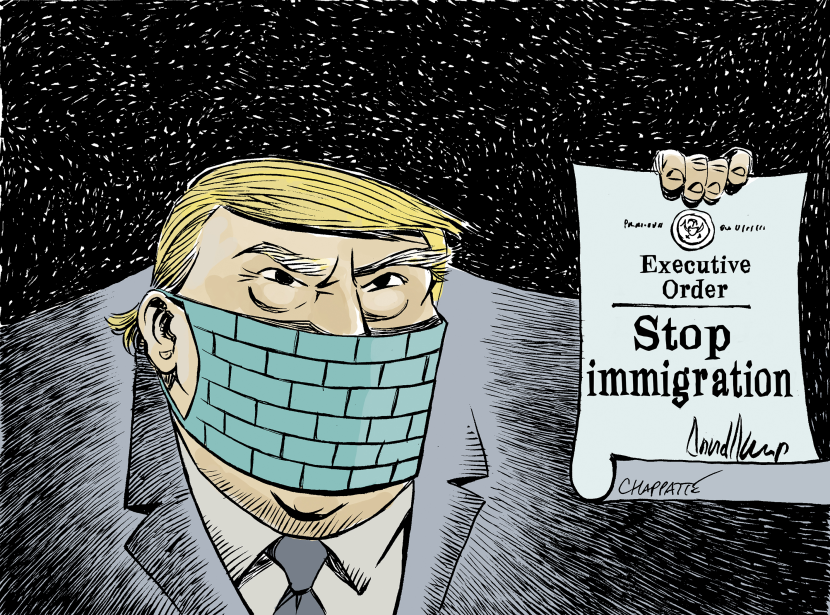
Trump expanded his April 22 Executive Order that only inconsequentially lowered legal immigration totals, and left employment visas untouched. For the remainder of 2020, the following visas, all of which include work permission, will be restricted: H-1B, mostly for tech; H-2B for seasonal nonagricultural workers that ludicrously include lifeguards, leisure industry employees and amusement park workers – as if young American wouldn’t do those jobs.

Also included are J visas that allow au pairs to work on the cheap in tony D.C. suburbs; H-4, an Obama-era program, never congressionally approved, that gives work permission to H-1B spouses, and L visas that allow, for example, a Hong Kong-based IBM accountant to transfer to the Armonk corporate headquarters – as if the New York/Connecticut region has no available bookkeepers. By the way, accompanying L visa holders will be their spouses and unmarried children age 21 or younger. Bringing family members keeps the U.S. population exploding and assures that K-12 schools remain overcrowded, both of which reduce Americans’ quality of life. But President Trump put extended family chain migration on hold. Only Green Card holders’ nuclear family will get Green Cards, making them eligible for lifetime-valid work permits.

The president moved to correct another preposterous immigration flaw. The Trump administration announced a new regulation that will prevent most of those who come to the U.S. illegally from getting work permits while they apply for asylum or make other pleas for special dispensation. Currently, aliens can obtain work permits while their cases are pending, a period that often stretches out for years. This misguided policy represents an obvious incentive to enter illegally, and then be rewarded with work permission.

When they learned of the president’s order, expansionists that include the Chamber of Commerce, the tech lobby and some in Congress went apoplectic, and sounded foolish. FWD.us, the immigration advocacy group that Mark Zuckerberg cofounded, pulled out the predictable hysterical claims that President Trump’s newest order was “a full-frontal attack on American innovation and our nation’s ability to benefit from attracting talent from around the world” and that it will “hurt our economy,” another tired old saw.

Not surprisingly, but nevertheless disappointing, Senate House Judiciary Chair Lindsey Graham is in complete accord with Zuckerberg’s group. In a series of tweets, Graham criticized President Trump, and predicted that his order would have “a chilling effect on our recovering economy.” Graham’s career voting record on increasing employment-based visas is the same as those of notoriously anti-American worker sellouts Chuck Schumer, Nancy Pelosi and dozens of other congressional globalists.

No intelligent argument can be made that the U.S. needs employment-based visas or – for that matter – more people. Americans agree with President Trump’s immigration pause. A Zogby Analytics poll taken in swing states Arizona, Florida, Georgia, Maine, Michigan, Minnesota, North Carolina, Ohio, Pennsylvania and Wisconsin showed that a strong majority, about 60 percent of registered voters, favor immigration reductions. In all ten states, majorities of voters concurred that “limiting admission of new immigrants and guest workers will improve the chances of laid-off American workers being rehired.” With record high unemployment, for Congress to force unemployed Americans to compete with imported labor is an outrage.

While Trump’s order doesn’t go far enough, or last as long as it should, he’s taken an important step in the right direction to protect beleaguered, job-seeking U.S. workers.

Joe Guzzardi is a Progressives for Immigration Reform analyst who has written about immigration for more than 30 years. Contact him at [email protected]

Comments Off on Trump Acts To Defend American Workers

Trump Administration Announces Overdue Asylum Guidelines

Recently, the departments of Homeland Security and Justice announced a new regulation that would overhaul the United States’ widely abused asylum process. Government officials stated their proposed rule will “more effectively separate baseless claims from meritorious ones. This would better ensure groundless claims do not delay or divert from deserving claims.” Among the 15 revisions the administration seeks is rejecting asylum petitions from applicants who previously but illegally entered the U.S., which would be a major step in the right direction.

The goals of DHS and DOJ are worthy. For decades, the asylum process has been subject to widespread fraud. Immigration advocates have instructed border-crossing asylum seekers to claim “credible fear,” the two words that almost always assure entry.

In 2018, NPR published an expose that targeted asylum mills. During a 2012 probe by federal immigration officials, 30 immigration lawyers, paralegals and interpreters were questioned about helping 3,500 foreign nationals located in Manhattan’s Chinatown and Flushing, Queens to fraudulently obtain asylum. Tellingly, the feds named their case “Operation Fiction Writer.”

Immigration authorities accused lawyers and their staffs of dumping boilerplate language into their clients’ persecution lies, coaching clients to memorize and recite fictitious accounts to asylum officers, and fabricating documents to buttress their phony asylum claims. Obama administration officials, including then-U.S. Attorney for the Southern District of New York Preet Bharara, declined to criminally prosecute any wrong-doers.

In 2019 Bharara was replaced by Geoffrey S. Berman, who recently stepped down under pressure. Berman sentenced a legitimate but dishonest Queens immigration attorney to five years behind bars for submitting more than 100 false asylum claims that included drafting applicants’ alleged persecution narratives, forging her clients’ signatures, and falsely notarizing affidavits.

Although most immigration lawyers practice their profession legally, asylum cases represent lucrative business. Legitimate immigration lawyers’ successes and the income they generate, however, have inspired con artists to pose as immigration experts in order to cash in on prospective, but unsuspecting, would-be asylees.

Earlier this year, U.S. Immigration and Customs Enforcement’s (ICE) Homeland Security Investigations (HSI) charged a Tampa fraudster with a 25-count indictment, including eight counts of mail fraud, eight counts of making false statements in immigration documents, and nine counts of aggravated identity theft. The swindler, who targeted Hispanic illegal immigrants who sought driver’s licenses and work authorization, falsely portrayed himself as an immigration attorney, pastor, accountant, former immigration official and former federal law enforcement officer, all bogus representations.

An all-encompassing asylum process should not be fraud-vulnerable. Historically, asylum claims are difficult to prove. Since asylum claims are evaluated either at a legal port of entry or processed after an individual has illegally entered the U.S., it’s important to weed out the valid from the frivolous.

Asylum fraud isn’t, as advocates disingenuously say, a “victimless crime.” The Government Accountability Office noted that granting asylum based on false statements jeopardizes the immigration system’s integrity by enabling the individual to remain, and then apply for affirmative federal benefits, including work authorization documents, and eventually treasured U.S. citizenship. Moreover, fraudulent asylum applications delay processing valid applications, and impede granting benefits to aliens who legitimately need protection.

The U.S. cannot be the ultimate destination wherein worldwide claimants’ grievances are resolved. Cases must be provable, not disinformation-based. Even prominent globalist Bill Gates said that the true asylum solution must come from the home nations of asylees. In 2018, Gates said: “Each country to some degree is on its own to solve their challenges.”

Joe Guzzardi is a Progressives for Immigration Reform analyst who has written about immigration for more than 30 years. Contact him at [email protected]

Comments Off on Trump Administration Announces Overdue Asylum Guidelines

GOP Joins Big Companies In Push For More Immigrants

If a contest were held to name the visas most hurtful to American workers among the 25-odd federally issued ones that include employment authorization, the likely outcome would be a tie. The overwhelming majority of employment-based visas mean that an American job will be lost to a foreign national or that a qualified U.S. candidate will be denied job opportunities because craven employers have such easy access to the cheap labor that visa holders provide.

Even visas that specifically deny employment are illegally and fraudulently substituted for work permits. Infosys Limited, an Indian outsourcing company, hired B-1 visa holders to perform skilled and unskilled labor that denied chances to Americans even though that visa is designated for temporary entry only. An estimated 1 million Indian nationals – predominantly lawful, white-collar IT workers – prevent American citizens from obtaining gainful employment.

Recently, President Donald Trump has been making noise about extending his April 22 immigration Executive Order to ban several employment-based visa categories from entry, at least for the immediate future. So far, nothing has come from the president’s ramblings, and rumors of further restrictions may be just more Trumpian smoke and mirrors.

Nevertheless, Capitol Hill chatter persists that the president’s expanded proclamation could bar U.S. entry for H-1B, H-2B, L-1 and J-1 visa applicants. Those visa categories represent, respectively, H-1B tech workers, H-2B seasonal nonagricultural workers, L-1 international transfers and J-1 Exchange Visitor programs that include au pairs, summer work-travel participants and interns, as well as high school and university student exchanges, and medical professionals.

Trump’s premise that more foreign nationals entering the devastated U.S. economy represents “a risk” is indisputable. After all, more than 40 million Americans are jobless, and their prospects are dim. The National Bureau of Economic Research estimates that more than 100,000 small businesses have closed forever. The economy is slowly reopening, but only at partial capacity. Even though the 40 million-plus total and the brutal reality that the U.S. is facing one of its most devastating economic turndowns are inarguable facts, immigration advocates and congressional globalists aren’t fazed one iota.

The Fortune 500 lobby wrote a whiny letter to Trump and the departments of Labor, State and Homeland Security, signed by 324 employers, trade, industry and higher education associations, including profiteers Google, Facebook and Amazon. Collectively, the lobbyists pleaded with the president to keep their incoming cheap labor stream flowing, arguing ineffectively and insultingly that “constraints on our human capital are likely to result in unintended consequences and may cause substantial economic uncertainty if we have to recalibrate our personnel based on country of birth.” In other words, if visas are put on hold, U.S.-based corporations would actually have to -perish the thought – hire Americans.

Given that Congress should be defending Americans, 21 GOP House Representatives shamefully joined forces with the Fortune 500 lobby when they sent a separate, supportive letter defending the presence of foreign nationals, specifically those who are part of the Optional Practical Training program. Never congressionally approved, OPT is one of the largest displacers of American tech workers. OPT includes thousands of graduates annually, and sidelines an equal number of American job aspirants.

Welcome to the world of immigration politics! No intelligent argument can be made that within the U.S. au pairs, landscapers, lifeguards and bookkeepers can’t be found, especially in this wrecked economy. Most of those jobs would be ideal for high school or college students that have recently graduated but are unemployed. The J-1, H-2B and L visas have devastated those employment categories. Even America’s medical school graduates, more than 35,000, have lost out on residency positions, without which they can’t practice as physicians because international graduates have entered the country to fill those jobs.

In 2017, a political eternity ago, Trump signed an executive order, “Buy American and Hire American,” intended to generate higher wages and greater opportunities for U.S. workers. Today, the president has a chance to take a big step forward toward reaching that goal. For Trump, now is put-up or shut-up time. The president must reject the immigration lobby’s shallow pleas, and keep his promise to put Americans first.

Joe Guzzardi is a Progressives for Immigration Reform analyst who has written about immigration for more than 30 years. Contact him at [email protected]

Comments Off on GOP Joins Big Companies In Push For More Immigrants

Congress Still Trying To Sell Out America’s Most Vulnerable Workers

The May jobs report from the Bureau of Labor Statistics dumbfounded economists and made Wall Street analysts look foolish. Supposed experts expected that the huge job losses reflected in the April report, 20.5 million, would continue in May to the tune of 7 million Americans sidelined. Instead, the economy added 2.5 million jobs, and the unemployment rate fell to 13.3 percent from 14.7 percent

Put aside whether those jobs are newly created or furloughed workers returning to their former positions. The BLS data raises important questions about what President Trump will do when his executive order that paused some immigration expires later this month.

The expansion lobby, which includes immigration advocates and lawyers, has long argued that employers face dire labor shortages in virtually every BLS occupational classification. The “Buy American, Hire American” proponents – those who want to protect American jobs through a commonsense immigration policy – face a huge problem. They don’t have congressional support. But, the expansionists do.

A recent example is seen in the letters members of the House and Senate sent to Trump asking him to protect the H-2B visa, the vehicle used to import low-skilled, foreign-born nonagricultural workers.

The Upper Chamber wrote that “farming, forestry, packing, hospitality, healthcare, communications, and information technology rely on non-immigrant guest workers to survive.” And the House letter stated, “It is important that the H-2B program continue to be available to our seasonal employers as a fail-safe in the event that we see a rapid drop in unemployment and a return to the extremely tight labor markets of just a few months ago.”

This year, the Department of Homeland Security announced plans to implement a rule that would add 35,000 H-2B visas to the existing 66,000 cap. But after a voter rebellion opposing the proposed increase, DHS backed off. Around that time, about 50 million native-born and 10.4 million foreign-born workers were detached from the labor force, and businesses were entering the shutdown phase.

Given the May U-6 20.7 unemployment rate, which measures individuals who want and are available for a job and have looked for work sometime in the past 12 months, the Senate and House letters are brazenly misleading. They show a cynical disregard for America’s most vulnerable workers and a sellout to the pro-business, cheap labor lobby.

Once Congress allowed employers to become dependent on foreign-born labor, those same employers stopped looking for Americans to hire. In the case of the agriculture industry, with an abundance of cheap labor available, thoughts of moving from stoop labor to more efficient mechanization have all but vanished.

Last year, the Department of Homeland Security granted more than 900,000 temporary work visas. In other words, the federal government allowed 900,000-plus foreign nationals to deny American workers a fair shot at available jobs.

Every year, employers claim that they’re facing a worker shortage. And every year, nonpartisan think tanks debunk the employers’ claims.

Two reports from the left-leaning Economic Policy Institute published in back-to-back years found “no evidence at all” of labor shortages in the top H-2B occupations. And in its editorial, the pro-immigration New York Times concluded that labor shortage claims don’t stand up. The Times, applying Econ 101 basics, wrote that when labor is scarce, unemployment falls, and wages rise. The Times noted that H-2B workers are subject to exploitation and unemployment “is high in the major H-2B fields, which include landscaping, groundskeeping, construction, hospitality and seafood processing, while wages in those fields have long been flat or declining.”

In 1986, Congress created the H-2B visa as part of the Immigration Reform and Control Act. IRCA’s goal was to supplement the U.S. labor market through the H-2B when true shortages exist. But Republican and Democratic administrations abandoned the visa’s original intent. They granted H-2B visas to lifeguards, landscapers, hospitality workers, Vail ski instructors, football coaches and Cape Cod summer employees. Nobody can intelligently argue that ski resorts can’t find local instructors or that Cape Cod, surrounded by New England colleges, couldn’t find nearby workers. Giving skiing lessons in the Rocky Mountains or waiting tables on the Cape are a young person’s dream job.

The traditional solution to true job shortages, which employers refuse to adopt, is to pay higher wages, not import more pliable foreign-born workers.

Joe Guzzardi is a Progressives for Immigration Reform analyst who has written about immigration for more than 30 years. Contact him at [email protected]

Comments Off on Congress Still Trying To Sell Out America’s Most Vulnerable Workers

Like NAFTA, Trump Trade Deal Lacks U.S. Worker Protections

A few years after President Bill Clinton signed the North American Free Trade Agreement, Rolling Stone sent investigative reporter Dan Baum out to pound the pavement to learn how the globalist-hyped deal was working on both sides of the border.

Baum quickly learned that Reform candidate Ross Perot, who predicted Americans would hear a “giant sucking sound” of companies fleeing the U.S. for Mexico, had analyzed NAFTA’s fallout correctly.

In his story, “The Man Who Took My Job,” Baum located David Quinn, a unionized Indiana auto parts worker who was one of 455 Breed Technologies employees to lose a job when the factory shut, then relocated to Mexico. Soon thereafter, more than 100 Indiana businesses followed Breed to Mexico – a great deal for cheap labor-addicted employers, but devastating to the U.S. domestic workforce.

By 2000, the $5.5 billion U.S. trade surplus with Mexico metastasized into a $16 billion deficit. Quinn and Baum traveled to Mexico where they eventually found “the man who took the [Indianan’s] job,” toiling longer work weeks for less money, few safety precautions and without union protections. During the next two decades, in part under George W. Bush, job losses continued to mount and deficits deepened. Today, the U.S. trade deficit with Mexico is $617 billion.

Bush learned nothing from the NAFTA fiasco. Instead, he used the NAFTA template to create the World Trade Organization, which opened up the U.S. market with China and led to more than a dozen bilateral trade treaties that have hampered America’s labor force. Congress is considering nearly 25 more agreements that may kill more U.S. jobs.

Since 2001, the U.S. has lost 3.7 million jobs to China, and is currently running a $346 billion trade deficit with the Asian superpower. Yet, Republican and Democratic-led administrations put trade first, above working Americans.

President Barack Obama’s 12-nation Trans-Pacific Partnership would have the opened borders to millions of foreign-born workers in every employment classification. Shortly after President Trump assumed office, he withdrew the U.S. from TPP.

Because of COVID-19 concerns and the relatively short time period for businesses to adjust to its new regulations, the president’s NAFTA replacement, the U.S. Mexico Canada Agreement, may be delayed beyond its June 1 starting date. U.S. Trade Representative Robert Lighthizer expressed his concern: “Let us not make long-term decisions in the midst of a crisis.”

A COVID-19 delay might be a lucky break for U.S. workers. The Economic Policy Institute is apprehensive that the U.S. International Trade Commission’s projections about higher U.S. wages and increased employment may be based, much like NAFTA, on “questionable assumptions.” Specifically, EPI doubts whether U.S. wages will rise as a direct result of improved labor rights enforcement in Mexico, a conclusion that the ITE model doesn’t validate.

America needs a better approach that will rebalance trade and level the playing field for U.S. workers and other participating countries. Despite two decades of White House bloviating about American jobs and railing against income inequality, the average worker isn’t as important to leaders as easing corporate trade.

Unregulated global trade consequences have led to worldwide criminal-level labor exploitation. Corporations set up sweatshops in Vietnam, China, South Korea, India, Honduras and Taiwan, all sources of plentiful cheap labor that enhance bottom-line profits.

Like NAFTA before it, USMCA has no real American worker protections. USMCA’s language refers to “temporary” immigrant entry to “supply services.” But as the old adage goes, nothing is more permanent than a temporary immigrant, especially when he supplies labor “services.”

Trump has talked pro-American about trade and immigration, but he’s fallen far short of delivering the goods he’s so often promised.

Joe Guzzardi is a Progressives for Immigration Reform analyst who has written about immigration for more than 30 years. Contact him at [email protected]

Comments Off on Like NAFTA, Trump Trade Deal Lacks U.S. Worker Protections

Panic As Expiration Date on Trump’s Immigration Order Approaches

Time is short to the expiration of President Trump’s Executive Order that suspended some immigration, and expansionists are pulling out all the stops. At stake is employment-based visas’ short-term future, specifically whether the White House will permit this year’s annual 85,000 allotment of foreign-born H-1B workers to enter.

A recent Forbes story written by immigration advocate Stuart Anderson claims that since the tech sector unemployment rate is low and declining – 2.8 percent in April versus 3 percent in January – the Trump administration would be remiss to include the employment-based H-1B visa as part of a suspension strategy. To make his point, Anderson selectively chose data from the Bureau of Labor Statistics Current Population Survey that supports his perspective.

But the bigger picture that Anderson ignored is the most important one. Employment statistics vary from month to month; employers lay off U.S. tech workers, but retain cheaper imported workers. But the addition of 85,000 H-1B visa holders will represent a permanent fixture in the labor market, because the H-1B is a dual-intent visa, meaning that holders can enter the U.S. on temporary status while simultaneously seeking lawful permanent residency. In other words, the new H-1B visa holders aren’t going home.

If tech employers are truly stretched thin, their first consideration should be to tap into the hundreds of thousands of U.S. workers displaced by H-1B visa holders. The list of corporations that use the H-1B visa to exile U.S. workers to the sidelines, after forcing those fired Americans to train their foreign-born replacements, is longer than Wilt Chamberlain’s arm. Among them are nationally known names like Disney, Apple, Facebook, Starbucks, Uber and Walmart.

A newcomer to the list is the Tennessee Valley Authority (TVA), which announced earlier this month that it would outsource 20 percent of its highly skilled, American-born technology workforce to Capgemini, CGI and Accenture, companies headquartered in France, Canada and Ireland, respectively.

At least 120 workers learned they will lose their jobs later this summer, and the TVA informed the local labor union that eventually another 100 jobs will be outsourced. Last month, affected workers were advised that they too would be required to train their replacements, a procedure deceptively labeled “knowledge transfer.”

The TVA is a federally owned corporate agency originally designed to bring jobs to the impoverished Tennessee Valley during the Great Depression. Although TVA employees are unionized, they still can’t escape the foreign worker displacement scourge. Similar public utility displacement programs played out in California when Southern California Edison and Pacific Gas and Electric fired their U.S. tech workers, and either outsourced their jobs or imported H-1B workers.

Originally, Congress created the H-1B visa program to complement the U.S. workforce. Instead, loopholes encourage abuses, paving the way for employers to bump Americans and deny opportunities to recent college graduates.

A relatively new displacement vehicle that creates roadblocks for young Americans is the never-congressionally approved Optional Practical Training Program. Initiated by the Bush 43 administration, and kept through President Trump’s three-plus White House years, OPT allows a maximum three years of employment to alien U.S. college graduates with degrees in science, technology, engineering and math. OPT provides generous tax subsidies to employers and has mushroomed into a huge foreign-born worker bonanza. More than 1.5 million OPT STEM workers hold jobs that should go to Americans.

Despite what elitists, globalists, immigration lobbyists and the American Immigration Lawyers Association claim with their misleading reports and cherry-picked statistics, no intellectually sound argument that favors more H-1B visas, or more of any employment-based visas, can be made.

The ball is in Trump’s court. He can either fulfill his 2016 campaign promise to “forever end” the H-1B visa or allow himself to be ridden roughshod over by anti-American worker advocates that include his son-in-law and advisor, Jared Kushner.

Last year, more than 900,000 new temporary work visas were issued, and more than 1.8 million work permits were granted or renewed. That’s a total of 2.7 million overseas workers entering an economy that today has more than 36 million unemployed. Among those 2.7 million were nearly 190,000 in the professional category, mostly H-1Bs. They joined approximately 500,000 settled H-1B workers.

American workers always deserve to come ahead of imported labor. Today, with the nation in the grip of the most painful economy since Herbert Hoover’s presidency, American employment must be the nation’s top priority.

Joe Guzzardi is a Progressives for Immigration Reform analyst who has written about immigration for more than 30 years. Contact him at [email protected]

Comments Off on Panic As Expiration Date on Trump’s Immigration Order Approaches

Mickey Mantle’s Mammoth Memorial Day Blasts

When the 1956 Major League Baseball season began, the New York Yankees were in the unfamiliar position of not being the defending world champion. The previous October the Brooklyn Dodgers dethroned the Yankees, and ended the Bronx Bombers’ unprecedented streak of five consecutive World Series titles.

In 1956, the Yankees set out to get back on the championship track. Emerging Yankees superstar center fielder Mickey Mantle had something to prove too. Although Mantle had an outstanding 1955 season, and led the American League in home runs, his injury-plagued World Series limited him to three games and two hits.

For both the Yankees and Mantle, 1956 was stellar. The Yankees returned to the World Series and regained the championship crowd from the upstart Dodgers. Mantle led the league in hitting, home runs and runs batted in, and thus became the first player since Ted Williams in 1947 to hit for the elusive Triple Crown.

Memorial Day weekend may have been the apex of Mantle’s 1956 season. The Yankees faced the hapless Washington Senators, “first in war, first in peace and last in the American League,” to cite the phrase baseball writer and humorist Charles Dryden coined about the perennial cellar dwellers.

Better yet for Mantle, the Senators’ first game pitcher was Pedro Ramos, nicknamed the “Cuban Cowboy” because of his fascination with the Lone Ranger movies and his propensity for 10-gallon hats.

Mantle feasted off of Ramos’ pitching. In game one of the May 30 double header, Mantle hit a 620-foot blast that came within 18 inches of clearing the distant right field Yankee Stadium facade. In the nightcap, Mantle launched a 475-foot homer off Ramos’ Cuban compatriot, Camilo Pascual. By the time the seven hour-long afternoon had ended, Mantle led the league in six offensive categories.

For Pascual, Ramos and Mantle, their post-baseball lives were a mixed bag. Pascual, age 86, lived the least controversial life of the three Memorial Day protagonists. After he retired from the active playing roster, Pascual remained involved in big league baseball for five decades. Pascual served as the Minnesota Twins’ pitching coach before he became an international scout for the Oakland A’s, the Los Angeles Dodgers and the New York Mets.

Ramos, however, was eventually arrested four times on drug and weapons charges that landed him in a Florida federal penitentiary. One bust found several kilos of cocaine in Ramos’ house. During their playing days, Mantle recalled, “Pedro always carried a gun.” Interviewed in prison, an unremorseful Ramos, the pitcher-turned-drug dealer, spoke only about fleeing the Castro dictatorship and, while he played for the Senators, hobnobbing with President Richard Nixon.

Mantle’s tale may be the saddest among the three Memorial Day adversaries. Idolized by millions of Americans for his baseball prowess, five years after his 1969 retirement, three-time Most Valuable Player Mantle entered the Hall of Fame on a near-unanimous vote. His only baseball regret, Mantle said, was that he didn’t retire earlier to preserve a .300 career average. By lingering too long, Mantle fell short, and hit .298.

Ill-advised hotel and restaurant investments nearly bankrupted Mantle, and when in 1983 he took a job glad-handing at an Atlantic City Casino, Commissioner Bowie Kuhn permanently banned the icon from baseball. The following year, new commissioner Peter Ueberroth reinstated Mantle and Willie Mays, who had also been expelled for casino-fronting. But then the baseball memorabilia boom hit, and Mantle made millions signing autographs, more money than he ever earned as a player.

In Mantle’s final years, accounts about his lifelong battle with alcohol and his philandering were included in stories about his liver cancer diagnosis. Liver transplant surgery was successful, but didn’t save his life. Mickey Mantle died at age 63.

Before he passed, Mantle ruefully admitted that, because of his alcoholism, he had often been cruel and hurtful to family and friends, and wanted to make amends. At former second baseman teammate and Baptist minister Bobby Richardson encouragement, Mantle became a Christian.

Despite Mantle’s many flaws, baseball fans – Yankees and non-Yankees alike – will always remember Mickey as the only player in history that whether batting left or right-handed could launch the ball more than 500 feet.

Joe Guzzardi is a Society for American Baseball Research and Internet Baseball Writers Association member. Contact him at [email protected].

Comments Off on Mickey Mantle’s Mammoth Memorial Day Blasts

As Unemployment and Bankruptcies Grow, Trump Still Listening To Kushner

A persuasive argument can be made that President Trump’s most trusted White House confidant is his son-in-law and senior advisor, Jared Kushner. Kushner has outlasted almost every presidential appointee except for his wife Ivanka Trump, who has hung on since day one.

Recently, the Brookings Institute compiled a White House turnover analysis of President Trump’s most influential inside advisors, or “A” team. As of May 1, turnover is 86%, with many of the departures labeled as “resigned under pressure.” More difficult to measure, Brookings admitted, is Cabinet turnover. Case in point, Nikki Haley was upgraded from United Nations Representative to the Cabinet. After she resigned, her Cabinet post evaporated. Despite the confusion associated with tracking the inner circle’s comings and goings, Brookings concluded, President Trump’s Cabinet turnover rate is “record setting.”

Throughout the turmoil though, Kushner remains on the President’s Cabinet. In January 2017 when President Trump named Ivanka and Jared as advisors, the president’s base wondered what possible good could come from adding family to the White House team. Little did the questioning base know they’d be poster children and proponents for high-immigration, the equal of any congressional Democrat.

Well-placed Washington insiders reported that Kushner, who has a long history of immigration advocacy, was the loudest voice in the push back against President Trump’s April 22 executive order to temporarily suspend immigration. “Globalist” Kushner, sources said, immediately objected to the order and led “an internal battle” over the suspension. He quickly became “one of the loudest voices pushing back on a full ban”, and sought “to carve out exemptions for refugees, temporary workers under the H1B visa program, and farmworkers under the H-2A visa program.”

Only a couple of weeks have passed since Kushner highjacked his boss’ original, more restrictive immigration order, and in that brief period the jobs’ landscape has dramatically worsened. The question is no longer “When will the economy restart?” or “When will the 36 million unemployed creep back into the labor force?” The new reality is as long as the status quo remains, many companies will declare bankruptcy, their employees will be set adrift, and those individuals may eventually have to file for personal bankruptcy.

J. Crew was the first of the major embattled retailers to file bankruptcy, with 15,000 on its payroll. Neiman Marcus, with its 13,500 employees, quickly followed, and others on the brink include JCPenney and Rite-Aid.

The Walt Disney Company, with its theme park, cruise line, and entertainment businesses hammered, has lost one-third of its market value. It hopes to recoup $80 billion through a debt offering, but Wall Street analysts peg the company, with its 223,000 employees, at a 41 percent chance of going bankrupt.

While some failing companies have been teetering for years, the COVID-19 pandemic has landed the knock-out punch. Their employees must now depend on slow-to-arrive unemployment insurance checks.

The longer this lockdown persists, the less the need for employment-based immigration. As the June 23 deadline for President Trump’s executive order nears, he can either listen to Kushner echo Senator Chuck Schumer’s come one, come all immigration dream, or he can bury the hatchet and listen to his former attorney general Jeff Sessions.

Sessions has said that the U.S. has no jobs, and will “lay off more people this week than last week.” He’s chided his old congressional colleagues for ignoring “the interest of the American people. It’s [high immigration] in the interest of their [Congress’] corporate friends and some ideology that they adhere to.”

Instinctively, President Trump knows importing foreign labor during this economic implosion is folly, but he needs the political courage to act on his common-sense predisposition. He’s been reluctant to do that and come November, he may regret his waffling.

Joe Guzzardi is a Progressives for Immigration Reform analyst who has written about immigration for more than 30 years. Contact him at [email protected]

Comments Off on As Unemployment and Bankruptcies Grow, Trump Still Listening To Kushner

On Armed Forces Day, Remembering Baseball’s First World War I Volunteer

Despite his 17-year career as a big-league player and coach, Major Harry Morgan “Hank” Gowdy is, to most baseball fans, a relative unknown. To military historians, however, Gowdy is famous for being the first player to enlist in World War I. Amazingly, by 1943, a 54-year-old Gowdy also served during World War II.

During his two stints with the New York Giants and another two with the Boston Braves, Gowdy had only modest on-field success, as attested to by his career .270 average. But in the 1914 World Series against the Philadelphia Athletics, Gowdy hit a lusty .545 with three doubles, a triple and a home run to lead his Braves to a four-game sweep over the heavily favored A’s.

Gowdy’s Miracle Braves had a well-deserved reputation as baseball’s toughest nine, a team that battled back from dead last at midseason to win the pennant by 10-1/2 games. In a testament to the rough and tumble Braves, Gowdy’s teammate and Hall of Famer Johnny “the Crab” Evers purposely let a fastball bean him in his helmetless head to drive in the game’s winning run.

When World War I broke out in 1917, Gowdy enlisted in the National Guard. By the following year, the catcher-turned-soldier was in France serving in the 166th Infantry Regiment, dubbed the Rainbow Division, the fighting 42nd, by General Pershing. Gowdy battled in the trenches and often engaged in bloody hand-to-hand combat.

“Every outfit ought to have somebody like Hank,” regiment commander Colonel B.W. Hough said of Gowdy. “The boys idolize him and he gets them all stirred up with his baseball stories. He helps ‘em forget about the terror of war. He carried the flag and … he was one of them who heaved gas bombs at the enemy … he was fantastic!”

Tossing grenades was Gowdy’s specialty. Evers witnessed Gowdy during a training session chuck a gas bomb 73 yards. And Gowdy’s grenade-hurling – “great exercise for the arm,” he called it – paid off when Hank returned to the Braves and regained his status among the most effective catchers at throwing out would-be base stealers. In three separate seasons, Gowdy’s caught stealing percentage led the National League.

“Lank,” the 6-foot-2 Gowdy’s nickname, frequently told his fellow Doughboys that while he was eager to trade his gas mask for his old catcher’s mask, he was unfazed by “the fast ones from Fritz,” meaning incoming German bombs.

Upon his return to Boston, the Braves designated May 24, 1919, as “Hank Gowdy Day.” Fans greeted “The Fair-Haired Skyscraper,” another Gowdy moniker, with a standing ovation. Braves and opposing Cincinnati Reds’ players embraced Gowdy, and the assembled 16,000 fans chipped in to present him with $800 in Victory Bonds, a gold watch and a cigar cutter. Gowdy rewarded the fans’ generosity when he smacked a single off the first pitch he had seen in more than two years, a hit that sparked the Braves to a 4-1 victory.

When the Great War ended, President Warren G. Harding called for “a return to normalcy.” For Gowdy, normalcy meant serving as a Braves, Reds and New York Giants coach. Then, at World War II’s outset, Gowdy’s peace-time routine ended. Gowdy re-enlisted in the Army, and took the chief athletic officer’s post in Ft. Benning, Ga. Gowdy remains the only MLB player to have participated in both major U.S. wars.

In a fitting tribute to the war hero and World Series champ, the baseball diamond at Ft. Benning is called Hank Gowdy Field.

Joe Guzzardi is a Society for American Baseball Research and Internet Baseball Writers Association member. Contact him at [email protected].
Comments Off on On Armed Forces Day, Remembering Baseball’s First World War I Volunteer