Purple Heart Winner Overcame Long Odds to Pitch in MLB

Because of COVID-19 fears, several Major League Baseball players opted out for 2020. Others remained active but have since gone on the Injured List with discomfort or tenderness in various limbs. Players and dinosaur fans from earlier eras rejected discomfort and tenderness as legitimate injuries.

If modern-day players knew U.S. Army Corporal Lou Brissie’s story and his determination to play baseball, they might demand to be penciled into tonight’s line-up. Or at least feel a little embarrassed.

Brissie had been a South Carolina high school pitching standout, and his dream was to reach the big leagues. By age 16, several clubs put out feelers to the 6-foot-5 lefty smoke-thrower. Among the clubs watching Brissie were the Philadelphia Athletics, whose owner and manager Connie Mack had expressed a keen interest.

But World War II intervened. On December 4, 1944, during combat against the Germans near Florence, Italy, an artillery shell exploded near Brissie, breaking both his feet and shattering his left tibia and shinbone in 30 places. Shrapnel also struck his right shoulder, both hands and both thighs. When his 88th Infantry Division engaged in heavy combat with the Germans, eight enlisted men and three of their four officers were killed or wounded. On the battlefield, and barely conscious, immobile in the snow and mud, squad leader Brissie was left for dead.

Finally, when medics arrived, they wanted to amputate. But Brissie, knowing an operation would end whatever chance he might have to play for Mack’s Athletics, refused. “You can’t take my leg off,” Brissie replied. “I’m a ballplayer. I can’t play on one leg.” Doctors warned that without an amputation, Brissie would die. Refusing, Brissie said, “Doc, I’ll take my chances.”

During the following two years, Brissie underwent 23 surgeries and had 40 blood transfusions. Brissie, now with his leg reconstructed with wire and a metal plate protecting it, still clung to hope that he’d one day achieve his vision of pitching for Mack’s Athletics. And Mack did everything he could to encourage the young war hero.

Mack wrote to Brissie to remind him that his immediate responsibility was to heal, and promised that when the time was right, he’d offer the lefty a tryout. But when Mack saw Brissie throw on the sidelines with his damaged foot propped up by a crutch, he thought, “Poor boy, he’ll never be able to pitch again.”

In six decades of professional baseball, the great Mack rarely miscalculated. But he was wrong about Brissie. In 1946, the Athletics signed Brissie and sent him to the competitive Class A South Atlantic League’s Savannah Indians, where he excelled.

Even though opponents tried every trick in the book, including laying down bunts to test his mobility, Brissie led the league in wins, strikeouts and earned run average. At the end of the South Atlantic League’s season, the Athletics called Brissie up. His first game was at Yankee Stadium on Babe Ruth Day, where he debuted with Ruth, as well as baseball immortals Ty Cobb, Tris Speaker and Cy Young looking on. Although Brissie took a 5-3 loss, he said, “I thought I had gone to heaven.”

During the 1948 and 1949 seasons, Brissie won 14 and 16 games, respectively, and got a spot on the 1949 All Star team where he described playing with Ted Williams and Joe DiMaggio as being “like a kid in a candy shop.” Eventually traded to the Cleveland Indians, Brissie retired in 1953. Pitching legend Bob Feller said that without World War II, Brissie would have been inducted into the Hall of Fame.

In his post-baseball career, Brissie developed young American Legion, Latin American and Australian players. Brissie also scouted for the Atlanta Braves and the Los Angeles Dodgers. Throughout, Brissie continued pain treatment at the Veteran’s Hospital. While at the Vet, Brissie comforted Iraq vets whose injuries he described as “worse than WWII.”

Brissie, winner of two Purple Hearts and the Bronze Metal, steadfastly refused Hollywood producers’ offers to make a film about his wartime and baseball lives. Insisting that he didn’t consider himself a hero, and that he didn’t feel right about a biographical movie since he felt “blessed,” as many of his friends “never came home.”

Brissie died in 2013, and remains, sadly, unknown to all but the most devoted baseball historians. To help their players appreciate the gift they’ve been given, MLB owners should require them to learn more about the remarkable Brissie.

Joe Guzzardi is a Society for American Baseball Research and Internet Baseball Writers Association member. Contact him at [email protected].

Comments Off on Purple Heart Winner Overcame Long Odds to Pitch in MLB

Pompeo Subverts Trump’s Immigration Order

Capitol Hill insiders speculate that Secretary of State Mike Pompeo has quietly begun his 2024 campaign to replace President Donald Trump in the White House.

Whether Trump wins or loses in November, the Beltway gossip is that Pompeo will be the Republican front runner. In recent weeks, Pompeo delivered rousing, campaign-style speeches in Iowa and at the Nixon Library in Orange County, Calif., near where he grew up.

Even Pompeo’s staunchest political enemies grudgingly admit he has a spectacular resume, which would position him well during a rough and tumble campaign grind. Before becoming Secretary of State, Pompeo directed the Central Intelligence Agency, and was elected four times from Kansas to represent the 4th District in the U.S. House. Pompeo also held positions on the House Intelligence Committee, as well as the Energy and Commerce Committee, and the House Select Benghazi Committee.

Before his political career began, Pompeo graduated No. 1 in his 1986 U.S. Military Academy West Point class. Pompeo served with distinction in the U.S. Army, and then earned a Harvard Law School degree where he helped edit the Harvard Journal of Law & Public Policy. For more than a decade after graduating from Harvard, Pompeo had a successful career in the Kansas aerospace industry.

Impressive though Pompeo’s curriculum vitae may be, as a presidential candidate he would need Trump’s endorsement. And whether such a commendation would be forthcoming in light of the State Department’s gutting of the president’s June executive order that paused employment-based visa entries through 2020 remains to be seen.

Inarguably, when the State Department effectively canceled the executive order by identifying dozens of so-called exceptions to the executive order, it landed a direct slap to Trump’s face. The employment-seeking foreign nationals that the president put on hold, the State Department waved in.

The intervention is so hurtful to American workers that profiteering immigration lawyers hailed the move as “expansive.” Immigration lawyer Greg Siskind, who has never met an immigration expansion bill that he didn’t embrace, could barely contain his glee when he alerted his foreign national client base, “They [Trump administration officials] are backing off … that could be good news for you guys.”

The State Department’s bulletin grants exceptions to foreign nationals “… whose travel would be in the national interest.” The memo opens the floodgates to virtually any prospective international employee that Silicon Valley, The Wall Street Journal and other immigration advocates brazenly insist are necessary to keep the U.S. economic engine moving forward. That’s a lie that’s persisted for 30 years, facilitated the displacement of thousands of skilled U.S. workers, and has done irreparable damage to the workers’ families. In corporate America and in the establishment media, cheap labor reigns supreme.

Whether State Department minions checked with Pompeo before their outrageous action is unclear. But given what’s known about the Deep State, it’s unlikely it sought prior approval. And had they pursued Pompeo’s okay, his congressional immigration grade hints that he might have given it his blessing. Although Pompeo voted solidly on most immigration-related issues like favoring border security, and rejecting amnesty, in 2015, he voted to grant President Obama the authority to, via Trade Promotion Authority, fast track expanded immigration levels without the consent of Congress.

The next move is President Trump’s. The president should summon Pompeo to the Oval Office to read him the riot act, demand that he identify the saboteurs, and force them to rescind their bulletin. President Trump’s message to Pompeo can be short and sweet: Americans, and not worldwide employment-based visa holders, deserve U.S. jobs.

Joe Guzzardi writes for the Washington, D.C.-based Progressives for Immigration Reform. A newspaper columnist for 30 years, Joe writes about immigration and related social issues. Contact him at [email protected].

Comments Off on Pompeo Subverts Trump’s Immigration Order

Meanwhile, Down on the Border…

For the last two months, the roiling immigration debate has centered around President Trump’s executive orders, which have slowed some legal migration and suspended most employment-based visas until the end of 2020. During the period, President Trump scored a major victory over globalists when he forced Tennessee Valley Authority executives to turn back their outsourcing commitment that would cost high-skilled American workers their jobs.

However, down on the still-porous Southwest border, illegal immigration – the contentious issue that propelled President Trump into the White House – is worsening. Since April, and despite President Trump’s efforts to curb illegal immigration in light of the coronavirus pandemic, unlawful entry arrests have soared 237 percent, according to Customs and Border Protection.

In March, pursuant to the urging from the Centers for Disease Control and Prevention, border officials turned back migrants, including those who claimed asylum. For more than 90 percent of the migrants, the normal timeline for returning unlawful border crossers dropped from a period of several weeks to a mere hour and a half.

In his compelling documentary, “They Come to America: the Politics of Immigration,” filmmaker Dennis Michael Lynch, in interviews with experts, gives an overview of the challenges that decades-long ineffective methods of slowing illegal entry present to the nation. Among them are drug smuggling, national security, environmental degradation and population growth.

But Lynch also focuses on illegal immigration as a labor variable that is especially harmful to low-skilled U.S. workers who have less than a college education. CBP acting Commissioner Mark A. Morgan acknowledged that, during the spring-time, surge jobs are illegal immigration’s biggest pull factor.

“Single adult Mexican nationals, who are generally seeking economic opportunities, accounted for almost 80 percent of the encounters,” Morgan said.

Based on the latest available federal statistics, Pew Research estimated that 8 million immigrants are in the labor force illegally, mostly employed in agriculture but also in sectors that would present hiring possibilities for America’s under-employed, like construction, hospitality, business services and manufacturing.

While there’s been much fanfare, both positive and negative, about President Trump’s “big beautiful wall,” Lynch makes clear that no structure can protect the nation’s waterways from illegal entrants. As an example, Lynch cites the CBP’s Miami sector that’s assigned to cover Florida, Georgia, North Carolina and South Carolina.

The Miami sector consists of approximately 187,000 square miles and has 1,203 miles of Florida’s coastal borders along the Atlantic and Gulf shores. In his statement, Morgan advocated for President Trump’s wall. But as Lynch pointed out, a wall is meaningless with such a vast expanse of unprotected shores and waterways that migrant smugglers can easily penetrate. At the time Lynch’s documentary went into production, a mere 111 CBP agents, and only two with boats, were assigned to the Miami sector.

President Trump’s wall-blustering is empty talk. Even if a wall were erected, the effect of deterring illegal immigration would be minor at best, and a flat zero for water arrivals. While talking about migrants in search of “economic opportunities,” Morgan missed a chance to promote E-Verify which, since the program confirms individuals’ lawful authorization to work, is a proven illegal immigration deterrent.

U.S. ineptitude at immigration enforcement is known to prospective migrants worldwide. Lynch’s documentary featured a local CBS broadcaster who reported that the Miami sector alone had apprehended aliens from 64 nations.

Labor Day will mark the official kickoff for the 2020 presidential campaign. Voters will be subjected to a nearly unbearable torrent of speeches that promise more jobs for Americans. But just as reporters asked Democratic primary candidates if they supported open borders and Medicare for illegal immigrants, President Trump and challenger Joe Biden should face an equally probing question: Would you, if elected, demand that Congress pass mandatory E-Verify?

Joe Guzzardi writes for the Washington, D.C.-based Progressives for Immigration Reform. A newspaper columnist for 30 years, Joe writes about immigration and related social issues. Contact him at [email protected].

Comments Off on Meanwhile, Down on the Border…

Congress Abandons 30 Million Unemployed Americans

Out of all 535 members of Congress, only about 10 percent can be classified as solidly pro-American worker. Their immigration voting records prove their inexplicable indifference to American workers’ fates.

Whether the immigration category is lawful permanent residents who arrive at the rate of more than 1 million annually, refugees, asylees and employment-based visa holders, all receive work authorization. Illegal immigrants caught and released at the border receive parole, a federal pardon that qualifies them for work permits which in turn allows them to remain in the U.S. and to be legally hired. Finally, illegal immigrants that successfully get past the border often enter the black-market economy, and are hired off the books.

While some in Congress vote to slow certain immigration categories, only about 50, at most, are behind a broad-based immigration slowdown. Proof: in 2017, senators Tom Cotton (R-Ark.) and David Perdue (R-Ga.) introduced the RAISE Act that would have eliminated the unnecessary diversity visa, slowed refugee intake, limited chain migration to a petitioner’s nuclear family, and slowed legal immigration over the next decade by about 50 percent. The bill’s sole two co-sponsors were Cotton and Purdue, a pathetic testimonial to Congress’ cynical attitude toward U.S. workers.

Congress has at least a half-dozen ethnic caucuses that defend special interests. But nowhere in Congress is there a caucus that defends American workers. And because no such caucus exists, over decades, millions of U.S. jobs have been outsourced, and millions of U.S. workers have been displaced.

During the last week in July – in a brazen effort to promote the welfare of Indian nationals but to the detriment of U.S. tech workers’ futures – Sen. Mike Lee (R-Utah) made another in a series of attempts to pass an outsourcing bill that would eliminate the cap restricting the number of Green Cards awarded to each country to 25,000.

If Lee were to prevail, for the foreseeable future, Green Cards would be issued almost exclusively to Indians. In its analysis of the bill, the Congressional Research Service concluded that passage of legislation would benefit Indians, and to a lesser extent Chinese nationals, but at the expense of other overseas citizens hoping to migrate to the U.S. and work here. Lee, by the way, is routinely identified as a conservative, and was rumored to be on President Trump’s short list to replace Justice Anton Scalia on the Supreme Court.

The House of Representatives and the Senate have powerful, influential India caucuses that speak with one voice on India-related issues. The Senate caucus dates back to 2004, and today’s House caucus on India and Indian Americans was established in 1933, and is the largest congressional House country-specific caucus. Yet, to repeat, no single congressional caucus exists to defend Americans against what is a decades-long pattern of importing foreign labor and outsourcing U.S. jobs to overseas nations.

Consistent with Capitol Hill’s disregard for the fate of U.S. workers, insiders report that nearly every Republican senator and the Department of Homeland Security support Lee’s proposal. And should Lee’s proposed legislation reach President Trump’s desk, the same insiders predict that, because so many corporations that benefit from cheap labor also donate to the chief executive’s campaign, he’ll sign it into law. This is a complete disgrace for the candidate who promised to reform legal immigration to serve American workers and “bring our jobs back home.” Now that 30 million Americans are unemployed, the nation could sure use those jobs President Trump pledged to deliver.

Trump has also joined with Congress in their mutual abandonment of E-Verify, the free, easy-to-use online system that confirms in a matter of seconds whether an employee is legally authorized to work in the U.S.

Congress has kicked around E-Verify without mandating the program since 1996 when it was named the Basic Pilot program. Since 1997, E-Verify has been available to corporations nationwide. Yet the pro-donor, pro-cheap labor Congress refuses to implement E-Verify which would protect U.S. workers from the illegal hiring scourge.

For a quarter of a century Congress has been vigorous in its support of the cheap labor lobby. Imagine instead if Congress had battled as steadfastly on Americans’ behalf. Then U.S. workers’ adjusted-for-inflation wages wouldn’t have been flat for the same 25 years.

Joe Guzzardi is a Progressives for Immigration Reform who has written about immigration for more than 30 years. Contact him at [email protected].

Comments Off on Congress Abandons 30 Million Unemployed Americans

California, In Ruins, Mounts Recall Against Its Governor

Californians – or at least some Californians – are fighting back against Gov. Gavin Newsom’s dysfunctional leadership. The nonpartisan California Patriot Coalition has gathered more than 80,000 voters’ signatures in a petition to recall Newsom.

The coalition inarguably cites a $54 billion budget deficit, a soaring “crime rate, unaffordable housing, rampant homelessness, failing schools, and irresponsible spending” as the causes that motivate it to remove Newsom. Among Newsom’s questionable spending is a dodgy $1 billion deal with a Chinese manufacturer for masks. The group also points to Newsom’s “encroachment” on citizens’ First Amendment rights.

Beyond those offenses, Newsom has violated several federal immigration laws related to harboring illegal immigrants and facilitating their presence. Newsom confirmed that his administration is providing millions of dollars in economic relief to California businesses that don’t otherwise qualify for federal aid, including those owned by immigrants in the state illegally, subjecting him to fines and a possible prison sentence for breaking U.S. code.

The coalition’s journey will be uphill every step of the way. To succeed, the recall effort must collect 1,495,709 signatures by November 17, a total that represents 12 percent of the 12.5 million votes that put Newsom into office. Two previous efforts to remove Newsom failed. The first netted a mere 281,917 signatures, while the second disbanded once it became clear the necessary signature totals wouldn’t be reached. In 2018, Newsom was elected California’s 40th governor with 61.9 percent of the vote.

Nevertheless, the coalition’s mission could be successful if several pivotal variables fall into place. First, gathering the required signatures over the next four months is challenging, but achievable. Unquestionably, the elitist, multimillionaire Newsom’s indifference to California’s steep financial and societal decline has disgusted many more than the million and a half residents whose signatures are required.

The California Department of State shows that as of January 3, the state has 20.4 million registered voters, 45 percent Democratic, 24 percent Republican, and 26 percent that didn’t identify a party affiliation. Doing the rough math, the 45 percent Democratic registered voters translates into 9.1 million potential signatories. Writing as a California native, I have every confidence that at least half of the 9.1 million registered Democrats are sickened by the state’s sanctuary status, harboring aliens, homeless encampments, feces-littered streets, rat-infested buildings, looting, arson and other crimes now commonly committed from Crescent City to the north and in San Diego to the south.

Nevertheless, the daunting task remains. Since 1911, 51 recall attempts have been mounted, and only one, the 2003 campaign to recall Gray Davis succeeded. The California Patriots organization should study the game plan that led to Arnold Schwarzenegger’s elevation from muscleman and action movie hero to California’s Republican governor.

The Davis recall campaign began when then-U.S. Representative Darrell Issa, Congress’ richest man with an estimated net worth during his tenure of $768 million, donated $2 million to Rescue California to gather signatures. Issa hoped to be California’s next governor. But Schwarzenegger shattered Issa’s dreams when he entered the recall race. Issa dropped out, and Schwarzenegger’s candidacy also doomed Davis.

Looking back, the reasons Davis was recalled are chicken feed compared to Newsom’s dereliction of duty. In 2003, voters charged Davis with mishandling the state’s electricity crisis and were angry about increased automotive registration fees, small potatoes when weighed against Newsom turning a blind eye to the state’s complete ruination. Today, no one calls California the “Golden State.”

No high-profile candidate like Schwarzenegger has emerged as a potential Newsom replacement. But the gubernatorial field is open to U.S. citizens and registered California voters. The Davis election attracted 135 candidates, and only the Bay Area and Los Angeles County voted no on Davis’ recall. Somewhere among the 10 million-plus Republicans and Independents a qualified gubernatorial candidate awaits.

Governing California is a filthy but prestigious job that a determined individual should undertake to save California from complete devastation.

Joe Guzzardi is a Progressives for Immigration Reform who has written about immigration for more than 30 years. Contact him at [email protected].

Comments Off on California, In Ruins, Mounts Recall Against Its Governor

On Opening Day, Three Cheers For A Baseball Obsessed Former First Lady

The 2020 Major League Baseball season is, in a manner of speaking, underway. Fans who can overlook the cardboard cutouts that have replaced them in stadium seats, or tolerate the piped-in music and masked players will be fine. Those who can’t abide by the 60-game season’s new guidelines will have to fend for themselves.

COVID-19 baseball has claimed many sports-related victims. Perhaps none will be more missed than the traditional presidential Opening Day pitch, a custom that dates back to 1910 when William Howard Taft tossed out the first pitch at the old Griffith Stadium for the Washington Senators’ home debut.

Chief executives and first ladies have come and gone from the White House in the 110 years since Taft initiated the first-pitch custom. Some presidents, like Woodrow Wilson, Harry Truman and Richard Nixon, were die-hard fans. Others, like Calvin Coolidge and Teddy Roosevelt, not so much. Roosevelt considered baseball “a mollycoddle game.”

The most passionate White House baseball bug was Grace Anna Coolidge, Silent Cal’s spouse. Cal could care less about baseball, and in 1924 was spotted trying to make a ninth inning exit during the crucial seventh World Series game between the Senators and the New York Giants with the score tied. Grace grabbed the president’s coattails and jerked him back into his seat.

During her White House years, 1923-1929, Grace was a regular at Griffith Stadium and, when Coolidge was Massachusetts’ governor, a fixture at Red Sox games. In the 1950s, Grace wrote to a friend: “I venture to say that not one of you cares a hoot about baseball, but to me it’s my very life.”

Her friends often wondered how Grace became such an avid fan. Some think that Grace turned to baseball to assuage her grief after the untimely 1924 sepsis death of her 16-year-old son, Calvin Jr. Others who had known Grace longer said that her baseball enthusiasm could be traced back to her college days at the University of Vermont when she was the Catamounts’ official score keeper.

Players and baseball writers acknowledged that Grace’s scorecard was, in their word, “perfect” in every respect – a flawless technique, completeness in detail and legible handwriting. Grace took her scorecards back to the White House so she could treasure them during her advanced years.

Since the scorecard first appeared in 1845, the art of noting each play as the game unfolds has fallen out of vogue. That so few fans today keep score is curious because, while there are guidelines that official scorekeepers recommend, really, anything goes. The scorecard chicken scratch has only to be intelligible to the scribbler. Remember: New York Yankee Hall of Fame shortstop turned team announcer Phil Rizutto was famous for marking “WW” on his card, the “Scooter’s” shorthand for “Wasn’t Watching.”

Fans who want to resume the scorekeeping skills they developed earlier in their lives need only two tools. First, reject the flimsy, generally useless scorecard handed out at the gate before each game. Instead, buy a scorekeeper that has multiple pages, extra-wide lines, ample space for substitutions, rolling pitch counts and extra innings. If possible, find one with a heavy cover that can be easily and safely stored. Historian Doris Kearns Goodwin kept a detailed account of Brooklyn Dodgers’ radio broadcast games so she could provide her father Michael with a pitch-by-pitch account when he returned home from work.

Second, buy a pencil that’s worthy of the task. New York-based C.W. Pencil Enterprise has an affordable, pencil – about $1.50 – specifically designed for scoring. Among the pencil’s most practical features are its soft eraser and dark smudge-proof core. For a total investment of less than $10, scorekeeper plus pencil, fans will be set for the season to, like Grace, keep a “perfect” scorecard.

But remember this cautionary note found inside the Baltimore Orioles program-scorecard: “Warning! Scoring a ballgame can be habit forming. Proceed at your own risk.”

Joe Guzzardi is a Society for Baseball Research and an Internet Baseball Writers Association Member. Contact him at [email protected].

Comments Off on On Opening Day, Three Cheers For A Baseball Obsessed Former First Lady

Ted Williams And Tales of Great All-Star Game Performances

In 1997, Major League Baseball adopted interleague play, a not-so-good idea that today has lost whatever pizzazz it once may have held. Some games like the Chicago Cubs versus cross-town White Sox have allure, but most AL-NL matchups are just another game. Baseball Commissioner Bud Selig promised that interleague contests would begin as an experiment, but they’re now firmly entrenched as a lackluster part of the regular schedule.

Interleague baseball also has diminished the All-Star Game’s sheen. Fans awaited their once-in-a-season chance to witness head-to-head matchups between rival AL pitchers against NL batting stars. No more – interleague games ended that special treat.

Although no All-Star Game will be played in 2020, fans still reminisce about history’s greatest mid-summer classic achievements.

In 1934, New York Giants pitcher Carl Hubbell turned in among the most impressive All-Star Game efforts in history. On July 6 at New York’s Polo Grounds, and taking advice from his catcher Gabby “Old Tomato Face” Hartnett to rely on his baffling screwball, Hubbell consecutively struck out Hall of Famers Babe Ruth, Lou Gehrig, Jimmie Foxx, Al Simmons and Joe Cronin. The five superstars combined for a collective career .329 batting average that included 13,452 hits and 2,208 home runs. And each of the American League’s starting nine cruised into the Hall of Fame.

Fans who became baseball-enamored after MLB’s 1969 expansion will find Hubbell’s dinosaur-era feats hard to fathom. In 1933, in the first doubleheader game between the Giants and the St. Louis Cardinals, Hubbell pitched an 18-inning, 1-0 complete game win. The Cardinal lineup included four Hall of Fame batsmen: Frankie Frisch, Ducky Medwick, Pepper Martin and Rogers Hornsby. Yet Hubbell struck out 12, and walked none. His 18 innings are roughly the equivalent to three games pitched by today’s starters, who average six innings per outing.

In the nightcap, the Giants’ side arming flamethrower Roy Parmelee bested the Cards’ Hall of Famer Dizzy Dean in another 1-0 complete game. Regularly scheduled doubleheaders, once a cornerstone of the baseball schedule, haven’t been played in decades. When owners caught on to the financial reality that they were giving away two games for the price of one, doubleheaders abruptly ended. Occasionally, rainouts will force teams to play day-night doubleheaders, but penurious owners demand two separate admissions.

In the mid-summer classic’s best offensive output category, the Boston Red Sox Ted Williams’ 1946 performance wins hands down. Williams, playing in his first All-Star Game after three years as a World War II Marine Corp fighter pilot, reached base in each of his five plate appearances. Williams’ final line: 4-for-4 with two HRs, 5 RBI, 1 BB and 4 Rs. One of Williams’ round-trippers was a blast into the right field bleachers off Pittsburgh Pirates’ eephus ball specialist “Rip” Sewell. Eephus, named from the Hebrew word efes, means “nothing,” an apt description of Sewell’s slow, high-arching pitch that he effectively relied on throughout his 13-year career.

In pre-game banter between Williams and Sewell, “The Kid” warned the blooper ball hurler not to throw him his eephus. But in the eighth inning of 12-0 AL wipe out, Sewell disregarded Williams’ challenge, and then watched his ill-advised pitch sail out of sight. Williams was the only batter in Sewell’s career to homer off his eephus. Years later, in reference to the 1946 All-Star Game, Williams recalled Sewell as “a tremendous pitcher.”

Of the three early All-Star Game central characters – Hubbell, Sewell and Williams – only Williams forever remains among the most revered players ever to don a uniform. Conversely, Hubbell and Sewell have unfairly faded from all except the most dedicated historians’ memory.

Joe Guzzardi is a Society for Baseball Research and an Internet Baseball Writers Association Member. Contact him at [email protected].
Comments Off on Ted Williams And Tales of Great All-Star Game Performances

Despite ICE Order, Students Unlikely To Be Deported

The Student and Exchange Visitor Program, a Department of Homeland Security unit that oversees non-immigrant students, recently announced that higher education students taking mostly online classes may not be allowed to remain in the United States.

In its bulletin that affects F-1 and M-1 visa holders, Immigration and Customs Enforcement made clear that students attending schools operating fully online or in hybrid instruction mode may not remain in the U.S. Prospective students whose chosen universities offer online-only education will not be allowed to enter. Students currently enrolled in such programs must either transfer to schools that offer in-person learning, leave the country voluntarily or risk deportation.

ICE created understandable anxiety across U.S. universities. But its announcement isn’t a new immigration twist; rather the order represents compliance with existing immigration law which strictly limits the number of online classes an international student may take.

For years, F-1 foreign students – more than 1 million are enrolled today – have arrived in the U.S., earned their degrees and returned home. The visa’s original intent is exactly that – students study here, go home and use their U.S-acquired education to improve their native countries. But as with most immigration regulations, over time there has been a slow drift away from the noble intentions into something less admirable.

Not all of the laxity that prevails should be attributed to the students. Since visa enforcement is breathtakingly weak, the federal government makes abuse easy. A DHS report found that in 2018, 68,593 students remained in the country after their visas had expired, the highest overstay rate of any eligible visa group.

International students who study science, technology, engineering and math can now extend their stays several years after graduation if they become part of Optional Practical Training. Federal immigration data shows that today almost 1.5 million STEM workers have white-collar jobs that they couldn’t have held had they not enrolled in U.S. universities. Eventually, they can ask their employers – or any employer – to file a petition on their behalf which ultimately puts them on a citizenship path. By then, the visa’s original intent is ancient history.

Universities pushed back against the Trump administration’s order. Harvard and MIT, among others, requested temporary restraining orders. Other schools are shuffling class options to make certain that foreign students can satisfy the in-person requirement. Public universities have a major financial interest in keeping the international student flow going. Students from abroad pay out-of-state tuition fees, often two or three-times higher than in-state tuition.

As the heat intensifies over the possibility of students returning home, two things are worth remembering. First, students who fulfill their institutions’ graduation requirements from abroad will still earn a degree that’s unlikely to include the qualifier “Earned Online.” Their full-fledged U.S. diploma will allow them to go forward with their lives, and seek employment consistent with their college educations.

Second, deportation fears rarely materialize. During his 2016 campaign, President Trump promised to end DACA “on Day 1,” and supposedly to remove illegally present participants. Nearly four years later, only a small handful out of about 800,000 DACA recipients have been deported. In fact, the reverse happened – about 40,000 DACA recipients applied for and received advanced parole which allowed them to leave the U.S. for humanitarian reasons and re-enter legally, which qualified them for lawful permanent resident Green Cards. Even DACA recipients with criminal convictions prove difficult to remove.

In 2014, John Sandweg, then the acting director of ICE, told the Los Angeles Times that the odds of illegally present immigrants, a category that would include out-of-status visa students, being deported are “close to zero.”

With only four months remaining until the presidential election, and with international students generating substantial broad-based sympathy, zero sounds about right.

Joe Guzzardi is a Progressives for Immigration Reform analyst who has written about immigration for more than 30 years. Contact him at [email protected].

Comments Off on Despite ICE Order, Students Unlikely To Be Deported

With No Baseball, A Look Back at President Nixon’s All-Stars

During a normal Major League Baseball season, by mid-July fans would be anticipating the annual All-Star Game. But in 2020, COVID-19, the great killjoy, has forced the game’s cancellation, the first time since 1945 when World War II travel restrictions interfered and no players were selected. Baseball bugs that would have cast their 2020 ballots, and would be looking forward to watching the All-Star Game, are plum out of luck.

Back during President Richard Nixon’s White House years, sports writers and baseball officials considered the president the nation’s most well-informed and devoted fan. Journalist Dick Young, who covered New York baseball for more than five decades, said Nixon wasn’t just a guy who showed up at season openers to take bows and get his picture in the newspaper. Nixon, Young said, “knows baseball.”

So profound was Nixon’s baseball knowledge that when his political career appeared over – he had lost the 1960 squeaker presidential election to John F. Kennedy and then lost by a landslide in his 1962 bid for California’s governorship to incumbent Pat Brown – professional players urged him to consider the MLB’s commissioner post.

The Players Association lobbied hard for Nixon, spearheaded by future Hall of Famers that included the Cleveland Indians’ Bob Feller, and two Philadelphia Phillies – Robin Roberts and Jim Bunning. Nixon, at the time a Wall Street lawyer, declined.

Instead, baseball soon entered the Marvin Miller-led era. Miller, a tough former U.S. Steelworkers Union labor expert, helped abolish baseball’s reserve clause which, in turn, ushered players into an era of continuously escalating salaries.

In 1972, after Nixon’s first post-Watergate press conference and in an effort to lighten the assembled crowd’s somber mood, a reporter asked if “the nation’s number one fan” would submit his all-time baseball team, a daunting challenge. A few days later and with help from son-in-law David Eisenhower, Nixon broke up his choices into the National and American Leagues and by the players’ era: the Early Era, 1925-1945; the Modern Era, 1945-1970; the Yankees’ Era, 1925-1959, and the Expansion Era, 1960-1991. Nixon’s selections were a mix of baseball’s most famous, and the games’ outstanding but less well-known players.

For example, from the Early Era, Nixon picked American League superstars Babe Ruth, Lou Gehrig and Joe DiMaggio, but also stars whose prominence had faded, such as Herb Pennock, Bobo Newsom and Harry Heilmann. From the National League’s Early Era, Nixon tapped the same mixture of historic favorites as well as worthy, but less familiar players: Dizzy Dean, Rogers Hornsby and Carl Hubbell are instantly recognizable, while Arky Vaughan, Pie Traynor and “Ducky” Medwick’s talents have faded from most fans’ memories.

As Chief Executive, Nixon, attended 11 games – 9 in D.C. and one each in Atlanta and Cincinnati. At a July 1969 game between the Detroit Tigers and his hometown Senators, Nixon saw a triple-play, an event every fan hopes to witness personally. Earlier in 1969, Nixon persevered through a 13-inning night game between the Senators and the Oakland Athletics.

Later, Nixon said he never left a game before the last pitch “because in baseball, as in life and especially in politics, you never know what will happen.”

Nixon may have been referring to his resurrection from the politically moribund. After his 1962 loss to Brown, Nixon told about 100 reporters standing outside the Beverly Hills Hotel that “You won’t have Nixon to kick around anymore, because gentlemen, this is my last press conference…” Six years later, Nixon returned with a roar. In November 1968, voters elected Nixon as the 37th U.S. president.

Nixon gave dozens more press conferences during his abbreviated five-year presidency, and he got kicked around in most of them.

Joe Guzzardi is a Society for Baseball Research and an Internet Baseball Writers Association Member. Contact him at [email protected].

Comments Off on With No Baseball, A Look Back at President Nixon’s All-Stars

Taxpayer-Subsidized Program Displaces U.S. Tech Workers

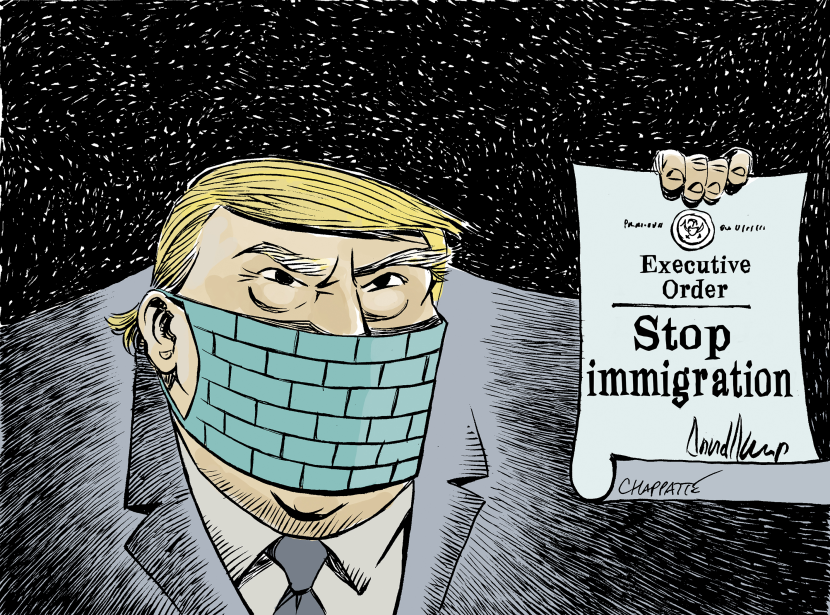
President Trump’s June 22 Executive Order suspending several temporary nonimmigrant visas is a good beginning. But as the Chinese philosopher Lao Tzu would have said way back around 600 B.C., “The journey of a thousand miles begins with a single step.”

The journey for true immigration reform that helps – not crushes – American workers has been, figuratively, a thousand-mile uphill trip. The forces that oppose commonsense immigration policies are powerful: globalists, lobbyists, religious institutions, the mainstream media, Silicon Valley, advocacy groups and immigration lawyers.

Suspended until at least Dec. 31 are visas that hinder thousands of job-seeking Americans. Among them is the H-1B, mostly for tech workers. A recent U.S. Citizens and Immigration Services report found that nearly 600,000 foreign-born tech workers are in the U.S. labor force. These workers are paid at wage levels well below the occupation’s local median wage, an outrage especially in light of large-scale IT layoffs that include currently employed H-1Bs.

Also suspended is the H-2B for nonagricultural workers. This visa often is issued to leisure employees who do jobs that Americans have historically done, including lifeguarding, landscaping and working at high-end resorts. The president’s order further includes the J-1 visa that bans Summer Work Travel participants who take au pair, camp counselor and internship jobs and the L-1 visa which facilitates international transfers from offices abroad to U.S. locations. Also banned are the family members who may accompany the visa holder or will soon.

But the order omitted one of the most egregious immigration programs, Optional Practical Training (OPT), which displaces qualified Americans and is especially harmful to U.S. students who recently earned their university degrees. About 1 million foreign-born are enrolled in America’s colleges and universities, and it allows students who enter the U.S. on F-1 visas to convert their diplomas into work permits if they have science, technology, engineering or math degrees. Several hundred thousand international STEM workers join the U.S. labor force annually.

The general public knows little about the program, but its particulars reveal an abuse of immigration policy and disdain for American workers. First and foremost, “practical training” regulations mean work permission; training isn’t its goal. The Immigration and Nationality Act of 1952 provides no employment authorization for the F-1 visa, and originally, the student was expected to return home after completing studies.

OPT was created entirely through regulation and without congressional authorization. The most significant expansion evolved from an all-out Silicon Valley lobbying effort. In 2008, then-Department of Homeland Security Secretary Michael Chertoff met with Microsoft’s Bill Gates at a Georgetown cocktail party. As a result of Chertoff and Gates’ informal talk, focused on circumnavigating the H-1B cap, three revised OPT guidelines evolved.

First, graduated aliens were allowed to remain in F-1 visa status so that, if jobless, they could search for employment. Second, employed OPT aliens could remain in F-1 status from the time their employers filed an H-1B petition on their behalf and until a decision was made on that petition. Finally, DHS authorized a 17-month work period for aliens with STEM degrees that created a maximum 35-month OPT term. For more than a decade, OPT has been under continuous litigation, yet federal courts have yet to rule on its questionable legality.

OPT represents corporate welfare at its worst. Not only are U.S. tech workers specifically targeted for displacement, but companies that hire OPTs don’t pay FICA payroll taxes. Think of it: U.S. employers receive financial incentives to discriminate against their fellow citizens!

President Trump gets an A- for his June executive order. Unlike his Republican and Democratic predecessors who turned their backs on American workers, President Trump realizes that American workers represent the nation’s backbone. But President Trump could achieve the coveted A+ if he would bring his office’s powers to end the likely illegal and ethically indefensible OPT.

Joe Guzzardi is a Progressives for Immigration Reform analyst who has written about immigration for more than 30 years. Contact him at [email protected].

Comments Off on Taxpayer-Subsidized Program Displaces U.S. Tech Workers