Elitist Ivanka Trump Wants More Skilled Immigration

Ivanka Trump wasn’t in the Golden Globes audience when master of ceremonies Ricky Gervais delivered his scathing indictment of celebrities and Hollywood elite. Trump would have been well advised to heed Gervais’ message. Gervais urged the assembled actors to, if called on to accept an award, shut up, refrain from making political speeches that no one wants to hear, and stop the hypocritical pretense of concern about average Americans, about whom they know nothing.

Trump is quite possibly the nation’s most privileged individual. A bride who pays an estimated $50,000 for a Vera Wang wedding dress that required the skills of 28 seamstresses, weighed 50 pounds and was accessorized with $265,000 of diamonds isn’t the average woman. Nor does such a woman hang out with entry-level H-1B types.

Even though Trump has only, at best, a superficial understanding of the technology industry and federal immigration policy as it affects the H-1B employment visa, she was nevertheless the Consumer Electronics Show’s keynote speaker. Speaking in her capacity as her father’s advisor and as the co-chair of the globalist American Workforce Policy Advisory Board, Trump made some condescending, throwaway comments about retraining existing American workers so that they would be prepared for “jobs of the future.”

But Trump’s sub-rosa message came through clearly – immigration laws should be revised to allow what she referred to as highly educated foreign nationals to live and work in the United States. Then Trump added that the president “thinks it’s absolutely insane that we educate immigrants from around the world and just when they’re about to start companies, we throw them out of the country. We need to reach over the sidelines, draw them into our workforce.” Trump’s reference was to students with F-1 visas, mostly Indian, enrolled in U.S. universities.

For immigration advocates like Trump and her like-minded husband Jared Kushner (who live in $5.5 million, 7,000 square foot homes) pontificating about what 50-year-old displaced U.S. tech workers should do with the remainder of their professional lives is easy. Trump/Kushner will never have to worry about making next month’s mortgage payment, putting food on the table, getting health care coverage or paying for their children’s college education. The H-1B visa means that corporations displace older workers with younger, foreign nationals, mostly age 34 or younger. A Bloomberg story described the plight of U.S. tech workers: “It’s Tough Being Over 40 in Silicon Valley.”

But the truth is that, as President Trump knows all too well, many students remain unlawfully after their visas expire, and few are “thrown out.” Many F-1 visa holders have been able to enroll in the Optional Practical Training program, which the Bush administration expanded and which continues unabated today, even though it never received congressional approval. Foreign nationals on OPT can work for 29 months; science, technology engineering and math (STEM) students may work for three years which helps employers circumvent the 85,000 H-1B cap. In terms of participants, OPT now exceeds the H-1B program. Department of Homeland Security data shows that universities provided 215,000 OPT work permits in 2018. The left-leaning Economic Policy Institute, among other think tanks, has concluded that OPT harms U.S. workers. Overall, an estimated 46 percent of all 10 million-plus visa holders remain in the U.S. after their departure date has expired. Many are illegally employed.

In the co-authored Atlantic Council report titled “Reforming US’ High-Skilled Guest Worker Program,” Ron Hira, a Howard University professor, and Bharath Gopalaswamy, director of the Council’s South Asia Center, spelled out just how devastating the decades-long inflow of cheaper, younger overseas labor is. Virtually every American-held white-collar job is at risk. A significant percentage of H-1B visas is not issued to tech workers, but instead to teachers, accountants and sales representatives. The authors also concluded that, by every objective measure, most H-1B workers have ordinary abilities, skills that are readily available in the domestic labor market.

The H-1B and its bastard offspring, OPT, and H-4 for spouses, a job displacement visa that also began without congressional approval in 2015, continue relentlessly because financial powerhouses like Bill Gates and Mark Zuckerberg have convinced Capitol Hill leaders and media potentates that the U.S. desperately needs foreign labor. They’ve also duped Ivanka Trump and her father who once promised to reform but has since abandoned his pledge to rein in the H-1B visa that’s been a consistent American job killer since its creation in 1990.

Joe Guzzardi is a Progressives for Immigration Reform analyst who has written about immigration for more than 30 years. Contact him at [email protected].

Comments Off on Elitist Ivanka Trump Wants More Skilled Immigration

Uber is the Latest Cheap Labor-Addicted Employer

Uber, the multinational ride-hailing company that burst onto the scene in 2009 and made Yellow Cab passe, has, at least superficially, enjoyed a phenomenal success record. Only a little more than a decade after its formation, Uber operates in more than 60 countries, 785 municipal centers and has an estimated 110 million worldwide users.

The San Francisco-based Uber also, like its Silicon Valley neighbors Facebook, Apple, eBay, Google and Yahoo, has displaced its U.S. software engineers with H-1B visa holders. Like its corporate partners-in-crime, Uber denies the charges that it laid off Americans in favor of employing foreign nationals.

But in its investigative journalism story, The Mercury News reported that Uber’s Sept. 10 filing with California’s employment regulator showed that in August it had laid off 88 workers from its San Francisco offices, and in October would lay off 320 more in its San Francisco and Palo Alto offices. Most were senior software engineers.

During 2019’s first three quarters, Uber filed about 1,800 preliminary applications with the Labor Department for H-1B visas for new software engineer jobs and about 1,500 for new senior software engineer jobs, proof that the company hopes to hire visa holders to replace the outgoing U.S. tech workers.

More evidence that money motivates the cheap labor-addicted Uber: its applications put nearly half the senior software engineer positions at the Labor Department’s Level 2 wages, the same level it listed for more than half of the non-senior jobs – a minimum of $109,242 for employment in Palo Alto and $121,077 in San Francisco.

But Ron Hira, a Howard University associate professor and H-1B expert, told The Mercury News that the Labor Department says that any software engineer’s job description that includes “senior” in its title should command a Level 3 wage, $132,184 in Palo Alto, and $147,597 in San Francisco.

Uber is just one more craven employer to terminate qualified Americans and replace them with pliant foreign workers. For example, in 2015, Toys “R” Us and Disney laid off their most experienced employees and, after forcing the outgoing Americans to train their less qualified replacements, filled the jobs with H-1Bs visa holders. Before and after 2015, the pattern of Americans out, visa holders in has been well established.

In its November 2019 report, Challenger Gray & Christmas, Inc., a global outplacement and business and executive coaching firm, stated that the tech sector announced 7,292 cuts in November. Furthermore, through November, tech companies estimated that they would reduce their payrolls by an additional 63,447 jobs. Tech’s annual job slashing total is 380 percent higher than the 13,222 cuts it announced during the same period in 2018 – 380 percent higher!

With H-1B visa abuse finally on Americans’ radar, President Trump is on the spot to deliver on the grandiose campaign promises he made to get tough. From candidate Trump’s March 2016 press release: “I will end forever the use of the H-1B as a cheap labor program, and institute an absolute requirement to hire American workers first for every visa and immigration program. No exceptions.”

Author, lawyer and long-time H-1B critic John Miano put together a list of seven steps that the president could take that include working with Congress to write legislation that would prevent foreign nationals from displacing Americans. But President Trump’s early promises have proven empty – he’s done little to alleviate the scandalous displacement of U.S. tech workers.

The H-1B visa benefits only the foreign nationals who come to the U.S. to take good jobs and the employers that hire them. The big losers are displaced Americans who will struggle to find new jobs. Also, on the stick’s short end are recent university STEM graduates who will be shut out because of employers’ cheap labor addictions.

Congress and President Trump have, so far, refused to protect Americans.

Joe Guzzardi is a Progressives for Immigration Reform analyst who has written about immigration for more than 30 years. Contact him at [email protected].
Comments Off on Uber is the Latest Cheap Labor-Addicted Employer

Don Larsen’s Perfect Game Remains Undervalued

Every baseball fan of a certain age knows that in 1956 the New York Yankees’ Don Larsen threw a perfect World Series fifth game against the Brooklyn Dodgers. But even though Larsen’s recent passing has once again drawn attention to his long-ago gem, his unique achievement is still under-appreciated.

Thirty four years had passed since the Chicago White Sox’s Charlie Robertson set down 27 Detroit Tigers in a row at old Nevin Field. And before Robinson, the Cleveland Naps’ Addie Joss threw the last perfect game in 1908 – 78 pitches, game time, 1:32.

Since Larsen, perfect games have become, by comparison, common. Seventeen have been tossed, but none in World Series play. Perfect games were so rare that Larsen after the game confessed to his battery mate Yogi Berra that he was unaware that he had accomplished the elusive feat.

Because the series was played between two intra-city rivals, Brooklyn and the Bronx-based Yankees, there were no off days. Larsen, shelled in game two, took to the mound with only two days’ rest. He faced a Dodgers’ lineup that led the National League in runs scored, and was loaded with sluggers like Duke Snider, Gil Hodges and Roy Campanella. Brooklyn’s contact hitters were imposing, too – Pee Wee Reese, Carl Furillo, Junior Gilliam and Jackie Robinson.

Even though he had to pitch cautiously, Larsen fell behind in the count 3-0 only once. And since Larsen never enjoyed more than a 2-0 lead after the sixth inning, he pitched the game’s final, tension-filled three innings with the potential tying run always deck. The game’s last batter, Dale Mitchell, who Larsen struck out on a called third strike, had only 119 strike outs in nearly 4,000 career at-bats.

Larsen came to the Yankees in 1955 via a 17-player trade with the Baltimore Orioles, who had just transferred from St. Louis where the team was called the Browns. In his first season with the Orioles, Larsen’s record was an embarrassing 3-21. Larsen’s .125 winning percentage is the lowest mark registered since 1920, and eighth lowest all-time. But Larsen, in his defense, had anemic batting support. The O’s hit only 54 homers during the 1954 campaign, a mere three more than National Leaguer leader Ted Kluszewski smashed that same season.

Luckily for Larsen, two of his three wins came against the Yankees. Yankees’ manager Casey Stengel decided to bolster his starting rotation by adding Larsen. As Stengel said at the time, pitchers have to be good to lose 20 games. The inference is that if the manager keeps trotting out a pitcher even though he’s regularly charged with a loss, it shows he has confidence in his starter. And managers always had faith in Larsen, despite his consistently mediocre pitching record.

Stengel gave Larsen the bulb for the seventh games of the 1957 and 1958 fall classics against the Milwaukee Braves. Then after being traded to the San Francisco Giants, manager Alvin Dark called on Larsen in a crucial fourth game situation during the 1962 series. Larsen replaced Hall of Famer Juan Marichal, and notched the win. In all, Larsen won four World Series victories against only two loses.

Berra, who hit three home runs in the series and won three Most Valuable Player regular season awards, said that catching Larsen’s perfect game was his biggest baseball thrill. Yogi helped guide Larsen through his perfect game. Berra had developed an extensive book on the Dodgers’ hitters with entries like “Snider… impatient hitter,” “Reese… tough to pitch to” and Robinson… “Strictly a big ball hitter.”

Larsen, who was 27 the day he pitched his perfect game, said he thought about his masterpiece every day. That likely included his final day on Earth, January 1, 2020, when he died at age 90.

A joyous memory like a World Series perfect game should be savored, and Larsen, understandably, did exactly that for more than 60 years.

Joe Guzzardi is a member of the Society for American Baseball Research and the Internet Baseball Writers Association. Contact him at [email protected].

Comments Off on Don Larsen’s Perfect Game Remains Undervalued

The Great Divide: Congress and Voters on Immigration

A year-end Associated Press poll showed that the two top 2019 stories were the House of Representatives’ vote to impeach President Trump and the president’s immigration agenda. The media and the president’s critics refer to Trump’s immigration views as hardline, when in fact they reflect his desire to enforce the laws as written and congressionally approved decades ago.

Incumbent Trump versus whichever pro-immigration Democrat survives the endless debate cycle sets up an interesting showdown. Another late December poll, this one taken by Rasmussen, found that Americans are becoming more aware of immigration’s effect on the qualify of life. The nation cannot add more than 1 million new immigrants year after year, as has been the long-standing practice, without societal consequences. Until the Immigration Act of 1965, immigration averaged 250,000 annually.

Included in Rasmussen’s findings: 47 percent of likely voters polled want to slow immigration-driven population growth, and 14 percent want no immigration-related growth. Further, 68 percent believe the federal government should limit legal immigration to no more than 1 million annually – a total it currently exceeds – and 36 percent want no more than 500,000 admitted each year.

With regard to population-busting family reunification, also referred to as chain migration, 59 percent of voters think legal immigrants should only be allowed to bring their spouse and minor children with them, while 32 percent favor maintaining the current practice that allows them to eventually bring in other adult relatives, including extended family and their spouse’s families.

Americans have shown a growing concern about immigration-related quality-of-life issues. Once more or less limited to border states like California, Texas and Arizona, immigration has now added population to every state, with dire effects on housing and the environment. The impacts are visible in more and more sprawl, overcrowding and traffic congestion.

Consider Virginia, for example. The state’s three fast-growing counties – Fairfax, Arlington and Prince William, all located adjacent to Washington, D.C. – reflect immigration’s consequences on population growth. Since 1990, hundreds of thousands of Hispanics and Asians have moved into the area, and today account for 32 percent of the 1.8 million aggregate residents in the counties. This is triple their 1990 level. During Northern Virginia’s local elections in 2018, some candidates, in response to constituents’ concerns, considered imposing population limits in various affected regions.

The Census Bureau – the ultimate nonpartisan source – projects that if the immigration status quo remains unchanged, future net immigration (the difference between the number coming and number leaving) will total 46 million by 2060, and the total U.S. population will reach 404 million, up from today’s 330 million. Census Bureau data projects that immigration will account for 95 percent of population growth between 2017-2060. Readers can do their own informal poll by asking their friends and neighbors how they feel about adding 75 million more people in the coming decades. The likely result is that most would be overwhelmingly opposed.

Yet, the federal government continues on its current path, apparently unconcerned about the nation’s future or cowed by likely xenophobia charges. But ignorance and cowardice are not leadership qualities.

Two years ago, senators Tom Cotton (R-Ark.) and David Perdue (R-Ga.) introduced the Reforming American Immigration for a Strong Economy Act (the RAISE Act) that would, over a ten-year period, reduce immigration by 50 percent. The bill had only two cosponsors. Reintroduced in 2019, along with Sen. Josh Hawley’s (R-Mo.) endorsement, the proposed legislation has only the original three signatories, plus Sen. Marsha Blackburn (R-Tenn.). In short, Congress is making little if any effort to comply with American voters’ wishes for less immigration.

In U.S. politics, nowhere is the divide greater between voters and elitist Congress than on immigration.

Joe Guzzardi is a Progressives for Immigration Reform analyst who has written about immigration for more than 30 years. Contact him at [email protected].

Comments Off on The Great Divide: Congress and Voters on Immigration

California’s Population Swells, but Leadership Wants More Immigration

The California Department of Finance announced that the state’s population fell just 40,000 people short of a historic 40 million residents. Sacramento demographers, as well as population experts nationwide, agree that California will reach a nightmarish 50 million people by mid-century.

The easiest way to understand the effect of 50 million residents on Californians’ quality of life is to imagine 25 percent more drivers on the roads, more students in the classrooms, more housing and more patients in hospital waiting rooms.

No one disputes this frightening inevitability. The already overcrowded and housing-short San Joaquin Valley, Riverside county and San Bernardino county experienced the largest population increases, and can ill-afford yet more growth. California’s relentless and unsustainable year-after-year growth has sent residents with financial and professional options fleeing from the state. For the first time since 2010, more people moved out of the state than moved in.

Unsustainable defined: In 1900, California was home to less than 2 million people, but by 1950 the population had reached 10 million. California’s population nearly tripled in the last half of the 20th century, and its growth has been much higher than that of the rest of the United States. As the most populous state, California has 10 million more people than the second most populated state, Texas, with 29 million people.

Californians can run, but cannot hide, from the consequences of population growth. Between 2017 and 2018, 21,000 Californians moved to Idaho. The result: Boise home prices increased about 17 percent, and new subdivisions and schools were built – the same sprawl elements Californians hope to escape.

Once an eco-friendly paradise, California’s population growth has created a demand for cars that require highway construction and more housing, making environmentally sound conditions impossible. In its October newsletter, the San Francisco Bay Area Planning and Urban Research Association (SPUR) acknowledged California’s population crisis and its vehicle dependence, and noted that the state’s car-based transportation system has stalled efforts to curb greenhouse gases. Roughly 40 percent of California’s emissions come from cars, trucks and buses.

But SPUR naively called for more investments in passenger rail service to stop sprawl and reduce emissions. SPUR contends more efficient, more frequent rail service would let people leave their cars at home, enable a low-carbon lifestyle and, at the same time, reduce the cost of living for strapped Californians.

In a perfect world, SPUR’s call for more rail transport service would be an ideal solution. But given the colossal failure of former Gov. Jerry Brown’s bullet train – years of delays, cost overruns, lawsuits and, on all levels, staggering ineptitude – rail service expansion is a pipe dream.

Never mentioned in the establishment media or in the think tank analysis of California’s population, sprawl and environmental struggles is the immigration variable. Immigration is not mandated. And while the federal government makes immigration policy, California as the union’s largest state could use its considerable power and influence to help enforce existing immigration laws and to work toward sensible immigration reform.

Instead, Gov. Gavin Newsom and senators Dianne Feinstein and Kamala Harris, as well as 90 percent of California’s U.S. representatives, are determined immigration advocates, and blind to the dramatic adverse consequences of immigration on population growth and the environment. Foreign-born California residents number more than 10.7 million, or 27 percent, of the state’s total population, and twice the national foreign-born percentage per state.

Even former Gov. Brown had a brief realization of limits to growth. In June 2015 while addressing the Metropolitan Water District of Southern California Board, Brown asked, “At some point, how many people can we accommodate?” Then, answering his own question, Brown added, “As we put more people with more impact on this constant natural environment, we run into certain limits.” Brown’s insightful comments fell on deaf ears.

California’s leaders can’t have it both ways. All vigorously assert themselves as pro-environment. But at the same time, their immigration advocacy stances doom the environment. Time is short. California’s leadership needs to put political correctness aside, or watch the state fall into further environmental degradation.

Joe Guzzardi is a Progressives for Immigration Reform analyst who has written about immigration for more than 30 years. Contact him at [email protected].

Comments Off on California’s Population Swells, but Leadership Wants More Immigration

New Report Points to Massive Immigration Issue

The Migration Policy Institute, which describes itself as a nonpartisan think tank that seeks “to improve immigration” through its research and analysis, recently published a report stating that in FY 2018 the State Department issued 9 million temporary visas to nonimmigrants. Although the 2018 total represents a 7 percent decline from FY 2017, 9 million is still a staggering number, the rough equivalent of New Jersey’s population.

MPI blames the visa issuance’s decline on President Trump’s more restrictive immigration policies and his “harsh rhetoric” that conveys the impression that the U.S. has become a “less welcoming place.” Be that as it may, the huge 9 million number indicates that the U.S. is generous, not restrictive, in its approach to foreign workers and visitors. Moreover, MPI didn’t outline the benefits to American citizens of fewer temporary workers and students on visas.

Employment visas – which give foreign nationals the right to legally work in the U.S. – include the H-1B for skilled employees, the H-2A for seasonal agricultural workers, the H-2B and the H-2Rfor seasonal nonagricultural workers, the O-1 and O-2 for workers with allegedly extraordinary ability or achievements, the P-1 for athletes and artists, the L-1 for intracompany transferrers, the E visa for investors and, finally, the TN visa for Canadian and Mexican professionals, as well as their spouses and minor children. Critics have long insisted that many of the visas are unnecessary, and hurt Americans.

For example, H-2B visas, limited to 66,000 annually, are granted to overseas workers who, among other positions, take landscaping, lifeguard and hospitality jobs – jobs Americans would eagerly do.

Temporary worker visa issuance has been on a dramatically upward trend since 2014. The number increased from 732,000 in FY 2014 to 911,000 in 2017 and to 925,000 in 2018. Basically, the presence of employment-based visa holders means that for Americans job competition is more intense, and citizens who hold jobs may find their employment status at risk from foreign, often cheaper workers.

For U.S. citizen students, especially those who hope to matriculate at their local state universities, the 27 percent decline from an estimated 1 million student visas in FY 2015 to 781,000 in FY 2018 means less international competition. Since overseas students pay higher tuition, college admissions offices prefer them to U.S. students who pay lower instate fees. The top international student sending nations are China, India, South Korea, Brazil and Germany which represent 39 percent of all student visas issued in FY 2018.

But the most troubling aspect of the huge inflow of foreign temporary visitors is that an estimated 40 percent of illegal aliens entered the U.S. legally on visas, but overstayed and thus became illegally present. Temporary eventually becomes permanent. Most overstays find white-collar jobs. In 2017, the Department of Homeland Security reported that during a recent 12-month period, nearly 740,000 foreign nationals didn’t return home in accordance with their visas’ terms. Their illegal presence is one of the major contributors to illegal immigration. Analysts have found that in each of the last seven years, visa overstays have exceeded illegal crossings.

The sad truth is that the federal government isn’t looking for overstays, and if it did look would have no idea where to start its search. But if Costco can immediately locate every brick of cheese in its 762 worldwide stores, then the federal government should be able to track down foreign visa overstays. A program exists that would help reach that goal – a biometric entry/exit system – but Congress has been indifferent to implementing it.

Fewer visas is good news for prospective U.S. college students and American workers. The fewer visas that are issued also means that the illegal alien population as well as the population in general will not continue to swell with overstayers.

Immigration advocates always push for more visas, so fewer is a refreshing change of pace that results in tangible advantages for many American workers and students.

Joe Guzzardi is a Progressives for Immigration Reform analyst who has written about immigration for more than 30 years. Contact him at [email protected].

Comments Off on New Report Points to Massive Immigration Issue

Baseball Analytics and Sabermetrics Are Older Than You Thought

Over the years, I’ve somewhat softened my position on sabermetrics.

Baseball’s analytics crowd puts out some valuable information, although most of it remains beyond comprehension. For example, no one truly understands EqA, a batters’ equivalent average that measures hitter independent of ballpark and league effects. VORP, a players’ value over his replacement, is a mystery. These formulas belong in high school math, not at the old ballpark.

Annoyingly, sabermetricians have a holier-than-thou attitude toward dinosaur fans like me. The most self-satisfied of them might be surprised to learn that they haven’t invented sliced bread.

The first sabermetrician was second baseman Johnny “the Crab” Evers, who developed his baseball theories more than 100 years ago when he was a vital cog in the Chicago Cubs’ 1907 and 1908 World Series championship teams. Evers earned his nickname because of the way he slid across the infield to gobble up hot ground balls, and also because of his rotten personality. The 5-foot-9, 125-pound crab – part of the brilliant Tinker-to-Evers-to-Chance double play combination – had a nasty disposition, and was often at odds with opponents, teammates and umpires.

After being traded to the Boston Braves, teammate Rabbit Maranville said of Evers: “He’d make you want to punch him.”

Evers, considered one of the headiest players of his or any other era, parsed baseball statistics before the first radio broadcast, long before television, and eons before computers became a fixture in every American home. Evers operated differently. After the games and gorging on candy bars to keep his mind keen, Evers took pencil to paper, and charted pivotal plays in that day’s contest. Every night, the bedside companions of the obsessive Evers were baseball rule books, the evening editions of the daily newspapers with the day’s final box scores, and baseball’s bible, the Sporting News.

When Evers co-authored “Touching Second,” first published in 1912, his book included numerous geometric diagrams designed to show how fielders should position themselves for batters in different hitting situations. Evers, baseball’s first student of the inside game, insisted that the percentages of getting a batter out must be based on “defensive angles.” The book’s subtitle, which includes references to “the science of baseball” and “its development into an exact mathematical sport,” reveals a lot about Evers’ commitment to analytics.

As Evers wrote: The more intensely baseball is studied, “The geometry of the game becomes more complex. As Mr. Euclid, who invented diamonds would say: ‘If X covers 24 feet with his arms and legs and 18 with his brain, Y, the baserunner is out provided Z, the umpire does not call him safe.”

Although he had only average career batting statistics – .270 over 18 years – Evers was clutch when it mattered most. In both the 1907 and 1908 World Series, he hit .350. After being traded to the Boston Braves in 1914, Evers hit .438 in the World Series against the Philadelphia Athletics.

Evers displayed his leadership qualities that year as the Braves, 25-40 on July 4, rallied to win the pennant and swept the heavily favored A’s. By that time, Evers was baseball’s highest paid player, $11,000, and the Chalmers Award winner, the equivalent of today’s Most Valuable Player. Later, Evers had two stints at managing the Cubs, and one with the crosstown White Sox. Along with Rick Renteria a century later, Evers is one of two men who managed both Chicago franchises.

In 1946, the Hall of Fame elected all three of the famous early 20th century Cubs infielders – Tinker, Evers and first baseman, Frank Chance, the “Peerless Leader.” By that time, Evers had reconciled with Tinker. Despite their smooth as silk fielding and their shared determination to Cubs’ winning, the two had an acrimonious personal relationship, and didn’t speak for years.

One year later at age 65 and after suffering a stroke that left him debilitated for life, an emotionally and physically exhausted Evers died in Albany, New York. But not before paving the way for today’s sabermetricians.

Joe Guzzardi is a Society for American Baseball Research and Internet Baseball Writers Association member. Contact Joe at [email protected].

Comments Off on Baseball Analytics and Sabermetrics Are Older Than You Thought

Bias Infests Once Respected Magazine

Michael Goodwin, a New York Post columnist who began his journalism career at The New York Times, wrote a two-part commentary last month that chronicled the long, steady erosion of reporting integrity.

Although Goodwin focused on the Times, his observations that bias has become common in the mainstream media easily applies to many publications. Editors who could once be counted on to, as Goodwin wrote, veer copy toward the middle, gradually became as much of a problem as the reporters whose work they review.

Nowhere is journalism bias more blatantly on display than in immigration stories. Even though polling shows that at least half of all Americans want less immigration, most stories tell only the expansion side, and in the process leave their readers under-informed.

Case in point: Fortune magazine, the respected, 90-year-old business publication, recently did a story about one of most controversial programs that’s hurtful to U.S. tech workers, the Optional Practical Training program. In brief, OPT allows international students on F-1 visas to remain in the U.S. and work for at least a year, and longer if they have earned degrees in science, technology, engineering or math (STEM).

Although there are multiple reasonable arguments that can be made in opposition to OPT, none of them appeared in reporter Nicole Goodkind’s article. Among OPT’s flaws that Goodkind omitted are that OPT is not congressionally approved, yet it has ballooned into the nation’s largest guest worker program.

OPT is a voracious American job killer. Department of Homeland Security data shows that, since 2015 and through May 2017, nearly 500,000 students received OPT, and another 150,000 have STEM extensions. That’s 650,000 good jobs being held now by foreign nationals versus qualified American workers. There’s a powerful incentive for tech companies to hire OPT foreign workers. A 15 percent discount has allowed multinational corporations to evade at least $20 billion to $30 billion in FICA taxes over the years. The OPT worker doesn’t pay FICA either, and therefore doesn’t contribute to Social Security or Medicare.

In her 1,200-word article, Goodkind glowingly cited five pro-OPT sources, including major corporations, that profit from the program. Among them are Google and immigration advocacy groups like the Mark Zuckerberg-founded FWD.us. Goodkind wrote that an amicus brief FWD.us filed supporting OPT read like: “a who’s who of Silicon Valley. Tech giants like Google, Apple, Amazon, Facebook, Airbnb, Bloomberg, Intel, Microsoft, Tesla, Twitter, Uber, and Zillow….”

Yet Goodkind quoted only one critic, John Miano, a lawyer and expert on the effect of foreign labor on technology workers. Miano has worked on behalf of workers and pro-American worker organizations, and for more than a decade has challenged OPT in federal court. Goodkind assassinated Miano’s character and that of his associates. Goodkind quoted Miano after she had inaccurately and wrongly marginalized him.

Miano told me, however, that if Goodkind had done the due diligence once considered honest journalism’s bedrock, she would have seen that the money trail explains everything. “The tech industry spends tens of millions of dollars each month lobbying for more foreign labor and to preserve their ability to replace working American with that foreign labor,” said Miano.

Fortune once was a highly respected magazine that would never have permitted slanted copy like Goodkind’s to get past the first editorial layer, let alone get published. By passing over OPT’s damaging effects on American workers, Goodkind abandoned the principals that journalists themselves established years ago.

The 110-year-old Society for Professional Journalists’ ethics code warns reporters to “avoid advocacy,” advice which Goodkind ignored. As former Washington Post ombudsman E.R. Shipp wrote in her column “In Pursuit of Fairness,” no story is fair if it omits facts of major importance and significance. Goodkind disregarded that basic, most obvious rule.

Reporters like Goodkind need to remember that the full story – he said, she said – is always more compelling than a cheerleading story that quickly becomes tedious.

Joe Guzzardi is a Progressives for Immigration Reform analyst who has written about immigration for more than 30 years. Contact him at [email protected].

Comments Off on Bias Infests Once Respected Magazine

Labor Report Great News for Trump’s Economy

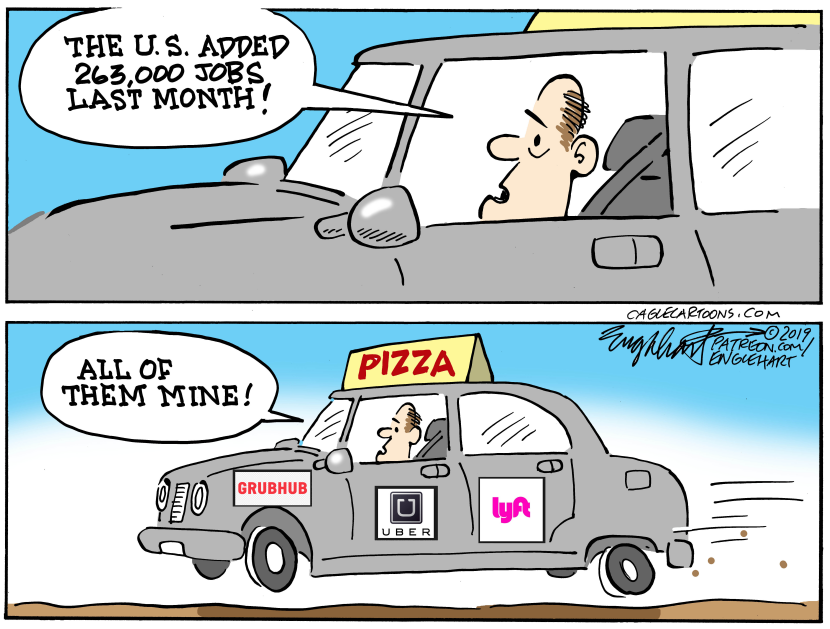
As if the unappetizing buffet of presidential candidates isn’t troublesome enough for the Democratic Party, along came an unexpectedly strong November jobs report from the Bureau of Labor Statistics.

In November, the economy created 266,000 jobs, aided in part by returning GM workers, a total that easily outstripped Wall Street’s 183,000 projections. Some doomsayers wrongly predicted that the labor market was “finally starting to crack.” Not only was November robust, the September and October jobs were revised upward, adding 41,000 to the payroll totals.

Annual wage growth increased by 3.1%, with last month’s wage growth revised from 3.0% to 3.2%, suggesting employers are responding to a tight labor market. Wages for production and nonsupervisory workers rose 3.7%, the best growth since 2008. Growth was strong in most employment sectors, including the better-paying manufacturing jobs.

While Democrats are fixated on impeachment, President Trump is eager to promote his accomplishments. In a White House blog written by the Council of Economic Advisers, the president touted his record that includes 7 million jobs created and low unemployment rates among African Americans, Hispanics, Asians, the disabled and those without a high school diploma. On the 2020 campaign trail, President Trump might be forgiven if he echoed Abraham Lincoln’s proverb that now, a period of strong economic growth, is no time to swap horses.

November is especially heartening to the primary victims of cheap labor-addicted employers who have repeatedly passed over citizens in favor of pliant foreign-born workers. The University of New Hampshire, which follows national trends in disability employment, noted that working-age disabled people’s participation has increased from 30.7 percent in November 2018 to 31.2 percent in November 2019. Hispanic and black employment rates are at historic lows, 4.2 percent and 5.5 percent, respectively.

To ensure that the upward trend in U.S. employment continues and that wages improve, Congress must cut back on guest worker visas, mostly unnecessary and harmful to Americans detached from the labor market. The assumption has long been that guest workers do jobs that Americans won’t – the H-2A and the H-2B visas are designated for agriculture and non-ag seasonal summer work. The J-1 visa is for foreign exchange students.

Many of those visa holders perform jobs that Americans would eagerly do in landscaping, forestry, recreation, construction and hospitality. The number of guest workers, or temporary labor migration program (TLMP) participants, in the U.S. is estimated at about 500,000 annually, according to the Economic Policy Institute. What is clear is that TLMPs displace U.S. workers. Because employers control their workers’ visa status and often abuse that responsibility, the practice has been criticized as the new American slavery.

Despite the obvious – that the continued guest worker flow expands the labor market and therefore exerts downward pressure on wages – Congress has steadfastly for nearly three decades refused to cut back or even enter into a meaningful conversation to improve the programs and protect Americans.

Earlier this year, the Department of Homeland Security, which under some circumstances has the authority to increase the H-2B cap, bumped it by nearly 50 percent, an increase that benefits employers but discourages qualified U.S. workers. And Congress is considering an ag worker amnesty that would give lifetime work permits to 1.5 million temporary guest workers, and eventual citizenship. Congress should focus on promoting farm mechanization instead of encouraging more immigration with an amnesty.

Thirty years of congressional failure to reform guest worker programs have left most Americans convinced that employment advancement for foreign nationals is more important than a future for U.S. workers.

Joe Guzzardi is a Progressives for Immigration Reform analyst who has written about immigration for more than 30 years. Contact him at [email protected].

Comments Off on Labor Report Great News for Trump’s Economy

Proposed DHS Revisions Offer Ray of Hope

The Department of Homeland Security’s recently released Unified Agenda gives hope to U.S. tech workers that major, long overdue changes may be coming soon.

New DHS guidelines would provide relief to American tech specialists from the decades-long onslaught of overseas H-1B visa holders, L-1 visa international transfers and foreign-born Optional Practical Training (OPT) graduates with science, technology, engineering and math (STEM) degrees. The H-1B, L-1 and OPT are visas that have displaced American workers or blocked them from employment consideration. The visas are popular vehicles for U.S. corporations and Indian IT services companies to add personnel and, at the expense of American workers, reduce their overhead.

A recent Forbes Magazine article, “Trump Plans Far-Reaching Set of New Immigration Regulations,” states that the administration’s specific goal regarding H-1B visas is to revise – in other words, tighten – the specialty occupation definition to better ensure that only the most qualified foreign nationals are granted visas. To the surprise of many, some computer programming positions don’t require foreign applicants to hold university degrees to qualify as a specialty occupation and receive an H-1B visa. The proposed H-1B ruling may be published this month.

The L-1 intracompany transfer visa, already approved in increasingly fewer numbers, is also under further review. Overseas employees, who may or may not have the alleged specialty skills they claim to hold, may be subject to more thorough scrutiny. The L visa has no numerical cap, and employers are not required to prove that Americans are unavailable for the work. Neither do employers have to pay prevailing wage. The Office of Inspector General found that the L-1 visa is particularly susceptible to fraud. Moreover, the L visa allows spouses and minor children to come to the U.S. on L-2 visas. In all, tens of thousands of L visa holders and their spouses work in the U.S. without any federal oversight. A September 2020 ruling is expected.

Another program that DHS hopes to corral is OPT which has morphed into the nation’s largest guest worker program. The term “practical training” should not be confused with actual on-the-job training, but rather means full-fledged work authorization. DHS has allowed aliens who originally entered on student visas to stay over for years, without statutory authority, and take good jobs that might otherwise go to U.S. tech workers. As an additional incentive for students and their employers, both are exempt from payroll taxes.

Finally, the newest employment authorized but not congressionally approved work population, H-4 spouses of H-1B visa holders, are under renewed review. After years of intensive lobbying, spouses – 90 percent Indian women – holding H-4 visas were first granted work authorization documents during President Obama’s administration. President Trump has often expressed his intention to rescind work permission for the H-4 visa category, but has not achieved any notable progress. Whether H-4 spouses can legally be employed has been tied up in the courts for years. A DHS ruling may be issued in March 2020.

Immigration lawyers are apoplectic, and quite possibly unhinged, by the possible DHS overhaul. One prominent lawyer called President Trump’s employment-based visa revisions “a white supremacist immigration agenda” that would “bar…all immigrants of color.” Other attorneys were equally outraged, but used more delicate language.

But hysteria aside, the H-1B, the L, OPT and H-4 have been relentless U.S. job killers, and all are unnecessary. No American worker shortage exists, only half of qualified STEM graduates find STEM careers, and no evidence exists of wage increases that would confirm worker shortages.

In their report released this January and titled “Reforming US’ High-Skilled Worker Program,” authors Ron Hira and Bharath Gopalaswamy wrote that the current system undercuts opportunities for U.S. workers and enables exploitation of H-1B workers. Since its creation in 1990, the H-1B program has never been fixed to meet Congress’ original promises to safeguard U.S. jobs. Instead, the program has been expanded to allow even larger numbers of H-1B workers, admitting them for longer periods, while its flawed governing rules have remained unchanged.

U.S. jobs should go to U.S. workers. To argue otherwise defies common sense.

Joe Guzzardi is a Progressives for Immigration Reform analyst who has written about immigration for more than 30 years. Contact him at [email protected].

Comments Off on Proposed DHS Revisions Offer Ray of Hope