Biden Occupying the Least Crowded Primary Lane

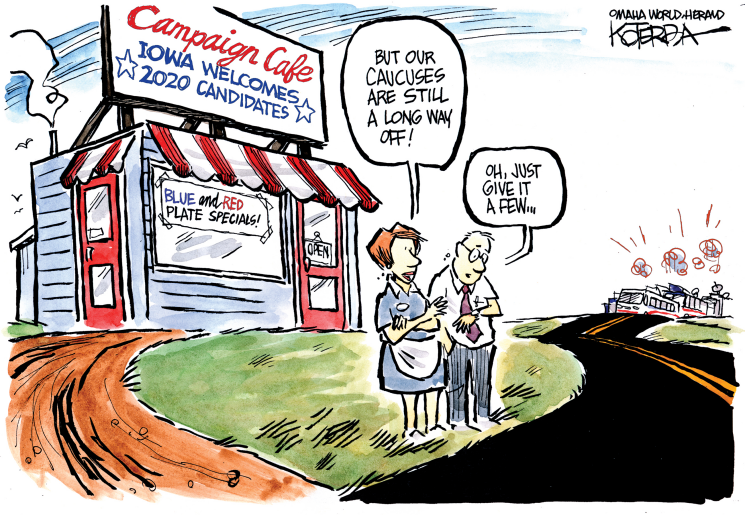
“Finding a lane” has become this election cycle’s shorthand advice to candidates attempting to separate themselves from the competition and focus on a pre-determined course that will lead to the ultimate prize.

For the 21 candidates seeking the Democratic presidential nomination, finding a lane has meant throwing sharp elbows, cutting one another off in the best tradition of congested freeway driving and knocking them permanently off stride.

Former Vice President Joe Biden is currently occupying the least crowded lane of all – right in the middle where history instructs us the majority of the American people are.

The other 20 have chosen the left lane and, in a version of the carnival amusement ride bumper cars, are clanging off one another on an increasingly narrow path, marked by each out-pledging their competitors in support of a breathtaking array of government-provided services and multi-trillion dollar spending.

Biden, who risked becoming a caricature of Hamlet as he agonized over whether to enter the race, leads the field by a margin ranging from single digits to nearly 30 points, depending on which poll findings one accepts.

While instant name recognition built up over some 40 years in public life and his perch at the right hand of President Obama for eight years undoubtedly played a role in his poll standings, his philosophy of moderation, embrace of the bipartisan politics of the possible and his man-of-the-people demeanor have placed him apart from the headlong stampede to the left and the promises of a fantasy, utopian America overseen by a benevolent Federal government which will – in the words of one cynic – “fix everybody’s leaky faucet.”

Biden is on cruise control in a deserted middle lane, gliding past those bunched in a pack on his left who are jockeying for a favorable position while arguing over who is more progressive; i.e., who can promise more social services no matter how expensive or unrealistic.

Of the left lane runners, five have risen above their competition as possible threats to Biden – Senators Bernie Sanders of Vermont, Kamala Harris of California and Elizabeth Warren of Massachusetts; former Texas Congressman Beto O’Rourke, and South Bend, Ind. Mayor Pete Buttigieg.

Senators Kirsten Gillibrand of New York, Amy Klobuchar of Minnesota, and Cory Booker of New Jersey are stuck at two to four percent support, struggling to remain in the conversation.

The remainder of the field is irrelevant and it won’t be long before Las Vegas bookies start taking action on whether Gillibrand, Klobuchar, Booker or O’Rourke will survive past the Iowa caucuses in February.

Biden’s front runner status and his impressive fund raising is clear evidence that the surge to the left led by the more militant members of Congress and their demands that the old line party establishment – exemplified by Biden – is neither as powerful or as widespread as its leaders would have people believe.

As candidates align themselves more tightly with the left, they risk placing the interests of a narrow sliver of the electorate above those of the broader American public – the segment of the population that played an outsized role in sending Donald Trump to the White House in 2016.

They are bogged down in crass attempts to one up one another, arguing over who is more ideologically pure on issues likeMedicare for all, immigration reform, free college tuition, forgiving all student loan debt, reparations for descendants of slaves, allowing prisoners (including convicted murderers and terrorists) to vote, increasing taxes and breaking up corporate behemoths.

They’ve ignored polling data which reveals voters – including a majority who identify themselves as Democrats – place a higher priority on nominating a candidate capable of defeatingTrump than on ideology.

Translation: Voters prefer a candidate in the middle lane.

Enter Joe Biden.

To be sure, Biden’s history will be a factor as the campaigns play out but he’s demonstrated he can deal with it.He deftly responded to allegations of unwanted personal interactions with females, apologizing for creating an uncomfortable situation, pledging to be more considerate in the future and attributing his conduct to a natural inclination toward comfort and compassion.

America is still a centrist nation in its politics and, if it chooses Biden next year, the ideological excesses of the Democratic Party, may be purged at last.

Copyright 2019 Carl Golden, distributed exclusively by Cagle Cartoons newspaper syndicate.

Carl Golden is a senior contributing analyst with the William J. Hughes Center for Public Policy at Stockton University in New Jersey. You can reach him at cgolden1937@gmail.

Comments Off on Biden Occupying the Least Crowded Primary Lane

Democrats Have a Socialism Problem

In deciding to frame the 2020 election as an apocalyptic showdown between free enterprise capitalism and government-controlled socialism, national Republican party strategists hope to shift attention away from the chaos and uproar of the Trump administration and convince voters that a Democratic victory will push the nation into economic and societal ruin.

Republicans seek to exploit an opportunity handed them by a Democratic Party seemingly intent on devouring its own, pulled relentlessly to the left by a vocal band of mostly young activists who reject the philosophy and principles of their party’s establishment and wish for its downfall.

Congresswoman Alexandria Ocasio-Cortez of New York has emerged as the chief of the insurgents, gathering support for her Green New Deal. It’s a broad manifesto initially peddled as an all out assault on climate change but which in reality consists of a demand for unprecedented, massive social change to provide – among other elements – Medicare for all, public jobs for the unemployed, guaranteed annual incomes, safe and affordable housing, free college, and elimination of fossil fuels.

A source for the estimated hundreds of trillions of dollars necessary to fulfill her utopian vision is a mystery and, when questioned, Ocasio-Cortez airily dismissed the concerns by suggesting that government could simply print more money.

House Speaker Nancy Pelosi and several candidates for the Democratic presidential nomination have gently distanced themselves from the Green New Deal, describing it as aspirationaland deserving of debate.Even Vermont Sen. Bernie Sanders, the socialist independent who started the entire movement in his 2016 presidential campaign, has been cool to it.

Ocasio-Cortez, through her adroit use of social media and benefitting from a national press corps that eagerly laps up her every comment and tweet, has skillfully managed to frame the reference of debate around her agenda.

In a startling display of hubris – even for her – she threatened to mount primary election challenges to fellow Democrats who she felt had strayed from the socialist orthodoxy, infuriating many of her colleagues who believe her threat is nothing short of betrayal.

Republicans, not surprisingly, are gleeful spectators occupying grandstand seats to witness their opponents shredding one another over pledging fealty to an ideological concept – socialism – that they believe most Americans reject.

They’ve wisely remained largely silent as well as House Democrats agonize over how to deal with the outraged fallout from anti-Semitic comments uttered by Reps. Ilhan Omar of Minnesota and Rashida Tlaib of Michigan.

The party leadership publicly struggled for days on end, eventually producing a resolution that was as embarrassing as it was meaningless, all in an outlandish effort to avoid a frontal assault and censure of their colleagues. For the party newly in control, it was a public relations disaster.

Democratic national chairman Tom Perez faces the task of negotiating a truce, easing the concerns of the veteran party establishment while mollifying the firebrands of the far left.

Ironically, it was Perez who early on contributed to the current party divide when he described Ocasio-Cortez as “the future of the Democratic Party” following her upset victory in the primary and her subsequent general election win.

More clear-eyed Democrats understand that America remains a largely politically centrist nation with occasional tilts to the left or right of center.When the leaning becomes perilously acute (Republican Sen. Barry Goldwater in 1964 and Democratic Sen. George McGovern in 1972, for instance), backlash ensues and the ideological needle moves back toward the moderate middle.

In the autumn of 1945, shortly after the end of World War II, Britain’s Prime Minister Winston Churchill, who had guided his nation through the war, addressed the Parliament as the English people grew increasingly restive over the privations and rationing they’d endured during the war and looked toward greater central government relief.

Churchill told his fellow MPs: “The inherent vice of capitalism is the unequal sharing of blessings.The inherent virtue of socialism is the equal sharing of miseries.”

Nearly 75 years later, the Republican election strategy is one of hoping to convince voters that the”unequal sharing of the blessings” of capitalism can be remedied through individual initiative and unfettered personal freedom while “the equal sharing of the miseries” of socialism is eternal.

Copyright 2019 Carl Golden, distributed exclusively by Cagle Cartoons newspaper syndicate.

Carl Golden is a senior contributing analyst with the William J. Hughes Center for Public Policy at Stockton University in New Jersey. You can reach him at cgolden1937@gmail.

Comments Off on Democrats Have a Socialism Problem

The Green New Delusion

What began as a slow but steady drift to the left has become a headlong and dangerous stampede to the ideological fringe as many high-profile Democratic – including several presidential candidates – embrace multi-trillion-dollar government programs with no way to pay for them while currying favor with the party’s vocal progressive wing and its demands for a vast new social welfare agenda.

The relatively small band of activists behind the drive to the left has coalesced around a manifesto called the “Green New Deal,” an idea developed and promoted as a response to climate change, but which reaches well beyond weaning the nation off dependence on fossil fuels over the next decade.

While the plan with its bold and wide-ranging initiatives – government health care insurance for all, job and employee benefits guarantees, affordable housing, free higher education, among many other similar items – was designed to capture the imagination of the American people, its rollout was badly botched and embarrassing to those involved.

The presentation was so riddled with errors and conflicting points that its leaders spent days clarifying, correcting, explaining and engaging in damage control to restore credibility.

More harmful, though, was the depiction of the group as ill-prepared amateurs either unaware of the provisions of their own plan or baffled as to how to explain it.

Ridicule rained down on it and critics dismissed the entire venture as repeating wearisome far left-wing dogma, a mashup of impractical and unworkable ideas whose cost is so prohibitive as to be fantasy.

Led by freshman Rep. Alexandria Ocasio-Cortez of New York, supporters have designated the Green New Deal a litmus test for those seeking the presidential nomination. They make up with fervor what they lack in political insight and wisdom.

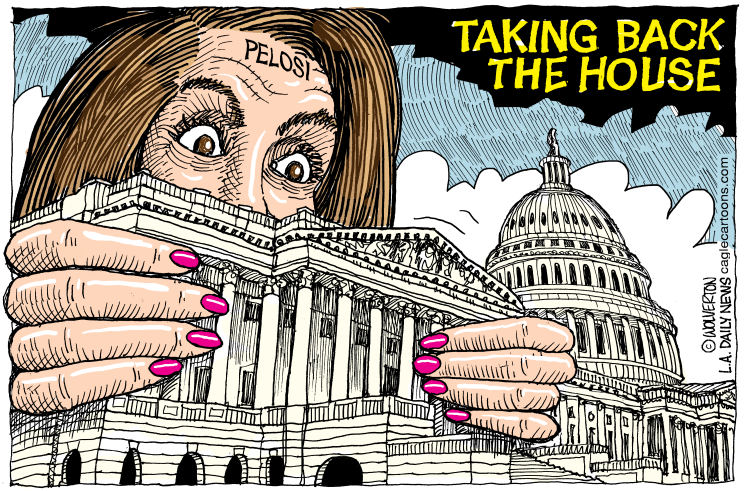
The odds of the platform winning approval in the Congress are non-existent, but House Speaker Nancy Pelosi, perhaps the shrewdest political mind in her party, quickly recognized the danger in the rush to embrace it.

Allowing the party to be defined as an out of control band of spendthrift socialists intent on massive tax increases and bankrupting the nation imperils both the chances of regaining the White House and the Senate, and retaining the majority in the House.

She was careful in her response, praising the “enthusiasm” of its supporters and welcoming many of the ideas as apt subjects for discussion.

It was not an outright dismissal, but the subtext in her response couldn’t have been more clear: Proceed at your own peril and without leadership support.

Because many elements of the plan are so vaguely presented – described in few words – while others are wildly out of the mainstream, they are open to definition in the worst possible light.

Handing President Trump and Republican congressional candidates an opportunity to campaign on preserving and protecting American values and tradition while portraying Democrats as hellbent on destroying those values and tradition is potentially disastrous to Democrats in 2020.

Trump’s Twitter account will overheat under a torrent of his customary sarcasm and derision while he seizes every opportunity to repeat his State of the Union speech pledge: “We will never become a socialist country.”

Pelosi understands that Trump will drive the Democrats into a defensive corner, demanding its candidates justify spending hundreds of trillions of dollars on ill-considered and ill-defined social programs which go against the grain of American governance.

Climate change – a legitimate and worthwhile subject for political debate – will be overshadowed by an onslaught of criticism of such proposals as government-funded employment for anyone, complete with health insurance, vacation andpension rights, or phase out of internal combustion engine vehicles, or government guarantee of healthy food and adequate housing.

Large swaths of the electorate – potentially enough to swing partisan control of the Congress – will find the ideas indefensible and respond negatively to candidates who support them.

It won’t matter that none of it was enacted or will ever be. Convincing voters that it is what the Democratic Party stands for will be sufficient, particularly if the party foolishly includes it in the 2020 platform.

Pelosi wants the 2020 election fought onfriendlier terrain – a referendum on Trump and a political environment which led to her return to the speakership.

Should it become a contest between Trump with all his foibles and flaws and a Democratic Party composed of wild-eyed radicals who will settle for nothing less than replacing capitalism with socialism, Pelosi is in line to become minority leader.

Copyright 2019 Carl Golden, distributed exclusively by Cagle Cartoons newspaper syndicate.

Carl Golden is a senior contributing analyst with the William J. Hughes Center for Public Policy at Stockton University in New Jersey. You can reach him at cgolden1937@gmail.
Comments Off on The Green New Delusion

Out of a Large Democratic Field, Can a Woman Emerge?

The United States elected its first president in 1789.One hundred seventy-one years elapsed before the nation chose its first Catholic president, another 20 years before voters elected a divorced man, and 28 years passed until the election of the first African-American chief executive.

A scant eight years later, it was a universally accepted truth that the election of the first female president was a foregone conclusion.

Oops! In one of the most wretched presidential campaigns in American political history, Hillary Clinton – ex-First Lady, U. S. Senator, and Secretary of State – squandered her historic opportunity, losing to a thrice-married real estate developer and reality television host who had never held public office and who spent a third of her total on the campaign.

In less than two years, a woman may very well stand on the portico of the east front of the Capitol, hand on a Bible, and become the first female to take the oath of office of president.

Convinced that President Trump is seriously vulnerable, upwards of two dozen current and former elected officials, ex-cabinet members, governors, ex-governors, and business executives have either announced candidacies or are seriously contemplating a run at the nomination.

Among that field, are five women – four sitting U.S. Senators and a member of the House.

Sens. Kamala Harris of California, Elizabeth Warren of Massachusetts and Kirsten Gillibrand of New York are committed to running while Amy Klobuchar of Minnesota is in the “I’m thinking about it” stage. Rep. Tulsi Gabbard of Hawaii is an announced candidate.

All at this point enjoy but single digit support, crowded out by the potential candidacies of former Vice President Joe Biden and Vermont Sen. Bernie Sanders, even though their leads are morereflective of name recognition than widespread support.

The large field will shrink over time as reality intrudes and a clear-eyed examination of their prospects reveals that tilting at windmills requires buying a horse and a suit of armor.

The challenge for the female Senators is to stand out from the crowd, draw attention and mount a credible campaign to convince the donor class to view them as a compelling candidate with a legitimate chance of winning.

Their success rests also on where the national party finally settles on the ideological spectrum.

It’s been driven further to the left by a vocal band of newcomers in the House who believe militant progressivism represents the path to victory – Medicare for all, free college education, government guaranteed employment, abolition of the Immigration and Customs Enforcement Agency, increased taxes on wealthy individuals and corporations, etc.

While such an agenda will most assuredly draw a sharp contrast with the Trump presidency, it is by no means certain it will capture the imagination of the nation.

The socialism upon which it rests has long been anathema to Americans, a rejection of the traditional values of individual freedom, personal responsibility and self-initiative.

The primary contests and candidates’ debates will reveal how far left the party will tilt and whether the American people can be persuadedsuch an ideological shift represents progress rather than a threat.

The unfavorable view of Trump held by a significant majority of the country may well assist Democrats in its message of change – even radical change.

The party will bank on discontent with an administration riven by chaos and headed by a president who often seems to have slipped his moorings to reality.Abrupt, contradictory shifts in policy combined with a temperamental chief executive waging running combat with the media in the midst of an ongoing investigation of his campaign all work to Democrats’ benefit in 2020 in the minds of party leaders.

It would, however, be a serious strategic error to rely heavily on antipathy toward Trump as the core of the campaign – a lesson learned the hard way by Clinton.Underestimating Trump, as the Clinton campaign discovered, is risky.

As the first female to secure a major party presidential nomination, Clinton opened the path for women to compete on an equal footing with their male counterparts.

It was no small achievement and will forever be viewed as a seminal moment in American politics, her subsequent badly flawed campaign and loss to Trump notwithstanding.

Any doubts about whether the country is prepared to accept a female as president have been put to rest.Clinton, after all, won the popular vote rather handily.

Intellect, insight, ability have replaced gender as the defining elements in choosing a president.

In 2020, two hundred thirty-one years may be put to rest as well.

Carl Golden is a senior contributing analyst with the William J. Hughes Center for Public Policy at Stockton University.

Copyright 2018 Carl Golden, distributed exclusively by Cagle Cartoons newspaper syndicate.

Carl Golden is a senior contributing analyst with the William J. Hughes Center for Public Policy at Stockton University in New Jersey. You can reach him at cgolden1937@gmail.
Comments Off on Out of a Large Democratic Field, Can a Woman Emerge?

Pelosi Keeping Loud New Progressives in Line… For Now

Facing an unruly band of newly-installed members of the House clamoring for impeachment proceedings against President Trump, Speaker Nancy Pelosi has been a voice of moderation, urging caution while warning that a move to drive the president from office in the absence of clear, irrefutable evidence of wrongdoing does not enjoy majority support in the country and will backfire on her party.

A politically shrewd Pelosi is willing to allow the supporters of impeachment to continue to vent publicly and sometimes profanely, aware that she holds the stronger hand and could easily crush any intra-party rebellion.

Her ascension to the Speaker’s office after dozens of candidates pledged to oppose her was a textbook lesson in manipulating the levers of power, dealing deftly with her critics, striking deals and dispensing favors. It was a masterful performance, picking off dissidents one by one until the entire opposition movement collapsed.

Even her severest critics came away grudgingly impressed at her ability to navigate choppy political waters which not so long ago threatened to swamp her and send her to a back bench.

Truth be told, Pelosi and congressional Democrats benefit from Trump remaining in office.They need an enemy, a polarizing and divisive figure whose mercurial personality, rapidly shifting and often contradictory policy pronouncements careen across the political landscape in such breathtaking fashion that even his staunchest supporters are often left bewildered and scrambling for supporting explanations.

Pelosi understands that, by contrast, her party’s legislative agenda seems insightful, rational, well thought out and broadly responsive.

She is aware, also, that an impeachment debate will rally Trump’s base and close ranks against what appears to be a revenge-filled attempt to overturn the results of the 2016 election. Some left leaning members of the media have egged the impeachment lobby on as well.

It may momentarily satisfy the lust of the party’s more shrill and strident impeachment advocates, but approval in the House is by no means assured and conviction in the Senate is out of the question. It would, in other words, play into the hands of Trump’s supporters who will argue it is an egregious abuse of Constitutional power to undertake impeachment on the basis of disagreement with presidential policies or personal dislike.

The Democrats’ 40-seat gain in the mid-term elections and control of the House did not reflect any great grassroots groundswell of support for the party’s platform; rather, it was an expression of deep dissatisfaction with Trump and a desire for a Democratic congressional majority to hold him in check. While their ideas may have held appeal for some, the driving force behind their victories was distaste for Trump.(Numerous polls, including that of the Stockton Polling Institute, bear out this explanation.)

Her cautious strategy on impeachment is indicative of a belief that if the more than two-year investigation by Special Counsel Robert Mueller reveals evidence of lawbreaking by the president or his staff, if will provide solid grounds for proceeding with a removal effort.

Should the investigation allege collusion by Trump campaign operatives with Russian interests to influence the 2016 election, it will be impossible to restrain the forces of impeachment. It will also validate the Speaker’s strategy.

Despite sporadic predictions that the Mueller probe is nearing its conclusion, there has been no definitive word from his office, although pressure on him will surely grow as jockeying for the 2020 nomination grows increasingly serious.

Keeping impeachment demands at arm’s length is an acknowledgement by Pelosi that a precipitous veering to the far left is risky for Democrats.While the party’s vocal fringe will continue to demand consideration of its agenda, the cooler, wiser heads – including Pelosi – understand that the multi-trillion-dollar cost of Medicare for all, free college, forgiving student debt, government paid public jobs for the unemployed among other proposals, is near fantasy and politically unacceptable to a majority of the country.

Pelosi will allow committee investigations of the Trump Administration to go forward as a relief valve for the frustrations felt by Democrats who feel they’ve been ignored during the years of Republican control.

Whatever the committees discover – the trivial as well as the potentially embarrassing – will be absorbed into the overall strategy of dramatizing the differences in philosophy of governance between the president and Democrats.

Pelosi understands that for as long as he remains in office – presumably through 2020 at least – Trump will provide political benefit to her party. Pelosi’s view seems to be forget impeachment – he’s better for us if he remains.

Copyright 2018 Carl Golden, distributed exclusively by Cagle Cartoons newspaper syndicate.

Carl Golden is a senior contributing analyst with the William J. Hughes Center for Public Policy at Stockton University in New Jersey. You can reach him at cgolden1937@gmail.
Comments Off on Pelosi Keeping Loud New Progressives in Line… For Now

Bill and Hillary Clinton Just Won’t Go Away

Like an aging vaudeville duo whose act has grown stale and whose once-adoring audiences have diminished to a nostalgia-driven handful, Bill and Hillary Clinton have taken to the lecture circuit in their obsessive quest for relevancy and, of course, money.

In their recent opening night in Toronto – the first stop on a 13-city, six-month tour – the Clintons played to a half empty hall of true believers who cheered their attacks on President Trump, clucked sympathetically and cursed the bad luck that had befallen Hillary in her loss to Trump.

The former first couple is singing to the choir; no one is apt to shell out anywhere from $75 to more than $700 a ticket in the hopes of learning something new. They filed into the Toronto venue because it was an opportunity to reinforce their fealty to the Clintons, swoon over their political heroes, and come away convinced the country is on the road to ruin because, among other things, the American people failed to elect the nation’s first female president.

Packed houses are unlikely for the remainder of the tour, but the Clintons won’t be deterred or embarrassed; the money will continue to flow (once Hillary left office, Bill’s quarter million dollar speaking fees dried up) and the media will cover their appearances – the twin goals of the ex-president and ex-first lady, U. S. senator and Secretary of State.

The distraction the two represent is the last thing the Democratic Party needs or wants as it struggles to accommodate the rising voices of a crop of new, young, ambitious and aggressive activists demanding an overthrow of the party establishment and a dramatic change in thinking.

The Clintons are quintessential establishment figures who stand for small, incremental steps toward change rather than the upheaval demanded by the restless newcomers.

Congresswoman-elect Alexandria Ocasio-Cortez of New York, who has become the symbol of the new wave for change, was three years old when Bill Clinton won the presidency. Neither she nor her contemporaries have any emotional attachment to his administration, policies or style, nor any desire to follow the same path. The Clintons are throwbacks in her mind, appreciated for their service but to be obeyed or emulated no longer.

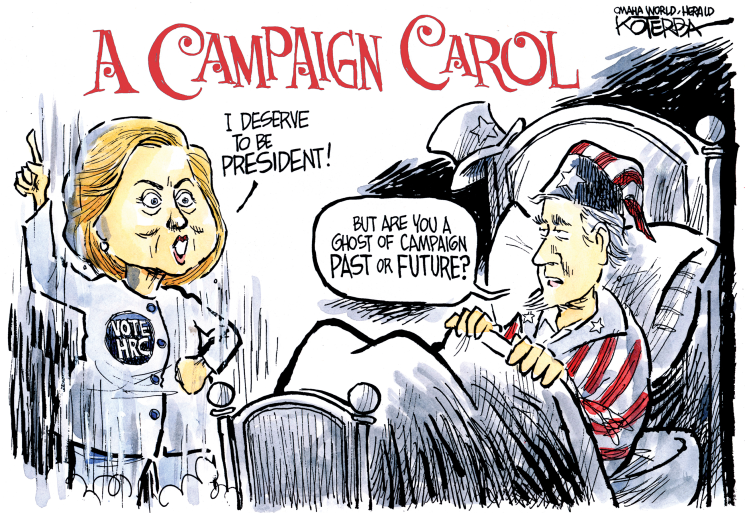
While the traveling Clintons berating Trump is consistent with party strategy, many worry the tour is a precursor to muscling Hillary into the mix of potential presidential candidates in 2020, a prospect that produces agita among those who blame her for booting away a sure thing two years ago and who remains a polarizing, divisive figure.

Her recent interview comment “Sure, I’d like to be president” sent shivers up the spines of party regulars whose optimism about 2020 grows with each new Trump pronouncement and Twitter commentary, not to mention the potential for the investigation into allegations the Trump campaign dealt with Russian operatives to influence his election spilling into the Oval Office.

Hillary Clinton, however, is not the object of their optimism. The blue tide that swept Democrats back into control of the House was an anti-Trump phenomenon, but one which someone other than Clinton is best equipped to take advantage of.

The Clintons, though, don’t seem concerned with the party’s future; only their own.

Her defeat at Trump’s hands wasn’t simply the loss of an election – it was a personal humiliation, a stinging rejection of her principles and values, a beatdown administered by an individual she disdained as inexperienced and unprepared with a volatile and erratic temperament.

Her tour with her husband is a stab at regaining relevancy, but a striving for redemption as well,dramatic proof that her loss was a colossal mistake committed by the American people.

The tour also fulfills a uniquely Clintonian need to occupy as much public space as possible, a relentless effort to remain the center of attention and the object of media and popular appeal.

Raking in considerable sums of money at the same time – another uniquely Clintonian trait – is an additional and welcome benefit.

Their decision to spend six months traveling the country is an unmistakable sign that, if the party wants them to retire gracefully, it will be forced to push them offstage. Self-absorption is in their DNA and they’re not about to leave voluntarily.

They may be a fading vaudeville act in peril of seeing their names in small typeface near the bottom of the theater lobby card, but the show must go on and they are convinced they deserve starring roles.

Copyright 2018 Carl Golden, distributed exclusively by Cagle Cartoons newspaper syndicate.

Carl Golden is a senior contributing analyst with the William J. Hughes Center for Public Policy at Stockton University in New Jersey. You can reach him at cgolden1937@gmail.

Comments Off on Bill and Hillary Clinton Just Won’t Go Away

Acosta Flap Proves It’s Time to End White House Briefings

The ugly confrontation between the president and a reporter in the White House briefing room should remove whatever doubts existed over whether the daily briefings should continue or be scrapped.

Not only have these sessions outlived their usefulness, they’ve become so distorted and warped from their original intent they are embarrassments to all who participate in them. It’s time to end them.

Once thought to be a direct, effective and welcome way to provide information to the American people by subjecting their freely elected government to questioning by reporters acting as surrogates for the citizenry at large, the briefings have deteriorated into a propaganda mill for the administration and an exercise in self-aggrandizement for the media.

The relationship between the Trump White House and the media was established on the administration’s first day by a petty, pointless argument over the crowd size at the inaugural ceremony. It’s continued downhill ever since, surpassing even that of Richard Nixon whose loathing for the press was returned in equal measure.

The spectacle of the president locked in the equivalent of a barroom argument with CNN reporter Jim Acosta while a White House intern attempts to wrest the microphone away from the reporter offended the professional and personal sensibilities of anyone who witnessed it.

Acosta is the stereotype of what many Americans resent about the media – an obnoxious, overbearing, insufferable, self-righteous, sanctimonious boor fond of the sound of his own voice, in love with his opinions, discourteous and disrespectful. The long-winded preambles to his questions are delivered with one eye on the television camera to assure it’s getting his best side.

While many of Acosta’s colleagues are embarrassed by his antics, viewing them as harmful to their credibility and professionalism, they’ve remained silent, feeling that he may be an (expletive deleted) but he’s our (expletive deleted).

Trump has manipulated the situation brilliantly, depicting Acosta as emblematic of a dishonest media dishing out fake news.(The “enemy of the people” cry is far-right hyperbole.) He understands that planting doubts in the public mind about an institution or group of people triumphs by singling out the most egregiously offensive individual and portraying him as representative of the whole.

As deceptive and shallow as his approach may be, Trump is a master at it. And, neither CNN nor any other news outlet can beat him at his own game and they should cease trying; it plays directly into his hands.

The historic low esteem in which the media is held and the majority view that news is slanted and untrustworthy is evidence of Trump’s success.

The media frustration is understandable. This is, after all, an Administration whose half-truths, exaggerations, embellishments and outright falsehoods are the stuff of legend.

It is the Grand Canyon of dissembling and distortion, breathtaking in its sweep and grandeur.

Press secretary Sarah Sanders doesn’t so much answer questions as she does in using the podium to rationalize the president’s latest commentaries and tweets and quickly pivoting to the propaganda talking points.

The old saw about never arguing with someone who buys ink by the barrel is a force no longer. Social media and the dire economic straits into which it has driven traditional print outlets has emptied the barrel.Trump long ago grasped this reality and has proven adept at turning it to his advantage.

His tweets drive daily coverage, forcing the media to follow his lead while placing significant control over the news cycle in his hands.

The media would be wise to play the long game – pursue story lines, cultivate sources, extract reliable, documented information and print or broadcast it in a straightforward, non-judgmental fashion.It is a fool’s game to lunge blindly at every morsel of bait Trump tosses into the waters each day.

The relationship between the White House and the media is beyond repair.They are like two scorpions in a bottle – neither can escape without killing the other.

There is no valid or credible rationale to continue the daily briefings.They’ve become an anachronism, a throwback to a time when the interaction between politicians and the press may have been adversarial but hadn’t yet deteriorated into the equivalent of a 3 a.m. back alley mugging.

Even should the briefings end, it will have minor impact on reporters or the administration. The White house will still be covered and the administration will continue to drive its agenda.

It’s past time to spare the public the televised ugliness that has descended on the briefing room.

Copyright 2018 Carl Golden, distributed exclusively by Cagle Cartoons newspaper syndicate.

Carl Golden is a senior contributing analyst with the William J. Hughes Center for Public Policy at Stockton University in New Jersey. You can reach him at cgolden1937@gmail.

Comments Off on Acosta Flap Proves It’s Time to End White House Briefings

Sadly, Kavanaugh Fight Night Over Yet

In the immediate aftermath of what was arguably the ugliest two weeks in modern United States Senate history, both sides claimed victory, each insisting the venomous, toxic atmosphere that cloaked the Capitol during the confirmation hearings and vote on the nomination of Brett Kavanaugh to the Supreme Court sent a jolt through their party’s bases and assured success in the mid-term elections.

Republicans made a case that Democrats carried out a coordinated smear campaign based on uncorroborated accusations of sexual assault against Kavanaugh while Democrats argued the allegations had merit, were credible and the nominee was so badly flawed and his temperament so uncontrolled that he didn’t deserve to sit on the nation’s highest court.

The outcome – a 50-48 vote to confirm him – energized Republican voters outraged at the treatment given Kavanaugh and, at the same time, mobilized Democrats convinced the nomination was bulldozed through to avoid a potential shift in Senate control.

The Judiciary Committee hearings brought out the worst in Senators, Republican and Democrat,and – for the television watching public – portrayed the consequences when a supposedly thoughtful and deliberative body is hijacked by ego driven individuals anxious to advance their political ambitions while tossing reasoned, insightful inquiry onto the scrap heap.

Democratic members of the committee, for instance, relentlessly pursued a remarkably silly line of questioning determined to uncover some sinister motive in the written ramblings in a high school yearbook of a bunch of teenagers.

New Jersey Sen. Cory Booker whose 2020 presidential ambitions are apparent to all suffered another delusional moment when he compared himself to the lead character in a 58-year-old movie to demonstrate his courage and independence.

Republican Sen. Lindsay Graham of South Carolina, in an arm waving, finger-pointing tantrum, excoriated his Democratic colleagues, accusing them of all manner of contemptible behavior.

The nominee defended himself from the accusations of misbehavior by reviewing his record as an attorney and an appellate judge and talking emotionally about the impact on his family of the attacks on him.

He careened off the rails, however, when he attributed the opposition to a cabal of Democrats carrying out a vendetta because they were still upset over their 2016 defeat.He even identified Bill and Hillary Clinton as accomplices, even though there existed no credible evidence to support it.

His chief accuser, Dr. Christine Blasey Ford, calmly, yet deeply emotional, recalled what she said was an encounter with Kavanaugh at a house party in 1982 and described his effort to sexually assault her.

Kavanaugh never wavered in his denials, insisting he never committed the act Ford described and suggesting she may have mistaken him for someone else.

Despite a lack of corroboration for Ford’s account and her inability to recall specific details of the evening, Democrats, with an assist from Arizona Republican Sen. Jeff Flake, forced another FBI investigation which turned up nothing beyond that already known.

In the end, Senators were left with an unresolved issue and no clear, irrefutable conclusion over whether Ford or Kavanaugh was truthful.

All of this was played out in an environment which, at times, resembled Mad Max in the Thunderdome as groups opposing Kavanaugh hurled insults, threats and warnings of political retribution in the hearing room and from the Senate gallery.

And, it’s not over yet.

Some Democrats, notably New York Rep. Jerrold Nadler – who is in line to become chairman of the House Judiciary Committee should Democrats take control – promised investigations and possible impeachment proceedings against President Trump and Kavanaugh.

There is ample polling evidence to support the claims of leaders of both parties of a measurable uptick in the enthusiasm level of their base voters who now view the November election as critically important.

It is the politics of resentment writ large and practiced by both parties; Republican voters with their fill of what they believe to be an elite ruling class indifferent to their needs and concerns and Democrats convinced their opponents are narrow-minded ideologues bent on returning to government by aristocracy.

The ugliness of the Kavanaugh nomination fight will linger and, if Democrats win a House majority, will most certainly flare up again and with greater intensity unless cooler Democratic heads can tamp down talk of impeachment.

Voters, it’s been argued cynically, are motivated more by a desire to express hatred rather than by making a statement of support.

It is, though, a sad commentary that the serious and sacred responsibility of selecting a justice of the Supreme Court can be distorted and used as evidence of that cynicism.

Copyright 2018 Carl Golden, distributed exclusively by Cagle Cartoons newspaper syndicate.

Carl Golden is a senior contributing analyst with the William J. Hughes Center for Public Policy at Stockton University in New Jersey. You can reach him at cgolden1937@gmail.

Comments Off on Sadly, Kavanaugh Fight Night Over Yet

Not Only is a Blue Wave Coming, Its Getting Stronger

As the Trump White House lurches from one public relations disaster to another, Democrats are increasingly optimistic over regaining control of the House in an overwhelming fashion.Some are giddily predicting a landslide of upwards of 60 seats – nearly three times the number it needs to assume the majority.

Buoyed by an advantage of 14 points in the generic Republican versus Democrat polling – the gap was a narrow two points a month ago – the party is again talking confidently of a blue wave in November and a resounding rebuke of a president whose job performance rating has fallen to 40 percent.

Republicans had counted heavily on the nation’s economic resurgence to carry it to another term in the majority, but a recent poll revealed that only 12 percent of Americans identified the economy as the most important issue facing the nation, while 29 percent named government leadership (read, Trump and the Republican Congress).

The election for the House is still 435 individual contests, but it’s become nationalized and a referendum on the president, fulfilling the Democrats’ fondest hope.Democrats have raised more money than Republicans nationally and seats that have been GOP property for years are suddenly competitive, if not dicey.

Democratic voters are considerably more motivated and enthusiastic, driven by an intense dislike for the President and a visceral desire to demonstrate the country committed a serious mistake in 2016 by choosing Trump over Hillary Clinton.

Republican congressional candidates – incumbents and challengers alike – face the brunt of this thirst for revenge.Payback is a… well, you know what.

Trump cannot escape the lion’s share of responsibility for the decline in party stature and for the bleak outlook in the mid-term election. He’s never been shy about speaking his mind, even when his musings create political headaches for party leaders and candidates alike.

What was once considered to be a refreshing attribute – smashing all the politically correct china – has become a serious drag as candidates struggle to distance themselves from Trump’s more outrageous and demonstrably false comments without alienating the hard core party base.

The president is clearly convinced that he is his own best media consultant and neither requires nor desires advice from others – advice and counsel which could avoid the frequent uproars which dominate the news cycle for days or weeks on end with absolutely no benefit to be gained.

Rather than taking every opportunity to promote a solid record of producing an economic powerhouse, Trump has drifted well off message by responding to every real or imagined slight as if the very future of the Republic was at stake.

Most recently, he’s spent enormous amounts of time attacking a new book by Washington Post editor Bob Woodward which portrays an Administration in such dangerous disarray that there is open talk of relieving Trump of office.

He followed by engaging in a monumentally stupid argument over the number of fatalities attributed to Hurricane Maria, when the storm devastated Puerto Rico last year. It was an epic blunder, embarrassing party leadership, dealing a potentially mortal blow to the Senate candidacy of Gov. Rick Scott in Florida and sending others scurrying to distance themselves from his remarks.

He seems to have forgotten that he’s no longer sitting behind a desk in Trump Tower barking orders at subordinates while delivering verbal broadsides against competitors, the news media or anyone he believes has crossed him in some fashion or another.

Rather than a smooth transition from New York real estate mogul to the leader of the Free World and the Republican Party, Trump has overlaid all his management practices from the private sector onto the public sector.He’s weighed down by his grudges, temperament, personal biases and is ill-served by a sycophantic coterie playing to his worst instincts.

The blue wave, once thought to be ebbing significantly, has gathered strength and, in some seven weeks, will either come crashing ashore or deposit a small puddle on the sand.

At this moment, the crash is more likely.

Copyright 2018 Carl Golden, distributed exclusively by Cagle Cartoons newspaper syndicate.

Carl Golden is a senior contributing analyst with the William J. Hughes Center for Public Policy at Stockton University in New Jersey. You can reach him at cgolden1937@gmail.

Comments Off on Not Only is a Blue Wave Coming, Its Getting Stronger

How Democrats Could Hurt Their Chances in November

In the face of month upon month of glowing reports of a national economy reaching new milestones, the blue wave – the movement predicted to sweep Democrats back into control of Congress this November – lost its momentum.

Well, it’s back, gathering power and strength and once again raising Democratic hopes it will come crashing down on Congress, washing Republicans into retirement and turning the House into a Democratic stronghold.

The economic news hasn’t lost its luster and promise – quarterly growth is approaching four percent and predicted to reach higher, job creation remains strong and unemployment has fallen below four percent.

The suddenly resurgent blue wave is building to a crescendo on indictments, guilty pleas and convictions of individuals associated politically, professionally or personally with President Trump.

The conviction of former Trump campaign manager Paul Manafort on tax and bank fraud charges and the guilty plea entered by former Trump attorney Michael Cohen to tax, banking and campaign finance charges dealt the president a serious blow. It also re-energized Democrats seeking victory in Congressional districts by tying their Republican opponents to a corrupt Administration.

While neither Manafort’s conviction nor Cohen’s guilty plea involved allegations the Trump campaign conspired with Russian operatives in 2016 – the basis for the ongoing investigation by Special Counsel Robert Mueller – the courtroom tales of tax evasions, offshore bank accounts, backroom deals with foreign countries, and hush money paid to buy the silence of women allegedly involved with Trump were damning.

The blue wave re-emergence brought predictions that Democrats would easily exceed the net gain of 23 House seats to win control.

The renewed sense of optimism is understandable, but before party leaders begin checking for new office space, jockeying for committee chairmanships, or assessing their chances for advancing in the hierarchy, they should turn their attention to the torches and pitchfork crowd braying loudly for immediate impeachment proceedings against the president.

It is crucial for the leaders to discipline the party’s hard left, that growing and vocal bloc squirreled away in the Capitol basement assembling a Frankenstein using parts donated by Bernie Sanders. It is a group to whom making a point is more important than making progress.

Being swept up in impeachment fervor – egged on by the amen corner in the media – would be a strategic and political blunder, playing into Trump’s hands and those of his hardcore base.

Democrats spent months demanding Congress protect Mueller from dismissal and insisted that no deadline be placed on completing the investigation.

Moving toward impeachment at this point would immediately give credence to the argument that it is a blatant political act produced not by evidence of criminal acts, but by a visceral dislike for Trump and an obsessive need to overturn the 2016 election and prove the illegitimacy of the outcome.

It would cut the ground from beneath the Democrats’ contention that they support Mueller and his investigation and that the probe is the proper vehicle to determine whether election irregularities or illegalities occurred.

Given such an opening, Trump will escalate his “witch hunt,” “rigged investigation” rhetoric and claim he was correct all along in his contention that impeachment was the pre-determined end game and that Mueller and his team are complicit in it.

The leftward shift in the Democratic Party has become increasingly apparent, crystallized by a platform embraced by many of its candidates to abolish the Immigration and Customs Enforcement agency (ICE), establish universal medical care, provide government employment and fringe benefits to anyone out of work, and offer free college education.

It represents a nascent socialist movement, but should it become the party’s face, it can only harm its prospects. This hard left agenda is not acceptable to the majority of Americans who are largely centrist and believe in individual rights and freedoms rather than ever deeper government involvement and control of daily life. In a recent poll, 56 per cent viewed capitalism positively while only 37 per cent viewed socialism in that light.

Impeachment is still opposed overwhelmingly as measured consistently in polling, a clear indication that such a step in the absence of clear and compelling evidence that Trump has committed a crime would be deeply damaging to the democracy.

An impending blue wave has clearly returned and Democratic leaders would be wise to ride the wave rather than attempt to get ahead of it lest it is they who are swamped and washed off the surfboard they hoped would carry them to victory.

Copyright 2018 Carl Golden, distributed exclusively by Cagle Cartoons newspaper syndicate.

Carl Golden is a senior contributing analyst with the William J. Hughes Center for Public Policy at Stockton University in New Jersey. You can reach him at cgolden1937@gmail.

Comments Off on How Democrats Could Hurt Their Chances in November