Trump’s War on the Press Won’t End Well

In baseball lingo, the high, inside fastball is known as the brushback, a tactic to inform the batter that he’d better be cautious about digging in.

The higher and tighter inside fastball is call head-hunting, a serious escalation of the fear tactic and infinitely more perilous.

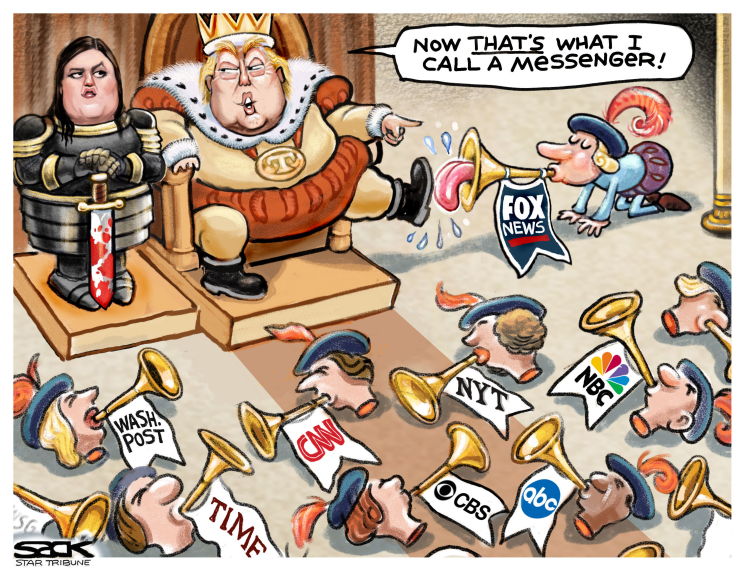
In spending the first 18 months of his administration accusing the media of “fake news” and deliberate dishonesty, President Trump has been throwing brushback pitches, warning reporters they’d better mend their ways or face consequences.

By ratcheting up the rhetoric to characterize the media as “an enemy of the people” and suggest reporters are unpatriotic, the president has gone for head-hunting, signaling to the media that he wants them out of the game entirely.

If history is any guide, Trump is engaged in a fight he’ll lose.

The relationship between the Trump Administration and the media long ago surpassed the normal tensions that have always existed between the elected and those assigned to record, parse and analyze their every move, comment and action.

Presidents have historically groused about the media, complaining about what they perceived as biased and unfair coverage colored by partisan sympathies on the part of reporters.President Eisenhower, perhaps the most beloved of all modern-day chief executives, sent delegates into a fist shaking uproar at the 1964 Republican national convention with his reference to “sensation seeking columnists and commentators.”

President Nixon despised the press, and his erstwhile Vice President Spiro Agnew enraptured partisan audiences with his colorful and alliterative assaults on the media.

Despite this history, all concerned moved on, grudges faded away and animosities buried. Cooler heads prevailed and, while the slights inflicted may not have been totally forgotten, it was in the best interests and professional obligations of both sides to concentrate on their duties.

All that went before, though, seems tame next to the naked antagonism and rancor that has come to mark the daily interaction between the Trump administration and the media.

The hardcore base supporting the president shows up at his rallies to roar approval for his ridicule of the media and gleefully join in derisive chants aimed at reporters.

White House press briefings have deteriorated into loud and bitter arguments rather than civil exchanges designed to elicit information for readers and viewers.

One reporter, CNN White House correspondent Jim Acosta, stomped out of a recent briefing in a childish snit because he couldn’t get an answer he wanted.He later suggested that reporters protest by marching on Pennsylvania Avenue outside the White House – a truly absurd notion that would play directly into the [resident’s hands. (A “Trump Unfair To Reporters” poster won’t elicit much sympathy.)

Acosta, by his behavior – shouting questions, interrupting the press secretary mid-response, giving speeches and opinions rather than asking questions while playing to the camera – has become the stereotype of the obnoxious, overbearing, insufferable reporter Trump loves to lampoon. Sadly, he’s not alone.

Acosta’s right to display all those qualities is Constitutionally protected and he successfully hides any self-embarrassment he may feel.

The President is clearly convinced his disdain for the media is paying off handsomely politically and,being his own best advisor, is not about to change his approach.

However, in the long run it’s a losing strategy.

He still must deliver for the American people solutions to those issues that matter most to them – the economy, job creation, immigration, government spending, crime and public safety, among others.

Running from rally to rally bellowing “fake news” to adoring audiences can only carry him so far.

The media will endure as it always has.It is not about to be cowed into silence or submission in the face of threats or obstacles thrown into its path.The media can play the long game; Trump cannot.

At the same time, reporters such as Acosta must keep their composure, avoid the temptation to respond in kind to the President’s taunts, and remember who they serve.Acosta’s antics only detract from their mission and make fulfilling it all the more difficult.

Trump will undoubtedly continue to throw brushback pitches and go headhunting.Reporters must remember to duck when necessary but be unafraid to dig in and wait for a pitch to hit.

Trump will become arm weary for certain and overstay his time on the mound.

Copyright 2018 Carl Golden, distributed exclusively by Cagle Cartoons newspaper syndicate.

Carl Golden is a senior contributing analyst with the William J. Hughes Center for Public Policy at Stockton University in New Jersey. You can reach him at cgolden1937@gmail.

Comments Off on Trump’s War on the Press Won’t End Well
Dems at Odds Over Trump’s Supreme Court Pick

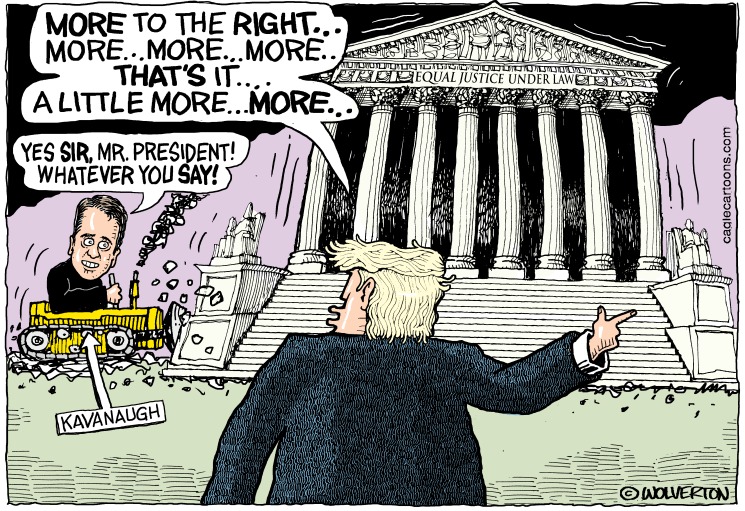
Sabers drawn, the Democratic Party’s far left has unleashed its charge up Capitol Hill to rout President Trump and send his U. S. Supreme Court nominee Brett Kavanaugh fleeing into the surrounding woods.

If they glance back over their shoulders, though, they’ll find that a handful of their foot soldiers are MIA, having concluded that this is a hill not worth dying for.

Within minutes of the President’s announcement, Democratic Senators and an array of private interest pressure groups elbowed one another aside in their rush to position themselves in front of the television cameras.

They warned all manner of evil would befall the republic should Trump’s choice be confirmed. It is not the nominee’s qualifications or experience at issue here- he currently sits on the U. S. Court of Appeals for the District of Columbia- it is simply that, because he is Trump’s choice, he is unacceptable.

Some, like New Jersey’s Cory Booker, New York’s Kirsten Gillibrand and Massachusetts’ Elizabeth Warren, concluded their 2020 ambitions could be furthered by a fulsome embrace of the hard left agenda. None will pay a price at home for opposing Kavanaugh and will achieve their goal- a risk free media ride throughout the confirmation process.

However, these three, their like-minded colleagues and the private interest organizations are aware that lacking a bombshell revelation during the Judiciary Committee hearings, they hold a losing hand.

Minority Leader Chuck Schumer of New York will continue to offer the obligatory message of opposition, but even he has conceded publicly options to defeat confirmation or delay a full Senate vote will fail.

Schumer is aware that colleagues like Sens. Joe Manchin of West Virginia, Claire McCaskill of Missouri, Joe Donnelly of Indiana, and Heidi Heitkamp of North Dakota face difficult re-election campaigns and a vote to deny Kavanaugh’s nomination could well tip the balance in favor of their Republican challengers.

Moreover, these four have made it clear they will act on the nomination in their best interest and will not be stampeded into a rigid party line demand.

Schumer is playing the long game, understanding that since the nomination is virtually assured, placing four Democratic senators in jeopardy this year greatly reduces the odds of the party achieving control of the Senate in 2020, a presidential year in which the election will be a national referendum on Trump and his policies.

Convincing the far left of the realpolitik at play, though, is a challenge for him.Many in that wing reject what they see as the outdated and discredited politics of the past.

They rejoiced at the upset victory of Alexandria Ocasio-Cortez, a 28-year-old American

Democratic Socialist who defeated long time Congressman Joseph Crowley in New York, and claimed her success was proof that party centrists and moderates are on the wrong side of history.

Schumer must find a path to avoid alienating those on the left while impressing on them that power is achievable only through election victories and that the overwhelming majority of Americans respond negatively to candidates standing on socialist platforms.

House Minority Leader Nancy Pelosi, for instance, suggested Ocasio-Cortez was an anomaly, a victory in one Congressional district and not representative of the country as a whole.A massive shift in demographics in the district was disregarded by Crowley and he fell victim to accusations that he was hopelessly out of touch with his constituents.

While Ocasio-Cortez’ message of abolishing the Immigration and Customs Enforcement agency, reforming the criminal justice system, offering tuition-free colleges and universal health care fell on receptive ears, her success was attributable more to Crowley’s perceived indifference than to her agenda.

Schumer must also tread carefully in dealing with the activist groups mobilized and spending money to block Kavanaugh’s confirmation.

Most of these groups have been reliable party supporters, financially and organizationally, and believe Kavanaugh’s confirmation is the place to make a stand.Millions of dollars have already been spent or planned in states where they feel votes can be swayed in their direction by predictions of a Supreme Court, with Kavanaugh as a justice,overturning abortion rights or access to health care.

Keeping these groups in the fold will require Schumer to pledge support for their causes but convince them they must remain clear-eyed about the dim prospect that Kavanaugh’s nomination can be defeated.

The nominee may be the battle, but the presidency and a Democratic Congress in 2020 is the war.

The last Democratic president, when confronted by critics of his policies, was fond of responding: “Elections have consequences.”

He was right.

Copyright 2018 Carl Golden, distributed exclusively by Cagle Cartoons newspaper syndicate.

Carl Golden is a senior contributing analyst with the William J. Hughes Center for Public Policy at Stockton University in New Jersey. You can reach him at cgolden1937@gmail.
Comments Off on Dems at Odds Over Trump’s Supreme Court Pick

Civic Discourse Has Tumbled to a Shocking New Low

Other than Dallas Cowboys fans living in Philadelphia, no collection of individuals is subject to as much vitriol and opprobrium as those in public life – politics, entertainment, business, media or professional athletics.

None more so, perhaps, than politics, whether elected, appointed or merely involved as advisors or consultants.

Granted, it’s never been a vocation for the easily offended or those who believe reason and logic will always win out over ignorance and dissembling.

There is a long and frequently sordid history in American politics of vicious insults based on physical appearance (Abe Lincoln was once compared to an ape), personal conduct (Bill Clinton behind closed doors in the Oval Office), or intellectual deficiency (George W. Bush and his casual book reading habits).

Since the election of Donald Trump, though, the environment has become so toxic there are no waters left to poison.Behavioral norms have been shattered, replaced by a race to determine who can reach the lowest level of human conduct first.

Campaign rhetoric has always been short on context and long on innuendo, but the civic discourse has tumbled into such a depth that calls for personal – if not physical – assaults on opponents is now acceptable.

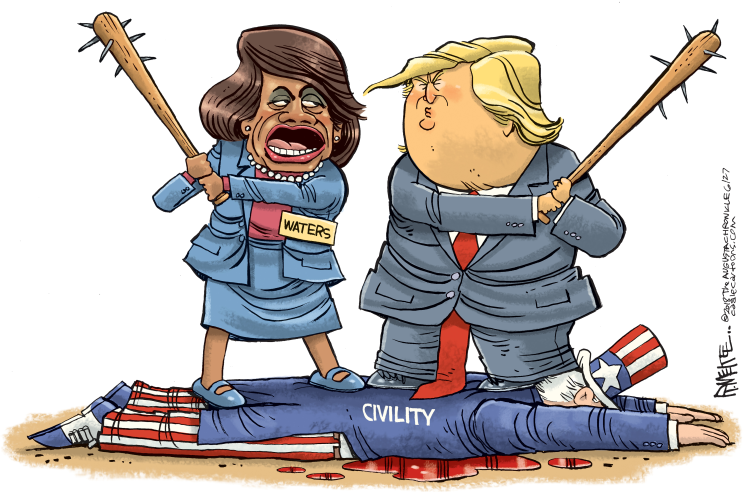
Its highlight arrived with the call to arms issued by California Democratic Rep. Maxine Waters to physically confront, harass, stalk, and scream obscenities at anyone serving in the Trump Administration.

Families, including children, are not exempt, nor are locations – restaurants, theaters, on the street, or in their homes – from her quasi-terrorist lunacy.

The catalyst for Rep. Waters’ latest declaration of war was the media coverage of children being separated from their immigrant parents who arrived at the southern border seeking asylum.

To be sure, the Trump Administration dealt with the issue about as badly as possible, struggling to defend what became increasingly indefensible, turning it into a public relations nightmare before eventually changing the procedure.

While former President Obama exercised authority to detain and separate families, his administration did so sparingly, while the Trump administration implemented a “zero tolerance” crackdown.

A parade of washed-up entertainers looking to resurrect faded careers by obscenity-laced assaults on the president and his family seized on the issue in a desperate search for internet traffic, hoping that somehow mouse clicks will confer relevancy.

The cable television talking heads eagerly participated in this seedy drama as well.The self-promoters who populate Fox News, MSNBC, and CNN may sing from ideologically differing hymnals, but the notes are equally as sour.

Trump bears responsibility as well for converting honest differences of opinion into seek and destroy missions.

He ridiculed his opponents in his primary election campaign, did the same to Hillary Clinton and members of Congress, and anyone with a contrary opinion.

He relishes his running battle with the media, accusing reporters of deliberate dishonesty – liars in less polite language – and has embedded the term “fake news” in everyday language.

His opponents, in Congress and out, have called him a Nazi, a bigot motivated by hatred of minority groups.His children have been debased and mocked in the most obscene and cruel fashion possible.

Rep. Waters’ suggestion for popular insurrection came in the aftermath of White House press secretary Sarah Sanders and her family being denied service in a rural Virginia restaurant.

The proprietor asked Sanders to leave because, after polling her employees, concluded Sanders’ presence was “morally offensive.” Sanders acted with class and dignity; the restauranteur did not.

Prior to the Sanders incident, Department of Homeland Security Secretary Kirstjen Nielsen left a Washington, D.C., restaurant after being harassed by protestors who later showed up at her home chanting insults.

Rep. Waters presumably looked with favor on this boorish and potentially dangerous behavior and hit upon the idea of taking it several steps further urging stalking and threatening anyone affiliated with the Administration.

Rep. Waters isn’t concerned about the possible effect on her political future, of course, but there is a genuine risk to Democratic congressional candidates in the mid-term elections posed by her becoming the leading example of resistance to Trump.

Americans understand politics is a blood sport, but there is a limit to their acceptance of it.They draw a line at obscene and threatening behavior, particularly when directed at children and family members.Such behavior brings an electoral backlash ever closer.

The closer a party gets to the fringe, the further it gets from success.Rep. Waters doesn’t seem bothered by it, but others should take heed lest they experience the wrath at being Cowboys fans in South Philly.

Copyright 2018 Carl Golden, distributed exclusively by Cagle Cartoons newspaper syndicate.

Carl Golden is a senior contributing analyst with the William J. Hughes Center for Public Policy at Stockton University in New Jersey. You can reach him at cgolden1937@gmail.
Comments Off on Civic Discourse Has Tumbled to a Shocking New Low

Democrats Might Have Reason to Worry About November

When writer, commentator, polemicist, talk show host and National Review magazine editor William F. Buckley ran for mayor of New York City in 1965, a reporter asked what his first act would be if elected.

Buckley replied he would stand on the sidewalk outside the New York Times building “and catch the falling bodies.”

He was spared his mission of mercy, receiving 13 percent of the vote in losing to John V. Lindsay.

Should Republicans maintain control of the House and Senate this November, there won’t be enough catchers available in the country to break the falls of editors, columnists, television talkers, academics and consultants flinging themselves from the parapets of their office buildings.

Maintaining control of the Congress would not only be a victory for President Donald Trump but a validation of his policies and style of governance – two things much of the national political media has been attacking for more than a year.

If their years’ barrage of critical coverage came to naught, it’s a stark indication that media influence of public affairs and politics has diminished dramatically.

Make no mistake; there is a great deal to criticize the Trump Administration for and it is the media’s professional duty and obligation to focus on the misstatements, embellishments, falsehoods, ethical lapses, internal bickering, legal entanglements and eccentricities which gush forth from the White House daily.

It is the media’s role to report and dissect them, provide context and assess their meaning. That responsibility, though, has been undercut by displays of bias and personal dislike which, in turn, have fueled Trump’s unrelenting assault on “fake news” and dishonest reporters.

The level of hostility between the Trump White House and the media has reached a level seldom seen. It began on the administration’s first day and has continued unabated. Each side holds the other in contempt and neither bothers to make any effort to hide their feelings.

It’s had an impact as measured in polling, which shows that only 40 percent of Americans have confidence in the media to report fairly and accurately.

Democrats are still well positioned to regain control of the House, but the party’s chance of doing so has diminished alarmingly from the lofty position it occupied a few months ago.

Trump’s job approval, for instance, has risen from the mid-thirties to the mid-forties and, more concerning for Democrats, their edge in the generic ballot has shrunk from the mid-teens to a statistically meaningless two per cent.

The Republican resurgence has been driven in large measure by the marked improvement in the national economy, one Trump has attributed to his tax reform/tax cut program.

While Democrats have mocked it, the president has touted tax relief as responsible for the historic low unemployment rate, increased wages, business expansion, consumer confidence, and a bullish stock market.

The Democrats’ argument that the rich have benefitted greatly while middle income earners have experienced marginal help hasn’t gained much traction.

House Minority Leader Nancy Pelosi’s dismissal of the tax cuts as “crumbs” was remarkably condescending and will likely rank alongside Hillary Clinton’s description of Trump supporters as “a basket of deplorables” as the greatest rhetorical blunders of the year.

The president and Republican congressional candidates can point to the burgeoning economy as proof of their ability to deliver sound and responsive government.

Democrats, on the other hand, seem to be flailing, desperate for a message other thanopposing all things Trump.

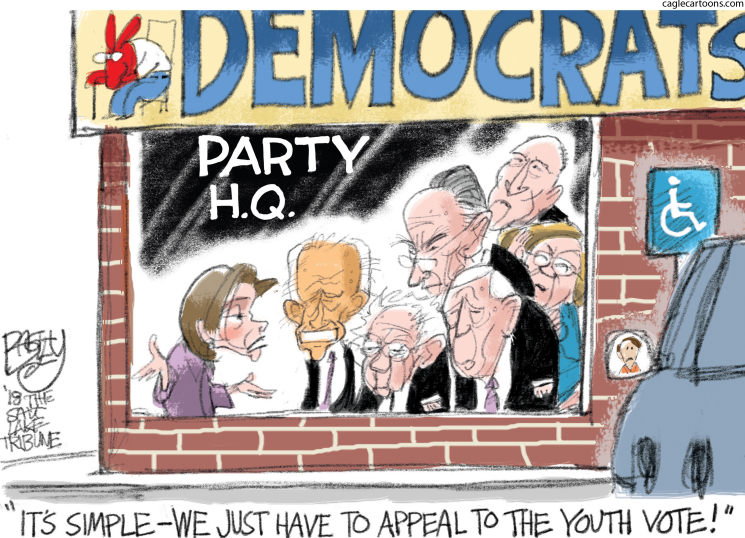
Moreover, the ties that bound the party together have frayed badly, pulled apart by an ideological brawl between Bernie Sanders liberalism and the centrist wing.Party leaders have had limited success in mediating the dispute even as they fear that nominating far left fringe candidates will result in losses in November.

It is significant that a fair number of Democratic candidates, obviously convinced that Pelosi is the embodiment of a political culture many Americans despise, have publicly pledged to vote for someone other than her for House Speaker should the party win control.

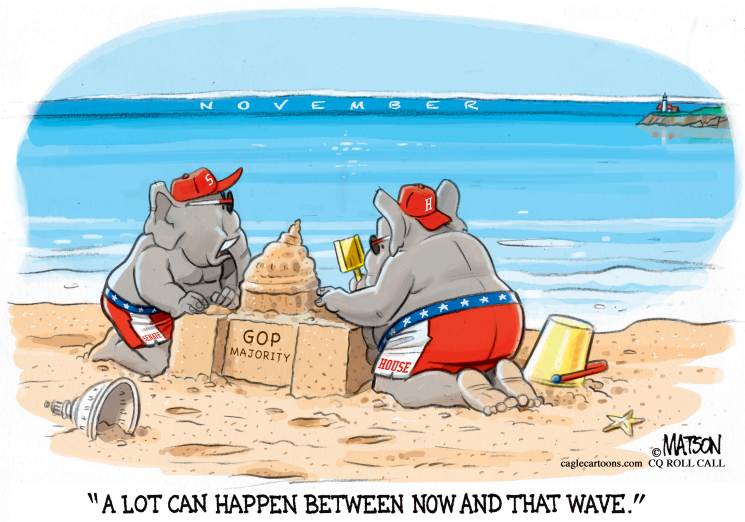
There is ample evidence that Republicans have made up ground in their campaign to keep Congress in their hands, but such an outcome is by no means assured.

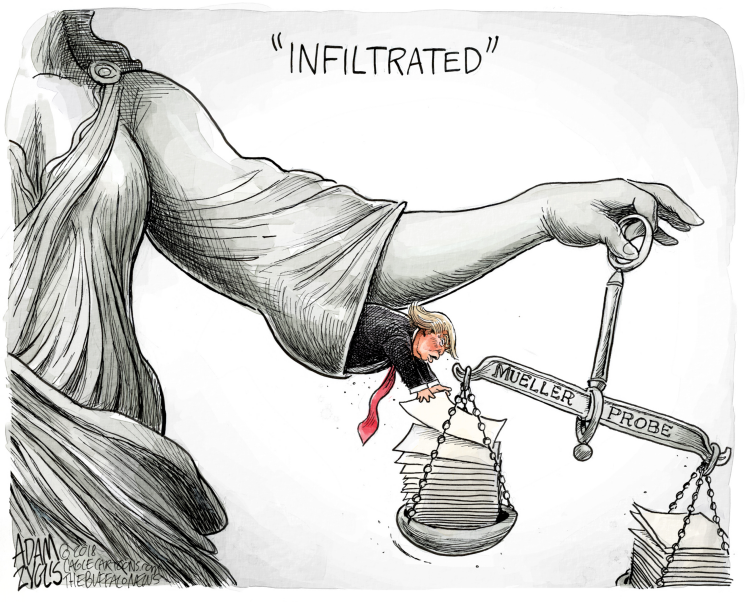
Trump remains a polarizing figure and hanging like a storm cloud over the entire political environment is the ongoing investigation led by Special Counsel Robert Mueller into allegations that the Trump campaign colluded with Russian operatives to influence his election.

It is unclear when Mueller will finish his task orissue a report. If completed prior to the midterm election, his findings will determine who will be a catcher like Buckley or a jumper.

Copyright 2018 Carl Golden, distributed exclusively by Cagle Cartoons newspaper syndicate.

Carl Golden is a senior contributing analyst with the William J. Hughes Center for Public Policy at Stockton University in New Jersey. You can reach him at cgolden1937@gmail.
Comments Off on Democrats Might Have Reason to Worry About November

Robert Mueller’s Investigation Plods On

It’s been said that, for the American people,the only thing shorter than their memory is their attention span.

Now, more than a year and $10 million later, the investigation into allegations that the 2016 Trump for President campaign dealt with Russian operatives to influence the election outcome is putting that theory to the test.

Despite signs the country has grown weary of it,the investigation led by Special Counsel Robert Mueller plods on, providing grist for the media, national Democrats and, of course, for President Trump’s Twitter feed.

Notwithstanding speculation that the end is in sight, the investigation has careened off in other directions unrelated to its initial task of determining whether, in fact, collusion occurred and whether Trump campaign operatives were a part of it.

For instance, the indictment of former Trump campaign chairman Paul Manafort alleges criminal conduct involving business dealings more than a decade earlier unconnected to allegations of election meddling.

Mueller has also extracted a guilty plea from former National Security Adviser Gen. Michael Flynn for lying to the FBI and has indicted 13 individuals and three companies related to the Russian bots.

The president’s legal team – notably former New York City Mayor Rudy Giuliani — has taken note of the public memory/attention span concept as well, arguing the investigation has gone far afield and the American people are so bewildered by the mass of conflicting accounts, charges, counter-charges and multiple investigations they are beginning to believe it’s hopeless to attempt to sort it all out and make any sense of it.

Tales of spying, secret dossiers, cloak and dagger rendezvous, clandestine contacts, FBI raids, payoffs, Russian billionaires, a blizzard of subpoenas, and millions of dollars changing hands have poured forth for more than a year, creating a surreal air of confusion.

An eclectic cast of characters has drifted on and off this stage drama, but none more bizarre than a porno film actress and her lawyer obsessed with public attention.

Giuliani, of course, has the well-being of his client at heart when he insists Mueller conclude his work quickly, act on his findings and put the issue to rest before this year’s mid-term Congressional elections, diluting – if not eliminating – its impact as a turning point campaign issue.

Trump, in the meantime, continues his daily “fake news, witch hunt, no collusion” Twitter blasts, driving the daily news cycle and providing an enormous amount of television time to academics, consultants, opinion writers and anyone who ever served in government and wants to share an opinion.

Mueller has been tight-lipped about the investigation, offering no hint of how far along it is or when he may bring it to an end although Giuliani said last week that Mueller had set Sept. 1 as a reporting date, coincidentally the time when tradition has it that campaigning begins in earnest.

It’s a given that Russian apparatchiks meddled in the presidential election, using cyber attacks to drive messages aimed at influencing public opinion.It’s a given as well that the effort was designed to benefit Trump and undermine Hillary Clinton.

For all the strum and drang drama, Trump’s hard core base has remained steadfast in its belief that Mueller is out to get the president, accepting the witch hunt characterization.

The Resistance has remained equally as steadfast in its belief that Trump is an illegitimate president, his election tainted by Russian interference and carried out with the campaign’s participation.

Despite persistent rumors that Trump intends to fire Mueller, the sentiment in the Congress favors allowing him to complete his task without arbitrary deadlines or political pressures.Any anxiety they feel about its timeline is kept largely to themselves.

Giuliani is certain to ratchet up the pressure in interviews and public appearances, making his case that Mueller has already taken far too much time, has uncovered nothing to implicate the president and has strayed well beyond his initial charter.

There is a risk certainly to the president and to Republican congressional candidates if the investigation drags on into the election season.Mueller confronts a risk as well and could open himself to criticism for deliberately prolonging his work, keeping the investigation at the top of the news to influence the mid-term outcome.

If memories are short and attention spans shorter – as Giuliani appears to believe to some extent – it is in his and Trump’s interest to try to force Mueller’s hand. Mueller in all likelihood has one eye on the calendar as well.

Copyright 2018 Carl Golden, distributed exclusively by Cagle Cartoons newspaper syndicate.

Carl Golden is a senior contributing analyst with the William J. Hughes Center for Public Policy at Stockton University in New Jersey. You can reach him at cgolden1937@gmail.
Comments Off on Robert Mueller’s Investigation Plods On

The Stunning Hubris of Nancy Pelosi

That renowned 20th Century sage and philosopher Satchel Paige once offered this bit of advice: “Don’t look back. Something might be gaining on you.”

House Minority Leader Nancy Pelosi might have pondered the ageless Paige’s advice before she began traveling the country to announce her return as Speaker and – in a stunning act of hubris – naming the chairpersons of several House committees.

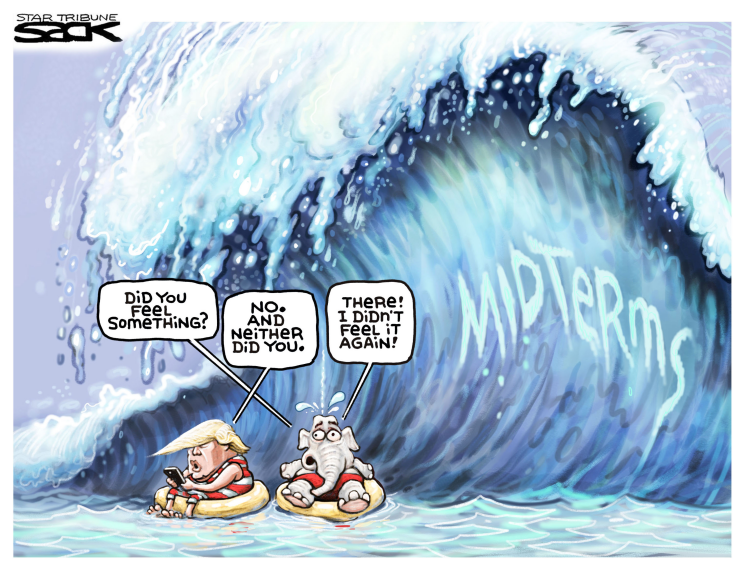
She and the Democratic Party are increasingly confident that predictions of a blue wave this fall will materialize, sweeping them back into power and re-installing her in the presiding officer’s chair.

Her optimism, perhaps, has convinced her there is no need to look back.For if she glanced over her shoulder, she would find, first, that Republicans are gaining on her and, second, that a growing band of her fellow Democrats are distancing themselves from her and seeking leadership turnover.

With Democrats needing just 23 seats while maintaining their current number to become the majority, the risk to Republicans of losing control is very real.But, not inevitable.

The most recent Real Clear Politics polling average, for instance, places President Trump at just over 43 percent, indicating that not only has the country become slightly more comfortable with him but that he is becoming less a drag on the party’s Congressional candidates as well.

The results of the generic ballot test in which respondents are asked to express support for a party rather than an individual also hold promise for Republicans.The Democratic lead, once in the mid-teens, has fallen sharply to as little as six percent, a clear sign of greater competitiveness.

More compelling, perhaps, is the RCP average measuring Trump’s handling of the economy in which he enjoys majority support, a crucial measure heading into the mid-term elections in which Republicans are expected to campaign heavily on the vastly improved tax, business and job creation record of the Administration.

Pelosi has pledged a Democratic Congress will swiftly repeal the tax cut/tax reform law, in effect raising taxes on corporations and individuals, despite a good deal of empirical and anecdotal evidence that the law has resulted in substantial benefits, including job growth, higher wages, and business investment and expansion.

A Congress under her leadership will also deny further funding for construction of a wall on the U.S.-Mexico border as well as provide protections and eventual citizenship for some one million undocumented immigrants brought to the country illegally.

While she has shied away from talk of instituting impeachment proceedings against the President, a raft of new and more activist Democrats is expected to push the issue vigorously.

While Pelosi has embraced the anti-Trump strategy, it is not at all clear that the country fully shares her view – something the polling averages support.

At the same time, the party is chewing on its own and potentially damaging its chances through heavy-handed attempts to cleanse the primary process of candidates party leaders feel stand no real prospect of winning in November.

The anger of Bernie Sanders supporters from 2016 has never really dissipated and they’ve reacted negatively to what they believe are efforts to reject their philosophy and move the party toward the more moderate center.

That disaffected wing of the party is vocal, committed and here to stay, convinced that edging toward the middle is tantamount to abandoning principle and denying that fundamental change is necessary.

And, there is Pelosi herself, a figure of controversy in her own party and who enjoys less than warm support from many.

The increasing calls for her and the remainder of her leadership team to stand down and make way for the younger elements will likely grow.Her announcement that she will be Speaker in a Democratic House – not merely a candidate for Speaker, mind you, but that the deal is done as far as she’s concerned – didn’t win her any friends among the restive insurgent group.

The smart money is still behind a Democratic victory, banking on the history of the party in power losing seats in mid-term contests and the traditional lower voter turnout compared to presidential years.

Further, it would be foolhardy, indeed, to underestimate the possibility that Trump will do or say something so outrageous that it will change the entire course of the campaign and its outcome.

In the meantime, though, should Pelosi glance over her shoulder hoping to see a blue wave, she might also glimpse in the distance a red tide – one that’s gaining on her.

Copyright 2018 Carl Golden, distributed exclusively by Cagle Cartoons newspaper syndicate.

Carl Golden is a senior contributing analyst with the William J. Hughes Center for Public Policy at Stockton University in New Jersey. You can reach him at cgolden1937@gmail.
Comments Off on The Stunning Hubris of Nancy Pelosi

Don’t Get Too Cocky, Democrats

It is the Democratic party’s most fevered hope that dawn on the morning of Wednesday, Nov. 7will reveal acres of smoking rubble that was once the national Republican party and its majorities in the Congress.

Of course, scores of the same party apparatchiks were confident they’d spend the evening of Nov. 8, 2016, dancing the night away on shards of glass from the ceiling shattered by Hillary Clinton on her way to the White House.

The party is increasingly confident that a combination of the normal mid-term losses experienced by the controlling party, dissatisfaction with President Trump, and the void left by the voluntary departures from the House of Representatives of some 40 Republican members will translate into a return to Congressional dominance.

Given the unceasing turbulence in the White House and the steady stream of news accounts of the investigation by Special Counsel Robert Mueller into allegations of election meddling by Russian operatives it will, when added to the other political burdens, prove too much to bear and crush enough Republicans that divided government will return.

There are, though, signs Democrats are leaning too far over their skis and may want to delay booking hotel ballrooms for victory celebrations.

Several recent polls have shown a narrowing of the gap in the so-called generic survey which pits party against party rather than candidate versus candidate.

The recent ABC/Washington Post poll showed a healthy 10-point lead by Democrats had shrunk to four points (a margin of error difference), and President Trump’s approval rating has risen to just over 40 per cent, similar territory for previous presidents at the same stage.

With more than six months before Election Day, there is ample time for a more competitive environment to develop and equally ample time for some disaster to befall the Trump administration and drag Republican congressional candidates down with it.

While Democrats argue that the polls don’t reveal the depth of voter enthusiasm in their favor, they gloss over the ideological schizophrenia which afflicts their party.

The committed left is pushing and pulling the party toward Bernie Sanders-like progressivism while the moderate wing is warning that leaning too far in that direction was a major factor in its 2016 debacle.

To be successful, they contend, Democratic candidates need more than a simple anti-Trump posture.A coherent, credible message is crucial, one that appeals to Democratic voters who abandoned the party in 2016 and who could again if they perceive their choice as between left wing fringe policies and gut level issues and concerns.

The special election victory last month of Democrat Conor Lamb in a southwestern Pennsylvania district carried handily by Trump is testimony to the effectiveness of the gut level strategy.

Not surprisingly, Republicans are expressing optimism about the prospects of retaining control of Congress while conceding their majority will likely shrink.

They believe the surging national economy, propelled by the tax reform/tax cut legislation, is a powerful message capable of overcoming the cascade of investigatory revelations and allegations – unsubstantiated thus far – of the Trump campaign playing footsie with the Russians.

Declining unemployment, rising wages, expanding job opportunities and more earned income in the pockets of workers as a result of tax reductions are far more compelling in terms of voter appeal than attempting to unravel or defend the tangled mass of charges and counter charges of ethical misconduct.

Republicans are convinced that voters will credit and reward them for nurturing a strengthened national economy and will put aside their misgivings about the President’s missteps or the conduct of his business or social life.

The closing of the gap in party support and the President’s uptick in approval – modest though it is – provides some justification for the Republican strategy and createscautious optimism in the initial stages of the national campaign.

There are, to be sure, a boatload of unknowns which could easily and adversely affect Republican hopes.If additional indictments are brought by Mueller, for instance, against individuals close to the President or if the investigation reaches into the upper levels of the White House, the fallout would be devastating.No amount of economic good news could blunt the impact.

Democrats could realize their hopes that the Republican party landscape will resemble nuclear winter on the morning after the election.Or, they could wake up with an Olympic-sized hangover brought on by a failure to heal a divided party and a second consecutive blown opportunity.

Copyright 2018 Carl Golden, distributed exclusively by Cagle Cartoons newspaper syndicate.

Carl Golden is a senior contributing analyst with the William J. Hughes Center for Public Policy at Stockton University in New Jersey. You can reach him at cgolden1937@gmail.

Comments Off on Don’t Get Too Cocky, Democrats