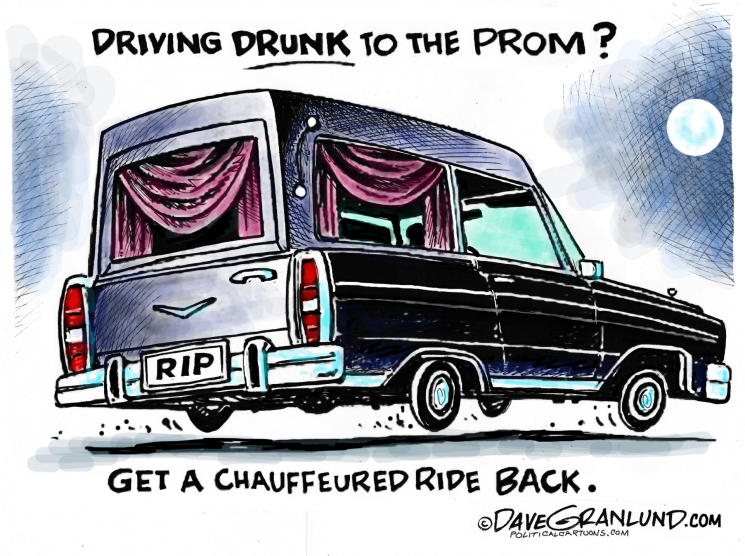
The Evolving American Prom

The more the American prom changes, the more it stays the same.

The modern prom, reports Slate, “may be traced to the Ivy League and the annual tradition of a ‘presentation week,’ during which formal dress and dancing accompanied a promenade concert.”

In the 20th century, the prom expanded to high schools, and is now a rite of passage for American teens everywhere.

I sure hope this year’s promgoers have a better experience than I did in 1980.

I didn’t know my date very well. She was in my photography class, pretty and, more important, available.

She laid down the law prior to the big night.

“I heard about you, a regular class clown,” she said. “You better not show up in a limo, wear a top hat or cane or do anything else to embarrass me.”

I knew right away things were going to work out fine.

On the afternoon of the prom, my friend Gigs and I – we double dated – took a drive to the prom hall to make sure we wouldn’t get lost later.

Later that evening, we picked up our dates for photos and false enthusiasm. We were late for dinner (we got lost), our dates were steamed, and the awful night was underway.

We hardly saw the two the rest of the night. They spent most of the night chatting with their pals, while Gigs and I counted how many times the hard rock band played Eric Clapton’s “Cocaine” (nine).

Finally, around 11:30 p.m., the dance was over. Unlike teens these days, we didn’t use our credit cards to party at an after-hours club or retire to a honeymoon suite. We took our dates home.

But our suffering was just beginning.

We picked them up early the next morning and drove to a country cabin, where my friend Cook was having an after-prom party.

The cabin was a two-hour drive, but it took us five (we got lost).

My date didn’t utter a word until about 2 p.m., when she challenged Gigs and me to a tennis match. I took it as a good sign. It wasn’t.

Gigs is an outstanding athlete and I am no slouch myself. Once the game got underway, our testosterone got inflamed. Every time we scored, Gigs and I high-fived each other. We won soundly and, after the match, the two refused to talk to us.

We arrived home five hours later (we got lost) and the torturous affair was finally over.

Elissa Stein, author of “Prom Night: The Best Night of Your Life,” tells USA Today that the prom is a “reflection of what is going on in the world as a whole.”

That is why, reports the Huffington Post, prom news features are highlighting our evolving views on “racial segregation and integration, LGBTQ rights, police brutality, disability inclusion, respect for women, cultural appropriation and more.”

This year, Stein tells USA Today, the prom offers Generation Z an opportunity to display its uniqueness, diversity and individuality. Many 2018 prom-goers are forgoing traditional gowns in favor of “do-it-yourself” and gender-fluid styles.

As prom trends, styles and traditions evolve, however, one thing remains the same.

The American prom is, at heart, a formal step for teens to begin shedding their adolescence. It’s a first foray into the grown-up world that may be as exciting as it is awkward.

Regardless of your experience, prom-goers of the class of ’18, be kind to your date. You never know if he or she may one day poke fun at you in a newspaper column.

Copyright 2018 Tom Purcell. Tom Purcell, author of “Misadventures of a 1970’s Childhood,” a humorous memoir available at amazon.com, is a Pittsburgh Tribune-Review humor columnist and is nationally syndicated exclusively by Cagle Cartoons Inc. For info on using this column in your publication or website, contact [email protected] or call (805) 969-2829. Send comments to Tom at [email protected].

Comments Off on The Evolving American Prom
Longing for the Old, Wooden Stereo Console

Editor Note: A prior version of this column was distributed by Cagle Cartoons in 2014. If you run this column, please mention that it is an excerpt from Tom Purcell’s humorous book, “Misadventures of a 1970s Childhood,” available at Amazon.com.

It sat in my parents’ dining room for 30 years or more: an old oak stereo console with large speakers concealed by green fabric. It filled my childhood with a harmony and clarity we could use lots more of about now.

Sundays after supper, the sweet smell of coffee and pot roast and pineapple upside-down cake still in the air, my father (the Big Guy) loved to play his favorite albums on it. He liked Barbra Streisand in those days. He loved Herb Alpert & the Tijuana Brass. And he’d go nuts when he played “The Stars and Stripes Forever!” by John Philip Sousa.

He’d turn the volume high and begin marching through our small house, lifting his legs and arms high and making exaggerated faces the way comedian Red Skelton did with his Clem Kadiddlehopper character. We’d jump from the table and follow behind him, marching and laughing until tears filled our eyes.

That old console played nonstop during the Christmas season. Our stack of records usually began with the “Holiday Sing-Along with Mitch Miller” followed by “Christmas with the Chipmunks.” Then came “Snoopy vs. the Red Baron” and Bing Crosby. As soon as Bing finished, we restacked the albums and played them again.

My mother used the stereo more than anyone. She loved to listen to it while working around the house. She loved to whistle, too, a habit she learned from her father (and one she passed along to me).

Hers was a high-pitched whistle – the sound of a happy robin singing on a sunny spring morning – and she could harmonize with most tunes. Sometimes she tuned in to an AM station that played Frank Sinatra and Dean Martin. Other times she’d play her Doris Day album. I still can hear her whistling to “Que Sera, Sera.”

I’ve been thinking about the old stereo console lately. I’ve been longing for the sweet, simple music that it brought into our home – a simple harmony and clarity for which the world is in desperate need.

There is so much yapping and shouting on television and the radio. There is an obsession with Don Imus and Anna Nicole, and every yapper under the son is beating both stories into the ground.

And while the experts weigh in on the idiotic statements uttered by Imus, few criticize the words and images on so many other channels that are 20 times more vulgar and demeaning; few are critical of so many real woes we face in a culture becoming more crass and cynical by the minute.

The shouting and hooting and hollering has gotten so loud, it’s getting hard to hear anymore – it’s getting hard for folks to distinguish between what is worthwhile on the tube and the radio and what is garbage. This must be the case. Why else would so many crude, silly and stupid programs litter the airwaves every night?

Some weeks – a week just like this one – I just want to escape it all. My family doesn’t have the old stereo console anymore, but I did buy a new turntable recently. My mother’s cousin gave me dozens of old albums she no longer listens to and I’ve been working my way through them.

I listed to an old Sinatra album recently. It was wonderful to transport myself from our noisy world into one of clarity and harmony and simplicity. It was wonderful to travel back to the 1950s and 1960s.

Human nature and the world were messy then, too, but the noise level was much lower. There was no cable then – no channels to allow the yappers to yap. The average citizen was certainly a lot more civil then than the average fellow is now.

Perhaps we’d all be better off if more folks started collecting old albums – if more folks tried re-creating the simple childhood memories of the old stereo consoles that once sat in their parents’ dining room.

Copyright 2018 Tom Purcell. Tom Purcell, author of “Misadventures of a 1970’s Childhood,” a humorous memoir available at amazon.com, is a Pittsburgh Tribune-Review humor columnist and is nationally syndicated exclusively by Cagle Cartoons Inc. For info on using this column in your publication or website, contact [email protected] or call (805) 969-2829. Send comments to Tom at [email protected].
Comments Off on Longing for the Old, Wooden Stereo Console

For Mother’s Day, Embracing Our Lost Sense of Humor

“You’ve lost your sense of humor, and you need to get it back!”

Such was the admonishment my mother gave me many times over the years when one of life’s temporary failures gave me license to indulge in self-loathing.

“Life is full of difficulty,” she’d say, “and you can either find the humor in life or let its continuous challenges make you miserable and self-absorbed!”

In my mother’s world, nothing is worse than self-absorption – nothing is worse being trapped in the narrowness of your own point of view.

During each of her “corrective sessions,” she’d have me laughing out loud before long.

You see, laughing loudly at life’s foibles was the greatest gift she ever gave my five sisters and me.

Most nights after dinner, when I was young, my sisters and I sat around the table, relating stories about we’d done that day or week and laugh deep into the evening.

On her 80th birthday a year ago, each of her family members (including 17 grandchildren and nine great-grandchildren) shared stories, on video, about how her nurturing, love and humor has touched us all – a video presentation that was side-splitting funny.

One of my mom’s funniest stories dates back to the 1980s.

While other moms got real jobs in companies, my mom, much to my family’s embarrassment, staged children’s birthday parties as Clown Clara. She wasn’t embarrassed, though; she couldn’t have cared less what other people thought. She loved nothing more than making children laugh, and children loved her Clown Clara character.

Regrettably, a male thief dressed as a clown had been robbing area banks; the clown robber had been widely reported upon in the local media. One Saturday morning, the clown robber struck again and the cops were on high alert.

Coincidentally, my mother, dressed as Clown Clara, was speeding to a gig that same morning (she still has a lead foot). A police officer spotted her and the chase was on. He barked at her to exit the station wagon, hands up, no funny business!

It took some time to clear up the confusion – at one point, the cop thought my mother was in cahoots with the guy who’d hired her to stage his kid’s party. When the confusion was finally ironed out, my mom had but one response: a giant burst of laughter.

My mother knew of laughter’s benefits long before scientific studies confirmed them.

Laughter, reports Forbes, releases endorphins in the brain and induces euphoria. It “activates the release of the neurotransmitter serotonin,” which provides a similar effect to antidepressants. It helps us form social bonds and strengthen our relationships.

My mother also knows that not all laughter is created equal. Self-deprecating humor is the best kind. It uplifts us and brings us together. By poking fun at ourselves, we escape ourselves and focus more outwardly on others.

However, she greatly dislikes sarcasm, mockery or ridicule – “humor” that is popular with many late-night comedians in our divided and polarized times.

Such “humor” does not uplift. It demonizes those we disagree with. It encourages us to harden our thinking. In increases polarization. It tears us apart.

Regardless of one’s politics or ideology, most of us agree on the issues of the day more than we disagree. Our differences have to do with approach, not necessarily the outcome. All of us want to eradicate poverty, educate our children, and solve a zillion other problems.

We need to re-engage in civil conversation to more effectively do that. One way to get started is to heed my mother’s advice.

“Hey, America, we’ve lost our sense of humor and we need to get it back!”

Copyright 2018 Tom Purcell. Tom Purcell, author of “Misadventures of a 1970’s Childhood,” a humorous memoir available at amazon.com, is a Pittsburgh Tribune-Review humor columnist and is nationally syndicated exclusively by Cagle Cartoons Inc. For info on using this column in your publication or website, contact [email protected] or call (805) 969-2829. Send comments to Tom at [email protected].

Comments Off on For Mother’s Day, Embracing Our Lost Sense of Humor

An Apology to My Niece on Her College Graduation Day

Dear Goddaughter,

You nailed it!

You graduated from the University of Pittsburgh last week with an excellent academic record. You enjoyed experiences and friendships that you will cherish for the rest of your life.

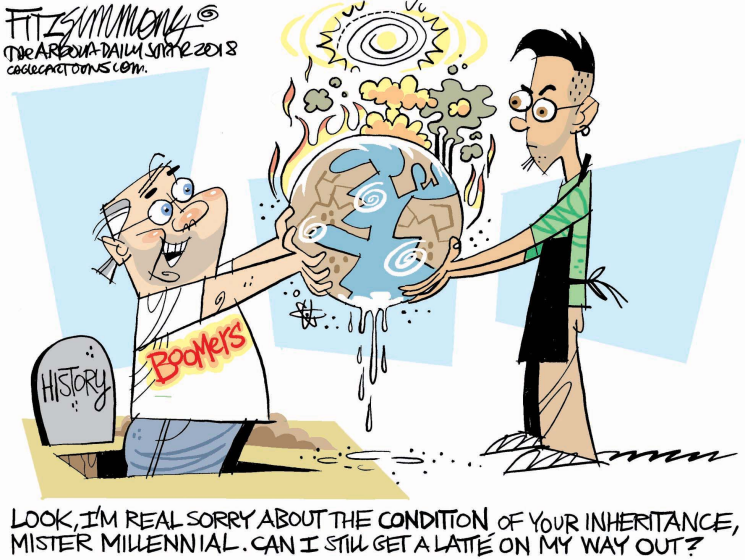
But I must apologize for the world you’re going to inherit. The generations that preceded you have saddled you with unimaginable debt, both government and personal.

Our country is currently $21 trillion in the hole, the result of unfunded wars, reckless spending by both political parties and rapidly-growing entitlement programs.

As baby boomers retire and Medicare and Social Security costs explode, our deficit is going to follow suit. The deficit is expected to exceed $1 trillion every year as early as next year.

Guess who’s on the hook for that expense?

Then there is student-loan debt, which stands at nearly $1.5 trillion.

Despite lots of high-paying jobs in the trades, we convinced you and your peers that college was your only option – that borrowing thousands to get a diploma was a solid investment.

Well, the average college graduate owes nearly $40,000. Time magazine reports that 6 million Americans owe more than $50,000 – “nearly triple the percentage who owed that amount in 2000.”

Forbes reports that student-loan debt is now higher than credit-card and auto-loan debt, and is exceeded only by mortgage debt.

Don’t worry about mortgage debt, however. With the huge financial liabilities you face, you may be renting for a while.

There are lots of other challenges ahead. Our healthcare system is a mess. As each party has taken turns enacting one-sided “reforms,” insurance premiums and deductibles have continued to go up, and millions still cannot afford coverage.

You see, neither political party has been able to correct our many woes (maybe you and your peers will replace our two-party system with something that works better).

It’s been easier for politicians to keep kicking the can down the road. It’s been easier to pass our debts and problems onto you, hoping you will finally address them.

And you will address them, because we have left you no choice.

However, despite your incredible burdens, I’m hopeful the class of 2018 will summon the will to do great things for mankind.

Our country is on the cusp of technological innovations that we cannot even begin to imagine, and no generation understands technology better than yours.

Here’s one example: The interconnection of devices and objects – referred to as the internet of things – will lead to massive insights and gains in productivity, economic performance and wealth.

Driverless cars, trucks and airplanes, which are already in the works, will be perfected.

Massive efficiencies and improvements in healthcare are coming – which will free up money to reduce patient costs as they dramatically improve health outcomes.

Cities, organizations and individuals will get smarter and more efficient – our waste and costs will go down as our profits and wealth increase.

The class of 2018 will be a driving force behind these and other innovations, no doubt.

It’s a good thing, too.

Because while you’re transforming the world and cleaning up the mess we left you, we’ll be reclining at the beach in black socks and plaid swimming trunks.

We’ll be sipping fruity cocktails from glasses with little umbrellas, grateful that your ingenuity and hard work are generating enough dough to cover our Social Security and Medicare costs.

As you begin the next chapter of your life, we wish you the best of luck – because you’ll be needing it!

Copyright 2018 Tom Purcell. Tom Purcell, author of “Misadventures of a 1970’s Childhood,” a humorous memoir available at amazon.com, is a Pittsburgh Tribune-Review humor columnist and is nationally syndicated exclusively by Cagle Cartoons Inc. For info on using this column in your publication or website, contact [email protected] or call (805) 969-2829. Send comments to Tom at [email protected].
Comments Off on An Apology to My Niece on Her College Graduation Day

The Growing Art of American Cursing

By Tom Purcell

Get this: the average American can’t get through the day without cursing.

So is the finding of a recent 9Round Kickbox Fitness survey, as reported in the New York Post.

Why are Americans cursing so much? One reason is stress.

Fifty six percent of survey respondents say financial worries are their biggest source of stress. A lack of sleep (36 percent), health concerns (35 percent), work (30 percent), the environment (9 percent) and our $20 trillion deficit (4 percent) are other sources of stress.

The survey didn’t explore politics, but the names “Trump” and “Pelosi” are generating an explosion of salty-tongued originality across our great land.

Whatever the source of our stress, cursing DOES relieve it.

A 2011 Keele University study, reports Forbes, found that yelling out curse words increases pain and stress tolerance.

Volunteers were asked to hold their hands in freezing-cold water twice. The first time, they shouted curse words. The second time they used inoffensive phrases. Each volunteer was able to keep his or her hands in the cold water longer while cursing.

“The researchers found that the enraged yelling raised the heart rate, which, they hypothesize, means that the yelling triggered a fight-or-flight response, ‘downplaying feebleness in favor of a more pain-tolerant machismo.'”

That’s one reason why, concluded the researchers, that “swearing has been around for centuries and is an almost universal human linguistic phenomenon.”

Cursing has certainly improved my capacity to deal with stress. I studied cussing under the tutelage of my father, now 85, a maestro in the art form. He perfected his skills while attempting plumbing repairs in our home.

Over the years, cursing has helped me ease the pain of financial setbacks, a broken heart and unpleasant co-workers. On a daily basis, it helps me cope with people who write checks in front of me at the grocery store and moronic drivers who drive too slowly in the passing lane.

But the question is, why are so many Americans cursing these days?

Some argue that it reflects a breakdown in manners and civility and a growing coarseness in our culture. San Diego State University psychologist Jean M. Twenge offers a more intriguing theory.

According to the National Post, Twenge conducted a 2017 study that explored how the use of the “seven dirty words” featured in comedian George Carlin’s 1972 monologue, “Seven Words You Can Never Say on Television,” changed in literature between 1950 and 2008.

Twenge found that the rise in profanity was dramatic ,’ she measured a 28-fold increase between 2005 and 2008. She said the increase can be blamed on growing individualism, which is “a cultural system that emphasizes the self more and social rules less.”

Twenge says that “as social rules fell by the wayside, and people were told to express themselves, swearing became more common.”

That makes perfect sense to me.

Whereas younger generations are being taught to freely express their innermost feelings and frustrations using words that were once considered taboo, prior generations were taught the opposite.

When I was a kid in the 70s, we knew we were pushing the line if we used words such as “son of a gun,” “gadzooks” and “h-e-double-hockey-sticks.”

If we got caught using real curse words, we’d be enjoying a bar of Dove soap for supper.

In any event, now that cursing is no longer considered taboo, I see one big problem.

As more people cuss freely, curse words will lose their shock value and their capacity to relieve our stress.

The h-e-double-hockey-sticks with that!

Copyright 2018 Tom Purcell. Tom Purcell, author of “Misadventures of a 1970’s Childhood,” a humorous memoir available at amazon.com, is a Pittsburgh Tribune-Review humor columnist and is nationally syndicated exclusively by Cagle Cartoons Inc. For info on using this column in your publication or website, contact [email protected] or call (805) 969-2829. Send comments to Tom at [email protected].

Comments Off on The Growing Art of American Cursing

Facebook Knows What about Me?

By Tom Purcell

A chat window opened on my computer screen. A Facebook “friend” I didn’t know began communicating with me.

“Happy birthday, Tom!” wrote the woman.

“Who told you it was my birthday?” I wrote back.

“You did, Tom. You provided that information when you joined Facebook.”

“I did?”

“Sure, Tom. The information you willingly provide to Facebook – combined with sophisticated tools that monitor your online usage patterns – gives Facebook a detailed understanding of who you are.”

“Why does Facebook care about who I am?”

“To make billions from advertisers, Tom! The more Facebook knows about your private life, the more that sellers can custom-tailor advertisements. And, boy, has Facebook been busy learning about you.”

“What does Facebook know about me?”

“Based on information you submitted willingly, Facebook knows your full name, marital status, gender, age, birthday and several of your interests. Every time you ‘like’ an item, click on a news story or interact with other users, you help Facebook determine personal details, such as who you are dating!”

“That’s my private business!”

“Not any more, Tom. As The New York Times reports, ‘Facebook can take all of the data you submit and combine it with other users and outside information to construct a profile of you.’ For instance, Facebook can determine ‘whether you own a motorcycle, or recently went on vacation or are a gadget geek.’ What’s worse is that Facebook is able to gather lots of additional information about you that you may not have submitted willingly.”

“What kind of information?”

“Your location, Tom. If you have the Facebook app on your phone and location tracking is turned on, Facebook will know exactly where you are, where you’ve been and can even determine where you may be going.”

“That’s unsettling, but why is my location information relevant?”

“Well, Tom, if you visit a particular store, don’t be surprised when you see several ads on your Facebook page that promote that store’s products. What many people do not know is that Facebook can track you even when you’re not using Facebook.”

“How is that possible?”

“Take your credit card purchases, Tom. Facebook collaborates with data brokers who monitor your credit card usage. Facebook then compares your purchases against data it already has to further refine your advertising profile.”

“You’ve got to be kidding me.”

“The Times explains how it works, Tom: ‘If you buy a burrito with your credit card, Facebook could know about the transaction, match it with a credit card that you added to Facebook or Messenger and start showing you ads for indigestion medication.’ ”

“It gives me indigestion to learn that advertisers know when I have indigestion!”

“Facebook also knows the people who you know, Tom. After all, you gave the company permission to download the email addresses and phone numbers stored in your smartphone.”

“It’s scary that Facebook knows so much about who I am, where I’m located and who I know.”

“It’s true, Tom. You need to be cautious about information you provide to Facebook and other online services. You should learn how to adjust your Facebook settings to protect your privacy. In any event, happy birthday.”

“Thanks for the birthday wishes, but can you please remind me who you are and how we became Facebook friends?”

“Sorry, Tom. I prefer to keep that information private.”

Copyright 2018 Tom Purcell. Tom Purcell, author of “Misadventures of a 1970’s Childhood,” a humorous memoir available at amazon.com, is a Pittsburgh Tribune-Review humor columnist and is nationally syndicated exclusively by Cagle Cartoons Inc. For info on using this column in your publication or website, contact [email protected] or call (805) 969-2829. Send comments to Tom at [email protected].

Comments Off on Facebook Knows What about Me?

Tax-Time Q & A

By Tom Purcell

The tax season is upon us. I’m no CPA, but let me offer advice and consolation to my fellow taxpayers.

Q. Dear Tom: My CPA told me that a tax bracket is a heavy, metal object that the government uses to hit you over the head every time you succeed in pushing your income up. Can you elaborate? – Annoyed in Minnesota

A. Dear Annoyed: Your CPA is correct! There is one silver lining, however. The recent tax-reform bill includes six brackets that run between 10 percent and 37 percent, but there is no tax on the first $9,525 in income, and the standard deduction almost doubles, from $6,350 to $12,000 for single filers, and from $12,700 to $24,000 for married couples who file jointly. If you have a middle-class income, you’ve likely seen a nice little bump in take-home pay. But taxes are still high, as the next question will reveal!

Q. Dear Tom: Like you, I contracted my writing services to a big technology firm last year. Well, I received my first 1099 and the taxes I owe are way more than I planned for. Why are my taxes so high? – Desperate in Des Moines

A. Dear Desperate: The short answer is FICA, the Federal Insurance Contributions Act. It requires you to make contributions to Social Security and Medicare. The 7.65-percent contribution rate combines the rates for Social Security (6.2 percent) and Medicare (1.45 percent). When you were an employee, your employer paid half of your FICA bill. As a self-employed person, you must pay both halves on your first $127,000 in income – a whopping 15.3 percent, which is nearly $20,000!

Q. Dear Tom: Despite the considerable taxes we pay, why the heck does the federal government spend billions more than it takes in? – Concerned in Connecticut

A. Dear Concerned: Regrettably, there continues to be a lack of seriousness about budget deficits. According to usdebtclock.org , we have $21 trillion in debt right now. We are poised to resume trillion-dollar deficits in a few years. That’s partly due to reckless spending, as demonstrated by the budget Republicans just pushed through. But as the Hoover Institution argued in a recent Washington Post op-ed, it also has to do with entitlement spending. As baby boomers retire, Medicare and Social Security are poised to explode. Hoover says we must reform and restrain the growth of entitlement spending.

Q. Dear Tom: I thought it was Republican tax cuts that are causing the deficit to worsen? – Tax the Rich

A. Dear Tax: Some argue that point. Former Federal Reserve chair Janet Yellen and four other economists penned a Washington Post op-ed in response to the Hoover Institution op-ed. They say tax cuts and unfunded wars, not entitlement spending, are the biggest culprits in our budget woes. However, the Congressional Budget Office says the tax cuts will boost economic growth and create 1.1 million jobs over the next decade, which will generate increased tax receipts. It’s a complicated matter.

Q. Dear Tom: Let me get this right. After Republicans cut taxes and increased spending, now they are trying to push through a balanced-budget amendment? – Incredulous in Indiana

A. Dear Incredulous: As of this writing, House Republicans planned to vote on a balanced-budget amendment. The Washington Post said it has no chance of passing because it would require Democratic support in the Senate, followed by ratification by three-fourths of the states within seven years.

Q. Dear Tom: All this talk about taxes, debts and deficits is making my head hurt. Can we change the subject to something less complex? – Hurting in Houston

A. Dear Houston: Absolutely. I will now accept questions about the many conflicts in the Middle East.

Copyright 2018 Tom Purcell. Tom Purcell, author of “Misadventures of a 1970’s Childhood,” a humorous memoir available at amazon.com, is a Pittsburgh Tribune-Review humor columnist and is nationally syndicated exclusively by Cagle Cartoons Inc. For info on using this column in your publication or website, contact [email protected] or call (805) 969-2829. Send comments to Tom at [email protected].

Comments Off on Tax-Time Q & A

How to Mooch off Your Parents in a Down Economy

I can’t really blame them, if you want to know the truth.

I speak of the latest down-economy trend: More 20-somethings are moving back home with Mom and Dad — and happily accepting financial assistance.

So pronounced is the trend — some 41 percent of parents are giving their 20-somethings some 10 percent of their combined income — that Parade magazine published six tips on how to “help grown children without going broke.”

Which prompts me to offer 20-somethings tips on how to take advantage of a good situation.

Look, 20-somethings, it’s only partly your fault that the economy is still a mess — most of you voted for you know who — but it isn’t your fault that you lack the skills to deal with it.

Your generation has been coddled like no other generation before it — never has any generation been given so much for doing so little — and that is your parents’ fault.

It’s payback time.

Parade suggests your parents charge you at least a token rent. Mom and Dad will likely assume that you’ll offer a stipend of some kind. Don’t.

Your father will complain to your mother — eventually they’ll get into loud arguments over the matter — but if you hold steady, you’ll likely keep living at home for free.

To that end, it will help to gripe loudly about your college loan bills. Mom and Dad will feel guilty that they were unable to pay for all your college costs — further ensuring that Mom won’t let Dad ask you for rent.

Complaining about the food is also helpful. No matter how good Mom and Dad’s cooking is — and it surely is better than the grub you prepare for yourself — point out its shortcomings. In the unlikely event that the subject of rent does come up, you can use this as a bargaining chip.

That brings us to your social life. It would be foolish to continue running up your credit cards at nightclubs when Dad’s liquor cabinet is full. Have your friends over. Mix your own drinks.

This is sure to agitate Dad further — he and Mom will be arguing regularly by now — and cause him to mark the level in his liquor bottles with Scotch tape. Simply adjust the tape as you drain Dad’s bottles.

Another important tip is earplugs. As you sleep off your hangovers late Saturday mornings, Dad will bang the lawnmower against the bricks under your window, figuring the least you can do is cut the grass.

Foam plugs offer the best Dad-noise-blocking capability.

I know some people will complain that I am encouraging you to mooch off your parents. Some will argue that everyone, including 20-somethings, must carry their own load if our country is to thrive.

Nuts to that.

The reason we got into our economic mess – one reason it persists – is because, like dependent children, so many have come to expect somebody else to bear the consequences of their poor decisions, irresponsible behavior, failure to plan and demands for instant, unearned gratification.

The Wall Street boys made risky decisions and the taxpayers bailed them out.

States that overspent during the good times want the federal government to bail them out during the bad times.

Our federal government is spending billions more than it is taking in and expects future taxpayers to bail it out.

Since few adults appear to be interested in carrying their own load, who can criticize 20-somethings who are moving home to mooch off Mom and Dad?

A great recession like ours comes along once in a lifetime. Don’t let it pass without free drinks from Dad’s liquor cabinet.

——

©2010 Tom Purcell. Tom Purcell, a freelance writer is also a humor columnist for the Pittsburgh Tribune-Review, and is nationally syndicated exclusively by Cagle Cartoons newspaper syndicate. For more info contact Cari Dawson Bartley at 800 696 7561 or email [email protected]. E-mail Tom at [email protected].

Comments Off on How to Mooch off Your Parents in a Down Economy

Needed: Blue-Collar Horse Sense

The article in The Washington Post filled me with hope: There’s a trend toward college-educated people getting into the trades.

One 29-year-old fellow in Washington, D.C. — he has a degree from Notre Dame — considered going to law school, like many others in the lawyer-saturated town.

After watching his friends work long hours as paralegals — and watching his lawyer pals sign their lives over to their firms — he did something sensible.

Cartoon by Gary McCoy - Cagle Cartoons (click to reprint)

Cartoon by Gary McCoy - Cagle Cartoons (click to reprint)

He became an electrician’s apprentice.

He’s not alone. The Post says more 20-somethings are forgoing the white-collar world to become plumbers, electricians, mechanics and carpenters.

I think it’s great.

This country was designed by people who worked with their hands.

Ben Franklin started off as a printer’s apprentice, a messy job. His trade helped him master communication, business management, politics and human nature.

George Washington, a farmer, toiled in his gardens to cross-breed the perfect plant. He was forever trying new ways to cultivate and harvest his crops.

Many of our Founders were farmers. They were humbled by the unforgiving realities of nature.

Hands-on labor made these fellows sensible and innovative. Their good sense is evident in the practicality of the Constitution.

We have lost touch with such common sense.

The shift happened over many years, of course. Industrialization moved Americans to the cities and, gradually, to paper-pushing jobs in the service industry.

Now we’re a country of white-collar snobs with an underdeveloped understanding of how things work.

The snobbery starts in high school. Parents and guidance counselors both point kids toward college and white-collar careers — they save the blue-collar careers for the kids whose grades aren’t so hot.

It makes no sense.

A skilled laborer earns more than many lawyers do — and likely enjoys his work more. Show me a dozen lawyers and I’ll show you 11 people who have considered driving a cab for a living.

Skilled laborers are good for our country — white-collar folks are not always so good.

Consider an important white-collar maxim: “If you can’t dazzle them with brilliance, baffle then with BS.”

I’ve seen highly skilled BSers establish long careers without producing anything of any value.

Blue-collar workers cannot BS their way through their work.

An electrician mixes up the hot wire and ground wire only once.

A carpenter is kept honest by his level — he measures twice, cuts once.

A plumber’s skill is evident when the water valve is opened and the pipes don’t leak.

Blue-collar workers have no choice but to develop horse sense — to develop efficient ways to solve real problems.

There was a time in America when many white-collar jobs were also infused with horse sense. An employee started as a bank teller right out of high school. He’d work his way up, through performance and sound judgment, to the highest levels of the organization.

Now any old Ivy League graduate can become an investment banker and put his company, and country, at incredible risk as he pursues a multmillion-dollar commission.

I hope more college-educated folks leave the white-collar world to become skilled laborers.

I hope we stop glamorizing careers on Wall Street, the legal profession and many other paper-pushing businesses.

I hope more people use their hands to produce something of value every day — and use their practical, decision-making abilities to help resolve other challenges we face.

If we don’t get a serious infusion of blue-collar horse sense, God help this country.

©2010 Tom Purcell. Tom Purcell, a freelance writer is also a humor columnist for the Pittsburgh Tribune-Review, and is nationally syndicated exclusively by Cagle Cartoons newspaper syndicate. For more info contact Cari Dawson Bartley at 800 696 7561 or email [email protected]. E-mail Tom at [email protected].

Comments Off on Needed: Blue-Collar Horse Sense

Navigating the Second Amendment in Washington, D.C.

“When you get mugged, there are certain rules you must follow,” my friend and his wife explained to me as we walked from a Washington, D.C., pub to their condo.

“When I get mugged?”

“Muggers are polite when you follow their instructions, but they get surly when you are rude,” said his wife.

“How can you be rude to a mugger?”

“Ignoring the mugger is rude,” said my friend. “This will give him license to strike you with a blunt object.”

“I see.”

“Making eye contact is also rude,” said his wife. “Look only at the mugger’s feet.”

“Why not just run?”

“Running might affect the mugger’s self-esteem,” said my friend. “You’ll give him little recourse but to club you with a blunt object.”

“Then what should I do when we get mugged?”

“Always make an offering of some kind,” said his wife.

“Hand over my watch?”

My friends laughed.

“You don’t wear a watch in this city!” said his wife. “You give up your wallet.”

“But my wallet contains my license, credit cards and other vital information.”

“You don’t hand over your real wallet,” said my friend, looking at his wife like I was an idiot. “You give up a dummy wallet. You carry your real wallet in your sock or your underwear.”

“I keep my credit cards in my bra,” said my friend’s wife.

“What if the mugger looks in your sock?”

“Muggers never do that,” said his wife. “They’re eager to complete their transaction, so they can move on to the next mugging.”

“Can’t you call for a policeman?”

“Ha!” said his wife. “If you can find one.”

“How about Mace?”

“If a mugger catches you reaching for Mace, that gives him license to –“

“Strike me with a blunt object?”

“Precisely,” said my friend.

“What if you were able to carry a gun?”

“The gun laws are very strict here,” said my friend. “It seems the only people who have them are the police or the criminals.”

“But two years ago, the Supreme Court held that D.C.’s handgun ban violated individuals’ Second Amendment right,” I said. “The court affirmed that ‘the right of the people to keep and bear arms shall not be infringed’ in federal enclaves.”

“It did?”

“The Supreme Court just ruled on a similar case from Chicago, which is not a federal enclave. It affirmed that the Second Amendment provides Americans with a fundamental right to bear arms that cannot be violated by state and local governments.”

“So the average law-abiding citizen is now permitted to own a handgun anywhere in America?”

“Local jurisdictions are still free to impose a variety of restrictions,” I said. “However, plenty of lawsuits will follow as the details are worked out. In D.C., for instance, law-abiding citizens may own guns but are not permitted to carry a concealed weapon as they walk home.”

“Too bad,” said my friend. “If the muggers feared we had a gun, they might be inclined to leave us alone.”

“But then again,” said his wife, “if the mugger discovers we have a gun, that might give him license to –“

“Shoot us with a blunt object?” I said.”Whatever the case, Justice Samuel A. Alito Jr., writing for the majority, said the right to self-defense is fundamental to the American conception of ordered liberty. It would appear you could use more ordered liberty in your neighborhood.”

As we approached their condo, my friend and his wife sprinted to the door. They scanned for suspicious movement in the shrubs, then ushered me inside and slammed the door.

“We made it!” said his wife.

“That was a close one!” said my friend.

“You have developed an interesting process for dealing with muggers in Washington, D.C.,” I said. “How long have you lived here?”

“We moved in last Friday,” said my friend.

—–

©2010 Tom Purcell. Tom Purcell, a freelance writer is also a humor columnist for the Pittsburgh Tribune-Review, and is nationally syndicated exclusively by Cagle Cartoons newspaper syndicate. For more info contact Cari Dawson Bartley at 800 696 7561 or email [email protected]. E-mail Tom at [email protected].

Comments Off on Navigating the Second Amendment in Washington, D.C.