Thankful Despite Cancellation of Family Feast

My family canceled Thanksgiving this year – my favorite holiday since I was a kid.

Usually, 30 to 40 people gather at my parents’ house and sit next to each other at three tables. But in this year of COVID-19 – aptly named, because I and everyone I know has put on about 19 pounds since March – the grand event has been canceled.

When I was a kid in the 1970s, my parents lived in a modest house. We packed people in for Thanksgiving nonetheless, with three tables taking up every inch of space in the dining room and living room. The tight circumstances made the event all the more fun and memorable.

When I taste turkey, mashed potatoes and cranberry sauce – the cheap kind in the ribbed can! – I taste the many years of camaraderie and happiness we’ve enjoyed around those tightly packed tables.

I knew as a boy, as I still do now, that the family members around the table were our primary blessings and sources of happiness. As sad as we are that wonderful aunts and uncles have left us over time, we are thankful for the many new souls whose joy has enriched our continually growing clan.

My parents have 17 grandchildren and nine great-grandchildren, and we all look forward to hearing stories about what they’ve said or done, often laughing out loud. Their joy fills us with joy.

But there will be no Thanksgiving gathering this year – no laughter around the dinner tables, no catching up as we talk about everything and nothing at all. That’s somewhat troubling, because we don’t know how many such gatherings we have left at my parents’ home.

That’s taking a toll on all of us this Thanksgiving, when everyone could use an enjoyable feast to take a respite from all the disruption in our lives and recharge our batteries a little bit.

If 2020 has given us one important lesson, it’s that we shouldn’t take for granted the blessings we still have in abundance. That lesson makes clear that the people who will NOT sit around the Thanksgiving table this year are what is most valuable to us. 

This year has reminded us to get back to the basics.

We don’t need massive riches to fill ourselves with happiness. To the contrary, material wealth can cause unhappiness – particularly when markets crash and fortunes disappear.
 
Truthfully, Kenny Rogers summarized well the three basic things we need in our lives to pursue happiness: someone to love, something to do and something to look forward to.

And, boy, am I looking forward to picking back up with my extended family’s magical Thanksgiving gathering next year – to getting back to normal.
Perhaps it takes an especially disruptive year to bring us back to our senses. That’s the spirit in which I’m taking 2020.

As far as the economy and our country’s future goes, my family is as apprehensive about the coming months as anyone. We have experienced lost work and wage cuts, as millions of Americans have.

Though we won’t sit around the Thanksgiving tables enjoying each other’s company this year, we still will be thankful for the many blessings we’ve been given.


Copyright 2020 Tom Purcell. Tom Purcell, author of “Misadventures of a 1970’s Childhood,” a humorous memoir available at amazon.com, is a Pittsburgh Tribune-Review humor columnist and is nationally syndicated exclusively by Cagle Cartoons Inc. For info on using this column in your publication or website, contact [email protected] or call (805) 969-2829. Send comments to Tom at [email protected].

Comments Off on Thankful Despite Cancellation of Family Feast

COVID-19 Obscures How Great 2020 Really Was

As challenging a year as 2020 has been, we still should be thankful that it has been the best year in human history to be alive.

Consider: In 1920, according to the book “Enlightenment Now,” the average person spent 11.5 hours each week doing laundry. By 2014, he or she was completing laundry chores in less than an hour and a half.

Or, in my case, five minutes – which is how long it takes me to drop off my laundry at the laundry-cleaning shop.

Right now, humans are living longer, more productive lives than ever before in human history.

“For 99.9% of our species’ existence, a newborn baby could expect to live, on average, to about the age of 30,” reports Tom Chivers for BuzzFeed. “According to the Encyclopaedia Britannica, that age dropped even lower in classical times, to perhaps 28 for ancient Greece and Rome. And as late as the start of the 20th century, according to the World Health Organisation (WHO), it was still just 31.”

But today, says Chivers, the global average life expectancy is 71.5 years, according to a study in The Lancet.

And life expectancy will keep increasing.

According to the World Future Society, we are in the early phases of a superlongevity revolution. Thanks to advances in nanotechnology and cell and gene manipulation, scientists may eventually learn how to keep humans alive for 120 to 500 years.

I hope I don’t live that long, though. I have zero desire to participate in one more presidential election, let alone several dozen.

COVID-19 has disrupted global markets, but the fact is that free markets and capitalism have been leading millions of people out of poverty – and will continue to do so as the world eventually returns to normal.

As poverty decreases, the global population enjoys a continually improving quality of life.

In 2017, Bill Gates reported global improvement across several indicators: Childhood deaths fell from 12 million in 1990 to 5 million in 2017. More than 90 percent of children were attending primary school. The proportion of people living in extreme poverty declined from one-third in 1990 to one-tenth.

Today, the average American family is living better than the world’s wealthiest lived just 100 years ago.

Cafe Hayek says the lifestyle of today’s typical middle-class American is better than billionaire John D. Rockefeller’s was 100 years ago.

As rich as Rockefeller was, he didn’t have air conditioning; sophisticated medicine; safe, fast travel; limitless dining and entertainment options; and many other wonderful things that we have.

Of course, Rockefeller didn’t have social media or talking heads on 24/7 cable news, so his lifestyle was not without its benefits!

This year has been no picnic. Many people are without work and are suffering terribly as they face an uncertain future.

Despite 2020’s setbacks, however, now is still the best time in history to be alive. We have our problems, to be sure, and have plenty of work ahead of us.

Then again, technological innovation is in the process of unleashing marvels – and, hopefully, much-needed economic growth – that will benefit us all.

This Thanksgiving, in addition to toasting the good health of my family and friends, I’ll toast the many blessings and opportunities that abound, but are harder to see during this most peculiar year.

Copyright 2020 Tom Purcell. Tom Purcell, author of “Misadventures of a 1970’s Childhood,” a humorous memoir available at amazon.com, is a Pittsburgh Tribune-Review humor columnist and is nationally syndicated exclusively by Cagle Cartoons Inc. For info on using this column in your publication or website, contact [email protected] or call (805) 969-2829. Send comments to Tom at [email protected].

Comments Off on COVID-19 Obscures How Great 2020 Really Was

America 2020: A Good Time for a Nice, Long Sleep

“It’s a miracle!” said the doctor. “You’ve just awakened from a coma after a terrible accident in October 2016, but you’re doing well, all things considered!”

“I’ve been out for more than four years?” said the patient.

“That’s right,” said the doctor. “You must have several questions?”

“You bet, Doc! I remember when America elected President Obama, a time of great healing and hope and change. Americans are surely getting along better than ever now?”

“It’s best that we come back to that one later,” said the doctor. “Anything else?”

“I remember Hillary Clinton won the Democratic nomination and appeared she’d become America’s first female president,” said the patient. “How’s she doing?”

“Let’s just say Hillary is very happy THIS week and that it might be a good idea that you take a tranquilizer before we continue,” said the doctor.

“I don’t want a tranquilizer,” said the patient. “I want information!”

“If you say so,” said the doctor. “Hillary lost the 2016 election to Donald Trump.”

“The ‘You’re fired!’ billionaire became president? But polls in 2016 showed Hillary would win easily!”

“Pollsters aren’t doing so well these days,” said the doctor.

“Did Americans accept the 2016 results and support the president nonetheless?” the patient asked.

“Sure you don’t want that tranquilizer?” said the doctor. “No, for four years, Trump’s opponents said the election results were wrong, trying everything to remove him – even impeachment.”

“Did that tear the country apart, like Bill Clinton’s impeachment did?” the patient asked hesitantly.

“Yes, but it’s not just Trump’s impeachment that has Americans so divided,” the doctor said. “We’ve been getting more partisan for years. Some say social media, such as Facebook, cause more people to see information that validates and hardens their thinking rather than truthful information that challenges and opens it.”

“Facebook?” said the patient, bewildered. “I thought Facebook was about posting funny pictures and sharing laughs with friends.”

“Not anymore,” said the doctor. “We’re getting angrier and less civil by the moment. The global pandemic has only worsened everyone’s mood.”

“The global what?” said the patient.

“A deadly virus that nobody is immune to has caused shutdowns that hit the world hard,” said the doctor. “Americans are struggling and more divided than ever.”

“Maybe I’ll try just one tranquilizer,” said the patient.

“Good idea,” said the doctor. “We’ve had riots. Half the country loathes Trump. The other half supports him strongly, saying he’s brash and gruff but his policies have been good for the economy, jobs, prison and Veterans Affairs reform and are even restricting endless wars and producing some peaceful results in the Middle East.”

“So, how did the 2020 election turn out?” said the patient.

“Mind if I have your second tranquilizer?” said the doctor. “Joe Biden won, but lawsuits and challenges are under way. Half the country thinks the 2016 election was rigged but this one’s perfect. The other half thinks the 2016 election was good, but this one was stolen. If we can’t believe in our voting system, I don’t see how anyone can govern our increasingly fractured democracy. America’s future is not looking terribly pleasant, regrettably. Any more questions?”

“Just one,” said the patient. “Any chance you can you put me back into a coma?”

Copyright 2020 Tom Purcell. Tom Purcell, author of “Misadventures of a 1970’s Childhood,” a humorous memoir available at amazon.com, is a Pittsburgh Tribune-Review humor columnist and is nationally syndicated exclusively by Cagle Cartoons Inc. For info on using this column in your publication or website, contact [email protected] or call (805) 969-2829. Send comments to Tom at [email protected].

Comments Off on America 2020: A Good Time for a Nice, Long Sleep

However this Election Turns Out, You’ll Still Have Your Vote and Voice


It’s calm as I write this the day before the 2020 general election.

I hope and pray that the outcome, whatever it may be, is accepted calmly – though I worry it may not be.

Americans’ growing divisiveness is concerning, but there’s one element of this election that’s worth celebrating: our right to vote.

According to USA Today, more than 62% of eligible voters 18 or older, about 150 million Americans, are expected to vote in this election – which would be the highest turnout in any presidential election.

More Americans than ever are engaging in the political process and carrying out their civic duty – exercising a precious, hard-fought right that gives us each the opportunity to express our will about government policies and leaders.

A record 62% of voters casting ballots would be great, but why would 38% still not do so? Why wouldn’t they exercise their right to vote when so many struggled so hard to give them this right?

National Geographic says of those struggles:

“Because the Constitution did not specifically say who could vote, this question was largely left to the states into the 1800s. In most cases, landowning white men were eligible to vote, while white women, black people, and other disadvantaged groups of the time were excluded from voting (known as disenfranchisement).”

It took many years of struggle to extend the right to vote to men who didn’t own property; to women; to African-Americans; and, in 1971, to U.S. citizens at age 18, who’d been old enough to fight in wars but unable to vote on war policies until they turned 21.

Do the 38% of eligible voters who won’t vote this November think their vote doesn’t matter?

It may matter a lot, according to The Borgen Project:

“A New Hampshire Senate race was decided by two votes out of 223,363 in 1974. A Massachusetts gubernatorial election was decided by two votes out of 102,066 in 1839. And the Alaskan congressional race was decided by a single vote out of 10,035 cast in 2008.”

Mental Floss cites 11 elections that have been decided by one vote.

Eligible voters who throw away their vote miss out on a wonderful opportunity to participate in their government and make their voice heard.

The voting process is enriching. Studying the issues and evaluating candidates’ records and plans is rewarding in itself. Debating the issues civilly with others helps all of us learn and better understand the stakes. Participating in peaceful political gatherings and volunteering to assist candidates are opportunities that millions of people around the world will never get to enjoy.

We all have a stake in our country’s future direction, and our ability to freely choose that direction is a precious and glorious gift. By not exercising your right to vote, you are shortchanging yourself.

Yes, I worry about the potentially contentious response to this week’s election outcome.

But if your candidates don’t prevail – if you feel your voice wasn’t clearly heard, or your fellow citizens disagreed with it – there’s still good news.

You still can write letters to the editor and post on social media. You still can participate in political gatherings. You still can volunteer to support candidates.

And you can still exercise your right to vote in the next election cycle.

Copyright 2020 Tom Purcell. Tom Purcell, author of “Misadventures of a 1970’s Childhood,” a humorous memoir available at amazon.com, is a Pittsburgh Tribune-Review humor columnist and is nationally syndicated exclusively by Cagle Cartoons Inc. For info on using this column in your publication or website, contact [email protected] or call (805) 969-2829. Send comments to Tom at [email protected].

Comments Off on However this Election Turns Out, You’ll Still Have Your Vote and Voice


Traditional Halloween Fun Pales in Face of 2020 Reality

Halloween is a huge letdown this year.

I love modern Halloween traditions. I love the sweet smell of autumn, the chilly air and the camaraderie of friends around a roaring campfire.

I love hayrides, Honeycrisp apples and the clever, hilarious costumes my left-brained accountant and engineer friends come up with. Why do CPAs always create the wittiest costumes?

But Halloween is awfully anticlimactic this year.

Most Halloween events are canceled by state and local governments. Trick-or-treating is banned in many communities. Even if an apple-bobbing contest were held, mandatory masks would eliminate any hope of anyone winning.

I loved the childhood mischievousness of Devil’s Night, when rowdy kids might soap some car windows or toss a harmless toilet paper stream into a brilliant orange oak tree – but such pranks pale in comparison to the real, nightly destruction we’ve seen in our cities’ streets for months.

Halloween traditionally is a time to celebrate the harvest, but our “harvest” is dismal this year: Economic shutdowns have hurt millions of people and small businesses – with no relief or long-term stability in sight.

And our people, and by extension our politics, are more divided than ever.

Halloween is supposed to be the peak time to savor the last warm autumn air and prepare for the bitter cold just ahead – but this year, we still haven’t recovered from the disruptive misery that has been dogging us since March.

The horror movies that have become staples of the Halloween season aren’t capturing our attention much anymore – because they aren’t half as compelling as our daily reality.

Hey, Jason! Trust me on this: You’d be a way scarier movie character if you DIDN’T wear a hockey mask. Rather than a machete, all you need to do is sneeze on your victims.

To make matters more unsettling, we’re just days away from a presidential election that, no matter the result, is going to agitate half the population as it elates the other half.

Though it may seem that our uncivil, vitriolic discourse can’t possibly get worse, nobody will be surprised if it does get more chaotic, violent and out of hand.

Though we haven’t begun to fully absorb or resolve the challenges our disruptions have caused – though we won’t get to enjoy a little autumn calm to help us prepare for the brutal winter months ahead – we’re already being warned that covid-19 is surging yet again.

Some government authorities, who are enjoying absolute power over us a little too absolutely, are telling us to cancel Thanksgiving and Christmas gatherings. It will be good for us, they tell us.

Few of them tell us about the other side of these endless shutdowns and disruptions for people with mental health issues, people with drug and alcohol addictions, and people who aren’t getting out to seek needed medical care.

What to do? I recommend re-watching the 1994 Stephen King TV miniseries, “The Stand.” It’s about a lethal, highly contagious strain of influenza that is accidentally released to the public.

It was scary when it first aired. Now it’s an adorable comedy.

And that’s one more reason why Halloween is a huge letdown this year.

Copyright 2020 Tom Purcell. Tom Purcell, author of “Misadventures of a 1970’s Childhood,” a humorous memoir available at amazon.com, is a Pittsburgh Tribune-Review humor columnist and is nationally syndicated exclusively by Cagle Cartoons Inc. For info on using this column in your publication or website, contact [email protected] or call (805) 969-2829. Send comments to Tom at [email protected].

Comments Off on Traditional Halloween Fun Pales in Face of 2020 Reality

You Know Politics Stinks When Stink Bugs Are an Escape

I’d rather focus on stink bugs.

The political season is at a fever pitch. Anger at those who disagree with others’ political views, the result of increasing polarization, is rampant.

I don’t have the stomach for what our politics and public discourse have become.

So I focus on stink bugs.

The brown marmorated stink bug, increasingly common in Pittsburgh, originated in east Asia.

The first documented U.S. stink bug was collected in Allentown, Pa., in September 1998 after likely hitching a ride on a shipping container.

Prehistoric-looking and persistent, the creature takes any opportunity to sneak into our homes each fall to survive winter’s cold – and boy, does it stink.

Just as I turn on a good movie and flip back my recliner to escape all things political, I see one of those buggers crawling along my crown molding – puzzled at how it got there.

Then my heart sinks.

According to Prevention, when threatened, a stink bug sprays a smelly fluid up to several inches toward me as I struggle to get it into a bottle.

I loathe that smell – almost as much as I loathe modern politics, which has begun to stink even worse.

Just after capturing my latest stinky invader the other night, I watched “The Social Dilemma” on Netflix.

It argues that social media platforms are damaging our society – and our politics – by deploying powerful computer algorithms that monitor our online usage patterns to better understand our likes and dislikes, so they can hold our attention and keep us logged in.

The more we use these platforms, the more they know about us – and the more ads these platforms can sell for us to click, generating billions of dollars.

These platforms are designed to be addictive – to give us a dopamine hit when someone “likes” something we posted – so that we spend as much time as possible online, generating revenue by clicking on ads.

But it’s more than that. Social media platforms have the power to not only predict our behavior, but to shape and manipulate it – by feeding us content and friends customized to our unique likes and needs, which we find agreeable and validating.

If you have liberal views, liberal content will pop up in your news feed. If you have conservative views, conservative content will display. If you have conspiracy views, left or right, guess what you’ll see in your news feed.

Is it any wonder that fewer people are able to distinguish between bogus theories and legitimate news – and that more people discredit legitimate news as bogus theories?

If your primary information source is social media, it’s no wonder if you think those with opposing views are wrong-headed or even evil. This endless feedback cycle, designed to exploit you for profit, contributes to our increasing polarization, poisoning our political process and resulting in violence in our streets.

I lack the stomach for all the angst brought on by the closing of our minds, which is getting us nowhere and harming our country, politics and every last one of us.

My primary escape these days is preoccupying myself with the stink bugs that keep sneaking into my house.

Copyright 2020 Tom Purcell. Tom Purcell, author of “Misadventures of a 1970’s Childhood,” a humorous memoir available at amazon.com, is a Pittsburgh Tribune-Review humor columnist and is nationally syndicated exclusively by Cagle Cartoons Inc. For info on using this column in your publication or website, contact [email protected] or call (805) 969-2829. Send comments to Tom at [email protected].

Comments Off on You Know Politics Stinks When Stink Bugs Are an Escape

The Fate of Gig Workers Could Turn on Ballot Question

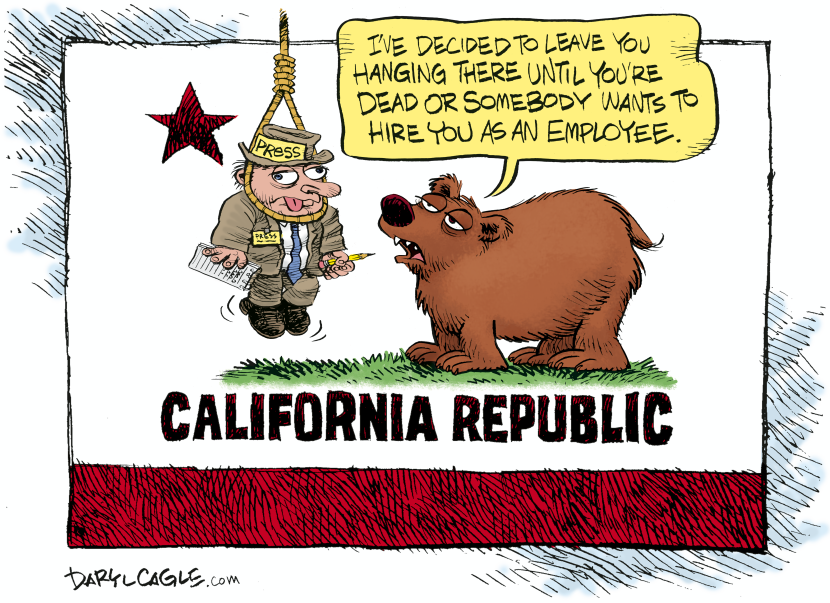
Become an employee with full paid benefits, or remain a mostly independent gig worker? That debate’s raging in California as November’s general election approaches, and its outcome is likely to affect the entire country.

According to The Washington Post, “Uber, DoorDash and other gig economy companies are bombarding TV airwaves, social media and even their own apps with ads and marketing materials promoting a ballot initiative [Proposition 22] that they say would improve drivers’ financial situation and working conditions but that would also deny them the right to be classified as employees in California.”

Proposition 22 would give gig workers limited benefits and wage and worker protections, but establish them as an independent class of workers – and undo a 2019 California law, Assembly Bill 5 (AB5), that “would guarantee drivers access to the minimum wage, employer-provided health care and bargaining rights.”

I’ve long been self-employed, with the exception of some recent cybersecurity consulting contracts in which I was paid as a full-time employee with benefits, but that’s been my choice.

Being fully self-employed is not for the faint of heart. Besides cybersecurity consulting and writing a newspaper column, I have an apartment-rental business. I recently earned a real estate license and am selling properties, too.

I manage my own invoicing and taxes. I know to the penny – once my CPA explains it to me and I drop whatever mug of coffee I’m holding – how high my income taxes are. Few employees are aware of how much they pay in taxes or what their benefits cost their employers – which would be helpful to know before voting for new government policies that will increase both.

I manage my own health-care insurance, which has gotten plenty expensive in recent years for individuals who don’t qualify for subsidies, in part because of government attempts to expand health insurance to everyone.

But, again, I choose to be self-employed. I like the freedom it provides. But it also makes me keenly aware of the unintended consequences of government regulations and policies.

California’s 2019 AB5 law would require Uber, for instance, to hire drivers as full-time employees with health insurance, paid sick leave and other benefits. Benefits are wonderful, but come at a price.

Uber claims that “if the company were forced to make all drivers across the country employees, for example, it could only support 260,000 full-time roles,” reports The Post. “That compares to 1.2 million active drivers the company was hosting on its app before the coronavirus pandemic.”

Uber also says fares would increase and drivers would be less available and timely – which means you might have to wait a while for your ride home to arrive after a night of enjoying the pub.

What it comes down to is that some politicians believe individuals shouldn’t have the freedom to exchange their skills and services for money from organizations, because organizations take advantage of those individuals. Joe Biden and Kamala Harris support AB5, not the watered-down Proposition 22.

Others think that in a free society, individuals should be able to offer their professional talents to anyone willing to pay for them, and government shouldn’t restrict the terms they negotiate. President Trump’s campaign supports that approach and is critical of AB5 (but has not, to my knowledge, supported Proposition 22).

That’s something else to think about when you vote in November’s election.

2020 Tom Purcell. Tom Purcell, author of “Misadventures of a 1970’s Childhood,” a humorous memoir available at amazon.com, is a Pittsburgh Tribune-Review humor columnist and is nationally syndicated exclusively by Cagle Cartoons Inc. For info on using this column in your publication or website, contact [email protected] or call (805) 969-2829. Send comments to Tom at [email protected].
Comments Off on The Fate of Gig Workers Could Turn on Ballot Question

It’s Healthy to Laugh in COVID-19’s Face this Halloween

If we can’t poke fun at COVID-19 on Halloween, when can we?

You see, Halloween is the one time of year when we can make fun of ourselves and current events by dressing up in clever costumes.

At least it used to be.

Until about 30 years ago, Halloween was mostly for kids. Around 1990 or so, adults begin celebrating it in big numbers, and, boy, did they embrace the opportunity to blow off steam and have some raucous fun.

Robert Thompson, Newhouse Director of the Bleier Center for Television and Popular Culture at Syracuse University, explained why.

“It’s the one day where almost anything goes,” Thompson told me in 2008. “Adults can be a wise guy or do something outrageous they’d never do normally.”

Thompson said adults generally picked costumes that mocked or satirized popular culture. In my opinion, nothing’s healthier for a well-functioning society than the ability to freely and heartily make fun of things we find silly, scary or wrong.

But that was Halloween 2008. Halloween 2020 is different.

We’re in the ninth, month of a global pandemic that has wreaked havoc on our markets and brought uncertainty into every aspect of our lives.

So a costume poking fun at the dastardly coronavirus bug would bring us some much-needed laughter and help us vent some of our pent-up disgust, right?

Nope.

According to the UK-based Politic Mag,, Amazon UK was forced to remove coronavirus Halloween costumes because of public outrage.

The latex costumes resemble what the virus looks like under a microscope, with eyes and sharp teeth added to the front.

Why would a costume mocking COVID-19 be offensive?

Because,, according to Bustle, “COVID-19 is not something to make light of. The death toll, globally, was more than 1 million people at the time this article was published, with 34.3 million reported cases in total (and likely millions more than even that).

“And as the virus is used as an excuse to direct racism toward China (even dubbed the ‘Chinese virus’ by the President), targeted groups could be offended by your costume.”

That’s one way to look at it. I look at it another way.

Adults should be sensitive to others and careful that they don’t go over the line with costumes that truly offend.

But poking fun at a disruptive pandemic on Halloween – laughing in COVID-19’s face, if you will – is a very healthy thing to do.

Humor,, according to Merriam-Webster, is “the mental faculty of discovering, expressing, or appreciating the ludicrous or absurdly incongruous.”

Is there anything more absurdly incongruous than COVID-19?

Isn’t there a place for a little gallows humor, which, “makes fun of a life-threatening, disastrous, or terrifying situation”?

Gallows humor is a stress-relieving mechanism used by people in very difficult jobs – such as medical professionals caring for so many people suffering from COVID-19.

Isn’t there a place this Halloween for satire, which is, “trenchant wit, irony, or sarcasm used to expose and discredit vice or folly”?

Laughter is among our most powerful tools for surviving adverse circumstances. By laughing at COVID-19, we display our strength – we make it clear that we will overcome the difficulties it has imposed on us and will thrive again.

As I said, if we can’t poke fun at COVID-19 on Halloween, when can we?

Copyright 2020 Tom Purcell. Tom Purcell, author of “Misadventures of a 1970’s Childhood,” a humorous memoir available at amazon.com, is a Pittsburgh Tribune-Review humor columnist and is nationally syndicated exclusively by Cagle Cartoons Inc. For info on using this column in your publication or website, contact [email protected] or call (805) 969-2829. Send comments to Tom at [email protected].

Comments Off on It’s Healthy to Laugh in COVID-19’s Face this Halloween

Served Lemons by Coronavirus, Entrepreneurs Make Lemonade

When life serves you lemons, you make lemonade.

That’s the thinking of no small number of bold Americans who are starting new businesses amid COVID-19’s disruption.

According to Philadelphia PBS station WHYY, applications for new businesses are soaring. They’re up 19% nationwide and 15% in Pennsylvania from pre-COVID levels, when the economy was doing very well indeed – until the daggone bug messed everything up.

With so many people still out of work, some are using the opportunity to pursue their lifelong dream of creating and running their own businesses.

WHYY shares the story of Philadelphia native Derwood Selby, who lost a good job in March as a food and beverage supervisor at a Marriott hotel.

“I started sweating,” Selby tells WHYY. “How the heck was I going to get some money?”

Like millions of Americans, Selby had good reason to worry. In April, Pennsylvania unemployment reached a historic peak of 16.1% – a level not seen since the Great Depression.

But rather than dwell on the negative, Selby focused on the positive.

“Pretty soon,” reports WHYY, “he found himself thinking seriously about an idea he had a few years ago: starting a business selling produce, along with his own line of olive oil and balsamic vinegar, at local farmers’ markets.”

Selby researched potential products. He enrolled in a small-business course at Temple University to learn how to develop a financial plan and use social media to market his goods.

Money is tight as he gets his new business rolling, but he’s determined to work for himself from now on.

I’m rooting for him. We all should be rooting for him and millions of other entrepreneurs who are the lifeblood of America’s economy.

David Pridham wrote for Forbes in 2017 that “startups have been responsible for literally 100% of all net job growth in the United States over the last 40 years. If you took startups out of the picture and looked only at big businesses, job growth in the U.S. since 1977 would actually be negative.”

Whatever you think of President Trump, small businesses – in particular, minority-owned small businesses, which had been flourishing before COVID-19 – have welcomed his administration’s tax-reduction and regulatory-simplification policies.

Before COVID-19, unemployment was at historic lows as wages were rising for all Americans. These gains were largely the result of the incredible creativity and productivity unleashed by entrepreneurs and small businesses.

For us to overcome the difficulties imposed on so many by COVID-19 restrictions on economic output, we need to unleash a new class of highly creative, productive and motivated Americans, just like Selby.

We must continue to improve government policies that enable, rather than hinder, entrepreneurial activity, so that our most creative people can invent, build and sell innovations that will improve the lives of the rest of us – and increase jobs, wages and economic vitality.

If you watch too many cable news shows, you likely are unaware that millions of Americans like Selby are toiling in silence to make better lives for themselves and their communities. But such people are still abundant in America, and we owe them our gratitude for risking it all to benefit us all.

Thankfully, we still have many Americans who, when served lemons, happily begin making lemonade.

©2020 Tom Purcell. Tom Purcell, author of “Misadventures of a 1970’s Childhood,” a humorous memoir available at amazon.com, is a Pittsburgh Tribune-Review humor columnist and is nationally syndicated exclusively by Cagle Cartoons Inc. For info on using this column in your publication or website, contact [email protected] or call (805) 969-2829. Send comments to Tom at [email protected].

Comments Off on Served Lemons by Coronavirus, Entrepreneurs Make Lemonade

Autumn’s Beauty Can Restore The Better Angels of Our Nature

Autumn has arrived – and it couldn’t come soon enough.

I love this time of year – the brilliant colors, the chilly air, the sweet yet tart taste of apple cider, and the smell of oak burning in a firepit.

I love childhood memories of Devil’s Night mischief and walking for miles on Halloween night to collect every last piece of free candy I could.

Autumn brings calm, a sweet surrender to the inevitable turning of our seasonal cycle, when leaves fall and nature prepares for bitter cold just ahead.

Whereas spring is about new life and fresh starts – and summer is about being youthful, playful, carefree, even reckless – autumn is about harvesting the hard-earned fruits of our labors and embracing the reality that all good things must come to an end.

Autumn is a time of wisdom and reflection – a reminder from nature to stop taking ourselves so seriously.

As the world around us explodes into brilliant colors, it’s impossible not to be affected. Autumn’s beauty is magnificent and moving. That beauty reminds us how small we are in the broader scheme of things.

It also should remind us that our politics are even smaller in the broader scheme of things, and that we ought to put politics into proper perspective – even in a presidential election year.

Sure, passions are heightened right now. The hyperbole and vitriol in our political discourse has made reasoned discussions almost impossible. Emotion – hatred, anger and violence – is becoming commonplace in the streets and at political rallies.

Our next president is important, indeed, but not so important that anyone should threaten violence and rioting if they don’t get their way.
The integrity of our political system – in which our “revolutions” occur on a regular, well-organized basis through peaceful elections – is far more important than any individual candidate or campaign.

We need to take a chill pill, America – and open our hearts and minds to autumn’s beauty.

I’m blessed to have a nice big yard surrounded by woods in the country. I built a big firepit that can accommodate several people – even during this pandemic, when we’re asked to stay six feet apart.

One of my favorite things to do this time of the year is to bring together friends from all my activities – people from different walks of life.

My friends hold a variety of political views, from liberal to libertarian to conservative. I love to mix up a pot of hot apple cider with a touch of Irish whiskey and watch my friends engage in spirited though civil conversations around a roaring fire.

If we can do that, anyone can.

Come on, America. Autumn has finally arrived. After such a nutty, restrictive spring and summer, let’s spend a chilly fall night outside.

Let’s hand cut some firewood and set it in the firepit just right. Let’s stuff some kindling wood and crumpled up paper beneath it. Let’s nurture the flame into a roaring fire and roast hot dogs and marshmallows as we sip on hot apple cider with a dash of Irish whiskey.

Autumn gives us the opportunity to surrender to the better angels of our nature, so that we put our politics and ourselves back into proper perspective, to the benefit of our shared republic.

Copyright 2020 Tom Purcell. Tom Purcell, author of “Misadventures of a 1970’s Childhood,” a humorous memoir available at amazon.com, is a Pittsburgh Tribune-Review humor columnist and is nationally syndicated exclusively by Cagle Cartoons Inc. For info on using this column in your publication or website, contact [email protected] or call (805) 969-2829. Send comments to Tom at [email protected].

Comments Off on Autumn’s Beauty Can Restore The Better Angels of Our Nature