Hail to Our Everyday Local Heroes  

A recent Reddit thread discusses the lack of heroes in modern society, but the truth is we have plenty of heroes.

It’s true that in the Internet era, historic figures we once considered heroic are being reevaluated as their past misdeeds and personal peccadilloes are revealed.

Celebrities we once admired suffer a fall from grace as their off-camera misbehavior is discovered and publicized.

Religious institutions have devalued their moral capital and fomented heartbreak as their years of scandals and cover ups are made public.

When I was growing up in the ‘60s the mantra of parents to their kids was “maybe you’ll grow up to be president one day.”

But that lofty aspiration began disappearing during the Vietnam War and the Watergate scandal, as Americans became more cynical about the motives and actions of politicians.

Today, according to the Pew Resource Center, public trust in government is ridiculously low.

A 2021 Pew study finds that only “about one-quarter of Americans say they can trust the government in Washington to do what is right ‘just about always’ (2 percent) or ‘most of the time’ (22 percent).”

Compare that to 1958, when 75 percent of Americans trusted the federal government to do the right thing almost always or most of the time.

Placing anyone too high up on a hero’s pedestal is a dangerous game. No human — and no institution — is without flaws.
But there are still plenty of heroes.

A hero, according to one definition of the American Heritage dictionary, is a “person noted for feats of courage or nobility of purpose, especially one who has risked or sacrificed his or her life.”

Acts of heroism are practiced daily by our men and women who serve in the military — soldiers placed by political leaders in often very difficult and dangerous situations.

WeAreTheMighty.com features many stories in which our service men and women have been exceptionally selfless and brave, but even in my own social circles I have seen many acts of heroism.

Two of my friends opened their homes and hearts to foster children.

One friend had hoped to adopt two or three of these kids and she and her husband were heartbroken when the children’s birth parents took them back to their dysfunctional homes.

But she and her husband prevailed and for more than a decade have been raising an adopted foster son and a daughter — giving both the parental love and support they need to be productive and successful in their lives.

Another friend saves dozens of abandoned and abused dogs from being put down every year.

She and her husband take the dogs into their home, restore their health and their hearts for as long as that process takes, then place them in homes that will love them.

Another friend cooks several meals one night every week and distributes them to her needy and shut-in elderly neighbors.

There are lots of reasons to be cynical these days. The charlatans and politicians who have exploited COVID to inflame our fears and further their ambitions is one of the biggest.

But there are many more reasons to be hopeful.

Our world is overflowing with ordinary people who quietly infuse our lives with goodness, beauty and compassion every day.

They are our true heroes. We just need to get better at acknowledging them.

Better yet, if we’re not already doing so, we should work at becoming everyday heroes ourselves.

Copyright 2021 Tom Purcell, distributed exclusively by Cagle Cartoons newspaper syndicate.

Tom Purcell is an author and humor columnist for the Pittsburgh Tribune-Review. Email him at [email protected].

Comments Off on Hail to Our Everyday Local Heroes  

The AOC’s of Student Loan Debt

‘Tis the season for giving — or, for some legislators, a good time to demand that the government force taxpayers to give others a large gift.

A few weeks ago, Rep. Alexandria Ocasio-Cortez took to the house floor to issue another plea for the federal government to cancel nearly $1.7 trillion in student-loan debt.

That is, she is demanding that taxpayers who didn’t go to college, or who didn’t take on large loans to go to college, pay off the often massive loans of those who did.

AOC argues that the student-loan system is ridiculous because at age 32 she still owes $17,000.

But then she unwittingly puts her finger on the crux of the student-debt problem:

“It’s teenagers signing up for what is often hundreds of thousands of dollars of debt…” she says. “We give 17-year-olds the ability to sign on and sign up for $100,000 worth of debt and we think that’s responsible policy.”

Of course it’s not responsible policy.

Of course borrowing 100,000 smackers before you’re even old enough to vote is not sound decision-making.

Of course it is a problem created and long enabled by lax federal student-borrowing policies.

A 2015 study by the National Bureau of Economic Research found the increase in student loan availability correlates to nearly all of the increases in college tuition since 1987.

It’s not complicated:

The more you allow young people to borrow, the more colleges jack up their costs — because colleges have known the borrowers will borrow more.

To compete for students — and to “justify” their ever-climbing tuitions — colleges have been on massive spending sprees the last 20 years, borrowing billions to build five-star dorm rooms and other lavish amenities.

A massive increase in non-academic administrators — people who do not teach or conduct research, but who earn fat salaries nonetheless — also has exploded the cost of running a college, according to the Huffington Post.

How to fund all these spiking costs? Raise tuitions.

A report by myelearningworld.com finds that in the last 50 years college tuition costs have risen five times the inflation rate.

If tuitions had kept pace with inflation, today’s students at private and public universities would be paying $10,000 or $20,000 a year – HALF of what they are today.

The entire tuition-funding scheme has been a sweet racket for the higher- education industrial complex for a long time.

But more and more young people (and their parents) are seeing through it.

Instead of borrowing tens of thousands of dollars to get a college degree, more high school grads are choosing good-paying, no-debt opportunities in the trades.

And with a record number of open jobs and a dearth of willing job candidates, more companies are hiring young people without college degrees.

This decreasing demand has forced colleges to suddenly begin cutting their “sticker prices,” according to Forbes.

So if more young people are becoming more sensible about taking on massive debt, would it be too much to ask our lawmakers to come to their senses, too?

Their well-meaning but wrong-headed student-lending policies have helped to create a massive $1.7 trillion debt bubble.

Demanding that the rest of us pay off the college debts that millions of others so willingly took on is not just ridiculous, it’s patently unfair.
Case in point: Alexandria Ocasio-Cortez makes $174,000 a year.

Rather than force taxpayers to pay off her $17,000 college loan, maybe she should trade in her Tesla for a used Hyundai.

Copyright 2021 Tom Purcell, distributed exclusively by Cagle Cartoons newspaper syndicate.

Tom Purcell is an author and humor columnist for the Pittsburgh Tribune-Review. Email him at [email protected].

Comments Off on The AOC’s of Student Loan Debt

The Merry Return of Christmas Cards

Christmas card trends are telling — they speak to the mood of the country — and this year’s trend offers some positive news.

According to the Washington Post, hand-written “snail-mailed” Christmas cards are all the rage, particularly among millennials who all of the sudden are spending more on Christmas cards than baby boomers.

We baby boomers came of age well before everything went digital.

I still have and cherish the hilarious hand-written letters my friends and I shared during our college years in the ‘80s, when we were spread all over the nation.

One of my most prized possessions is a letter my grandfather wrote in 1921. He died when my dad was only 3 years old, but the old letter offers a connection to the grandfather I wished I had got to meet.

For a long time, Christmas-card writing was a big social event.

The card itself didn’t matter so much as the funny notes my friends would write and the pleasure and enjoyment we would experience when the cards arrived in the mail.

I can’t recall the last time I wrote and snail-mailed a letter to a friend. And I likewise stopped hand-writing Christmas cards long ago, as most of my friends have.

Maybe millennials will inspire us to resume the annual practice.

They came of age in the digital world, where everything — even Christmas cards — is automated and bulk mailed.

Every year, companies send out generic mass-printed cards to employees and customers, and every year the cards, which took no effort to produce and therefore evoke zero emotion in their recipients, are tossed unopened into the trash.

Millennials are taking an entirely opposite approach to Christmas cards.

“Lindsey Roy, chief marketing officer of Hallmark, which has more than 3,600 holiday cards in its lineup, says millennials are looking for special cards for important people in their lives,” reports the Post.

“’They have teachers to thank, or caregivers,” Roy tells the Post. “They want to find the card that is exactly right, and they are willing to pay a bit more if they like the design and it says the right thing.’”

To get the right card with the right message — to create a card that stands out in a stack of junk mail — they’re using foil-lined envelopes, decorative tape, vintage postage stamps and more.

Technology offers new opportunities to share authentic messages.

“Hallmark’s new Sign & Send service allows users to compose a handwritten message on paper, snap a photo of it and upload it,” reports the Post.

Sign & Send users also can send cards with QR codes that the recipient can scan with a smartphone and see the personalized multimedia content.

Whatever the approach, millennials are willing to pay up to 6 bucks per card to prove that they went to great lengths to show their gratitude and affection to their recipients.

This year’s upward Christmas card trend may appear to be a small matter.

But in a digital world in which so many are experiencing increasing social isolation, increasing rudeness and incivility, and increasing inhumanity, I think it’s a wonderful step in the right direction.

It offers a nice and badly needed human touch that we can all use more of.

Better yet, the combination of technology and thoughtfulness offers an opportunity for humor.

Send a card maker a photo of your cat and the company can create a custom Christmas card that says cheery things, such as “Meowy Christmas from my humans!”

Copyright 2021 Tom Purcell, distributed exclusively by Cagle Cartoons newspaper syndicate.

Tom Purcell is an author and humor columnist for the Pittsburgh Tribune-Review. Email him at [email protected].

Comments Off on The Merry Return of Christmas Cards

The Best Christmas Gift is Time

Our time is the best gift we can give to our friends and family this Christmas.

Nobody knows how much time we have on Earth — nobody knows when our time will end.

We all have friends and loved ones who were claimed way too early.

Hopefully, you are blessed, as my family has been, to have loved ones who have lived long and fruitful lives.

Such family members have an abundance of wisdom to share — wisdom cultivated over time.

I particularly enjoy the pearls of humorous wisdom my 88-year-old father has shared:

“Getting old ain’t for cowards!”

“At my age, never buy green bananas.”

“When life serves you a lemon, make lemonade — but crack open a Pabst Blue Ribbon first.”

My mother has long been a source of positive energy, hope and inspiration. She is forever forging ahead, forever looking for a silver lining.

So many times as a child — and later as an adult — she corrected me when I got lost in the moodiness of my self-perceived failures and pushed me to keep on going.

Life is hard for everyone at times. It is not easy to maintain my mother’s stubbornly positive mindset, but she powers on, demanding the rest of us to do likewise.

Hopefully, your extended family is also as equally blessed as mine is by young family members who offer their own kind of innocent wisdom.

Children are filled with a natural sense of wonder, joy and hope. They especially love visiting Grandma and Grandpa — my Mom and Dad.

That makes perfect sense to me. Kids and old folks have a natural connection.

It’s those of us in the middle of time — from our teens up through middle age — who are caught up in the seriousness of a worldly world.

It’s easy to fall into the trap so many of us are stuck in. We seek success, praise, financial security, nicer houses and more and more stuff.

What we don’t see is that while the youngest and the oldest members of our families spend their time on wonder, hope and laughter we are wasting too much of our precious time on acquiring worldly things.

Nobody ever said on his deathbed, as the old humorous saying goes, “I wish I’d spent more time at the office!”

According to Lifehack, here are some other common deathbed regrets:

– “I wish I had kept on going.”  Refer to my mother’s guidance, above, on how to avoid having this regret.

– “I wish I told others how much I love them.” Add to this, “I wish I’d spent more time with those I love.”

– “I wish I had laughed it off.” This third regret is particularly helpful now, as so many of us are so angry constantly about politics and other matters that, in the end, are not deserving of the high importance we have granted them.

The Christmas season is upon us and time is the very best gift we can give.

Rather than material goods or money, why not write up a series of IOUTs (I owe you time) to give to others:

– I’ll make you your favorite dinner.

– I’ll help you clean your gutters twice a year, then join you for tea.

– I’ll go walking with you once every week.

Our time is priceless. This Christmas let’s share it like the fleeting treasure that it is.

Copyright 2021 Tom Purcell, distributed exclusively by Cagle Cartoons newspaper syndicate.

Tom Purcell is an author and humor columnist for the Pittsburgh Tribune-Review. Email him at [email protected].

Comments Off on The Best Christmas Gift is Time

Just Say No To Unaffordable Spending

I wish I had a change of heart, but I still can’t support it.

Back in 2009, long before I got my beloved 11-month-old puppy, Thurber, I was critical of a proposed federal bill that sought tax deductions for pet owners.

According to the Washington Times, Robert Davi, a tough-guy Hollywood actor, and then Rep. Thaddeus McCotter, R-Mich., attempted something back then that tough guys and conservative Republicans don’t often do.

They collaborated to get a bill — the Humanity and Pets Partnered Through the Years (HAPPY) Act — to the floor of the U.S. House that sought a $3,500 annual tax deduction for pet expenses.

To be sure, pet care has gotten expensive.

People magazine reports that the average pet owner spends $4,500 per year just to meet their pet’s basic needs.

That doesn’t cover many unexpected costs, such as the two pairs of prescription glasses, two pairs of leather shoes and two very nice wool rugs Thurber chewed up (he exploded the blue ink in a pen on one rug and just ate a hole in the other).

He’s gotten much better behaved as the months have gone by, but I am in constant risk of the “Labrosecond,” challenge, the time it takes for whatever I accidentally drop to end up in his jaws.

I’m in the process of purchasing health insurance for Thurber — yes, you read that right. Pet owners like me are getting it for good reason.

Labs have been known to eat entire socks, which require surgical removal, which costs upwards of $5,000.

I love my dog. And if he ever has any kind of serious health emergency, I’m going to do everything I can, regardless of cost, to restore him to excellent health.

In 2009 Davi argued that since pets are good for us — they bring down our blood pressure and lift our spirits — a tax deduction for their care would be good for everyone.

He argued that the deduction would be good for the economy because people would spend more on their pets and fewer people would have to give their pets to animal shelters during recessions.

I argued in 2009 that our federal tax code is an incredible mess precisely because well-intentioned people like Davi have been getting special breaks added in by congress members.

Our emotions, skillfully exploited by politicians, have brought us all kinds of government social programs that have bloated the budget and exploded the deficit.

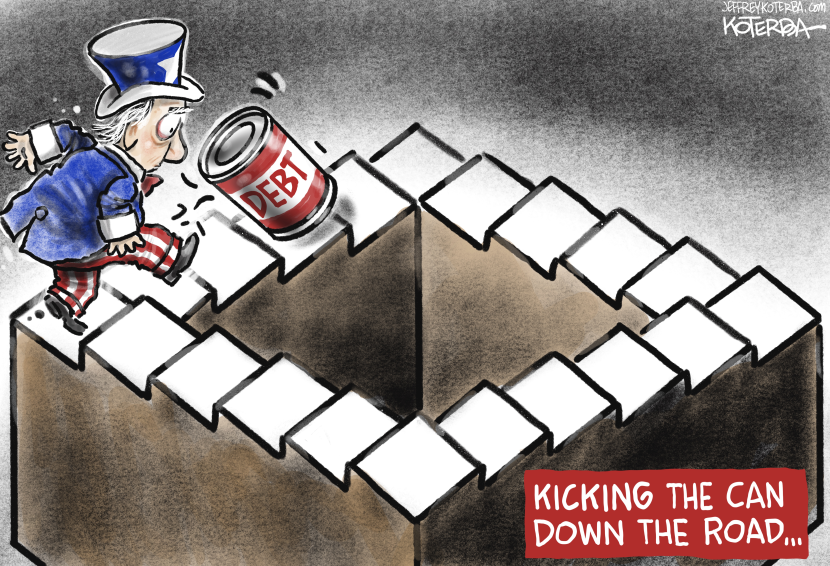
I argued a dozen years ago that we had to get our spending and debt back in order, but since then our reckless government — both Republicans and Democrats — has more than doubled our debt from $12 trillion to just under $29 trillion.

Now that pet ownership has soared during the COVID pandemic, spending on pets is at an all-time high.

The HAPPY Act didn’t become law in 2009, though, as Forbes reports, some tax deductions are available to some pet owners, such as those who have emotional support animals or earn income from pets with names like Lassie.

But as much as I’d love to have a sweet $3,500 tax deduction to offset the costs of caring for my best buddy, Thurber, I still could never support the idea.

If current legislators don’t stop imposing well-meaning, feel-good ideas on our bloated budget, someone should bop them upside their heads with a rolled-up newspaper.

Copyright 2021 Tom Purcell, distributed exclusively by Cagle Cartoons newspaper syndicate.

Tom Purcell is an author and humor columnist for the Pittsburgh Tribune-Review. Email him at [email protected].
Comments Off on Just Say No To Unaffordable Spending

A Tradition To Be Thankful For

I love pumpkin pie — but not just any pumpkin pie.

It has to be my mother’s pumpkin pie, made with her unique thick and dry crust, and it has to be enjoyed only on Thanksgiving Day.

It’s a Purcell family tradition, after all, and tradition is the reason Thanksgiving is my favorite American holiday.

The very first recorded Thanksgiving occurred in November 1621 when the Plymouth colonists enjoyed their first corn harvest and invited the Wampanoag to share a three-day feast to give thanks for their bounty and to express their gratitude to the tribe for helping them adapt to, and survive in, the new land.

According to History.com, there’s some controversy over the first Thanksgiving.

Similar events may have taken place earlier in other parts of North America and, given the bloody conflict among Native Americans and European settlers that took place over many years, there’s also disagreement about how peaceful and friendly the first thanksgiving really was.

For the next few centuries, as America flourished, individual colonies and states celebrated various kinds of thanksgiving events.

It didn’t become an official holiday until 1863, when, in the midst of the destructive Civil War, President Abraham Lincoln proclaimed a national Thanksgiving Day to be held each November.

It didn’t take much time after that for Thanksgiving to evolve into its current customs and formalities.

My great grandfather, who came to America from Ireland in the 1880s and his wife, whose parents came from Alsace Lorraine, likely celebrated it the same way my extended family still celebrates it.

They ate too much turkey, mashed potatoes and gravy, cranberry sauce and fresh-made muffins.

They found room for a piece of pie covered in whipped cream, then sat around the messy dinner table sipping coffee, talking and laughing and feeling thankful for their bounty.

Their tradition didn’t involve NFL football games, as ours now does, nor my mother’s version of pumpkin pie.

Truth be told, the staples that many of us enjoy each Turkey Day were not a part of the first Thanksgiving.

In 1641, when Governor Bradford wrote a book about the history of the Plymouth settlement, he described the bountiful spread at the first Thanksgiving.

He wrote that the settlers and the Wampanoag consumed geese, duck and venison — and likely lobster, seal and swans.

They had no potatoes, since they didn’t yet grow in North America.

There was no cranberry sauce, because the colonists didn’t begin boiling berries with sugar until 1671.

There wasn’t any bread because they had no ovens. And though pumpkins were plentiful, it’s doubtful they had the butter and wheat flour they needed to make pie crust.

So how did the country end up with a day devoted to gorging ourselves on turkey and all the fixings?

In the late 1840s through the 1860s Sarah Josepha Hale, an editor of a popular magazine, lobbied hard to have Thanksgiving proclaimed a national holiday. She succeeded.

She also published many recipes that featured the turkey and trimmings that are now the core of the traditional Thanksgiving meal.

But the specifics of how we arrived at our annual Thanksgiving feast are not so important.

What’s important is that the day always be a common celebration that unites Americans — a day in which we honor past generations and pass on our shared, ever-evolving rituals to the next.

Now if you’ll excuse me, I have a piece of pumpkin pie to devour!

Copyright 2021 Tom Purcell, distributed exclusively by Cagle Cartoons newspaper syndicate.

Tom Purcell is an author and humor columnist for the Pittsburgh Tribune-Review. Email him at [email protected].

Comments Off on A Tradition To Be Thankful For

Give Thanks for Our Blessings, Big and Small

Because life is mostly made up of little experiences, occasionally interrupted by big events, it’s easy to take the little things for granted.

But Shutterfly, the photography and image-sharing company, offers a list of 100 things, large and small, that we ought to single out for our gratitude this Thanksgiving.

Our homes, our incomes and our savings are three large items to be thankful for — especially if we still have them after nearly two years of a pandemic.

Clean water is something we take for granted in America, but much of the world lacks it, reports the Republic.
We take our indoor plumbing and electricity for granted, too.

We expect the lights to go on when we flip a switch, potable water to flow when we open a faucet, or the toilet to flush when a lever is pulled.

Most Americans have access to excellent healthcare.

Sure, it’s expensive and our government has been incapable of improving it through much-needed meaningful reforms, but if we experience a health scare or get into an accident, most of us will be given the best of care.

Technology innovation is a big blessing.

It allows millions to work from home, rather than the office, and, aside from the rancor and divisiveness enabled by social media, it will solve many more problems than it creates, and already is, according to Asia’s online training platform EDUCBA.

Then there are the really big little things to be thankful for — like pizza.

I don’t know that I’ve ever met anyone who doesn’t enjoy it. It’s festive and delicious and crosses party lines. No matter how bad our political divisions get, pizza can bring us together.

How about coffee?

To me, this is one of life’s greatest little experiences and one I enjoy twice every single morning.

The process of making coffee, the wonderful scent that fills the air as it drips into my mug, the waiting until the temperature is just right before enjoying the first glorious sip…

And bacon.

Sure, it’s a bit controversial for some, and it’s an early victim of growing inflation, but we can still run down to the convenience store for a dozen eggs and a package of bacon and life is good all morning long.

Then there’s the afternoon nap.

Covid’s working-from-home revolution has enabled the greatest increase in afternoon mental agility in the history of napdom.

And the belly laugh.

It comes easily to the young as they frolic. We forget that we don’t do enough of it as adults — until we gather with our childhood friends and enjoy many much-needed belly laughs.

Now more than ever we need more belly laughing in America to disrupt our seriousness and political anger, which is resulting in a narrow understanding of current events and our fellow human beings.

Freedom of speech is certainly one of the biggest things we Americans should be grateful for at Thanksgiving — and every day — but it’s something too many of our fellow citizens are trampling on.

We all need to renew our understanding of the importance of free speech and why it’s so crucial to a civil, well-functioning and clearer-thinking republic.

In any event, whether it’s for something as large as free speech or as small as pizza, giving thanks for our blessings is good for our health, according to the Harvard Health Publishing. Gratitude makes us happy.

Which is why we must go out of our way to embrace it this Thanksgiving.

Copyright 2021 Tom Purcell, distributed exclusively by Cagle Cartoons newspaper syndicate.

Tom Purcell is an author and humor columnist for the Pittsburgh Tribune-Review. Email him at [email protected].

Comments Off on Give Thanks for Our Blessings, Big and Small


Never Forget Our Vets

My dad’s hearing was damaged more than half a century ago when, as a young man, he trained to be an Army military policeman during the war in Korea.

MPs were required to qualify for every weapon, including the exceptionally loud .50 caliber machine gun.

One day, while congested with a cold, the concussive impacts of the gun’s noise caused blood to seep out of his nose and ear.

His hearing would never be the same and it grew gradually worse until he went completely deaf in his left ear before he was 45.

For years, he and my mother tried to apply for care from the Veterans Administration, but after going through the lengthy bureaucratic application process, they were never approved.

It wasn’t until a year ago, in his 87th year, that my sister completed some VA applications to see if any assistance was available.

Truth be told, none of us expected he’d receive any help.

Our understanding, shaped by my parents’ prior experiences and a series of negative news stories over time, was that the VA — now named the Department of Veteran Affairs — wasn’t going to be the place to go to get better care than he was already getting.

Thankfully, we were wrong.

The VA arranged assessments with a hearing specialist and a retired primary care doctor who had both contracted with the VA. This time, its bureaucrats determined that my father qualified for a top-notch hearing aid that was far superior to the devices he’d been buying.

I was with my dad during these VA medical assessments and everything was incredibly professional and thorough.
Our waits in the VA’s waiting room were never more than 15 minutes, and they always offered a glimpse into the lives of other veterans, whose lives had been impacted by their service.

Some were in wheelchairs and missing limbs.

Some, like my father, were elderly and finally getting treated for issues that happened long ago.

Some were younger and dealing with severe mental-health effects after serving tours in Afghanistan and Iraq — and they need help, as veteran suicide rates are at an all-time high.

Our government owes these vets the very best medical treatment, but, until recently, they didn’t get it.

Though improvements finally began to happen seven years ago in response to the VA’s scandal over the long wait times vets had to regularly endure, the VA still must do better.

Congress authorized the temporary Choice Act in 2014 to allow vets to see private doctors outside of the VA’s system, but it wasn’t until the bipartisan 2019 Mission Act that things got much better.

The act established the Veterans Community Care Program that allows vets to receive primary care and mental health services outside the VA system through non-VA providers in the local community.

A subsequent survey found that more than 80 percent of vets were satisfied with their VA care, reports the VA website.

Those improvements at the VA were long overdue and must continue for all veterans, but will they?

According to Military Times, the VA recently announced it is phasing out its office in charge of community care programs, “a move that some advocates are decrying as unfairly limiting veterans’ medical options….”

I don’t know what the VA’s current leaders are planning, and I’m not sure I trust them.

But I do know that the men and women hurt in our wars should be honored and thanked every day, not just Veterans Day — and must never again be forced to wait months for the medical care they deserve.

Copyright 2021 Tom Purcell, distributed exclusively by Cagle Cartoons newspaper syndicate.

Tom Purcell is an author and humor columnist for the Pittsburgh Tribune-Review. Email him at [email protected].

Comments Off on 
Never Forget Our Vets

A Good Month to Grow a Beard

November has arrived and things are going to really get hairy now.

Every November, two charitable organizations I like, Movember and No-Shave November, raise funds by encouraging people to not cut or shave their hair.

Movember began in Australia in 2003 when two friends joked about bringing back the moustache (or “mo”) as a male fashion trend.

Inspired by a friend’s mother who was fundraising for breast cancer, they decided to create a Movember campaign in which men grow moustaches to raise funds for men’s health and prostate cancer.

No-Shave November “is a month-long journey during which participants forgo shaving and grooming in order to evoke conversation and raise cancer awareness,” according to the organization’s website.

It was formalized in 2009, after Matthew Hill passed away from colon cancer and his eight children created the charitable organization to raise funds for cancer research.

Both organizations have made November a very fun month as people share photos of their thickening facial hair on social media.

I’ve grown a goatee a few times over the years, but never went full beard until covid turned half the country into homebodies.

Not having to shave every morning was a gift from the heavens.

But an unexpected benefit of sporting a thick, graying beard was that strangers finally give me some respect — as though I am a college professor or some kind of dignitary.

Bearded, I look like the type of fellow who would never default on a bank loan or who can explain how the Federal Reserve works.

(I have no idea how the Federal Reserve works. However, to my credit, neither does the Federal Reserve.)

I’m a big fan of the beard and both charities but there are always going to be those who rain on our parade.

In 2019 a spate of beard-bacteria stories hit the news with headlines like this one in the Daily Mail UK:

“Men with beards carry more germs than DOGS with deadly bacteria in their facial hair, study reveals.”

I wonder if that study included dogs with beards.

In any event, some previous beard studies found differing conclusions.

Medical Daily reported in 2016 that beards may actually help fight infection — and that even if a beard were to trap some bacteria all a fellow needs to do is wash it on a regular basis.

Which brings us to the war against covid and our biggest anti-beard crusader, our beloved federal government.

“Certain types of facial hair, like beards, can make mask-fitting difficult,” according to the CDC. “To have a better fit, people with beards can shave their beards or trim their beards close to the face.”

The CDC goes into painstaking bureaucratic detail to explain which of 46 beard styles are medically acceptable, reports CNN.

Most beard styles are frowned upon, but a few, such as the “toothbrush” — the small moustache made famous by a certain Nazi dictator — get the CDC’s thumbs up.

That makes sense, I guess, since top-down, big-government socialism is becoming popular of late.

Anyhow, with all the mixed covid messages government public health experts have given us the past year and a half, I’m not sure what guidance to follow anymore.

I do know this:

If our health experts want us to trust their guidance more, maybe they ought to grow dignified beards.

Copyright 2021 Tom Purcell, distributed exclusively by Cagle Cartoons newspaper syndicate.

Tom Purcell is an author and humor columnist for the Pittsburgh Tribune-Review. Email him at [email protected] p

Comments Off on A Good Month to Grow a Beard

Memories of a Non-Political Halloween

Halloween was fun while it lasted.

For decades it has been the one day of the year we could all forget our worries and live in the moment.

When I was a kid in the 1970s, Halloween was for kids.

As the weather became chilly and the leaves turned brilliant colors, we knew our annual candy haul would happen soon.

We didn’t put much effort into our costumes — any old sheet could be converted into a ghost outfit — but planning our trick-or-treat route took hours.

Since our parents wouldn’t let us begin trick or treating until it got dark out — and since we had to be home before 8 p.m. — Tommy Guillen and I refined our routes every year with the intensity of logistics executives.

We’d hit the well-to-do homes on the other side of the railroad tracks first.

Those people gave away full-size delicacies, including Hershey’s, Nestle Crunch, Milk Duds, Almond Joy, Snickers, Milky Way, Reese’s Peanut Butter Cups and my favorite, the Mallow Cup.

The only downside with well-to-do people was that, because their homes are farther apart, we had to travel a greater distance to earn that name-brand candy.

We’d then return to our own neighborhood of modest homes and then hit the small post-WWII ranch homes a few blocks away.

The wonderful people who lived in those houses had only one minor flaw: they favored the budget-conscious, locally made Clark Bar, which was made of peanut-butter taffy and a chocolate coating.

As an adult, I love Clark Bars and love that they are still being made 104 years after they were launched. But as a kid, they weren’t as valuable to me. I’d have to trade 10 of them to get a single Reese’s Peanut Butter Cup.

I’m incredibly nostalgic about my old trick-or-treating days.

To this day, when I enjoy an occasional candy bar, the taste immediately transports me back to 1972 and the wonderful memory of arriving home with a pillowcase full of sugary loot, my feet raw from the effort.

Here’s why I am especially nostalgic about my childhood Halloween memories: it was a time when kids were free to be kids — free to explore, create and blossom — completely unburdened by the worries of the adult world.

In 1972, the Watergate scandal was in full swing, Bloody Friday bombs were exploding in Belfast and the last U.S. ground troops were being withdrawn from Vietnam.

But as those and other awful experiences played out in the wide cruel world, we kids were free to completely immerse ourselves in our innocent and uncomplicated Halloween traditions.

In recent years adults have grown to enjoy Halloween.

Until recently, it was the one day when they, too, could dress up in ridiculous costumes — costumes that often satirized current events or mocked people in the news in very funny ways — and really let themselves have fun.

But now, thanks to the fun-crushing power of social media, those days are over, too.

Politics has infused itself into every waking moment of our lives, including Halloween.

Some schools are canceling Halloween parties and parades. The media offer guidance on what costumes are politically and socially unacceptable.

Everyone is on guard, worried that he or she may be recorded doing or saying something politically incorrect that inadvertently offends somebody else.

It’s become a very bad idea to let yourself have too much fun, or one too many adult beverages, at a Halloween gathering.

As I said, our Halloween fun was good while it lasted.

Copyright 2021 Tom Purcell, distributed exclusively by Cagle Cartoons newspaper syndicate.

Tom Purcell is an author and humor columnist for the Pittsburgh Tribune-Review. Email him at [email protected].

Comments Off on Memories of a Non-Political Halloween