Old family photos bring new perspective

My mother and father keep our old photos in their hall closet in a sturdy old Pabst Blue Ribbon box.

Sifting through old photos is a glorious experience — one, we now know, that relieves aches and pains by calming the brain, according to a recent study.

The last time I looked through the box with my mother, we came across a black-and-white photo of a little girl.

That photo was taken 82 years ago, when the girl had her whole life before her.

Elizabeth Hartner Purcell at two years of age.

She didn’t know yet that one of her sisters would be struck with polio 12 years later, that her father would die at 49 just a month before her wedding, that she’d have six children and 17 grandchildren, or that she’d outlive two of her six siblings.

That was my mother’s picture. It was taken when she was 2.

Today we take photos on a daily — or hourly — basis. But before the era of smart phones, photos were taken mostly to document special occasions.

The old black-and-white photos often show family members in formal attire posing for graduation portraits, weddings and other important events.

Many require the help of our eldest family members to identify who the people in the photos are.

I found my father’s black-and-white high school graduation photo. He was trim and handsome with a thick head of hair. The photo had red coloring around his lips.

When I asked my mother what the coloring was, she told me it was her lipstick — that she kissed the photo every day while my father served overseas during the Korean War.

One of my favorite photos is a black-and-white photo taken of my dad’s father and mother at a Lake Erie beach in the 1920s.

My grandfather, who died way too young in 1937 at the age of 34, wore a swimsuit that had a top, as was the fashion of that time.

I bear my grandfather’s full name — Thomas James Purcell — as does my dad.

I always wished I got to meet him, as I heard many stories from other family members, now gone, who got to experience his generosity and humorous spirit.

My grandfather’s photo causes considerable pause because, I now realize, his time on this earth wasn’t so long ago.

When I was born in 1962, my grandfather would have been 59 — my age right now.

I know now that the years go by way faster than I ever anticipated — and that a typical lifespan is but a blip in time.

I remember as though it were yesterday what it was like to grow up in the 1970s — how can that be a half-century ago?

It wasn’t so long ago that I was born — which means 59 years before I was born wasn’t so long ago, either.

That takes us to 1903 when cars were just being put into production and the airplane was just invented.

Penicillin wouldn’t be used until 1945 — eight years too late to cure my grandfather from the strep infection that claimed his life.

The people in our family photo box experienced great economic booms and busts, five wars and many technological miracles.

The old photos bring a perspective and calm.

They help me realize how precious our time is and make me want to work harder to leave the world a better place than I found it.

Because the time is not so far off when one of my descendants will point to a digital photo of me and ask his mother, “Who’s that man in this old photo, Mom?”

Copyright 2022 Tom Purcell, distributed exclusively by Cagle Cartoons newspaper syndicate.

Tom Purcell is an author and humor columnist for the Pittsburgh Tribune-Review. Email him at [email protected].

Comments Off on Old family photos bring new perspective

Ukraine’s Hero in Chief  

Their bravery inspires.

As I sit safely in the cozy office in my home writing this column, the people of Ukraine are greeting Putin’s massive military invasion with incredible defiance and courage.

Their president, Volodymyr Zelensky, reportedly rejected an offer to evacuate to safety in the U.S. — despite reports that Putin hired mercenaries to assassinate him.

His response: “I need ammo, not a ride.”

Zelensky’s story reads like a Hollywood screenplay.

He was born to Jewish parents in the Russian-speaking industrial city of Kryvyi Rih.

He earned a law degree but never worked in the legal world, because, at 17, he and his friends created a comedy troupe that became very successful in Ukraine.

Zelensky played a zany and silly character in many sketches. He acted in movies before creating a TV show, “Servant of the People,” in 2015 in which he plays a history teacher who rails against government corruption.

Without his knowledge, one of his students records one of his rants and releases it on social media. The recording goes viral and the teacher is elected president of Ukraine by a people hungry for freedom and a functioning democracy.

Zelensky’s real-life story followed a similar vein.

In 2018 his television company established a political party also named “Servant of the People.” In 2019, running as an anti-corruption and anti-establishment candidate, he won the presidential election in a landslide.

Much like the humble, everyman character he played on TV, he stumbled some early in his presidency.

The New York Times says he “was often derided as a comic turned unlikely politician” but has emerged as the “leader Ukraine did not know it needed.”

“Mr. Zelensky’s decision to remain in the capital, Kyiv, while it’s under Russian attack — and his family’s decision to stay in Ukraine — has moved many, particularly in contrast to the Afghan president, Ashraf Ghani, who fled Kabul as soon as the Taliban were on the outskirts, demoralizing what was left of the Afghan army,” reports the Times.

At 44, his heroic leadership is inspiring his people to fight for the freedom, independence and democracy they clearly hunger for.

Acts of courage and defiance are happening throughout Ukraine.

According to BuzzFeed News:

– A group of border guards who defied a Russian warship order were captured or killed.

– A military unit took on 34 Russian attack helicopters and dozens of paratroopers during a battle for a key airport.

– A Ukrainian soldier rigged a bridge to blow up in order to stop a Russian advance on Kyiv and sacrificed his life to ensure the blast was successful.

– Civilians laid down in front of rolling Russian tanks and berated occupying troops to their faces.

– Tens of thousands of civilian volunteers have taken up arms and are rushing to the frontlines.

The world marvels at the countless acts of courage that are taking place in Ukraine because the Ukraine people want to be free.

It makes you wonder: if your country was being invaded by a massive military force, would you put your life at risk to fight the aggressor?

I’d like to think I would have the incredible courage to stay and fight as Zelensky has.

Lucky for me, I live in a country in which such brave decisions were made by people long ago, so that I and millions of others can live in freedom — a freedom we must cherish and protect.

Zelensky reminds us all that the price of freedom is steep.

I am praying for him and his country.

Copyright 2022 Tom Purcell, distributed exclusively by Cagle Cartoons newspaper syndicate.

Tom Purcell is an author and humor columnist for the Pittsburgh Tribune-Review. Email him at [email protected].

Comments Off on Ukraine’s Hero in Chief  

Four-day workweek? I wish.  

Three-day weekends sound good to me.

According to Business Insider, a movement is afoot for companies to offer employees four-day work weeks — 10 hours a day over four days, rather than eight hours over five days — so they may enjoy three-day weekends.

More employers say that a four-day work week will help them retain and attract employees who, during COVID, reported “working longer, taking fewer breaks, and signing on at all hours of the day and night.”

COVID exposed millions of new work-from-home employees to the experience that the growing class of self-employed gig workers have been living for some time.

The era of going to an office, putting in your eight hours, then leaving your work worries behind ended for millions of workers long ago.

Computers, email and virtual meetings allowed office workers to ditch their traditional jobs working for one employer to provide on-demand services — such as copywriting or software engineering — to multiple clients located anywhere in the world.

These devices also result in working longer hours, taking fewer breaks and signing in at all hours day and night — but individuals are free to choose how many hours they want to work and how many breaks they want to take.

To be sure, the line between one’s work life and one’s personal or leisure life have been forever blurred.

So it is interesting to revisit how the 40-hour work week became the working standard in the first place.

As industrialization transformed America, millions worked long hours on assembly lines and often in very unpleasant and unsafe circumstances.

According to PBS, when the U.S. government began tracking workers’ hours in 1890, the average workweek for full-time manufacturing employees was an exhausting 100 hours — prompting the growth of the labor movement.

By the early 1900s some private companies, such as Ford, had begun to adopt the 40-hour standard, but it wasn’t until 1938 that the federal government got involved.

Congress passed the Fair Labor Standards Act, which limited the workweek to 44 hours in specific industries. In 1940 Congress amended the Act, limiting the workweek to 40 hours.

The Fair Labor Standards Act of 1938, which covered about a fifth of the country’s workforce,  also established a minimum wage (25 cents an hour), overtime pay and put an end to oppressive child labor.

Though government policy was helpful in a highly industrialized era when millions worked in awful and unsafe conditions, should the government butt into the digital workplace debate in 2022?

According to U.S. Today, one U.S. congressman proposed a bill to amend the Fair Labor Standards Act and mandate a 32-hour work week as the new standard — employers will have to pay overtime for any hours beyond 32.

As the world of work gets ever more individualistic and creative — as organizations that need services are able, thanks to technological innovation, to engage a variety of different talents and skills to address their needs — is another one-size-fits-all federal mandate really a solution?

Or will it be the source of multiple unintended problems?

This self-employed gig worker is of the latter opinion.

Now if you’ll excuse me, I have to get back to my work life of long hours, infrequent breaks and signing in at all hours of the night — a work life I have happily and freely chosen.

Copyright 2022 Tom Purcell, distributed exclusively by Cagle Cartoons newspaper syndicate.

Tom Purcell is an author and humor columnist for the Pittsburgh Tribune-Review. Email him at [email protected].

Comments Off on Four-day workweek? I wish.  

Social Insecurity

A quarter of a million dollars.

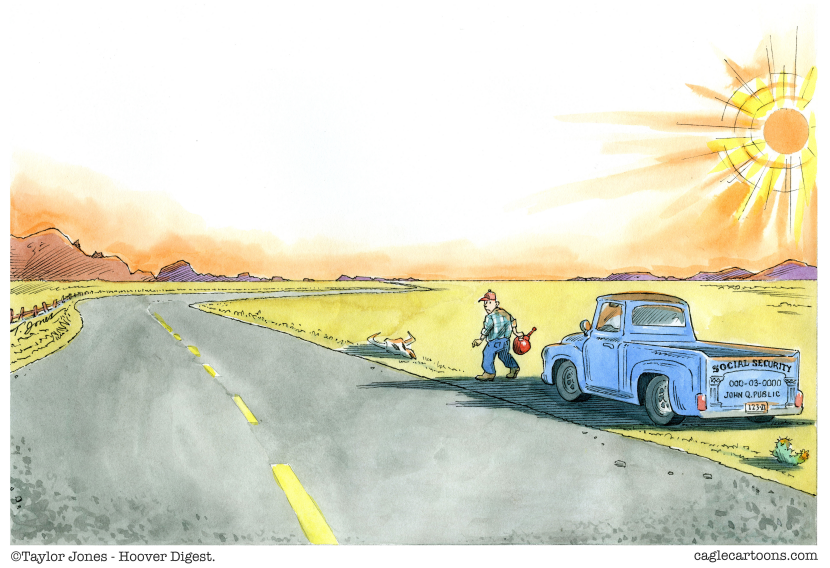
That’s the amount that I’ve paid in FICA payroll taxes during my working career, according to my recent Social Security statement.

FICA, which stands for “Federal Insurance Contributions Act,” “is a payroll tax that helps fund both Social Security and Medicare programs, which provide benefits for retirees, the disabled and children,” says the Social Security Administration (SSA).

The FICA tax also will partially fund — at least I hope it will — my retirement years.

My statement says I am eligible to begin receiving Social Security payments of $1,851 a month when I hit age 62.

If I wait until I am 70, I’ll receive $3,370 a month — which is a nice little chunk of dough.

However, if I had invested the $250,000 FICA deducted from my earnings on my own, I’d have, according to my money manager, more than $1.5 million socked away.

If I drew a conservative 4 percent of that $1.5 million every year, I’d be collecting a $5,000 retirement check every month right away.

Of course, that is assuming I would have saved and invested all the money that FICA took from my weekly paychecks.

More likely, me knowing me, I would have blown most of it on nicer cars and more vacations.

Saving money for your future is hard, even for more-disciplined people.

My parents raised six kids on one income and had a lot of big bills along the way, so saving money for the future was not always possible.

They now rely on the Social Security payments they receive every month to help them cover their basic expenses.

Millions of elderly Americans are in the same precarious financial boat.

The Social Security Administration reports that about 40 percent of Americans 65 and older receive half of their retirement income from Social Security — and about 13 percent rely on it for 90 percent or more of their income.

It takes some of the sting out of the 15.3 percent FICA tax that is imposed on my self-employed earnings to know that my contributions are helping others get by in their old age.

But will Social Security be around to help me in my old age?

Social Security is now paying out more than it is taking in and the funds working taxpayers contribute now go directly to Social Security recipients.

But what about the Social Security “trust fund,” which saved trillions of the surplus tax contributions that had rolled in for years?

The partially good news is that it will not run out of money until 2034 — at which time Social Security payments will have to be reduced, taxes will have to be raised or more money will have to be borrowed.

The bad news is that its funds were “invested” in government bonds, which the federal government happily spent on day-to-day budget expenses, such as foreign wars, food stamps and the national debt.

As the great columnist Charles Krauthammer explained in 2011, the Social Security trust fund is filled not with money but with special-issue government IOUs that can only be repaid by raising taxes or borrowing even more money.

In any event, it’s anybody’s guess how much my monthly Social Security checks will be, so let me make the guys at the Social Security Administration an offer.

How about you give me back my 250 large in return for removing me from your rolls?

What do you say, SSA?

Hello?

Copyright 2022 Tom Purcell, distributed exclusively by Cagle Cartoons newspaper syndicate.

Tom Purcell is an author and humor columnist for the Pittsburgh Tribune-Review. Email him at [email protected].
Comments Off on Social Insecurity

The Scandalous Silence about China

It’s possibly the only scandal we are allowed to discuss.

In 2015 the peaceful and tiny world of competitive curling was rocked by a broom kerfuffle that sent the ancient sport reeling.

Curling — which is currently getting its quadrennial global TV exposure at the Winter Olympics in Beijing — is a civilized, nonviolent sport invented in 16th Scotland.

As described by Britannica, in curling two teams of four players compete by sliding heavy stones — concave on the bottom with a handle on the top — across the ice with the goal of each team getting its stone closest to the center tee or button.

Each player takes turns delivering two stones, while two other members of the team use brooms to sweep the “pebbled” ice — thus altering the ice’s smoothness and temperature — to guide or “curl” the stones to their desired destination.

The sport’s jovial nature turned bitter in 2015 when some players began using brooms with advanced fibers and brush-head inserts that significantly enhanced their ability to alter the stone’s course.

Smithsonianmag.org reports that, according to critics, the rougher fabric on the new broom heads “can too easily change the way a curling stone moves down the ice, negating the precise moves and strategies that players use.”

A fierce hullaballoo resulted.

“The resulting explosion caused a stream of accusations, agreements, broken agreements… even some near-fisticuffs,” reports theCurlingnews.com.

Some players conducted on-ice experiments to show that the new brooms made it so much easier to alter the direction of the stones that a team of hack amateurs could use them to outplay a team of seasoned pros.

The World Curling Federation addressed and resolved their broom scandal with grace and transparency and today there’s one standard fabric used for all brushes in sanctioned championship events.

I bring up the “Great Curling Scandal of 2015” because that minor scandal was fully debated and settled out in the open.

Compare that to the major scandal going on right now at the Winter Olympics in China — where oppressive behavior by a dictatorial government is a daily reality for 1.4 billion citizens.

As the autocrats in communist China commit genocide on Uyghur Muslims, punish dissidents and jail or “disappear” any citizens bold enough to criticize their government’s repressive policies, the expected response is silence — by everyone.

The International Olympic Committee and political and business leaders are eager for the world to look the other way.

We don’t want to upset the people in charge of the fastest growing consumer market in the world, after all, when our global corporations, our politicians investing in China-related stocks and many others like Nike and the NBA have so much money to make there.

Athletes competing in the winter games who routinely use their public platforms to criticize wrongs in open countries are warned by House Speaker Nancy Pelosi that their safety may be at risk if they criticize China’s policies.

The best our spineless political leaders could do to protest China’s notorious human and civil rights violations was cobble together a diplomatic boycott that will keep an official U.S. government delegation at home.

Meanwhile, this loud silence about China’s genuinely scandalous actions is beyond shameful.

It allows its autocrats to use the Olympics to polish its international status while the IOC and global leaders skirt a golden opportunity to use the Olympics to spotlight China’s abuses and demand change.

As I said, the curling scandal of 2015 is possibly the last scandal we are allowed to discuss.

Copyright 2022 Tom Purcell, distributed exclusively by Cagle Cartoons newspaper syndicate.

Tom Purcell is an author and humor columnist for the Pittsburgh Tribune-Review. Email him at [email protected].

Comments Off on The Scandalous Silence about China

Thin mints should be our next government ban

The federal government should ban them.

Girl Scout cookie season is upon us, my friends — the most agonizing of all the seasons.

Dieters with ever-worsening health like me who need to lose weight are always at the mercy of those devilish treats — as thin mints are clearly as addictive as nicotine.

This year, thanks to COVID madness, our challenge is greater than it has ever been.

Millions of us haven’t put a dent in removing the significant weight we put on in years one and two of our stay-at-home isolation.

When it comes to dieting, I’ve long suffered from a Dr. Jekyll and Mr. Hyde syndrome.

I am either really fit and healthy and spending hours at the gym or I can be found cruising the junk food aisles at bulk-warehouse stores, loading up on the salty and sweet snacks I’ll devour while binge-watching streaming content on Netflix.

Thanks to two years of sloth and diet abuse, the COVID pandemic has really set me back in the health and fitness department.

But in the last few weeks I’ve been eating right, exercising in my new home gym and going on regular long walks with my best buddy, Thurber, my yellow lab.

And now, just as I am on the cusp of making my new healthy-living routine permanent, I am greeted — that is, accosted — by a cabal of Girl Scouts stationed outside the entrance of my local grocery store.

Which is why, for our greater good, Girl Scout cookies must be banned, cancelled, de-platformed, whatever, by the federal government.

Look, calling for such a ban is no longer so crazy. There’s recently been many crazy emergency government edicts in the pursuit of health.

As COVID-19 began its spread in early 2020, federal, state and local government bodies shut down many of our businesses, closed schools and dictated our behaviors.

For months we were required to wear masks over our noses and mouths indoors and outdoors — only to recently discover that the blue cloth masks most of us wore were useless facial decorations.

The Biden administration even issued a vaccine mandate on all businesses with more than 100 employees — a mandate it withdrew only after the Supreme Court ruled that it exceeded the president’s constitutional authority.

Meanwhile, any doctor, scientist or podcaster who has had questions about the efficacy of the vaccines or the government’s COVID decisions has been labeled by the government, the media, the big social media platforms and aged ‘60s rock stars as a heretic who must be silenced.

To be sure, there will always be kooks spewing conspiracy theories in our digital world and the misinformation they share can be ridiculous and even harmful.

But what happened to the rational, open, level-headed pursuit of scientific truth?

Isn’t there a lot of COVID data and evidence yet to sort through?

Considering the magnitude of this deadly global problem, isn’t there a lot of science yet to do and scientific theories yet to study and test?

I’ll leave it up to our government leaders and experts to answer such questions.

But since the authorities in charge have issued so many arbitrary and often discredited COVID bans and mandates in the interest of public health, I don’t think it’s asking too much that they ban the sale of Girl Scout cookies next.

The words “Girl Scout cookies” are horrible emotional triggers to chubby COVID victims like me.

Since millions of us are powerless to avoid these tasty treats — thus making them a public health nuisance — our government must ban them next.

Copyright 2022 Tom Purcell, distributed exclusively by Cagle Cartoons newspaper syndicate.

Tom Purcell is an author and humor columnist for the Pittsburgh Tribune-Review. Email him at [email protected].

Comments Off on Thin mints should be our next government ban

Beating Inflation Is Laughable

In these inflationary times it’s not easy to laugh as you watch the value of your hard-earned savings being destroyed.

But I chuckled out loud when I read some of the tips offered by Bloomberg News to beat inflation, which is at its highest point in more than 40 years.

Since Americans have enjoyed low inflation and stable consumer prices for a long time, Bloomberg explains, Americans are “a little rusty on basic inflationary-era tactics.”

Bloomberg turned to the long-tortured people of Argentina for guidance, as they have become experts at navigating hyperinflation rates as high as 50 percent in a typical year.

The tips the Argentines offer are the polar opposite of everything my Depression-era parents taught my sisters and me about managing our money — nutty tips that suddenly make sense in a nutty world.

Here’s the first one: spend your paycheck immediately.

Why put money in the bank where its purchasing power will decline in value every day, when you can buy a new refrigerator, sofa or some other big-ticket item that will cost more a month from now?

In these goofy times, the sooner you buy it, the less you will pay for it.

Another tip: borrow lots of money.

If you can borrow a million today at a 3 percent annual rate and the inflation rate continues at 7 percent, you will enjoy a 4 percent gain.

That is, as today’s dollars inflate, it will be easier for you to repay the loan in the future.

Even this English major can see that makes sense — sort of.

Another tip: buy cars.

That was certainly my strategy in my spendthrift 20s, when I lived paycheck to paycheck, in part because I always had to have a nice ride that I couldn’t afford.

I can’t believe any news outlet would encourage Americans to put their money into automobiles, traditionally a horrible, rapidly depreciating investment.

But in a world turned on its head — there is a shortage of cars due to a shortage of computer chips used in their manufacture — even new and old cars are soaring in value.

My father has lost a fortune in cars over his lifetime, as they depreciated 30 percent or more the day he drove them off the car lot.

Finally, he got lucky. He leased a 2020 Kia. A year from now when his lease is up he will make the payoff of $13,500 and keep the car because it will be worth significantly more than that.

Bloomberg offers some traditionally sensible tips, such as buying inflation-linked bonds, which increase in value as inflation increases.

Bloomberg also suggests buying a home, which also makes sense, as a house is a great hedge against inflation. Though good luck finding one at a reasonable price, as housing values have soared.

Covid has caused considerable market disruptions that have contributed to rising prices and our inflation woes.

The federal government’s stimulus spending, massive borrowing and especially its continuous money printing are major drivers of inflation.

I wish we had confidence that our political leaders had a sound strategy to solve this problem — a problem largely of their own making — but we don’t.

I’m surely not alone in my worry that financial matters may get plenty worse before they get better.

Until then I’ll demonstrate my investor acumen by squandering my hard-earned savings on a shiny new car I can’t afford.

Copyright 2022 Tom Purcell, distributed exclusively by Cagle Cartoons newspaper syndicate.

Tom Purcell is an author and humor columnist for the Pittsburgh Tribune-Review. Email him at [email protected].

Comments Off on Beating Inflation Is Laughable

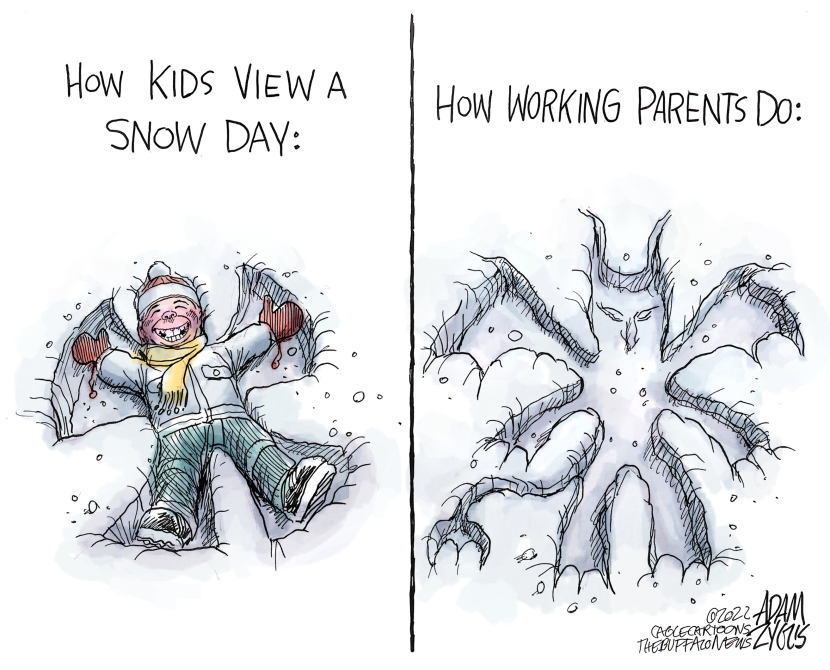
It’s time to cancel ‘snow days’

“Snow day.”

Those were once the two most glorious words ever uttered on an early morning radio broadcast.

When I was a kid in the ‘70s, it was pure heaven to wake to snow-blanketed hills, then tune into Jack Bogut’s KDKA morning show, praying he’d say our suburban school district was closed for the day.

As soon as our snow day was granted, we’d grab a bowl of cereal, layer up our clothing, then hit the sledding slopes for hours.

So I read with interest — and sadness — that many school districts across the country are putting an end to snow days.

Thanks mainly to remote learning technologies, bad weather and other emergencies are no longer reasons to shut down schools.

Technology has made the snow day a relic of our past, but why should it be the only relic of our educational system to go?

Why, for example, do kids still get 10 weeks off from school every summer? Are they still tilling fields and tending to livestock?

Education experts know that a long summer away from school causes learning loss among most students, as their math and reading skills regress.

This is particularly true among poorer students whose families cannot afford things like the  summer learning programs wealthier kids enjoy.
But what about using those 10 weeks of summer for learning gain?

What about radically reforming how, where and when we teach our kids, so that we  produce minds that are eager to learn, that think critically and that are nimble and creative so they may flourish in our modern knowledge economy?

According to an article in the Foundation for Economic Education, the current public education approach — 20 or 30 kids of the same age stuffed into a classroom and led by one teacher — is about 150 years old.

“Even though the curricula have developed, the essence has stayed the same,” reports Paul Boyce at FEE.org. “Children are still taught in a standardized and industrialized way.”

That standardized and industrialized way — which American educators imported whole from the fun-loving folks of Prussia in the late 1800s — sure didn’t capture my attention as a lad.

I spent much of my classroom time daydreaming and staring out the window — and getting my knuckles wacked for not keeping up with my Catholic school teachers.

Today’s kids are whizzes with electronic devices. They can access any information they need instantly with a few taps of a smart phone.

It’s got to be even tougher now for them to pay attention to a teacher, no matter how exciting or inspiring she is.

Aren’t we long overdue, then, for real education reform? Reform that radically changes the approach to learning — and does it all year long?

Can’t we make better use of new electronic learning tools and other innovative approaches and tailor them to each student’s individual needs so that we unleash their natural creativity and curiosity — rather than crushing both?

Giving disadvantaged kids a few months more of instruction each year would go a long way toward bridging the wide — and shameful — gap between their learning levels and those of wealthier students.

I hold tremendous nostalgia for snow days and summer vacations and wish every school kid could continue to experience them, but they can’t.
Sorry, kids. It’s 2022. You’re living in the Digital Age, not the Industrial Age.

The time has come for “snow day” to be replaced by “innovative learning day” — every school day all year long.

Copyright 2022 Tom Purcell, distributed exclusively by Cagle Cartoons newspaper syndicate.

Tom Purcell is an author and humor columnist for the Pittsburgh Tribune-Review. Email him at [email protected].
Comments Off on It’s time to cancel ‘snow days’

Reshaping America’s Battle of the Bulge

An anti-diet movement is afoot? Where can I sign up! 

According to the Wall Street Journal, more people are taking a more reasonable approach to dieting that lets them be healthy while staying at their non-skinny weight. 

The WSJ article features people who tried a variety of different diets over the years only to put back any weight they lost once the diet was ended. 

Rather than diets that focus primarily on weight loss and the pursuit of skinniness, a growing number of nutritionists are helping people live healthier lives at heavier weights — weights that may be more natural to them. 

More nutritionists are focusing on “intuitive eating,” which allows people to, within reason, eat the foods they enjoy and stop obsessing over body size — so long as other health indicators are good. 

For most of us the primary ways to stay thin are good genetics or a rigorous focus on diet and exercise. 

That’s fairly easy to do when you’re young. But as we know, our metabolism changes as we age and by our 40s  many of us take on rounder proportions.

It doesn’t help us in the fight against fat that the American diet is saturated with processed foods that correlate directly to America’s obesity epidemic — an epidemic made worse as covid 19 kept us indoors and way too close to goodies in the refrigerator. 

This endless weight-loss struggle is a subject I know well.

It’s a war I’ve not been winning since my thyroid, a key regulator of metabolism, had to be removed 20-plus years ago.  

Prior to that I had always been a trim 178-pounder who exercised daily and ran a half dozen 10K races every year. 

In my quest to return to a slightly larger vestige of my younger, thinner self,  I have just begun, yet again, a low-carb diet that has been successful for me in the past.

It features a lot of super healthy foods, including mounds of vegetables, endless salads and low-fat meats. 

I weigh in every Saturday morning and consult with the diet’s practitioner. It is hard to get this diet going, but when I do, Saturday mornings are glorious.


I am generally able to shed 4 or 5 pounds per week for several weeks. 

The first time I followed this diet, I lost nearly 40 pounds. I felt great. While not as super sleek as I had been in my 20s, I looked better than I had in years.

Soon I began lifting weights and going for long brisk walks. I slept well. I felt great. It was glorious.  

And then I had a slice of cherry pie and vanilla ice cream that had been denied me for several weeks. 

Good God! It was the single most memorable – and pleasurable — gastronomic experience I ever had. 

Still, I managed to keep fairly trim for the next year, but in time the pounds slowly slipped back on and, faster than you can say “yo-yo diet,” I was back to where I had started. 

I did the low-carb diet all over again and initially lost weight but a year later it had returned, and that’s where I am yet again at the beginning of 2022.  

Like many adult Americans, I suffer from a Dr. Jekyll and Mr. Hyde dieting syndrome. I am either really fit and healthy or larger and really eating poorly. 

But this new anti-diet movement is a kinder, gentler and smarter one I’ll happily sign up for.

Copyright 2022 Tom Purcell, distributed exclusively by Cagle Cartoons newspaper syndicate.

Tom Purcell is an author and humor columnist for the Pittsburgh Tribune-Review. Email him at [email protected].

Comments Off on Reshaping America’s Battle of the Bulge

We’ve Got Our Eyes on You, 2022! 

Hello, 2022.

We hope you’re not expecting to get the honeymoon treatment that most New Years have gotten throughout history.

You see, 2022, most of us are very cranky here in the USA and we have our eyes on you.

It’s nothing personal, 2022.

It’s just that our hopes for the last two New Year’s have fallen far short of our expectations.

We remember the high hopes we had for 2020 — which seems many decades ago.

That year got off to a really great start. The economy was thriving. Employment was high. Inflation was low. Energy was abundant — and cheap.

Half of the country and most of the media grumbled about our orange-haired president who said embarrassing or divisive things and sent out strident tweets in the middle of most nights, but we knew we couldn’t have everything.

One of the few minor problems we had in January 2020 was that gasoline prices had spiked all the way to $2.57 a gallon — 34 cents higher than they were a year earlier.

With gas now on track to hit $4 a gallon, we had no idea how spoiled we were back then.

We also had no idea that just a few weeks into 2020 our relatively untroubled and prosperous lives were going to be turned upside down by a scary global pandemic that would kill 800,000 Americans and massively disrupt our economy and smother our daily lives.

Now, following two years of draconian government lockdowns, closed schools and an ever-changing array of often arbitrary or politically driven mandates, we’ve piled up a troubling number of economic and social problems.

Because of the stress and depression the lockdowns caused, the number of suicides and drug overdoses in 2020 and 2021 spiked around the country. So did crime rates and the homicide totals in our riot-torn cities.

Meanwhile, the federal government has been pumping so many dollars into our collapsed economy that inflation is running its fastest pace in decades.

The poor and the middle class who lost their jobs because of the 2020 and 2021 lockdowns — and millions of small business owners who went under — are still struggling to keep afloat as our wealthiest only seem to get wealthier.

For the last two years our governments and their public health experts have failed in virtually every way to meet the challenge of the pandemic or communicate clearly.

Based on the way the people in charge and the national media are responding now to the soaring number of positive cases of the Omicron variant, which reportedly is more like a bad cold than a lethal virus, the coming year is already looking unpleasant, 2022.

If you want to be helpful, help us to chill. Help us to become wiser under your watch.

Help us take a more nuanced and thoughtful approach to addressing our country’s many challenges — and our individual challenges.

Help us be courageous, hopeful and graceful as we power forward.

The hope is that this coming December, we can look back to a year in which we finally got ahold of ourselves and began again realizing our incredible potential to solve problems and flourish.

What’s it going to be, 2022?

Remember, we’ve got our eyes on you!

Copyright 2021 Tom Purcell, distributed exclusively by Cagle Cartoons newspaper syndicate.

Tom Purcell is an author and humor columnist for the Pittsburgh Tribune-Review. Email him at [email protected].

Comments Off on We’ve Got Our Eyes on You, 2022!