Restarting The Economy Shouldn’t Be A Life Or Death Decision

My mother texted me a photograph on Sunday. That doesn’t sound like a newsworthy occasion, but mom had never texted anything to me or anyone else, ever. It was a photo of the flowers I sent her for Mother’s Day. The picture was a little grainy and out of focus, but that’s what a 15-year-old flip phone will get you.

“Does this mean you’re going to start texting now?” I asked when I called her.

“No. I don’t text.”

“Why not?”

“If you want to talk to me, you call me so I can hear your voice.”

My sister bought mom a smart phone for Christmas a couple of years ago. She returned it. I don’t think it was ever out of the box.

“I don’t need one of those.”

My mother is 80 – stubborn, sassy and sharp as ever. And much like New York Gov. Andrew Cuomo’s mother, she’s not expendable.

In March, in response to President Trump’s desire to get the economy moving again, Cuomo tweeted that elderly people are “not expendable.”

I’m glad the governor reminded me. I was seriously considering calling mom and workshopping a few scenarios.

“You know what, ma, you’ve had a pretty good run. I mean, did you ever really think you’d make it this long? Anyhow, we really need to get this economy going so what do you say you take one for the team?”

I’m trying to figure out why not wanting to see people lose their livelihoods, homes and businesses is the equivalent of giving my mother – or anyone else’s mother for that matter – the Fredo treatment.

Like every other issue that profoundly impacts American life, when and how to restart the economy is being debated along partisan lines. Early in the pandemic I was naively hopeful that our elected representatives would see this crisis as too important to deal with from the comfort of ideological bunkers. Sadly, that ship left the harbor pretty early.

Instead, the question of reopening is now being demagogued into submission. The argument goes something like this: If you want to get back to work now, the illnesses and deaths of all future COVID-19 victims are on your hands. It’s a matter of “public health versus the economy,” as Cuomo continues to repeat like a mantra.

It’s simplistic to say, as many politicians and pundits have, that reopening sooner rather than later means that more people will get sick and more people will die. That’s almost certainly true. Without a vaccine or any real treatment options in the short term, we can’t keep everyone 100 percent safe. But that’s not only a reality in a COVID-19 world, it’s a reality of life in general. That doesn’t mean I want people to needlessly perish.

The economic damage to the country is already overwhelming – 15% unemployment, the highest level since the Great Depression, with some 33.5 million Americans filing for unemployment benefits in the last seven weeks. Treasury Secretary Steve Mnuchin has already said unemployment will get worse before it gets better. Are you willing to concede to 30% unemployment? How about another depression? The physical and mental health ramifications of such a catastrophe are incalculable.

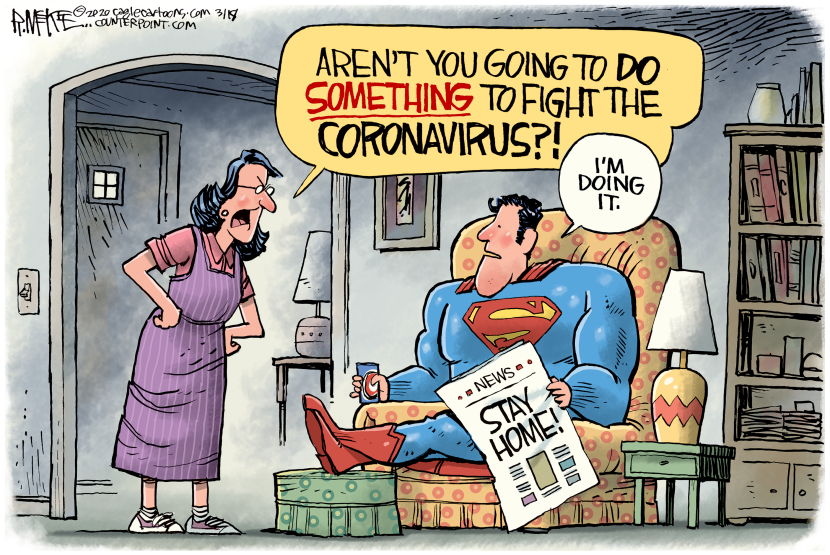
I’m not an epidemiologist or an “ologist” of any sort. But it seems to me that we can take reasonable measures to keep people safe while reopening for business. Grocery and home improvement stores have been allowed to remain open during the pandemic and I’m not aware in any spike in coronavirus cases that can be traced to a Piggly Wiggly or Home Depot. If we can keep people safe in those places by social distancing and wearing masks, why is an office or a bakery any different? The immunocompromised and the elderly – Mrs. Cuomo and my mother included – should stay home.

If the last two months are any indication, Americans are willing to cooperate provided the restrictions make sense. You want me to wear a mask, a bandana or a kerchief, no problem. I’ll dress up like Yosemite Sam if it’ll do any good. Social distancing? Done. There are plenty of people I don’t want within six feet of me, or six miles, and vice versa.

Unless there’s an underlying, sinister reason why some politicians want America’s economic shutdown to drag on indefinitely – I can’t imagine – we shouldn’t have to choose between public health and economic ruin.

Our elected officials and medical experts need to find the acceptable middle ground, for the sake of our mothers and everyone else.

Copyright 2020 Rich Manieri, distributed by Cagle Cartoons newspaper syndicate.

Rich Manieri is a Philadelphia-born journalist and author. He is currently a professor of journalism at Asbury University in Kentucky. You can reach him at [email protected].

Comments Off on Restarting The Economy Shouldn’t Be A Life Or Death Decision

There’s Room For Compromise, If We Look For It

Over breakfast the other day, my wife, who happens to be a physician, asked, “Whatever happened to compromise?”

She was wondering why Americans can’t seem to put their political and ideological biases aside during the current pandemic and understand that we can do our best to protect ourselves from the virus and still keep our economy from collapsing.

The answer came to me about 30 minutes later, in an angry email from a reader.

In my last column I pointed out that America’s patience was wearing thin. Over 30 million people have filed for unemployment in the last six weeks. Our neighbors can’t pay their bills. We need to get the economy going while protecting our vulnerable citizens. In other words, I was calling for a balanced approach.

“Presumably, given your job title, you are an educated man,” the email began. “From your picture you look old enough that you should have saved some money to be prepared for a period of time when you might have unemployment.”

My first thought was that I need a new headshot. As I read on, it was clear the writer was making the argument that if you haven’t saved enough money to make it through an unforeseen pandemic or the government-ordered shutdown of your small business, tough darts.

Later, she told me to stop whining and “grow up.”

I can’t remember the last time I was told to “grow up.” It might have been when I didn’t get a part in a Hollywood film and my godfather grabbed me by the collar, slapped me around and said, “You can act like a man!” Actually, I think that was a scene from “The Godfather.”

Nevertheless, the point is the writer’s position leaves no room for compromise. You are either in favor of an indefinite shutdown of the economy or you don’t care if people die.

This sort of zero-sum discourse has become a template for debate. If you oppose abortion, you hate women. If you believe in enforcing immigration laws, you’re xenophobic. If you’re a Bible-believing Christian and dare to say so publicly, you’re a fanatic. (I can show you the letters.)

There is no daylight for compromise within such wooden positions.

At the beginning of the COVID-19 crisis, Republicans and Democrats were able to put aside their differences for the good of the country… for about two weeks.

In 1914, during World War I, there was a series of Christmas cease fires along the western front. German and British soldiers left their trenches and exchanged gifts. On Dec. 27, they resumed slaughtering each other wholesale.

Even the fiercest adversaries can put aside their differences for a little while, merely delaying the inevitable.

Our political cease fire is now over. The “we’re-all-in-this-together” spirit, if it ever actually existed, has evaporated. We’re back to politics as usual and, as usual, truth is the casualty.

Meanwhile, another news story has infiltrated the front pages – sexual assault allegations made against former vice president and current presidential candidate Joe Biden by former staffer Tara Reade. The same Democrats who wanted then Supreme Court nominee Brett Kavanaugh burned at the stake based on the testimony of his accuser, Christine Blasey Ford, are now lining up to support Biden. The same Republicans who ran to Kavanaugh’s defense now want Biden’s head.

For its part, until recently, most of the media have been conspicuously disinterested in the Biden story.

I don’t know whether Biden’s accuser is telling the truth, just like I didn’t know whether Blasey Ford was on the level. I am a big fan of due process but, as the editors of the National Review pointed out this week, “due process must be habitually applied to nobody or to everyone.”

We must now serve as our own factcheckers. The burden of discernment rests squarely on our shoulders, assuming we’re interested in getting remotely close to the truth. We can either seek affirmation of our righteous indignation or we can search earnestly for information, weighing disparate perspectives on an issue and drawing our own conclusions.

Or we can get angry at those with whom we disagree and make sure we tell them so.

The latter might make us feel good for a while but it gets us nowhere.

Copyright 2020 Rich Manieri, distributed by Cagle Cartoons newspaper syndicate.

Rich Manieri is a Philadelphia-born journalist and author. He is currently a professor of journalism at Asbury University in Kentucky. You can reach him at [email protected].

Comments Off on There’s Room For Compromise, If We Look For It

COVID-19 questions: Where’s the beef and What’s Next?

So, now it’s meat.

Just as I was celebrating my latest acquisition – the last four-pack of generic bathroom tissue – I rolled my way over to the meat aisle, only to find a few sad, lonely leftovers. There was a butt roast, a package of sausage and a pair of pork chops. That was about it.

COVID-19 is taking a toll on the country’s meat processing plants. A Smithfield plant in South Dakota was forced to close after hundreds of its employees tested positive for coronavirus. Other plants throughout the country are also closing. Bottom line: If the processing plants close, the meat doesn’t get to your grocery story.

I was just coming to grips with the prospect of resorting to a toilet paper substitute. I never considered life without burgers or bacon.

Yes, no ground beef might be a small-potatoes inconvenience for experienced food shoppers, but for the inexperienced and reluctant, it only deepens the mystery of the grocery store.

There are now blue arrows on the floor. One aisle goes north, the next goes south. No U-turns. If you want out, you either play through or back out illegally, which I tried and almost took out a display shelf full of Oreos.

There are now employees without uniforms stocking shelves. The other day, I found myself with five cans of the wrong diced tomatoes. As I was putting them back, a woman wearing a mask, approximately six feet behind me, asked me if there was any baking soda.

“Yeah, one aisle over.”

I admit I’m having a difficult time staying six feet away from others, mainly because it’s hard to judge distance while people are moving around. So, I overcompensate and treat people as if they’re radioactive. If someone rolls up behind me, I quicken my step. If they’re gaining on me, I break into a trot.

In the grand scheme of a pandemic, navigating the supermarket isn’t a big deal, confusing as it might be. But it is representative of a question this pandemic continues to beg: What’s next?

People are growing impatient.

On Wednesday, protestors surrounded the state capital in Michigan to protest the governor’s draconian stay-at-home orders.

Some 15 million Americans have lost their jobs during the current pandemic. The number will continue to go up as long as the country remains shut down. We’re quickly getting to the point where the risk of contracting coronavirus will be worth taking if the alternative is not being able to put food on the table or pay your bills.

Small businesses are drowning. The guy who owns my gym is now delivering pizzas to make ends meet.

Americans across the country have been arrested and/or fined for violating social distancing orders.

California Gov. Gavin Newsom announced Wednesday that he’ll be giving stimulus checks to immigrants who are in the country illegally.

New York Governor Andrew Cuomo signed an executive order Wednesday requiring everyone to wear face coverings in public.

Local governments are releasing thousands of inmates.

This is not sustainable for much longer and Americans should not have to accept any version of such new rules and restrictions as a “new normal” as we’ve heard far too often in the last month.

No one in charge, Republican or Democrat, should be willing to concede – as some experts have predicted – 16 percent unemployment by July.

An economic collapse of such magnitude will only invite government to fill the void. If you think that’s something you want, consider the delay getting those relief checks in the mail.

What’s the answer? Beats me. That’s why we have elected officials to figure this stuff out. President Trump and the governors need to work together and come up with a plan to reopen the economy and they need to work fast.

This is not a matter of choosing between, as Cuomo said in one of his recent media briefings, “public health and economic activity.” The latter term trivializes the depth of the economic component of this crisis. There’s a big difference between “economic activity” and financial ruin, which scores of Americans are facing at this very moment.

We can come up with a nuanced approach that will allow Americans to get back to work while keeping them as safe as possible.

If we don’t find such a solution, we’ll be asking “What’s next?” a month from now. And we’re not going to like the answer.

Copyright 2020 Rich Manieri, distributed by Cagle Cartoons newspaper syndicate.

Rich Manieri is a Philadelphia-born journalist and author. He is currently a professor of journalism at Asbury University in Kentucky. His book, “We Burn on Friday: A Memoir of My Father and Me” is available at amazon.com. You can reach him at [email protected].

Comments Off on COVID-19 questions: Where’s the beef and What’s Next?

Surviving Coronavirus At Home With Teenage Triplets

You’re stuck home with your kids and feeling sorry for yourself. How are you going to keep them busy? What about their school work? I’ve got a better story – stuck at home with 16-year old triplets.

Beat that. Anyone? Anyone?

That’s what I thought.

Last week, as I was lamenting our collective plight I considered – as I always do – how I can use this situation to my advantage.

There are only so many indoor tasks you can ask of three, housebound 16-year-olds – get out of bed by noon, clean your rooms, put your dishes in the dishwasher. Actually, on a given day, I’d take any one of the three.

So, I went out and bought 22 bags of mulch and quickly morphed into a cross between Gunnery Sgt. Hartman from “Full Metal Jacket” and my father, minus the profanity. When it came to spewing obscenities, my father could go toe-to-toe with Sarge.

I did, however, take a page from my father’s playbook as I attempted to motivate the triplets with cliches – “That mulch won’t spread itself you know.” “Let the rake do the work.”

I know I sounded just like my father, for whom I was a self-contained leaf and snow removal system. Oddly enough, as much as I loathed raking and shoveling when I was young, I actually enjoy it now. Still, when you have three able-bodied 16-year-olds (two girls and a boy) hanging around the house with nowhere to go, why should I risk throwing my back out?

What I didn’t account for was their work ethic and efficiency. They were finished in a couple of hours and we had nothing left for them to do.

It’s an odd thing, not being able to go places or even be around other people. It’s the right thing to do under the circumstances but it’s still strange, although a minor inconvenience if it means keeping others from getting sick.

It is interesting to see how we adjust our schedules and adapt. I can say, without fear of contradiction, this is the longest I have gone in my life without watching sports on TV. I was so desperate the other day, I found myself watching a 30-year-old hockey game on YouTube. Not the entire game, as if that makes it better. About halfway through I had to come to grips with the reality that I have a problem.

For me, and I would imagine for many, this crisis has drawn a clear distinction between essential and non-essential. Situations we once would have considered intolerable we now tolerate.

For example, our Great Dane Bosco, about whose antics I’ve written previously, ate my very expensive and only pair glasses. He didn’t actually ingest them but he somehow got the lenses out, intact, and chewed off the tips of the frames, rendering them unwearable. I ordered a new pair but in the intervening week, my optometrist closed up shop due to COVID-19. I was left with no choice but to pop the lenses back in and bend the frames so they’ll stay on my head, at least for a while. Sure, they look ridiculous, like I was in a bar fight and got hit in the face with a stool, but necessity compels in a crisis.

I’ve watched more Netflix than I ever have and like millions of others, was transfixed by the sordid tales of Joe Exotic, the “star” of a seven-episode freak show called “Tiger King.” I won’t ruin it for you if you haven’t seen it but I will tell you that I think my wife and I watched five episodes in one sitting. I say that not as a source of pride but rather an indication of the show’s cringeworthy appeal.

My only outing is my regular run to the grocery store, which isn’t much of a field trip because it’s about a mile from our house. Still, these trips have led me to make the following observation – Americans, and I’m including myself, need to eat more fruits and vegetables. You can’t find a roll of toilet paper or a frozen pizza but you can buy enough Brussels sprouts and navel oranges to keep you going for weeks.

There is one, universal and undeniable essential with which we all need to come to terms – we’re in this together and whether you’re dealing with a surplus of sprouts or teenagers, each is a blessing, and small price to pay for the greater good.

Copyright 2020 Rich Manieri, distributed by Cagle Cartoons newspaper syndicate.

Rich Manieri is a Philadelphia-born journalist and author. He is currently a professor of journalism at Asbury University in Kentucky. His book, “We Burn on Friday: A Memoir of My Father and Me” is available at amazon.com. You can reach him at [email protected].

Comments Off on Surviving Coronavirus At Home With Teenage Triplets

Reassurance in the Midst of Coronavirus Crisis

One of my many bosses in TV news once told me the media’s job is to reassure the public. I can’t remember the context, though I do remember dutifully nodding my head.

What did I know? I was 22 and reassurance sounded like a good thing.

Today, I’m not sure if reassurance is or has ever been the media’s responsibility. If it is, we’re doing a lousy job of it. I feel a lot of things when I turn on CNN or Fox News for the latest coronavirus update. Reassured isn’t among them.

In fact, if I look back at my own career of covering snowstorms, hurricanes and various other emergencies, I don’t recall being very reassuring. Of course, in my defense, it’s difficult to be reassuring when you can’t feel your feet or you’re dodging a flying a stop sign.

However, here and now, as you scour the countryside for toilet paper and biscuits, I am going to honor my news director of long ago and do my very best to reassure you.

While COVID-19 needs to be taken seriously, we’re not going to run out of food or other essentials. Sure, there’s a burgeoning black market for Charmin and hand sanitizer but I’m reasonably confident the shelves will be restocked and Americans will, once again, return to the good ol’ days of practicing shoddy hygiene.

I wish we would be this vigilant all of the time, and I want to believe that the guy who leaves the men’s room stall and never so much as glances at the sink before walking out the bathroom door will transform into Felix Unger, but human experience tells me otherwise.

I’m old enough to remember the oil crisis and subsequent gas lines of the 1970s. We got through that OK, no thanks to my father, who used most of the gasoline on the eastern seaboard to fill up his Plymouth Fury and Bonneville Brougham.

World wars, economic crises, past pandemics – through it all, if Americans have proven anything, it is that we are a resilient bunch. Life can throw pretty much anything at us and we’ll keep moving forward. We adapt, we innovate, we find a way.

Under normal circumstances, our elected representatives in the House and Senate can’t work together to order a pizza. But Republicans and Democrats, with the president’s support, were able to come together and hammer out a coronavirus relief package. For the most part, they’ve put politics aside for the greater good. I haven’t written that sentence in a while.

In communities throughout the country, for every knucklehead at Costco making fists over the last roll of toilet paper, countless others are actually helping their fellow humans.

Churches are live streaming services. Concerned neighbors are running errands for the elderly. Disneyland is giving away its extra food. NBA players are donating money to team employees who aren’t getting paid during the shutdown. My school is running a food drive for international students stuck on campus because they can’t get home.

We’ll be OK.

What we can’t do is panic. There’s no need to hoard food or convert all of your assets to gold bullion. Take a deep breath, turn off the TV for a while, take a break from social media and stop watching the rise and fall of the stock market until your eyes cross.

Instead, do something productive. I’ve been catching up on some household chores, though truth be told, I’m too efficient for my own good. I’ve been home three days and there isn’t much left to do and I’m afraid I’ve reached the limits of my capabilities. Whatever my wife asks me to do next is bound to be beyond my skillset.

Still, you get the idea. If home improvement isn’t your thing, read a book. Play your guitar. And there’s always Netflix, but stay away from films or documentaries about pandemics, which have suddenly catapulted their way to the top of the playlist.

History tells us this will pass and life will eventually get back to normal. In the meantime, hunker down, practice “social distancing” and relax.

Do you feel reassured yet? If not, just nod your head anyway.

Copyright 2020 Rich Manieri, distributed by Cagle Cartoons newspaper syndicate.

Rich Manieri is a Philadelphia-born journalist and author. He is currently a professor of journalism at Asbury University in Kentucky. His book, “We Burn on Friday: A Memoir of My Father and Me” is available at amazon.com. You can reach him at [email protected].
Comments Off on Reassurance in the Midst of Coronavirus Crisis

Biden’s Comeback and Bernie’s Cuba Problem

Joe Biden sputters and gaffes his way along the campaign trail and somehow manages a resounding victory on Super Tuesday.

Go figure.

Perhaps what Super Tuesday revealed, among other things, is that Democrats prefer an uninspiring, sometimes-bizarre Biden to a Marxist.

Maybe America really isn’t ready for Bernie Sanders’ brand of socialism after all. Nor does it appear the Democratic establishment is ready. Prominent Democrats, including billionaire Mike Bloomberg – who dropped out of the race on Wednesday – are now throwing their support and money toward Biden.

What about Bernie?

His loyalists won’t bail on him, despite his disappointing showing on Tuesday, because they believe with an almost religious fervor in his collectivist policies – free tuition, healthcare, a “green economy” and a massive expansion of government.

But I can’t help but wonder if Sanders hasn’t gone too far.

His outrageous comments about Cuban dictator Fidel Castro didn’t end his campaign, but they might have been the stick in his bicycle spokes.

I have to give Sanders credit. After listening to him, I was almost convinced Castro was a pretty nice guy.

“You know, when Fidel Castro came into office, you know what he did? He had a massive literacy program. Is that a bad thing? Even though Fidel Castro did it?” Sanders said in a “60 Minutes” interview that aired Feb. 24.

You know, Hitler loved his dog. Is that a bad thing?

In the “60 Minutes” interview, Sanders was responding to questions about his comments in the 1980s when he said the Cuban people didn’t overthrow Castro because he gave them healthcare and education.

He also had scores of people who disagreed with him imprisoned and shot.

But hey, for Cubans under Castro’s thumb, while you were dodging firing squads and watching the government seize your property, at least your gall bladder surgery was on the house.

Sanders has not, nor will he, apologize for his Castro comments. Why not? Because that’s what he believes and how he thinks.

Of course, Castro was a murderous tyrant who oppressed and terrorized Cuban citizens for more than five decades. Not exactly breaking news. And it’s not as if Sanders isn’t aware of Castro’s record. That’s why, despite the bipartisan outrage from Florida lawmakers following the “60 Minutes” interview, there was no attempt by the Sanders camp to walk back his Castro praise.

Sanders knows thousands of Floridians and their families have ties to Cuba and many risked their lives to escape the Castro regime. Still, “When dictators do something good, you acknowledge that,” Sanders said.

OK. Maybe I’m the unenlightened one. Perhaps I should do a column on the sunny sides of Joseph Stalin, Pol Pot and Genghis Khan.

Unemployment in Stalin’s Soviet Union was less than 2 percent. You’d get thrown in a gulag if your boss didn’t think you working hard enough. Still, it’s a living.

Sanders is a communist sympathizer from way back. He had high praise for Daniel Ortega’s Nicaraguan revolution in 1985 and he honeymooned in the Soviet Union in 1988, using the opportunity to denounce American capitalism. At least he’s consistent.

All of this presents a huge problem for Democrats and they finally seem to be understanding as much.

If Sanders somehow were to win the nomination, he will be filleted, breaded and deep-fried by Team Trump, which won’t even have to work that hard because Sanders will have already half-cooked himself. They’ll have Sanders photoshopped next to a picture of Lenin faster than you can say Lev Trotsky.

Democrats now seem to realize that this leaves them with few options, other than trying to drag Biden across the finish line.

Biden will also get sliced and diced by the Trump camp but Sanders offers more meat to Republicans.

Sanders thinks he can win by “expanding the electorate” which, in his case, means increasing turnout among young people. Democratic strategist James Carville recently called the theory “stupid.”

Tuesday, Carville was proven right, as exit polls showed young voters didn’t turn out for Sanders as they have in the past.

This leaves Democrats to sort out Sanders’ Cuba problem, Biden’s Biden problem and a potentially contested nominating convention which will be political mud wrestling at its finest.

The only one who won’t end up dirty is Donald Trump.

Copyright 2020 Rich Manieri, distributed by Cagle Cartoons newspaper syndicate.

Rich Manieri is a Philadelphia-born journalist and author. He is currently a professor of journalism at Asbury University in Kentucky. His book, “We Burn on Friday: A Memoir of My Father and Me” is available at amazon.com. You can reach him at [email protected].

Comments Off on Biden’s Comeback and Bernie’s Cuba Problem

Impractical Manifestation of a Midlife Crisis

I bought a BMW.

It’s a white convertible that screams “Midlife crisis!” from the highest rooftops.

Of course, when I bought it two years ago, I didn’t think I was having a midlife crisis. I just thought I liked the car. Although, I don’t think most men in their fifties, who buy totally impractical sports cars, are rushing to their therapists with a self-diagnosed midlife crisis.

Now, I’m doing what most middle-aged men do with impractical sports cars – I’m selling it.

I love the car. I bathe it regularly and rub it with a diaper. It’s immaculate. But I haven’t driven it that much and I won’t drive it in the rain, snow or cold. That leaves me with a pretty limited window for travel.

All of this has me now preparing for the most awkward of consumer dances – the car salesman/chump-car-buyer tango.

Buying a car is one of the few business transactions in which you’re pretty sure going in that you’re going to get fleeced but believe when you leave that you’ve gotten a “great deal.” You even tell your friends. “Yeah, I just bought this. Got a great deal.” In reality, the dealer got the great deal. You got the car. And yet, we’re all OK with this arrangement because we keep buying cars.

I’m not good at this dance. I find that whenever I walk into a car dealer, no matter how much I’ve psyched myself up or what I say when I get there, the salesman hears, “I’m looking for a car and I am prepared to pay absolutely anything. So, what do I have to do to get you to put me in this car today?”

The most curious part of this transaction is the deferral to the manager.

“I have to check with my manager,” the salesman says, and disappears. Where does he go? Why is it taking so long? The Treaty of Versailles took less time to hammer out. I always wonder if he’s really talking to his manager or, for that matter, if there even is a manager. Maybe he’s in the bathroom or sitting on the edge of a desk in the breakroom eating Skittles, just waiting me out until I start second-guessing my offer.

It’s an effective strategy because when he comes out, I’m willing to do whatever he says.

Then, there’s the math.

Every car salesman I’ve met must have been the inspiration for the movie, “A Beautiful Mind.” He can weave a tapestry of numbers and mathematical formulas that not only trigger a migraine but ultimately leave me convinced that I’m getting this car for free.

And why is the car I’m considering always “rare”?

“Oh, you won’t find one like this. We don’t see many of these on the lot.” Meanwhile, the automaker is cranking out about 5,000 versions of this very model every 30 minutes. I just saw five of them on my way to the dealership.

“Not in this color you didn’t.”

My history of car buying is spotty at best. There was the unfortunate VW Beetle that had a nasty habit of stalling on the highway; a 1986 Pontiac Le Mans – there’s a reason you never saw many on the road – and now my BMW which my wife has nicknamed, “Precious,” primarily because of my vigilance in keeping her clean and healthy and because sometimes, when referring to the car, I use the female pronoun – like a ship.

I must say, nothing beats the fine handling and acceleration. So what if I have to take it to the dealer for maintenance and a routine oil change is $250? And they always manage to find something else.

“Yeah, your Zungenbrecher gasket needs replacing. The part is about five bucks but the labor is $3.000.00. We have to take the car apart and send half of it to Stuttgart.”

Still, look at how it corners!

OK, it was a dumb purchase and now I’m about to get my comeuppance from a car salesman who not only can recite every element of the “Sport Package” but is also an expert in psychological warfare.

Before I show up, I’ll say what I always say. “We have to be prepared to walk!” But I rarely do.

I’ve read that the term “Stockholm Syndrome” was coined following a bank robbery in Sweden in 1973. The hostages were apparently brainwashed by their captor and refused to testify against him.

I heard the same thing happened at the Volvo dealership.

Copyright 2020 Rich Manieri, distributed by Cagle Cartoons newspaper syndicate.

Rich Manieri is a Philadelphia-born journalist and author. He is currently a professor of journalism at Asbury University in Kentucky. His book, “We Burn on Friday: A Memoir of My Father and Me” is available at amazon.com. You can reach him at [email protected].

Comments Off on Impractical Manifestation of a Midlife Crisis

Don’t Know How Your Dog is Feeling? Check His Eyebrows.

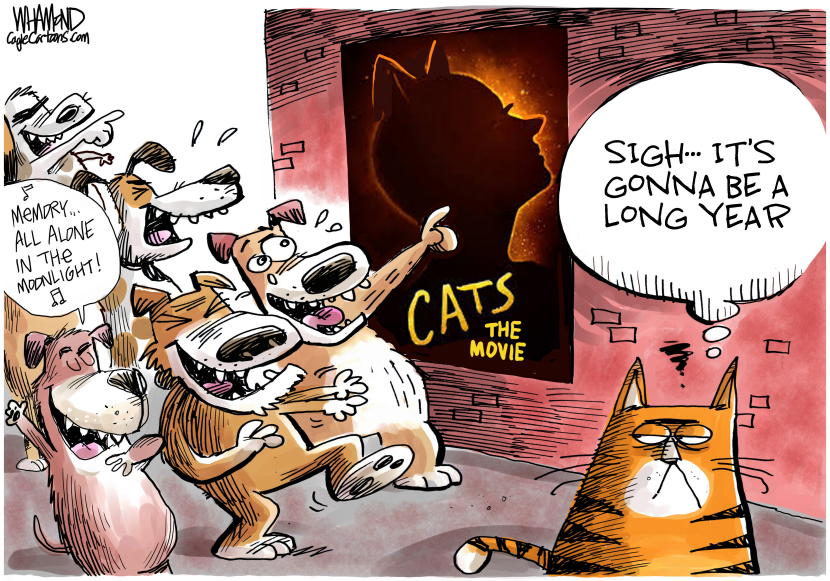
I would love to know what my dog is thinking or feeling.

Apparently, someone does know, or at least has an inkling.

I recently stumbled upon an essay in the Wall Street Journal titled, “What does it feel like to be a dog?” The piece was written by Dr. Alexandra Horowitz who runs a dog cognition lab Barnard College. It’s a fascinating look at whether dogs experience emotions comparable to our own.

First, let me make public and perfectly clear that I volunteer my Great Dane, Bosco, for any and all behavior modification studies and/or clinical trials. The lab might have to knock out a wall or two to accommodate him but it’s a risk I’m willing to take.

I read the WSJ story, mainly because I’m interested in what’s going inside my dog’s massive cranium.

Horowitz writes that researchers have actually come up with a catalog of facial expressions associated with different emotions in dogs. For example, “the eyebrow on the left side of the face is more active when dogs see their owners, presumably because it corresponds to the right side of the brain, which controls emotional expression.”

Did you know that your dog’s tail-wags are more intense the longer you’ve been gone? Neither did it.

For what it’s worth, I have some suggestions for the catalog.

What does it mean when Bosco rests his chin on the kitchen counter – without craning his neck – and breathes hot nose air on a plate of biscuits? It can’t possibly mean he’s hungry. He eats 12 cups of food per day. I can’t buy a bigger bag of animal food this side of a zoo.

Bosco is a little more than a year old. He’s about 165 pounds – 100 percent Merle Great Dane, 100 percent goofball. During his potty-training phase, I really would like to have known when he had to go to the bathroom.

Bosco didn’t have “accidents” in the house. A cocker spaniel has an accident. A beagle has an accident. It would be an insult to accidents everywhere to classify Bosco’s… well… missteps as accidents.

What Bosco had were environmental disasters. They required response personnel and heavy equipment. As much as I tried to read his eyes – or his eyebrows – for, “Please, take me out or there’s gonna be trouble,” I often, too often, didn’t get it. Thankfully, he’s over that part of his development and we’ve agreed never to speak of it again.

I’m sure I’m guilty of assigning human emotion and reasoning to Bosco’s behavior.

For example, I assume that when he jumps on my wife and I in the middle of the night that he’s trying to kill us for the insurance money.

I also believe that when he clobbers me upside the head with one of his great paws while I’m watching a football game that he wants me to change the channel.

There are plenty of times when I think he looks guilty, and for good reasons – chewing my glasses, eating a hole in the sofa, taking a plant out of the pot and dragging all over the family room.

“He knows what he did,” I’ve said to my wife many times.

I do frequently speak to Bosco in complete sentences to which my wife replies, “He missed his ESL classes this week.” But I know he understands, like Mr. Ed understood Wilbur.

Bosco has what we call “people eyes.” His head is so big that his eyes are the size of a human’s. So, when he lays on the couch, always with his head on a pillow, his eyes say to me, “Yeah. I’m here. So what? I’m comfy and I don’t think you have the energy or enthusiasm to make me move.”

In most cases he’s right. Trying to move an unmotivated Bosco even a few inches is a powerlifting exercise.

I realize Bosco has no concept of his size or strength though, mercifully, he has not a malicious bone in his enormous body. Usually he just wants to snuggle in your lap. It looks to me like that’s when he’s happiest. How can I tell? Now, I’m not sure because according to Horowitz, that “smile” I think I see is probably just “a function of his anatomy” and I have no business arguing with a scientist, as any of my high school science teachers can attest.

So, what is my dog thinking? Beats me.

What am I thinking? He knows.

Copyright 2020 Rich Manieri, distributed by Cagle Cartoons newspaper syndicate.

Rich Manieri is a Philadelphia-born journalist and author. He is currently a professor of journalism at Asbury University in Kentucky. His book, “We Burn on Friday: A Memoir of My Father and Me” is available at amazon.com. You can reach him at [email protected].
Comments Off on Don’t Know How Your Dog is Feeling? Check His Eyebrows.

A State of Laziness? I Don’t Think So.

I was hoping we weren’t going to make the list but, deep down, I knew better.

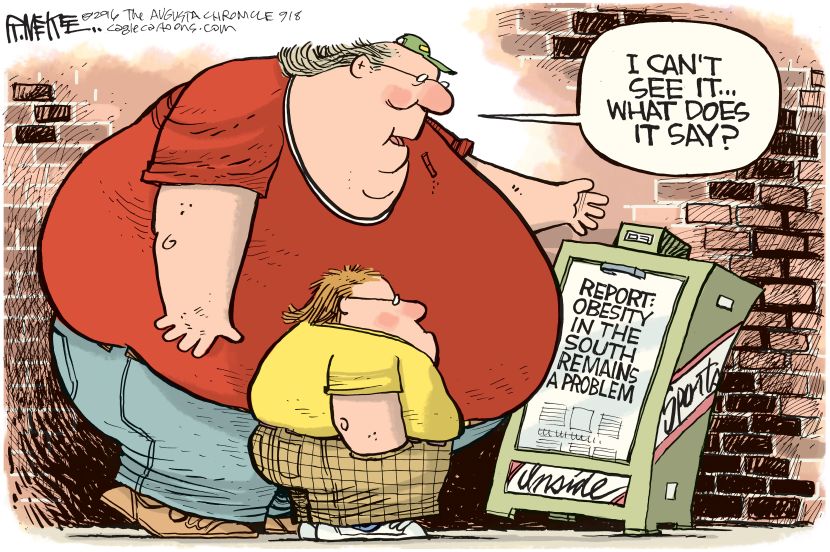
The votes have been counted and yes, my adopted home of Kentucky is one of the laziest states in America. (It also happens to be the eighth most obese state in the country.)

Six other states -, Oklahoma, Arkansas, Louisiana, Mississippi, Alabama and Tennessee -, reported the highest levels of inactivity, according to the Centers for Disease Control and Prevention.

The results were based on surveys of adults who were asked the question, “During the past month, other than your regular job, did you participate in any physical activities or exercises such as running, calisthenics, golf, gardening, or walking for exercise?”

I’m calling a foul right away. The question is clearly biased toward traditional forms of exercise.

I’m not suggesting that just because Kentucky also has the dubious distinction of having more adult smokers than any state in the U.S. – except West Virginia – that walking to the store to buy cigarettes should be considered exercise. Although if you walk far enough, you might have a pretty good case. It gets a little tricky if you smoke on the way back.

Nevertheless, it would set a dangerous precedent – counting steps to the fridge, for example, could someday be considered exercise. It’s not that far-fetched. Some believe “competitive eating” is a sport. I’ve never believed jamming six dozen, soggy hot dogs down one’s gullet is very sporting.

I’m making the case here for those of us who engage in silly forms of exercise that are not only physically challenging but really, really dangerous.

Flipping tractor tires, pulling sleds, jumping on boxes, throwing a medicine ball against a wall until you black out – now that’s exercise.

And deadlifting. I’ve found that there’s nothing better for a guy in his fifties with a bad back than lifting very heavy weight off the floor. If the potential for severe injury isn’t there, what’s the point?

Ever hear of a Bulgarian split squat? How about a Turkish get-up? Or what about a Pittsburgh sampler? Actually, I made the last one up but the first two are legit, and I hadn’t heard of them either until I started doing CrossFit.

My personal favorite is the hammer swing. You get to hit a big tire as hard as you can, over and over, with a sledgehammer. Short of wrestling a bear, I can’t think of anything more fun.

The CDC kept federal and state health officials busy for four years collecting laziness data. Where were they when I was doing 10 thrusters, five split jerks and a three Sumo deadlifts?

Golf? Gardening? Please. Where’s the danger? I suppose you can get clocked by a Titleist. And Vito Corleone did drop dead is his garden. All I know is if I don’t have to sign a release form to do it, I’m not interested.

Besides, I’m just as much a danger to myself in my own home. The other day, I was standing on a folding chair – yes, dumb – taking a screw out of the wall when the chair did what folding chairs are supposed to do. I crashed, face-first, on the bedroom floor. I got up and finished the job. One thing I’ve learned from my fitness routine is that a potentially debilitating fall is no reason to stop.

I’m not really trying to defend Kentucky here. Besides, how can I, what with the inactivity, obesity and smoking?

I am defending the often-overlooked and underappreciated alternative exercise community. Do our battered shins (I missed the box a couple of times), strained shoulders and ruptured discs mean nothing?

Don’t talk to me about “calisthenics.” You want calisthenics, I’ll give you calisthenics. You try five sets of five pull-ups, 10 burpees and 25 air squats. You’ll see visions.

I know that running around a parking lot with heavy sandbags on your shoulders isn’t everyone’s cup of tea. But we demand equality and recognition. This is 2020 after all.

The CDC and the rest of the world can pretend we don’t exist but we’ll be here, with our Russian kettle bell swings, squat jerks and high pulls.

I demand to be counted, assuming I survive.

Copyright 2020 Rich Manieri, distributed by Cagle Cartoons newspaper syndicate.

Rich Manieri is a Philadelphia-born journalist and author. He is currently a professor of journalism at Asbury University in Kentucky. His book, “We Burn on Friday: A Memoir of My Father and Me” is available at amazon.com. You can reach him at [email protected].
Comments Off on A State of Laziness? I Don’t Think So.

Liberals, Where is Your Sense of Humor?

Who doesn’t love a good joke? Apparently, many Democrats and CNN.

It’s all knee slaps and giggles until you make fun of the wrong people.

Most recently, CNN mounted its moral high-horse to scold the Babylon Bee, a conservative satirical website that needles – mostly but not exclusively – the political left.

The story in the Bee, “Democrats call for flags to be flown at half-staff to grieve the death of Soleimani,” highlights the ridiculously misplaced and selective outrage on the part of many on the left over the death of a murderous terrorist who, according to the State Department, was responsible for the deaths of some 600 Americans and scores of others via Iranian proxy wars. Some Middle East experts consider his death more important than that of Osama Bin Laden.

Soleimani’s killing “far eclipses the deaths of [Osama] Bin Laden or [Abu Bakr al-]Baghdadi in terms of strategic significance and implications … there really is no underestimating the geopolitical ramifications of this,” Charles Lister, a resident fellow at the Middle East Institute, told CNBC.

Still, that hasn’t stopped many liberals and Hollywood types, who had no issue with taking out Bin Laden, from falling all over themselves to decry Soleimani’s death.

Filmmaker Michael Moore and actress Rose McGowen apologized to Iran.

“I deeply regret the violence on our behalf by a man that most Americans have never voted for,” Moore tweeted.

The Bee’s story, which went viral, contained several choice tidbits. For example, “In a rare moment of unity with The Squad, [Nancy] Pelosi gave each of the girls a hug, telling them to just ‘let it all out’ in their time of sadness.”

That’s funny. But CNN didn’t think so, neither did its “disinformation” reporter Donie O’Sullivan. Yes, reporting on disinformation is a job, at least at CNN.

O’Sullivan was deeply concerned that too many conservatives thought the Bee’s story was real.

“To put this in perspective, this is the same number of engagements the top NY Times and CNN stories on Facebook had over the past week,” he tweeted. “A lot of people sharing this ‘satirical’ story on Facebook don’t know it is satire,” O’Sullivan tweeted.

Let me say that I appreciate CNN’s attempt to parent those of us who are either too naive or too ivory-skulled to recognize satire. In fact, I’m thinking of hiring someone from the network to sit next to me when I watch movies with complicated plot lines to answer all of my annoying questions.

“Who’s that guy?”

“What did I miss when I asked, ‘Who’s that guy?’”

I’m prepared to pay handsomely. We thickies need all the help we can get.

But even I didn’t need help working out the Bee’s story. The site’s tagline “Fake news you can trust” is kind of a giveaway, as are a couple of the Bee’s recent headlines:

“Iran declines to sign Colin Kaepernick after reviewing workout video.”

“Trump holds press conference to moon Iran on national television.”

I had to factcheck that last one, but it is indeed fake.

I’m not sure why CNN feels the need to send up flares to warn us of satire. I must have missed all of the red alerts when “Saturday Night Life,” “The Daily Show” and “The Colbert Report,” among others, were lampooning conservatives which, by the way, is OK with me. Political satire is a form of free speech.

But when the Bee responds to CNN with the story, “CNN Attacks Babylon Bee: ‘The internet is only big enough for one fake news site’,” the left stops laughing.

There is always an underlying element of truth to humor. That’s what makes it funny. As Churchill once said, “A joke is a very serious thing.”

CNN and its loyalists on the left aren’t really interested in protecting us from disinformation. They’re more interested in silencing critical and even satirical voices. They don’t seem particularly alarmed that many millennials rely on “The Daily Show,” which appears on Comedy Central, as their primary news source. Nor do they have a problem when liberals share stories from the Onion poking fun at conservatives. But it drives them to distraction to learn that the Bee’s story on Soleimani was shared 500,000 times on social medial.

I’m sure that CNN and the Democrats complaining about the Bee also enjoy good satire once in a while, but only if they’re the ones holding the skewer.

Copyright 2019 Rich Manieri, distributed by Cagle Cartoons newspaper syndicate.

Rich Manieri is a Philadelphia-born journalist and author. He is currently a professor of journalism at Asbury University in Kentucky. His book, “We Burn on Friday: A Memoir of My Father and Me” is available at amazon.com. You can reach him at [email protected].

Comments Off on Liberals, Where is Your Sense of Humor?