Out in the Cold: There But For the Grace of God

But by the grace of God I am what I am, and his grace toward me was not in vain. On the contrary, I worked harder than any of them, though it was not I, but the grace of God that is with me.

- 1 Corinthians 15:10

He couldn’t have been more than a kid, early twenties maybe, though he looked older. Life outdoors tends to age a person prematurely. He was homeless, addicted, alone.

I’ll call him “Daniel” and I met him at a homeless shelter where I was volunteering with my wife the other night. More accurately, Denise is the active volunteer, serving on boards, giving out scarves and blankets, getting to know the residents. Mostly, I tag along for support.

On this particular night, temperatures were in the teens and a steady snowfall covered the streets and sidewalks in front of the church where we waited for walk-ins.

Denise recognized Daniel from another shelter where she volunteers. She asked him how he was doing, what he was up to, showed him where he could sleep for the night and where to get some food in the kitchen.

For the four hours we were there, from 8 p.m. to midnight, Daniel left and returned a few times. At one point, he produced a drawing pad on which he had made a few sketches. He showed them to Denise and she made a fuss, as you would when one of your kids presents you with a few doodles.

A little later, Daniel asked us what the temperature was supposed to be tomorrow. It took a minute but it dawned on me that he wasn’t asking us about the weather in an effort to make small talk. He wanted to see if it was going to be warm enough to survive.

As we spoke to him, I couldn’t help but wonder. How did he get here? What led a young and seemingly healthy young man to an aimless existence on the streets? Certainly, addiction is part of the answer but only part. What happened in his past? Was he ever nurtured or encouraged by anyone?

Then, after the questions, came the realization that there are so many others, like Daniel, living life day-to-day; outdoors and forgotten.

It is true that a few homeless people are homeless by choice. Though able to work or even get back on their feet in a shelter, they choose homelessness instead of structure and rule-following. Denise will tell you that some of the men with whom she worked at the shelter simply walked away on their own rather than follow the house rules. Others were kicked out.

I had another thought as I spoke to Daniel. Could I have been him? With a slight alteration of circumstances, could I have wound up in the same situation due to job loss, financial ruin or illness?

Oh, we say, “Not me. Don’t be ridiculous. Those people are sick. They have problems. They can’t be helped and they don’t know how to help themselves.” Exactly.

There was a time when it was easy for me to disregard young men like Daniel. After all, in Philadelphia, there were hundreds of them. It was easy to walk by, not make eye contact, even snicker.

“Better him than me,” as if I were somehow impervious to personal catastrophe.

We’re all fragile, vulnerable, mortal. Ask the people of Texas where a winter storm has turned life upside down.

While politicians bicker about why it’s so cold and whose fault it is, millions of residents are freezing, without power or drinking water. Warming shelters have opened throughout to state. People who were warm and secure suddenly found themselves hungry, cold and in need of help.

According to the National Alliance to End Homelessness, there are an estimated 553,742 people in the U.S. experiencing homelessness on a given night. In the Kentucky county where I live, 400
public school students were identified as homeless in 2019.

This is not a call to action to volunteer or donate to your local homeless shelter, though you may feel led to do that. Rather – and I’m speaking to myself as much as anyone – it’s a call to compassion and empathy.

The truth is there’s less daylight between Daniel and me than I was ever willing to admit.

Copyright 2021 Rich Manieri, distributed by Cagle Cartoons newspaper syndicate.

Rich Manieri is a Philadelphia-born journalist and author. He is currently a professor of journalism at Asbury University in Kentucky. You can reach him at [email protected].

Comments Off on Out in the Cold: There But For the Grace of God

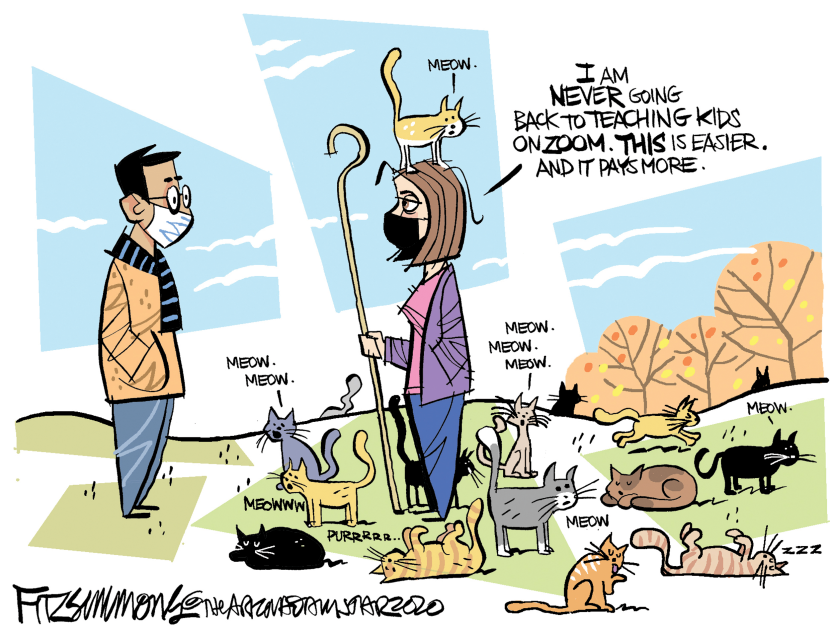
Getting Kids Back to School Shouldn’t Be This Difficult

Kids need to be in school. This seems to be an epiphany for some who, a year ago, suggested sending a teacher into a classroom was the equivalent of landing on the beach at Normandy.

This is the problem in a world of extremes where every issue, no matter how fundamental, is politically charged. If you believe children need to be in school, you want to kill teachers. If you believe businesses need to open, you care more about money than human life.

In October, the Atlanta Journal Constitution released a poll that showed 87% of Republicans supported the resumption of in-person classes while only 34% of Democrats favored reopening.
These numbers say a lot about where we are as a society. I’m firmly convinced that if Gallup conducted a poll asking the question, “Do you think puppies are cute?” the numbers would somehow fall along political lines.

Now, some prominent Democrats, Chicago Mayor Lori Lightfoot among them, are pushing teachers’ unions to get their members back in classrooms. Lightfoot, according to the Chicago Tribune, has spent $70 million dollars making schools safe for students to return.

It would be easy to say unions are holding students and parents hostage which, of course, they are. But they’re also preventing their own members, most of whom I believe want to be in the classroom, from doing the work they believe they were called to do.

It should surprise absolutely no one that remote learning is an unmitigated disaster. The only positive might be that it’s failure will short-circuit any momentum for both public and higher education to move to a predominantly online modality.

For starters, scores of minority students – primarily Black and Hispanic – don’t have access to online learning. Those students who do, regardless of race or ethnicity, are falling behind.

Since schools closed in March, the average student has lost about a third to a full year’s worth of learning in reading, according to a Stanford University study. A few months ago the Wall Street Journal mentioned a study of schools in Broward County, Fla. that found “52% of students in grades 6-12 don’t feel motivated to complete distance-learning assignments. About 45% said they almost never receive adult help at home to complete assignments.”

And those are the students who actually show up online. Student absence rates have doubled during the pandemic.

“Student absenteeism rates are higher for schools and districts that have stuck with full-time remote learning, but they’re also up in schools doing full-time in-person instruction or a mix of remote and in-person learning,” according to Education Week.

It gets worse. More suicidal children are showing up in emergency rooms.

“The kids that we are seeing now in the emergency department are really at the stage of maybe even having tried or attempted or have a detailed plan,” Dr. Vera Feuer, director of pediatric emergency psychiatry at Cohen Children’s Medical Center of Northwell Health in New York, told NPR.

What’s even more shocking than these numbers is the ongoing debate about whether or how to get children back in school.

The majority of private schools in the country made the necessary adjustments and reopened for in-person learning in the fall. Five months later there haven’t been any significant COVID-19 outbreaks traced to private schools.

Here in Lexington, Ky., private schools, such as the Sayre School, ignored Gov. Andy Beshear and opened anyway. Sayre didn’t just throw open the doors. School administrators, parents and students came up with a plan – social distancing, mask wearing, plexiglass and so on – and figured it out.

Sending our kids to school shouldn’t be this difficult. I know this is a “We put a man on the moon” argument but it seems appropriate under the circumstances.

This is also cautionary tale, as if we needed another, about how political partisanship and broken government prevent us from reaching agreement on how to deal with even the most basic issues.

There’s a long list of intractable problems facing our country. Sending children to school shouldn’t be one of them.

Copyright 2021 Rich Manieri, distributed by Cagle Cartoons newspaper syndicate.

Rich Manieri is a Philadelphia-born journalist and author. He is currently a professor of journalism at Asbury University in Kentucky. You can reach him at [email protected].
Comments Off on Getting Kids Back to School Shouldn’t Be This Difficult

Searching for Unity in a Sea of Exclamation Points

An email laced with exclamation points is never a good sign. At least not if you’re me.

In my world, exclamation points usually follow words such as “idiot!” or “communist!” I take issue with the latter though the former is certainly up for discussion.

Moreover, when the salutation itself is followed by an exclamation point, as it was in a recent email, I know it’s trouble. “Mr. Manieri!”

Inside voice. I’m right here.

This particular writer went on to make several assumptions about my intellect, or lack of. He ended with a call to action. “Defend your character!”

For context, the writer was responding to a column I wrote in which I blamed President Trump for lighting the fuse that led to the Capitol riots. He went on to ask how I could do such a thing when it was clear that members of Antifa and Black Lives Matter were bused in and were, in fact, responsible for the insurrection – a claim without any basis in fact.

My response featured a conspicuous absence of exclamation points as I encouraged the writer to keep an eye on his blood pressure.

I resisted quoting from Proverbs 15: “Those who are hot-tempered stir up strife, but those who are slow to anger calm contention.”

If you watch much television, or any television, or if you engage in social media, it’s pretty clear that we tend to punctuate our discourse with exclamation points. Perhaps Jerry Springer was actually a visionary. He understood the marketability of impoliteness and boorish behavior long before it went mainstream. (By the way, I promise never to use the name “Springer” and the word “visionary” in the same sentence again.)

Civility has fallen out of fashion. Some say it’s overrated. How do I know this? I refer you to a Dec. 2019 piece in the Atlantic titled, “Civility is Overrated.”

An NPR article in 2019 quotes Lynn Itagaki, an associate professor at the University of Missouri, who said, “Civility has been about making sure that the status quo, the hierarchy of the status quo at the moment, which means racial inequality, gender inequality, class inequality, stays permanent.”

By this redefinition of civility, it would be permissible and even encouraged to meet any injustice, perceived or actual, with an uncivil response. That’s fine if you happen to agree on the injustice. For example, if your candidate loses a presidential election and you believe the election was rigged, storming the Capitol might be an appropriately uncivil response.

Thus, if you disagree with someone and you’re convinced you’re on the right side, what’s the point of a civil response? After all, you’re right and he’s wrong.

Many believe our national discourse fell apart the moment Donald Trump darkened the doorway of the Oval Office. Surely, the former president, with his unhelpful rhetoric, name-calling and incessant tweeting contributed to the problem. But he wasn’t alone.

Our elected representatives in Washington – Republicans and Democrats – have been content to play their respective parts in the Monty Python “Argument Clinic” sketch.

“Is this the right room for an argument?”

“I told you once.”

“No you haven’t.”

“Yes I have.”

“When?”

“Just now.”

“No you didn’t.”

“Yes I did.”

The main difference, of course, between the sketch and reality is there’s nothing even mildly amusing about the real thing.

For what it’s worth, President Biden struck mostly the right tone in his inauguration speech.

“I pledge this to you – I will be a president for all Americans, and I promise you, I will fight as hard for those who did not support me as for those who did,” Biden said. He then signed 15 executive orders undoing various Trump policies.

Unity is a fine message but no amount of rhetorical gymnastics will bring people together unless we’re willing to understand and listen to those with whom we disagree. That means acknowledging that not all of the 75 million Americans who voted for Donald Trump are racists and that not everyone who voted for Joe Biden is pushing a Marxist agenda.

From the president on down, unless we’re truly committed to making unity a reality, it won’t happen, no matter how many exclamation points we use.

Copyright 2020 Rich Manieri, distributed by Cagle Cartoons newspaper syndicate.

Rich Manieri is a Philadelphia-born journalist and author. He is currently a professor of journalism at Asbury University in Kentucky. You can reach him at [email protected].

Comments Off on Searching for Unity in a Sea of Exclamation Points

Laying Blame for the Capitol Riots Where it Belongs

You might have seen the photo by now. Of all the disturbing images of Wednesday’s insurrection, this one lingers.

The photo, shot by Michael Robinson Chavez of the Washington Post, shows seven or so Trump supporters scaling the wall on the Senate side of the U.S. Capitol.

There’s a certain irony in this photo, due only perhaps to the way my mind works.

On June 6, 1944, D-Day, a group of 225 Army Rangers scaled a 100-foot cliff at Pointe Du Hoc on the coast of Normandy in France. The soldiers used ropes and ladders as German gunfire rained down on them. It was chaos and carnage but they kept climbing and a handful made it to the top.

Most of the soldiers who made the climb are gone now, killed either that day, in subsequent days of fighting, or claimed by time.

If they were here, and we could ask them, I wonder what they would think of the photo from Wednesday. Would they simply shake their heads? What would they say?

I’m reasonably sure they would tell us they didn’t scale that cliff 76 years ago for this – for the business of our Republic to be shamefully disrupted by extremists who wouldn’t recognize the Constitution if it were stapled to their foreheads.

The soldiers who scaled the cliff at Pointe Du Hoc were fighting for an objective truth – “that all men are created equal, that they are endowed by their Creator with certain unalienable Rights, that among these are Life, Liberty and the pursuit of Happiness.”

On the other hand, some can justify any sort of abhorrent behavior in the name of what they believe to be a just cause.

The one thing far-left anarchists, neo-Nazis, Antifa, the Ku Klux Klan and the rioters who stormed the Capitol have in common is they believe they’re on the right side of history. This is the problem with a worldview absent of objective truth.

Let’s not confuse extremists who feel justified in committing violence with those with whom we disagree politically. The rioters involved in Wednesday’s national embarrassment are no more conservative than left-wing radicals, who lay siege to American cities in the name of “justice” are liberal.

“What is the difference between the left-wing fringe, BLM, that lit police stations on fire, tried to light a federal courthouse on fire, occupied two cities, looted and engaged in violence, and what the people did yesterday in the Capitol? There’s not much of a difference at all. It all needs to be condemned,” Ari Fleischer, former press secretary for President George W. Bush, told Fox News.

What we saw on Wednesday was a violent, angry mob – not patriots – shamefully invited and incited by the President of the United States, engaged in what amounted to an invasion of the American Capitol, the likes of which has not been seen since the British set fire to the structure in 1814.

For six weeks, Trump had been telling his loyalists, and anyone else who would listen, that the election was stolen, that the fight must continue, that the election results must be overturned. On Wednesday, he worked his supporters, assembled near the Capitol, into a lather one more time as Congress met to certify Electoral College votes.

Yes, this is President Trump’s fault.

Former Attorney General William Barr, who resigned last month after he refused to cave in to the president’s demand to investigate unsubstantiated election fraud, told the Associated Press that “orchestrating a mob to pressure Congress is inexcusable.” And, I would add, indefensible.

The president’s behavior aside for the moment, what about the rest of us?

I’ve heard many times since Wednesday, from politicians and pundits, “This is not who we are as Americans.” But maybe it is. It’s clearly not who we should be but maybe it really is who we are. Maybe the fringes are creeping ever closer to the center.

But we say, “Come on now! I would never do something like that.” Perhaps not but would we fire off a divisive tweet or post an angry Facebook entry? Would we bait our coworkers into arguments or fail to listen to those with whom we disagree?

If we’re really going to save the country, we need to admit who we are.

There is one thing on which we should all agree as we look at that photo from Wednesday. Whatever America should be, this isn’t it.

Copyright 2020 Rich Manieri, distributed by Cagle Cartoons newspaper syndicate.

Rich Manieri is a Philadelphia-born journalist and author. He is currently a professor of journalism at Asbury University in Kentucky. You can reach him at [email protected].

Comments Off on Laying Blame for the Capitol Riots Where it Belongs

Is There a Doctor in the White House?

Some people are sensitive about their titles. Some are sensitive on behalf of others who are sensitive, which might help explain the hysterical response of some liberals to a Wall Street Journal op-ed in which contributing writer, Joseph Epstein, argued that soon-to-be first lady, Jill Biden, should drop her “doctor” title.

As an aside, liberals don’t have the market cornered on hysterical responses. (See President Joe Biden = Apocalypse)

Regarding the issue at hand, among other things, Epstein said Biden’s “doctor” title “feels fraudulent,” pointing out that Biden is not a medical doctor. She holds a Ed. D. in education from the University of Delaware. (Go, Blue Hens.)

“Fraudulent” might be a bit strong. It’s not as if she’s Kramer’s (Seinfeld) Dr. Van Nostrand, “a Julliard-trained dermatologist.” Still, it seems the blowback toward Epstein, the left’s new Hitler, is also a bit much. The op-ed was called “sexist” and “misogynistic.” There have been calls for the resignation of the WSJ opinion page editor. Please.

Some of the loudest cries of injustice were from members of the credentialed media – Washington Post, CNN, New York Times and so on.

Righteous indignation from the media is certainly nothing new, but it’s somewhat surprising in this case. Here’s why.

Virtually all media outlets in the country subscribe to and abide by the Associated Press Stylebook which has been around for more than a century. It’s basically THE style and usage guide for journalists. There are rules for just about everything.

I decided to check with the stylebook about this “doctor” business. Is there, in fact, a rule? I’m glad you asked because there is.

“Use Dr. in first reference as a formal title before the name of an individual who holds a doctor of dental surgery, doctor of medicine, doctor of optometry, doctor of osteopathic medicine, doctor of podiatric medicine, or doctor of veterinary medicine,” according to the stylebook.

There’s more.

“Do not use Dr. before the names of individuals who hold other types of doctoral degrees.”

So, AP style aligns with Epstein. Jill Biden should be referred to as “Jill Biden” by the media unless of course someone is going to declare the rule misogynistic and change it.

I worked for the opinion page of a newspaper and we abided by this rule. Every once in a while, we’d receive a contributing piece from a writer with a Ph.D. who referred to himself as “doctor” and wanted “Dr.” in his byline. We wouldn’t do it unless the person’s title was relevant to the subject matter about which he was writing – a psychologist writing about PTSD, for example.

By way of background, I happen to be married to a medical doctor; internal medicine. My wife doesn’t introduce herself to anyone as “doctor.” She doesn’t sign “Dr.” on her checks or anything else. In fact, unless you know her, or see her intervene in an emergency – she once saved someone from an overdose while on an airplane – you wouldn’t know she’s a physician. Thus, I have a difficult time referring to anyone as “Dr.” who can’t write a prescription. Plus, I’m around Ph.D.s all day and not one has ever introduced himself or herself to me as “doctor.”

Still, in Jill Biden’s defense, there are plenty of folks out there who aren’t medical doctors calling themselves “doctor” – Dr. Phil, Dr. Ruth, Dr. Who, Dr. J, Doc Severinsen, Dr. Seuss, to name a few.

On the other hand, you might be surprised to learn of a few who sound like frauds but are legit. The gunslinger, Doc Holliday, for example, was a dentist. Doc Marten, inventor of clunky footwear, was a physician, Dr. Oz is a bona fide heart surgeon, though he’s more known for his daytime TV show and kooky wellness advice. While we’re at it, does Dr. Oz really need to wear scrubs on his show? We know he didn’t perform a bypass in the green room. Who is he trying to convince? The audience or himself? Based on the stuff he’s been peddling on his show, if I needed my mitral valve repaired, I’d sooner see Dr. J.

Nevertheless, Jill Biden decides what to call herself. Journalists, in the meantime, should stick to the rules which, by the way, they made.

I suppose the rest of us should address others as they want to be addressed. Me? I’m not picky. Of course, when you receive emails that begin, “Dear Moron,” the bar isn’t terribly high.

Copyright 2020 Rich Manieri, distributed by Cagle Cartoons newspaper syndicate.

Rich Manieri is a Philadelphia-born journalist and author. He is currently a professor of journalism at Asbury University in Kentucky. You can reach him at [email protected].

Editor’s note: This column has been corrected to say Jill Biden holds an Ed.D in education, not a Ph. D. We regret the error.

Comments Off on Is There a Doctor in the White House?

Lessons From the Inbox on Divisiveness and Unity

I collect my hate mail. Not because it makes me angry or because I want to obsess over it. It’s just so interesting and I want to understand it.

I receive a lot of emails in response to columns, and most are generally positive. But the negative ones are really negative. This fascinates me.

For example, in a recent piece on how the media will miss President Trump when he’s gone, and vice versa, a reader unleashed a stream of conscious under the subject “Absurd!” He went on to call me “demented” and then took a shot at Kentucky, where I currently live. Mind you, he sent this email to me on Thanksgiving.

The funny thing is the piece wasn’t really partisan in any way, and I still can’t figure out how it could enrage someone to the point where he would still be thinking about it a week after it was published.

There’s a lot of anger out there, folks, though that’s not exactly breaking news.

Here’s another.

“Your column, ‘Lessons learned from the 2020 election,’ validates the axiom ‘to assume makes an ass of you and me.’”

That was it, the entire email. I’m not sure how the axiom applies in this case, but these things don’t have to make sense.

I sometimes read my hate mail to my students, who find it entertaining and often sit slack-jawed and incredulous that people can be so mean.

In response to a column about California Gov. Gavin’s Newsom’s draconian rules for holiday celebrations, a reader responded with a question.

“What overdramatic nonsense did I just read?” It got worse. She called me “dim” and “childish.” She ended with “keep your uninformed views in your own disastrous state.”

Again, a swipe at Kentucky? I never realized there was so much latent Kentucky hate among the populace.

Prior to the election, several readers responded with dire prophecies. Interestingly, predictions of the “end times” came from both sides of the political aisle. My favorite was from a man who began his email with, “I’ve got news for you pal….” The poor guy was so worked up he wrote some 500 words on the pending disintegration of our economic and political systems.

I respond to every email I receive, even the mean ones. It seems to me that those of us who do this kind of writing have a responsibility to at least attempt to understand why someone who disagrees with me believes what he believes. This is not always easy, of course, especially when the one who disagrees begins his email, “Dear boil on journalism’s rear…” That’s me, if you didn’t put it together.

The reader was responding to a column about the conduct of reporters and the president at White House press briefings. I was critical of both but the reader didn’t see it that way. We had a back-and-forth during which he seemed to gradually soften. Then, after about the sixth email exchange, he wrote, “Thank you for your conversation. I wish more people would talk or argue viewpoints…”

It struck me that maybe the man just wanted someone to listen to him, about anything. We never came to an agreement on the issue at hand but, by the end of the conversation, that didn’t seem to matter.

Not all of these exchanges have happy endings. One concluded with a simple suggestion: “Shut up!” Not necessarily bad advice.

In the New Testament, James writes, “Everyone should be quick to listen, slow to speak and slow to become angry…” James 1:19. I’m challenged by this because, apart from my dependence on the grace of God, I can’t do it.

I’d much rather do exactly the opposite – react, quickly and angrily, and get my adversary in checkmate. Twitter and other social media outlets understand this better than anyone. They’ve turned this basic, human inclination into a multi-billion dollar phenomenon.

I don’t claim any unique insight into the human condition but I have realized that if we are willing to listen and keep our mouths shut for a while, we’ll take a significant step toward understanding one another.

That doesn’t mean everyone is going to like us. But as I tell my students, if everyone likes us, we’re probably doing something wrong.

Copyright 2020 Rich Manieri, distributed by Cagle Cartoons newspaper syndicate.

Rich Manieri is a Philadelphia-born journalist and author. He is currently a professor of journalism at Asbury University in Kentucky. You can reach him at [email protected].

Comments Off on Lessons From the Inbox on Divisiveness and Unity

The Media Will Miss Trump, and He’ll Miss the Media

Batman needed the Joker. Javert needed Jean Valjean. Patton needed Rommel.

The media needs Donald Trump and vice versa. What will they do without each other? We can only speculate.

CNN will have to radically change its entire programming schedule and return to actually covering the news. Remember that? Those were the days, before the 24/7 “10-reasons-why-we-hate-Donald-Trump” format.

What will become of CNN? What of Jim Acosta, Brian Stelter, Chris Cuomo and friends? For goodness sake, Jake Tapper and Van Jones cried on live TV when the network announced Biden had won the election. Aside from demonstrating a shocking absence of objectivity on what is supposed to be a news program, this outpouring of emotion shows me that these folks are in for some serious withdrawal.

It’s fine to be part of the anti-Trump resistance, but what happens after your nemesis rides off into the Mar-a-Lago sunset? The French resistance faced the same problem with the German army after World War II. “Good. They’re finally gone. Now what?”

Fact checkers for TV and social media will be hard-pressed to justify their existence. For that matter, the fact checking industry as a whole is going to take quite a hit. Remember, fact checking wasn’t really a job until Trump became president.

The media will have to get out of the polling business, if it was ever seriously in it in the first place. I’m pretty sure I could come up with a more accurate poll in Wisconsin than did the Washington Post, which had Biden winning the state by 17 points. Either that’s an epic miscalculation or the poll was intentionally weighted and a not-so-transparent attempt to suppress the vote. Neither choice is comforting.

The Boston Globe, a week prior to the election, offered a dire prophesy on its opinion page.

“Without Trumpatainment, cable news will largely die.” The end? Oh, the irony.

Let’s face it. Trump was the best thing that ever happened to cable news outlets and once he’s gone they’re not going to know what to do without him.

Trump was a nonstop story. The media chronicled everything he did, said and tweeted. Trump didn’t make news – he was news. The president and the media took turns baiting each other and neither could ever resist the chum in the water. Sweet, sweet chum.

I can already tell reporters are having a hard time letting go. President-elect Biden has had a couple of press conferences and the questions were mostly about Trump. In Biden’s first presser after election night, one reporter asked him, “If President Trump is watching, what would you say to him?”

Obsessions never end well. Ask Glenn Close’s character in “Fatal Attraction,” though she didn’t go down – or under, as was the case – without a fight.

For Trump’s part, he clearly doesn’t want to leave the White House. I’m not sure what he plans on doing Jan. 20, short of hiding in an armoire. Maybe Dr. Jill should do a quick sweep for former presidents before the new one makes himself at home. I know Joe jogged to the podium before his victory speech but the man is pushing 80. We don’t need Trump popping out of a wardrobe in the middle of the night to surprise him.

And what about Trump? Maybe no one else has noticed, but he seems to have a resigned, forlorn look on his face these days, almost as if he’s staring out the window in an Ingmar Bergman film. What will there be to tweet about without fake news? “Got 18 holes in today. Melania made grilled cheese for lunch.” Sad.

I suppose if we’re all honest with ourselves, we’ll miss the daily Trump/media cabaret. We’ll miss the back and forth, the bi-play, the tug of war. We like a fight, whether we’re willing to admit it or not. I can remember, years ago, there was talk of banning boxing. And here we are. Not only was traditional prizefighting not banned, we came up with something even more violent – cage fighting.

The reason men and women beat each other to a pulp in cages and, more important, the reason people will pay to watch them do it, is because it appeals to our base nature. Sure, the combatants are getting something out of it – money, adrenaline rush, notoriety. But the rest of us can’t look away. It’s brutal and violent and relatively pointless but we’re all getting something out of it. Otherwise, it wouldn’t exist.

Can the media and Trump really live without each other? Can we live without them both? I’m not sure but it might be worth a try.

Copyright 2020 Rich Manieri, distributed by Cagle Cartoons newspaper syndicate.

Rich Manieri is a Philadelphia-born journalist and author. He is currently a professor of journalism at Asbury University in Kentucky. You can reach him at [email protected].

Comments Off on The Media Will Miss Trump, and He’ll Miss the Media

Lessons Learned From the 2020 Election

Sure, we didn’t know who won right away, or the next day, or the day after that, but we still learned quite a bit from the election.

Among other things, I learned that “pollster” should no longer be considered a job.

Those who have made polling their life’s work need to pursue another vocation. They blew it “bigly” again, with an assist from a media that lapped up every flawed percentage point.

In some cases, the media made a hash of their own polls. For example, on Oct. 28, a Washington Post poll had Biden with a 17 point lead over President Trump in Wisconsin. “Missed it by that much,” as Maxwell Smart once said. Yes, former vice president Joe Biden won the state, but by less than a percentage point, as of Thursday.

How can a poll be that far off? If there is such a thing as polling malpractice, this would be it. In addition to getting it wrong about a Biden landslide, pollsters missed the mark on several Senate and congressional races. But hey, pollsters, you had a good run. It doesn’t mean you’re bad people, you’re just finished. It happens. Blacksmiths were living large until that killjoy Henry Ford showed up with his horseless sleigh and ruined everything.

I learned that an election isn’t over just because the sun sets, or when it rises again.

I can remember, as a youth, playing stickball in the street in front of my house. We would play all day, breaking only for lunch. We’d play until it was too dark to see. Then, the team ahead would declare itself the winner, even if the other team had the bases loaded. “We win. Game over. See you tomorrow.” Invariably, there would be a fight. President Trump said he won on election night. But several innings remained. Biden, on the other hand, didn’t declare victory, he merely predicted it.

In a year when Zoom replaced in-person learning, Halloween candy was delivered through PVC pipes and NFL football games were played in front of 70,000 empty seats, it figured that a presidential election would feature both candidates declaring and/or predicting victory on election night and the next day while the result was still in doubt. At this point nothing should surprise us.

I learned that a whole lot of mail-in ballots is a big problem.

I know this is an unprecedented circumstance. But come on, folks. In 2020, there’s no reason why most, if not all votes can’t be counted by election night or shortly thereafter, as in the next day, whether the ballots arrived by regular mail, stagecoach or stork. I know the court gave you extra time but you shouldn’t need. Delays breed skepticism and uncertainty, which are among the last things Americans need right now. It wasn’t as if this was a surprise. Somehow, on Thursday, my home state of Pennsylvania found itself, once again, in the spotlight for all the wrong reasons as hundreds of thousands of ballots remained uncounted. Yes, I know an election isn’t a stickball game. It shouldn’t be a cricket match either.

I learned that we’re still a 50/50 country.

This election saw the highest voter turned out as a percentage in 120 years. After four years of consternation, presidential tweet storms, a media that cast themselves as the anti-Trump resistance, an impeachment, a pandemic, and various other dramas along the way, the voters are still pretty evenly divided.

This is a good thing. It’s a sign of moderation, that we reject extremes and are much more comfortable in the middle. I realize that many Democrats saw the re-election of Donald Trump as the end of America and Republicans viewed a Joe Biden victory as a sure sign of the Apocalypse. The rest of us knew neither was the case.

No matter who you wanted to win, we can choose to see this election and its aftermath as an opportunity to understand and empathize with those on the other side. There are reasons why we believe what we believe. No segment of voters is a monolith. There’s room for nuance and compromise. We don’t have to agree with one another. In fact, there will be times when we will vehemently disagree.

But we can make a pledge listen, not to the pundits and the media but to each other.

Copyright 2020 Rich Manieri, distributed by Cagle Cartoons newspaper syndicate.

Rich Manieri is a Philadelphia-born journalist and author. He is currently a professor of journalism at Asbury University in Kentucky. You can reach him at [email protected].

Comments Off on Lessons Learned From the 2020 Election

Thanksgiving in California: Take It Outside

This Thanksgiving promises to be a bonanza for dogs, raccoons, coyotes and any other varmints that call California home.

Every carnivore in the Golden State has gotten the health department’s memo: This Thanksgiving is outdoors only! Imagine the leavings – discarded drumsticks, misplaced potatoes, spilled stuffing. Bon appetit!

Gov. Gavin Newsom, a Democrat, has pole vaulted over the line that separates good government from tyranny and canceled Thanksgiving. Well, that’s not quite fair. Rather, he’s made it very difficult to celebrate Thanksgiving if you follow his new rules.

Newsom has mandated that all Thanksgiving celebrations be held outside, provided only three households are represented in the gathering. Of course, all mask-wearing and social distancing guidelines must be observed.

I know what you’re thinking. What if Uncle Joe, who’s annoying, somewhat inappropriate and always stays too long needs to use the bathroom. Fear not. The guv has an answer.

“Attendees may go inside to use restrooms as long as the restrooms are frequently sanitized.”

Just so we’re all on the same page. After Uncle Joe uses the facilities, the cleaning crew needs to go in, disinfect and repaint if necessary.

If you have any questions about hygiene, the government offers a brief tutorial on how to wash your hands. A little refresher can’t hurt.

“Everyone at a gathering should frequently wash their hands with soap and water, or use hand sanitizer if soap and water are not available. A place to wash hands or hand sanitizer must be available for participants to use.”

I’m not sure what “frequently” means. Every three minutes?

Also discouraged are “singing, chanting and shouting.” I get the shouting. When I was a kid, if there was no shouting at an Italian Thanksgiving, or Christmas, or any gathering that included more than six people, I would have thought there was something horribly wrong. But are there many popular Thanksgiving chants? If you feel the need to chant, at least have the common decency to wear a mask.

For the mathematically challenged, there’s this: “Gatherings may occur in outdoor spaces that are covered by umbrellas, canopies, awnings, roofs, and other shade structures provided that at least three sides of the space (or 75%) are open to the outdoors…Seating must provide at least 6 feet of distance (in all directions – front-to-back and side-to-side) between different households.”

Got all that? To be safe, bring a tape measure and preferably a nephew who’s majoring in math a Cal Tech.

And do you remember how you always passed the big bowl of mashed potatoes around the dinner table? Well, forget it.

“Shared items should not be used during a gathering. As much as possible, any food or beverages at outdoor gatherings must be in single-serve disposable containers.”

And there’s something else. There won’t be much time for regaling your guests with post-feast storytelling, or even dessert for that matter. You need to keep it short – two hours maximum, the governor says. Then, it’s everyone out, post-haste. If you have any lingerers, do what a friend of mine does when he decides the party’s over and wants everyone to leave – start cleaning up. You can even put up the chairs. They’ll get the hint. If not – and I hate to resort to this but rules are rules – you might have to get physical. I don’t see anything wrong with hiring a bouncer for a couple of hours to clear out the riff raff.

Yes, in a state where only Nancy Pelosi can still get a rinse and a blow-out, you, the tax-paying citizens, have to celebrate Thanksgiving in the yard.

I’m not sure how California plans on enforcing what it calls “mandatory requirements for all gatherings.” Along with the obvious challenges, defunding local police departments is all the rage in Cali so good luck finding enough cops to staff a special turkey detail.

I can see this leading to a resurgence of the “speakeasy,” Thanksgiving style. Illicit establishments selling only turkey dinners will be popping up everywhere.

Here in Kentucky, Democratic Gov. Andy Beshear, to whom the U.S. Constitution is merely an unsubstantiated rumor, hasn’t told us to take it outside, at least not yet.

But that’s the thing about government overreach. Give a bureaucrat with power and inch and he’ll take a drumstick.

Copyright 2020 Rich Manieri, distributed by Cagle Cartoons newspaper syndicate.

Rich Manieri is a Philadelphia-born journalist and author. He is currently a professor of journalism at Asbury University in Kentucky. You can reach him at [email protected].

Comments Off on Thanksgiving in California: Take It Outside

Attack Ads An Unfortunate Reflection of Our Discourse

If you’re looking for a high road in political advertising, you’ll find it somewhere between the South Pole and Hades. Short of photoshopping devil horns on your opponent, anything goes. There are no rules. It’s Thunderdome, where truth is relative and context is but a rumor.

We’ve reached the point in the current election cycle when we’re all sick of attack ads. We’d probably see fewer of them if there was some hard evidence they didn’t work. One thing ad folks – political and otherwise – understand is what motivates potential customers to action.

Negative ads are nothing new. If you’re old enough you might remember Lyndon Johnson’s famous “Daisy” ad in 1964. Johnson was trying to portray his Republican opponent, Barry Goldwater, as a reckless militarist, though Goldwater himself was never mentioned in the ad.

The ad shows a little girl picking a daisy in a field and counting. Before she gets to 10, she’s interrupted by a male voice counting down a nuclear missile launch followed by a mushroom cloud. The tagline reads, “Vote for President Johnson on November 3rd. The stakes are too high for you to stay home.” In other words, a vote for Goldwater is a vote for nuclear annihilation. Unfair but effective. Johnson won in a landslide.

Today, thanks to technology and all sorts of digital hocus pocus, it’s easier than ever to make even the most reasonable statesman look like a hysterical maniac.

In Kentucky, Senate Majority Leader Mitch McConnell, a Republican, is running against Democrat and former marine fighter pilot Amy McGrath.

In one of a series of ads, the McConnell camp tries to portray McGrath as a far-left radical, unhinged over the election of Donald Trump. McGrath is shown, in most unflattering black and white video and looking positively loopy, saying, in an angry tone, “I am not accepting of this!” McGrath, says the voiceover, wanted to “remove” Trump from office. She’s later called “Extreme Amy McGrath.”

McGrath is running ads of her own in which McConnell appears only slightly less evil than Mr. Burns of “The Simpsons.” One McGrath ad opens with a creepy montage of black and white McConnell photos with McGrath saying, “Mitch McConnell has spent his whole political career trying to stop people from getting affordable health care.” She goes on to tie McConnell to Kentucky’s high cancer mortality rate and its prevalence of heart and lung disease. Of course, Kentucky has one of the highest obesity rates in the country and is second to only West Virginia in cigarette smoking. So, there’s that.

If we’re wondering why so many good, qualified people spurn political office, we really don’t need to look much further than political attack ads. Not that there aren’t good people currently serving, but exposing oneself to constant ridicule and mischaracterization is not all that appealing to someone who is already successful and shielded from public scrutiny. Why anyone wants to be president, I have no idea.

Politics can be nasty business and it doesn’t get any nastier than a month before an election. But when it’s all about winning, nothing is sacred and money is no object. Advertising Analytics projects $6.7 billion will be spent on advertising in the 2020 election cycle and at least half of that will be spent in the last 10 weeks of the campaign.

It’s more than a little ironic that Republicans and Democrats alike take turns bemoaning the state of our political discourse and, at the same time, spend millions trying to figure out how to hit the other guy where it hurts the most. Hate and hyperbole are part of the game and, worst of all, if you aren’t willing to engage and get dirty, you probably won’t win.

I can’t pretend to have an answer, only a suggestion for our elected representatives of both parties: Before you yield to political strategists who can rationalize any tactic as long as it achieves the desired result, consider cleaning it up. Elevate the conversation. Talk about issues and vision. Put away the blunt instruments. You can change the tone of the discussion, assuming that’s really what you want.

I approved this message.

Copyright 2020 Rich Manieri, distributed by Cagle Cartoons newspaper syndicate.

Rich Manieri is a Philadelphia-born journalist and author. He is currently a professor of journalism at Asbury University in Kentucky. You can reach him at [email protected].

Comments Off on Attack Ads An Unfortunate Reflection of Our Discourse