My Friend Mike

Elwood Edwards died last week. Can’t place the name? Chances are you’ve heard him speak. Edwards, an employee at TV station WKYC in Ohio, was the voice of AOL, declaring for millions of us, “You’ve got mail!”

Ben Baldanza also died last week. Who? If you’ve ever flown on Spirit, you’re familiar with the airline that Baldanza turned into a profitable powerhouse in 2005 with low prices, bare-bones service and bold marketing gimmicks.

And Mike Shatzkin died last week. The name might not ring a bell. But if you’ve bought a book — almost any book — in the last few decades, chances are you benefited from the procedures and strategies he developed as a publishing guru.

We lose roughly 57,000 people in the U.S. each week, most of whom never get a mention in the newspaper. In journalistic terms, that makes them “ordinary Americans.” But I’m going to share a bit about Mike Shatzkin, my close friend, because as accomplished as he was in his chosen field, in his robust personal life he was extraordinary.

More than anyone I’ve known, Mike saw people for what they were and always managed to find something good. As a result, everyone liked him. What a marvelous prescription for a successful life!

When we were kids, he wasn’t much of an athlete, but the jocks in our school admired him. He didn’t drive fast or talk tough, but the guys who did respected him. There were better looking classmates, but many young women were drawn to him. How was this possible?

Mike didn’t judge people. He smiled a lot. He was fiercely opinionated but he never pushed it too far and was careful not to let differences interfere with friendships.

Mike’s dad, Leonard Shatzkin, was responsible for innovations in the publishing trade that included standardizing book sizes for production efficiency, maintaining a nationwide sales force and developing methods for stocking bookstores. Mike followed in his footsteps, advising publishers on how to bring the book business into the digital age, having introduced the concept of “verticality” — or subject-specific publishing — as a way to think about the digital transition.

Mike loved sports. Soon after graduating from UCLA, he wrote “The View from Section 111” (Prentice-Hall, 1970), an account of the New York Knicks first championship season. In 1990, he authored his most impressive work, “The Ballplayers” (William Morrow) — 750,000 words about baseball history. It grew into a website, hosted by CBS Sportsline.

There were other books, various honors and his beautiful marriage with Martha Moran. Mike was a very lucky guy — until a few months ago, when a bout with Covid, and other complications, led to a fatal condition called HLH. There’s a lesson there for all of us: While the pandemic has faded, the need for vigilance about Covid remains.

Always the optimist, Mike was planning to write a book about the wonderful nursing staff that cared for him at New York’s Lenox Hill Hospital. I’m sure they’ll long remember the smiling guy, who reminded them that when we act our best, none of us is ordinary.

Copyright 2024 Peter Funt distributed by Cagle Cartoons newspaper syndicate.

Peter Funt’s new book, “Inside Fantasy Football: America’s Favorite Non-Contact Sport,” is available through Amazon.

Comments Off on My Friend Mike

Women lead the fantasy football surge

In a memorable “Saturday Night Live” football sketch from 2016, Vanessa Bayer toils in the kitchen preparing Totino’s Pizza Rolls while her six “hungry guys” lounge in the living room watching “the big game.” It’s hilarious — but no longer remotely accurate in portraying the audience for NFL games and, specifically, fantasy football.

Nearly 14 million women now play fantasy football, representing roughly 25 percent of the nation’s 55 million total participants, according to research compiled for my new book, “Inside Fantasy Football: America’s Favorite Non-Contact Sport.”

NBC’s Matthew Berry, one of fantasy football’s top analysts, says the games used to operate in “a fairly insular world.” He recalls fantasy conferences not long ago where, “You’d go there and there were three women and two people of color. It was a lot of white men between 30 and 50.”

Now, Berry told me, he sees a lot more women getting involved. “I get recognized these days by more women. I was at an event a couple of weeks ago where a woman came up to me and said she was a big fan. She let me know she’s in four leagues, and she’s the commissioner of two of them.”

Connecting with other women who share an interest in fantasy football motivated Rachel Woodford, a Vikings fan in Rochester, Minnesota, to create “Unwind,” a female social media group. “We get on a Zoom call and we discuss fantasy football,” she told me. “We discuss life, and it’s just a hangout session. There’s a good number of us women in the community. I think connection is really important, especially when we’re a minority in a male-dominated sports industry.”

When Woodford reached out via social media for interested participants, she was surprised to find that several veteran commentators wished to join in, among them, Stephania Bell, an ESPN analyst since 2008. “When I arrived at ESPN, it was the rare fantasy league that included female participants,” notes Bell. “The unspoken expectation was that they would be unskilled and therefore easier to defeat. However, many of these same women, aware of how they were perceived, made it their mission to learn and study as much as they could about the game which then translated to success. It also resulted in enjoyment of the game, which in turn led to continuing to play in subsequent years.”

This summer Bell became the first woman to receive the Matthew Berry “Game Changer” award. Concurrently, the Fantasy Sports & Gaming Association inducted the first woman, Stacie Stern, into its Hall of Fame, where she joined 25 men. She is a senior vice president at Underdog Fantasy, where she is one of the leading voices lobbying in state capitals for fantasy sports.

“I know this seems insane,” says Matthew Berry, “but I wonder if there’s going to be an uptick in female fans because of the Taylor Swift effect. Taylor has a massive female audience. There are certainly a lot more women interested in the NFL and aware of the NFL because of Taylor Swift’s interests.”

Female fans make use of numerous social media platforms, among them Women of Fantasy Football, whose YouTube channel and @WomenOf_FF postings on X, alerts female players to year-round drafts and high stakes contests. One of the founders, Faith Enes, explains, “Originally we had wanted to gather some women content creators but we recently decided that’s not what our role is. That’s not who we are. There are plenty of women content creators who are already creating for multiple sites. There doesn’t need to be just one specific place where women gather. It’s more important that women are in those places where it’s mostly men, and we just promote the crap out of that.”

The group’s motto:

“Women of Fantasy Football exists to promote, support, and nurture women in sports so they know they can achieve what they dream. We believe that it’s what’s between your ears — not your legs — that matters most.”

Copyright 2024 Peter Funt distributed by Cagle Cartoons newspaper syndicate.

Peter Funt’s latest book is “Inside Fantasy Football: America’s Favorite Non-Contact Sport.”

Comments Off on Women lead the fantasy football surge

What Harris must do

If Vice President Kamala Harris, the former prosecutor who insists, “I know Donald Trump’s type,” takes the advice of many Democrats and tries Tuesday night to “prosecute the case” against Trump, she’s likely to lose. And by lose I mean she won’t persuade enough undecided voters to move her way.

Electoral stragglers probably know everything they need to about the former president. They know his bluster, his inclination to hurl insults and his willingness to be frisky with facts. They’re well aware of his legal problems. That’s why on the debate stage, Harris either wins or loses by making a compelling argument for herself, not a case against Trump.

Harris should focus on two things. First, she must appear capable and truly presidential. Fair or not, that is a bar that the first female president will have to soar over. In Harris’s case it’s made more difficult by her history of giggles and gaffs — repeated incessantly on YouTube. In the short time since President Biden withdrew, however, Harris has made remarkable strides in cleaning up this part of her performance. She must refine it on the debate stage and not react to Trump’s taunts in ways that could be seen as weak or unprofessional.

Second, Harris needs to persuade viewers that she can do something about inflation and the prices Americans are paying for basic goods and services. She’s made a start with recent announcements about economic strategy, but she’ll need to say more while signaling that she understands what’s troubling most Americans.

I’d suggest she gamble and say, “I don’t think Donald Trump even knows what a half-gallon of milk or a loaf of bread costs these days. Well, I do. And I intend to fix it.”

Beyond that, Harris should bite the Biden bullet and come up with something about which she can flatly state, “President Biden and I do not agree on that. Right now, the buck stops with him. Come January, I plan to go in a different direction.” That will take strength and conviction and it won’t make her current boss happy — yet it’s something undecided voters desperately want to hear.

She should also address one or two of her policy shifts head on. Regarding fracking, for example: “Look, I was against it as recently as 2019 and I said so. Since working in the White House I’ve learned a lot — about the process and the alternatives — and I’ve changed my view. I wish I never had to adjust my thinking, but that’s part of leadership.”

Meanwhile, there are a few things Harris would be wise to stay away from. One is Project 2025. She shouldn’t try to paint Donald Trump with its content, even if it is the work of his cronies. Voters aren’t buying it. Moreover, there’s enough fodder in Trump’s own words to underscore key policy differences without citing an unofficial conservative wishlist.

The vice president’s biggest vulnerability is on immigration. There, the Biden administration has been reluctant to trumpet recent reductions in illegal border crossings, apparently fearing that if the statistics change again, Harris will suffer. But now is the time to update the record — while not making excuses. Harris should cite the facts and pledge to finish the job.

Finally, Harris ought to take a break from debate prep and watch a seven-minute video narrated by the actor Jason Bateman for “The Daily Show.” Its argument is that what most Americans want in their next president is someone who is “Just Normal.”

“People are exhausted,” Harris said the other day, describing the nation’s political climate.

She’s right, which is why her game plan Tuesday night should focus on emotional climate change.

Copyright 2024 Peter Funt distributed by Cagle Cartoons newspaper syndicate.

Peter Funt’s latest book is “Playing POTUS: The Power of America’s Acting Presidents,” about comedians who impersonated presidents.

Comments Off on What Harris must do

Fantasy football: A game of mistrust

Fantasy football is played by more than 50 million Americans — and we’re all experts. Of course, my expertise usually costs me money while the genuinely smart analysts earn the big bucks.

As the 2024 season kicks off, we find ourselves drifting, while drafting, in a sea of advice. On YouTube alone, there are now more than 600 channels offering tips and tricks. For my new book, “Inside Fantasy Football: America’s Favorite Non-Contact Sport,” I examined the question we all wrestle with: Whose advice should I trust?

FantasyPros has been charting the accuracy of prognosticators since 2009, when it determined that Yahoo’s Andy Behrens was the season’s most accurate NFL ranker. “I’m glad someone runs an accuracy competition,” Behrens told me. But he added, “Being an accurate ranker, by their definition or anyone’s, doesn’t mean someone is a good fantasy manager. It’s a small piece of the content pie — although it definitely clicks well.”

FantasyPros determines not only the accuracy of leading experts, it also provides the Expert Consensus Rankings (ECR) used by almost every site that provides fantasy football information. “We take pride in having built a platform that showcases experts and provides tools to help them create their fantasy advice,” the head of FantasyPros, Andrew Sears, told me.

The snag is that not all the best analysts participate. Matthew Berry, widely regarded as the top tout, boycotts FantasyPros and I asked why. “I have a real issue on a personal level with how FantasyPros conducts its business,” he said. “My personal opinion is that they are unethical. And it’s not a company that I want to support in any way, shape or form.”

Berry declined to elaborate but others, familiar with the long-running feud, say it relates to how experts are allowed to update rankings on FantasyPros, particularly on Sundays, which could put some TV journalists at a disadvantage. There is also the prickly question of intellectual property: To what extent are football rankings proprietary?

Says Sears: “Our track record of working with thousands of experts is a testament to the positive relationships we’ve developed in the fantasy industry. It’s worth noting that Matthew Berry proudly displays our accuracy awards on his own website despite not wanting an association with FantasyPros.”

So, who is the best? “I think if you look at it objectively,” says Sears, “the person who has performed the best in our competitions has been Sean Koerner of the Action Network. He’s finished in the top 10 in eight out of the 11 years that he’s participated. He’s won it four times.”

Of course in September we all believe we have it figured out. This is the year we win our leagues! We’ve studied the stats, made our cheat sheets and watched dozens of videos. What could possibly go wrong?

Copyright 2024 Peter Funt distributed by Cagle Cartoons newspaper syndicate.

Peter Funt’s book, “Inside Fantasy Football: America’s Favorites Non-Combat Sport,” is available at Amazon.

Comments Off on Fantasy football: A game of mistrust

Questions about questions for J.D. Vance

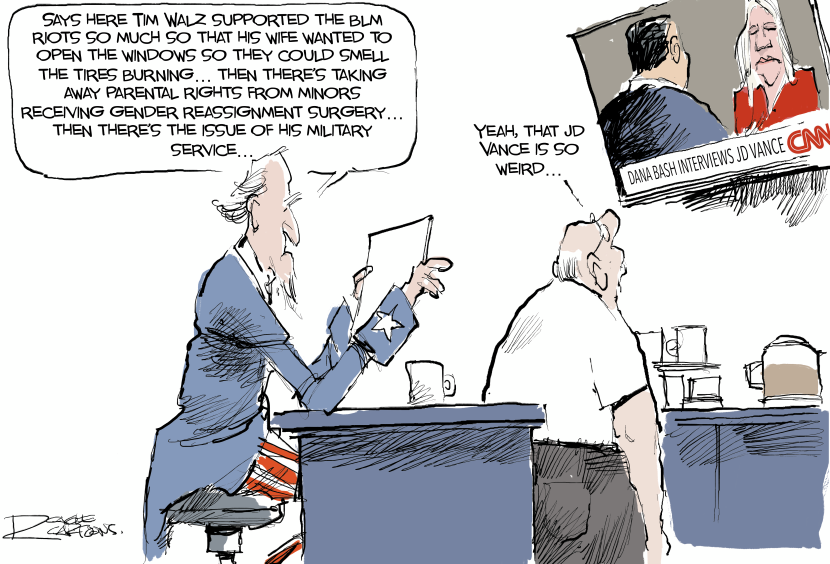
If you were among those curious about J.D. Vance’s positions on key issues, you got some answers the other day when the GOP vice presidential nominee sat for three separate TV interviews. But what you actually learned depended on which program you watched — because the questioning varied widely and was, to use the term of the moment, a bit weird.

The sessions were conducted in the same place, on the same day, for about the same length of time (25 minutes). The interviewers were three accomplished veterans: Margaret Brennan of CBS, Dana Bash of CNN and Jonathan Karl of ABC.

Bash was the most combative as she dwelled on the recent fussing between Vance and Democrat Tim Walz over Walz’s military record and Vance’s criticism of Americans who don’t have children. Bash asked Vance how he felt about Walz referring to him as “weird.” She even brought up Donald Trump’s odd statements about his presidential opponent, asking Vance, “Do you believe Kamala Harris is Black?”

Brennan stayed away from all those topics. She was more low key but persistent in asking about child tax credits, breaking up giant companies, refugees from Afghanistan and trade with China.

Karl was the most conversational, asking Vance about deportation of undocumented immigrants and gender-affirming legislation. He questioned Vance about the notion that Americans with kids should get an extra vote in elections.

The only topic addressed in all three interviews was abortion.

The range of subjects was so varied that during two interviews — on ABC and CNN — Vance made a plea for questions relating to inflation, housing and foreign policy, but got none. He asked Bash why she never asked about immigration.

I understand the challenges facing TV hosts when they get an early crack at interviewing someone like Vance. It’s tempting to shoot first at the headlines, especially the more sensational ones, as Dana Bash did. It’s reasonable to go a bit afield, as Margaret Brennan and Jon Karl sought to do.

Considering the tightness of the race coupled with the profound differences between the parties there is a need for more meaningful interviews with all the candidates. It would help, of course, if Harris and Walz agreed to participate.

As Ted Koppel, a master back when TV did more probing Q&A, told me recently, “An interview is nothing more than a stylized conversation. You can dominate a conversation, but then the conversation is about you. The whole point of an interview is to learn about the other person.”

Copyright 2024 Peter Funt distributed by Cagle Cartoons newspaper syndicate.

Peter Funt’s latest book is “Playing POTUS: The Power of America’s Acting Presidents,” about comedians who impersonated presidents.

Comments Off on Questions about questions for J.D. Vance

Biden, without rose-colored aviators

If Kamala Harris manages to become the 47th U.S. president it will be despite Joe Biden, not because of him.

Biden is a decent man and an honorable politician. His record of accomplishments as president is robust. “I’ve given my heart and soul to my nation” he said in a prime-time speech, but he may have given it too late.

The accolades being tossed at Biden following his decision to withdraw from the presidential campaign are misguided, as were several of his earlier actions that placed Democrats in the position they’re in now — racing against time and odds to prevent another four years of Donald Trump.

Former President Barack Obama said Biden’s decision to withdraw proved that he’s “a patriot of the highest order.” The renowned historian Jon Meacham called it, “one of the most remarkable acts of leadership in our history.” And so it went, in a flood of praise for Biden that seemed more designed to honor his decades of service — and to reflect a great national sigh of relief — than to objectively take stock of what could have been an avoidable crisis.

There is little honor in finally acknowledging an untenable situation months, perhaps years, after those around you saw it. There is nothing heroic about clinging to a presidential re-election campaign that never should have been embarked upon in the first place. And there’s hardly cause for celebration when a campaign of such high consequence is stubbornly taken to the brink before the course is corrected.

When he ran in 2020 Biden explained, “I view myself as a bridge, not as anything else.” He said younger politicians were “the future of this country.” Had he kept to what seemed like a pledge to serve a single term it would have, indeed, qualified as an act of patriotism.

Instead, Biden decided to run again, declaring that he had to “finish the job.” To be clear: No president has ever left office with the job completely done and few would be so audacious to suggest that only they were capable of handling whatever tasks remained.

Joe Biden’s missteps actually began before he selected Kamala Harris as his running mate. By declaring that he would only select a woman to run as vice president, he laid the foundation for unfair criticism that Harris faces now: that she is a “DEI” (diversity, equity and inclusion) selection. In other words, the label Republicans are using for Harris isn’t so much about her as it is about how Biden went about picking her in the first place. (Biden made the same mistake with his U.S. Supreme Court pick, Ketanji Brown Jackson, first declaring that the choice would only be a Black woman.)

It’s probably worth remembering that in 2020 neither Biden nor Harris were the Democrats’ best options. Harris had stumbled so badly in her early effort to get the presidential nomination that she dropped out when it became clear she wouldn’t even prevail in her home state of California. Biden looked shaky on the ground in Iowa, especially when seen alongside younger, energetic campaigners that included Pete Buttigieg, Elizabeth Warren, Amy Klobuchar and even the senior citizen Bernie Sanders. Biden lost in Iowa and New Hampshire and was going nowhere until Rep. Jim Clyburn endorsed him in South Carolina — giving Biden that state’s primary and ultimately the party’s nomination.

It may well be that Biden was the best person to defeat Trump in 2020. The nation wasn’t focused on youth or vigor, it was seeking wisdom and stability. But after a few grueling years in the White House Biden’s age and cognitive challenges began to show. Though many Democrats claim to have been surprised by Biden’s June 28 debate debacle, evidence of his struggles had been on display for months in video compilations that ran almost daily across the internet. The President and those closest to him must certainly have been among the first to recognize this, not the last.

Biden and many in his party’s leadership point to the 14 million votes he received in this year’s primaries. That’s about as meaningless as the “voting” that keeps returning Vladimir Putin to power. Incumbent presidents aren’t meaningfully challenged within their own party unless they withdraw early enough for a legitimate primary process. That’s what Lyndon Johnson did in late March of 1968; Joe Biden waited until July 21.

Vice President Harris insisted she wanted to “earn” the nomination. But due to Biden’s delay, what she got was the very “coronation” that Democrats hoped to avoid.

If Harris wins in November, Biden’s place in history will be secure and the stubbornness he displayed in the campaign will be forgotten. If she loses, her political career will be over and, sadly, the blame will rest largely with her boss.

Copyright 2024 Peter Funt distributed by Cagle Cartoons newspaper syndicate.

Peter Funt’s latest book is “Playing POTUS: The Power of America’s Acting Presidents,” about comedians who impersonated presidents.

Comments Off on Biden, without rose-colored aviators

Biden needs grade-schooling

Joe Biden’s closest confidants are wrestling with the same questions that 81.2 million of us who voted for him in 2020 have been mulling since the President’s disastrous debate against Donald Trump.

For answers, I turned to a fifth grader named Emily, who, though a figment of my imagination, dispenses the type of clear thinking that seems lost among older politicians and pundits. She wrote an essay for class urging President Biden to withdraw.

Q: Emily, even presidents can have a “bad night,” right?

A: I once did poorly on a geography test. However, I never was confused about which end of the pencil to write with, and I never started an answer about Germany and ended it with a statement about the South Pole.

Q: President Biden sounded sharp the very next day, didn’t he?

A: Teleprompter. When I sing along with a Taylor Swift track I’m amazed at how much better it sounds than when I sing alone.

Q: What about Mr. Biden’s insistence that he can still win?

A: Let me quote from the Girl Scout handbook. “Willingness to serve is not enough; you must know how to do the job well, even in an emergency.”

Q: Why should voters ignore all that Joe Biden has accomplished?

A: They shouldn’t, but it’s no longer possible to run on your record when you find it challenging just to walk.

Q: Isn’t Donald Trump a dangerous politician who speaks riddles?

A: What has two hands but can hold nothing? A clock. Now, that’s a riddle. Trump doesn’t tell riddles, he just lies, which is why this election is so important.

Q: Do you know any old people?

A: My grandpa, the smartest person I know. He can tell you who pitched in every World Series ever played. But sometimes he forgets to turn off the stove or can’t remember where he left his keys. Mom won’t let him drive me to school anymore.

Q: How old is he?

A: Seventy-four.

Q: Joe Biden isn’t a quitter, so why should he give up?

A: Life isn’t a Disney movie. In “Finding Nemo,” Marlin never gives up on finding his son Nemo — even when it means facing fears and crossing an entire ocean, we get that. But if President Biden stepped aside for the good of the nation, it would be heroic.

Q: What would you say to Jill Biden and others who are advising the president?

A: Get real. Aren’t you smarter than a fifth grader?

Copyright 2024 Peter Funt distributed by Cagle Cartoons newspaper syndicate.

Peter Funt’s latest book is “Playing POTUS: The Power of America’s Acting Presidents,” about comedians who impersonated presidents.

Comments Off on Biden needs grade-schooling

The NFL is always ready for some football

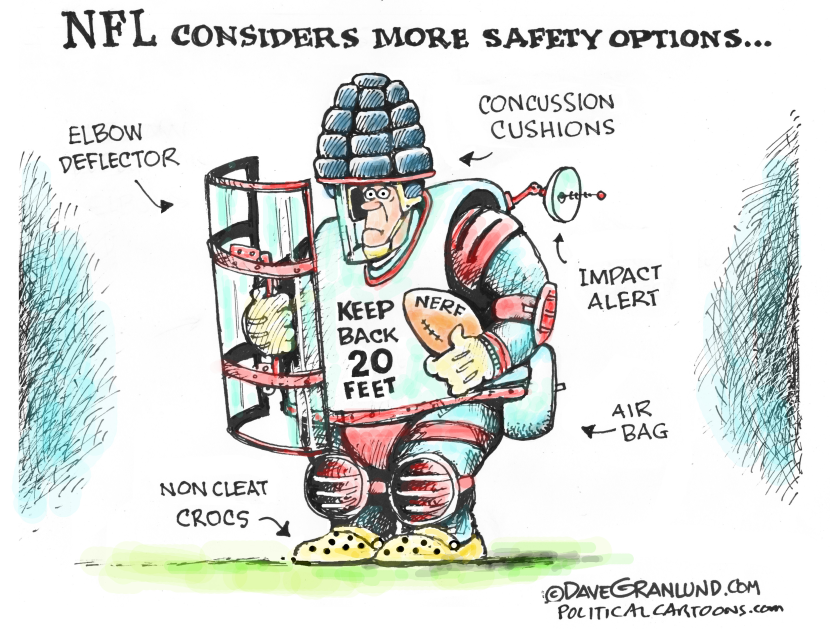
The other night the National Football League commandeered two hours of prime time on ESPN for what used to be accomplished in a minute or two with a fax machine — the release of next season’s schedule. It was underwhelming television, but in the NFL’s quest to make pro football a year-round attraction it was an important piece of a rather amazing marketing matrix.

Why would even the most dedicated diehards care about a schedule that doesn’t take effect until September? The answer involves a fast-growing style of fantasy football and sports wagering known as “best ball,” for which the betting windows are open 365 days a year, with multi-millions at stake.

Back in January, nearly two weeks before the Chiefs would defeat the 49ers in the Super Bowl to conclude the 2023 season, the leading company in best ball, Underdog Fantasy, began conducting tournaments for the following season. In other words, fantasy football competitors were drafting teams for games that were still nearly nine months away. And it wasn’t for small change: “The Big Board,” featured $2 million in prize money for a $10 entry fee, while “The Little Board” offered $150,000 in prizes for a $3 entry fee.

Matthew Berry, NBC’s top fantasy football analyst, said the ultra early gaming opportunity was certain to appeal to “fantasy football sickos of all shapes and sizes.”

In April, the NFL splashed its annual draft of college players over three days and two networks. The free event in Detroit set an attendance record with over 700,000 people spending an estimated $160 million at downtown businesses. Two days later, Underdog opened its flagship contest, “Best Ball Mania,” with 672,700 entries (up to 150 per person), each costing $25 (a $16.8 million take) with $15 million in prizes, including $1.5 million to first.

In best ball participants draft a team of NFL players, but unlike traditional leagues there are no in-season lineups, trades, or waiver wire pickups — in fact, there’s nothing for the entrant to do following the draft but sit and wait. A computer automatically selects each week’s optimal lineup after the games are played.

But knowing the schedule of games is a vital piece of best ball strategy —taking into account when teams have a bye week and and what the matchups will be in the final do-or-die weeks of the season.

For the NFL, which not too long ago rejected fantasy football and related types of sports gambling, best ball has emerged as a valuable tool in maintaining year-long fan interest. For sportsbooks, including Underdog, Yahoo, DraftKings and other providers, it’s the perfect product because millions of dollars are collected and held for as long as a year before winnings are paid out.

When Best Ball Mania opened, Mr. Berry’s colleague Peter Overzet spoke for the NFL and sportsbooks when he declared, “It’s Best Ball Christmas.”

Copyright 2024 Peter Funt distributed by Cagle Cartoons newspaper syndicate.

Peter Funt’s latest book is “Playing POTUS: The Power of America’s Acting Presidents,” about comedians who impersonated presidents.

Comments Off on The NFL is always ready for some football

What’s with all the big stuff?

After years of trying to develop what he called a “premium” hamburger, McDonald’s CFO Ian Borden surprised no one the other day by announcing that the company’s new focus is not making burgers better, just a lot bigger.

The move won’t please nutritionists, but it fits perfectly with a growing desire among Americans for super-sized stuff.

Consider ads for the 2024 Chevrolet Suburban boasting that, at 18 feet in length, the vehicle is “impossible to ignore.” Chevy refers to its massive SUV as “a room with a view.”

And what about the 100-year-old Stanley company that found new life when its giant drinking cups became a sensation. Now Stanley is selling a humongous 96-ounce version for $90, “thoughtfully designed to be your personal hydration companion.” When this big baby is filled with water it weighs 8.8 pounds.

In the world of fashion — or at least fashion fads — a recent headline in the New York Times noted “Fashion’s Big Idea: Oversize Everything.” Seems skinny jeans are out and clown pants are in. This month Julianne Hough wore what might have been the biggest pants in Oscar history when she hosted ABC’s red carpet show. “Hough wore a white Alexandre Vauthier couture jumpsuit with a gold and silver metallic bodice,” People Magazine dutifully reported. “The pants were so voluminous, though, that they acted as an optical illusion, making her jumpsuit look like a gown.”

The fascination with over-sized items comes at a time when many folks are troubled by a shift toward deceptively smaller products in categories such as snack foods, the result of what’s known as shrinkflation. “Some companies are trying to pull a fast one by shrinking the products little by little and hoping you won’t notice,” said President Biden last month.

But there’s no such problem when it comes to, say, TV screens. They’ve grown steadily in recent years—from roughly 55 inches, measured diagonally, to 98 inches. Samsung offers a version it calls The Wall, which measures 292 inches, making it the largest TV on the retail market.

Being a golfer I was intrigued by a club I saw on Amazon named the Sooolong, with the “biggest, baddest driver head on the planet.” It’s listed at 750cc’s, which, for the record, is about 60% larger than USGA rules permit.

The rest of the world has long scoffed at the way we Americans favor bigness — from our 10-gallon hats to our Big Gulp sodas.

That brings us back to McDonald’s which recently offered a Double Big Mac sandwich, consisting of one-and-a-half buns surrounding four beef patties. “The opportunity is significant” said Mr. Borden, for a “large, more satiating type burger.”

Satiate is an interesting choice of words to describe the trend. The dictionary defines it as “gorge, overfeed, sicken and nauseate,” which are really big matters, to say the least.

Copyright 2024 Peter Funt distributed by Cagle Cartoons newspaper syndicate.

Peter Funt’s latest book is “Playing POTUS: The Power of America’s Acting Presidents,” about comedians who impersonated presidents.

Comments Off on What’s with all the big stuff?

Our obsession with true crime

In television, now more than ever, crime pays.

A search for “true crime” on Netflix produced 300 titles. Nearly half of Apple’s top 20 podcasts in the U.S. are devoted to true crime, and the internet is chockablock with recommendations for the best new true crime books.

As I type this, Paramount+ is announcing that Dennis Quaid will play the real-life serial killer notoriously called “Happy Face,” based on the “Happy Face” podcast from iHeart. And Village Roadshow Entertainment is announcing both a scripted series and a two-part documentary based on the story of convicted serial killer William Dathan Holbert, better known as “Wild Bill,” who is currently serving 47 years in prison for five murders.

Why are Americans drawn to this genre more than at any time in TV history? Some people suggest the trend is linked to the continuing perception of rampant crime in American cities (a politicized issue whose statistics are debatable). But real-world crime is perpetrated largely by gangs, drug dealers and street thugs — none of which is central to most true crime dramas on TV.

Hollywood’s favorite theme concerns white females who were harmed by strangers, described by the late journalist Gwen Ifill “Missing White Woman Syndrome.” Surprisingly, Pew Research found that 43% of true crime fans are Latino, and 36% are Black, and 34% are white.

Dr. Chivonna Childs of the Cleveland Clinic believes, “True crime appeals to us because we get a glimpse into the mind of a real person who has committed a heinous act. We want to see how they tick, and that’s totally normal and healthy.” However, University of Colorado professor Amber McDonald says a “dopamine dump” occurs for many viewers of true crime programs, along with an adrenaline rush. “So there is a physiological component with these shows that gets people hooked beyond just the story.” This, she says, can lead to “secondary traumatic stress.”

“I’m concerned about the trajectory we’re on,” said Glenn Sparks, a professor at Purdue University who has studied the effects of media violence. “If I worked at Netflix I might say, ‘Well, this is what people want.’ But that doesn’t mean it should be provided,” he added. “Research shows that escalating violence on-screen can make us more tolerant of it in real life. It can leave lingering fear that can cause sleep disturbances and other problems.”

“Because Netflix bases so much on technology, when something works, you’re going to have a lot of different versions of that same thing. I think that’s what’s happening with this kind of violent content,” said Gina Keating, the author of “Netflixed: The Epic Battle for America’s Eyeballs.”

True crime drama has been part of tabloid media for over a century, but its modern exploitation is often traced to Truman Capote’s 1966 book “In Cold Blood,” covering the deaths of four family members on a Kansas farm. In the era of streaming television, the genre has exploded, beginning with “Making a Murderer,” the landmark Netflix program from 2015, with its story of a man accused of murder and sexual assault.

Regardless of how politicians spin the statistics, many Americans are concerned about safety. And Hollywood’s eagerness to exploit it is, indeed, a true crime.

Copyright 2024 Peter Funt distributed by Cagle Cartoons newspaper syndicate.

Peter Funt’s latest book is “Playing POTUS: The Power of America’s Acting Presidents,” about comedians who impersonated presidents.

Comments Off on Our obsession with true crime