A Week of Pomp and Circumstance

Three disparate events within a week’s time captured the world’s attention and provided a fresh take on how we regard pomp and circumstance.

The funeral of Barbara Bush was a celebration in the grandest sense of a beloved first lady, honored on April 21 after 92 robust years of life. In her final days, Mrs. Bush planned every detail of her funeral, set in Houston’s St. Martin’s Episcopal Church, where she and President George H. W. Bush attended services for half a century.

Her wishes were summarized in son Jeb’s eulogy as he spoke of her “looming presence” and imagined her cautioning, “Jeb, keep it short. Don’t drag this out.”

If only there had been a television camera behind the pulpit to scan the faces of those in the front row. On one side were former presidents Bush 41 and Bush 43, along with members of the Bush family. On the other side, Melania Trump sat next to Barack Obama; then came Michelle Obama and, to her left, Bill and Hillary Clinton.

It would be a mistake to attach too much political significance to a funeral, but the vibe that day was a reminder of the civility that frequently marked our political world in Pre-Trump days. We don’t have royalty in our country – but if we did, the roster would include several of those in the front row. In her final gesture, Barbara Bush created a tranquil moment that brought people together.

The British do have royalty, of course, and its brightest stars took to the world stage April 23 with the birth of the third child for Prince William and Kate Middleton. Emerging from the hospital just seven hours after delivering her son, Kate looked every bit as glamorous, yet refined, as her millions of admirers wish her to be. For the media throng across the street no detail was too small – from Kate’s red Jenny Packham dress, to the latest odds set by London bookmakers on what the couple would name their child.

The New York Times playfully asked in an editorial about the royal fuss, “Was it too much? Of course, but when offered alongside all the other ‘evil news’ of White House iniquities, shooting rampages and other horrors, it’s barely enough, as Mark Twain might have put it.”

Scoff as we might might from time to time about British traditions, the fact that they manage to keep royalty and governance separate is a virtue – especially considering the state of things in Washington.

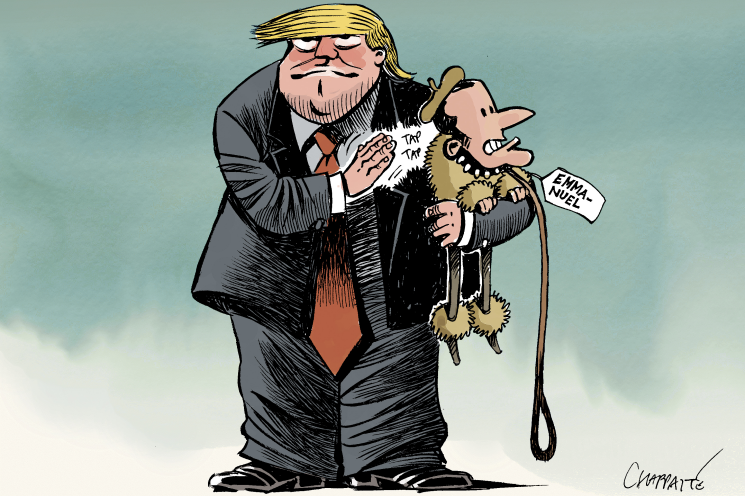
And so the world turned its attention, briefly, from Kate’s baby to the state visit of French President Emmanuel Macron and wife Brigitte to the White House. Politics aside, President Trump is socially awkward, smiling at the wrong time, shaking hands for too long and, the other day, brushing what Trump called “a little piece of dandruff” from Macron’s shoulder.

For the state dinner April 24, Mrs. Trump donned a black Chantilly lace Chanel Haute Couture gown, hand painted with silver and embroidered with crystal and sequins. There were 1,200 branches of cherry blossom, 2,500 stems of white sweet peas and 1,000 stems of white lilac. The guest list, as distributed by Mrs. Trump’s office, included “The Honorable Jared Kushner and The Honorable Ivanka Trump,” along with at least 10 billionaires from private business.

The world saw an administration that has neither the charm of British royalty nor the dignity of the Bush family. It wasn’t so much pomp as it was pompous.

A list of Peter Funt’s upcoming live appearances is available at www.CandidCamera.com.

Peter Funt is a writer and speaker. His book, “Cautiously Optimistic,” is available at Amazon.com and CandidCamera.com.Copyright2018 Peter Funt. Columns distributed exclusively by Cagle Cartoons, Inc., newspaper syndicate.

Comments Off on A Week of Pomp and Circumstance
Race Against Time

One headline after another seems to confirm that racism remains a serious problem in America. Yet, while deeply disturbing, the situation is neither unexpected nor necessarily an indication of a significant shift in the nation’s character.

Cartoon by Nate Beeler - Washington Examiner (click to reprint)

Cartoon by Nate Beeler - Washington Examiner (click to reprint)

Present conditions – from economic distress at home, to war and the specter of terrorism abroad – create a perfect storm for racial upheaval. Over the last decade, three developments in particular have stirred those with racial bias to erupt, much as bees react when their hive is disturbed.

The first was 9/11, which, along with lesser acts of terrorism that followed, triggered legitimate fears among many Americans, while also inviting inappropriate prejudice against those of Muslim lineage. Then came increases in illegal immigration in the Southwest at a time of severe nationwide unemployment, making latent bias against Latinos boil over. And there was, of course, the election of the nation’s first black president, which has become an emotional call to action among closeted and cowardly Americans for whom equal rights is more an abstract concept than a philosophical way of life.

Within this triad of racial hatred, the bigotry exposed by Obama’s Presidency is in some respects the most painful, and yet the easiest to understand. The election of a black chief executive did not, in and of itself, move the line that separates the fair from the biased. It did, however, underscore how far the nation had progressed to that point, and it challenged – perhaps even dared – the prejudiced among us to reveal themselves, which is what they are doing.

Overt acts of racism can be limited by laws or curbed by social pressure, but an actual shift in the nation’s consciousness takes generations to accomplish. Moreover, each period of meaningful racial progress, such as occurred in the mid-sixties, is often preceded by vocal and even violent outbursts, as the fearful become more threatened.

In his memorable speech on race during the 2008 campaign, Barack Obama spoke of his white grandmother, “a woman who once confessed her fear of black men who passed by her on the street, and who on more than one occasion has uttered racial or ethnic stereotypes that made me cringe.” People who struggle, and sometimes fail, to overcome the fear that leads to racism are nonetheless, said Mr. Obama, “a part of America, this country that I love.”

Such compassion was sorely lacking among administration officials who reacted in knee-jerk style last week when the deliberately distorted video of Shirley Sherrod, an official in the Agriculture Department and an African-American, caused a political and media firestorm. Although it was not clear at first, Sherrod was actually using her own life experiences to underscore how racial bias is difficult to overcome – a process that in her case took many years, and was similar in many ways to what President Obama had recalled about his grandmother.

For all the parsing of Sherrod’s speech, little attention has been given to the message she actually sought to deliver at the NAACP dinner last March, on the 45th anniversary of her father’s funeral. He was shot in front of three white witnesses by a white man, who an all-white jury refused to indict. That’s when she dedicated her life to helping black Americans escape the racial hatred that her family faced.

“I’ve come to realize,” she explained, “that we have to work together and – you know, it’s sad that we don’t have a room full of whites and blacks here tonight, because we have to overcome the divisions that we have.”

“Our communities are not going to thrive.our children won’t have the communities that they need to be able to stay in and live in and have a good life if we can’t figure this out. White people, black people, Hispanic people, we all have to do our part to make our communities a safe place, a healthy place, a good environment.”

Added President Obama at week’s end: “If there’s a lesson to be drawn from this episode, it’s that rather than us jumping to conclusions and pointing fingers at each other, we should all look inward and try to examine what’s in our own hearts.”

That’s a slow and painful process, as Shirley Sherrod discovered, as must we all.

—–

©2010 Peter Funt. This column is distributed exclusively by Cagle Cartoons, Inc. newspaper syndicate. For info call Cari Dawson Bartley at 800 696 7561 or e-mail [email protected].

Peter Funt writes about newspapers at www.FuntonFronts.com and is a writer and public speaker. He’s also the long-time host of “Candid Camera.” A collection of his DVDs is available at www.candidcamera.com.

Comments Off on Race Against Time

Penny Wise and Fan Foolish

The sales slogan used by the San Francisco Giants this season, “It’s Magic Inside,” seems to pertain to this trick: Fans arrive early hoping for a precious promotional souvenir and, for many, the Giants make their hopes vanish.

Cartoon by Andy Singer - PoliticalCartoons.com (click to reprint)

Cartoon by Andy Singer - PoliticalCartoons.com (click to reprint)

The slogan is unique to the Giants, but the ploy of getting fans to show up early because of severely limited quantities of promotional items is increasing among Major League teams.

One of the most egregious examples of this sleight of hand took place at the Giants’ game July 17, when 20,000 paying customers obtained the much-sought Tim Lincecum bobblehead, while 22,599 others did not. How successful is a “promotion” that disappoints more people than it pleases?

Worse, in order to stand a chance at obtaining the souvenir, fans gathered outside AT&T Park more than three hours before the scheduled game against the Mets, with lines stretching around the stadium on all sides.

By limiting the promotion to “the first 20,000 fans,” the Giants created massive congestion at the stadium hours before the game, while effectively blocking paying fans from entering on time even if they didn’t want the bobblehead. The move also fostered a bustling street-sale market for the Lincecum doll after the game, and frustrated thousands of people – including many kids who stood in line yet were too late for the doll.

Why? Could it be that the Giants, like many other clubs, profit handsomely by selling food and drink to thousands of customers who wouldn’t ordinarily be sitting in the stadium hours before the first pitch? And how considerate of the Giants to even send vendors out to sell things to fans in line.

The idea of attracting fans with a promotion, then limiting its distribution, becomes even more unfortunate when the targets are children. On the Giants’ Mesh Jersey Day, Aug. 15, only the first 7,500 youngsters will get the souvenir. In Kansas City, the Royals held a Bat Day July 18 but only furnished bats to the first 8,000 kids. On August 22, the Marlins will limit their Lunch Cooler souvenir to just the first 5,000 youngsters.

With attendance slumping, promotions at Major League parks are increasing. Most teams follow the pattern of limiting promotional giveaways – ranging from 10,000 for most Cubs’ premiums, to 25,000 for the Mets.

At Yankee Stadium, which has had the largest attendance this season and some of the highest ticket prices, fans pay $300 for a field-level seat, but on July 22 were denied a free baseball cap if they weren’t among the first 18,000 to show up. Assuming current management hopes to rehabilitate Yankee Pride now that George Steinbrenner is gone, they should start by fixing marketing schemes like that.

The Dodgers, on the other hand, have four bobblehead giveaways this season and to their credit stepped up to supply 50,000 for each game. A few teams, known for graciousness to fans – including the Angels, Indians, Phillies and Pirates – manage to provide virtually all premiums to all fans in attendance, without limits or excuses.

And then there’s the Red Sox, a team that continues to play in a league of its own, selling out all games at Fenway Park in Boston while offering no promotional giveaways whatsoever.

Few teams are as fortunate as the Red Sox and Yankees – especially during this economic losing streak – but being cheap with promotions isn’t going to win new fans, or help keep the old ones. You want cheap? How about opening day in Houston when the Astros limited magnet souvenirs to the first 40,000 fans. Minute Maid Park holds 40,950.

After the Lincecum bobblehead game in San Francisco, fans with kids who paid to attend but missed out on the “Magic Inside” because they were too late for the souvenir, were seen buying the bobblehead on the street outside for more than the price of a ticket. That’s not “magical,” as the Giants’ marketing claims, it’s just a dirty trick.

—–

©2010 Peter Funt. This column is distributed exclusively by Cagle Cartoons, Inc. newspaper syndicate. For info call Cari Dawson Bartley at 800 696 7561 or e-mail [email protected].

Peter Funt writes about newspapers at www.FuntonFronts.com and is a writer and public speaker. He’s also the long-time host of “Candid Camera.” A collection of his DVDs is available at www.candidcamera.com.

Comments Off on Penny Wise and Fan Foolish

Link to This

There are several things, Barack Obama, that I’m going to do, Tea Party, to promote what I write, Lady Gaga, and generate more buzz, oil-covered birds.

The first is to include as many tags as possible in the first sentence so that Internet searchers are directed to my articles whether they care about them or not. It’s part of my SEO, or search engine optimization.

Cartoon by Mike Keefe - Denver Post (click to reprint)

Cartoon by Mike Keefe - Denver Post (click to reprint)

**A message from Bud: This column’s for you.** The preceding sentence is an example of advertising that I’ll be placing within my reports. I’ll also be selling product-placement plugs, but unlike my ads which will be identified, the plugs will be designed to fool readers who won’t realize that when I mention driving to the scene of a story in, say, an all-new 2011 Odyssey with its aggressive stance and sporty lightning bolt beltline, that I’m actually getting paid by Honda.

I’m going to launch a blog in which I’ll ramble about the exciting things that happen to me while writing columns. I’ll blog about how my mother always phones to see if I’ve written anything funny just as I’m about to think of something funny, and how we spend the next hour trying to come up with an entry for The New Yorker magazine’s weekly cartoon caption contest, which we never win, even though I seriously believe many of my entries have been superior to those the judges picked. And who, exactly, are these judges anyway?

I’ll also be able to blog about a lot of stuff that editors and readers keep telling me no one cares about, but which I think are kind of interesting. For instance, I intend to blog about the fact that official scorers in Major League baseball are much kinder to fielders than they are in my men’s amateur league. Sun in your eyes? Ball hits a pebble? Turn the wrong way? Don’t worry, in the Majors its a hit! Stuff like that.

I’m installing a webcam on my computer so readers will be able to go online and watch me write 24/7. In order to make it more interesting, and to address the fact that I only manage to write 2/5, I’ve placed a monitor behind my desk so lurkers can see LolCats.com in the background.

From now on I’m going to Tweet when I get an idea for a story. For example: researching Biden fave BBQ recipes, 2500 wds.

I’ve hired hourly workers in Singapore to develop apps for my columns. So far they’ve come up with an app that tells what time it is wherever I’m writing.

On the advice of industry pundits, I’ve decided not to erect a pay wall around my content. This is a huge gamble, because with millions and millions of Net surfers out there, if just one would pay me $19.95 per month, I’d have almost $20.

This is kind of cool: I’m going to record myself reading everything I write and make it available as a Podcast. I’ve often heard that audiences enjoy letting their imaginations run wild when listening to writers painting delightful word pictures, so I’ll be offering my downloads for just 99 cents.

From now on, you’ll find a considerable number of hyperlinks in my writing. These can be annoying, I know, because they’re going to appear in different colors and some will be underlined. On the bright side, I’ll be sending readers to sites that will pay me money for each click.

I’m going to offer RSS feeds as soon as I learn more about how to do that.

I think this new “model” is going to provide me with more lift than I’ve been getting with the old model, which I first developed when they stopped selling ribbons for my IBM Selectric.

I’m sure to wind up with many new followers, Tiger Woods.

—–

©2010 Peter Funt. This column is distributed exclusively by Cagle Cartoons, Inc. newspaper syndicate. For info call Cari Dawson Bartley at 800 696 7561 or e-mail [email protected].

Peter Funt writes about newspapers at www.FuntonFronts.com and is a writer and public speaker. He’s also the long-time host of “Candid Camera.” A collection of his DVDs is available at www.candidcamera.com.

Comments Off on Link to This

King James Version

MIAMI – In his first satellite interview with a female network correspondent from an evening newscast not employed by a cable company, basketball superstar LeBron James today disclosed why he chose to play next season for the Miami Heat.

“At the Cleveland airport I saw a headline that said RECORD HEAT,” James told Katie Couric. “I assumed they were talking about me, and it was some kind of sign.”

Couric fired back: “You mean you didn’t know that temperatures were over 100 degrees in many sections of the East?” James insisted it was “an honest mistake,” explaining that he had been huddled with advisors day and night, and “we’ve got air conditioning in all the suites.”

Asked if he might reconsider his plans in light of the mistake, James said he would have an announcement about that in a few days during a three-hour HBO LaBron-a-thon, “Decision II,” to be hosted by Oprah Winfrey. “The Heat was never going to be my only team anyway,” James told Couric. “My plans have always included the possibility that during the summer I could also play for the Yankees. I don’t know a lot about baseball, but the Yankee organization has made me a very attractive offer. I only want to play with winners.”

In the second hour of his live interview with the CBS anchor, James was asked how he felt about news reports showing fans in Cleveland burning his jersey. “I huddled with my advisors about that,” James said. “They assured me that we now have a line of highly flammable jerseys available at www.KingJames.com that are perfect for burning. They’re made from recycled mattress covers in cribs that came from China.”

Just as the third hour of the interview with Couric was beginning, James said that after exchanging text messages with his advisors during the commercial break, he was pleased to announce that he would be donating 10 percent of his payment from CBS to the LeBron James Foundation, which trains kids in how to negotiate if ever offered big sports contracts.

“We’re not paying you anything,” Couric explained.

Upon hearing that, James and his advisors abruptly left the studio. CBS was forced to fill the remainder of the hour with highlights of an interview James recorded earlier in the day with noted sports reporter Chip Caray.

In the daytime, regional, cable exclusive with Caray, it was disclosed that James had seen a headline in Miami saying OIL ON FLORIDA BEACHES. James explained: “I thought if there’s so much oil in Florida that it’s just washing up on the beach, free for the taking, this must certainly be a great place to get rich.”

James added, “Whatever happens, I’m always going to surround myself with winners.”

—–

©2010 Peter Funt. This column is distributed exclusively by Cagle Cartoons, Inc. newspaper syndicate. For info call Cari Dawson Bartley at 800 696 7561 or e-mail [email protected].

Peter Funt writes about newspapers at www.FuntonFronts.com and is a writer and public speaker. He’s also the long-time host of “Candid Camera.” A collection of his DVDs is available at www.candidcamera.com.

Comments Off on King James Version

The Daily Content

You have here what I’d humbly call an “opinion column.” Fact is, you can call this 665-word missive anything you like, as long as you don’t call it “content.”

For those who take their creativity seriously, content has become a dirty word.

Cartoon by Brian Fairrington - Cagle Cartoons (click to reprint)

Cartoon by Brian Fairrington - Cagle Cartoons (click to reprint)

With so much space to fill on the Internet and the cable dial, not to mention satisfying the seemingly endless needs of iThis and iThat, it’s all about content. I’ve sat through lengthy industry dissertations about how media can’t get enough video content, audio content and, of course, written content, but I don’t ever recall anyone mentioning “good” content.

Imagine going to a restaurant hoping to get a culinary treat and instead learning you’ll be served a plate of “kitchen content.” How about if you went to pick up your suit at the cleaners and were handed a bag of “laundry content.”

If this were only a semantic shortcut it would be no big deal. But lumping together the efforts of writers, musicians, videographers and so many other hard working creative folks and calling it content is not only demeaning, it’s also part of the mindset that devalues creativity – by under paying, plagiarizing and repackaging it to the disadvantage of reputable creators.

Much of what’s published on the Internet these days comes from companies known as “content farms.” It’s difficult to imagine a more abhorrent term for what passes as journalism, but it’s a billion-dollar business at places like Demand Media, a leading farm that harvests roughly 4,000 “pieces of content” each day.

On its own sites, such as eHow.com and Golflink.com, as well as for outside clients ranging from the newspaper USA Today to the fashion guru Tyra Banks, Demand develops its content by monitoring words and topics sought in Internet searches, then paying freelancers to write short articles and videos to address the supposed need.

One eHow contributor named “Jenajera” describes herself as a mother of four living in the Pacific Northwest and a “paralegal-turned-SEO-writer.” (SEO is a slick term meaning “search engine optimization.”) She has written such reports as “How to Determine the Value of Scrap Gold” and “How to Choose a Site for a Backyard Chicken Coop.” But perhaps her most enlightening piece is “How to Make Money Writing eHow Articles,” in which she notes that her most recent story “has earned me nearly $1 in less than a week” – from ad revenue that Demand Media shares with some writers on top of a fee of about $15.

Her advice: “The key to optimizing your earnings is to create a large cache of targeted, keyword heavy articles quickly.” Also: “You will make more money from your eHow articles if you choose topics that are well supported by advertisers.”

I have no beef with Jenajera or thousands of others like her, who undoubtedly work hard for each dollar Demand Media pays them. But, as the axiom has it, you get what you pay for, and it’s fair to say readers of Demand’s content aren’t getting much.

Still, low-cost, low-quality content has certain appeal. Media analyst Tish Grier, writing for the respected Poynter journalism site, goes so far as to suggest that companies like Demand Media could help struggling newspapers stay afloat by providing “edited, optimized evergreen content at reasonable cost.”

That’s true, I suppose, just as optimized toys can be purchased at reasonable cost from China.

It remains a possibility that as new media become more established, and the fascination wears off, things will change for the better. After all, the earliest material for television involved harvesting content from radio, until viewers demanded more. And when cable emerged as a programming force, ESPN, for example, cared so little about the quality of its fare that it devoted hours to rugby and Australian Rules Football, until fans grew tired of cheap sports content.

In the end, it’s not all just “content,” anymore than it’s all just laundry, which is why the public must continue to demand the most from its media.

—–

Peter Funt writes about newspapers at: www.FuntonFronts.com.

©2010 Peter Funt. This column is distributed exclusively by Cagle Cartoons, Inc. newspaper syndicate. For info call Cari Dawson Bartley at 800 696 7561 or e-mail [email protected].

Peter Funt is a writer and public speaker. He’s also the long-time host of “Candid Camera.” A collection of his DVDs is available at www.candidcamera.com.

Comments Off on The Daily Content

Help Needed

Next week’s news: Calling him “the right man at the right time,” President Obama today named Gen. David H. Petraeus commander of all U.S. operations in the Gulf of Mexico. Mr. Obama acknowledged that efforts to stop the Deepwater Horizon spill are “bigger than any one person,” yet expressed confidence that Petraeus could single-handedly win the war against oil in the Gulf.

Cartoon by Daryl Cagle - msnbc.com (click to reprint)

Cartoon by Daryl Cagle - msnbc.com (click to reprint)

Reaction came swiftly from Sen. John McCain, who said, “had Gen. Petraeus been in charge of Gulf operations from the start, the spill might never have happened in the first place.”

Next month’s news: Expressing dismay at the Senate vote rejecting Elena Kagan’s bid to join the Supreme Court, President Obama today nominated Gen. David H. Petraeus as the Court’s next Associate Justice. “The Supreme Court is bigger than any one Justice,” the president told reporters. “I have complete confidence that Gen. Petraeus will help guide our nation in the war against bad laws.”

In a hastily called news conference, Sen. John McCain applauded the nomination, adding, “I believe Gen. Petraeus will be confirmed with record speed, perhaps even during a coffee break. We’ve seen this man, and we like what we see.”

Rarely has an individual won such unanimous praise among Republicans and Democrats ““ especially at a time when the two parties can’t seem to agree on anything or anyone. It is therefore smart strategy for the president to seek nominees who: (a) have rousing GOP support, (b) will be quickly confirmed, and (c) won’t make the White House look bad if they fail, thanks to (a) and (b).

Regrettably, there don’t seem to be many candidates with these qualifications who aren’t named Gen. David H. Patraeus, which explains why the president turned to him after Gen. Stanley A. McChrystal went all Rolling Stone and revealed that when it comes to loyalty he’s one fry short of a happy meal.

Mr. Obama should immediately rank all members of his administration according to confirmability, and then nominate everyone with a passing grade for as many positions as possible. The list currently consists of: Gen. David H. Patraeus, Sec. of State Hillary Clinton, First Lady Michelle Obama, and Bo, the Obama’s Portuguese Water dog.

Clinton is the only female Democrat whom Republicans seem to swoon over almost as much as Sarah Palin, although the reasons remain unclear. It may be that Clinton is seen as the most electable Democrat on the national scene, which is why Republicans would speedily confirm her for any non-elective office ““ preferably a lifetime position.

Gen. Petraeus, meanwhile, continues to demonstrate his mastery of the Capitol Hill interview process. Just a few weeks ago he avoided a tough question at a Senate hearing by fainting in his chair. He later claimed to have been dehydrated due to heat, yet it’s unlikely that any senator will ask him at his next confirmation hearing if he realizes that Afghanistan’s temperature averages 117 degrees, even inside taverns where Gen. McChrystal used to hang.

Michelle Obama now has an approval rating 13 points higher than her husband, according to Pew Research, and she has already proved herself to be more than capable in waging war against gophers in the White House garden.

Bo, too, has maintained a low profile despite a seemingly endless run of bad news at the White House, and clearly deserves more responsibility.

The president must take decisive action before it’s too late.

Next year’s news: After thanking Joe Biden for his service to the nation, President Obama today named Gen. David H. Patraeus to be his running mate in the 2012 election. “Governing the nation is a job too big for any one person,” said the president. “Gen. Petraeus is the right man to help win the war against those forces who might vote against me.”

John McCain was not available for comment.

—–

Peter Funt writes about newspapers at: www.FuntonFronts.com and can be reached at www.candidcamera.com.

©2010 Peter Funt. This column is distributed exclusively by Cagle Cartoons, Inc. newspaper syndicate. For info call Cari Dawson Bartley at 800 696 7561 or e-mail [email protected].

Peter Funt is a writer and public speaker. He’s also the long-time host of “Candid Camera.” A collection of his DVDs is available at www.candidcamera.com.

Comments Off on Help Needed

Studying the T-Threat

The T-word was back in the news this week as the U.S. Supreme Court upheld laws barring material support to “terrorist” organizations, even if, in the words of Chief Justice John Roberts, “the supporters meant to promote only the groups’ nonviolent ends.” Alas, “nonviolent terrorists” is an oxymoron, and its use underscores the struggle faced in simply identifying our foes.

Cartoon by Daryl Cagle - msnbc.com (click to reprint)

Cartoon by Daryl Cagle - msnbc.com (click to reprint)

In the latest National Security Strategy, published last month by the Obama Administration, the word “terrorism” in its various forms ““ terror, terrorist, etc. ““ appears 57 times. The nub of the document’s 52 pages, essentially consistent with the view of prior administrations, is: “The American people face no greater or more urgent danger than a terrorist attack with a nuclear weapon.”

These ambiguously defined nuke-toting terrorists would seem to include all foes ““ political, religious or simply demented ““ who target civilians with violence. Indeed, the threats we face, especially within our own borders, have become so sweeping that to speak of a “terrorist attack” is the same as saying, “we fear attacks by attackers.”

Since 9/11, when so much changed in our view of domestic threats and foreign policies, we seem at times to be bogged down in a war of words. Terrorism, for instance, is a tactic, not a opponent. Moreover, it is a tactic sometimes practiced by states as well as non-state groups. And the killing of civilians, although often the result of an act of terrorism, is not a defining element of the tactic.

It is difficult to defeat an enemy without first identifying it and understanding its ideology.

Such work is occurring at the Monterey Institute of International Studies in California, where this fall the nation’s first masters program will be offered in nonproliferation and terrorism. Among the early lessons taught by Jeffrey Bale, the director of terrorism research, is that “most definitions of terrorism ““ including those employed by many government agencies ““ are imprecise if not seriously misleading.”

According to Bale, terrorists select victims “for their symbolic or representative value, as a means of instilling anxiety in, transmitting one or more messages to, and thereby manipulating the attitudes and behavior of a wider target audience or audiences.” Absent from his definition is any mention of civilians or religious groups.

“Even within the U.S. government,” he adds, “there are probably 13 different definitions of terrorism, and most of them miss the point.

What about the nuclear threat, the one given so much weight by government policy makers?

“I don’t think it’s a particularly imminent threat,” says Bale. “Within the vast array of extremist groups that use violence, there’s only a small subset that’s interested in using chemical, biological or radiological materials, and within that group there’s an even smaller subset with the resources and means to do it. Such an attack is not likely.”

But the most controversial element in the Obama administration’s security statement isn’t defining terrorism or its weapons of choice, but whether to put a face ““ or at least a clear label ““ on the “enemy.” Even more so than the Bush administration, which targeted those who would “exploit the proud religion of Islam,” current leadership is fearful of identifying violent Islamist extremists as the greatest threat to U.S. security.

Obama’s top advisor on terrorism, John O. Brennan, insists that terms “jihadists” or “Islamists” are inappropriate because their use would “play into the false perception” that al-Qaeda and its affiliates are “religious leaders and defending a holy cause, when in fact, they are nothing more than murderers.”

Prof. Bale, an Obama supporter, sees it differently. “This is the one area of his policy that is potentially catastrophic. It’s just muddying the waters and making it impossible for people to clearly understand the agenda of the enemy.”

What undoubtedly concerns the administration is that so many Americans incorrectly see all Muslims as enemies, real or potential; worse, that an increasing number of the world’s peace loving Muslims believe such a distorted view to be U.S. policy.

Which approach would best address the problem: not labeling an enemy so as to avoid misperception? Or carefully identifying the violent Islamist component to make clear that the vast majority of the world’s billion Muslims do not fall within those ranks?

Like the “war” on terrorism, the war of words can’t ever be won. But seeking to understand and properly identify our enemies is certainly a battle worth waging.

—–

Peter Funt writes about newspapers at: www.FuntonFronts.com and may be reached at: www.CandidCamera.com. .

©2010 Peter Funt. This column is distributed exclusively by Cagle Cartoons, Inc. newspaper syndicate. For info call Cari Dawson Bartley at 800 696 7561 or e-mail [email protected].

Peter Funt is a writer and public speaker. He’s also the long-time host of “Candid Camera.” A collection of his DVDs is available at www.candidcamera.com.

Comments Off on Studying the T-Threat

News I Can’t Bear

It’s becoming apparent that Americans are wasting too much time worrying about illegal immigrants when the far bigger danger turns out to be illegal bears.

Stories and photos about bears are showing up with alarming frequency in the nation’s news media, such as these just this month. LA Times: “Authorities on alert for increased bear sightings.” Baltimore Sun: “Area black bear sightings increase.” Seattle Post-Intelligencer: “Nuisance bear trapped near Kingston.”

Cartoon by Daryl Cagle - msnbc.com (click to reprint)

Cartoon by Daryl Cagle - msnbc.com (click to reprint)

Delaware News Journal: “Maryland man killed in bear crash.” Whoops. It seems the accident occurred in the town of Bear, Md., and did not involve any actual bears.

Associated Press: “Calif. freeway closed after bear wanders in lanes.” Elma, Wash. (UPI) – “Rest area closed due to bear.” Seattle Times: “Elma rest area reopens after bear wakes up, leaves.”

Daily Markets: “Bear of the Day: CONMED Corp.” Sorry. This story apparently concerns stock trading for a company that “competes in the orthopedic surgery markets,” and is not known to be involved with bears.

Asbury Park (N.J.) Press: “Wayward bear causes traffic snarl during Monday rush hour.” WPVI-TV: “Bear caught on tape in Lehigh Co. (Pa.) neighborhood.”

Verde (Ariz.) Independent: “Black bear cruises Clarkdale before capture.” I checked, and this cruising creature was confirmed to be a genuine bear. However, a report in an Alabama paper headlined, “Big changes for Boyertown American Legion Bears,” may involve a baseball team since, according to the story, “The Bears have combined a strong offense with inconsistent pitching.”

New Baltimore Voice Newspapers: “Bonds formed between women and prisoners making teddy bears.” The report discloses this is taking place as part of the Macomb Correctional Facility “Teddy Bear Program.”

The (Penn.) News Leader: “I looked out and all I saw was a paw, claws and fur,” Emily Miller said in reference to a black bear that has been stubbornly hanging around the Millers’ Craigsville home.

San Jose Mercury News: “Charges dropped vs. man in Tahoe bear death.” An El Dorado County sheriff’s investigation has determined that John Wilkinson of Tahoma, Calif., acted in self defense when he shot a bear that entered his home through a window. Ann Bryant, president of the Lake Tahoe-based BEAR League, said she was disappointed in the way the investigation was handled. “To just allow people to get by with something this tragic and this horrific is absolutely terrible,” she said.

Knoxville (Tenn.) News Sentinel: Letter to the editor, “Why do we continue to penalize the poor black bear for the stupidity of people?”

Chicago Sun-Times: “Weekly Bears Q and A.” It turns out the questions pertain only to football.

Duluth (Minn.) News Tribune: “Hope the Internet-famous black bear cub has been spotted alive and apparently well by Ely bear researcher Sue Mansfield.”

From these accounts it’s clear that Americans are even more sharply divided about illegal bears than they are about illegal immigrants. Congress should hold hearings to resolve the bear issue, and President Obama must take a firm stand and not forget his campaign pledge to keep Hope, the Internet-famous bear, alive.

And speaking of Congressional hearings, I’d suggest a full investigation of the following piece of news, which I promise I didn’t invent, as reported by High Times:

“Bear Attack Victim Eligible for Workers’ Comp Despite Marijuana Use.”

—–

Peter Funt writes about newspapers at: www.FuntonFronts.com and may be reached at: www.CandidCamera.com. .

©2010 Peter Funt. This column is distributed exclusively by Cagle Cartoons, Inc. newspaper syndicate. For info call Cari Dawson Bartley at 800 696 7561 or e-mail [email protected].

Peter Funt is a writer and public speaker. He’s also the long-time host of “Candid Camera.” A collection of his DVDs is available at www.candidcamera.com.

Comments Off on News I Can’t Bear

Tough Sell

There’s nothing, absolutely nothing, that BP could say in an ad that would change my thinking about the oil business or prompt me to buy BP gas. So it’s hard to fathom why BP continues to run so many expensive ads in the midst of the unchecked disaster in the Gulf of Mexico.

But then, I’m probably as naive about advertising as I am about the oil business. I can’t honestly recall ever doing anything at the suggestion of an ad – except, perhaps, arrive at a movie theater at the proper time. That’s a powerful statement considering more than $100 billion is spent on advertising in the U.S. each year.

Not to say all ads are bad. Some, like the radio spots that feature the humorist Tom Bodett have put a smile on my face for years. I love the sappy music, and I enjoy hearing Mr. Bodett say, “We’ll leave the light on for ya.” But I’ve never stayed at Motel 6; never even considered it. All the ads have reminded me is that if I ever run into Tom Bodett in a bar I’d like to buy him a drink.

I love the fact that Dos Equis beer has used its ad dollars to identify the world’s most interesting person, albeit a fictitious fellow, and I applaud the fact that he’s honest enough to say, “I don’t always drink beer.” It’s particularly impressive that these entertaining ads survive despite press releases like the one from Dos Equis Brand Director Paul Smailes that includes in a single paragraph: “strategic understanding of the brand platform,” and “strong digital and social media experience.”

Ironically, Mr. Smailes uses the very sort of obnoxious PR thinking that seems absent in his commercials, but must be exactly what BP’s ad team is talking about. Regardless, I’ve never tried the beer.

Nor do I buy much Corona, although its ads set some kind of record for televised tranquility. The current batch feature folks on a beautiful beach, never saying a word. In one spot a guy is so blissed out he throws his cell phone into the ocean.

A woman I work with said she really enjoys a Huggies commercial for designer diapers with the tag line: “You’ll never look so good pooping in your pants.” Would this influence a diaper purchase? No.

My wife expressed fondness for a commercial touting the virtues of cotton, in which the actress Zooey Deschanel wears quirky, slightly retro cotton ensembles. Ever buy anything made of cotton as a result of the ad? Nope.

What’s not to enjoy about the Mac vs. PC commercials? My hunch, however, is you’re either a PC person or a Mac type, and casting two lovable guys in the roles of digital devices isn’t going to change that.

So, what hope does BP possibly have in swaying public opinion by boasting about its attempt to deal with disaster in the Gulf of Mexico by running ads that foolishly state, “our efforts will not come at any cost to taxpayers”? And, the insulting pledge to honor all “legitimate” claims?

Adweek magazine was kind in a headline that reported, “BP’s ‘Apology’ Ad Not a Complete Disaster.” The magazine notes that although BP’s TV commercial rated “average” with viewers, “many consumers expressed their anger and unhappiness with BP.” No kidding.

BP shot its commercial on a pristine beach with no tar balls or oil-coated pelicans in sight. President Obama expressed disappointment that BP would squander time and money on rehabilitating its image at a time when the last thing needed is public relations.

In 1989 when the Exxon Valdez spilled 11 million gallons of oil into Prince William Sound, the company spent $1.8 million on a newspaper ad that offered regret, but no acceptance of responsibility. “The accident has been receiving our full attention and will continue to do so,” said the ad about the largest spill in U.S. history.

In its current print ad, BP pledges, “We will get this done. We will make this right.” One fears that they’re talking about developing a successful commercial, not cleaning up the oil. I’m still not buying.

—–

Peter Funt writes about newspapers at: www.FuntonFronts.com.

Peter Funt may be reached at: www.CandidCamera.com.

©2010 Peter Funt. This column is distributed exclusively by Cagle Cartoons, Inc. newspaper syndicate. For info call Cari Dawson Bartley at 800 696 7561 or e-mail [email protected].

Peter Funt is a writer and public speaker. He’s also the long-time host of “Candid Camera.” A collection of his DVDs is available at www.candidcamera.com.

Comments Off on Tough Sell