In Search of My 9-Dollar Heirloom

As the joke has it, nine months from the start of the pandemic – right around January 2021 – we’ll experience a baby boom. After all, some activities are better suited to sheltered lifestyles than others.

But while the gestation period has months remaining, pandemic garden propagation is now upon us.

Enforced free time is resulting in a summer season with some of the saddest little fruits and vegetables ever seen on kitchen tables. Many of us have been gardening furiously since April – some folks for the first time in their lives.

Manhattan balconies and suburban backyards are chockablock with edibles, planted and potted where none has ever appeared before. Crops range from the challenging, such as broccoli and eggplant, to the relatively easy to handle garden staples, mint and basil.

A Google search of “recipes with basil” produced 1.2 million results. It also directed me to the more pressing issue: “What to do with too much basil.”

I have no data to support this, but I believe that after basil the most prevalent pandemic crop is tomatoes. My wife Amy has watched me nurse three tomato plants since early spring and determined that I’m producing the exotic “nine-dollar variety” – a tomato whose fully amortized unit cost is nearly ten bucks.

Amazon brings daily deliveries of potting soil, compost and mulch – most of it in bags triple the size I require, at double the price I would pay at Home Depot. I’ve purchased vermiculite, perlite, worm castings and neem oil, along with various potions designed to encourage blossoms to produce fruit.

I’ve watched hours of YouTube videos about growing tomatoes. Most of these, designed to be inspiring, are downright depressing.

The hosts casually display row after row of pristine specimens that “you, too, can grow.” Except I can’t. Maybe it’s because I’m using a 4-10-5 fertilizer instead of 6-8-3. Perhaps it’s because I don’t have a fully-automated drip irrigation system. Or maybe it’s just that I don’t live in San Diego or Yuma, where the sun always shines.

I’ve heard that “watching grass grow” is the most tedious horticultural activity. Actually, watching tomatoes grow – or, in my case, not grow – is worse. I’m up before dawn to investigate progress. With little else to do, I check mid-morning, mid-day, mid-afternoon and mid-evening.

I’ve learned: A watched tomato plant never fails to boil a gardener’s patience.

If my pandemic garden does a produce a ripe tomato, I intend to photograph it and, perhaps, give it a name.

However, after all I’ve been through this summer, I don’t know if I’ll have the heart to eat it.

A list of Peter Funt’s upcoming live appearances is available at www.CandidCamera.com.

Peter Funt is a writer and speaker. His book, “Cautiously Optimistic,” is available at Amazon.com and CandidCamera.com. © 2020 Peter Funt. Columns distributed exclusively by Cagle Cartoons, Inc., newspaper syndicate.

Comments Off on In Search of My 9-Dollar Heirloom

What’s to Debate About Needing More Debates?

In a presidential campaign that has twisted at every turn, it’s no surprise that the latest issue up for debate concerns debates.

Surprisingly, the Trump campaign now favors more debates, while some liberal pundits are suggesting that there should be fewer – maybe none. Seems clear to me: In a pandemic-torn campaign, voters will benefit from as many presidential face-offs as possible.

Writing to the Commission on Presidential Debates, Trump lawyer Rudy Giuliani argued that a fourth debate should be added to the current schedule of three, with the first moved up before early voting gets underway.

Giuliani noted that by the time of the first debate on Sept. 29, “as many as eight million Americans in 24 states will have already started voting.” Even more ballots will have been cast by the second and third debates, Oct. 15 and 22.

The CPD said it would not move the planned debates earlier. However, the group indicated that if both Trump and Biden want a fourth debate it would consider the request.

Both campaigns should act immediately to arrange a fourth event, in the interest of filling the gaps in this most unusual presidential campaign. Both candidates have been off the trail, with rallies and virtually all public appearances canceled. Democrats announced that Biden will not be going to the convention in Milwaukee to accept his nomination, opting to speak by video connection. Republicans will hold a modified convention in Charlotte but Trump, too, will appear via video.

At this point, nationally televised debates are all that remains of a conventional campaign.

“For a nation already deprived of a traditional campaign schedule because of the COVID-19 global pandemic,” Giuliani wrote, “it makes no sense to also deprive so many Americans of the opportunity to see and hear the two competing visions for our country’s future before millions of votes have been cast.”

Meanwhile, a mystifying op-ed by columnist Elizabeth Drew in The New York Times declared: “Let’s Scrap the Presidential Debates.” What a strange suggestion in an election year that has already been forced to scrap just about everything else.

The chorus of liberal pundits urging Biden to skip the debates entirely is alarming. Joe Lockhart, Bill Clinton’s former press secretary, advises Biden: “Whatever you do, don’t debate Trump.” According to Lockhart’s analysis for CNN, “It’s a fool’s errand to enter the ring with someone who can’t follow the rules or the truth.”

If Lockhart believes Biden can’t think fast enough to counter Trump’s lies, he’s wrong. Moreover, if the former vice president can’t handle a ruthless debate opponent then he probably can’t handle the presidency.

It wasn’t long ago that some of us believed Trump might duck the debates altogether, with so much of his disastrous past year ripe for interrogation. But as polls show him trailing Biden (the Real Clear Politics average gives Biden a 7 point lead), Trump’s strategy is shifting.

Four presidential debates of two and a half hours each is probably all that can be squeezed in. Perhaps one could be devoted to domestic issues and one to foreign affairs. To further probe the differences between the two campaigns, a second debate for the vice presidential candidates should be added to the one planned for Oct. 7.

Before selecting Joe Biden as their nominee, Democrats had 12 official debates. The events were strained at times because there were so many candidates – but not because debating itself wasn’t vitally important. Now, with Election Day drawing near, why should voters have to settle for misleading campaign ads, brief news clips and Twitter bombs to make their decision?

The CPD has opened the door for a fourth presidential debate – and presumably a second vice presidential debate – if requested by both campaigns. Trump and Biden should act quickly to make it happen.

In Pew research following the 2016 election, 63 percent of voters said the presidential debates were “very” or “somewhat” helpful in deciding which candidate to vote for. Certainly in the pandemic election of 2020 voters deserve all the help they can get.

A list of Peter Funt’s upcoming live appearances is available at www.CandidCamera.com.

Peter Funt is a writer and speaker. His book, “Cautiously Optimistic,” is available at Amazon.com and CandidCamera.com. © 2020 Peter Funt. Columns distributed exclusively by Cagle Cartoons, Inc., newspaper syndicate.

Comments Off on What’s to Debate About Needing More Debates?

Trump’s Message

WASHINGTON (Jan. 20, 2021) – President Trump’s remarks to the nation today, as recorded by Fox News:

In a few hours I will temporarily leave office, but I will never give up our fight to make America great again.

As you know, I tried to have the rigged November election delayed. However, the Supreme Court, led by the turncoat John Roberts, refused to put aside partisan politics and ordered voting to proceed as scheduled. We suffered the most inaccurate and fraudulent election in American history, probably in world history.

The election results are fake news! As a result, in a few hours you will have a fake president.

Tens of thousands of people, many of them illegal immigrants, mailed in counterfeit ballots. I saw a TV report about one man who boasted that he voted over 500 times.

The conspiracy to remove me from office began, as you know, during the corrupt Obama administration. Was it an accident that Obama’s accomplice was the same senile man who later today will take the fake oath of office?

The plot against me never would have succeeded without help from China. Joe Biden and his son Hunter made millions on illegal deals with the Chinese. Why is there no investigation of how these two despicable men probably conspired to release the China Virus, as I call it, on our shores before I closed the border?

Tomorrow, I will be opening the office of T.R.U.M.P. – The Real Unofficial Majority President – at the Trump International Hotel Washington D.C., a 5-star property, with 263 air-conditioned rooms, featuring minibars and flat-screen televisions.

Kayleigh McEnany will be releasing our schedule of rallies, beginning Friday night at the Greensboro Coliseum in North Carolina. I’m told that there are already lines of beautiful people outside this beautiful 23,000 seat facility in the beautiful city of Greensboro.

Tickets for the T.R.U.M.P. rallies are just $19.95, with VIP seating available at a slightly higher price. The patriots who attend will each receive a coupon good for 10 percent off on their next purchase of Trump Steaks.

Our rallies will all be what I call “NMNM Events”: No masks, no media!

I know that all of you in fake news, especially women with blood coming out of your eyes, blood coming out your – wherever – are happy today. You think you won’t have Trump to kick around anymore. Well, in 2024, if not sooner, we will prevail.

I’m leaving my second set of golf clubs and most of my suits in the executive residence at the White House. Your interim fake president will probably be in a nursing home and won’t notice.

Behind and around me stands the Party with which I became great and which has become great through me. Our enemies must not deceive themselves. In the years of American history, our people-poor whites and rich whites alike-have never been more united than today.

According to fake news, the horseface slob Nancy Pelosi wants the Justice Department to pursue criminal charges against me.

I want to say this to the television audience. I have never profited from public service. People have got to know whether or not their real, unofficial president is a crook. Well, I’m not a crook. I’ve earned everything I’ve got.

A list of Peter Funt’s upcoming live appearances is available at www.CandidCamera.com.

Peter Funt is a writer and speaker. His book, “Cautiously Optimistic,” is available at Amazon.com and CandidCamera.com. © 2020 Peter Funt. Columns distributed exclusively by Cagle Cartoons, Inc., newspaper syndicate.

Comments Off on Trump’s Message

Ballplayers Do a Spit-Take

For the virus-plagued season, Major League Baseball has come up with special rules that players will find even more challenging than a sharp slider in the dirt. No showering at the ballpark. No sunflower seeds. No high-fives. In all, the pandemic protocol runs 120 pages.

The rule that is likely to cause the most consternation, however, is the ban on spitting.

Baseball is the nation’s most saliva-oriented sport. You don’t see NBA players spitting on their hands before taking a shot; golfers don’t spit on the green, and I rather doubt that helmeted football players do much expectorating. But spitting is an integral part of the National Pastime.

I know a lot about this. During the 2003 season I arranged a “Candid Camera” scene in which I pretended to be from the commissioner’s office, and I lectured players on the Yankees about the urgent need to curb spitting – especially in nationally televised games. Every player I met with privately before a game against the Angels was gobsmacked.

“We’ve monitored you spitting 847 times so far this season,” I told the team’s all-star catcher Jorge Posada. He nervously asked me to assure the commissioner he would try to cut back, but said it wouldn’t be easy.

A lot of baseball’s rich history of spitting during games stems from players’ passion for chewing tobacco. But ballplayers also have the nasty habit of spitting on their hands before swinging a bat – as if batting gloves, pine tar and rosin aren’t enough to provide a good grip. Fielders spit into their mitts between pitches – as if oils and creams won’t keep the pocket supple.

Many players simply spit to make a point. Dr. Mary C. Lamia, writing in “Psychology Today” back in 2010, sought to make sense of what she called “the deliberate and unconstrained” act of spitting in baseball. “If spitting can protect a person by evoking disgust in the observer,” she reasoned, “then, given the consequences, it might be considered as an aggressive or contemptuous display… Evoking disgust in another person can be a way to cope with, or disguise, one’s own anxiety.”

Players will now have to find other ways to evoke disgust. Or will they? Are umpires going to enforce the ban on spitting? What sort of penalty will there be for expelling a chewed seed onto the diamond?

Oddly, while ballplayers are forbidden from spitting during games, they will be required to spit before games. MLB is avoiding nasal swabs by using a virus test for which players spit into a tube.

And what about the most famous aspect of the game’s fondness for saliva, the spitball? Loading up the baseball with “foreign substances” was outlawed by Major League Baseball before the 1920 season. That didn’t stop pitchers from doctoring the baseball – it simply compelled them to be more clever about it.

In his 1974 autobiography “Me and the Spitter,” Gaylord Perry detailed how he applied Vaseline to his zipper before dabbing some on the ball – because umpires were disinclined to inspect a player’s crotch area too closely.

As it happens, MLB has addressed the dilemma pitchers will face this summer. Section 5.1 of the new protocol states: “All pitchers may carry a small wet rag in their back pocket to be used for moisture in lieu of licking their fingers.”

Record books will need an asterisk for pitchers who overachieve in 2020 with the baffling ragball.

A list of Peter Funt’s upcoming live appearances is available at www.CandidCamera.com.

Peter Funt is a writer and speaker. His book, “Cautiously Optimistic,” is available at Amazon.com and CandidCamera.com. © 2020 Peter Funt. Columns distributed exclusively by Cagle Cartoons, Inc., newspaper syndicate.

Comments Off on Ballplayers Do a Spit-Take

If COVID Isn’t a National Tragedy, What Is?

“My fellow Americans, I am today ordering that Monday, August 3, shall be a national day of mourning. All of us should take time on that day to honor the memories of more than 134,000 souls taken by COVID-19. Flags will be lowered to half staff.” – Donald J. Trump, President

“When our leagues resume play for their shortened seasons, all players will wear black uniform patches to acknowledge the tragic coronavirus deaths.” – Adam Silver, NBA Commissioner; Rob Manfred, MLB Commissioner

“I am asking all New Yorkers to observe a moment of silence at noon each day until further notice, as we remember the lives lost to COVID-19. I urge people in cities and towns across the nation to join the citizens of New York in expressing our collective grief.” – Bill de Blasio, Mayor

None of these statements has been made, and a reasonable question is, why?

What’s happening to us? Are we already experiencing what could be called the “thoughts and prayers” phenomenon?

So often, when tragic events have leapt to the top of our collective consciousness, Americans have pledged to never forget, to take action, to work for social and political change and, of course, to offer thoughts and prayers to the victims and their families. Then, as has happened so often with gun violence, we quash our emotions and move on.

One thing is certain: the public and its news media can’t rely on the Trump administration to acknowledge the gravity of the pandemic. Our president is never seen shedding a tear or leading the nation in grieving. Better to resume campaign rallies in a display of reckless disregard for the well-being of the living and the memories of the dead.

Police brutality is absolutely worthy of protests and outrage, but the overpowering national objection to it in recent weeks is in strange contrast to the failed pandemic response. Yes, many Americans complied with social distancing and other rules – at least for a few months – but why hasn’t the nation stood in protest over scandalous conditions at nursing homes, prisons, and meatpacking plants?

With a U.S. COVID-19 death toll greater in five months than the 14 years of American combat in the Korean and Vietnam wars combined (95,000 lives lost), many of us are in deep despair over this horrific loss, while others seem unable – or unwilling – to process such staggering numbers. America’s difficulty in putting the pandemic’s toll in proper perspective is causing significant emotional, social and political problems.

Where do senior citizens, particularly those who are in nursing homes, rank? I’ve heard some right-wing talk show hosts shamefully scoff that many of the dead are old, some already suffering other illnesses. Between the lines: These deaths are less newsworthy because they don’t count as much as those of younger persons.

Even the basic math has become controversial. Some conservatives claim death counts are being inflated to make the Trump administration’s handling of the crisis appear worse than it is. Others, including the head of the Centers for Disease Control, Robert Redfield, believe the toll is much higher – as much as 10 times higher – than has been reported.

When some politicians and their misguided followers choose to treat death counts as mere points on a graph, much like a stock table, it leads to reckless decisions about reopening public places before safety conditions are met. It creates a national numbness. It allows politicians to frame the deaths as collateral damage in their self-proclaimed war. It twists a national crisis into a political pretzel.

No one’s death, regardless of age or pre-existing medical condition, should be dismissed as a statistic. Why aren’t we wearing pins or ribbons in remembrance of the dead? In addition to 7 p.m. tributes for heroic doctors and nurses, why isn’t there also a national moment of silence at noon each day to honor those who have passed? Or a national day of mourning? Why aren’t more flags at half staff?

News organizations have devoted enormous space and airtime to the pandemic. Most, including this one, have worked vigilantly to track down individual stories and give names and faces to the dead. But it’s not enough.

Our friends and neighbors are dying in unthinkable numbers. When we stop giving that proper focus it’s the first step in allowing a president and his cowardly allies on Capitol Hill to escape retribution at the ballot box in November.

We talk a lot these days about a “new normal.” If by normal we mean treating so many deaths as routine, then we should be ashamed. I can think of over 134,000 reasons why.

A list of Peter Funt’s upcoming live appearances is available at www.CandidCamera.com.

Peter Funt is a writer and speaker. His book, “Cautiously Optimistic,” is available at Amazon.com and CandidCamera.com. © 2020 Peter Funt. Columns distributed exclusively by Cagle Cartoons, Inc., newspaper syndicate.
Comments Off on If COVID Isn’t a National Tragedy, What Is?

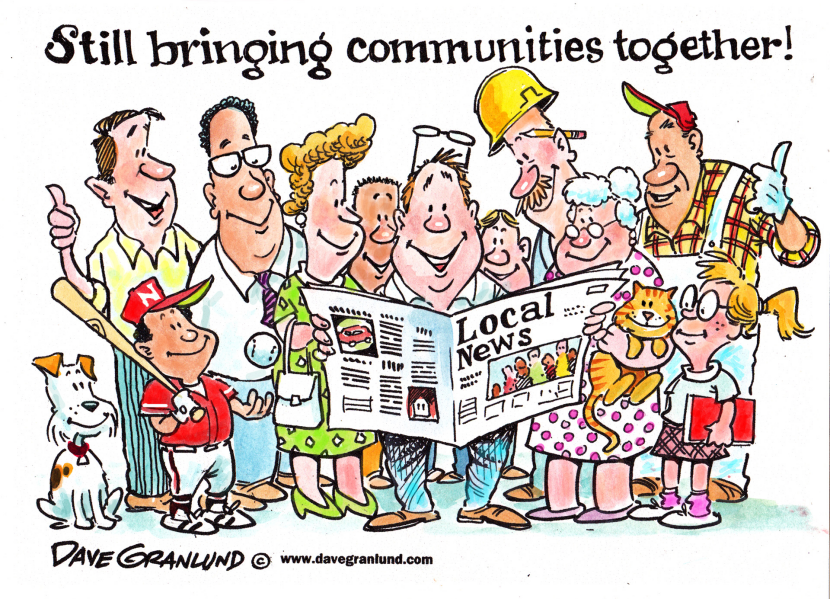
A New Morning in News

The New York Times made a quiet disclosure recently that speaks loudly about the state of news media today.

Its newsletter, “The Morning,” has reached over 17 million circulation, which the paper says is one the largest daily audiences in any form of journalism across all platforms.

Let’s process that. A free news summary sent by email – similar to missives now offered 24/7 by most publishers – has found the journalistic sweet spot for a vast number of readers. It prompted the Times’s media writer, Ben Smith, to tweet: “So many news organizations gradually realize we are, in varying degrees, email newsletter publishers with websites.”

That’s a clever turn of phrase, but is he right? Some readers will always want depth and will click – or pick up the paper – for the full story. But as newsletters become more detailed, while consumers’ time and attention scatter, elements of the news business will change or be forced out.

I still get six newspapers delivered to my driveway each morning. I stick with them because I enjoy holding a paper in my hands and scanning the printed pages; also, because I wish to support the efforts of publishers, both locally and nationally. I think most newspaper websites have yet to figure out the best way to display stories online, so while traveling I prefer to read the replica e-editions of daily papers.

Lately, though, I find that the best newsletters bridge the gap between digest and detail – while jumping over print. Before even taking rubber bands off the papers, I sit at my kitchen table, with coffee, cereal and laptop. My inbox contains more than two dozen newsletters that arrived overnight since I read Brian Stelter’s “Reliable Sources” report from CNN before bed.

Ironically, while the purpose of newsletters is to encapsulate and streamline content, the combined volume of multiple daily subscriptions can be overwhelming. For many of us it has changed our daily routine and the way we consume news.

The newsletter boom is creating marketing challenges for publishers similar to what they faced decades ago when deciding whether online content should be free or paid. The Washington Post offers a surprisingly detailed newsletter called “The Daily 202” in the morning and “The 5-Minute Fix” in the afternoon – both for free, to draw readers into the digital tent. The Wall Street Journal has seen its paid subscriptions rise significantly, something the paper’s CMO Suzi Watford attributes to the Journal’s growing array of newsletters.

The Times has made perhaps the biggest push into newsletters, recently giving one of its most skilled journalists, David Leonhardt, the task of writing “The Morning,” assisted by his own small staff of writers. It has been expanded – delivering not just headlines and teasers, but as much detail as, say, an hourly newscast on NPR.

It’s been clear for some time that many printed newspapers are fading. We’ve assumed that publishers were victims of forces outside their direct control: cable-TV, internet, social media and, of course, readers’ changing habits. What if publishers’ own newsletters deliver the final blow to ink-on-newsprint?

Funny thing: When Ben Smith quipped that his bosses had become “email newsletter publishers with websites” he never even bothered to mention that, for now, they also print newspapers.

A list of Peter Funt’s upcoming live appearances is available at www.CandidCamera.com.

Peter Funt is a writer and speaker. His book, “Cautiously Optimistic,” is available at Amazon.com and CandidCamera.com. © 2020 Peter Funt. Columns distributed exclusively by Cagle Cartoons, Inc., newspaper syndicate.

Comments Off on A New Morning in News

Sometimes a Rose Is More Than a Rose

The rose bush outside our kitchen window is telling a different story this spring.

Severely cut back each winter, it always rebounds as the weather turns warmer. I once read in a gardening book that it’s almost impossible to over-prune roses.

But last week, although the stems had grown tall and the leaves were vibrant, the plant produced just a single flower. I watched as it transitioned from bud to bloom – a soft shade of crimson, not too dark, mixed with a bit of pink from nature’s limitless palette. It was beautiful and mysterious.

The days have been especially pleasant here along California’s Central Coast. With just enough late-winter rain and bright spring sun, gardens are lush.

There are many golf courses nearby and with players sheltering at home the links quickly became wildlife sanctuaries. Families of deer, who usually poke around in the rough during daylight hours, spent March and April bounding across the fairways, not having to worry about golfers or their errant shots.

As much as I like sports, when Gov. Gavin Newsom allowed courses to reopen this month it was bittersweet. I had taken to riding my bike on the empty cart paths and watching how, with each day, the animals and plants seemed more comfortable in surroundings which, after all, are home.

With extra time on my hands this spring I went back to growing vegetables in large containers. I had given it up a few years ago when things at the office were busy. Also, because my wife Amy did the math showing that each tomato I proudly produced was costing about $8 after all the fertilizer, water and various gardening supplies had been tabulated.

But this year is different. I’m not quite so bored that I’m willing to watch grass grow, but I do enjoy spending hours evaluating the progress of a healthy Early Girl plant. My blueberries are small, but sweet. The Meyer lemons were right on time. There was fresh basil for last night’s salad and mint to garnish Amy’s spiced chickpea stew.

Yesterday, a few petals dropped from the lone rose. This morning, what remained of the flower had fallen to the ground.

As I walked from the kitchen for a closer look I was surprised to see that the bush had produced nearly 30 new buds, all forcing their way open at the same time. I don’t know how I missed them. I could swear they weren’t there yesterday, or perhaps they were so tiny that they went unnoticed. The bush is more robust than ever.

What am I to make of that first rose? Was it a scout? A message in increasingly uncertain times?

I don’t care much for omens, unless of course they come along when we really need them. So, I’m taking this as a good one.

A list of Peter Funt’s upcoming live appearances is available at www.CandidCamera.com.

Peter Funt is a writer and speaker. His book, “Cautiously Optimistic,” is available at Amazon.com and CandidCamera.com. © 2020 Peter Funt. Columns distributed exclusively by Cagle Cartoons, Inc., newspaper syndicate.

Comments Off on Sometimes a Rose Is More Than a Rose

Class of 2020: Can You Hear Me Now?

Thank you, Class of 2020! It’s an honor to be delivering your college commencement address, even with this awkward Zoom connection. Testing…

I’m sorry you and your friends won’t be partying tonight but, when you think about it, today isn’t all bad.

You didn’t have to rent the purple cap and gown that hasn’t been restyled since the school was founded in 1907. You avoided arriving at 8 a.m. in the parking lot behind the student union, only to be scolded by Mr. Walsh for being in the wrong alphabetical position.

You didn’t have to stand in the sun while Jessica Shapiro struggled through “God Bless America,” followed by Chancellor Botwick, who promised to be “brief” but spoke for 35 minutes about plans for the new science building that you’ll never set foot in. You missed hearing him say, “I’m proud to know each of our students personally,” even though in four years he never found time to meet you.

You skipped the humiliation of Dean Martin (hat-tip to Rodney Dangerfield) reading the names of 164 classmates graduating with academic honors, with your parents hoping you’d be included despite your 2.3 GPA.

You didn’t have to walk across the platform and shake hands with trustees who weren’t bothering with Purell. You were spared worrying if dad got those few seconds on video – considering that he was some 400 feet away on the school lawn using the flip phone he bought when you were in 9th grade.

You missed the awkwardness of introducing Ryan and Sakiko and wondering what your parents thought of his tattoos and her purple hair. You dodged having to answer questions from other parents about your future plans, considering that you don’t really have any.

Plus, picture this: the lawn is muddy. The punch at the reception makes you think of Kool-Aid, except that you’ve never actually had Kool-Aid. It starts to rain just as you and dad lug your stuff from the dorm to the car. Mom won’t stop complaining about what the humidity is doing to her hair.

Look, the saddest people today are your parents. They’ve managed to forget the awkwardness of their own college graduations. Or, maybe, they weren’t fortunate enough to go to college, and today was to be a combination of vicarious pleasure and parental pride. Give them a hug. Promise that when the pandemic restrictions are lifted you’ll find a way to get that cap and gown and pose with them, and that your sister will use her iPhone 11 Pro to take a photo for their mantel.

So, what’s your next move? If you can afford it, volunteer this summer: deliver meals, entertain seniors, offer to pick up and distribute books from the library. If you and your family need money, postpone your career goals for at least a few months and work on the front lines. Deliver pizza, handle the cash register at the supermarket or take a temp job on a U.P.S. route.

I put on this suit and tie today to talk in front of my computer because I believe in you. I’m counting on you to see beyond the fear and frustration of the moment.

You knew that graduation would mark the start of a new chapter in your life, filled with mysteries and challenges. You understood that college prepared you for the future. You just didn’t expect the future to arrive so soon. Good luck.

Wait, what? I’m on mute?

A list of Peter Funt’s upcoming live appearances is available at www.CandidCamera.com.

Peter Funt is a writer and speaker. His book, “Cautiously Optimistic,” is available at Amazon.com and CandidCamera.com. © 2020 Peter Funt. Columns distributed exclusively by Cagle Cartoons, Inc., newspaper syndicate.

Comments Off on Class of 2020: Can You Hear Me Now?

Biden Needs More Clickbait

If a tree falls in the forest – or, as the case may be, if Joe Biden conducts a virtual town hall – and there’s no one to hear it, does it make any noise?

With rallies and other live events frozen by the pandemic, the presidential campaign is limited to news coverage (so-called earned media), paid ads and, importantly, social media. As Barack Obama proved in 2008 and 2012, and Donald Trump demonstrated in 2016, social media is critically important in modern politics, even without a novel virus.

Which brings us to April 28, when the Biden campaign held a virtual town hall to discuss women’s issues and to showcase an endorsement from the 2016 nominee, Hillary Clinton. The hourlong event ended with Biden’s YouTube channel having just 7,074 viewers. Additionally troubling for the former vice president, there were 978 “likes” and 2,400 “dislikes.”

Such audience numbers would be disappointing for a mayoral campaign in Dubuque, and the negative feedback is flat out alarming. After 24 hours of replays, the event had reached 61,000 views, with dislikes still exceeding likes by three to one. Part of Biden’s problem: his YouTube channel has roughly 50,000 subscribers, while Donald Trump’s has over 390,000.

But that’s just the tip of the Biden campaign’s social media concern. From mid-March to mid-April, posts about the president generated seven times more interactions (likes, comments and shares) than the former vice president on Facebook and Twitter, according to the monitoring service NewsWhip. Trump’s social media followers far exceed Biden’s – 77 million to 5 million on Twitter, 27 million to under 2 million on Facebook, and 19 million to under 2 million on Instagram.

Of course, Donald Trump devotes considerable time and effort to peppering his Twitter feed, and he has the power of the presidency behind him. Still, while Joe Biden has 5 million Twitter followers, recent rival Sen. Bernie Sanders has nearly 12 million and former President Obama has about 116 million.

Although Trump obsesses over his TV ratings and social media numbers, there’s no need for Biden to launch a Twitter war – but he does need to improve his social media presence. Fundraising, for instance, is tied directly to digital outreach. As of April 21, Trump and the GOP had $187 million more in donations than Biden and the DNC.

Organizing, which the Biden campaign struggled with during most of 2019, is also dependent on social media. It was clear to those of us who followed Biden across Iowa for months that his crowds were far smaller than those of, say, Sanders, whose relentless texting and emailing helped create huge turnout.

Then there’s basic messaging. One reason Mr. Trump dwells in the Twitterverse as much as he does is that it allows him to bypass news media and connect directly with supporters. Joe Biden doesn’t have enough of that clout, at least not yet, and the deficit is particularly crippling during the pandemic, when there are no live events.

The Biden camp hopes to level the playing field by utilizing tech veterans of the 2016 Trump campaign, led by Silicon Valley denizen James Barnes, who specializes in Facebook targeting. Barnes, once a Facebook employee, is credited with applying much of what the Obama campaign achieved with social media in 2012 to help elect Trump in 2016. Now, Barnes works on the Biden campaign.

To the extent that the Biden campaign is counting on Trump to self-destruct during the pandemic, as death counts rise and economic readouts fall, then keeping a low profile might not be a bad strategy. But at some point Biden’s team must step up its social media game if it hopes to generate adequate funds, enthusiasm and, ultimately, turnout.

Back to YouTube for a moment, where the Biden channel had anemic viewer totals with Clinton, House Speaker Nancy Pelosi and former Vice President Al Gore. Notably, however, when the message is appealing, clicks do come. President Obama’s April 14 appearance on Joe Biden’s channel has so far logged over 2 million views.

A list of Peter Funt’s upcoming live appearances is available at www.CandidCamera.com.

Peter Funt is a writer and speaker. His book, “Cautiously Optimistic,” is available at Amazon.com and CandidCamera.com. © 2020 Peter Funt. Columns distributed exclusively by Cagle Cartoons, Inc., newspaper syndicate.

Comments Off on Biden Needs More Clickbait

What YouTube Sees in Me

Many of us are overdosing on YouTube during coronavirus confinement, and we’re used to the fact that, like it our not, we’re being monitored. Things we shop for online invariably pop up in ads accompanying the videos.

Lately, however, I’m struck by the fact that the videos themselves are tracked. Watching one leads to suggestions for others – the product of YouTube’s AI, which blends genius with quirkiness.

YouTube has some 1.3 billion users and they upload over 7,000 hours of video each day. Even sheltered 24/7 there’s too much inventory to navigate without YouTube’s help, as I learned in a recent session. It began innocently enough when I heard President Trump mention at a briefing that he had glimpsed shots of deserted streets in Manhattan. So I searched for that.

Sure enough, YouTube delivered live video from cameras overlooking Times Square. At 2 p.m. on a recent Tuesday there were more of us lurking (504) than were walking the streets. This feed began March 7 and has registered 28,000 “likes” and 1,700 “dislikes.” (Note to self: Don’t try to find meaning in the voting patterns of quarantine victims.)

Anyway, when I refreshed YouTube its algorithm had apparently determined that I’m a fan of random street views, so it suggested one in Jackson Hole, Wyoming, overlooking the Pizzeria Caldera in Town Square (104 watching; 45,000 likes). Another click and I was transported to an intersection in La Grange, Kentucky (140 watching; 10,000 likes). I counted many more cars and pedestrians in downtown La Grange than in Times Square, and no one was wearing a mask.

The Kentucky view included train tracks. Naturally, AI assumed I’d enjoy a page provided by Virtual Railfan. With 886 others I watched a live stream of the rail yard in La Plata, Missouri, “for people who enjoy watching trains.” The description added, “Amtrak’s Southwest Chief passenger train stops here twice a day.”

YouTube then determined that I must love subways. This resulted in “Good Samaritans Confront Man with Hatchet on NYC Subway Train,” which led to “The Ugliest NYC Subway Station,” and then to “New York’s Incredible Subway Dancers.”

After a while AI must have concluded: This guy is really into transportation! So I watched a fly-over video of a place in Victorville, California, where some 400 commercial planes are parked during the coronavirus shutdown. And that took me to “10 Things You Should Not Say to Car Dealers.”

Eager to escape the transportation thread, I tried to trick AI by searching for “suggested YouTube videos.” The first recommendations was a video titled “YouTube Suggested Videos Suck!!!”

Clearly, YouTube knows itself even better than it knows me.

A list of Peter Funt’s upcoming live appearances is available at www.CandidCamera.com.

Peter Funt is a writer and speaker. His book, “Cautiously Optimistic,” is available at Amazon.com and CandidCamera.com. © 2020 Peter Funt. Columns distributed exclusively by Cagle Cartoons, Inc., newspaper syndicate.

Comments Off on What YouTube Sees in Me