The Day My Mother Went Fishing with Ted Williams

This is a story about my mother, Boston Red Sox Hall of Famer Ted Williams and a fishing trip they took together more than 60 years ago. My tale is also about a wonderful kindness Williams did for Mom decades after their chance meeting.

In 1956, my family moved from Los Angeles to San Juan, Puerto Rico. The same year, the old Sears, Roebuck and Co. had just broken ground on the island for its first store outside the continental U.S.

In the mid-1950s, Sears signed Williams to glad-hand and sent him to Puerto Rico to celebrate its grand opening with government officials. A deep-sea fishing trip with Sears’ friends and clients that included my father’s company would highlight Williams’ trip.

After my mother picked me up after school one afternoon, she announced, “I’m going fishing with Ted Williams.” Mom loved Williams, a fellow Californian who she thought was a hunk.

Williams had just come off a great year, having hit .345. He narrowly lost the batting title to Triple Crown-winning Mickey Mantle. I tried to con an invitation, but kids flat-out weren’t allowed. Adding to my displeasure was that I had never seen a major league baseball game. My professional baseball experiences were limited to my former hometown Hollywood Stars and the Puerto Rican Winter League Cangrejeros de Santurce. The memorable fishing trip came and went. My mother reported that Williams was great, and patiently showed her how to set up a fishing rod.

By 1959, I still hadn’t seen a major league game, but was enrolled in an East Coast school. In May, when Mom visited me, she sprung me for the day to see the Yankees play the Red Sox in a mid-afternoon match up.

To Mom’s great disappointment, Williams didn’t start that day. But in the eighth inning, the public address system blared out, “Pinch hitting for the Red Sox, Number 9, Ted Williams.” While Williams gathered a handful of bats, Mom jumped to her feet and yelled, “Go, Ted!” I’ll always remember Williams striding toward the plate, swinging four bats over his head to limber up. No player has ever hit so many home runs, 521, with such a high career batting average, .344.

Williams took his stance in the batter’s box. His gray, traveling flannels were baggy. As was the custom in those days, Williams wore no batting gloves or helmet. I wish I could tell you that Williams hit the ball into the upper deck. But he grounded out weakly to first base.

The story about Mom and Williams has a heartwarming footnote. Years after Yankee Stadium, I wrote to Williams to tell him that Mom had been hospitalized, reminded him of his Puerto Rico visit, and the fishing excursion. I recounted for him the joy Mom had watching him at the plate that long ago spring afternoon. Then, I told Williams that Mom was recuperating from a hospital stay and suggested that her spirits would be lifted if he dropped her a note.

I never doubted that Williams would write. And sure enough, true to his reputation as a great guy, two weeks later a pen and ink sketch of Williams taking his long, level swing arrived in the mail bearing the inscription: “To Betty, with every best wish, your friend, Ted.”

Both Williams and Mom are gone now. But when people ask me for my favorite baseball memory, I tell them the story about Williams, my mother and the fishing trip that took place miles away from a baseball field.

Joe Guzzardi is a member of the Society for American Baseball Research. Contact him at [email protected].

Comments Off on The Day My Mother Went Fishing with Ted Williams

The Day My Mother Went Fishing with Ted Williams

This is a story about my mother, Boston Red Sox Hall of Famer Ted Williams and a fishing trip they took together more than 60 years ago. My tale is also about a wonderful kindness Williams did for Mom decades after their chance meeting.

In 1956, my family moved from Los Angeles to San Juan, Puerto Rico. The same year, the old Sears, Roebuck and Co. had just broken ground on the island for its first store outside the continental U.S.

In the mid-1950s, Sears signed Williams to glad-hand and sent him to Puerto Rico to celebrate its grand opening with government officials. A deep-sea fishing trip with Sears’ friends and clients that included my father’s company would highlight Williams’ trip.

After my mother picked me up after school one afternoon, she announced, “I’m going fishing with Ted Williams.” Mom loved Williams, a fellow Californian who she thought was a hunk.

Williams had just come off a great year, having hit .345. He narrowly lost the batting title to Triple Crown-winning Mickey Mantle. I tried to con an invitation, but kids flat-out weren’t allowed. Adding to my displeasure was that I had never seen a major league baseball game. My professional baseball experiences were limited to my former hometown Hollywood Stars and the Puerto Rican Winter League Cangrejeros de Santurce. The memorable fishing trip came and went. My mother reported that Williams was great, and patiently showed her how to set up a fishing rod.

By 1959, I still hadn’t seen a major league game, but was enrolled in an East Coast school. In May, when Mom visited me, she sprung me for the day to see the Yankees play the Red Sox in a mid-afternoon match up.

To Mom’s great disappointment, Williams didn’t start that day. But in the eighth inning, the public address system blared out, “Pinch hitting for the Red Sox, Number 9, Ted Williams.” While Williams gathered a handful of bats, Mom jumped to her feet and yelled, “Go, Ted!” I’ll always remember Williams striding toward the plate, swinging four bats over his head to limber up. No player has ever hit so many home runs, 521, with such a high career batting average, .344.

Williams took his stance in the batter’s box. His gray, traveling flannels were baggy. As was the custom in those days, Williams wore no batting gloves or helmet. I wish I could tell you that Williams hit the ball into the upper deck. But he grounded out weakly to first base.

The story about Mom and Williams has a heartwarming footnote. Years after Yankee Stadium, I wrote to Williams to tell him that Mom had been hospitalized, reminded him of his Puerto Rico visit, and the fishing excursion. I recounted for him the joy Mom had watching him at the plate that long ago spring afternoon. Then, I told Williams that Mom was recuperating from a hospital stay and suggested that her spirits would be lifted if he dropped her a note.

I never doubted that Williams would write. And sure enough, true to his reputation as a great guy, two weeks later a pen and ink sketch of Williams taking his long, level swing arrived in the mail bearing the inscription: “To Betty, with every best wish, your friend, Ted.”

Both Williams and Mom are gone now. But when people ask me for my favorite baseball memory, I tell them the story about Williams, my mother and the fishing trip that took place miles away from a baseball field.

Joe Guzzardi is a member of the Society for American Baseball Research. Contact him at [email protected].

Comments Off on The Day My Mother Went Fishing with Ted Williams

NAFTA 2.0 Poses Major Threats to US Workers

NAFTA 2.0 Poses Major Threats to U.S. Workers

The Mexican and Canadian governments are pushing the White House to step up the North American Free Trade Agreement’s renegotiation pace and to conclude talks in May. Dubbed NAFTA 2.0, President Trump must proceed cautiously lest he open up the U.S. labor market to a new flood of employment-authorized visa holders.

NAFTA, which went into force on January 1, 1994, created the Treaty NAFTA (TN) visa, a nonimmigrant temporary employment-based visa through which an unlimited inflow of allegedly high-skilled workers can legally enter the U.S. The TN is valid for a not-so-temporary three years, and renewable indefinitely.

TN visas are part of a much larger group of employment-based visas like the H-1B, J-1, L-1 and Optional Practical Training (OPT) that, in the aggregate, have paved the way for hundreds of thousands of overseas workers to displace Americans.

Since NAFTA is a congressionally approved treaty, the TN visa is beyond the Department of Homeland Security’s purview, meaning U.S. officials have no vetting authority. The definition of high-skill is, as visa critics point out, often liberally interpreted to the detriment of American workers. And Congress hasn’t authorized an analysis that would review the TN’s effect on American workers and industries.

The problem of the ever-increasing arrival of foreign-born workers on the TN and other visas poses important questions about national sovereignty. According to the Congressional Research Service, foreign nationals can enter the U.S. on 24 major nonimmigrant visa categories, and more than 70 specific types of nonimmigrant visas are currently issued. Many of these visa categories are employment-based. Others that don’t provide legal work authorization, like the B-1 temporary business visitor visa, have been unscrupulously used by employers and their subcontractors for hiring purposes.

Senate Judiciary Chair Chuck Grassley has grave concerns about the effect more TN visas would have on American workers. In his letter to U.S. Representative Robert Lighthizer, President Trump’s chief NAFTA 2.0 negotiator Grassley, citing a State Department report, wrote that in 2016, 14,768 TN visas were issued along with 9,762 TD visas for spouses and children. In 2015, another 13,093 were approved, and in 2014, yet another 11,207. For the three-year period, Grassley pointed out, a total of 39,068 TN visas had been issued, mostly to Mexican workers. While Canadian workers aren’t required to formally apply for a TN, an estimated 100,000 Canadian nationals work in the U.S.

Grassley asked that Lighthizer evaluate whether the admittance of unlimited temporary workers under a multinational trade agreement, as opposed to through existing statutory and regulatory frameworks that the State, Homeland Security and Labor Departments have established for other worker visa categories, serves America’s best interests. But since Congress stubbornly refuses to evaluate the H-1B’s consequences on the American labor force, Grassley is unlikely to have his wish for a TN review granted, especially since the pro-immigration lobby, big business and Wall Street endorse the TN.

At different times during the NAFTA 2.0 talks, President Trump has said that in exchange for any deal he might agree to, Mexico must help to stop drug trafficking and to stem illegal immigration. But the president said nothing about TN visas. Most Americans know that millions of illegal immigrants, either border crossers or visa overstays, live in the U.S. But only a microscopic percentage could talk knowledgeably about employment visa categories and the harm they do to the domestic labor market.

During the NAFTA 2.0 conversations, more critical focus should be put on excessive visa issuance and its consequences on U.S. workers.

Joe Guzzardi is a Progressives for Immigration Reform analyst. Contact him at [email protected].

Comments Off on NAFTA 2.0 Poses Major Threats to US Workers

State Department Shuts Out Kids from Summer Jobs

With summer just weeks away, teenagers and college students looking for seasonal employment will have to compete with the annual influx of international workers.

The State Department’s Summer Work Travel Program (SWT) will once again, as it has for decades, provide an unlimited number of J-1 visas to young foreign nationals who will come to the U.S. to work at a variety of jobs. The State Department defends SWT as a valuable cultural exchange tool when in reality it’s a cheap labor bonanza for employers.

The jobs include lifeguarding, waiting tables at resorts, guiding tourists through national parks, scooping ice cream and providing child care as au pairs. These are jobs that most American kids would eagerly do, given the opportunity.

But since the J-1 has no prevailing wage requirement, employers can pay the visa holders lower wages than those U.S. workers earn in similar occupations and in the same geographic region. Furthermore, employers are exempt from paying the Social Security, Medicare, federal and state unemployment taxes on J-1visa holders who are often required to work overtime without extra compensation.

Because international students pay an average of about $1,100 in fees to private organizations that sponsor their participation in the program, the program generates well over $100 million in annual revenues for those organizations. Participants pay out millions more in visa fees to the State Department, and in travel expenses to and from the U.S. In the end, sponsors pay government dues to be part of the program; students pay the fees associated with the program and their own roundtrip travel expenses; employers pay nothing., Many unsuspecting SWTs return home disillusioned, often with little money saved.

The State Department’s failure to oversee its own program has led to multiple instances of exploitation like last year’s Myrtle Beach case. Ten Dominican Republic college students were promised jobs at an Italian ice shop, plus adequate accommodations, but ended up keeping house and living in a bed bug-infested motel. Similar abuses have been documented in Virginia, Michigan, Pennsylvania and Mississippi.

Last year, The Wall Street Journal reported the Trump administration is considering reducing the number of visas issued under SWT. And as usual when employment-based visas are scrutinized with an eye toward cutting the total granted, businesses cry foul and falsely predict that without cheap foreign labor they’ll go bankrupt.

Yet, despite well-deserved and documented criticism from labor experts who point to multiple SWT flaws, the program carries on year after year even though the unemployment rate among young Americans, and especially minorities, is high. Last summer, a survey showed that teens were about three times as likely to be unemployed as other Americans.

A few takeaways: serving gelato or waiting tables on the Boardwalk can’t reasonably be considered cultural exchange. If employers offered decent wages and working conditions, they’d have little trouble attracting American kids. Moreover, shutting Americans out of the labor market has negative long-term consequences. Unemployed young adults don’t learn how to interact with their peers or their often demanding bosses. They don’t acquire essential work qualities like timeliness and accountability that will lead to a productive career.

The most obvious and important conclusion of all to draw from SWT is that the federal government cannot enact or efficiently monitor any type of immigration legislation that helps American workers.

Joe Guzzardi is a Progressives for Immigration Reform analyst. Contact him at [email protected].

Comments Off on State Department Shuts Out Kids from Summer Jobs

All Eyes on Supreme Court With Trump v Hawaii

All Eyes on Supreme Court With Trump v. Hawaii

Observing the Swamp during the last few weeks, one trend is clear: federal courts are all-powerful, and even though the judges are appointed, not elected, they have the final say in legislative issues. Nevertheless, lower court judges don’t have the right to steal American sovereignty or usurp presidential powers including those the Executive Branch has over immigration.,

Two recent examples: in Sessions v. Dimaya, the Supreme Court struck down a congressional statute that mandates criminal alien deportation. Dimaya is a twice-convicted foreign national and, therefore, deportable. Then, Washington, D.C., U.S. District Judge John D. Bates wrote that the Trump administration’s decision to rescind the deferred action for childhood arrivals program, DACA, “was unlawful and must be set aside.” But DACA isn’t a law; President Obama created the program through an executive memo.,

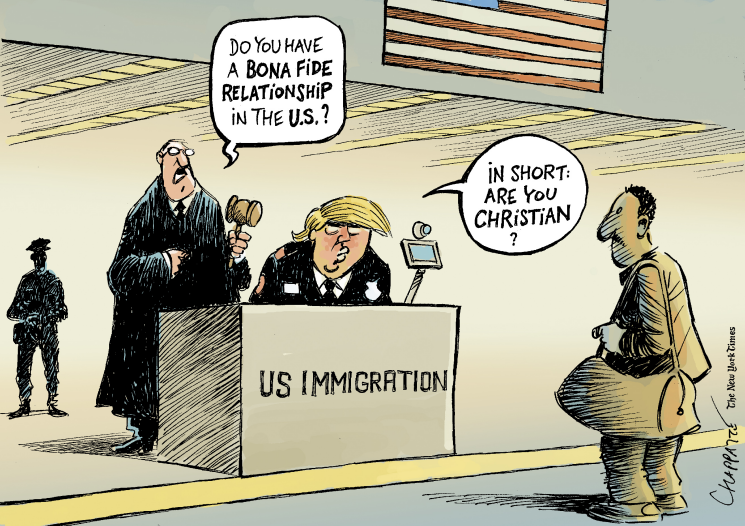
Now, America’s attention turns to the Supreme Court hearing on Trump v. Hawaii, the third version of the president’s refugee resettlement efforts to improve vetting and tighten domestic security. But in Trump v. Hawaii, the president’s campaign rhetoric is on trial, and not the law, which is clear. Hawaii’s U.S. District Judge Derrick K. Watson blocked the travel ban’s second version when he wrote that it was unconstitutional and discriminatory.,

The 1952 Immigration and Nationality Act gives the chief executive broad immigration powers: “Whenever the President finds that the entry of any aliens or of any class of aliens into the United States would be detrimental to the interests of the United States, he may by proclamation, and for such period as he shall deem necessary, suspend the entry of all aliens or any class of aliens as immigrants or nonimmigrants, or impose on the entry of aliens any restrictions he may deem to be appropriate.”,

The Supreme Court’s decision will be announced in June. In the meantime, intense scrutiny of U.S. refugee policy is overdue. A former refugee coordinator who served in the Middle East, Russia, Africa and Cuba provides a good starting point. In her April 24 op-ed, retired 25-year State Department veteran Mary Doetsch called for the refugee program’s “complete overhaul.” Doetsch based her conclusion on the “alarming” levels of “pervasive fraud.” Doetsch witnessed widespread exploitation, abuse, identity fraud and marriage scams that dated back to 1990s Cuba and the early 2000s in Somalia.,

Moreover, Doetsch noted, resettlement has, over generations, shifted from privately funded charities to a taxpayer-subsidized big business where executives earn from $260,000 to $700,000 annually. More refugees means higher income for the administrators. Last year, a Government Accountability Office report found the State Department and its partner, the United Nations High Commissioner for Refugees, has a shortage of anti-fraud procedures in place. For its part, the Department of Homeland Security confirmed that refugee fraud is “easy to commit, but not easy to investigate.”,

From the refugees’ perspective, the end game is worth whatever measures they take. Once entry to the U.S. is granted, a refugee may include his spouse, minor children, and after two years can petition his extended family to join him from abroad. He’ll immediately receive lifetime work authorization, and after one year can file for permanent residency status that will lead to citizenship. These benefits are appropriate for deserving humanitarian cases, not for those who committed fraud.,

The U.S. has successfully resettled more than three million worldwide refugees. But continuing a poorly administered refugee program like the current one undermines support among Americans for the future resettlement of deserving persons.

Joe Guzzardi is a Progressives for Immigration Reform analyst. Contact him at [email protected].

Comments Off on All Eyes on Supreme Court With Trump v Hawaii

The Central American Caravan: What You Should Know

By Joe Guzzardi

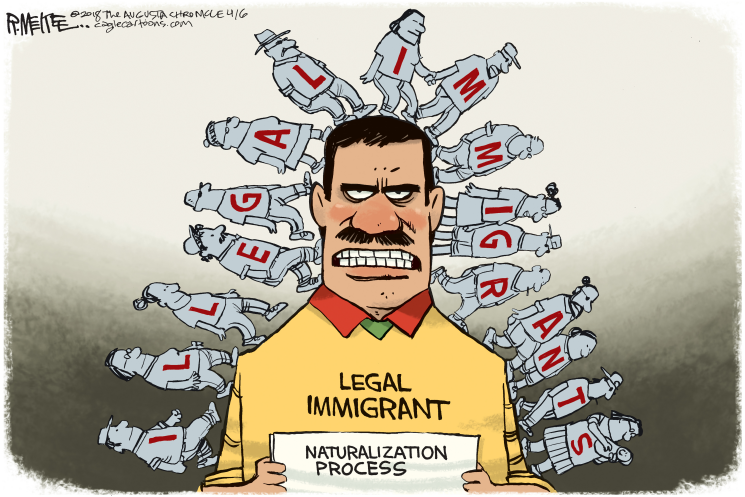
Weeks ago, a 1,500-strong caravan of Central American migrants headed north. Along the way, partly in reaction to President Trump’s decision to send the National Guard to the border, the group splintered. But a small handful proceeded to Tijuana where they hope to begin the asylum process. According to Juventud 2000, hundreds more asylum seekers are on the way. But, earlier this week, Homeland Security Secretary Kirstjen Nielsen pledged that border jumpers would be prosecuted, and that she would order legal teams to the Southwest to adjudicate amnesty claims on the spot.

Asylum is a two-fold problem. First, the existing asylum process is particularly vulnerable to fraud. A New York Times story, “Asylum Fraud in Chinatown: An Industry of Lies,” provided the details of commonly used, but deceitful techniques. And in Queens, N.Y., an immigration lawyer pleaded guilty to essentially cutting and pasting identical false statements into his clients’ amnesty applications. Second, Congress has done nothing to restore integrity to the flawed process.

As with most immigration complications, amnesty fraud could be minimized by enforcing existing law. According to countless media reports, Central American families and unaccompanied minors qualify for amnesty pursuant to the 2008 Trafficking Victims Reauthorization Act. The very wording of the act’s name, “trafficking victims,” implies that many amnesty seekers don’t qualify. The caravan was organized by the San Diego-based, pro-immigration Juventud 2000. Central Americans who boarded the caravan did so voluntarily, and were not in any way trafficked, a crime that involves coercion and is normally associated with bringing minors to the U.S. for sex slavery.

Moreover, even a credible fear defense may not reach amnesty’s qualifying level. The Migration Policy Institute, an immigration advocacy organization, concluded that “being forced to join a gang or experiencing violence do not generally qualify as a basis for refugee status [amnesty] or fall readily into one of the refugee definition categories.”

Asylum seekers are skilled in gaming the U.S.’s toothless amnesty loopholes. Once across the U.S./Mexico border, they turn themselves in to an immigration official, request asylum and then disappear into the interior. With the backlog already at 300,000, new petitions hurt asylum seekers already in the U.S. whose cases have been pending for years.

A humane option for Central American asylum seekers is to take refuge in a safe third country, possibly permanently but at a minimum while their application is reviewed. Along their way north, the Central Americans pass through Mexico, a democracy that offers migrants a healthy economy and a mutually shared language. The safe third country option helps weed out fraud. If an individual is truly fleeing fear of persecution, the most common claim asylum petitioners make, the first port in the storm should suffice.

But U.S. asylum process, although convoluted and tedious, is ultimately more rewarding both for the applicant and his extended family than staying in Mexico. If 150 days pass without a decision on an asylum request, the petitioner can apply for employment authorization. The successful petitioner can also bring his spouse and minor children to the U.S., and after a year, file for permanent residency which initiates chain migration. In the end, amnesty’s long-term effects include a looser labor market, higher population and increased pressure on social services like education and health care.

A compassionate but prudent approach to asylum that honors valid claims, but denies fraudulent appeals, best serves Americans’ interests.

Joe Guzzardi is a Progressives for Immigration Reform analyst. Contact him at [email protected].

,

Comments Off on The Central American Caravan: What You Should Know

How Honolulu Transformed From Utopia to Urban Muddle

By Joe Guzzardi

Let’s be clear from the outset. Travelers who have never visited Honolulu, Hawaii’s capital located on Oahu, should make it their next destination before what was once paradise vanishes forever.

In some ways, Honolulu, with Waikiki Beach and Diamond Head, is still magnificent. But with each day that passes, Honolulu is less like the garden utopia that existed decades ago and that might still live in many people’s Hawaiian fantasies.

In the 1920s, not that long ago in the long-term picture, a Los Angeles Steamship Company ocean liner sailed for the Hawaiian Islands every Saturday to make the 2,500 mile journey, while the Royal Hawaiian band played “Aloha Oe.” As friends and family stood cheering, tossing confetti and waving goodbye, passengers danced on deck to the popular jazz tunes that the ship’s band played. Ocean travel’s romantic imagery soon gave way to quicker airliners, and eventually to jumbo jets like the Airbus A330 that brings millions of worldwide tourists to Honolulu each year, great for the state’s multi-billion dollar economy but devastating to its landscape.

Many of Honolulu’s popular restaurants display glorious pictures from the 1930s. In one, legendary surfer Duke Kahanamoku is standing on Waikiki’s shoreline without another building in sight. Today, the coast is overbuilt with high-rise condos and expensive resorts. International sunbathers lie shoulder-to-shoulder, a far cry from the magnificent conditions during the Duke’s day.

Since 1970, when the Ala Moana Hotel was Honolulu’s first building to exceed 350 feet, the construction boom has brought the total to more than 470 high-rises. To put the 470 number in perspective, it places Honolulu as sixth in the nation behind New York, Chicago, Los Angeles, Houston and Washington, D.C. More than 17 Honolulu asymmetric eyesores exceed 40 floors.

With tourism comes the rental car scourge, the leading factor in Honolulu’s ranking on America’s most congressed highways’ list. In the dubious most trafficked category, Honolulu comes in eighth, behind nightmarish California cities of Los Angeles, San Francisco and San Jose. Consistent with Americans’ love affair with the automobile, tourists disdain a viable public transportation option, Honolulu’s efficient citywide bus system.

Like much of the rest of the nation, Honolulu’s underbelly has a growing homeless population. In 2016, Hawaii Governor David Y. Ige, in an effort to move homeless individuals away from popular tourist hotels, declared a state of emergency. A U.S. Housing and Development report identified Honolulu as having America’s highest per capital homelessness rate, hardly surprising given the city’s exorbitant living costs. Recently, Hawaii set up a homelessness initiative to help identify the neediest among the unsheltered and get them emergency medical attention. In the meantime, homelessness has contributed to an increased crime rate.

Population increases have also contributed to Honolulu’s sprawl. Since 2010, Honolulu’s population increased 3.7 percent from 953,000 to 989,000, an unsustainable growth pattern. Honolulu’s construction boom brought with it a significant migration increase; the U.S. Census Bureau reflects a 9.7 percent Latino population.

When asked about Honolulu’s transformation over the decades kama’ainas, native Hawaiians or long-time residents, express resignation to their diminished quality of life. Some have departed for the mainland. Last year, more than 1,000 people, net, left Hawaii.

No matter how gradually they occur, dramatic changes like those Honolulu has undergone are hard to come to terms with, especially for those who knew it back when.

Joe Guzzardi is a Progressives for Immigration Reform analyst. Contact him at [email protected].

,

Comments Off on How Honolulu Transformed From Utopia to Urban Muddle