Ryan’s Parting Betrayal Biggest Amnesty in US History

Ryan’s Parting Betrayal: Biggest Amnesty in U.S. History

Amnesty spawns illegal immigration, a talking point enforcement advocates repeatedly make. Because the math conclusively proves that amnesty leads to more illegal immigration, the pro-amnesty contingent rarely counters. Here are the statistics: In 1986, when President Ronald Reagan signed the Immigration Reform and Control Act (IRCA), 2.7 million people were amnestied, including those covered as part of Special Agricultural Worker provisions.

Today, the estimated illegal immigrant population is 11 to 12 million, curiously, the same popularly cited statistic for roughly the last 20 years. To be sure, not every illegal immigrant that resided in the U.S. in 1986 applied. Still, it s safe to assume that the illegal immigrant population has increased by at least five million during the last three decades.

The major reason that illegal immigration grew is that Congress never delivered on its promise to implement interior enforcement and to crack down on employers who hired workers present illegally. And despite widespread congressional insistence back in 1986 that IRCA would be the last amnesty, six others have passed since then, including the 2000 Late Amnesty for 400,000 illegal immigrants who claimed that, for various reasons, they couldn t participate in IRCA.

Having learned nothing from IRCA s fallout – that amnesty encourages illegal immigration and that chain migration from previous amnesties continues today – the U.S. House of Representatives is poised to vote on two legalization bills this week, one dramatically better than the other, but neither perfect.

House Judiciary Committee Chair Robert Goodlatte introduced his bill which would codify deferred action for childhood arrivals, end the visa lottery, cancel some chain migration categories, and provide full funding for a border wall. Also, parents of U.S. citizens could only relocate on nonimmigrant visas that would not lead to citizenship, and with evidence of pre-paid health insurance. A downside to Goodlatte s proposal is that it transfers the 55,000 lottery visas to employment-based categories, already bulging at the seams.

But the most important takeaway from Goodlatte s bill is that it would require mandatory E-Verify which would eliminate the jobs magnet that lures a large percentage of employment-seeking illegal immigrants. Congress has consistently blocked E-Verify since 1996 when it was established as the Basic Pilot Program as part of the Illegal Immigration Reform and Immigrant Responsibility Act.

The second bill which the establishment GOP covets is the odds-on-favorite to pass. A leaked draft version indicates that Goodlatte s E-Verify provision would be stripped, chain migration and the visa lottery left intact, and the status quo maintained for citizens parents.

Worse, the House Speaker-led Paul Ryan establishment version would dramatically increase legal immigration. In a shameless and brazen cave-in to the tech lobby and to immigration expansionists, Ryan s version would end the per-country visa cap which means more South Asians would dominate the H-1–visa category, would amnesty long-term foreign tech workers children that currently hold temporary visas, and might grant legal status not only to DACA recipients but also to their parents.

The retiring Ryan s going-away present to immigration-weary Americans eventually could be the biggest amnesty in U.S. history and could include the 3.5 million DACA-enrolled and DACA-eligible residents, and an untold number of border-surgers who might somehow qualify, an estimated additional one million.

Congress is rushing toward an amnesty vote without committee hearings as if it were the most important item on America s agenda. The reverse is true. Four of five Americans want less immigration, according to a recent Harvard-Harris poll.

More math: Goodlatte will fail because it won t get a single Democrat s vote, and Ryan will likely win because pro-amnesty Republicans will join the Democrats to push it over the top. The variable remains President Trump and his veto power. Last week, on a single day and within a span of just a few hours Trump was reported to have rejected, and then said to have supported Ryan s version.

With the president, one never knows.

Joe Guzzardi is a Progressives for Immigration Reform analyst who has written about immigration for more than 30 years. Contact him at [email protected].

Comments Off on Ryan’s Parting Betrayal Biggest Amnesty in US History

Jerry Brown, ‘California Dreamin,’ Faces Reality Check

A few weeks ago, I turned down an all-expenses-paid invitation to attend a late summer conference in San Francisco. After my 2016 visit to the Bay City, I vowed never to return. San Francisco is, to put it gently, an undesirable destination. Since most of California s major cities are as unpleasant as San Francisco, I ll likely never return to my native state. I left California in 2008 because of acute overcrowding and a state government determined to make living conditions worse for its residents, especially those already struggling in the lower economic bracket.

A comprehensive listing of all California s failures would be an 800-page treatise. But a brief summary of the financial consequences of Sacramento-induced woes follows. For eight years, Gov. Jerry Brown has ignored multiple red flags that a responsible leader would recognize as a call for immediate directional change.

While Brown is taking bows for leaving his as yet unelected successor with a $6.1 billion surplus, nonpartisan analysts view California s finances more pessimistically. Last year, a California Policy Center report found that state and local debt totals $1.3 trillion. Another study pegs California s debt at $2.3 trillion, while the Capital Research Center calculated that the state has $1 trillion in pension liability alone, an average $77,000 per household. The CRC report s subtitle accurately stated: Governments Continue to Understate Massive Unfunded Liabilities on Public Employee Pensions.

Brown s math on California s infrastructure upgrading requirement is equally flawed. Brown claims that California needs $187 billion to repair dam and road damage. Again, nonpartisan analysts came up with more overwhelming totals. The Bay Area Economic Council put California s unfunded infrastructure requirements at $737 billion or possibly as high as $765 billion.

Meanwhile, low and middle income taxpayers fed up with expensive housing and too few good jobs can t leave California fast enough. The exiting masses doubtlessly anticipate that California s recently elected and its 2018 candidates will usher in an era of fiscal and public policy that will further work against the state s poorest. Exhibit A: when SB1, the California gas tax, goes into effect next year, motorists will pay 76.7 cents per gallon in total taxes and fees. Diesel fuel will cost more.

Finally, Exhibit B, Brown s pet project, the California bullet train, which some won t live long enough to ride and others have no interest in traveling on, is still on the drawing board. Assuming it s eventually completed a huge leap of faith initial service is projected to begin in 2029, and the Los Angeles to San Francisco route, 2033. The current cost estimate, revised upward three times since 2012, could reach more than $98 billion.

An affordable housing crisis, homelessness, poverty and a raging drug epidemic should encourage California to perform a reality check. With California teetering on the brink, the state can t risk adding more people to its nearly 40 million population, a goal California s leadership promotes. California Attorney General Xavier Becerra, U.S. Senator Kamala Harris, 2016 winners and most of the 2018 candidates like Gavin Newsom for governor and Kevin de Leon for U.S. Senate favor much higher immigration levels which will mean more job competition for the lower-skilled, underemployed or unemployed Californians already residing in the state. Becerra has filed 35 lawsuits against the Trump administration including some aimed at thwarting White House efforts to limit refugee resettlement and to remove convicted criminal aliens.

With its massive debt, California s first priority should be to stabilize its population. More people means more financial obligations, a recipe for more trouble ahead.

Joe Guzzardi is a Progressives for Immigration Reform analyst who has written about immigration for more than 30 years. Contact him at [email protected].

Comments Off on Jerry Brown, ‘California Dreamin,’ Faces Reality Check

Immigration Fraud Abuse Tip Line Lighting Up

Immigration Fraud, Abuse Tip Line Lighting Up

Suddenly, emails are pouring in! On April 3, 2017, U.S. Citizenship and Immigration Services (USCIS) established an internet hotline to inspire individuals to report H-1–abuses and fraud.

The Fraud Detection and Nationals Security Directorate (FDNS) encouraged American workers and overseas H-1–visa holders to come forward with any tips they may have that relate to irregularities in the hiring process or in job assignments. USCIS also pledged to increase its efforts through a “more targeted approach” to ensure that American tech workers are interviewed for job openings. According to a USCIS representative during his interview with Newsweek, a plethora of H-1–abuses have caused “too many American workers who are as qualified [as visa holders], willing, and deserving to work in these fields [to be] ignored or unfairly disadvantaged.”

Through May 21, USCIS had received about 5,000 calls from tipsters, an encouraging start but likely not reflective of the H-1–fraud’s magnitude. H-1–fraud detection is an investigator’s dream job – nothing but low-hanging fruit.

The longest standing, biggest fraud is employers’ claim that not enough American tech workers are available and that, therefore, they’re forced to recruit abroad. USCIS can begin its probe at tech companies that have booted Americans out the back door, and immediately escorted in H-1Bs through the front door. A brief interlude during the revolving door process includes mandatory training from the outgoing to the incoming, referred to as “knowledge transfer.”

Although tech employers like to reference a 500,000 jobs shortage, they are actually prolific job-cutters. Challenger Gray & Christmas Inc., a job-search firm that compiles data on workforce reductions, found that technology companies have cut more than 413,000 jobs since 2012, including more than 96,000 in 2016. Wall Street anticipates that the layoffs will continue for the foreseeable future.

Employers disingenuously argue that they’re importing what they like to call the “best and brightest.” But, the visa holders aren’t paid as if they’re the best and brightest. In his written testimony submitted to the Senate Judiciary, AFL-CIO President Richard Trumka wrote: “According to a Government Accountability Office analysis of Labor Department data, 54 percent of H-1–visas are certified at the Level 1 wage (17th percentile wage) and 29 percent are certified at Level 2 wage (33rd percentile wage).” Trumka concluded that both Level 1 and Level 2 wages are below the local average, and therefore, 83 percent of H-1–visas are certified below the local average wage for their occupation.

The ultimate betrayal: even the Labor Department has sunk to employing cheaper labor H-1–visa workers. A Politico story found that the visa renewal applications of two systems analysts scheduled to work at the Labor Department’s D.C. headquarters listed annual wages of $61,714 to $65,000. But after it analyzed the Bureau of Labor Statistics mean wages for the profession, Politico learned that in the D.C. area, the mean wage is $96,680.

Since Congress created the H-1–visa as part of the Immigration Act of 1990, employers’ fraud and abuse have been common denominators that have helped displaced hundreds of thousands of American tech specialists. The federal government doesn’t provide H-1–employment statistics, but Goldman Sachs estimates that about 1 million H-1Bs have employment authorization documents and hold college-level jobs.

The tip line is a good start, but will need vigorous follow up to send unscrupulous employers the message that H-1–visa fraud and abuse could result in criminal convictions, hefty fines and possible jail terms.

Joe Guzzardi is a Progressives for Immigration Reform analyst who has written about immigration for more than 30 years. Contact him at [email protected]

Comments Off on Immigration Fraud Abuse Tip Line Lighting Up

Bush Sr Reminisces about His College World Series Days

Bush Sr. Reminisces about His College World Series Days

For the next three weeks, baseball fans will have a chance to see the game played the way it should be. The NCAA’s best college nines, well-schooled in fundamental baseball, will display their talent in Omaha at the annual College World Series.

Given the choice between watching the College or Major League World Series, I would unhesitantly pick college. Even in the CWS’ opening rounds, the players demonstrate an ability to advance the runner, hit the cut-off man and lay down a bunt, skills that too often elude multimillion-dollar ML–players. If the college players donned major league uniforms, fans couldn’t tell the difference. Many of the college pitchers throw over 90 miles per hour and field their positions flawlessly.

The CWS has a rich tradition that dates back to 1947 when Kalamazoo, Michigan, hosted the event. Two players from that year’s final that pitted the California Golden Bears against the Yale Bulldogs went on to achieve outstanding success in their professional careers: Jackie Jensen, with the New York Yankees, Boston Red Sox and Washington Senators, and George Herbert Walker Bush, United States president.

Although Jensen pitched for the Golden Bears, by the time he was named the American League’s Most Valuable Player in 1958, he played outfield. Bush, nicknamed “Poppy,” was a slick-fielding, no-hit first baseman and a recently returned decorated World War II hero who earned the Distinguished Flying Cross, three Air Medals and a Presidential Unit Citation.

In the series opener, Jensen came through with a pinch hit single to drive in Cal’s game-tying run. Red Mathews, Yale’s third baseman, recalled that Jensen was “… strong and fast and big. I was very impressed with him.” The game wasn’t close for long. The Golden Bears scored 11 runs in the top of the ninth to win easily; Cal 17, Yale 4.

Then as now, the series final had a best two of three format. In the next day’s deciding double header, Jensen started the opener. The “Golden Boy,” as Jensen was known, gave up a run in the first inning but then held Yale in check until the bottom of the fourth. The Bulldogs made a fatal mistake when manager Ethan Allen ordered Cal’s number eight hitter walked to face Jensen. Years later, Bush recalled that: “He [Jensen] hit one that’s still rolling out there in Kalamazoo.”

Eventually, Jensen tired and was lifted in the bottom of the fourth with the score tied, 4-4. In the end, the Bears prevailed 8-7. Bears’ relief pitcher Virgil Butler struck out Bush, 0 for 7 in the series, to end the game. As Butler later joked: “On the last pitch, I struck out George Bush on a curve ball. I got my 15 minutes of glory!”

In January 1960, after only 11 mostly outstanding years in professional baseball and his career declining because of his air travel anxiety, Jensen retired. While Jensen starred on the baseball diamond, his later life was plagued by personal and financial misfortune. He was married to, and divorced from Zoe Ann Olson, an Olympic diving star. By 1974, however, Jensen returned to Berkeley to coach his beloved Golden Bears who he led to more than 100 wins. But in 1982, age 55, Jensen died from his second heart attack in two months.

Bush, on the other hand, turns 94 on June 12. His political resume includes two terms in the U.S. House of Representatives, stints as the U.S. Ambassador to the United Nations and Director of the Central Intelligence Agency, two terms as Vice President and one term as President.

As for his CWS memories, Bush disputes his teammates’ criticism that he couldn’t hit. According to Bush, he batted about .250. Bush added, “And I think if I were playing today in the bigs, I’d probably get about $8 million a year for that.”

Many other CWS superstars followed Jensen’s ML–career path, and some reached the Cooperstown Hall of Fame. Among the most well-known are Dave Winfield, Barry Larkin, Mike Schmidt and Paul Molitor. But only “Poppy” reached the White House.

Joe Guzzardi is a Society for American Baseball Research member. Contact him at [email protected].

Comments Off on Bush Sr Reminisces about His College World Series Days

To 2018 Graduating Class Beware Jobs Market Landmines

To 2018 Graduating Class, Beware Jobs Market Landmines

In June, about four million teenagers will graduate from high school, and another three million or so will earn associate or four-year university degrees. The happy graduates should view cautiously the strong May Bureau of Labor Statistics report that showed growth in employment and wages. While the economy added 223,000 jobs in May and for the year average hourly earnings increased 2.7 percent, an ever-expanding labor force assures that essentially stagnant wages will continue to plague American workers and keep the U.S. locked in a wage recession.

,

Congress, arriving back on Capitol Hill this week from what most would call a vacation, but members like to identify as “constituent work days,” always pledges to have young Americans’ futures at heart. Yet, immediately upon its return, Congress will begin its umpteenth round of immigration haranguing. And as it always does, Congress will omit from its debate the deleterious effect millions of employment authorization documents issued to immigrants, both permanent residency and temporary status, has on the labor pool, including these seven million job-seeking graduates.

,

Front and center on the upcoming congressional agenda are deferred action for childhood arrivals (DACAs) and DREAMers. DACAs, who have work permission, and DREAMers both want full legal status. With legal immigration compounding at the rate of more than one million annually year after year, employment-based visas adding about 750,000 guest workers to the economy each year and asylum approvals, the labor market continuously expands ,’ outpacing job creation ,’ and by extension gradually squeezes out large segments of the American working-age population.

,

Over-immigration, and Congress’ steadfast refusal to address its impacts, harms not just recent graduates, but also older, minority and military retiree job seekers.

,

For recent graduates though, unemployment and under-employment have forced more back home to live with parents, rather than entering other types of domestic housing situations. In 2014, for the first time in more than 130 years, adults ages 18 to 34 were more likely to be living in their parents’ home than they were to be living with a spouse or partner in their own household. Today, the young adults in this age range who remain at home still is high.

,

Like America’s youth, another economically struggling demographic is retired military personnel. According to a recent report, veteran job seekers are struggling to find meaningful employment, with nearly one-third self-identifying as underemployed. Congress’ immigration obsession also ignores millions of American black and Hispanic minorities who need employment.

,

Overall, 40 million people live in poverty in America. The United Way ALICE Project found that an estimated 50.8 million households, or 43 percent of households, can’t afford basic essentials, including housing, food, transportation and health care.

,

No intellectual argument can be made that more immigration helps America’s young, its poor, its workers or its unemployed. Yet immigration continues at unsustainably high levels as if it were on autopilot, much to the voting public’s dismay and consternation.

,

Joe Guzzardi is a Progressives for Immigration Reform analyst who has been studying immigration and population issues for more than 30 years. Contact him at [email protected].
Comments Off on To 2018 Graduating Class Beware Jobs Market Landmines

A Homeland Security Announcement that Flew Under the Radar

Federal agencies that deal with immigration love to deliver bad news late on Friday afternoon. Better yet to obscure the disappointing announcement is when the Friday falls on a three-day national holiday weekend. So, on this year’s Memorial Day getaway Friday Department of Homeland Security Secretary Kirstjen Nielsen, hoping that the fewest possible people would be paying attention, announced that DHS was, once again, caving into big business interests. DHS will issue an additional 15,000 H-2–visas during fiscal year 2018; the new round of visas is on top of the existing 66,000 allocation.

According to the Office of Public Affairs press release, DHS made its decision after consulting with Secretary of Labor Alexander Acosta, members of Congress and business owners. Noticeably missing from the roundtable of purported experts was a representative from the many not working.

One of the most predictable false claims the immigration expansion lobby, that includes businesses, makes is that owners will be forced to shut down or, in DHS lingo, are “at risk of failing,” unless a new cheap labor infusion happens soon. But business’ looming bankruptcy meme is so tedious that few Americans outside of Congress buy into it.

Last summer provided multiple examples of how, when an H-2–visa shortage was anticipated, Maine employers sought out locals. Among those Maine businesses that raised wages to attract Americans were restaurants, hotels and bicycle repair shops – nonessential industries that don’t have to depend on visas to satisfy their labor requirements. On Martha’s Vineyard, a New England tourist haven, small businesses also hiked their pay scales to attract Americans.

Ample evidence culled from federal data proves that no national labor market shortages exists, especially in the job categories that H-2–employers insist overseas workers must fill. In its detailed 2017 study, the Washington, D.C.-based Economic Policy Institute found that in the top ten H-2–occupations, shortages if any occurred only in isolated markets. The top ten occupations are: landscaping workers, forestry, housekeeping, amusement parks, meat, poultry and fish cutting, construction, waiters, cooks, production workers, and non-farm animal caretakers.

EPI, through its wage analysis, provided further proof that the H-2–depresses earnings. From 2004 to 2016, wages in the top H-2–categories grew less than an average of one-half of one percent in nine of the 10 most petitioned occupations. During the same 12-year period, unemployment rates in the ten professions remained at relatively high rates.

Beyond employers’ craven H-2–misuse, the American Civil Liberties Union linked the visa to abuse, trafficking and inhumane working conditions, each a criminal violation.

DHS’ decision to expand the employment pool by 15,000 ignores and defies tight labor markets’ inherent value to U.S. workers. Around 43 million Americans live below the poverty line and need the jobs employers give to low-skilled visa holders. Employers’ first move should be to recruit from among those 43 million, and raise wages as necessary until Americans fill the vacant jobs. Moreover, instead of approving more H-2–employment-based visas, many of which go to non-essential landscaping and resort jobs, Congress should protect the most vulnerable Americans.

Casual observers may ask what the big deal is about another 15,000 employment-based visas. But they miss the point. Each employment visa denies an opportunity to, or displaces, an existing U.S. worker, untenable in today’s soft labor market. Economists know that the lasting solution to true labor shortages is to pay more.

Joe Guzzardi is a Progressives for Immigration Reform analyst who has been studying immigration and population issues for more than 30 years. Contact him at [email protected].

Comments Off on A Homeland Security Announcement that Flew Under the Radar

Congress’ Memorial Day Goal: Give Millions Amnesty

In 2014, more than two years before he became Secretary of Defense, United States Marine Corps General James Mattis addressed an audience of war veterans for the Iraq and Afghanistan conflicts. Mattis told the all-volunteer group, “You signed blank checks payable with your lives to the American people,” a reference to the day corps members signed their contracts obligating them to serve.

General Mattis praised the soldiers’ personal commitment, their determination to bring home their fellow soldiers, their value and ferocity, and their families’ sacrifices. During his speech, General Mattis referenced the “political rhetoric swirling around these little understood wars… .”

Debate about the Iraq and Afghanistan wars has subsided. But, since President Donald Trump’s inauguration, the Capitol Hill immigration furor has ratcheted up to ten times the level of the wars’ din. The question put before likely mid-term election voters on Memorial Day 2018 is whether the more than 1.1 million U.S. military who have died protecting America and her citizens in the last 250 years would be on board with the Republican-controlled Congress’ amnesty obsession.

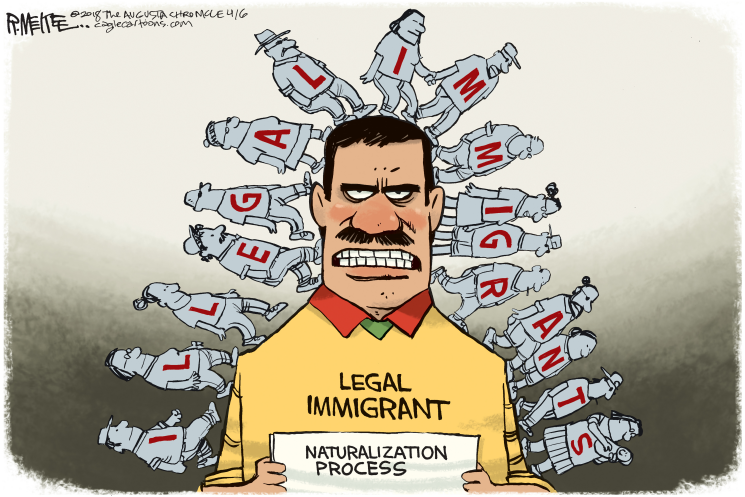
The best way to describe the congressional pro-amnesty factions, GOP and Democrats alike, is that they’re frantically committed to force an amnesty upon a majority immigration-skeptical American public. With amnesty would come lifetime work authorization privileges and the resultant chain migration that will eventually add millions more residents to an already overcrowded America. Immigration and chain migration drive the majority of population growth.

In its effort to impose amnesty, Congress is in the midst of gyrations so convoluted that only immigration lawyers and geeky policy wonks who specialize in immigration can decipher. The two key elements, both obscure, are a discharge petition and the so-called Queen-of-the-Hill vote.

Without getting too bogged down in the swamp, if the discharge petition gets 25 GOP votes, the minimum necessary assuming all Democrats also sign on, then a vote on four different immigration bills would take place, including the DREAM Act and deferred action for childhood arrivals (DACA) amnesties. The legislation that gets the most votes over 218 would be sent to the Senate where, because 100 percent Democratic support is certain and enough GOP backing is highly likely, it would pass.

Between now and Congress’ weeklong Memorial Day recess, no one can predict what may happen. But that Congress is so totally disconnected from Americans’ resistance to higher immigration is a remarkable and troubling indictment of the political process. U.S. House Republican Jeff Denham, the leading force behind the Queen-of-the-Hill movement, represents Exhibit One which proves how far over the amnesty edge Congress is.

A Pulse Opinion Research poll recently taken in Denham’s 10th California District revealed that 50 percent of likely Hispanic voters oppose a DACA amnesty plan that doesn’t include corresponding benefits for Americans. Hispanics comprise about 40 percent of Denham’s district. The poll also showed that 58 percent of Hispanics support mandatory E-Verify and reducing the one million annual legal immigration total.

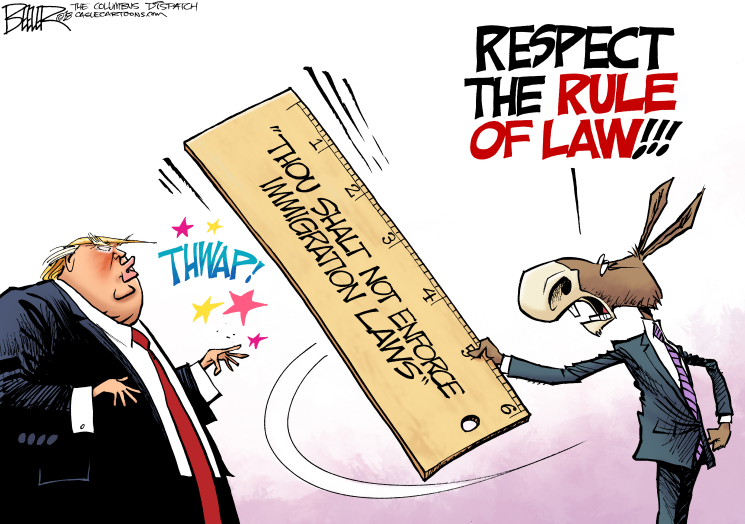
The lesson that Congress willfully refuses to learn is that amnesty begets more amnesties. Since the 1986 Immigration Reform and Control Act, promoted and passed as the last-ever amnesty, the then-three million illegal immigrant population has soared to today’s conservatively estimated 12 million.

Nevertheless, Congress’ goal as Memorial Day approaches is amnesty and work authorization for millions, the people’s will be damned.

Joe Guzzardi is a Progressives for Immigration Reform analyst who has been studying immigration and population issues for more than 30 years. Contact him at [email protected].
Comments Off on Congress’ Memorial Day Goal: Give Millions Amnesty

Obscure Federal Program Displaces Workers

The federal government has created yet another immigration employment hurdle for U.S. science, technology, engineering and math (STEM) workers, according to a new report.

After obtaining data through a Freedom of Information Act request, a Pew Global analysis of Immigration Customs and Enforcement (ICE) data showed that almost 1.5 million foreign students have been allowed to stay and work in the U.S. after graduation as part of the little-known work program, the Optional Practical Training program (OPT). ICE is the federal agency that oversees, ineffectively, the Student and Exchange Visitor Program.

Since 2008, the number of STEM students using OPT has increased a staggering 400 percent. In 2008, the longest period that an F-1 student visa holder could remain and work in the U.S. was one year. After executive actions in 2008 and 2016 initially doubled, to 29 months, then later tripled to 36 months, and thus extended the maximum employment duration for foreign STEM degree students, their numbers soared from 79,877 in 2008 to 257,064 in 2016.

The first extension was granted to appease Microsoft co-founder Bill Gates who suggested to then Department of Homeland Security Secretary Michael Chertoff at a dinner party that the existing 85,000 H-1–cap was inadequate. The second extension occurred during President Obama’s administration. According to Pew, F-1 visas have risen sharply, a 104 percent surge between the same period reviewed, 2008 to 2016, versus a dramatically lower 3.4 percent increase in overall college admissions.

In the name of merit-based immigration, a misnomer that immigration advocates have successfully promoted, the federal government has enthusiastically doled out millions of F-1 visas that have circuitously paved the way to good American jobs. The F-1/OPT now joins the ranks of the most abused visas and employment-based frauds that shut deserving Americans out of the labor market.

More outrageous: Through tax breaks, the federal government subsidizes U.S. corporations when they hire foreign nationals, an incentive too lucrative for most employers to ignore. Because they don’t have to pay FICA or Medicare taxes, an OTP employer gets roughly an 8.25 percent tax break that’s unavailable to him when he hires an American. This largess, which denies the Social Security Administration, Medicare and unemployment insurance coffers about $2 billion annually, is done without congressional committee debate, and therefore ultimately without congressional approval.

While OPT students, mostly from India, China and South Korea, matriculate nationwide, many upon graduation relocate to U.S. financial centers where job opportunities are more plentiful and more lucrative. Among the top ten destinations are New York, San Francisco, Los Angeles, Boston, Chicago and Washington, D.C., hub cities that American graduates aspire to work in as well. Some students have advanced degrees and graduate from prestigious universities, but others obtain their degrees from institutions that Senate Judiciary chair Chuck Grassley and other critics identified as visa mills.

No shortage of talented American STEM workers exists. The annual guest worker inflow equals half of all tech hires each year at a time when U.S. colleges graduate thousands of STEM workers. Moreover, the F-1 visa and the OPT program that it spawns are light years away from their intended purpose. Developed decades ago, the original concept was that foreign students would gain U.S. work experience for a year, and then take their newly acquired skills and knowledge back to their underdeveloped home nations to help those countries advance. Not until George W. Bush’s administration did the program devolve into a guest worker scam to boost corporate profits.

Presidents Bush and Obama extended OPT through executive actions. President Trump should, on behalf of the American workers he campaigned for, end it the same way.

Joe Guzzardi is a Progressives for Immigration Reform analyst who has been studying immigration and population issues for more than 30 years. Contact him at [email protected].

Comments Off on Obscure Federal Program Displaces Workers

AP to Reporters Stop Using ‘Chain Migration’

The establishment media has dramatically moved away from using precise language in its reporting of immigration stories. In the latest effort to distract the reading public from understanding unsustainable immigration’s broad consequences, the Associated Press announced that journalists should “avoid” using “chain migration” unless it’s a direct quote, and then the term should be explained. The reasons AP cited for banning “chain migration” is that it’s “applied by immigration hardliners” in reference to what the federal government calls family reunification.

Chain migration has been part of the immigration lexicon for decades. Even in Congress, those who push for open borders, amnesty and limited internal enforcement have often included the words “chain migration” in their dialogues. In 2010, when he was promoting one of the various DREAM Act versions, Sen. Richard Durbin pointed out that one of the advantages of his legislation was that it would not allow “chain migration.”

In today’s poisoned atmosphere, mainstream, pro-immigration reporters are unlikely to correctly explain how family reunification relates to population growth. Family reunification, a large population growth driver, means that millions of extended family members including cousins, aunts, uncles and in-laws will come to the U.S. regardless of their educations, skills or backgrounds.

Department of Homeland Security data shows that between 2005 and 2016 about 9.3 million foreign nationals came to the U.S. as chain migrants. During that same time period, more than 13 million lifetime work-authorized foreign nationals entered the U.S. through legal immigration processes. Seven out of ten new arrivals come to America as part of the chain. Then, on average, each immigrant present sponsors 3.45 additional family members for green cards.

AP content, according to its website, reaches more than half of the world’s population. When the powerful AP bans the words “illegal immigrant,” purposely conflates lawful immigrants with illegal immigrants and then blocks the use of “chain migration,” it’s guilty of encouraging inaccurate journalism in an effort to influence readers. Illegal alien, the correct term, appears repeatedly throughout the U.S. Code, the Immigration Reform and Control Act, and the Immigration and Nationality Act, but has mostly vanished from mainstream media copy. The Media Research Center found that the public favors giving legal status to “undocumented” workers over “illegal immigrants.” Amnesty is the end result that the AP favors.

Journalists who want to keep their jobs should heed the AP mandate. An Israeli Rutgers University student was fired from The Daily Targum, the campus newspaper, when he objected to editorial changes that substituted “undocumented” for “illegal” in reference to immigrants who entered unlawfully. His editors pointed to the AP Stylebook to defend their decision. And an internet subscription-only legal newsletter stopped posting the opinions of retired immigration judges when they refused to comply with its editorial board’s demand that they replace “illegal alien” with “undocumented.”

In their opinion column, the judges pointed to the U.S. Court of Appeals for the Fifth Circuit’s pronouncement in the Texas v. USA case that challenged President Obama’s deferred action for childhood arrivals. The court compared the term “undocumented immigrant” to “near-gobbledygook.” The judges also wrote that they found the newsletter censorship “oppressive, derogatory, and inflammatory to the American ideals of freedom of thought, [and] expression… .” They referenced William Lutz, author of “The New Doublespeak” who wrote that doublespeak is language “which makes the bad seem good, the negative seem positive, the unpleasant seem unattractive, or at least tolerable.”

The true hardliner in the immigration imbroglio is the media that stifles debate with its politically correct language, and brazenly rejects the standards of journalism. The ethics code of the Society of Professional Journalists requires that advocacy be identified, and that the open and civil exchange of views should be supported, even if reporters find those views “repugnant.”

In today’s media, immigration stories are thinly disguised editorials; proponents of commonsense immigration are dismissed. Words matter. Reporters are professionally obligated to use correct language.

Joe Guzzardi is a Progressives for Immigration Reform analyst who has been studying immigration and population issues for more than 30 years. Contact him at [email protected].

Comments Off on AP to Reporters Stop Using ‘Chain Migration’

Feds Sanction Slave Labor, 21st Century Style

“With President Trump, you never know.” Those were the exact words a U.S. Senate legislative aide said to me when we were talking about President Trump’s immigration views. The specific topic at the time was deferred action for childhood arrivals, DACA, which candidate Trump had vowed to end on “Day 1” of his presidency, but didn’t. In part because of President Trump’s DACA dithering, the program and its future have since devolved into a political and legal quagmire.

President Trump’s most recent fumbling and bumbling came during a Michigan rally when he said, to his base’s horror but to the powerful agricultural lobby’s delight, that “we have to have your workers come in,” a reference to issuing H-2A agriculture visas, a program that its critics say is systematically abused.

As President Trump spoke, the Washington, D.C.-based National Council for Agricultural Employers, WAFLA, formerly the Washington [State] Farm Labor Association, the Washington [State] Growers League and the Fresno [California] County Farm Bureau could barely contain their collective joy. In fiscal year 2017, the U.S. Department of Labor approved 200,049 H-2A visas for foreign-born agricultural guest workers, up 20.7 percent from 165,741 in FY 2016.

Just days before President Trump’s speech, the Labor Department settled with G Farms, a Maricopa County, Arizona, agribusiness, on the grounds that it had subjected its grossly underpaid workers to “simply inhumane” conditions. G Farms had housed 69 guest workers in overcrowded, unsanitary semi-truck trailers and school buses, where they were exposed to Arizona’s summer heat without proper ventilation, and with dangling gas lines fed through bus windows.

The no-cap H-2A visa should be a national embarrassment because it enables agricultural employers to import vulnerable, easily exploitable individuals. The farm industry takes advantage of the susceptible while neglecting its own responsibility to enter the 21st century through mechanization. Sharing in the blame is the federal government which, through the H-2A, sanctions modern day cheap, pliant slave labor. In 2014, Indiana University published its study which found that, because employers control their visas, legal temporary guest workers are guaranteed to be underpaid and can’t advance in the labor market.

Growers contend that without easy access to cheap labor, “crops will rot in the field.” Crops that don’t rot, agricultural representatives claim, will soar to unaffordable retail prices, the mythical $20 avocado. A wealth of nonpartisan academic research undermines the advocacy groups’ allegations. In its 2016 overview of the effect of farm labor costs on consumer prices, National Geographic reported that if workers’ wages increased by 47 percent, grocery bills would go up just $21.15 a year, or $1.76 a month. Those findings are consistent with other academics’ conclusions, including those from Iowa State, the University of California Davis and the Economic Policy Institute.

The H-2A visa and the ample supply of cheap labor it makes readily available have slowed mechanization’s progress and eliminated growers’ incentive to pay wages high enough to attract American workers. Historically, the solution to labor shortages, assuming employers can document their existence, is to pay more, not to hire illegal immigrants, a crime, or lobby for more employment-based visas.

Case in point: In 2017, Christopher Ranch, which grows garlic on 5,000 acres in Gilroy, Calif., announced that it would hike pay for its farmworkers from $11 an hour to $13 an hour that year, or 18 percent, and then to $15 in 2018. The result: the ranch went from having a worker shortage to having a 150-person employment waiting list.

Created in 1952 as part of the Immigration and Nationality Act, the H-2A requires employers to seek Americans first, a condition that they’ve ignored too long, in large part because of the federal government’s willful blindness towards its abuses.

Joe Guzzardi is a Progressives for Immigration Reform analyst who has been studying immigration and population issues for more than 30 years. Contact him at [email protected].

Comments Off on Feds Sanction Slave Labor, 21st Century Style