California’s Solution to Overpopulation and Inequality? More Immigration.

Only a few of us are still around – native-born Californians who lived in the paradise-like state before the 1965 Immigration and Nationality Act and after the disastrous 1986 Immigration Reform and Control Act. Reading the handwriting on the wall, anticipating continued unwieldily immigration-fueled population growth and the diminished quality of life that it brings, hundreds of thousands like me that experienced the early and great California fled.

More than half a century of sustained immigration has affected California more dramatically than any other state. Overcrowded schools and hospitals, bumper-to-bumper freeway traffic, American blue-collar worker job displacement, sprawl, a housing crisis, wildfires, poverty with the attendant income inequality now worse than Mexico’s, and urban decay that remolded the state’s two major cities – Los Angeles and San Francisco – into homeless havens are among the changes to which over-immigration contributed.

Yet, despite California’s obvious decline, 47 of its 53 U.S. representatives and its two U.S. senators – Dianne Feinstein and Kamala Harris – enthusiastically support unlimited immigration. Since Feinstein was San Francisco’s mayor during its salad years, 1977-1987, her immigration passion is a puzzle. Homelessness, crime and public drug abuse now plague the once glorious “city by the bay” that Feinstein once presided over.

California Gov. Gavin Newsom, following in the footsteps of his predecessors, is all-aboard with California’s no borders congressional delegation. In his ongoing and juvenile dust-up with President Trump over border security, Newsom ordered National Guard troops removed. Then, less than a week later, Newsom gloated that his pending lawsuit opposing President Trump’s National Emergency declaration would be California’s 46th legal challenge against the administration, many of them immigration-related.

More immigration is the goal of California’s leadership. This means more job competition and flat wages for new hires. Legal and illegal immigration has devastated at least three of California’s white- and blue-collar employment categories that historically offered Americans living wages, benefits and pensions:Silicon Valley’s IT industry, the construction trade and building maintenance.

First, in Silicon Valley and the surrounding area, only 29 percent of tech workers are American citizens. The majority are foreign-born H-1B visa holders whose presence in IT displaces skilled, qualified Americans and shuts off opportunities for blacks, Hispanics and other minorities. Despite countless reports issued over the decades that identified H-1B visa abuse and pointed out that U.S. universities graduate more than enough talented Americans to fill IT employment opportunities, no positive reforms are in the offing. In fact, Sen. Harris and long-time H-1B shill U.S. Rep. Zoe Lofgren introduced bills that would assure that 75-80 percent of employment-based visas would go to Indian nationals.

H-1B critic John Miano, co-author of “Sold Out,” described the proposed legislation as “the most massive change” in immigration policy history,, creating a “train wreck” in America’s immigration system.

Second, Americans once dominated Los Angeles’ unionized construction crews. Then, nonunion immigrants gradually replaced them. And eventually so many job-seeking immigrants arrived on the scene that American and immigrant construction workers alike saw their decent wages plunge.

Third, in the mid-1980s black Americans held the majority of janitorial jobs in Los Angeles. Through their union, the janitors won good-paying jobs that provided stepping stones to better positions. But the increasing availability of an immigrant workforce enabled nonunion janitorial firms to hire immigrants at half the union wage and quickly place them in jobs Americans once held. In its 1988 report, Illegal Aliens: Influence of Illegal Workers on Wages and Working Conditions of Legal Workers, the Government Accounting Office provided a detailed analysis of how Americans lost their good jobs to unlawfully present migrants.

Given what’s known – that more immigration means more people, a reduced quality of life, and more cheap labor job competition that undermines American workers – California’s determination to stay the failed course it has traveled for decades baffles those who look at the state from afar.

Joe Guzzardi is a Progressives for Immigration Reform analyst who has written about immigration for more than 30 years. Contact him at [email protected]

Comments Off on California’s Solution to Overpopulation and Inequality? More Immigration.

The Swamp Swallows Trump

President Trump wants more people to come to the United States! With my own two ears, I heard the President say on back-to-back days that he wants historically high immigration levels, and more people that he foolishly claims “we need.”

Since Trump was referring to more legal immigration, one could be forgiven for thinking that he had never heard of chain migration, where eventually one legal immigrant petitions an average of 3.5 family members to come to the U.S. But analysts who follow and study the nation’s suicidal immigration laws and their loopholes know that the president fully aware of chain migration and its consequences.

Last year, in his State of the Union address, Trump touted ending chain migration. At various times in 2018 he enthusiastically supported Reforming American Immigration for a Stronger Economy (RAISE), legislation from Republican senators Tom Cotton and David Purdue that favored skill-based over the current family-based immigration which drives more than 75 percent of the nation’s population growth. Assuming the status quo continues, by 2065, America will see an increase in population from today’s 328 million to more than 400 million.

Ignore for the moment the effect adding more work-authorized immigrants has on job competition and stagnant wages, and concentrate on the practical significance of adding ever-more people to the ever-swelling population of our country. Of course, adding more and more people to an already overpopulated country is something that apparently neither President Trump, nor private citizen Trump, has a clue about.

Whether Trump is in the White House, Trump Tower or Mar-a-Lago, he’s isolated from the everyday reality of getting from one place to another. Among the many headaches the president doesn’t endure that are all too familiar to the rest of us are paralyzing beltway traffic jams, maddening Florida I-95 traffic jams, and the stifling, undependable DC Metro or NYC Subway. Trump will never be forced to, as I recently was, make a half-mile sprint and then jump on a tram through the sprawling Minneapolis/St. Paul Airport, carry-on luggage in hand, in a failed and frustrating effort to make my connecting flight.

When Trump returns to private citizen status, he will travel on his personal 757 equipped with 24-karat gold seat belts. In American presidential history, President Trump is the only office holder for which Air Force One represents a downgrade. For those shorter jaunts, the President owns a $7 million Sikorsky S-76 helicopter. The president sails through city streets preceded by a Secret Service manned motorcade.

But for most of us, more people means we’ll have to deal with more cars and buses that will hit the road, generating more traffic and inevitably more sprawl. Hard to believe though it is, air travel will become more uncomfortable as airports expand, and airline manufacturers produce larger seating capacity commercial jets.

On immigration and specifically on more immigration, Trump is rejecting Americans’ wishes. A survey of 1,000 voters after the 2018 mid-term election found that 53 percent want to reduce legal immigration from its annual level of more than 1 million, while only 30 percent of voters want immigration increases.

With Trump’s promotion of more immigration to grow our population even larger, it appears the Swamp has swallowed whole the country’s chief executive.

Joe Guzzardi is a Progressives for Immigration Reform analyst who has written about immigration for more than 30 years. Contact him at [email protected].

Comments Off on The Swamp Swallows Trump

E-Verify (Finally) Coming to the Trump Organization

Last week, the Trump Organization, an umbrella group that oversees more than 500 companies still owned by President Donald Trump, announced it would use the federal E-Verify program to confirm the work eligibility status of its new employees. Because of a little-known provision in immigration law that I’ll explain later, the long overdue move may portend the first step in mandatory national E-Verify.

In his statement to the Associated Press, Trump Organization Executive Vice President Eric Trump blamed the lax existing I-9 paperwork system for giving illegal immigrants the opportunity to submit false information on their applications which in turn gives employers cover when they hire unauthorized workers. The move to E-Verify was prompted in part by the embarrassment caused to the president when it was learned his golf clubs had hired unauthorized workers, and also in part because of intense pressure from his base to do something.

Pilot programs were first introduced in 1996 to verify employee status, and Congress has since failed – for two decades – to pass mandatory E-Verify. Not only does the free, online program protect American and lawfully authorized workers from illegal job competition, it’s an effective tool against identity fraud. For Congress not to have passed this program is a disgrace.

A new feature, Self-Lock, allows users to lock their Social Security numbers to prevent unauthorized or fraudulent use within E-Verify. At various times during the last several years, pro-immigration officials and leading daily newspapers have heartily endorsed E-Verify which has a high satisfaction rate with employers who use the program, and with likely voters. The short list of E-Verify fans: current Senate Minority Leader Chuck Schumer, then-Sen. Barack Obama, The New York Times, Houston Chronicle and Des Moines Register.

E-Verify is more effective at protecting jobs and wages than a wall or other physical barriers. A 2017 Federal Reserve Bank of Dallas analysis showed that states which mandate E-Verify experienced wages that were 7 to 9 percent higher for U.S.-born or naturalized low-skilled, prime-age workers, while at the same time, the average hourly wages of unlawfully present Mexican men fell nearly 8 percent once E-Verify went into effect.

Moreover, compared to physical barriers, E-Verify is an equal, if not superior, deterrent to illegal immigration. Faced with an exorbitant fee for a smuggler to guide him through the desert, a migrant who knows he’ll be E-Verified and therefore unable to get a job is much less likely to come to the U.S.

Among the additional E-Verify benefits are a decrease in deportations and family separations, and a leveling of the playing field for honest employers. But despite public demand, law enforcement endorsement and a legion of positive data that proves E-Verify reduces illegal immigration, Congress has consistently bailed on mandatory legislation. In recent years, the House Judiciary Committee passed E-Verify bills, but then-speakers John Boehner and Paul Ryan refused to bring them to the floor for a full vote.

As the 2020 presidential campaign heats up, President Trump has the option, should he decide to exercise it, to mandate E-Verify. Under 8 USC 1324a(d), the President, after advising Congress, has executive order authority to replace the existing and failing I-9 employment verification system with an improved, updated E-Verify version. An executive order requiring E-Verify would doubtlessly be temporarily enjoined, but President Trump could point to his bold decision as a good faith effort on his part to protect American workers.

Let President Trump’s opponents explain to voters why they’re okay with maintaining the flawed, status quo I-9 verification that profits greedy employers and rewards illegal immigrants, but against E-Verify that protects American and lawfully present workers.

Joe Guzzardi is a Progressives for Immigration Reform analyst who has written about immigration for more than 30 years. Contact him at [email protected].

Comments Off on E-Verify (Finally) Coming to the Trump Organization

Immigration Foils Small Classroom Fantasy in Los Angeles

If any reader can describe a more comic-tragic state than Los Angeles Unified School District teachers demanding smaller classroom sizes when their union, the United Teachers of Los Angeles (UTLA), vigorously supports unlimited immigration, please contact me at the email listed below.

Last month, striking teachers approved a contract between their union and Los Angeles Unified School District officials that will give instructors a 6 percent pay hike, additional staff support and – over a four-year period – smaller class sizes. As one teacher told CNN, “39,42, 50” students are “stuffed” into a single room.

The details on how to get to those smaller class sizes will be worked out later, weasel words for nobody has a clue. And why everyone is clueless is because thousands of immigrant children flock into California’s public schools every year with the blessing of every official with decision-making power. Starting with Gov. Gavin Newsom and down to the local school principals, everyone, at least officially, is all in on immigration.

All are welcome in sanctuary state California, and the UTLA is among the most welcoming. The UTLA has hosted “Immigrants’ Rights for Educators,” and participated in “Freedom for Immigrants” and “Here to Stay” rallies, actions that belie searching for classroom overcrowding solutions.

Some legislative history partially explains how California’s schools got into the mess they’re in today. In 1982, the Plyler v. Doe Supreme Court decision ordered equal access to all children regardless of their immigration status. At about the same time that the Supreme Court handed down its decision, California’s legal and illegal immigrant population began to increase dramatically. Today, about half of the country’s 43.7 million immigrants live in California, Texas and New York, with California accounting for 24 percent, or about 10.7 million, according to Pew Research. The state’s entire population is 39.8 million.

In 1994, Proposition 187, which would have denied some benefits to illegal immigrants, including public education, passed with 59 percent of the vote. But after immigration advocacy groups with the assistance of then-Governor Gray Davis filed serval law suits, eventually Prop 187 was dead.

How much blame for California’s education failures can be attributed to the Supreme Court, Prop 187’s federal court scuttling or the subsequent 25 years of unenforced immigration laws with myriad loopholes in the law that encourage immigration is hard to pinpoint. But bundle the three variables together, and the explanation for California plunging from one of the nation’s most effective and respected public school systems to tenth from the bottom becomes apparent.

For the 2017-2018 academic year, about 25 percent of LAUSD’s total enrollment is classified as English Learners. About 100 languages other than English are spoken in LAUSD, mostly Spanish, but also Korean, Armenian, Tagalog, Cantonese, Arabic, Vietnamese and Russian.

Statewide, the EL breakdown is similar. Of the state’s 6.2 million enrollees, about 1.3 million are ELs. The California Department of Education doesn’t identify whether the non-English speaking students are legal immigrants’ children, the American-born citizen children of illegal immigrants or illegal immigrants. But using the widely accepted cost per pupil rate of roughly $10,000 annually, California taxpayers spent approximately $10 billion last year and have spent hundreds of billions of dollars over the decades to educate non-English speaking students. That amount of money and teacher effort comes with at least some consequences to the mainstream students. A teacher has only so much time during a demanding day.

Going forward, if L.A. teachers truly want smaller classes, they must defy their union on the grounds that it’s unreasonable and unfair to promote more immigration when so many existing students are already underserved.

Joe Guzzardi is a Progressives for Immigration Reform analyst who has written about immigration for more than 30 years. Contact him at [email protected].

Comments Off on Immigration Foils Small Classroom Fantasy in Los Angeles

Baseball Hall of Fame Needs Tighter Standards

New York Yankees’ great Joe DiMaggio is widely considered one of the top ten players in Major League Baseball history. DiMaggio played a brilliant center field for the Yankees from 1936-1942 and from 1946-1951. His career batting average was .325, he had 2,214 hits, 361 home runs and 1,537 runs batted in. An All-Star thirteen times, DiMaggio was a World Series Champion nine times, an American League MVP three times, batting champion twice, home run leader twice and RBI leader twice.

Joltin’ Joe, as fans fondly nicknamed Di Maggio, has a never-to-be-broken ML–56-game hitting streak five fewer than his incredible 61 in the Pacific Coast League. In 1955, the Baseball Hall of Fame inducted DiMaggio. But here’s the rub – DiMaggio’s 1955 appearance on the HOF ballot was his third attempt at induction, a seemingly impossible oversight.

Back then, a first ballot HOF was the cherry on top of the banana split. But today, HOF standards – like so much of baseball – are watered down. While I don’t have any serious objection to this year’s selection that put in first ballot relief ace Mariano Rivera and stellar starter Roy Halladay in along with previous candidates Edgar Martinez and Mike Mussina, the trend from the Baseball Writers’ Association of America (BBWAA) shows that very good, but not necessarily great, players often get in on their first crack. Halladay was a very good pitcher, but he doesn’t come close to other first-ballot inductees like Bob Gibson, Bob Feller, Warren Spahn, Steve Carlton or Tom Seaver.

Going back to the 2018 ballot, Jim Thome, who never finished higher than third in MVP voting, got in on his first try, and looking back one year earlier to 2017, catcher Ivan Rodriguez, another first-timer, was inducted. Rodriguez isn’t at first-timer Johnny Bench’s level, so justifying the two players’ skill differential, with both being first-time inductees, is difficult. And let’s not forget that the Yankees’ Yogi Berra and Bill Dickey, as well as the Dodgers’ Roy Campanella – 1950s superstars – had to wait several years. Other notables who had to wait: Jimmie Foxx, Whitey Ford, Cy Young, Tris Speaker, Nap Lajoie, Mel Ott, Eddie Mathews and Harmon Killebrew all had to wait until at least their second ballot.

The urge among BBWAA is to expand the Hall to the greatest number of inductees. Watch any of the sports talk shows and the patter is about candidates who were very good players but have minimal HOF credentials. Yet the talking heads heartily endorse Andruw Jones, Omar Vizquel and Todd Helton. These are crackerjack players who would enhance any roster, but they’re not HOF caliber.

Returning to the curious 1954 ballot that put DiMaggio on the outside looking in at inductees Rabbit Maranville, Bill Dickey and Bill Terry, a good dose of sabermetrics might have enlightened the writers. Father Gabriel Costa, a U.S. Military Academy mathematics professor, broke down Joe D.’s 56-game streak, and although considered one of the most unassailable baseball records, it’s underappreciated.

Costa devised a mathematical formula based on balls put into play – that is, plate appearances minus walks and minus strikeouts – and calculated that the likelihood that DiMaggio would hit safely in 56 straight games is about six in 10,000, roughly the same odds as flipping a coin that comes up heads ten consecutive times. Today’s devil-may-care free-swingers have no statistical chance to equal Joltin’ Joe’s record. Bryce Harper, according to Costa, has a 6 in 100 million shot, the same as 25 straight heads. Mike Stanton has literally no chance, 7 in one billion.

Another HOF mathematic consideration that’s inarguable. A smaller HOF is more exclusive than an ever-growing one. Writers should tighten up their standards so that the truly worthy don’t get lost among the less deserving.

Joe Guzzardi is a Society for American Baseball Research member. Contact him at [email protected].

Comments Off on Baseball Hall of Fame Needs Tighter Standards

In Federal Court, Exploited Foreign Workers Score Big Win

If asked to identify the most unnecessary visa, an answer would be impossible to give. Among the dozens of employment-based visas that the federal government issues, a strong case can be made to discontinue, or at least dramatically cut back, all of them.

When exploited foreign workers finally get justice from the employers and intermediaries who took advantage of them – a rare but heartening occurrence – a two-fold benefit should result. One, some of the back wages stolen from international employees in terms of underpayment will be restored. Two, future employers and the brokers that place the employees may take note, and clean up their unscrupulous, if not criminal, behavior.

Case in point: the Associated Press reported and the Economic Policy Institute analyzed a court decision that ruled in favor of exploited immigrants involved in the U.S. State Department’s Au Pair program, one of 15 programs in the State Department’s J-1 Visitor Exchange Program. American families hire about 20,000 au pairs annually, frequently through nongovernment placement agencies or for-profit third-parties which charge fees to the au pairs and the families.

Over the years, the State Department has gradually ceded management and oversight of the J-1 program to those same for-profit and nonprofit sponsors who act as labor recruiters. As a result of the State Department’s callous indifference to the well-being of the foreign workers it encourages to participate, too often the au pairs are underpaid and subjected to substandard and even abusive treatment.

The au pair program has an extensive, ugly, even scandalous three-decades long history that Politico Magazine summarized in its 2017 story, “They Think We Are Slaves.” Included in the story was the inconvenient fact that in 2015 the State Department received 3,500 mistreatment complaints from au pairs. Most went uninvestigated and unreported.

But the latest au pair story has a happy ending. A Denver federal court announced a proposed $65.5 million settlement on behalf of 100,000 au pairs, mostly women, who worked in the U.S. during the last decade.

In their suit, a dozen Colombian, Australian, German, South African and Mexican au pairs claimed 15 intermediaries colluded to keep their wages low, and ignored overtime and state minimum wage laws. The lawsuit also alleged that families assigned menial, demeaning duties unrelated to childcare.

The J-1 visa has its roots in the 1961 Fulbright-Hays Act intended to promote cultural exchange and good will between the U.S. and participating nations. Instead, J-1 visa-related programs quickly devolved into low-wage worker scams that displaced American youths seeking seasonal employment. Reports from the General Accounting Office and the State Department Inspector General concluded that the J-1 visa results in lost American jobs.

Consider the myriad incentives that employers have to hire J-1s. The visa has no prevailing wage requirement, basically an open invitation to underpay. Employers are exempt from paying Social Security, Medicare and federal and state unemployment taxes to J-1 workers. At the same time, J visa holders must shell out for their own health insurance – another huge savings to employers. Finally, employers are not required to post job openings or recruit U.S. workers.

Yet neither Congress nor the White House will call to end the flawed visa. Return to the question the first paragraph poses. The J-1 is a federally sanctioned cheap labor program that often generates ill will, takes criminal advantage of unsuspecting and, until recently, voiceless immigrants. No valid reason exists for the visa to continue.

Americans who need but contend that they can’t find quality childcare should offer higher wages and better working conditions – the historic and always successful solution to labor shortages.

Joe Guzzardi is a Progressives for Immigration Reform analyst who has written about immigration for more than 30 years. Contact him at [email protected].

Comments Off on In Federal Court, Exploited Foreign Workers Score Big Win

Trump Clueless on Legal Immigration

Nearly three years ago, back when President Trump was a candidate, voters were clear on his illegal immigration stance. Then-candidate Trump promised a “big beautiful” wall, a vow that helped him blow 17 other contenders out of the water. But among the cognoscenti, those knee-deep in immigration issues 24/7, serious doubt existed about candidate Trump’s depth of legal immigration knowledge. Since only a tiny percentage of American voters clearly understand the complexity of federal immigration laws, no real reason existed to expect that business mogul Trump would be among them.

One of President Trump’s most recent tweets about the H-1–visa proves two things: one, that the skeptics are right. President Trump is badly under-informed about legal immigration. And two, assuming he’s serious about his often-made promised to clean up the temporary guest worker visa mess that’s been so harmful to and displaced so many American workers, he’s talking to the wrong people, most likely pro-H-1–visa special interest lobbyists and immigration lawyers. Absent from high level H-1–conversation are those most directly affected – U.S. tech workers.

The first part of President Trump’s tweet confirms how little he knows about the H-1–visa. Addressed to H-1–visa holders in the United States, the president’s tweet promised that “changes are soon coming that will bring simplicity and certainty to your stay including a potential path to citizenship.”

Under current immigration law, H-1–holders have the option to apply for a green card to obtain permanent residency before their work visas expire; typically a three-year term with quasi-automatic three-year extensions. Then, applicants have a minimum five-year wait period before they can apply for citizenship. In other words, H-1Bs are already on a path to citizenship, if they chose to pursue it.

John Miano, co-author of “Sold Out” which details how greedy employers and a craven Beltway crowd have subverted U.S. tech workers, pointed out that the citizenship fringe benefit plum has helped employers recruit foreign-born workers. The H-1–visa means that, for the holders, returning home is optional.

The second part of President Trump’s tweet indicated that he’s been poorly advised and heavily influenced, quite likely by members of his pro-H-1–holdover staff. Part two: “We want to encourage talented and highly skilled people to pursue career options in the U.S.” Wrong! President Trump is quoting vapid, age-old talking points – proven false – that major corporations and their lobbyists who benefit from cheap labor endlessly promote.

Despite purposely deceptive messaging about the imagined need for more H-1–visas and the holders’ exceptional skills, numerous left-leaning think tanks, including the Economic Policy Institute, have debunked that argument.

Ron Hira, a Howard University associate professor of public policy and “Outsourcing America” author, wrote in an EPI post that the H-1B’s original intent was to bring in foreign workers who complement the U.S. workforce. Instead, Hira concluded, loopholes have made it too easy to bring in cheaper foreign workers, with ordinary skills, “who directly substitute for, rather than complement, workers already in the country. They are clearly displacing and denying opportunities to U.S. workers.” The U.S. Tech Workers website emphasizes that today in Silicon Valley American citizens account for only 29 percent of the workforce.

President Trump’s error-ridden tweet insults U.S. tech workers, as well as other Americans, that a cockamamy employment-based visa system creates, and reminds voters that the President has abandoned his supporters, those who elected him. The U.S. President’s first obligation is to the nations’ citizens, not foreign national job seekers. American tech workers must be protected, not victimized.

Joe Guzzardi is a Progressives for Immigration Reform analyst who has written about immigration for more than 30 years. Contact him at [email protected].

Comments Off on Trump Clueless on Legal Immigration

Proposed MLB-Cuba Deal Spells Trouble for U.S. Hopefuls

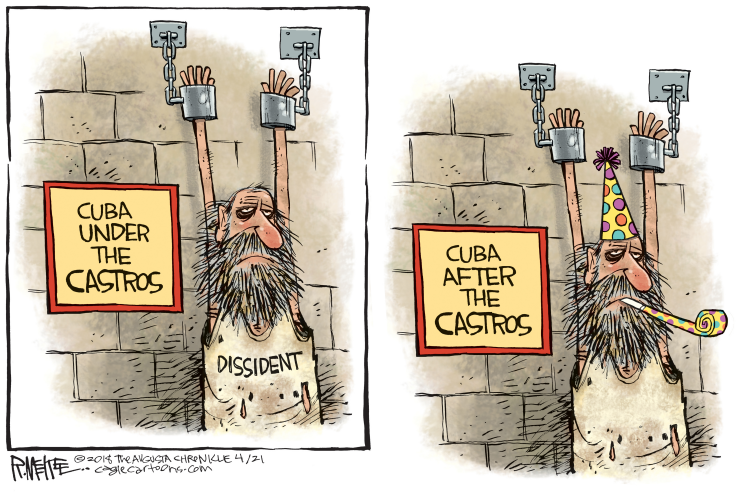
In December, Major League Baseball announced that it had arrived at an agreement with the Cuban Baseball Federation (CBF) that would allow Cuban nationals to play in the MLB, but still return home without penalty at the season’s end. Cubans could sign directly with ML–franchises which would pay a fee to the CBF, aka the Communist Cuban government.

ML–argues that, among the agreement’s other advantages, Cuban players would no longer have to defect which often involved being smuggled or trafficked into countries from which they could then reach the U.S.

Since the Department of Justice recently announced a sweeping probe of MLB’s international signing practices and widespread corruption throughout the $10 billion industry, the league’s deal with Cuba may have been coordinated to deflect criticism. According to documents Sports Illustrated obtained, a 2015 chart created by Los Angeles Dodgers’ executives ranking its Latin American employees on an “egregious” behavior scale. The Dodgers ranked 15 employees on a five-point scale ranging from a one, “mostly just an innocent bystander,” to a five that’s equated with “criminal” behavior. Five Dodgers’ employees received a five.

Rumors of MLB’s tacit support of trafficking Cubans have been intensifying since 2014 when the Dodgers’ Yasiel Puig came to the team via the Mexican drug cartel Los Zetas who kidnapped the outfielder, and held him hostage. Eventually, Puig signed a seven-year contract for $42 million.

In the last five years, at least 20 Cuban nationals have signed ML–contracts for an aggregate $300 million. Another ugly smuggling story: the Chicago White Sox Jose Abreu confessed to a Miami grand jury that while in transit to Florida where he knew federal immigration agencies were waiting, he ate as much of his fake U.S. passport as he could swallow to cover up his illegal travel, and to ensure his eventual $68 million contract.

Adding Cubans to ML–rosters is a mixed bag of success and failure. After tolerating Puig’s on- and off-the-field antics that included an arrest for driving 110 MPH in a 70-MPH zone, the Dodgers traded him to the Cincinnati Reds. And although Abreu has performed well, the White Sox have finished fourth in a five-team league in each of his five seasons.

Beyond the dubious practice of going into business with the virulently anti-American RaC:l Castro regime to negotiate the future of young Cuban baseball chattel, another major fallout from any agreement, assuming the Trump administration approves it, is its effect on American players. Expanding the international baseball pool that already includes players from the Dominican Republic, Venezuela and several Asian countries makes it more difficult for Americans to break in.

Playing baseball is a job, and at that, the world’s best job, some would argue. The starting salary is about $550,000 annually, the average salary is nearly $4.38 million, and superstars earn more than $30 million. Players belong to the nation’s strongest union, and teams cater to players’ whims. ML–is handing foreign nationals jackpots, while qualified U.S. kids are passed over. University of Texas’ legendary manager Augie Garrido said that despite their considerable skill, the majority of college players never play organized baseball after they graduate.

An educated guess: if the 2018 College World Series champion Oregon State Beavers wore ML–uniforms, the average fan would accept them as highly qualified, and would enjoy the game just as much as they do watching pros. CWS players are fundamentally sounder baseball-wise, and – better yet – don’t have to be illegally trafficked.

Welcome to corporate America’s 21st century business model. Whether the employer is Silicon Valley-headquartered or one of the 30 ML–franchises, employers’ reflexive instinct when good jobs become available is to go abroad even though a wealth of local talent is available.

Joe Guzzardi is a Progressives for Immigration Reform analyst who has written about immigration for more than 30 years. Contact him at [email protected].

Comments Off on Proposed MLB-Cuba Deal Spells Trouble for U.S. Hopefuls

Call to Journalists: Return to Your Professional Standards

On New Year’s Eve, The Washington Post published a shockingly biased (even as measured in the current shoddy journalism era) op-ed piece. Titled “The Demographic Time Bomb that Could Hit America,” the commentary reflects columnist Catherine Rampell’s opinion that declining population would represent many dramatic societal challenges.

Crucial details though are omitted, perhaps purposely. Specifically, according to the U.S. Census Bureau, by 2060 the United States is projected to grow by 79 million people, from today’s 326 million to 404 million. Population is not in decline as the column infers. Far from it, population is projected to cross the 400-million threshold in 2058.

Calling all Post editors! Publishing a column about declining population’s perils when population is in fact soaring is an example of why the mainstream media’s trustworthiness remains well below poll numbers from decades back in the public’s eye.

According to the Post, in 2017 the U.S. had the fewest babies born in the last 30 years – nearly 3.9 million births, down 2 percent from 2016. The birth decline is statistical fact, but then the Post’s speculation runs wild. Fewer births would mean fewer workers, and therefore a smaller economy and a reduced tax base to collect the revenues that pay for vital social services.

The Post’s immigration advocacy likely explains the half-truth column. Rampell called for “a more liberal immigration system,” and noted that “immigrants … tend to have more babies than do native-born Americans.” But surprisingly, Rampell ignored the key Census Bureau fact that immigrants and their children are population growth’s leading drivers. The Pew Hispanic Center took the current population growth rate trends and, assuming that they remain unchanged, projected that by 2065 – a slightly longer timeline than the Census Bureau used – immigrants and their children will account for 88 percent of the increase.

Editors have an organization that claims to pursue the highest journalistic standards. In 1922, the American Society of Newspaper Editors, renamed in 2009 as the American Society of News Editors, was formed to advance its profession, and to that end wrote a code of ethics for members to adhere to. Currently, the ASNE posted and thereby endorsed the Columbia Journalism Review’s guidelines for immigration stories: “Look at immigrant connections and contributions to industry, economy, religion, education, culture and family life.” Okay to all that. But there’s another part of the immigration tale that must be, because it affects all Americans including immigrants, included.

The Census Bureau facts and the Pew Hispanic Center’s analysis of that data represent vitally important information that Post readers and, for that matter, all Americans should know, especially during the Trump era when immigration dominates the daily news cycle.

Many Americans are conflicted about immigration, and deserve to know both sides of the argument. After all, the population increases between today and the mid-2060s represent about a 25 percent bump. If Americans were asked how they feel about 25 percent more people in their already overcrowded neighborhoods, schools and hospitals and on highways, most would be overwhelmingly opposed.

Instead of the full, unvarnished story, readers routinely get a set of cherry-picked facts that the media, abandoning its professional responsibilities, puts forward. Time for the truth, and let the nation come to its own conclusions.

Joe Guzzardi is a Progressives for Immigration Reform analyst who has written about immigration for more than 30 years. Contact him at [email protected].

Comments Off on Call to Journalists: Return to Your Professional Standards

Christmas in New York: A Cautionary Tale

I have seen the major U.S. metropolis’ future, and it is bleak. A New York City Christmas vacation, spawned by nostalgia for the Manhattan where I lived for most of the 1960s and 1970s, was a grave disappointment, and proof that Thomas Wolfe is right – you can’t go home. Happy memories of carefree skaters around the Rockefeller Center Christmas tree were quickly dashed.

Whether walking along Park Avenue’s Upper East Side or downtown around the East Village, the city is an unlivable, overcrowded, filthy mess. Not that the 60s and 70s were perfect – far from it. Crime and workers’ strikes were major problems. The city teetered on bankruptcy. But with the passage of a half a century, I expected improvements, but found none.

Good luck getting around, and forget about parking. The only viable method to get from point A to point –is on foot, okay for the ambulatory but only for short distances during which construction debris and scaffolding have to be negotiated. Every building appears to be under construction. Public transportation and private cars are at the mercy of road closures, detours, bicyclists, inattentive pedestrians and double-parked vehicles on narrow streets.

Underground is problematic too. Subways are packed, unreliable and often rodent-infested. Public address messages are unintelligible. New York’s annual 60 million tourists, some who come for an extended stay, exacerbate crowding.

Other U.S. cities – including San Francisco, Los Angeles, Houston and Chicago – have similar problems which proves that once too many people are crammed into too small an area, the quality of life rapidly deteriorates. Proposed solutions like bike lanes and car-free zones can’t offset the relentless flow of more humanity. Once smart growth was all the rage. The smart growth fantasy is that a vertical lifestyle – apartments and condos – would minimize congestion. But New York is almost exclusively vertical, and crowding worsens every year.

Basic math proves the point. NYC has about 8.6 million residents distributed over 302 square miles which makes it the nation’s most densely populated major city with more than twice the population of the second largest city, Los Angeles. As well, 38 of the nation’s 50 states each have less population than NYC. Since 2010, New York’s population has increased an unsustainable 5.5 percent.

Approximately 37 percent of the city’s population is foreign born, nearly three times the national average, and more than half of all children are born to immigrant mothers. Among those immigrants, between 2000 and 2010, Asians constituted the fastest-growing segment of the city’s population.

But adding more people hurts already severely suffering New Yorkers. More people mean more competition for jobs, affordable housing, public transportation, quality education, police protection and social services. A report that the Center for Economic Opportunity published found that 45.6 percent of all New Yorkers barely make ends meet, and that the most severely affected are the rapidly growing Asian population, especially the non-English speaking.

Alleviating rampant population growth in New York and elsewhere isn’t a panacea. The controllable variable in the overpopulation equation is immigration. Don’t eliminate it, but instead create manageable immigration policies that help instead of hurt immigrants already in the U.S. and native-born citizens.

Joe Guzzardi is a Progressives for Immigration Reform analyst who has written about immigration for more than 30 years. Contact him at [email protected].

Comments Off on Christmas in New York: A Cautionary Tale