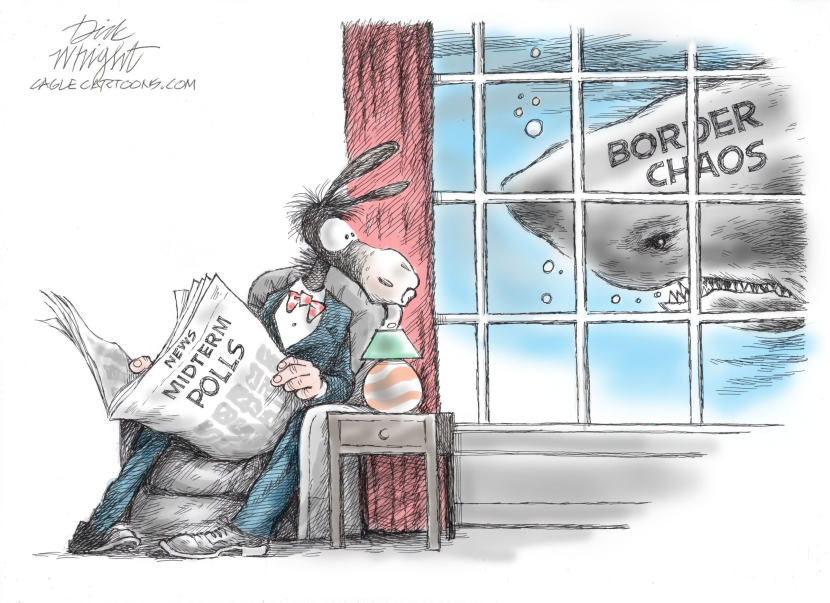
Mid-term voters prefer status quo, which is bad news

Voters are, to understate their mood, disenchanted with Congress. Yet paradoxically, voters re-elect, over and over, the same representatives they hold in dismally low esteem, consider ineffectual and out-of-touch.

On average for 2022, about 80 percent of polling respondents disapproved of how congressional representatives handled their jobs. Many critics had previously claimed that underrepresentation of women and diverse legislators was a key reason that Congress was so incompetent. But the 117th Congress was the most racially and gender diverse in history. In 2022, 142 women were in the U.S. House of Representatives, a record high.

Despite these House gains, voters maintained their same opinion of Congress – a bungling, self-important body that does little right.

In November, when the moment-of-truth mid-term election was held, 73 percent of voters disapproved of incumbents’ job performance. But the vote count told a different tale. Despite their 73 percent disapproval rate, congressional incumbents had a 98 percent win rate. Forty-one states had a 100 percent win rate in congressional races.

The takeaway: talk is cheap, but the votes tell the true story. Overwhelmingly, the majority wants to maintain the status quo.

The status quo translates into continuing high inflation, which in 2022 averaged 8.4 percent per month. Status quo also means national debt mounting from its current $31 trillion and funding the Ukraine war, which, with Biden’s signature on a $1.9 trillion omnibus spending bill, will put the U.S. investment in the faraway conflict at $100 billion.

As entrenched as those costs are, Biden’s open border is another unsustainable drain on taxpayers’ pocketbooks. To provide public education, Medicaid and other affirmative benefits to the 1.35 million illegal immigrants that have become part of the general population since Biden took office will cost taxpayers an estimated $100 billion over the aliens’ lifetimes. Many recent arrivals have limited education and English language skills, so jobs they may end up accepting likely will pay little.

Regardless of which candidate voters supported in the 2020 presidential election, only a tiny percentage would have cast their ballots in favor of adopting the current border policy. For the first quarter of fiscal year 2023, Customs and Border Protection reported that it had released 430,677 aliens into the interior, witnessed 240,340 migrants the agency calls “gotaways” and expelled 186,340 illegal immigrants. Agents caution that their official numbers may be low because many more aliens may have escaped without CBP’s knowledge. Nine out of 10 agents, a whistleblower reported, are away from the line.

The southwest border chaos also represents a dangerous criminal threat to innocent citizens. Too many migrants have either criminal or terrorist histories. Retiring Border Patrol Chief Rodney Scott told his agents that known or suspected terrorists, as identified in the FBI’s Terrorist Screening Database, are entering in huge numbers, representing “a real threat.”

CBP, which operates at ports of entry and along the border between entry ports, reported that during fiscal year 2022, they encountered more than 25,000 convicted criminals. When the numbers that pour across the border total millions, ill-intended people will be among them.

The argument against the border “management” of Biden and Department of Homeland Security Secretary Alejandro Mayorkas shouldn’t be construed as anti-immigrant. Rather, the disagreement reflects reasonable questioning about the wisdom of open borders and a sincere concern that citizens are funding the administration’s immigration follies that only it approves of.

The border crisis is a direct result of the Biden’s administration’s willingness to allow anyone from anywhere to enter the U.S., even though the electorate is strongly opposed to such recklessness. The nation wants a responsible, sensible immigration policy, a prudent but, to date, elusive goal.

Copyright 2023 Joe Guzzardi, distributed by Cagle Cartoons newspaper syndicate.

Joe Guzzardi is a Progressives for Immigration Reform analyst who has written about immigration for more than 30 years. Contact him at [email protected].

Comments Off on Mid-term voters prefer status quo, which is bad news

U.S. ecological footprint confronts the border crisis

Ask the millions of migrants who have either entered the United States or are lined up at the border what motivated their journeys, and all will answer that they’re in pursuit of the proverbial better life.

Translated, a better life means they’re longing to become consumers — consumers of housing, hard goods like cars, and natural resources such as water, electricity and natural gas. The migrants’ goal is great news for big businesses that never met a consumer they don’t love, but bad news for environmentalists who hope to preserve a vanishing America.

As conservationists look ahead, the future they see is unsettling.

With Title 42 set to expire on December 21st, Republican Rep. Tony Gonzales, whose district includes 42% of the Texas-Mexico border, predicts a “hurricane” of illegal immigration. Everyone in his district, Gonzales said, is in “batten down the hatches” mode as they await a historic and unmanageable increase in migration — more eventual consumers.

Border patrol agents advised Uvalde residents to expect about 150 daily migrant drop offs indefinitely, evidence which, Gonzales said, proves that the Biden administration has no meaningful plan to cope with the ongoing invasion. Because of the COVID-19 pandemic, Title 42 has been enforced since March 2020 to expel migrants at the southern border. But, in November, in his 49-page opinion, U.S. District Court Judge Emmet Sullivan, President Bill Clinton’s appointee, ruled that Title 42 is “arbitrary and capricious,” and violated federal regulatory law.

For FY 2022, an estimated 5.5 million aliens, a total that includes the 4.4 million that U.S. Customs and Border Protection reported, and 1.1 million gotaways, are in the U.S. interior. Princeton Policy Advisors’ analyst Steven Kopits, who correctly predicted the FY 2022 crisis, wrote that “… based on the last two months [October and November], 2023 should set yet another record for illegal border crossing — and by a substantial margin over 2022.” March, April and May 2023 will be, Koptis concluded, especially high as part of the illegal immigrant siege. Only if Republicans captured both congressional chambers, Kopits envisioned, could the migrant invasion be halted — wishful thinking as the mid-term results were tallied.

The red tsunami that Kopits saw as the vehicle that might level off illegal immigration turned out to be a mere trickle. The House will have a narrow margin, and the Senate remains under Democratic control. All fifty senators have, since 2020, an unbroken voting record that supports open borders. Many of those senators are captives of the corporate donor class that wants the steady stream of consumers to continue unabated.

Environmentalists should be front and center in the battle to preserve the nation’s green space and irreplaceable resources. But not only have congressional Democrats abandoned limiting immigration to sustainable levels, but environmentalists have also given up the battle. Although population surges destroy the ecosystems, wildlife habitat, and farmland that exists between their cities and towns, no large environmental group today advocates for saving natural habitat from relentless growth. The Census Bureau projects that by mid-century, immigrants and births to immigrants will drive more than 85% of U.S. population growth, and add more than 100 million people to its current 333 million population.

American has one of the world’s largest ecological per capita footprints, 8.04. Any and all U.S population growth — let alone the massive multi-million-person border surge — will grow its existing footprint. The average U.S. citizen’s ecological footprint is about 50% larger than that of the average person in most European countries. The nation has more suburban sprawl and less public transportation than most countries, which means it burns more fossil fuels that adds to its per-capita carbon consumption, and uses more energy and water per person than most other developed countries.

No one in the Biden administration or in Congress or among the major environmental organizations has meaningfully addressed the open border’s long-term consequences even though they are potentially dire. E.O. Wilson, biologist and writer, expressed the ecological threat dramatically, but accurately: “The raging monster upon the land is population growth. In its presence, sustainability is but a fragile theoretical concept.”

Copyright 2022 Joe Guzzardi, distributed by Cagle Cartoons newspaper syndicate.

Joe Guzzardi is a Progressives for Immigration Reform analyst who has written about immigration for more than 30 years. Contact him at [email protected].

Comments Off on U.S. ecological footprint confronts the border crisis

The MLB umpire who learned in a German POW camp

During World War II, 130,000 American soldiers and nearly 19,000 U.S. civilians were prisoners of war.

The Japanese camps where POWs lived offered brutally inhumane conditions, but on all but the worst circumstances, a little recreation was possible, and baseball was the preferred pastime.

In his book, “POW Baseball in World War II,” author Tom Wolter tells the stories of baseball played behind barbed wire in the most unlikely places, including Central Asia, along the Baltic Seacoast, in Indonesian jungles, and in Japanese cities where guards challenged prisoners to games. Refusal would have been dangerous.

Games were played, said one POW, to avoid crushing boredom, and to create a “Little America.” Within the camps, the players formed leagues, and rivalries were intense. Umpiring disputes were heated, and ringer roster-stacking allegations common. Prison-run newspapers detailed the games in prose that would have made Damon Runyon proud.

Among those liberated from POW camps was Army Air Force Sergeant Augie Donatelli, a future National League umpire. Stationed in England with the 379th Bomb Group as a tail-gunner on a Boeing B-17 Flying Fortress, one of the Air Force’s most dangerous jobs, Donatelli’s plane, during the first daylight mission over Berlin, was shot down. Looking back, Donatelli said that “fighters [were] diving at us, 20-millimeter shells exploding all around. We flew into the clouds to hide. What action! That day 68 bombers were shot down.”

Donatelli, who previously had flown 17 successful missions, parachuted out but broke his ankle when he hit the ground. Trying to escape from the forest after his fall, Donatelli recalled that he heard a Nazi soldier yell, “Halt,” and was soon a Stalag Luft IV POW.

During his 14 months as a POW, Donatelli tried to escape twice, but was recaptured. Former National League umpire and friend Doug Harvey later recalled, “He always laughed when he talked about his second attempt. He was hiding in a haystack, but didn’t get all the way in. His rear was showing. One of the German guards got him out with a pitchfork.”

As a young boy, Donatelli, the son of Italian immigrants, worked in Western Pennsylvania’s coal mines. Donatelli told the Society for American Baseball’s Oral History Committee, “It was dangerous and hard work, but what else were you going to do? I started even before graduating from high school.” But Donatelli began his 24-year career, which ended with him universally regarded as one of baseball history’s best umpires, when he presided over POW softball games.

Before Donatelli enlisted, something he said that his patriotic spirit compelled him to do, he had played shortstop in the Class D league for the St. Louis Browns. But Gus, as Donatelli’s friends called him, sensed that his skills weren’t up to MLB snuff. After graduating from umpire school, his new career began, and soon, he was umpiring in the big leagues, where he became famous for his quick hook and the dramatic gestures that accompanied it.

By the time he retired, Donatelli had worked four All-Star games, five World Series, two League Championship Series. Donatelli was also behind the plate for four no-hitter and several notable historic moments, such as when Whitey Ford set the World Series record for scoreless innings and when Don Drysdale set the mark for consecutive shutout innings in a season. He was present when Stan Musial hit five homers in a doubleheader, and when “The Man” got his 3,000th base hit, and when Nate Colbert hit five homers and knocked in 13 RBIs in doubleheader.

In 1970, Donatelli helped organize the Major League Umpires Association, which eventually led to today’s umpires earning an average $235,000 salary.

When Donatelli looked back at his career, he pointed with pride to missing only one game in 24 years, and his patriotic World War II service. “I felt it was something I had to do, not to escape the mines but because you just felt it was up to you to get into it,” Donatelli said.

At age 75, Donatelli died at home in St. Petersburg, Fl.

Copyright 2022 Joe Guzzardi, distributed by Cagle Cartoons newspaper syndicate.

Joe Guzzardi is a Society for American Baseball Research and Internet Baseball Writers’ Association member. Contact him at [email protected].

Comments Off on The MLB umpire who learned in a German POW camp

Tech workers brace for possible job killer

Like the proverbial bad penny that keeps reappearing, lousy immigration bills are hard to kill off.

Consider the EAGLE Act of 2022, also known as Equal Access to Green Cards for Legal Employment, or formally recognized as H.R. 3648. The newest proposed legislation is another iteration of the Fairness for High-Skilled Immigrants Act. Although it passed the House by a 365-65 vote, eventually it stalled in Congress.

Introduced by immigration lawyer, amnesty advocate, enforcement foe and expansionist champion Rep. Zoe Lofgren (D-Calif.), the new and the old versions of her proposed legislation both share the same ruinous-to-U.S. tech workers’ feature: the legislation would rob thousands of U.S. tech workers of access to well-paid, white-collar, high-skilled jobs in the science, technology, engineering and math fields, STEM jobs for which they are fully qualified.

Along with her like-minded congressional allies that include Rep. Tom Emmer (R-Minn.), who was just elected as House Majority Whip for the 118th Congress and thus became the third highest ranking Republican in the House, Lofgren has scheduled a vote on the legislation, which has bipartisan support, when Congress returns from its Thanksgiving recess.

Briefly explained, the EAGLE Act would dramatically revise portions of the Immigration Act of 1990. Almost any alien who has been on the visa waiting list for at least two years with an approved petition for an employment-based green card could apply for adjustment of his or her status which then wouldn’t count against existing numerical caps.

Stated another way, employers can sponsor a temporary foreign-born worker for an H-1B nonimmigrant visa and convert that worker to permanent by merely sponsoring him for a green card. Aliens go from temporarily present to permanent residents. With the stroke of a pen, job searches become more challenging for U.S. tech workers – Congress’ twisted idea of sound legislation.

The bill also eliminates the per-country caps for employment-based visas, which means that within about a decade Indian and Chinese nationals will receive virtually all such visas, especially the H-1B.

Under current law, no countries’ nationals can comprise more than 7 percent of any visa category. This provision ensures that skilled workers from around the globe have an opportunity to come to America. The EAGLE Act, however, seeks to entirely remove all caps from employment-based visas and more than double the existing family-preference visa from 7 percent to 15 percent, a hike that would, because of family reunification, ensure significant population surges.

The proposed visa cap elimination is ironic because Lofgren and the EAGLE Act’s cosponsors claim to embrace diversity, but the bill heavily favors Chinese and Indian citizens to the exclusion of most others.

Moreover, dependent children of the aliens granted the new status would be allowed to retain their legal standing, a form of amnesty, as dependents of their parents for the duration of the green card application process; they would be protected from aging out while their parents move up in the backlog. An estimated 190,000 minors would be protected.

There was a time when Democrats purported to care about America’s minority workers. But their empathy toward U.S. workers is long gone, and is now redirected to foreign nationals, particularly Chinese and Indians. Blacks, Hispanics and other minorities aspire to IT jobs, too. But they’ve had little luck in obtaining those coveted STEM jobs. Pew Research found that black workers make up 9 percent of the STEM workforce, while Hispanics also comprise about 9 percent. The low STEM representation among blacks and Hispanics is largely unchanged from 2016.

For rational thinkers, few and far between in Congress, a push for liberalized immigration laws and amnesty in light of the border surge and its 2 million-plus encounters in 2022 is beyond the pale. But those sound-of-mind types don’t understand the congressional mindset – nothing stops its amnesty drive. And if the EAGLE Act doesn’t get Senate approval, Lofgren always has the option to attach it to a must-pass Omnibus bill.

With the 118th House about to transfer into GOP hands, EAGLE Act supporters view December as their last chance to subvert U.S. tech workers.

Copyright 2022 Joe Guzzardi, distributed by Cagle Cartoons newspaper syndicate.

Joe Guzzardi is a Progressives for Immigration Reform analyst who has written about immigration for more than 30 years. Contact him at [email protected].

Comments Off on Tech workers brace for possible job killer

On Veterans Day, baseball’s forgotten hero

Baseball history is rich with inspiring stories about Hall of Fame players who served with distinction during World War II, then returned to the diamond and picked up their stellar careers exactly where they left off.

In 1942, Marine Corp Captain Ted Williams hit .356, then came back in 1946 to hit .342, which earned him the American League MVP award.

New York Yankees’ shortstop Phil Rizzuto, after two productive years, joined the Navy, and served in the Pacific Theater from 1943 to 1946. Once reunited with the Yankees, Rizzuto excelled, won the 1950 MVP title, and played on five All-Star teams.

But for another shortstop, World War II brought an end to what certainly would have been a Hall of Fame career.

The Washington Senators’ Cecil Travis broke into baseball with a bang. In May 1931, after hitting .356 for the Double-A Chattanooga Lookouts, the Washington Senators called Travis up. Travis got five consecutive hits in his first-ever game, quickly establishing himself as one of the American League’s most stellar players.

Playing shortstop and third base, Travis compiled a .322 batting average in 1940. A year later he had his best season as a professional, playing in all 152 games for the Senators and batting .359, second only to Ted Williams’ incredible .406. Unfortunately, Travis, who hit .300 or better in eight of his first nine seasons, played for the perennial-losing Senators, a team that got little media attention. Otherwise, fans nationwide would have hailed Travis as a superstar.

A month after Pearl Harbor, the Army inducted Travis and sent him to Georgia’s Camp Wheeler. By 1944, Travis joined the 76th Infantry Division’s Special Forces and was shipped to Europe for active duty. The 76th entered the European Theater in December. That winter, during the Battle of the Bulge’s final days and in pursuit of Hitler’s retreating German soldiers, Americans suffered through bitter cold. Travis developed frostbite on two of his toes and spent time recovering in a French hospital.

After the 76th was deactivated in June 1945, Travis returned home, and by September, manager Ossie Bluege inserted his name into the Senators’ starting lineup. But Travis never returned to his pre-war excellence, and his potential Hall of Fame career came to a screeching halt. Travis wasn’t the same player who had compiled a .327 career batting average before the war. He batted just .252 in 1946, his last season as a full-time player.

On August 15, 1947 at Griffith Stadium, the Senators celebrated “Cecil Travis Night.” At the ceremony, which former Supreme Allied Commander General Dwight D. Eisenhower attended, Travis was showered with gifts, including a fancy DeSoto automobile and a 1,500-pound Hereford bull. Travis officially retired after the 1947 season – he hit .216 as a part-time player – and then until 1956, he scouted for the Senators.

Travis, like most World War II veterans, refused to blame his military service for derailing his baseball career. Instead, Travis simply said that his four years away from the game were “too long.” He said, “We had a job to do, an obligation, and we did it. I was hardly the only one.”

Bob Feller and Williams lobbied unsuccessfully for Travis’ Hall of Fame induction, and pointed out that Travis’ .314 career average ranked him favorably with other Hall of Fame shortstops. Feller considered one of the toughest batters he faced, and Williams labeled as an efficient pure hitter.

But as Travis philosophically said: “I was a good player, but I wasn’t a great one.”

Copyright 2022 Joe Guzzardi, distributed by Cagle Cartoons newspaper syndicate.

Joe Guzzardi is a Society for American Baseball Research and Internet Baseball Writers’ Association member. Contact him at [email protected].

Comments Off on On Veterans Day, baseball’s forgotten hero

Immigration restrictionists brace for looming lame-duck session

Between today and January 3, 2023 when the 118th Congress convenes, the nation may undergo a shift away from the party that minimizes border security to the party that favors enforcement and a more rational immigration policy. The outcome will depend on more than the election night results.

A hotly contested lame-duck session that will include a major amnesty push will play a significant role in the political dynamic of the next two years. Voters have consistently rejected amnesty because legalizing illegal immigrants incentivizes future illegal immigration waves and immediately expands the labor market, harming U.S. workers.

Lame-duck sessions represent opportunities for the outgoing Congress to make one final push for their pet causes, even though, despite their terms in office, they’ve been unable to legislatively achieve their personal wish list. From the defeated or retired legislators’ perspectives, since they’re no longer accountable to their constituents, they have nothing to lose.

Efforts to end lame-duck sessions, dating back 90 years, have failed. The 20th Amendment, approved in 1933, was originally drafted to eliminate the lame duck. The amendment’s proponents argued that lame ducks were subject to nefarious influences. Moreover, passing lame-duck legislation might contradict the voices of the people as expressed in the last election. But the 20th Amendment didn’t definitively prohibit lame-duck sessions. Instead, dodging its original intention, the amendment simply moved the date on which the newly elected President and Congress took office from March to January.

Since the 20th Amendment didn’t kill off the lame duck, Congress will have to deal with it. If Democrats prevail in November, then a disastrous amnesty and other immigration-expanding measures are possible. More immigration has a host of Capitol Hill allies: religious and academic institutions, special interest groups, social media, big business and lobbyists who spent $3.7 billion to influence peddle targeted congressional members.

Higher immigration levels mean more consumers, and more cheap labor, so naturally corporate interests favor higher immigration levels. Democrats are united and tireless in their commitment and determination to enact amnesty. Last year, Democrats tried to sneak amnesty into a larger budget bill. This bill was scheduled to go through the reconciliation process, meaning it would only require a simple majority to pass, and the problematic filibuster would have been avoided. But the Senate Parliamentarian had to confirm that the bill’s contents specifically dealt with the federal budget.

Democrats unconvincingly argued that giving millions of illegal aliens legal status was a budgetary matter. Nevertheless, the Parliamentarian ruled against all three amnesty attempts.

Big business, anticipating December, is hard at work with a multifaceted game plan that includes multiple immigration provisions in unrelated amendments that it wants to include in the must-pass National Defense Authorization Act. The amendments would give more low- and high-skilled workers legal U.S. work permission.

Other amnesty schemes are afoot. California Senator Alex Padilla, appointed to replace Vice President Kamala Harris, is working in concert with Illinois Senator Dick Durbin to change registry laws to allow illegal immigrants to apply for permanent residence after they’ve lived in the U.S. for at least seven years, legalizing about 8 million illegal aliens. Padilla’s proposal reflects Democrats’ mindset – all roads can lead to amnesty.

When the lame-duck period begins, one fundamental principal should guide the GOP – no amnesty deals! The U.S. has more immigration than the nation can manage. More than 1 million lawful permanent residents arrive annually; millions more enter on employment visas, and fiscal year 2022 ended with a staggering 2,378,944 migrant border encounters, the highest ever recorded, but exclusive of the 599,000 known “gotaways” that Customs and Border Protection agents estimate eluded capture, but including an estimated 78 on the FBI’s terrorist watch list.

Since the only way to ban the lame duck would be through another constitutional amendment, Democrats and Republicans could adopt a civil tone if just for a few weeks. The parties could agree that a lame-duck session cannot create major legislation and simply let the next Congress take up leftover business.

Copyright 2022 Joe Guzzardi, distributed by Cagle Cartoons newspaper syndicate.

Joe Guzzardi is a Progressives for Immigration Reform analyst who has written about immigration for more than 30 years. Contact him at [email protected].

Comments Off on Immigration restrictionists brace for looming lame-duck session

Heritage Month: The all-brothers baseball team

In 1997, the Cooperstown Hall of Fame honored the Acerra family, an all-Italian, 12-brother semi-pro team that played .700 winning baseball from 1938 to 1952.

Between 1860 and 1940, 29 baseball teams were made up entirely of brothers; the Acerras played longer than any other.

Honored isn’t the same as inducted, so the brothers didn’t join the powerful Italian-American contingent that has Hall of Fame plaques, which includes Joe DiMaggio, Tony Lazzeri, Yogi Berra and Phil Rizzuto.

Among the Italian-American baseball standouts born too soon to benefit from today’s watered-down Hall of Fame standards were Sal “the Barber” Maglie, a New York Giants, Brooklyn Dodgers and Yankees pitcher, and Rocco Domenico Colavito, a nine-time All-Star with 374 career home runs.

The Acerras’ wonderful story is one of strong family ties and exceptional baseball skills. Louis “Pop” Acerra coached his sons, part of his family of 17 children. The team consisted of Alfred and Edward as catcher, James and Robert on the mound, Charles at first base, Louis Jr. at second base, Fred at shortstop, Richard at third base and sharing outfield duties, Paul, Joseph, William and Anthony.

Back then, girls didn’t play baseball, so Pop’s five daughters rooted from the sidelines along with the family dog “Pitch.” Neighbors couldn’t remember a time when the brothers weren’t out in their yard playing catch or hitting fungos to each other.

The age difference between oldest brother, Anthony, to the youngest, Louis Jr. was 25 years. While being scouted by major league teams, their playing ages were as young as 17 and as old as 40. For 22 consecutive years, the Long Branch High School baseball team fielded an Acerra brother.

Officially formed in 1938, the team played throughout the East Coast for 14 years. In 1948, the sibling squad challenged the New York Yankees to an exhibition game, an offer the Bronx Bombers rejected.

During World War II, the team temporarily disbanded. Defending America’s freedom was more important than baseball. At different times, six brothers enlisted; when they all returned, the team resumed playing. The brothers turned down college scholarships and offers to play professional baseball.

Alfred, the catcher, continued to play after losing sight in one eye. Attempting to bunt, the ball bounced off Alfred’s bat, and struck him directly in the eye. Within months, Alfred was back behind the plate. Brother Freddie said: “He was a pretty good catcher for a guy with one eye.”

In 1946, the Acerras joined the Long Branch City (New Jersey) Twilight Baseball League, and during the next six years, won the championship four times. When the Acerras played, the stands were always packed with fans.

Along their road to success, the Acerras became the talk of the town. In 1947, Life and Look magazines and Ripley’s Believe it or Not ran features on the brothers. The Acerras also appeared on the popular “Once in a Lifetime” nightly radio program.

By 1952, the brothers had married and were raising children. The team’s playing days were over. But 45 years after their last game, the seven still-living brothers accepted the Hall of Fame’s invitation to participate in its annual ceremony. James M. Accera, pitcher Jimmy’s son, donated his Dad’s uniform and glove which now are in the same museum with the artifacts of the lives of Babe Ruth, Ty Cobb and Willie Mays.

Acerra said, “This just touches the surface of a family that stayed a family, behind all the baseball and athletic achievements. A family that never allowed sibling rivalry and infighting or success to tear them apart. Their team was a reflection of something greater, something that 14 years, many hardships, the lure of professional contracts, and even a World War could not destroy.”

Acerra’s loving memory stands as a reminder that the team’s accomplishments were more about family values than baseball, and how the national pastime unified them in brotherly love.

Copyright 2022 Joe Guzzardi, distributed by Cagle Cartoons newspaper syndicate.

Joe Guzzardi is a Society for American Baseball Research and Internet Baseball Writers’ Association member. Contact him at [email protected].

Comments Off on Heritage Month: The all-brothers baseball team

Clinton’s post-1994 midterm immigration awakening

Every now and again, both during and after his two-term presidency, Bill Clinton espoused sound immigration thoughts that focused on the nation’s best interests. Most recently, Clinton, without naming Joe Biden, took direct aim at the sitting president’s open border fiasco.

On a CNN podcast, and in response to a question about economic migrants who are, in the host’s description, “gaming” the asylum system, Clinton replied that “there’s a limit” at which point open borders will cause “severe disruption.” Clinton added that the established immigration protocols, presumably a reference to the traditional agencies that assist incoming immigrants, function on the assumption that border conditions would “be more normal.”

“Severe disruption” may be the kindest way to describe the chaos in the Rio Grande Valley and other entry points along the Southwest Border. And severely disrupted is an understatement to define the conditions in sanctuary cities New York, Chicago and Washington, D.C. where the mayors are grappling unsuccessfully to accommodate the migrants that Texas and Florida governors Greg Abbott and Ron DeSantis send north.

New York Gov. Kathy Hochul summoned the National Guard to help  New York City Mayor Eric Adams with his plan, still in flux, to relocate the migrants to a Randall Island tent city. Adams, who declared the incoming migrants’ need for assistance “a humanitarian crisis,” pleaded to no avail with Biden for a minimum $500 million emergency aid infusion. Having no money to deal with incoming migrants is as disruptive, to use Clinton’s word, as conditions get.

Clinton has long been aware of over-immigration’s effect on American citizens. In his 1995 State of the Union address, given shortly after Republicans picked up eight Senate seats and a net 54 House seats after a GOP midterm rout to win congressional control for the first time in four decades, Clinton spoke about the anxiety Americans experience during periods of unchecked immigration. Clinton listed many dangers that illegal immigration presents to Americans that included illegal hiring, the subsequent U.S. job losses and providing costly social services.

Clinton’s word-for-word conclusion: “It is wrong and ultimately self-defeating for a nation of immigrants to permit the kind of abuse of our immigration laws we have seen in recent years, and we must do more to stop it.”

During his speech, Clinton mentioned Barbara Jordan, the former U.S. representative who chaired the U.S. Commission on Immigration Reform. The commission’s goal was to establish “credible, coherent immigrant and immigration policy.” The African-American Democrat from Texas endorsed significant legal immigration reductions with an emphasis on high-skilled admissions, fewer refugees, more deportations and a chain migration overhaul that would limit sponsorship to nuclear family members.

Jordan distilled her immigration vision in a sentence: “Those who should get in, get in; those who should be kept out, are kept out; and those who should not be here will be required to leave.”

However, Jordan died just months after releasing her report, after which a civil rights, Hispanic advocacy coalition opposed to Jordan’s immigration goals strong-armed Clinton into backing away. Had Jordan lived, her presence would have kept Clinton committed to her commonsense immigration reform rules.

Should the GOP manage to recapture Congress, no sure thing, the results won’t spawn a 1995-style immigration awareness in Biden similar to Clinton’s. As vice president, Biden continuously hailed “constant” and “unrelenting” immigration stream “in large numbers” as America’s source of strength.

Given the red carpet welcome Biden has extended to millions of illegal immigrants and got-aways, complete with, in many cases, parole and work authorization, a presidential immigration awakening is highly improbable.

Copyright 2022 Joe Guzzardi, distributed by Cagle Cartoons newspaper syndicate.

Joe Guzzardi is a Progressives for Immigration Reform analyst who has written about immigration for more than 30 years. Contact him at [email protected].

Comments Off on Clinton’s post-1994 midterm immigration awakening

Hispanic voters trending red

For the last several presidential election cycles, media messaging has been consistent: candidates who capture the Hispanic vote will win.

The suggestion, often unstated, was that GOP candidates need to promote an illegal alien amnesty, pledge to curtail interior enforcement and promote expanded immigration. In 2022, however, Hispanics could indeed hold the key to a GOP victory, but not because they endorse amnesty.

Hispanics, realizing that an open border creates job competition, classroom chaos and disrupts their communities, oppose President Biden’s immigration agenda.

The Hispanic shift toward Republicans has been building slowly, but steadily. In 2004 and 2016, Republican Presidents George W. Bush and Donald Trump scored well among Hispanics, 40 percent and 38 percent, respectively. Trump’s 2020 total was almost 10 points higher than his 2016 tally. But in the 20 months since Biden’s inauguration, the White House’s open borders agenda has accelerated the Hispanic shift to the GOP. Remember that Hispanics who vote are U.S. citizens, and their hopes and concerns are largely identical to other Americans.

In his new book, “Political Migrants: Hispanic Voters on the Move,” Jim Robb wrote that Biden’s refusal to enforce border laws, and instead to opt for catch-and-release, has been disastrous for all Americans, but especially legal immigrants and the 40-plus million American-born Hispanics.

This fall, indications are that Hispanics will vote Republican at a higher rate than they did in 2020: 41 percent plan to vote Republican against 45 percent who will support Democrats, with others undecided. Since only 29 percent of Hispanics voted Republican in the 2018 mid-term election, 41 percent would be a significant GOP move toward capturing an important demographic. In fact, 41 percent would be the highest mid-term election share Republicans have ever received from Hispanics.

On important life-affecting issues, Hispanics side with the GOP. Among likely Hispanic voters, 52 percent believe the government is doing “too little to reduce illegal border crossings and visitor overstays.” Only 15 percent believe the government is doing “too much.” Hispanic voters overwhelmingly agree that chain migration should be limited to spouses and minor children, that Congress should mandate E-Verify which helps assure that only citizens and lawfully present foreign nationals can hold jobs, that businesses should raise wages to attract American workers before hiring foreign nationals, and that legal immigration should be reduced from its current 1 million-plus annually inflow.

Other poll findings may vary, but tangible evidence exists that the Hispanic shift to the GOP is real and may represent the difference in November. In a special June election to determine who would represent Texas’ 34th congressional district in the illegal immigration-besieged Rio Grande Valley, Mayra Flores defeated Democrat Dan Sanchez. A citizen since age 14 and married to a border patrol officer, Flores represents a burgeoning breed of Hispanic officeholders who promote strict border enforcement.

Flores is the first Republican to represent her historically blue district in 150 years, and the first woman born in Mexico ever elected to Congress. Just weeks after her victory, Flores called on her colleagues to impeach Department of Homeland Security Secretary Alejandro Mayorkas for his abject failures to enforce immigration laws which have caused the ongoing border crisis.

Texas gubernatorial challenger Robert O’Rourke, trailing Republican incumbent Greg Abbott, explained why Hispanics have abandoned Democrats. O’Rourke, harkening back to 2020, blamed Biden who “…didn’t spend a dime or day in the Rio Grande Valley or really anywhere in Texas….”

Flores will be on the November ballot when she’ll face Democrat Vicente Gonzales who has consistently voted to support Biden’s open borders policy. Political forecasters maintain that the 34th still leans blue. But a Flores victory would confirm that the Hispanic trend to red is real.

Copyright 2022 Joe Guzzardi, distributed by Cagle Cartoons newspaper syndicate.

Joe Guzzardi is a Progressives for Immigration Reform analyst who has written about immigration for more than 30 years. Contact him at [email protected].

Comments Off on Hispanic voters trending red

GOP pins hopes on ‘Commitment to America’

With seven weeks remaining before the 2022 midterm election, Republicans and Democrats have drawn their battle lines and staked out what each party considers their opponents’ political vulnerabilities.

Last week, the Republicans released what it called a “Commitment to America” that included many oft-made, unfulfilled promises to its base. GOP House Minority Leader Kevin McCarthy and fellow Republicans Steve Scalise and Elise Stefanik vowed to fund border enforcement, end catch-and-release and mandate E-Verify, the online program that confirms whether a newly hired employee is legally authorized to work in the U.S.

President Biden swiftly rebutted. Speaking to the teachers’ union in Philadelphia, Biden called the “Commitment to America” thin gruel, and chided McCarthy for omitting references to issues that, in his view, voters most care about like a woman’s right to choose, Medicare, Social Security, gun violence and LGBT discrimination.

Enforcing immigration laws may help give Republicans a winning hand – border patrol agents have apprehended an estimated 4.9 million illegal immigrants during the 20 months since Biden’s inauguration. The variable in the November election is whether the GOP can unify behind its promises, traditionally a huge problem for Republicans, and press their advantages into a congressional majority against what will be solidly determined, no defectors allowed, Democrats.

Key to the Commitment to America is E-Verify. At first glance, the program should have universal congressional support – no one from either party can intelligently argue that citizens and lawfully present immigrants shouldn’t be protected against illegal immigrant employment. But the donor-base wants illegal immigrant employees, cheaper and more subservient. And because the corporate elites are so influential with U.S. representatives and senators, E-Verify has hit a congressional brick wall for nearly 30 years. Thus, E-Verify has never had the benefit of a full floor vote.

Sadly, the Biden administration has moved dramatically away from E-Verify’s intention. Department of Homeland Security Secretary Alejandro Mayorkas’ October 12, 2021 memo prohibits Immigration and Customs Enforcement from conducting worksite enforcement raids that might turn up employed illegal aliens. Mayorkas’ memo is an administrative subversion of immigration law, and an open invitation for employers, penalty-free, to hire illegal aliens who will also be protected from enforcement consequences. Under existing but ignored law, employed illegal immigrants could be deported.

Despite insistence from immigration advocates that Americans won’t do most of the jobs that aliens are hired to do, the evidence proves the contrary. In 2017, ICE audited an industrial bakery in Chicago which forced the employer, Cloverhill Bakery, to fire 800 illegal aliens. The terminated employees were quickly replaced by mostly Black Americans. Similar ICE cases targeted illegal employment at Mississippi chicken plants, at a trailer manufacturer in Texas and a meatpacker in Tennessee. Not only were hundreds of Americans hired to fill the now-vacant jobs, but the government indicted some directly involved managers. The cases’ common denominators were the aliens’ presence in the labor market, a problem that E-Verify would have averted.

The Commitment to America is encouraging, but skeptics wonder if there’s muscle behind it or if it’s more GOP smoke and mirrors. McCarthy, Scalise and Stefanik have what’s generously described as tepid voting records on reducing illegal presence and jobs. In the same illegal presence and jobs category, Senate Minority Leader Mitch McConnell scored a zero. About a week ago on the Senate floor, McConnell delivered a squishy speech about immigration’s importance; his tone didn’t reverberate with the Commitment to America theme.

During the campaigning, certain to be contentious, GOP leaders may have an awakening, and persuade undecided voters that American jobs and sovereignty must be saved. Time is short. At Biden’s current pace of admitting the world – including got-aways – the U.S. could have more than 7 million illegal aliens added to its population by 2024, an unsustainable total that will adversely affect every aspect of Americans’ lives.

Copyright 2022 Joe Guzzardi, distributed by Cagle Cartoons newspaper syndicate.

Joe Guzzardi is a Progressives for Immigration Reform analyst who has written about immigration for more than 30 years. Contact him at [email protected].

Comments Off on GOP pins hopes on ‘Commitment to America’