Critics are wrong to go after Caitlin Clark

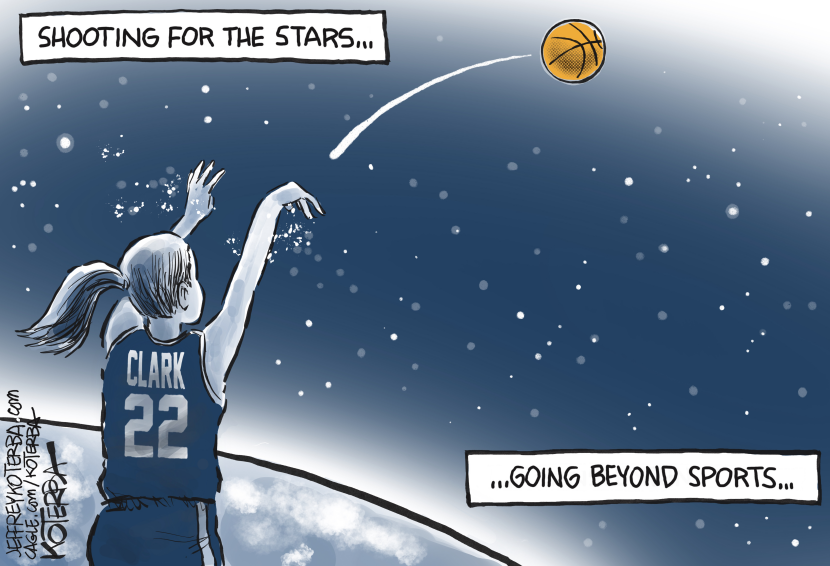
The torrential downpour greeting WNBA star Caitlin Clark over comments made during an interview at a Time magazine event have been both amusing and disturbing.

Clark, the Indiana Fever star who was recently named Time magazine’s Athlete of the Year, expressed her admiration and respect for Black women who have paved the way in female basketball and the importance of promoting diversity as well as diverse voices in the sport. She also expressed hope to utilize her platform to develop possibilities for others while acknowledging various racial situations in professional sports often play out in ways that benefit white athletes, like herself.

“[The WNBA] has only been around 25-plus years. I know there’s been so many amazing Black women that have been in this league, and continuing to uplift them I think is very important. That’s something I’m very aware of,” Clark said during the interview.

Supporters lauded Clark for highlighting systemic inequities and for acknowledging the contributions of Black players who made it possible for athletes like her to flourish. But critics denounced her comments as “performative,” asking whether a Black player in a disproportionately white-dominated sport would feel pressured to make similar statements. Some even questioned if Clark’s acknowledgment of privilege detracts from her own hard-earned success.

“Look at this. She’s on the knee all but apologizing for being white and getting attention,” former Fox News personality Megyn Kelly wrote in an unhinged rant on social media. “The self-flagellation. The ‘oh pls pay attention to the black players who are REALY the ones you want to celebrate.’ Condescending. Fake. Transparent. Sad.”

Clay Travis, the founder of conservative sports site OutKick, re-posted a video of Clark at the gala and shamed her for her comments. “If Caitlin Clark insists on thanking people for the WNBA legacy she joined, why doesn’t she thank the NBA players who have spent 25 years subsidizing the WNBA, a league that has still never made a single dollar in profit?” Travis wrote in a series of tweets.

The WNBA’s legacy as a league that has always been deeply connected to Black culture, and Clark places herself within a broader narrative — one where her success does not overshadow the contributions of those who came before her. The fact the WNBA is an organization where Black LGBTQIA+ women are well represented accounts for the considerable degree of homophobia and racism among a segment of conservative right-wing critics. The incident has been a Rorschach Test of epic proportions.

The Black experience in America is a distinctive one that has been simultaneously marked and marred with rivers of blood, mountains of sweat and more than a few tears. Such historical and sadistic treatment has consistently manifested itself centuries later in various and menacing ways. Most, if not all of the aforementioned vices are largely due to centuries of past and present circumstances that afflict many people of African descent. The psychological impact is real.

The truth is people like Megyn Kelly and Clay Travis would prefer Clark tout the disingenuous “we are all Americans” rhetoric about working hard and pulling ourselves up by our bootstraps. If Clark remains quiet and resorts to “shutting up and dribbling,” diplomatically responding to questions about race from the media, she would remain a talented athletic white goddess to many on the right. But now that she has directly weighed in on racial issues, she is no longer the white Cinderella to the MAGA right. She has now reverted to becoming an ugly stepsister.

For Clark, the situation represents a test to her tenacity and her skill in navigating the political baggage that can occasionally present itself with being a high-profile athlete. Her decision to address privilege directly may jilt some fans, but it also politically embedded her with a growing movement of athletes who use their outsized platforms to discuss and draw attention to political and social issues.

The controversy surrounding Caitlin Clark’s “white privilege” remarks reflects the cultural dexterity and political minefields of discussing controversial topics such as race and privilege in a public forum, especially in the world of professional sports. While some view her remarks as a careless deviation from her athletic achievements, others among us see them as a strong and essential recognition of the various inequities that are prevalent throughout the industry.

Bravo to Clark for speaking truth to power and keeping it real.

Copyright 2024 Elwood Watson, distributed by Cagle Cartoons newspaper syndicate

Elwood Watson is a professor of history, Black studies, and gender and sexuality studies at East Tennessee State University. He is also an author and public speaker.

Comments Off on Critics are wrong to go after Caitlin Clark
Black voters supported Trump. So why is his administration so white?

Donald Trump owes his electoral victory to his campaign’s gains with Latino and Black voters. That being said, his second presidency (at least at the moment) is strikingly duplicative of his initial largely, overwhelmingly white profile of the Washington power establishment.

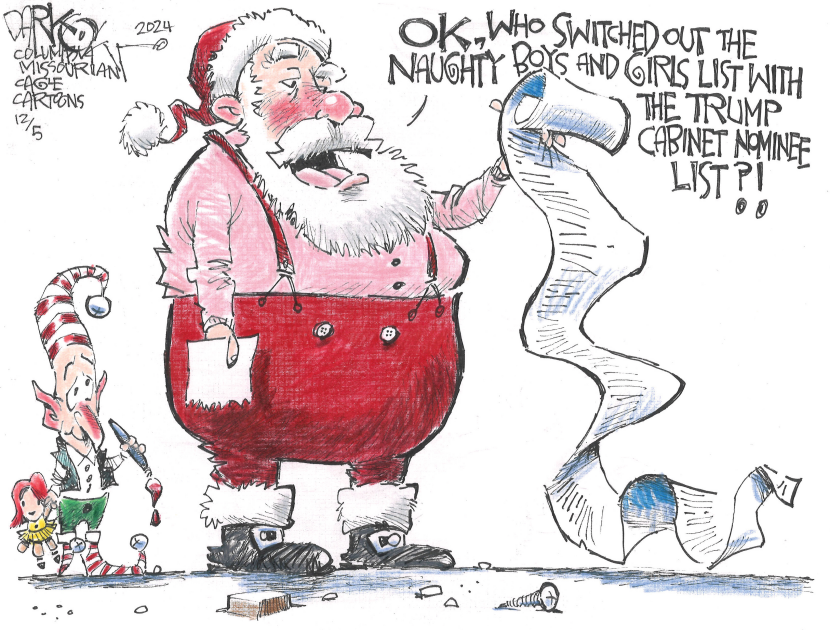
As of this writing, Trump has nominated just one Black American to his 16-member Cabinet: Scott Turner for Secretary of Housing and Urban Development. He has also selected two Latino nominees: Lori Chavez-DeRemer for Secretary of Labor and Marco Rubio for Secretary of State. To be fair, if confirmed, Scott Bessent, Trump’s treasury secretary pick, would be the first openly gay person in that position. Tulsi Gabbard would be the first Asian American director of national intelligence. And Susie Wiles is the first woman to be named as White House chief of staff.

The former and returning president has selected more Cabinet contenders alleged of sexual misconduct, aiding and abetting sexual abuse and other sorts of nefarious behavior than he has Black nominees — Matt Gaetz, who ultimately withdrew as the attorney general pick; Pete Hegseth, whose nomination as defense secretary is slugging along at best; Robert F. Kennedy Jr., anti-vaccine and nanny issues candidate and Trump’s choice to lead the Department of Health and Human Services; and Linda McMahon, the education secretary nominee who is being sued for allegedly enabling the sexual exploitation of children by an employee of WWE, where she was the longtime CEO.

Go figure.

Throughout this year’s presidential campaign, several Black Republicans, among them Senator Tim Scott of South Carolina, Rep. Byron Donalds of Florida, and Ben Carson, who previously served as Housing and Urban Development secretary during Trump’s first term, stumped for Trump. Given the fact these men had such notable media visibility associated with the campaign, the question being asked by many is why aren’t either of these men or more Black people being considered for high profile positions in the administration?

In an ABC News interview, someone identified only as a “Black Southern Republican” asked, “Why is every Black person given HUD?” which they called “the literal Black job of the administration.”

No cabinet position in history has had more Black secretaries than HUD, and it’s looking like, for the second time, that will be the only cabinet position offered to a Black person by Trump.

Beatrice Pearson, in a column written for ABC News, quotes a GOP official responding to such charges: “The Republican Party has never really fallen into the category of ‘representation matters.’ Our strength comes from diversity, but that is not our bumper sticker slogan. We’re not going to nominate Black folks for the sake of nominating Black people.”

This same individual noted that Black Republicans have made strides in leadership across the country. Sen. Tim Scott will chair the National Republican Senatorial Committee, Donalds is speculated as possibly running for governor or U.S. Senate in Florida, and Winsome Sears is seeking to become the first Black female governor in the country in Virginia.

Notably, a couple of weeks after the election speaking on various news programs, Donalds downplayed the dearth of Black people chosen by Trump for his Cabinet. “What Donald Trump’s election is about is bringing competency and reality back to D.C. in the White House, making sure that the job gets done on behalf of the American people regardless of their race, regardless of their religion, regardless of their creed.”

Assuming Donalds is naïve or gullible enough to believe such a thing, this fact fails to address why Trump is under the assumption that only one Black person is suitable to be a member of his presidential cabinet. This is a question that Black Republicans and conservatives should be asking themselves.

For a party that claims discussions about racism are anti-American, Republicans love to promote Black politicians when it is beneficial to their agenda. The party treats Black Republicans like an ice cream shop or bakery promotes a flavor or dessert of the week. It shares its special China it showcases to guests for specific or special occasions. After the event has concluded, the China is promptly restored to its original location where it remains until it is desired or needed again.

Watching and observing House members during congressional proceedings, one can definitely notice the racial and gender diversity that personified the Democratic members of the house. Meanwhile, the Republican side of the House represented the racial demographics of your typical Louisiana country club. Even former Republican house speaker Kevin McCarthy has echoed the current republican party similar sentiments

Black Republicans have been relegated to a familiar status. Republicans don’t mind showcasing them at rallies and conventions in an attempt to prove their inclusiveness — or rather, the colorblindness of their party — during a presidential campaign. But once the election ends, Black Republicans are largely left staring at their phones waiting for a call that’s probably never going to come.

Perhaps, most Black conservatives do not need to answer themselves such a question. They all too likely already know the answer.

Copyright 2024 Elwood Watson, distributed by Cagle Cartoons newspaper syndicate

Elwood Watson is a professor of history, Black studies, and gender and sexuality studies at East Tennessee State University. He is also an author and public speaker.
Comments Off on Black voters supported Trump. So why is his administration so white?

Republicans have a shrinking mandate

President-elect Donald Trump is about to resume a second term as president with such a slim GOP majority in the House of Representatives that it offers the party little if any room for error.

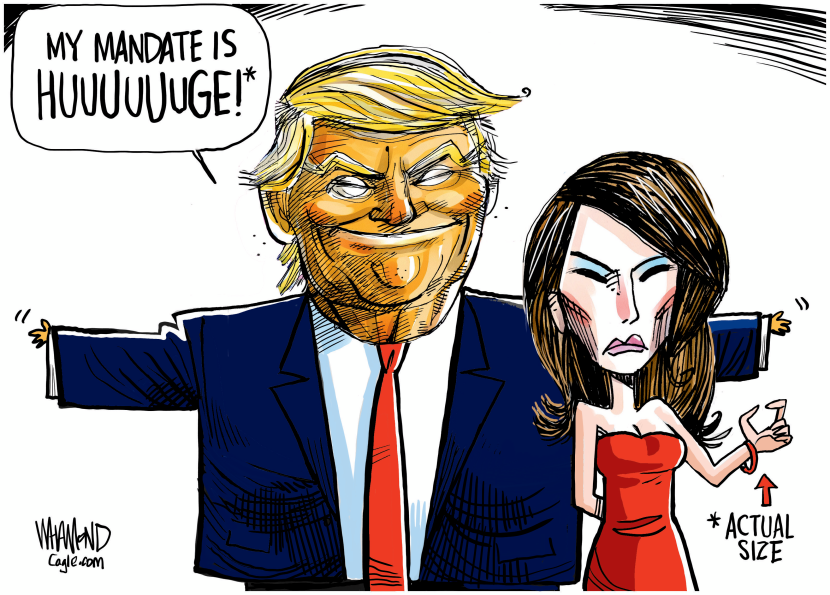
Republicans deliriously reveling about their supposed “huge election mandate” may want to keep a lid on such unabashed glee. As final results are being tabulated from California, the party appears to have the smallest House majority in more than a century.

Republican Rep. Michelle Steel lost her Orange County seat to Army vet Derek Tran, while as of this writing Rep. John Duarte narrowly trails Democratic challenger Adam Gray in his Fresno-area district.

If Duarte loses his race, Republicans would control nine of 52 House seats in California. Gerrymandering in California, New York (19–7 Democratic to GOP seats), Illinois (14–3), and Massachusetts (9–0) means four states will deliver 85 of the Democratic’s 215 seats in the next Congress.

While Republican leaders are likely breathing some small sigh of relief at remaining in the majority, the numbers are cause for alarm. Due to its ever-decreasing small majority, the GOP has been unable to ratify its own partisan bills into law, which House Democrats were powerless to stop.

Notably, come January, three prominent GOP figures are out. Rep. Matt Gaetz of Florida resigned last week and won’t return to the house; Rep. Mike Waltz of Florida vacating his seat to join Donald Trump’s White House team; and Rep. Elise Stefanik of New York is relinquishing her position to become the U.S. ambassador to the United Nations.

Once it’s all said in done, Republicans could begin the next Congress with just a one-seat majority.

In the immediate days after the 2024 election, House Speaker Mike Johnson supposedly pleaded with Trump to cease recruiting too aggressively from his House conference for administration positions given this fact.

“It’s a great problem to have. We have an embarrassment of riches in the House Republican Congress. Lots of talented people who are very attuned to the America First agenda, and they can serve the country well in other capacities. But I’ve told President Trump, enough already, give me some relief. I have to maintain this majority. And he understands that, of course, we’ve been talking about it almost hourly every day,” Johnson added.

I bet they have.

One message that many conservatives have failed to grasp is that, while the majority of voters who cast ballots did so for the Trump–Vance ticket, such support for Republicans is conditional at best. The party fared better in the Senate, gaining three seats, but they won each by narrow margins. In fact, the party lost races in Wisconsin, Michigan, and Nevada despite party operatives believing such contests to be winnable.

Now that they have complete control, Republicans have limited time to get things accomplished. If congressional history is any indication, the party is likely to lose House control in 2026, and the partisan Senate map is shaping up to be an arduous one for them. Voters tend to stay home or refrain from voting in non-presidential election years, especially when Trump isn’t on the ballot. The window for opportunity and accomplishment is radically narrow. Members’ attention turn to political survival in 2026.

Some of us ardent political junkies will avidly watch and wait to see if House Republicans work together or remain a fragmented group of political factions. Yes, the menacing Matt Gaetz will no longer be a factor, but other right-wing carnival barkers are still present to wreak political havoc and point fingers.

Can Donald Trump and Speaker Johnson keep their subjects in line? Time will tell, but factionalism will mean the end of a functioning majority, a pyrrhic victory at best and guaranteed defeat in 2026.

Copyright 2024 Elwood Watson, distributed by Cagle Cartoons newspaper syndicate

Elwood Watson is a professor of history, Black studies, and gender and sexuality studies at East Tennessee State University. He is also an author and public speaker.

Comments Off on Republicans have a shrinking mandate

Landslide? Trump’s ultimate goal is minority rule.

Donald Trump kept telling us he’d be a threat to democracy if re-elected president. Now he’s showing us.

Several months ago on his Truth Social website, Trump threatened to “expel” and “cast out” government workers who oppose his radical views, describing them as a “sick political class” that hates the country. The 2024 election, he wrote, “is our final battle.”

He is wasting no time acting on his promise.

Trump, who has endured his own accusations of sexual harassment and election interference, appears to have no qualms concerning the backgrounds of his Cabinet selections and has not indicated any intention to reconsider his current picks, apart from Matt Gaetz dropping out. Trump has dug in his heels and remained steadfast in his decisions as is his modus operandi providing his candidates unambiguous support, praising them as the sort of individuals who will implement the radical sort of change he desires.

The allegations against some of Trump’s picks makes the real consequences of past failed political nominees seem quaint.

Douglas H. Ginsburg, a Harvard law professor, had to withdraw his name from consideration as President Ronald Reagan’s nominee for the Supreme Court in 1987 once it was revealed he had used marijuana as a college student during the 1960s and sporadically throughout the 1970s as a faculty member at Harvard Law School.

A few years later, the first two attorney general nominees of President Bill Clinton, Zoe Baird and Kimba Wood, were disqualified from consideration due to their employing of undocumented immigrants.

More than a quarter of a century later, former South Dakota Democratic Sen. Tom Daschle, who President Barack Obama nominated in 2008 to be health secretary, withdrew his himself from consideration once it was discovered he never paid income taxes on the use of a car he used while being employed by a financial consulting firm. More recently, in another high-profile incident, in 2021, Neera Tanden, President Biden’s nominee to lead the Office of Management and Budget, withdrew after it was determined that she wouldn’t be able to garner the votes required due to previous social media posts critical of senators.

Compare those allegations to Pete Hegseth, an Army veteran and Fox News personality whom Trump nominated for defense secretary. Hegseth reached a settlement to avoid a lawsuit by a woman who accused him of sexual assault at a conservative conference in California in 2017.

The checkered pasts of the president elect’s nominees have elicited little outrage among one of his most loyal constituencies: white evangelicals. Trump is astute at the fact that these communities, particularly the older members, harbor beliefs deeply etched in the right-wing anti-communism of the Cold War era. Differing political ideologies – communism, socialism, and Marxism – were seen as not only anti-American, but also anti-Christian. Trump’s solid support from white evangelicals reveals how much they embrace his desire to abolish democracy and reconstruct a xenophobic, white ethnostate in their own image. Anyone heard of Project 2025?

For the past several years since Trump was elected, leaders of and subscribers to this political segment of American politics have engaged in the most destructive rhetoric publicly expressed by paranoid citizens since the days of the early McCarthy era. During the height of the Black power era, even President Richard Nixon’s infamous “southern strategy” of the late 1960s and early 1970s, which was able to successfully garner the support of the region by manipulating racist whites fearful and resentful of the civil rights movement, did not seem so overtly hostile in its aims.

The fact minorities have managed to secure Supreme Court seats and live in the White House has driven a number of these “Leave it to Beaver” fans mad with paranoia. In the idolized post-World War II suburbia they pine for, non-white people were absent from the top echelons of power in the U.S.

Trump’s acidic rhetoric is seen as a license by his followers to demean and disregard others just as he does. He portrays others as existential threats, determined to destroy everything his MAGA base admires about America. It signals to his supporters that disregarding basic human restraint and destroying your perceived enemies “by any means necessary” is permissible.

While there are some conservatives who have denounced the tactics of their more extreme brethren, they seem to be isolated voices in the wilderness rather than taken seriously among Republicans as rational voices of reason.

The current Republican Party has become so rapacious in its blind thirst for power, its members seem determined to attack and nullify any movements not conducive to their dystopian agenda. We have already witnessed the party engage in this sort of undemocratic activity with voter suppression and the duplicative election laws they have enacted.

The acrimonious rhetoric of the far right betrays the undeniable truth they are terrified and aware their stronghold on the current state of affairs will erode if they are unable to manipulate the laws and future elections. Thus, they are attempting to establish a form of minority rule.

If democracy is to survive, they must be prohibited from carrying out their nefarious efforts.

Copyright 2024 Elwood Watson, distributed by Cagle Cartoons newspaper syndicate

Elwood Watson is a professor of history, Black studies, and gender and sexuality studies at East Tennessee State University. He is also an author and public speaker.

Comments Off on Landslide? Trump’s ultimate goal is minority rule.

Trump’s clown car on a collision course with Congress

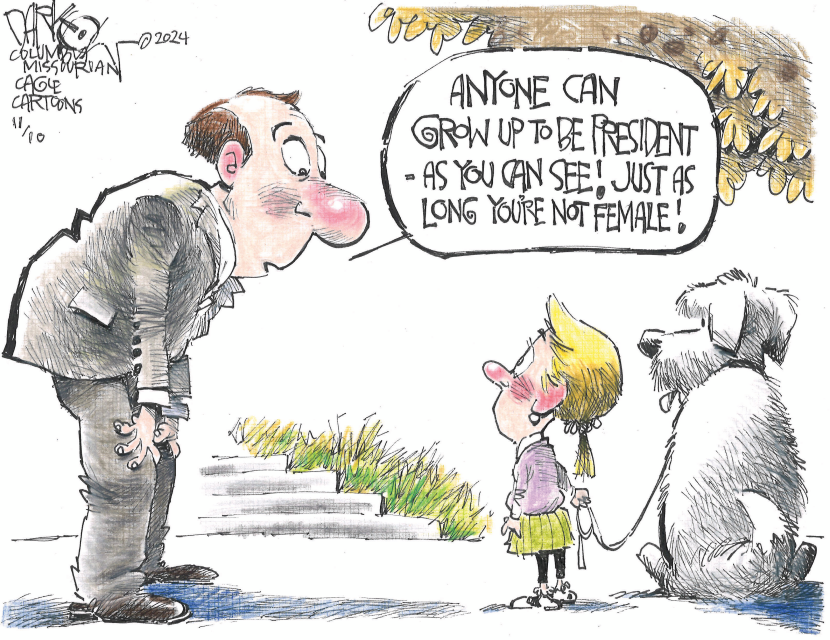
President-elect Donald Trump has hit the ground running, alerting the public to the sort of individuals he intends to appoint to his second presidential cabinet. He continues to advertise his colorful selections, rewarding his most ardent supporters, setting the tone for what his administration will attempt to accomplish, and demonstrating little if any concern for what anyone else thinks.

As I write this, Trump’s most controversial picks include former Florida Rep. Matt Gaetz to lead the Department of Justice,  former Hawaii Democratic Rep. Tulsi Gabbard to oversee the U.S. intelligence community, and anti-vaccine activist Robert F. Kennedy Jr. to lead the Department of Health and Human Services. All three lack relevant leadership experience and have been accused, respectively, of having sex with a 17-year-old, spreading deranged conspiracy theories about Syria and Ukraine, and having a literal worm eating away at their brain (actually, Kennedy said that about himself).

Then there’s Fox News personality Pete Hegseth, who doesn’t wash his hands and maybe has white nationalist symbols tattooed all over his body. Trump picked him to lead the Department of Defense.

Trump’s picks are facing an unpredictable future, even with Republicans controlling the Senate. Gaetz, a GOP far-right MAGA figure who was under investigation by the House Ethics Committee for sexual misconduct and obstruction allegations, has drawn bipartisan criticism. Hegseth, an Army combat veteran and former Fox News anchor, generated concerns after sexual assault allegations against him surfaced. Critics of Gabbard argue she doesn’t have a background in intelligence, and she has garnered criticism for her dubious perspectives on U.S. adversaries.

“These people are manifestly unqualified, and you know, they’re not prepared to run the very complicated organizations they’ve been asked to run,” Democratic Rep. Jim Himes of Connecticut said during an interview on CBS’ “Face the Nation” last week.

Some people refer to these selections as Trump engaging in trolling. Perhaps. Nonetheless, with each of these appointees Trump aims to target and disrupt the power of bureaucrats and institutions he holds in contempt and perceives as a direct threat to his power or authority. He has selected these appointees not as his advisers, but rather as his political stooges.

As both Trump and his numerous supporters have repeatedly and gleefully stated over the past few weeks, his decisive victory indicates the public has provided him with a mandate. Although such a sentiment is an overstatement, many on the political right are increasingly weaponizing it. Perhaps this is why Trump is behaving so confidently and arrogantly. He has simultaneously nominated a number of under qualified and unqualified individuals to lead the nation’s most prestigious institutions and appears to be daring the Senate majority to reject his requests.

Additionally, Trump has been urging the Senate to allow him the power to implement recess appointments — or in unison decide to adjourn to grant him the ability to install the individuals he prefers without a vote —arguing that his choices must be ratified to assume their positions as soon as possible. If such a scenario were to take place, this would result in a breathtaking show of fealty to Trump as well as a dereliction of the Senate’s constitutional duty to offer “advice and consent” on some of the most crucial presidential nominees. Like many wannabe dictators, Trump rules by fear.

Millions of the president-elect’s voters agree with him that entire layers of government bureaucrats should be fired, think regulations contribute to their own economic problems, worry about millions of border crossings by undocumented migrants, and oppose diversity programs. Trump is their agent of change. And his lightning bolt picks for top government jobs are his lieutenants in that effort.

Although there are a few conservatives who have continually denounced the tactics of the more extreme segments of their party, these individuals have been remote and futile voices in the wilderness. Whether the Senate confirms one, two, or all of these individuals remains to be seen.

Republicans and other conservatives may want to do some real soul-searching about what is happening in their party. For the moment, far-right lunatics are running the political asylum.

Copyright 2024 Elwood Watson, distributed by Cagle Cartoons newspaper syndicate

Elwood Watson is a professor of history, Black studies, and gender and sexuality studies at East Tennessee State University. He is also an author and public speaker.
Comments Off on Trump’s clown car on a collision course with Congress

Harris remains an inspiring figure, even after election loss

It’s been over a week since Election Day, and we’ve heard what pundits think cost Vice President Kamala Harris the election.  Their hit list of topics included the uneven economy, high inflation, the Israeli-Hamas conflict, rising crime, extreme and excessive wokeness, and out-of-control borders.

Yet, there is another reason that hasn’t been discussed nearly as much in most quarters – the intersection of race and gender.

Harris would have been the first woman of any race and the first South Asian person to have been elected president of the most powerful nation in the world. Instead, she lost the election, as well as the popular vote, to Donald Trump, whose coalition transcended racial and gender lines in unprecedented ways as he made notable inroads with people of color and netted a larger share of women’s votes.

The nation was provided an opportunity to allow a biracial Black woman to move us forward beyond several years of Trump’s racist, sexist, and toxic style of grievance politics with a broad agenda steeped in hope, concern, and access. America, particularly the majority of white Americans, said: “No thank you.”

From the minute she was selected as vice president, Harris found herself in the line of political fire. Several Republican members of Congress referred to her as a “DEI hire,” which is a reference to diversity, equity, and inclusion. In this instance, it was an assumption that Harris became the nominee only “because of her ethnic background,” as Republican Representative Glenn Grothman of Wisconsin dishonestly declared.

Former Trump campaign manager Kellyanne “Alternative Facts” Conway attacked Harris as lazy, commenting, “She does not speak well; she does not work hard; she doesn’t inspire anyone.” Republican Representative Harriet Hagemen of Wyoming declared, “Intellectually, [she is] just really kind of the bottom of the barrel.”

A September survey from the Associated Press/NORC Research Center showed 38 percent of voters think being a woman hurt Harris’s chances of winning, and only 13 percent of voters said being a man hurt the GOP nominee.

“We’ve come a long way in terms of making sure of equity in this country, but there’s still a lot of this bigotry in this country in terms of sexism, in terms of racism,” Democratic Rep. Maxwell Frost of Florida, who is Black, said last month. “They still exist in a lot of communities, and we still have a lot of work to do here.”

For the second time this century, Americans rejected a woman to lead the nation. If they weren’t ready to trust a woman for the job, they were even more apprehensive to trust a woman of color. It is not accidental that prior to this election, we have only had two Black women elected in the history of the U.S. Senate: Kamala Harris and Carol Mosley Braun of Illinois. A third, Laphonza Butler, was appointed by California Senator Gavin Newsom to fill the vacancy created by the death of Dianne Feinstein.

Just last week, two more Black women won their Senate races – Angela Allsbrooks of Maryland and Lisa Blunt Rochester in my home state of Delaware. That will bring the total number of Black women who have served in the U.S. Senate to five.

In every speech, Donald Trump fueled the flames of sexism and racism, calling Harris a “monster,” “low-IQ,” “mentally impaired,” and “only pretending to be Black.” The best-selling merch at Trump’s rallies was a sweatshirt with the slogan: “Say No to the Hoe.” Additionally, as a woman of color and a biracial one at that, Harris has had to deal with the two-headed dragon of “Jim Crow and Jane Crowm” a term espoused by pioneering legal scholar Pauli Murray.

At a moment’s notice, Harris had to revitalize a rapidly imploding campaign and rejuvenate a demoralized Democratic base that had fallen into despair due to Biden’s poor debate performance and sinking political standing. She remained devotedly loyal to her boss who had grown widely disliked, and who at times privately questioned her chances. She maintained the role of warrior for the administration despite a number of its members doing much to marginalize her. She rallied a party whose major leadership in midsummer discussed the possibility of bypassing her to put a white male at the top of the ticket.

During her concession speech at Howard University, her alma mater, Harris repeated much of the rhetoric she maintained on the campaign trail and called on her supporters to keep fighting. “While I concede this election, I do not concede the fight that fueled this campaign.”

While she fell short of achieving her goal and becoming the first woman to be elected president of the United States, Harris did make history by shattering the once all-male door of the office of the vice presidency and has undoubtedly inspired other women of all backgrounds to consider pursuing the opportunity to run for the most powerful political position on the planet.

Copyright 2024 Elwood Watson, distributed by Cagle Cartoons newspaper syndicate

Elwood Watson is a professor of history, Black studies, and gender and sexuality studies at East Tennessee State University. He is also an author and public speaker.
Comments Off on Harris remains an inspiring figure, even after election loss

America is heading into uncharted territory

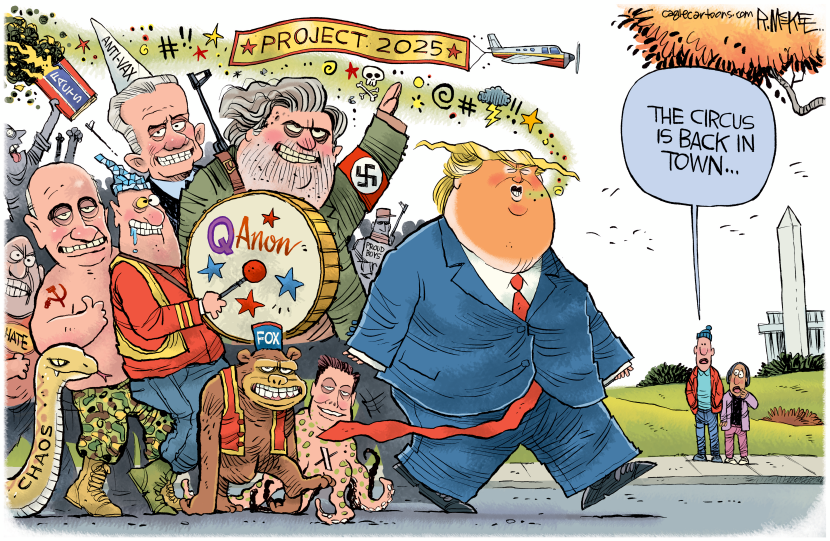
For some people, November 5, 2024, was one of the greatest days in American history. Others may well remember it as a day that will live in political infamy.

Regardless, the 2024 presidential election is over, and Donald Trump has been reelected as the 47th president of the United States. And if people are honest with themselves, they would probably admit that Tuesday’s results shocked but did not totally surprise them.

Throughout various periods in our nation’s history, charismatic politicians espousing a populist message have sporadically emerged onto the political scene, garnering the support of those citizens who felt disenfranchised or ignored. Both Trump (and Vermont Senator Bernie Sanders in 2016) successfully tapped into the intense populist tsunamis that were raging throughout the nation. Both men fervently discussed economic marginalization, outsourcing of jobs, Wall Street (Trump has made a U-turn on this issue), unchecked globalization, neoliberalism, and other factors they saw as contributors to many working-class people’s demise.

The major difference is Trump has brazenly tinged his message with a blatant and dangerously high level of jingoism and nationalism.

Another undeniable factor was the double standards that segments of the media applied to both campaigns. The passive-aggressive approach to which Harris was subjected to was disingenuous and annoying. While Trump routinely went off the rails and little if anything was said, every comment made by Harris was meticulously critiqued and dissected.

CNN commentator Van Jones stated it most accurately when he declared while Trump “is allowed to be lawless, she has to be flawless.”

W.E.B. Du Bois accurately stated in his classic book “The Souls of Black Folk” that race would be the definitive issue of the twentieth century. His prophetic message still rings true today.

To be blunt, the Trump campaign once again engaged in a blatantly racist, sexist, divisive campaign. Remember the October 27 Madison Square Garden carnival? His advisors and surrogates employed the same nativistic playbook that has preyed upon and exploited fearful whites’ resentment toward immigration, DEI and affirmative action (despite the fact that white people, especially white women, are the biggest beneficiaries of the policy).

Then there were the double standards. Throughout the campaign for president, some voters insisted they just did not know enough about Harris. Several political pundits argued she was light on specifics, while journalists bemoaned she did not engage in long interviews and avoided answering tough questions. Her opponents cast her as an “empty suit,” a lightweight with dangerous ideas.

In contrast, they gave Trump leeway to espouse all sorts of crude, incoherent rhetoric, which much of the mainstream media largely dismissed and ignored. They would often let him go off on tangents about various topics without challenging him to verify his statements, as they required of other candidates. It is also probably safe to say the press was largely unprepared to cover a presidential candidate who was already a professional media celebrity. He was able to manipulate much of the press core successfully. There are others. This fact itself was disturbing.

Differences and double standards aside, many American people returned this morally deficient man to power, despite behavior in the past that includes chronic sexual abuse, rampant fraud, abundant lies, multiple felonies, racism of his campaign, insults, and threats. His previously loyal vice president declined to endorse him, his top generals referred to him as a “total fascist,” and some of his closest aides and Cabinet members described in detail his unhinged character and callous indifference to the Constitution.

The nation awakened to a president-elect who ran an overtly sexist and racist campaign, who threatened to weaponize the armed forces against his political enemies, and who terrorized transgender and immigrant communities — because the American people granted him permission to do so. It is a disturbing reflection of who we are.

Race aside, we cannot totally dismiss the reality that Trump’s political coalition was totally devoid of people of color. In fact, he achieved a surprising upset victory in a heavily Black county in North Carolina and won Dearborn, Michigan’s largest Arab-majority city. He doubled his Black support in Wisconsin and won Hispanic men by ten points.

On the contrary, Harris’s efforts to bolster her appeal in the suburbs failed to materialize. She performed worse than Biden did in 2020.

As is the case with race, America is a nation with sexism deeply etched into its social fabric. Hillary Clinton was unsuccessful in her bid to become the nation’s first female president, and Harris fell far short in achieving this goal. If we are honest, more than a few women refused to cast a ballot for another woman. They can be conditioned to be misogynistic, whether conscious or otherwise. In Harris’s case, being Black and Asian were additional impediments against her. The intersection of race and gender worked against her.

The nation is entering uncharted territory. Those of us who are committed to liberation and equality for all citizens regardless of race, gender, sexual orientation, religion must remain unrelentingly committed to fighting for what we know is right.

Copyright 2024 Elwood Watson, distributed by Cagle Cartoons newspaper syndicate

Elwood Watson is a professor of history, Black studies, and gender and sexuality studies at East Tennessee State University. He is also an author and public speaker.
Comments Off on America is heading into uncharted territory

Newspapers miss the point by skipping out on presidential endorsements

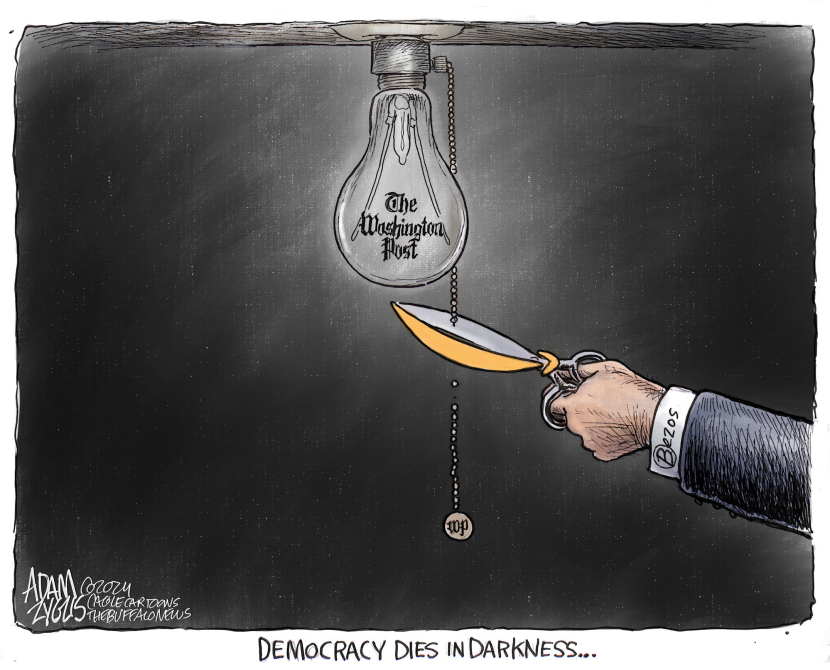
Both the Washington Post and Los Angeles Times have attracted significant attention for their decisions not to endorse a presidential candidate this election cycle.

Washington Post staffers announced they had already drafted an endorsement of Vice President Kamala Harris, and that owner Jeff Bezos halted its publication. Bezos’s sudden decision resulted in the departure of editor-at-large Robert Kagan, who made it clear he was very disturbed by Post publisher William Lewis’s announcement the publication would discontinue the practice of endorsing presidential candidates.

Bob Woodward and Carl Bernstein, the two reporters who broke the iconic Watergate scandal for the paper and brought down Richard Nixon’s presidency, referred to Bezos’s decision as “surprising and disappointing.” Former top Post editor Marty Baron chided the move as “cowardice.”

The Times’ decision led three staffers – editorial board leader Mariel Garza, Pulitzer Prize-winner Robert Greene, and columnist Karin Klein – to resign in protest of owner Patrick Soon-Shiong’s refusal to support a candidate.

Presidential endorsements tend to have limited influence. They are distinct from local or statewide endorsements for office and provide a different purpose: to emulate a specific institution’s spirit and underlying ideals. This is particularly the case regarding the upcoming election.

Donald Trump is one of the worst presidential candidates in recent history. His bone-deep dishonesty, hypocrisy, and avarice make him unsuitable for office. He has routinely demonstrated he is xenophobic, vengeful, triflingly contemptuous of democracy, and enamored of autocrats and dictators.

Trump and his supporters have described a Project 2025 agenda that would give him power to execute the most extreme of his promises and threats. He has announced he will weaponize the federal government and the Justice Department into political tools to exact revenge on his political enemies. In several instances during his presidency, he did exactly that, leaning on federal agencies and prosecutors to punish people he felt had wronged him, with scant reason to prosecute them.

Fortunately, some members of his cabinet spared the nation from having to deal with his dangerous inclinations. Learning from such experience, an even more devious Trump intends to populate his administration with men and women willing to carry out his orders unconditionally. He will have virtually unrestrained power to enact his agenda, which would likely result in irreconcilable harm to democracy.

Several prominent Republicans,  such as former Vice President Dick Cheney  and his daughter Liz Cheney, have refused to support Trump given the serious threat he poses. Gen. Mark Milley, chair of the Joint Chiefs of Staff under Trump, called his former boss a “fascist.” Again, these are charges coming from people who actually served with hm in the White House and had a front-row seat to such unrestrained antics.

Since Vice President Harris moved into the political spotlight following Joe Biden’s exit, her campaign has been a textbook in political jujitsu, deftly transforming Trump’s supposed strengths into glaring weaknesses. With a focus on joy, the vice president sharply contrasted with Trump’s grim narrative of U.S. decline. In their sole televised debate, Harris skillfully manipulated Trump, who fell into her traps, coming across as angry and disheveled. She was confident, collected, and composed, he was unrestrained.

What is most tragic for American politics is Trump has morphed the Republican Party, a party that supposedly prided itself on its staunch support for the law and constitution, into his personal dictatorial instrument as he attempts to regain power.

Former Secretary of State Hillary Clinton accused Trump of re-enacting a famous 1939 Nazi rally by holding an event in Madison Square Garden this weekend. Even by MAGA Trump standards, the event was a cesspool of racism, anti-Semitism, sexism, homophobia, and xenophobia. This is why Republicans who support Harris recognize this election is about something more basic than simple partisan interest. It is about absolute principles that extend beyond party.

Donald Trump wants to rule the nation under an autocracy. Kamala Harris wants to represent a diverse nation where everyone has access to opportunity, regardless of their race, gender, religion, or socioeconomic background. That’s why she is the only feasible choice for president.

Copyright 2024 Elwood Watson, distributed by Cagle Cartoons newspaper syndicate

Elwood Watson is a professor of history, Black studies, and gender and sexuality studies at East Tennessee State University. He is also an author and public speaker.

Comments Off on Newspapers miss the point by skipping out on presidential endorsements

What about Trump’s mental fitness?

Donald Trump’s public appearances follow a typical direction. He has a speech in mind he intends to deliver with the help of a teleprompter, but instead he resorts to rambling and discussing odd, bizarre thoughts about all sorts of topics.

To put it bluntly, the former president has increasingly spouted rhetoric that is nonsensical and incoherent.

MSNBC columnist Zeeshan Aleem convincingly stated that, “Trump has been embedded in the public consciousness as a rule-breaker for so long that it can be easy to forget how far he is from fulfilling the basic requirement of a politician to speak clearly. Trump’s speeches seem to be growing more discursive and difficult to comprehend by the day.” New York Times op-ed writer Jamelle Bouie similarly stated Trump is unable “not just to speak truthfully about a topic, but speak coherently about any topic . . . Trump hasn’t just deteriorated, he’s clearly cognitively impaired, and it is bizarre to me that this isn’t just a major story.” And as MSNBC anchor Chris Hayes commented, “It is a little weird that ‘age concerns’ have disappeared as a constant focus of campaign reporting and discussion even though the GOP nominee would be the oldest man ever sworn in to the office and is very obviously sharply declining before our eyes.”

For much of the campaign season, there was considerable spirited public conversation, fueled by rabid media interest, about whether President Joe Biden was too old and harried to perform his presidential duties. Over the past few months, discourse surrounding such concerns has all but gone silent. One could argue that now is a ripe moment to revive such conversations about the ongoing antics of President Biden’s possible successor and his returning to the White House for a second time as president.

Most of us can remember when President Biden, after responding incoherently with his replies during a debate in June with Trump, eventually ended his bid for a second term a few weeks later. Many Democratic politicians and pundits passionately raised concerns about Biden’s cognitive fitness, and the mainstream media fiercely and endlessly covered the controversy with a severe degree of ruthlessness for weeks. Numerous editorial boards urged Biden to step aside.

Meanwhile, Trump’s documented rambling, repetitive, and winding addressess have been punctuated by strange comments about his “beautiful” body, male genitalia, staged ploys at fast food restaurants and apparent obsession with the past going back before the 1980s. Trump danced to his personally curated Spotify playlist while interacting with attendees during the final 30 minutes of his town hall in Oaks, Pennsylvania.

Understandably, such comparisons have both dated him and raised more than a few psychologists and psychiatrists’ eyebrows.

The medical community’s concerns about Trump’s mental fitness are far from new. In mid-September, a coalition of physicians and mental health experts convened at the National Press Club in Washington, DC, for a conference on Trump and the specific danger they believe he represents to the nation and the world.

Just last week, more than 230 doctors, nurses, and health-care professionals, many of whom back Harris over Trump, issued a public letter calling on Trump to release his medical records — as Harris has done and Trump has promised but failed to do. These medical professionals argued that without such records, they were left to decipher Trump’s mental acuity based solely on his public appearances — and that “on that front, Trump is falling concerningly short of any standard of fitness for office and displaying alarming characteristics of declining acuity.”

Ever increasing alarming antics aside, neither the Republican Party nor much of the media have shown that same level of concern in demanding that Trump step down. As I see it, such double standards are grossly unfair and irresponsible.

Such laxity does not bode well for the nation if such a mentally unhinged individual is reelected president in November.

Copyright 2024 Elwood Watson, distributed by Cagle Cartoons newspaper syndicate

Elwood Watson is a professor of history, Black studies, and gender and sexuality studies at East Tennessee State University. He is also an author and public speaker.

Comments Off on What about Trump’s mental fitness?

Obama’s condescending message to Black men

Former President Barack Obama stirred up some attention last week when he suggested lackluster support for Kamala Harris among Black men is mostly about her gender.

“Part of it makes me think that, well, you just aren’t feeling the idea of having a woman as president, and you’re coming up with other alternatives or other reasons for that,” Obama said at Harris’ campaign offices in Pittsburgh. “You’re thinking about sitting out, or even supporting somebody who has a history of denigrating you?”

Obama likened this attitude to betrayal. “Women in our lives have been getting our backs this entire time,” he said. “When we get in trouble and the system isn’t working for us, they’re the ones out there marching and protesting.”

The larger Black community has viewed Obama as a complex spokesperson. His most recent remarks conjured up times during his tenure when, as an upscale, elite, educated (Columbia and Harvard University) Black man, he was — and still is — perceived to be condescending in his rhetoric to Black people.

Former democratic Ohio representative and CNN commentator Nina Turner chastised Obama by responding, “Why are Black men being belittled in ways that no other voting group [is]? Now, a lot of love for former President Obama, but for him to single out Black men is wrong.”

Bloomberg political columnist Nia-Malika Henderson argued that Obama needs to stop lecturing condescendingly to Black men. Democratic activist and actor Wendell Pierce declared, “Awful message,” asserting that the Democratic Party must cease scapegoating Black men. “Any Black man that has an issue with a Black woman rising, they have to look at their own inadequacy,” Pierce said. “What would make you so fearful of someone who was so beloved of you, who was so loving to you, like your mother and your grandmother and your aunts and your sisters, that you cannot be proud and embolden yourself when you see someone from your community rise up?”

There is certainly some kernel of truth in Obama’s assumption that a sizable segment of Black men are wary of a Harris presidency due to the fact that she is female. Sexism, like racism, is a perverse vice that is deeply embedded in the fabric of American society.But the reality is Black men support Harris and the Democratic Party at considerably larger rates than men of any other racial group.

Trump’s drastically limited degree of appeal to Black men is centered on whether their livelihoods are smoother when Democrats are in power and, sadly, for a segment, the answer is no. Nonetheless, Harris has the potential to be far more progressive on racial issues than  Obama was.

While speaking at Harris’ campaign office, the former president referred to such distinctions. He stated that Black men should appreciate that Harris “grew up like you, knows you, went to college with you, understands the struggles and pain and joy that comes from those experiences.” Indeed, this is the sort of rhetoric that is far more endearing and persuasive than levying paternalistic and patronizing comments toward the minute segment of Black men who are politically ambivalent toward Harris of being sexist.

The majority of Black men are adamant critics of systemic and systematic racism, concerned about ongoing police brutality, want politicians to challenge greedy businessmen, and want more attention directed to issues that include ballooning college tuition debt and stagnant wage growth.

In other words, Black men are just like voters of all genders and ethnic groups. They want to see a society  dedicated to fairness, justice, and equality for all, as opposed to a privileged, preordained few.

Copyright 2024 Elwood Watson, distributed by Cagle Cartoons newspaper syndicate

Elwood Watson is a professor of history, Black studies, and gender and sexuality studies at East Tennessee State University. He is also an author and public speaker.

Comments Off on Obama’s condescending message to Black men