Trump can’t erase Black history

According to those who were in attendance, a Black History Month reception held at the White House last week contained all the glitz, opulence and pizazz of previous celebrations. Donald Trump made an effort to demonstrate a degree of appreciation to the Black community by praising individuals he viewed as representative of Black American progress, including attendees Tiger Woods, Sage Steele, and  unsuccessful political candidate Herschel Walker.

But the dissonance in the East Room was undeniable.

Although Trump saluted the contributions of Black Americans at the event, he has spent pretty much every day since his inauguration denouncing and prohibiting federal programs aimed at challenging economic and social inequality in America. Furthermore, he suggested that actions taken by the civil rights movement over the past several decades have victimized white people. Let’s not forget he blamed a deadly plane crash over the Potomac River on diversity programs in the Federal Aviation Administration.

The event proceeded despite rumors the White House was considering cancelling all similar activities, as government agencies have been frantically shutting down such events in light of Trump’s executive orders. The president has spent the past several weeks nullifying decades of diversity efforts throughout the federal government and beyond, replacing many Black employees from the federal workforce and launching a fierce culture war on “woke” diversity, equity, and inclusion policies he disparaged as “dangerous” and “immoral” race-based programs.

Such gestures have not been immune from criticism and cynicism Detractors decried last week’s event as a blatant example of the president simultaneously lauding and discrediting Black history. “This White House celebrating Black history is like asking a cow to serve steak,” said Derrick Johnson, the president of the NAACP, the nation’s oldest and largest civil rights organizatio. “He’s holding a celebration at the same time that he’s banning the people from learning about history and civil rights.”

Only hours before the reception, Stephen Miller, Trump’s deputy White House chief of staff for policy, derided D.E.I. policies and said his move against them is among Trump’s biggest accomplishments in his first month in office. “This nation has been plagued and crippled by illegal discrimination, diversity, equity, and inclusion policies,” Miller said. “It strangled our economy. It has undermined public safety. It has made every aspect of life more difficult, more painful and less safe.”

Such a comment is foolish and outright nonsensical. The fact is Black people have a complex and vibrant history distinct from other ethnic groups because of the experiences that have been visited and inflicted upon us.

By exploring and acknowledging Black History Month, the nation is paying homage to a group of men and women leaders and inventors, as well as the traditions and triumphs of people of African heritage. Black Americans have contributed tremendously to the vitality and success of the United States — a nation where some people never intended for us to obtain full citizenship or be fully included within the panorama of American culture.

Black History Month undercuts reductive cultural stereotypes by highlighting vital facts, notable statistics and distinguished accomplishments. Although media portrayals of Black people have improved notably over the past few years, particularly in commercials, the triumphs are far too often obscured and dismissed from public discussion.

The indisputable reality is racism has always been a part of this nation. It is deeply ingrained in the fabric of our culture and is as American as apple pie. What we have witnessed over the past several years is blatant, undisguised bigotry — the type that many white people had to keep disguised and leashed since the 1950s and early 1960s — and this prejudice is now being allowed to unapologetically permeate various sectors of our society, in many cases without consequences.

We have brazen, right-wing politicians like Trump, Miller, Defense secretary Pete Hegseth and others who routinely stoke the flames of racial and cultural animosity and division. The time is ripe for a reinforcement of Black excellence to combat such racial resistance.

Since the time of this nation’s inception, Black Americans have had to wage a historically long battle, fighting to obtain rights that were supposed to be guaranteed by our constitution — rights most other groups have taken for granted. The mountains and minefields that our ancestors had to face head-on and triumph over are a testament to their impervious strength and spirit.

We are enduring similar battles today in the 21st century. Being Black in America often means dealing with history and with people who have been defined by rivers of blood, mountains of sweat, piercing pain and more than a few tears.

Black history is not some celebratory event that should be confined to one specific month of the year. The history of Black people, like other ethnic groups, is one that deserves our full and undivided attention on an ongoing and eternal basis.

Copyright 2025 Elwood Watson, distributed by Cagle Cartoons newspaper syndicate

Elwood Watson is a professor of history, Black studies, and gender and sexuality studies at East Tennessee State University. He is also an author and public speaker.

Comments Off on Trump can’t erase Black history

What the controversy over Kendrick Lamar’s performance reveals

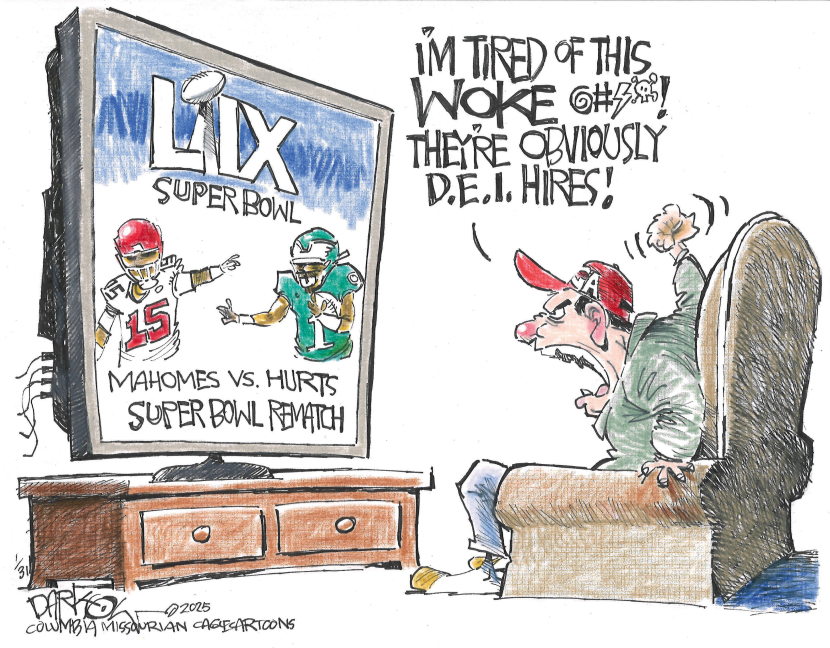
More than a week later, Kendrick Lamar’s Super Bowl halftime performance is still garnering controversy.

Lamar, a Pulitzer Prize winner, is known for his passionate storytelling, and his performance at Caesars Superdome told a story of Black Americans and their placement within the fabric of American history. It was a performance filled with political references and allusions to Black history. Given the frantic and hostile reaction from many on the right, you would have thought that the artist had performed a reenactment of Nat Turner’s Rebellion – an 1831 slave rebellion where enslaved African Americans killed between 55 and 65 white people in Southampton County, Virginia.

Lamar’s performance began with the appearance of Samuel L. Jackson. Known for his deft timing and, in particular, his penchant for spewing the f-word, Jackson donned a red, white, and blue garish outfit with a top hat to introduce Lamar at “the Great American Game.” This representation was one that offered a starkly divergent narrative of what the patriotic Uncle Sam, routinely depicted as white, looks like. Midway through the performance, Jackson accused Lamar of being “too loud, too reckless, [and] too ghetto,” depicting stereotypes often associated with Black people, hip hop music, and Black culture.

As the rapper and his all-Black dancers danced around the field, it became readily apparent that they were performing in a prison environment. The platform was structured to draw attention to the issue of mass incarceration and the gross racial disparities faced by those who are currently behind bars. Black Americans are incarcerated at considerably higher rates than white Americans, even for committing duplicative offenses.

While Lamar has never been a victim of the criminal justice system, he routinely raps about its impact on Black Americans. In 2016, he donned a prison outfit and led a chain gang of backup dancers across the stage as musicians performed in prison cells. During the performance of “Not Like Us,” Lamar rapped to his backup singers, “40 acres and mule, this is bigger than the music.” This was a direct reference to the reparations and 40 acres of land promised to Black Americans following the end of slavery by the union army. The promise was never fulfilled, and the issue is still a part of current debates related to reparations for Black Americans.

Perhaps the most critiqued aspect of Lamar’s performance his dancers were dressed in red, white, and blue. However, if the message was not clear enough, they came together during “Humble” to form an explicit image. At one point during the lineup, the dancers all bent forward, lifting their backs in the air. This was a not-so-subtle message to remind or inform viewers that the nation was built on the backs of Black Americans during slavery. Afterwards, the dancers separated, standing in two groups on either side of Lamar. The image of a divided flag spoke to stark political divisions around the nation, to which Lamar hinted at with the line, “It’s a cultural divide.”

Throughout the 13-minute performance, many people likely came to the realization that although they cannot stop the constant avalanche of despairing news, they do have some degree of control. Turning off the television or changing the channel are two options they have. The action reinforced his declaration at the beginning of his performance as he knelt on top of a Buick GNX: “The revolution ’bout to be televised. You picked the right time, but the wrong guy.”

This slogan was a direct reference to Gil Scott-Heron’s 1971 song “The Revolution Will Not Be Televised.” According to his biographer, Marcus Baram, the song was written in part to showcase “the disconnect between the consumerism celebrated on TV with the social unrest that was occurring in the nation at the time.” Lamar reversed the meaning of these famous words during his radical performance, ending with a wake-up call reminding us that we do, indeed, have control, and the controller, in our hands. We as the public have the ingredients necessary for resistance at our disposal.

Lamar’s halftime performance at the Super Bowl collectively asked, “What is America without Black people?” Indeed, the performance represented a measure of racial progress that should not be ignored. What it also indicated is that there is still work to be done on the racial front.

Copyright 2025 Elwood Watson, distributed by Cagle Cartoons newspaper syndicate

Elwood Watson is a professor of history, Black studies, and gender and sexuality studies at East Tennessee State University. He is also an author and public speaker.
Comments Off on What the controversy over Kendrick Lamar’s performance reveals

Democrats need real change to take on Trump’s Washington

Recently, Democratic leaders gathered in Washington, D.C. to select new officers for the Democratic National Committee.

With the now assembled Trump administration already trampling on the rights of American citizens, firing watchdogs, dismantling alliances and attacking the U.S. government’s commitment to equality, the stakes could not be more dire.

After Democrats lost the White House and the Senate and fell short in its bid to take the House, you’d think members would be interested in making radical changes? Instead, members promoted the committee’s vice chair and retained the majority of previous senior leadership. In other words, business as usual — not necessarily a good thing for party prospects.

The truth is Trump’s victory was a five-alarm fire for Democrats. Trump did not win his second presidential election by being cautious and tepid. He voraciously campaigned as a radical populist, promising unprecedented change to a nation of individuals who believe the current system has callously abandoned and forsaken them. In every geographic region and from coast to coast, many people throughout the nation feel short changed and are demanding leaders who will address their resentments against an economy rigged to benefit a few segments of the elite.

Trump won because he spoke directly to the frustrations people were feeling. During the campaign, he ferociously railed against trade deals that stifled manufacturing in states like Pennsylvania and vowed to target the powerful establishment manipulating the system. His promises were deceptive and insincere and populated with many code-based references intended to conjure up grievances. Nonetheless, his rhetoric struck a direct, political chord because so many Americans are economically swimming upstream and are looking for a scapegoat to blame. If we are being honest, he also pacified the rapacious emotions of bigots who fiercely embraced his racist, sexist, anti-trans, to some extent, anti-Semitic and xenophobic rhetoric.

Because of Trump’s success, there are some politicians and pundits who argue that Democrats should adopt “Republican-lite” policies and tack to the center to recapture Trump voters. Such a recommendation is ill advised. Historical evidence shows that when Democrats intentionally move toward the political center, the party is defeated. It alienates its base, fails to inspire new voters, and unwittingly provides ammunition to Republicans.

As a number of economists, scholars, and other cultural critics have routinely argued, the Democratic Party has relied on an elitist, top-down approach to messaging. It has focused on strategically crafted sound bites delivered through traditional media outlets. This approach is antiquated.

The current era calls for alternative communication strategies — those that are peer to peer, grassroots, digital, and designed for the social media age. The days of trusting politicians or pundits to effectively and convincingly convey political messages are largely gone. Voters must make a more valiant effort to educate themselves and empower themselves to be effective messengers. This also means showcasing the voices of local leaders and working-class voters who can tell real, relatable stories about how Democratic policies will make their lives better. Research shows individuals are far more inclined to trust information from a friend, coworker, neighbor, and relative than from a political ad or television pundit.

Some critics argue Democrats’ previous approach will claim the “resistance” did not work. Such an assessment is incorrect. It was such grassroots political activity that led to Democrats winning the House in 2018 and retaking the Senate and the White House in 2020. The party must learn to promote newer voices who can effectively connect with more voters, in particular, younger Americans who are immersed in new media. The nation is rapidly transforming, but too many establishment Democrats are stubbornly sticking to the status quo.

This is not to say there are no signs of hope amid what has been a less than stellar response to the second Trump presidency. The committee did select new Gen Z vice chairs, including Malcolm Kenyatta, Artie Blanco, and David Hogg. They are moving in the right direction, but Democrats must move away from their elitist, centralized messaging strategy to one that is truly grassroots and inclusive.

The base is expecting and demanding such an approach and the party must succeed in accomplishing such a goal.

Copyright 2025 Elwood Watson, distributed by Cagle Cartoons newspaper syndicate

Elwood Watson is a professor of history, Black studies, and gender and sexuality studies at East Tennessee State University. He is also an author and public speaker.
Comments Off on Democrats need real change to take on Trump’s Washington

Trump’s new slogan: Make Washington white again

First responders were still retrieving dead bodies from the icy waters of the Potomac River when President Donald Trump proclaimed to the nation his presidential predecessors, Democrats, and diversity were prime culprits in the fatal collision of an Army helicopter and an American Airlines passenger plane.

Not even less than five minutes from asking for a moment of silence to remember the victims, Trump abruptly started touting his draconian political agenda, primarily his promises to reduce the strength of the federal workforce and eradicate diversity, equity, and inclusion (DEI) programs from all agencies. The president told reporters he had seen no evidence to attribute the crash to changes in hiring standards for air traffic controllers. Rather, he commented, “It just could have been.” When asked why, he replied, “Because I have common sense.”

The Congressional Black Caucus shot back, saying mourning of the victims was “marred by a truly disgusting and disgraceful display of racist political prognostication.” Trump had moved “to falsely blame the diversity initiatives of past administrations for the cause of this incident. Not only are the president’s claims untrue, they also speak to the Republican Party’s desire to divide us as a country.” Presidential historian and Vanderbilt University professor Douglas Brinkley said, “At these moments you’re supposed to take a solemn note of respect. That’s what we do in America when tragedy occurs . . . But Trump tried to use it as an opportunity to push the MAGA 2025 agenda in a nonsensical way.”

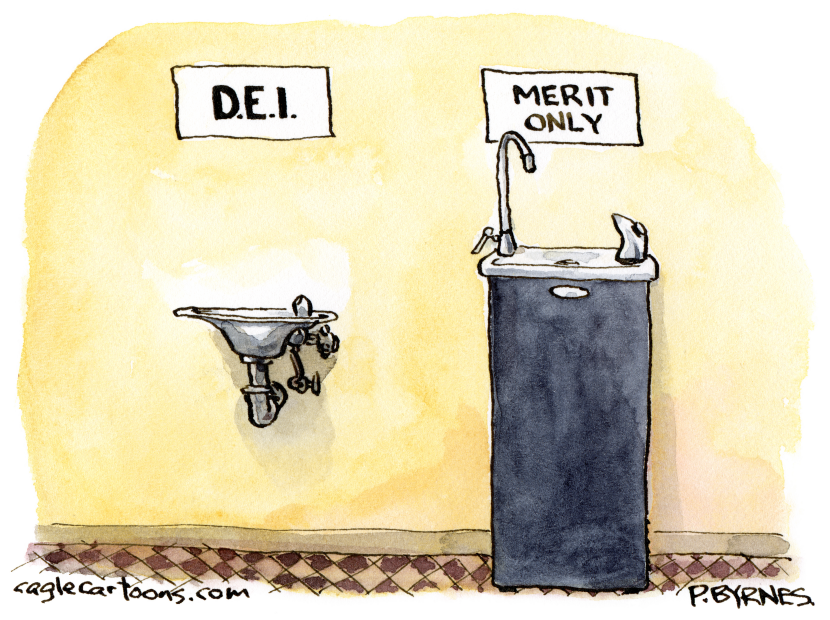
Over the past few years, influential voices on the right have talked about DEI programs in disparaging and shrouded tones, arguing they provide unfair advantages to non-white people and women (rather than serving to address the unfair advantages often enjoyed by white men). It is an issue that has found political cachet with a segment of Trump’s base, largely because it complimented the sense of grievance that has long buoyed his support.

Donald Trump does not give a damn about meritocracy. If he genuinely did so, then Pete Hegseth — a former Fox News host accused of having a history of alcohol and spousal abuse as well as professional misconduct — would not be running the Department of Defense. If he was concerned about merit, then JD Vance, one of the least experienced politicians in American history, would not be vice president of the United States. If merit-based qualifications were an utmost priority, neither Robert F. Kennedy Jr. nor Kash Patel would be a heartbeat away from serving in prominent government roles.

What does DEI mean to the president and his administration? It is the presence — in a skilled or high-status role — of anyone who is not white, male, and able-bodied, regardless of qualifications or abilities. At the same time, in the Orwellian formulation of the president and his allies, it is meritocracy to bestow the highest public trust on men like Hegseth, who have, if nothing else, the right look.

The wanton MAGA right-wing attacks on DEI are intended to grant political license to all employers to no longer provide justification for hiring or admitting solely white men from one’s social circle, fraternity, congregation, country club, or social class. If someone falls into the “correct” category, employers can effectively tell the hiring agent, “He is okay. He is one of our kind of people.”

This is textbook racial discrimination, the type that was supposed to be nullified with the passage of the Civil Rights Act of 1964. On the contrary, what the administration appears to desire is the stratification of resources and human dignity along with race, gender, and physical ability. At its core, The Trump’s anti-DEI frenzy is an effort to disappear Black people from public life altogether under the guise of protecting a white meritocracy, a fallacy that never existed. Such efforts to end DEI disturbingly resemble Woodrow Wilson’s successful effort, in his first administration, to resegregate the federal work force in 1916.

DEI is not likely to be the three-headed boogeyman that effectively extinguishes the Trump administration’s political enemies. However, we all know that Trump is like a horse wearing blinders. Once he seems to make up his mind to pursue an agenda, he will not be deterred from it. This may very well be the case with his perverse attacks on DEI. Such a sinister effort must be aggressively challenged.

Copyright 2025 Elwood Watson, distributed by Cagle Cartoons newspaper syndicate

Elwood Watson is a professor of history, Black studies, and gender and sexuality studies at East Tennessee State University. He is also an author and public speaker.

Comments Off on Trump’s new slogan: Make Washington white again

Trump’s pardons, scared Republican and a second Jim Crow

His second inauguration had just occurred and the speeches were barely over when Donald Trump pardoned pretty much all of the January 6 rioters. At the moment, the president continues to enact executive orders, coupled with promises to force Washington to bend to his political will.

Given the intense degree of activity and resistance, it may be difficult to decipher what is actually happening.

Hours into his second term, Trump surrendered accountability under an avalanche of pardons for some 1,500 of his most loyal supporters who attempted to nullify the 2020 election. They were self-appointed members of Trump’s personal resistance militia who viciously and violently assaulted police officers at the U.S. Capitol. Some of those officers lost their lives.

Such an insulting act was just one example of his obscene, no-holds-barred attack on the law. Trump’s rapid pardons have created a loyalty oath for the Republican party. While a few Republicans, including former Senate leader Mitch McConnell, have denounced the move, the vast majority have supported the president or engaged in extraordinary levels of verbal gymnastics. Two major police unions stated they were “deeply discouraged” by the pardons and commutations, even as Trump described the attacks on officers as “very minor incidents.”

Trump’s pardon blitz feels like a frightening nightmare, though the onslaught of revenge, retribution, and violence will haunt the nation much longer. One can only ponder how the children, spouses, and friends of those who testified against the January 6 insurrectionists and in defense of the Capitol Police and other officers received such dispiriting news. Indeed, they probably felt as if they were under assault once again. A president who rewards violence, disorder, thuggery, and treason is hardly an inspirational and morally responsible leader.

The decision of pardon is far from a popular one. Nearly six in 10 Americans are opposed to pardoning rioters convicted of crimes, according to a survey released last week.

The most crucial result of the pardons isn’t who has been freed from prison, but rather the symbolic meaning of Trump’s actions, namely, that radical militias are free to act with no restraints — as long as they’re loyal to Trump. Any right-wing extremist who breaks the law can take perverse solace in the reasonable possibility Trump will rescue him or her from facing any responsibility. In fact, this is one of the major reasons for engaging in political violence across various communities — a belief among perpetrators they have been granted a license to do so and will suffer no consequences. Political violence, particularly on the far right, has been increasing over the past several years. Now, after being granted pardons, right-wing extremists have little, if anything, to fear from law enforcement and no longer have any reason to reside in obscurity.

The Republican Party of 2025 is alarmingly and tragically duplicative of the Democratic Party of the 1850s: callous, arrogant, confrontational, and prone to violence. The primary issue of that era was slavery. Today, the dissension is stratified across several issues, including immigration, race, abortion, sexuality, free speech, and religious freedom.

The current Republican Party has become so rapacious, barbarous, and amoral in its blind thirst for power that it seems determined to attack and, if possible, overturn any election outcomes or social movements that are not conducive to its agenda. We have already seen the GOP engage in this sort of undemocratic activity with the voter suppression laws they have enacted in various states.

The acrimonious rhetoric of the far right betrays the undeniable truth they are terrified and aware their current political stronghold will erode if they are unable to manipulate the laws and future elections. Thus, they are attempting to establish a form of minority rule. As many left-wing activists have observed, such retrograde antics are a form of “Jim Crow 2.” In fact, there are some scholars who argue that November 5, 2024, was the end of America’s second reconstruction (1964–2024).

The present climate is filled with fear, resistance, and anxiety. Things are tense to be sure, a situation that certainly does not bode well for the immediate future. Those of us committed to equality for all Americans have our work cut out for us.

Copyright 2025 Elwood Watson, distributed by Cagle Cartoons newspaper syndicate

Elwood Watson is a professor of history, Black studies, and gender and sexuality studies at East Tennessee State University. He is also an author and public speaker.

Comments Off on Trump’s pardons, scared Republican and a second Jim Crow

What would Martin Luther King Jr. stand for today?

This month, as they have for almost forty years, millions of Americans will celebrate the legacy of Dr. Martin Luther King Jr. He was indisputably one of the most iconic historical figures of the twentieth century, dedicating his life to ensuring that the ideals of life, liberty, and the pursuit of happiness would become a reality for all those who were marginalized and deprived of full citizenship and equal rights.

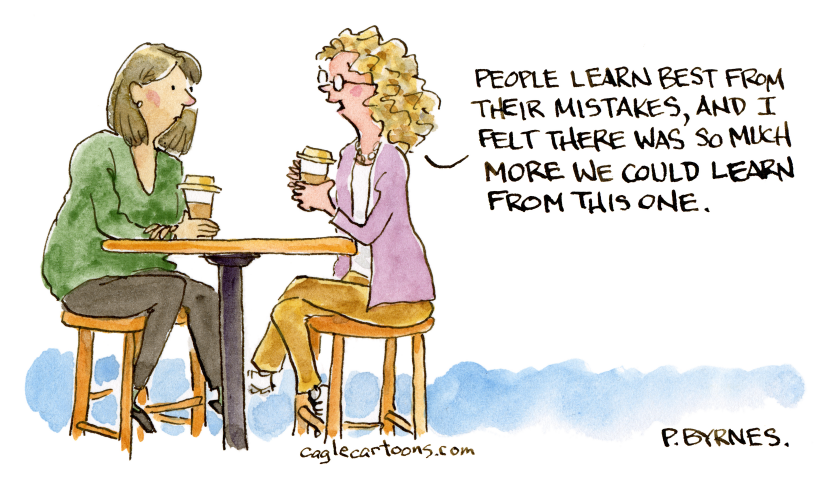
King endured scurrilous and acerbic attacks from his enemies during his all-too-brief life. Like many people, he was a complex man. He was prone to volatile anger. He could be bawdy and crude. He could be overtly sexist. At times, he suffered from envy. Other times, he could be ruthlessly competitive. One of the most common attacks among his critics was he engaged in adultery.

The truth is King did occasionally stray from his marital vows, but so did many white priests, politicians, and other high-level, well-appointed men. Franklin Roosevelt, John F. Kennedy, and Lyndon B. Johnson come to mind, as do many of the founding fathers of our nation. J. Edgar Hoover, whose own sex life during his lifetime was routinely whispered about and discussed candidly in select private circles, incessantly discussed King’s private life with friends and the media.

As a historian and scholar of the modern civil rights movement, I am acutely aware that many Black male ministers of this era were morally deceitful. More than a few felt sex was a benefit they were entitled to, and more often than not had no qualms about stepping outside of their matrimonial bounds by sleeping around. Indeed, many harbored deeply nineteenth-century Victorian attitudes toward sexuality. Preach one thing, practice another. As a mid-twentieth-century Baptist minister, King was the product of an era where the role of women, including many Black women, was matriarchal.

On the larger front, King was candid about the limits of bootstrap politics and self-determination in a society deeply entrenched with racism, division, and intense levels of marginalization. He decried the callousness of demanding economic advancement without addressing systemic and systematic inequities, arguing “It’s all right to tell a man to lift himself by his own bootstraps, but it is a cruel jest to say to a bootless man that he ought to lift himself by his own bootstraps.” His words challenged those in power to move beyond the rhetoric of bootstrap politics and rugged individualism toward challenging and confronting institutional barriers that contributed to such conditions.

Although he would be 96-years-old today, that wouldn’t stop him (health permitting) from being on the front lines with other activists, denouncing the ongoing police brutality that routinely claims the lives of many Black and Latino Americans. He’d be a vocal critic of the apparent hostility and indifference that has defined the mainstream media and a sizable segment of white America.

A staunch advocate for equality in all its forms, King would decry augmenting tuition debt, increasingly making college unattainable for many lower-income students. He would strongly advocate for voting rights and challenge those who seek to deprive certain groups of such an opportunity. He would continue to bring attention to the multitudes of individuals who were being left behind in our society.

King would have embraced globalization. During his lifetime, he emphasized in his speeches the importance of embracing people from all corners of the world. His rhetoric of equality and justice transcended borders, sparking movements for civil rights and social justice on a global scale. Despite the fact he resided in a parochial and segregated America, King recognized the importance of diversity and cultural pluralism, envisioning a world where people from diverse backgrounds could come together harmoniously. His inclusive vision promotes unity, reminding us that embracing diversity is essential for building a just and unified society.

He would have been a vociferous critic of the alarming nationalist and fascist ideology increasingly capturing the political spirit of America and the larger hemisphere. Unlike many of today’s leaders, King would not have sacrificed his people or political constituencies for his own personal gain. He would have seen that, while there has been progress, there is still considerable work to be done.

Up until his assassination, King directly dealt with all of the unrelenting adversity that came his way. His legacy, revered by many, denounced by some, and complex to others, will continue to be the subject of fierce debate long into the future. Though his role in history will not.

Copyright 2025 Elwood Watson, distributed by Cagle Cartoons newspaper syndicate

Elwood Watson is a professor of history, Black studies, and gender and sexuality studies at East Tennessee State University. He is also an author and public speaker.
Comments Off on What would Martin Luther King Jr. stand for today?

Donald Trump and the end of America’s second Reconstruction

The past few months have been an uneasy time for Black Americans, who wonder what the future will hold with Donald Trump back in the White House.

Trump won reelection, even though controversy politically marred and tarred his acidic campaign rallies, such as campaigning in a number of former sundown towns and supporting extremists’ acerbic-tinged speeches at Madison Square Garden deeply injected with racially-inflammatory rhetoric. Trump’s reelection has understandably raised considerable concern within Black communities about the status of civil rights protections.

“Trump’s rhetoric is dangerous, and his choice of venues speaks volumes,” said Dr. Benjamin F. Chavis Jr., president of the National Newspaper Publishers Association.

In a nation where white people make up 75% of voters, 60% of white men voted for Trump, while Latino men split almost evenly between both candidates. Black men voted overwhelmingly for Harris, but the 25% who voted for Trump is more than twice the percentage Trump received in 2020. The Associated Press VoteCast reported Latino support for Trump rose from 35% percent in 2020 to 43% this year, despite his incessant hounding of Latino immigrants.

In addition, 53% percent of white women voted for the former president, even after he arrogantly boasted about terminating Roe v. Wade. The LGBTQIA+ community was seemingly missing in action while Trump ran anti-trans commercials around the clock in the run-up to his victory.

In essence, the majority of Black men supported Harris, whereas men of other ethnicities broke for Trump. Such results do not resoundingly prove race and gender were decisive factors in men’s voting decisions. But they did reveal alliances we thought we had with other groups were fragile at best, fair-weather fans, as it were.

Black theologian Bishop D. Kimathi Nelson described Donald Trump’s 2024 election as the official end to America’s second Reconstruction. He argued that the first Reconstruction (1866–1877) was a period of expanding rights for Black people that lasted for a dozen years. He further argued that the second Reconstruction, which began in 1965 and ended in 2024, was another such period of expansion providing opportunities and possibilities for Black people.

Bishop Nelson’s comments are certainly worth considering. The Supreme Court’s ruling in Students for Fair Admissions v. Harvard outlawed affirmative action policies in higher education, resulting in a tidal wave of state and corporate rollbacks targeting diversity, equity, and inclusion (DEI) initiatives. In the months that followed, legislative efforts and legal challenges have rapidly accelerated the dismantling of these programs, further demonstrating that such opportunities for Black and Latino communities are being systematically erased. Corporate DEI programs are intensely being scrutinized.

That’s where Black people find ourselves now, because Trump’s agenda, as laid out in the Project 2025 political initiative, would harm us by dismantling the very federal agencies that safeguard us from discrimination at both state and local levels. The majority of Black people knew that, which is why 83% of Black voters supported Vice President Kamala Harris.

As with the end of the first Reconstruction, which brought a screeching halt to Black progress, a rollback of rights and an unprecedented rise in violence and mistreatment against Black people, this second Reconstruction might very well do the same thing. It is likely to include other non-whites as well.

Many Black Americans have learned a simple but valuable lesson from Donald Trump’s resounding political victory: sometimes you have to walk in solitude. Those who claim to be allies are often in it for their own gain. Those who state they know your pain aren’t familiar with your struggle. Those who say they understand you and what you are feeling often do not. After the disappointment of realizing your so-called friends deserted you in the struggle, the only thing left to do is look forward. Realize that you can still view what’s above you. Be aware of the reality that there’s light at the end of the tunnel to guide you through the darkness.

Goodness knows that Black America has endured adversity before, and we have always managed to survive. Our ancestors were strong and resilient. Black America has always been an integral part of the American story. Now, we must also be seen as indispensable partners in its future. We can, and must, remain as tenacious as our forebears in our determination for fairness, equality, and freedom.

Copyright 2025 Elwood Watson, distributed by Cagle Cartoons newspaper syndicate

Elwood Watson is a professor of history, Black studies, and gender and sexuality studies at East Tennessee State University. He is also an author and public speaker.
Comments Off on Donald Trump and the end of America’s second Reconstruction

Conservatives and their DEI boogeyman

While New Orleans and Las Vegas are still attempting to process the New Year’s Day violence that gripped their cities, some are trying to capitalize perversely (and unsuccessfully) on such tragedies.

Even before the dust settled, a number of conservatives rushed to social media to blame both events on diversity, equity, and inclusion (DEI) initiatives. Among them was House Majority Leader Steve Scalise who said “some of these agencies have gotten so wrapped up in the DEI movement” that they ignore security altogether.

“Call it wokeness, call [it] whatever you want, but where their main focus is on diversity and inclusion as opposed to security, and they’re two very different things, and we’ve got to get back to that core mission,” Scalise said during an interview with a New Orleans radio station last week.

It is important to note that Capitol Police officer Crystal Griner, a Black lesbian in a same-sex marriage, saved Scalise’s life after he was shot and critically injured during a congressional baseball practice in June 2017.  Does he consider the “supposedly DEI” officer who saved his life to be unqualified for her job?

Scalise’s comments reminded me of the verbal drama that engulfed former Harvard University president Claudine Gay. In January 2024, Gay, the first Black American and second woman to serve as the university’s president, resigned after months of turmoil on the prestigious campus. Many on the right celebrated Gay’s resignation as a victory in the war against DEI.

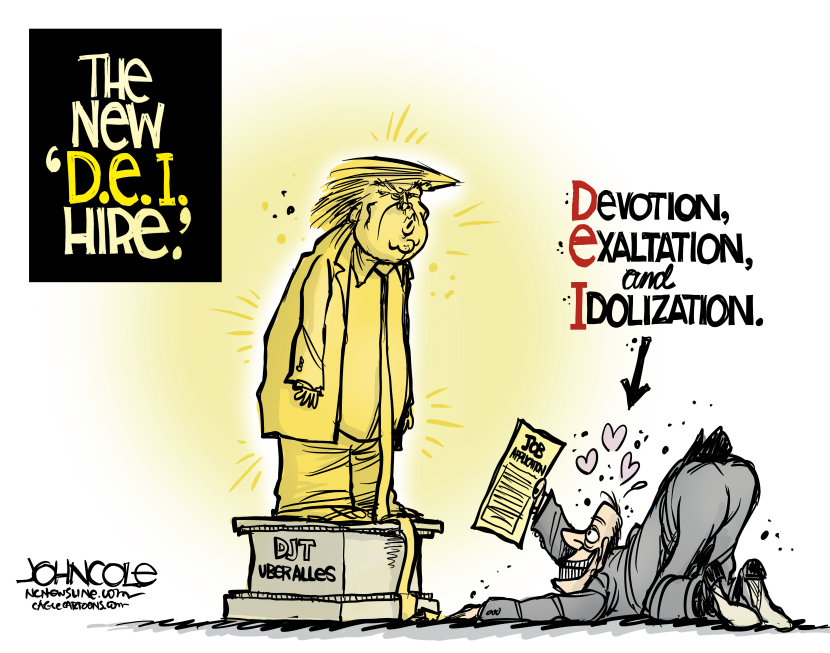
The conservative right (and more than a few neoliberals) view DEI as a sinister two-headed dragon that benefits and rewards supposedly undeserving and incompetent people — code words for non-whites and other historically marginalized groups, including Black people and women. DEI has become an all-inclusive verbal weapon to attack any non-White person or any woman in a position of authority.

We all have witnessed how Vice President Kamala Harris was perennially labeled a “DEI hire” during the presidential campaign, despite the fact she had been involved in politics for more than a quarter century. In contrast, Vice President-elect JD Vance had been in the U.S. Senate (his first public service position) for only two years before Trump tapped him as his running mate.

Far too often, critics have labeled any form of commitment to diversity as politically correct window dressing or a source of bureaucratic excess. But when diversity is done right, it can be a crucial strategy for bolstering American power. Joe Biden entered office committed to creating an administration that resembled America, and he delivered. Half of his cabinet appointments were people of color, according to Inclusive America, a nonprofit organization that puts out a government diversity scorecard. His cabinet included the first Black defense secretary (Lloyd Austin), the first female Treasury secretary (Janet Yellen), the first Native American cabinet member (Deb Haaland, interior secretary), and the first Senate-confirmed, openly gay cabinet member (Pete Buttigieg, transportation secretary). The number of individuals who were immigrants or offspring of immigrants was notable as well.

The second Trump administration will have some immigrants, along with Elon Musk (South Africa) and Sriram Krishnan, an Indian American immigrant who will serve as Donald Trump’s AI adviser. Even the person picked to run the civil rights division at the Justice Department, Harmeet Dhillon — who is expected to wage war on wokeness — is a Sikh born in India. It seems that MAGA has jumped on the diversity bandwagon.

Conservatives blamed DEI for the collapse of Silicon Valley Bank, for Boeing’s safety crisis, and for the collapse of the Baltimore Bridge. Some even blamed DEI for the assassination attempt against Trump. Even a global tech outage has been associated with attempts to diversify American institutions. Such intellectually dishonest allegations are insulting, irresponsible, and potentially dangerous in that they are far too frequently employed to weaponize and maliciously distort the benefits that pluralism can provide in an effort to enhance various organizations.

We reside in an America that remains heavily politically and racially polarized. The white grievance Donald Trump and his campaign intentionally and sinisterly agitated during his victory in 2016 and once again in 2024 have made it clear that during his second administration, they intend to dismantle programs targeted at or geared toward women, non-whites, immigrants, and those deemed “other.”

Those of us committed to fairness and equality for all citizens, not just for a select few, must ensure that such a statement fails to reach fruition.

Copyright 2025 Elwood Watson, distributed by Cagle Cartoons newspaper syndicate

Elwood Watson is a professor of history, Black studies, and gender and sexuality studies at East Tennessee State University. He is also an author and public speaker.
Comments Off on Conservatives and their DEI boogeyman

The good and the bad of Jimmy Carter

His tenure as president was punctuated with unrelenting adversity, tortured from the outset by obscenely high inflation and a post-Vietnam-and-Watergate nation that had a sour disposition. His fragmented administration was disproportionately populated by political cronies from his home state of Georgia. His micromanaging style drew widespread derision and his right of center values resulted in serious conflicts with a much more liberal and progressive congress.

In the eyes of many historical and political observers, Jimmy Carter’s one-term presidency was considered a Waterloo. He was defeated by Republican Ronald Reagan in 1980 by the largest electoral margin (489–49) any incumbent president has suffered. He oversaw a sluggish and stagnant economy, continual energy shortages, a horrendously failed effort to rescue hostages in Iran, and a Soviet invasion of Afghanistan.

Despite such challenges, his tenure as president accomplished distinctive achievements. He successfully brokered a peace between Israel and Egypt, which endures to this day almost a half a century later. He was successful in persuading the Senate to ratify a treaty ceding control of the Panama Canal, likely preventing a war from breaking out in the region. He secured a relationship with red China, resulting in several decades of abundant benefits for the larger, global economy. And he placed the issue of human rights as the core mission of his foreign policy.

Carter entered the 1976 presidential election as an obscure, one-term southern governor. His victory in the Iowa caucuses propelled him onward, ultimately winning the election on a campaign of populism, touting his experience as a small businessman and peanut farmer. His memorable promise to “never tell a lie” was widely welcome in the post-Vietnam, Watergate scandal era.

Once in office, much of Carter’s legislation was stifled and he failed to cultivate any considerable degree of support when events became acutely challenging. Murphy’s Law was in full effect for much of his presidency.

Carter amplified this weakness by embracing old political allies who were just as bereft of experience as he was. When he belatedly hired experienced veterans who knew how to navigate Washington, he appeared to abandon his own unique traits that got him elected – he struggled with how to effectively employ their political skills and acumen.

Two Cabinet-level departments — Energy and Education — were created under Carter, as was the Superfund to clean up toxic-waste sites. The Alaska National Interest Lands Conservation Act more than doubled the size of the national park and wildlife refuge system. Carter was light years ahead of most individuals on environmental issues. In June 1979, he installed 32 solar panels on the roof of the West Wing of the White House, telling reporters the point was to harness “the power of the sun to enrich our lives as we move away from our crippling dependence on foreign oil.”

As the nation’s 39th president, he had the advantage of solid Democratic majorities in both houses of Congress paradoxically within a nation that was moving increasingly to the right. Positions he took on feminism, foreign policy, race, and others alienated millions of voters from what would eventually come to be known as the religious right, led by increasingly influential televangelists such as Jerry Falwell of Virginia.

During this time, Republicans were feverishly recruiting white Southerners who were nervous, if not outright hostile, toward racial integration. Notably for his opening campaign event for president, Ronald Reagan visited the Neshoba County Fair in Mississippi and delivered a speech touting state’s rights near where three civil rights workers – Michael Schwerner, James Cheney and Andrew Goodman – had been murdered 16 years earlier in July 1964.

Many were shocked and disturbed by such racially-infested tactics. Such a callous event was just a continuation of Richard Nixon’s and the larger Republican Party “Southern strategy” to take white voters away from the Democratic Party, employing and weaponizing racial coded tactics as a sinister tool in the process.

Ted Kennedy’s decision to challenge Carter for the 1980 nomination did considerable political damage to Carter and to an already fragmented Democratic party. Kennedy’s less than professional behavior on the night Carter was nominated for a second term further ripped apart the party.

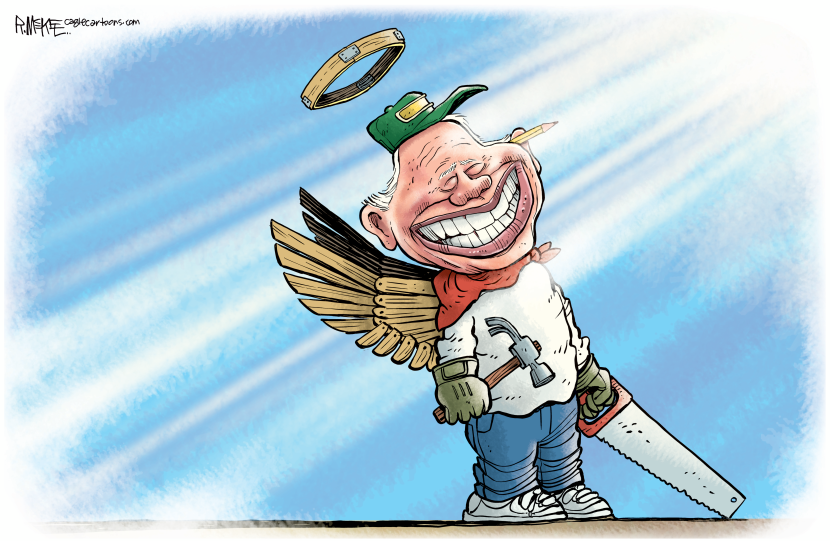
During his post-presidential years, Carter reset his life and redefined his reputation. He built houses with Habitat for Humanity. He established the Carter Center, which improved health care, raised living standards, supervised elections, and continued to speak out for human rights all across the world. He was a recipient of the Nobel Peace Prize for “his decades of untiring effort to find peaceful solutions for international conflict, to advance democracy and human rights, and to promote economic and social development.” He also authored 30 books, almost all of them bestsellers.

During his presidency, Carter was a walking shorthand for ineffectual leadership and incompetence. His post-presidential career was splendid and serves as a superb example of how an ex-president can best conduct themselves, with dignity, professionalism, a degree of humility and grace about the honor of presiding over the highest office in the land.

Copyright 2025 Elwood Watson, distributed by Cagle Cartoons newspaper syndicate

Elwood Watson is a professor of history, Black studies, and gender and sexuality studies at East Tennessee State University. He is also an author and public speaker.
Comments Off on The good and the bad of Jimmy Carter

Congress has an old problem to deal with

Brandon Granger, the son of Texas Republican Rep. Kay Granger, informed the Dallas Express his mother has been battling “some dementia issues late in the year” and had been residing in an assisted-care facility for the last half year. The most recent vote she casted on the House floor was in July, and she has been absent for more than 300 votes since that time.

While this is certainly alarming news to hear, Granger is hardly an anomaly

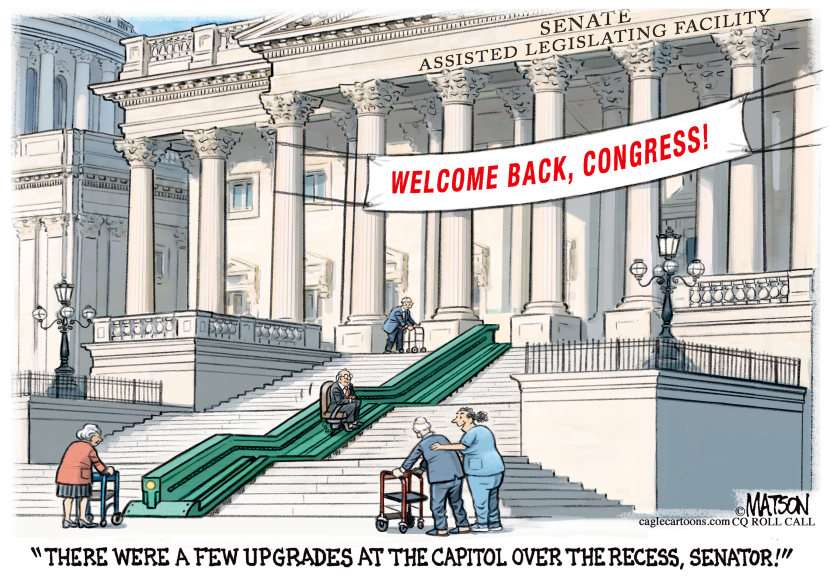
The median age of senators in the incoming 119th Congress will be 64 years old. In the House, the average age is 59. A majority of our current Supreme Court is past or approaching retirement age. Do senior officials possess the mental capacity or innovation crucial to lead the country?

Soon to be former president Joe Biden was just one example of the frailty of officials who demonstrated a decline in motor skills. The late Sen. Dianne Feinstein was a prime and depressing example of someone who should have stepped down before she was visibly impaired. Mitch McConnell, who was the victim of a few sporadic frozen public episodes, stepped down from Senate leadership but will remain in office until his term expires in 2026.

The senility situations of a sizable segment of numerous powerful and influential leaders in Washington is a quiet but growing scandal. Increasing public concern about leaders who are defiant and resist any suggestion to exit while their mental faculties are intact is amplified by a Congress that appears to be psychologically indifferent and confined to the days of yesteryear bereft of the political acumen crucial to effectively combat modern problems. Many are devoid of the ever-increasing social media platforms that are essential in effectively connecting with a younger as well as middle aged voting blocks. connecting

A number of polls earlier this year showed public unease about the ages of Biden and 78-year-old Donald Trump. Polls show upwards of 70% of Americans support the idea of implementing an age limit on candidates for president and for Congress, and a mandatory retirement age for Supreme Court justices,  potential legal challenges notwithstanding.

In the early 1990s, certain activists employed such an initiative process to ratify passage of term limits on Congress in more than 20 states, without a single loss. Back in 1995, the Supreme Court ruled 5–4 that states cannot arbitrarily impose such term limits. Almost three decades later, the idea remains overwhelmingly popular as ever. If you have to be a certain age to run for certain offices, which makes sense, then shouldn’t there be an age limit to prohibit persons from inhabiting certain positions?

Many high-ranking members of Congress have amassed colossal donor networks that provide them unchallengeable job protection, so they routinely recite the same fatigued filled arguments against establishing term limits. Many of them claim it would result in staff and underlings running government affairs, only that’s largely happening now! Most senators born before 1950 (and there are a disproportionate number of them) struggle with acute memory loss, cognitive decline and other health issues that often accompany most people as they get older.

It is highly obscene for our nation to let a potentially vibrant and well-received reform such as term limits for Congress be stifled by members’ refusal to relinquish power. No one is saying that “no one over 60 need apply” to run for Congress. In fact, some elderly members would be very effective in serving in advisory capacities. Nonetheless, the nuts and bolts coupled with the daily demands of an increasingly complex nation and larger world require men and women who possess the energy, vision, technological skills and physical stamina pertinent to effectively deliver such demands

Some critics of younger members, such as Alexandria Ocasio Cortez and Maxwell Frost, argue that they are “too aggressive” or should “wait for their turn” to pursue certain positions. The fact is they are members of the Millennial and Gen Z generations who are being directly affected by the current state of affairs. They are well aware of the fact that the nation is heading in a downward slope, they cannot afford to “wait” and that the “turn” that is needed is a sharp, decibel screeching U-Turn.

Copyright 2024 Elwood Watson, distributed by Cagle Cartoons newspaper syndicate

Elwood Watson is a professor of history, Black studies, and gender and sexuality studies at East Tennessee State University. He is also an author and public speaker.

Comments Off on Congress has an old problem to deal with