Philadelphia Must Be Saved, So I’m Changing Parties

Shortly after I turned 18 in December of 1979, I marched myself down to the local firehouse down the street in Llanerch, Pa. and registered as a Democrat. In those days, nothing was done online, and it was a solemn moment when I signed the application and became a full member of civic society.

About 11 months later, I cast my first vote. It was for Ronald Reagan.

Pretty much every vote thereafter was cast for Republicans, but I remained a Democrat because I assumed it was part of my DNA and heritage. Party is good for slogans and lawn signs and talking points, but candidates are the ones who matter.

Or at least, used to matter.

In 2016, after 37 years of being a Democrat, I officially changed my registration to Republican so I could vote for John Kasich in the Pennsylvania primary. I remained a registered Republican for about three years, voting for Trump and Republican senatorial and congressional candidates until I became an Independent in 2019. There was just too much vitriol from both sides, and neither side wanted to own their guilt.

But Independents, ironically, are slaves to a system that doesn’t give them voices. In Pennsylvania, the party structures are so tight that unless you belong to a particular party, you are frozen out of the primaries. The party honchos love this, the rest of us don’t, but money and influence have more pull than the righteous indignation of individual voters.

So I went online and re-registered. I am now a Democrat. Again.

I only plan to stay a Democrat for two weeks. This is not an attempt to embrace AOC, Biden, Kamala and the toxic policies of the party that is much, much more radical than the one that I abandoned five years ago. No, this is my wartime effort, my strategic move to strike a blow against a man who is doing profound damage to a city I now live in.

Larry Krasner cannot be re-elected as the District Attorney of Philadelphia. Although I still have my home in Delaware County, I spend a good bit of time at my residence in Center City and have a lot invested in salvaging Philadelphia from the maelstrom of violence, bloodshed and blindness that has engulfed her since Krasner took office four years ago.

The man’s policies can be summed up in my suggested campaign slogan: “Empty the jails, Fill up the morgues.” The city has seen the highest homicide rate since statistics were recorded. Children – Black, brown and white – are dying in record numbers. Drugs and addiction have turned the streets into shooting galleries. Victims of crime are ignored, abused, ridiculed. And the assistant district attorneys hired by Krasner, a full third of whom failed the bar the first time around, are regularly castigated and sanctioned by the judges they appear before.

This has to stop. This cannot continue. The center will not hold.

And so, I registered as a Democrat to vote against Krasner in the May 18 primary. I hope that Carlos Vega, his challenger, will win. My vote, like the votes of thousands of other Republicans who changed their registration, might not have the impact of the millions of outside donations Krasner’s campaign is receiving from radical groups across the nation. My voice might not have the same weight as the money of some stranger, six degrees separated from George Soros.

But it’s what I can do to make the party system work for me. And the feeling of unease I had clicking on “Democrat” was balanced out by the sense of power I experienced in working to prevent Krasner from completely destroying a city I love.

My first vote as a Democrat was for a great man, who inspired America to greatness.

My last vote as a Democrat will be against another man, in a completely different class, whose idea of greatness is anathema to me.

Copyright 2021 Christine Flowers. Flowers is an attorney and a columnist for the Delaware County Daily Times, and can be reached at [email protected].

Comments Off on Philadelphia Must Be Saved, So I’m Changing Parties

Charging Hate Crimes is a Slippery Slope

I have renewed respect for Keith Ellison. The former congressman and current Attorney General of Minnesota appeared on “60 Minutes” last week and said that he didn’t charge Derek Chauvin with a hate crime because “we only charge those crimes that we had evidence that we could put in front of a jury to prove.”

In other words, they didn’t find the requisite hate.

Ellison did something I would not have expected him to do, given his past comments and actions. He honored the law, honored its limits, honored our need for due process in the face of emotion and outrage.

In short, he was the adult in the room.

Some years ago on a radio program I was hosting, I suggested that hate crimes were at the summit of a slippery slope, because they forced you to get into the minds of perpetrators and try to figure out what was the motivation.

It’s true that we do that all the time with run-of-the-mill criminal charges like assault, but that usually only requires a general sort of intent. When you start layering prejudice, bias, hatred, and bigotry over it, you stop being a neutral arbiter and you start allowing your own biases to, in a sense, rewrite the law. Or to put it another way, you start seeing justice through a specific lens, one that might distort the actual view. And that’s when you start slipping down the slope.

More important, you teach people that some victims are more worthy of justice than others. If you have been killed by someone who wanted your money, you are just as dead as someone who targeted you because you were gay.

If you were raped, you are just as devastated and torn if your rapist was a stranger at a party than if he was a misogynist who wanted to brutalize women.

It is true that motivation is a key factor in determining why a crime was committed, along with the likelihood of it being committed against a specific person, but to enhance a sentence because the person was a bigot on top of being a criminal places far too much power in the hands of those looking for the “bigotry.”

I say this because we have seen, these days, the ease with which people throw around the term “white supremacist.” I have seen it in emails from readers who hate my columns, on social media against people who defend traditions like mascots that offend their neighbors, in op-eds and essays from folks who think mispronouncing ethnic names is bias, and I have heard it from the mouths of public officials who brand whole swaths of their constituencies with the racist label.

If it is this easy to use words that have lost all relevant meaning when they are regurgitated every time someone wants to make a political point, imagine how easy it will be for some prosecutor to use those suspicions of bias to impugn a criminal defendant.

That opens up a can of worms that will eat away at the decaying body of due process and our criminal justice system.

I’m not naïve enough to believe that people don’t have hate in their hearts. They do, and those pretentious little signs that pop up like crabgrass on suburban lawns aren’t necessary to corroborate that fact. We know that bigotry exists.

But to take that certainty and graft it onto our adversarial process is dangerous. You cannot take judicial notice of the fact that someone is a bigot, and that their bigotry motivated their criminal actions. You need to prove it by actual admission from the perpetrator and, if necessary, circumstantial evidence. And except in the cases of people like Dylan Rufe, who was quite clear that he wanted to kill African Americans at Mother Emmanuel, you will have a very hard time proving that and still protecting the defendant’s due process rights.

We all want to punish bad people. I, frankly, have always supported the stiffest of penalties for heinous crimes. I am an advocate of the death penalty, and nothing will sway me from that position.

But adding “hate” penalties is a dangerous thing in a society that is already primed to see “hatred” in every act that troubles them. I applaud Keith Ellison for pointing out that even in a country where the majority celebrated the conviction of Derek Chauvin, convicting him as a bigot was a step too far.

Copyright 2021 Christine Flowers. Flowers is an attorney and a columnist for the Delaware County Daily Times, and can be reached at [email protected].

Comments Off on Charging Hate Crimes is a Slippery Slope

Protest or Riot? It Depends Where You Stand.

When the Nazis wanted to march through Skokie, Ill., many of the residents were horrified. A large percentage were Jewish, and some had been interned in concentration camps. The memory of those camps was still vivid, since this was 1978, a mere three decades after World War II had ended.

I was in high school when the controversy erupted. At the time, the ACLU defended the Nazi group, which never ended up marching. But the fact that the storied civil rights organization swooped in to uphold the rights of evil men seemed to me, at the time, incredibly honorable. No one would ever call me a card-carrying member of the ACLU, but the fact that it was able to see beyond the vile character of its client to the larger principle of free speech, assembly and expression taught this high school senior a valuable lesson in civics.

The right to protest, passionately, forcefully but peacefully, is a foundational bedrock of our democracy. The ACLU understood that four decades ago, in Skokie. And it’s likely they’ll come back to defend that principle in Florida. But there’s a big difference, wrought from years of dangerous, anarchic explosions in the streets of our cities and towns.

Gov. Ron De Santis recently signed into law a set of prohibitions on “riots.” The law is designed to prevent the type of demonstrations seen over the past few years in cities like Minneapolis, Seattle, Portland, Baltimore, Ferguson and Philadelphia.

According to the “Combating Public Disorder Act,” people who engage in protests that become violent will be subject to increased criminal penalties. The bill also creates specific, new laws that prohibit mob intimidation and cyber intimidation.

It is designed to protect private citizens and law enforcement officers against violent riots. After having seen much of the country burning over the past few years in the wake of police shootings, many Americans have good reason to support De Santis even though, as was pointed out, Florida has had very few recent instances of mob violence.

But my old heroes of the ACLU have a problem with the law, using the classic “overbroad” argument. Kara Gross, legislative director of the Florida branch, stated that “The problem with this bill is that the language is so overbroad and vague … that it captures anybody who is peacefully protesting at a protest that turns violent through no fault of their own…those individuals who do not engage in any violent conduct under this bill can be arrested and charged with a third-degree felony and face up to five years in prison and loss of voting rights. The whole point of this is to instill fear in Floridians.”

The 18-year-old high school senior is now a 59-year-old attorney with three years of law school under her belt and three and a half decades of dealing with legal “word splitting.” For that reason, I’m not moved by Gross’ concerns with the law that, at its essence, puts protesters on notice that assaulting police officers, burning buildings, looting stores and attacking innocent bystanders is not constitutionally protected conduct.

If you are a peaceful protester, you will not find yourself involved with rioters. If you do see violence breaking out at the “Kumbaya” march you’ve organized, you either get out of there as quickly as possible, try and quell the violence, or call the police. Better yet, you make sure that the violent elements will be neutralized before they even have a chance to infiltrate your “peaceful protest.”

I’m also not persuaded that these individuals referenced by Gross as “peacefully protesting at a protest that turns violent through no fault of their own” are entirely innocent. I said that same thing when I saw the “peaceful protesters” at the Capitol on Jan. 6. While the vast majority may indeed have gone to D.C. to air their grievances, the ones who got caught up in the violent assault on our Capitol can’t hide behind the “I am innocent” mantra unless they can prove that they were, in fact, innocent.

What’s good for the goose is good for the gander, or rather, what’s good for the elephant is good for the donkey.

My point is that riots are easily distinguishable from protests, and there is a clear, bright line we can follow. The Florida law draws it, and the protests from my youthful heroes at the ACLU ring hollow.

In these moments when people like Maxine Waters are literally urging people to go into the streets and “confront” their opponents, and when we have those who condemned Donald Trump for dangerous rhetoric excusing her words, and when we have the media ginning up anger at the possibility of verdicts they don’t like, it is inevitable that peaceful protests will be nothing more than a pipe dream.

Accompanied by pipe bombs.

Copyright 2021 Christine Flowers. Flowers is an attorney and a columnist for the Delaware County Daily Times, and can be reached at [email protected].

Comments Off on Protest or Riot? It Depends Where You Stand.

Some People Shouldn’t Be in a Position of Authority

At a time when police are being attacked on all sides for brutality, racism, recklessness and all sorts of social sins and criminal acts, I hesitate to write this column.

I hesitate, not because I think that what I am about to say is wrong, but because words have been used as weapons and in the wrong hands, they misfire and they wound. I hesitate, because the very last thing I want to do is wound the good men and women of the fragile blue line.

On December 5, 2020, Caron Nazario, a second lieutenant in the U.S. Army Medical Corps, was kicked and pepper sprayed when he refused to get out of his car during what turns out to be an illegal traffic stop.

The reason we are only hearing about this now after four months is that Nazario has filed a lawsuit against the small Virginia town where the assault took place. He’s seeking damages in excess of $1 million.

The video of the incident is unassailable proof that the two police officers involved in the traffic stop, allegedly due to Nazario driving his SUV with a missing license plate, don’t deserve my support. If I were to extend the benefit of the doubt to them, I’d never again have the right to stand up for an officer who, in the course of putting his life on the line, is attacked by a raging mob.

One of the officers involved, Joe Gutierrez, has been fired. There’s still no information on what’s happening with his partner, Daniel Crocker.

Race should not be an issue, because Nazario is Afro Latino, and Gutierrez is also Latino. Race is going to be an issue, because in this climate, it’s unavoidable.

But I am a white woman who knows of white men and women who have also had problems when the police have stopped them, people who cannot be characterized by their epidermal attributes. I have witnessed some extremely unreasonable acts by those who wear the uniform, abuses in attitude and authority. None of them were justified, but none of them rose to the level of actual abuse.

Making this about race obscures a greater problem if we excuse the actions of Joe Gutierrez. And those of us who don’t believe the police should be defunded and who honor their presence in our lives and communities need to speak out.

There are people who should not be in positions of authority over the rest of us. Either because of their temperaments, their lack of self-control or empathy, their inability to calmly assess a situation or their sense of Nietzschean supremacy, they are unfit to hold the societal imprimatur that commands “obey me.”

And that’s why the people who have said to me something along the lines of “Well, if you do what the police say you won’t have a problem” just don’t get it.

That is not supporting the police. That is enabling the bad ones to do the things that the good ones find abhorrent.

That must be what it’s like to live in, say, Myanmar.

Some have said that the officers were justified in their actions because when they put their sirens on, Nazario didn’t initially stop. And I understand that argument.

But the circumstances of that “stop” turned out to be illegal, since the officers were aware that Nazario had temporary plates and still pursued him. The circumstances of that “stop” were also charged because there was no reasonable suspicion that the driver had done anything wrong, that he was weaving, that he was speeding, that he was causing a threat to other drivers. They apparently had nothing other than their subjective sense that this car was not his car.

And the worst thing about it is that the driver of that car was in the military. Here you have a man wearing the uniform of his country being treated as if he was a second-class citizen, by a brutish officer who – when told by Nazario that he was afraid of getting out of the car – was told “you should be afraid.”

“You should be afraid.” No American should ever say that to an American soldier, an Army medic. The fact that another man in uniform said it is reprehensible.

I hate that I have to write this column, at this time. But if I remain silent when this sort of thing happens, I have no right to shout out my support for the honorable warriors who police our streets competently, courageously and with humility every day, every hour, every minute. And I have no intention of ever giving up that right.

In my daily walks, I pass by the memorial plaque that commemorates the place where Daniel Faulkner was murdered by Mumia abu Jamal. I also walk by the memorials to Charles Knox, and the mural to Sgt. Robert Wilson.

I hope they’d understand why I wrote this column.

Copyright 2021 Christine Flowers. Flowers is an attorney and a columnist for the Delaware County Daily Times, and can be reached at [email protected].

Comments Off on Some People Shouldn’t Be in a Position of Authority

Philip and the Queen: A Love Story Like No Other

The first person I thought when I heard that Prince Philip had died was Elizabeth, a Queen in the greater world but only and always a wife to the man who’d been by her side for longer than I’ve been alive.

The second thing I thought that Harry and Meghan better stay in L.A. and not show their “respects” to the grieving monarch.

Well actually, I expect that Harry will come to say goodbye to a grandfather he reportedly loved very much, and who was closer to him than his own father. Meghan, though, should keep her California vibes back on this side of the pond and allow what she referred to as “the Firm” to grieve in dignity.

Of course, Elizabeth being Elizabeth, she’d never tell Meghan to stay away. She learned her lessons after the death of Diana and has been much more tolerant of wayward young women who put “self-care” over their institutional duties. It is an alien thing to the Queen, this modern narcissism where we need to do for ourselves before we can do for others. Sacrifice is Elizabeth Windsor’s middle name, a word that sounds as anachronistic to most of the younger generation as dial-up internet.

Philip’s death, which really doesn’t affect any of our lives at a visceral level, had an unexpected impact on me. He’d lived a good life, a long one, a very consequential and in some ways quite courageous one, so there wasn’t that regret that comes with tragic loss at a young age and unfulfilled expectations. The Queen’s consort was a very privileged man.

But unlike some people who fall into a privilege in unexpected and entirely unwarranted ways, he was born royal and understood the obligations that come with the advantages. He might have taken the privilege for granted, but he also accepted those obligations with the same sense of stoicism. It wasn’t a chore to support his wife at all of those public events, decades and decades of them. It was payback for the exceptional life he’d been allowed to live.

Elizabeth and Philip were married on November 20, 1947, which means that when he died on Friday, they had been together for almost 74 years. They’d already been married 14 years by the time I was born. People have lived their entire lives within the lifespan of their union. That is exceptional.

In these days of emotional brevity, when our affective interests have the life expectancy of an African Violet or a snowflake in the Sahara, the ability to cleave onto one other single person in your life is a rare example of beauty, resilience, humility and dedication. I think that the most important element in that formula is humility, because putting yourself second in any relationship (with the reciprocal understanding that you are placed first by your partner) is the key to longevity.

Ironically, I have never been married, nor have I been in a relationship that has lasted more than a few years. This could be due to many factors, but it’s probably the banal result of being born in the 1960s and coming of age in the 1970s and 1980s where “feeling happy” became something akin to a sacrament. Now, if it doesn’t “work out,” we simply leave. In abusive situations that is a necessity and an improvement over the old “Keep Calm and Carry On” philosophy, but only in abusive situations. In all others where the glass slipper no longer fits, we could take more than a few lessons from our elders on how to deal with conflict and disappointment.

My own grandparents, Mamie and Mike, were married for only 32 years, but that was because my grandfather died in 1968. His wife survived him by 17 years and never remarried. She kept the faith.

My parents, Lucy and Ted, were married for only 22 years, but that was because my father died in 1982. His wife survived him by 32 years and never remarried. She, too, kept the faith.

I feel a deep sense of loss for a woman with whom I have nothing in common, but who reminds me of what we’ve lost in a society of throwaway moments and shallow emotions. I’m sure the psychologists out there will accuse me of simplifying the complicated nature of human relationships, and I will bow to their superior expertise and their doctoral degrees.

I just know that the contrast between those who wallow in self-serving grievance, like Harry and Meghan, and those who accept the joys and sorrows of life with as much dignity as humanly possible, like Harry’s grandparents and my own, is emblematic of who we now are. And if that makes me a bitter old maid, bring on the cats.

Copyright 2021 Christine Flowers. Flowers is an attorney and a columnist for the Delaware County Daily Times, and can be reached at [email protected].

Comments Off on Philip and the Queen: A Love Story Like No Other

Georgia Voting Law is No Return to Jim Crow

I am so glad the whole white supremacy and gun nut narrative is over, so we can get back to the one about voter suppression. Those horrific shootings late last month diverted our attention away from what President Joe Biden has called “Jim Crow on steroids,” namely the recent controversial voting reform legislation passed in Georgia and signed by Gov. Brian Kemp.

Anyone who has actually read the almost 100 pages of the Georgia law would know that it is not an attempt to keep Black voters from voting. It is not akin to the KKK roadblocks that my father encountered in Mississippi in 1967. It is not anywhere near as egregious as the murder of Viola Liuzzo, a white woman assassinated by the Klan in Alabama because she was accompanying Black friends to the airport after a voting rights rally. It doesn’t come close to creating the atmosphere on the Edmund Pettus bridge, the site of the late John Lewis’ near fatal beating.

It simply doesn’t measure up to being “Jim Crow on steroids.”

I think that phrase is what angered me the most. Biden tried to play politics when he compared what Georgia did to what happened during the 1950s and 60s. The reason I felt that rage is because so many people who were born after Goodman, Chaney and Schwerner were murdered and thrown into a Philadelphia, Miss., ditch will take what the president is saying at face value.

The sort of folk who get their news in tweets and social media spasms might actually believe that forcing someone to bring their own water to stand in a voting line is a human rights violation. They have no first-hand memory of crowds mowed down by Bull Connor’s water hoses, more powerful and at least as damaging as pepper spray. They’d have to google the name “Medgar Evers” to realize that needing some form of readily available ID to cast a vote is not the same thing as getting gunned down in your driveway. They like the poetry of Amanda Gorman, their generation’s Maya Anjelou, appreciate the stylized words of woke rappers like Common, and love the music played on a loop (Rise up, Rise up!) on the saccharine promos of self-interested cable networks.

They think they are warriors because of the things they post on Tik Tok and Instagram, and the elders on the left let them think that they are part of a movement as big and as great as what came before.

And now they have a president telling them that Jim Crow is back, and better than ever. Or bigger than ever. Or whatever he needs to say to get people to love him and hate his predecessor.

The problem is when you actually read the law and its provisions, you will see that nothing in it comes close to destroying the right to vote. In some cases it makes it more inconvenient when, for example, it limits the number of drop boxes you can have, or reduces the amount of time within which to request an absentee ballot. In other cases, it actually allows the state to increase the hours polls can be kept open, a provision that has gotten very little attention by the industrial grievance complex. Early voting, and Sunday voting, is also expanded in some cases under the new legislation.

But the focus has been on the sexy parts of the law, the parts that pundits can point to and say, “See, they want to silence us!” The perennial fight over whether voters should be forced to provide ID is highlighted as being, what some critics suggested in a CNN column “disproportionately likely to burden Black voters.”

Of course, no one ever has a good explanation why that’s the case. The law provides for at least six alternative forms of identification, from Social Security numbers to driver’s licenses to utility bills. Georgia is not requiring, as far as I know, proof that someone holds a hereditary title or a DNA test.

Yes, my tongue is back in my cheek. When you really look at what Georgia did, the wailing from critics rings hollow. More importantly, and as I mentioned on social media, Joe Biden’s suggestion that this is anything like Jim Crow is akin to peeing on the graves of the murdered boys of Mississippi.

You can question why Georgia made the changes it did, and look for a sober discussion of the facts.

But the ghosts of Mississippi and Alabama, among them a fellow named Ted Flowers, will haunt your waking hours if you dare suggest that Mr. Crow is still around.

Copyright 2021 Christine Flowers. Flowers is an attorney and a columnist for the Delaware County Daily Times, and can be reached at [email protected].

Comments Off on Georgia Voting Law is No Return to Jim Crow

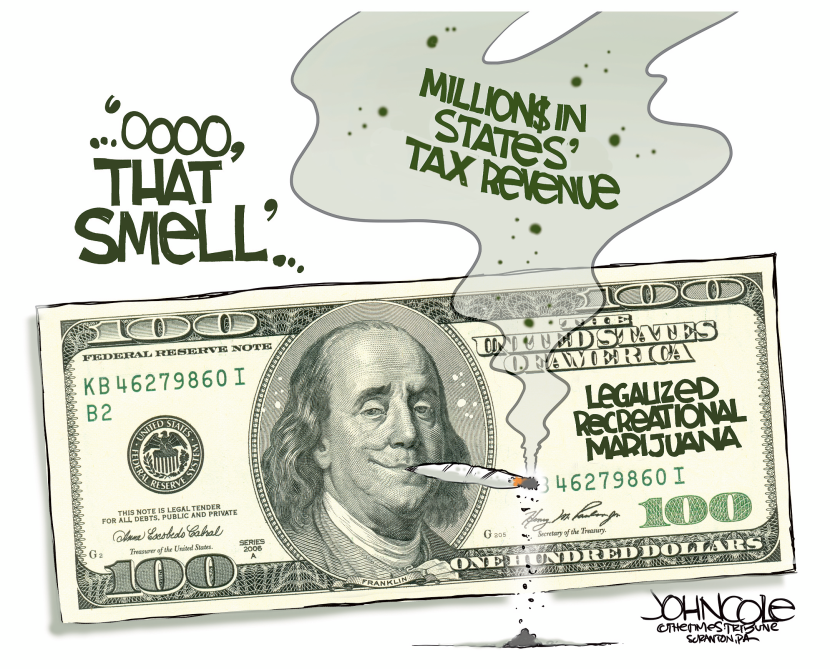
Don’t Give in to the Pot Decriminalization Culture

Tom Wolf, lame-duck governor of Pennsylvania, announced on Twitter that he wanted the commonwealth to legalize pot. His comment was hailed as timely, necessary and courageous by many of his lame-duck followers on social media.

There is a huge constituency in Pennsylvania, and nationally, for ending what some call a prohibition and others view as a common-sense limitation on recreational marijuana. It is important to note that neither Wolf nor I are referring to medical cannabis, which has helped scores of afflicted citizens find solace from their pain. That is compassionate care, and it should have been available to patients who suffer from a host of treatable diseases decades ago.

No, we’re talking about the occasional toker, the weekend smoker, the casual partaker, the people who amble through Philadelphia’s Rittenhouse Square with their doggies and their doobies enjoying a nice spring day while polluting the atmosphere with that sickening sweet stench of “happy daze.”

Obviously, I have an opinion on this. But my opinion is not based on some old “Reefer Madness” morality play where evil people smoke evil weed and do evil things to innocents. It is based on personal experience and science. There is value in keeping a legal and societal brake on marijuana, and I will present you with two reasons: Two humans I once loved.

The first human is a person I dated over a decade ago, a wonderful man of limitless intelligence who was, when I knew him, emerging from a 20-year tunnel of drug use. He’d been clean for a long time, but that drug use had deprived him of a large chunk of his youth. He had dropped out of school, worked at menial jobs that didn’t challenge the brilliance of his mind, lived in somebody’s basement, and had toxic relationships with other users. When I met him, he was back in school, healthy, working in his desired profession and cognizant of his fortune, and his close brush with the abyss.

He told me in no uncertain terms that the studies he had done proved that pot smoking had a negative biological impact on the developing brain. It had also stolen some of the best years of his life from him, and that had pot been legal when he first tried it, he would have tried it sooner. And for him, that was the gateway drug, the one that helped him feel the heady rush of the illicit, of the psychotropic, of the opiate, of the stimulant.

It scared me, to think that this wonderful person might have lost himself in the dark forest of addiction. It scared me, because someone else that I dearly loved had not found his way out of that thicket.

A close family member of mine died of suicide. It was an overdose, and so we don’t know if it was deliberate or accidental. But my relative’s introduction to drugs came through some high school friends, and came in the form of a joint. And that joint led to more, to daily use, and then to other drugs higher up on the food chain, and then to things more easily accessible, like pills, and then back to drugs that you needed to get from “someone that someone knew,” and then circling back to the “legal stuff.”

People who have no problem with legalization will discount my anecdotal stories. They might even admit that they, themselves, are fully functioning pot smokers, and will ask me, “Well, do you drink alcohol?”

I do drink alcohol. I will have a glass of wine with a huge plate of pasta, once or twice a week. I do not drink wine just to get buzzed, although I know that there are people, some I grew up with, who do just that. Clearly, alcohol can be a problem.

But that’s not the point. In the first place, acknowledging that one substance causes illness and disease, and creates social mayhem, does not mean that we should double down on that crisis by adding another “de-controlled” substance to the mix.

And again, there are reasons to drink alcohol that have nothing to do with becoming inebriated or buzzed. That is absolutely not the case with recreational pot. The only reason to smoke it is to get that heavy, honey-sweet, saccharine-sickening buzz.

We are at a place in this society where we have a huge drug crisis. We have people driving under the influence of one substance, and we seek to legalize another. We pretend that it’s about race and that the Black community has been disproportionately impacted by arrests and criminalization.

That part is likely true.

But so what? Crack down on everyone equally, don’t discriminate.

But don’t create an environment where we guarantee more problems, more DUIs, more lost decades and more family members, knelt over in pain, at the cemetery.

Copyright 2021 Christine Flowers. Flowers is an attorney and a columnist for the Delaware County Daily Times, and can be reached at [email protected].
Comments Off on Don’t Give in to the Pot Decriminalization Culture

Some Things in the Catholic Church Will Never Change

The Vatican came out last week and confirmed that it would not be “blessing” same sex unions, a move that should have surprised no one.

The church changes certain things all the time, adapting and updating as it sees fit. Beyond changes in language and style, there have been some more substantive changes, including allowing for “altar girls,” allowing lay persons to distribute communion, allowing women to participate more fully in the liturgy and delighting butchers everywhere by removing the “no meat on Fridays” prohibition.

Along the way, they also got rid of some totally respectable saints, like Christopher and-to my grandmother Philomena’s disgust, Philomena. She carried the weight of that injustice with her to the grave.

However noteworthy, none of these changes significantly altered church teaching. That’s because, for whatever else you might think of it, Catholicism does not change with the times, with cultural evolutions, or with the whims of the woke.

The sacraments are not optional rules that we can update depending upon group membership. They are fundamental, inalterable, doctrinal precepts that define the character of the church itself.

In the years that I’ve been writing about culture and politics, the confluence of Catholicism and evolution has been a frequent topic of discussion. Ironically enough, I’ve found that non-Catholics are often the ones most sympathetic to my position – namely, that the struggle between conscience and compromise is a hard one.

So when the Vatican came out and said that it would not bless same-sex unions, it shouldn’t have been a surprise, even with this kindler, gentler pope. The sacrament of matrimony is reserved for two people – one heterosexual man and one heterosexual woman. It is not designed for two gay men, or two lesbians, regardless of how devoted they are to one another.

That is why the old term “living in sin” was coined. A man and a woman living together with biblical knowledge of each other (and possibly of the Bible, too) is also condemned by the church. There is a very bright line about what sort of union gets the sacramental imprimatur.

You might say, well, okay but why can’t they “bless” the union without giving it sacramental gravitas? That’s easy. How do you approve something that violates your rules? If you have any sense of self-preservation, you don’t.

Some have taken that as yet another insult to the LGBT community. Others have gone so far as to say that the church cares more about protecting pedophile priests than it does about the feelings of devout gays and lesbians. Totally expected, totally trite.

The point is that matrimony is a sacrament that applies to a “union” of two individuals, and has very little to do with the intrinsic worth of those individuals. Bad people get married. Bad Catholics get married. Believe me, I know them.

But the institution of Catholic matrimony transcends the flaws in its human participants. The church has aspirational values, and one of them is to promote the beauty of a union open to the creation of human life.

The pope has consistently made clear that the church still embraces its gay and lesbian members, going so far as to say “Homosexual people have a right to be in a family. They’re children of God and have a right to a family. Nobody should be thrown out or be made miserable over it.”

But that is very different from saying that a union which violates church teaching should be permitted simply out of a sense that we don’t want to hurt those who violate those teachings not in their identity (which cannot be changed) but by their actions.

This isn’t about updating names, eating meat instead of fish sticks or kicking out some saints. This is about what it means to be Catholic.

For some people, that will mean saying goodbye. Those who remain, like me, have reasons that transcend the things that can be expressed in words.

Copyright 2021 Christine Flowers. Flowers is an attorney and a columnist for the Delaware County Daily Times, and can be reached at [email protected].

Comments Off on Some Things in the Catholic Church Will Never Change

Evil Comes in All Colors

The hashtag #White Supremacy is trending this week in the Twitterverse. That is due to the horrific murders of eight Asian Americans in Georgia. They were likely hate crimes, with ample evidence that the shooter of those innocent women was motivated by hostility against Asians.

Asian Americans have often been among the most vulnerable populations in the United States. Until recently, they didn’t have the lobbying groups and voices that spoke out on behalf of other minorities, and suffered from the perception that they were so successful they didn’t need protection.

Asians were basically out there, on their own, and anyone who pointed out that they were endangered by the same sort of hatred that targeted Blacks or Hispanics or members of the LGBT community were dismissed. I was dismissed many times when I made the same claim. I remember one particular instance when a Korean grocer was gunned down in his store in West Philadelphia by an African American, and when I mentioned the fact that there was a lot of hostility between the Asian and Black communities in the city, I was called a racist.

But now, it’s not racist to suggest that Asians are being targeted by “White Supremacy.” Now that everyone has a new hashtag to use, a new philosophy to exploit, a new narrative to push, we don’t have to worry about pointing fingers. The blood that was spilled in Georgia this week was apparently spilled by a man whose skin color identified the content of his character.

And we slip further back into the muck of civilization, the gravitational pull downward toward blaming hatred on skin color as opposed to ideology.

Evil comes in all sorts of packages, including the obvious ones that you can see from a mile away. The Nazi swastikas, the Stalinistic purges, the Cultural Revolution of Mao, the killing fields of Pol Pot and the jails of Fidel Castro are all forms of evil. They are clear and blatant instances where some men felt that they were better than others, and so decided to eliminate the “lesser humans” from existence and circulation. They chose domination and annihilation over reconciliation and acceptance. And the men at the head of those movements represent all the colors of the rainbow, a somewhat perverted Rainbow Coalition.

Is this an attempt to deflect attention from the fact that the murderer of these Asian victims was a white man? Absolutely not. If he targeted the ethnicity of his victims, he committed a hate crime. And if he was one of those people calling COVID the “China virus” and blaming foreigners for ruining the country and spouting off about how the people at the border are bringing leprosy and other diseases along with them, his is, in fact, a bigot.

But his skin color and race do not define him, just as the skin color of the Black robber in West Philadelphia does not set him apart from any other killer on the streets. This idea that we have to use labels to distinguish “hate crimes” from other garden-variety offenses is, in and of itself, offensive. And it gives a very easy out to the people who have “Hate Has No Home Here” signs on their lawns in eight different languages, but who are quite willing to swallow the idea that “white hatred” is unique.

It’s not. Any time you have someone targeting someone else because of their identity, that is a form of supremacy. I see it all the time in my immigration practice, and I’m really tired of hearing folks whine about how only a certain sort of human, white and conservative and religious and poorly-educated with only a few dollars in his bank account, is capable of rage.

You can disagree with me, and you can say that white supremacy is a thing, and that our country is being destroyed from within by people who wear red hats and cling to their guns and religion and you can measure the value of a human by his level of melanin, and you can perhaps feel virtuous while doing it.

But while you are doing it, you are doing a grave injustice to the people who were gunned down in Georgia, because you are using them to advance your own political and philosophical agendas.

And you are too blind to see it. Color blinded.

Copyright 2021 Christine Flowers. Flowers is an attorney and a columnist for the Delaware County Daily Times, and can be reached at [email protected].

Comments Off on Evil Comes in All Colors

The Pro-Life Case for the COVID Vaccines

I’m pretty open about my pro-life views. I want abortion criminalized, banned and recognized as an act of inhumanity. I agree with Mother Theresa that “abortion has become the greatest destroyer of peace, because it destroys two lives, the life of the child and the conscience of the mother.”

I am also a Catholic, and I am quite proud of the fact that my church is the most vocal, most unapologetically pro-life among the three great monotheistic traditions. I know that there are some Catholics who disagree with the church’s position on abortion, including our current president, but that’s their burden. They can deal with God when the time comes, and they are called to explain that moral compromise.

While we can never impose Catholic morality on secular law, we do need to follow its guidance in our personal choices. And one of those choices is whether to be vaccinated against the coronavirus.

I got my first shot this week. It was the Moderna vaccine, which gave me some relief. The reason for that relief is the main point of this column.

The Moderna and Pfizer vaccines, two of the three that have been cleared for use in the United States, were tested on cells derived from aborted babies.

Those cell lines have been cloned and reproduced, and date back to the 1970s and 1980s. Those two vaccines have some remote, generations-removed connection to elective abortions, but the vaccines themselves are so distant from the act itself that they cannot really be viewed as morally compromised. Not so with the third vaccine, produced by Johnson & Johnson, which used abortion-derived cells in the direct production of the vaccine.

This is where the dilemma arises, for those of us who call ourselves pro-life.

The U.S. Conference of Catholic Bishops has come out with guidance that essentially tells the faithful that while some of the vaccines are morally compromised, it is better to be vaccinated than not to be. Choices can be made, and in some cases people can opt to wait for the vaccine they feel has less of a connection to the evil of abortion, but ultimately the church says the evil of the pandemic outweighs the temporal evil of using the products of abortion.

The Vatican’s Congregation for the Doctrine of Faith stated last December that “it is morally acceptable to receive COVID-19 vaccines that have used cell lines from aborted fetuses in their research and production process.” That principle was echoed by the Vatican COVID-19 commission which stated that “all clinically recommended vaccinations can be used with a clear conscience.”

As if to punctuate the point, both Popes Francis and Benedict have been vaccinated.

Of course, people have differences of opinion. Many local dioceses are urging people to avoid the Johnson & Johnson vaccine if they possibly can. And many have said that they will not take the any vaccine that is connected, even remotely, to dead babies.

As I said, I got my first shot of Moderna. I know that some of my pro-life friends will be skeptical of my choice, given a vocal history of opposing anything that seems-in even the most minuscule way-to advance the “choice” agenda.

I sympathize with them much more than they suspect. That shot in my upper arm did not fill me with euphoria and relief, as many have described themselves in the moments after being vaccinated. It filled me with resignation, and a sense that I was doing something to keep my family safe. It also brought with it the sense of shame that this “safety” came at the expense of lost lives.

Those who don’t see abortion as the greatest modern evil will laugh at that feeling, I suppose. They don’t understand the horrible implications of benefiting from the death of innocents. They would probably understand it if I said “I don’t want to use any drug that was developed from Nazi-era experiments or the Tuskegee syphilis trials.” But mention abortion, and their eyes glaze over.

They’re irrelevant to me. And at the risk of justifying myself to God, I like to think that those innocent souls that were sacrificed in the 1970s and 1980s have been raised up, glorified, and sanctified by their ability to save future generations from this scourge.

I carry in me their sacrifice, and their legacy. That the church understands this as well is a singular blessing.

And a painful one.

Copyright 2021 Christine Flowers. Flowers is an attorney and a columnist for the Delaware County Daily Times, and can be reached at [email protected].

Comments Off on The Pro-Life Case for the COVID Vaccines