Subscribers Only Content
High resolution image downloads are available to subscribers only.
Not a subscriber? Try one of the following options:
OUR SERVICES VISIT CAGLE.COMFREE TRIAL
Get A Free 30 Day Trial.
No Obligation. No Automatic Rebilling. No Risk.
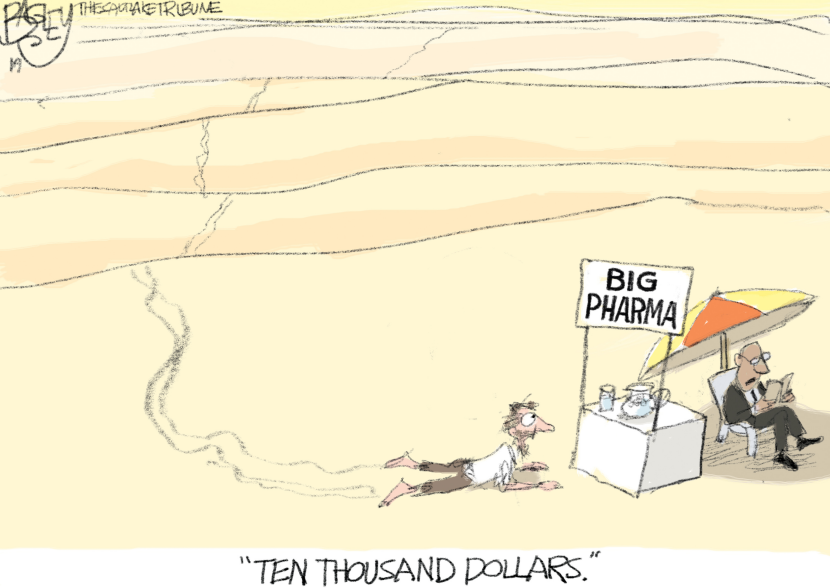
“The issue is patents,” Nobel-prize winning economist Milton Friedman explained when asked in 2004 why he opposed drug reimportation, the practice of bring back prescription drugs originally manufactured in the U.S. and exported to other countries to sale.
“The issue is a government-granted monopoly and whether that, how extensively the rights that are granted for that purpose extend,” Friedman said. “The real issue is not really reimportation. The real issue in my opinion is the Food and Drug Administration. The FDA in the United States has followed policy, which means that it costs roughly $800 million to bring a single new drug entity to the market.”
That $800 million estimate from Tufts University in 2004 has since climbed to $2.6 billion.
“And the question is where is that $800 million going to come from?” Friedman continued. “The answer we have given is that it’s going to come by giving the producer of the drug a patent, a monopoly privilege to sell that drug, to exclude others from the sale of that drug.And the question is, are you going to enforce that exclusion? The only way in which that $800 million can be raised is by charging very high prices to some people. Now, the question is given that you’re charging those high prices to some people, is it okay to charge low prices to some people? This is a standard case of a monopoly which engages in price discrimination as a way of maximizing its income. It charges high prices where the elasticity of demand is low, it charges low prices where the elasticity of demand is relatively high to the citizens of other countries.”
In other words, the company that invests the exorbitant cost of developing a new drug is incentivized by the prospect of securing a patent that will exclude anyone else from selling the drug in the United States for a period of time.As long as foreign governments set prices above marginal cost, it is in the interest of drug companies to take the additional profit on top of their main business in the U.S. market.And it is their right, as patent holders, to do so.
Friedman used a thought experiment: “Consider the following case: Suppose somebody in Canada simply counterfeits a patented drug. Does free trade require that the US accept importation of that drug? I think the answer’s no, if you’re going to enforce the patent, you have to keep out such counterfeits. Well, fundamentally and from an economic point of view, essentially when drugs that are purchased in the United States under a contract that they will be sold in Canada, or instead shipped to the United States, that’s the same thing. That’s violating the patent law.”
Moreover, the drug companies would almost certainly restrict supply into the Canadian market or cease sales entirely to prevent undermining their pricing power in the American market.Which means a loss of Canadian sales, reduced return on capital overall, and upward, not downward pressure on U.S. prices.And the excess supply in Canada available for the U.S. market would therefore – despite whatever safety protocols are in place – consist largely of counterfeits.
As legal scholar Richard Epstein put it, “reimportation is just a costly way (two shipments, not one) to avoid a price discrimination regime that is legal and proper…Banning parallel imports, alas, does not supply any remedy to the persistent problem of foreign free riding on American innovation, when foreign governments use their sovereign power to limit price freedom in their own countries.”
It’s still true.
–
Copyright 2019 Phil Kerpen, distributed by Cagle Cartoons newspaper syndicate.
Mr. Kerpen is the president of American Commitment and the author of “Democracy Denied.” Kerpen can be reached at [email protected].
