Subscribers Only Content
High resolution image downloads are available to subscribers only.
Not a subscriber? Try one of the following options:
OUR SERVICES VISIT CAGLE.COMFREE TRIAL
Get A Free 30 Day Trial.
No Obligation. No Automatic Rebilling. No Risk.
All eyes were on Steph Curry the other night as he stepped behind the arc and lofted a shot that made him the NBA’s all-time leader in 3-point baskets. But my eyes were drawn to Curry’s uniform. Had he accidentally dressed in the uni of the Philadelphia 76ers?
The Sixers wear red and blue, while the Warriors mix yellow with a bit of blue, but never, ever red. Yet here was Curry, with his number 30 in bright red, wearing what appeared to be a Philadelphia uniform.
It’s Nike’s fault. The equipment company is behind the NBA’s uniform switches, as well as color changes in the NFL and MLB. In what Nike calls its “Classic Edition” uniforms, the Warriors were supposedly honoring the fact that 60 years ago they were a Philadelphia team — a heritage that fans in both Philly and San Francisco would probably rather forget.
Is nothing sacred in sports anymore, even team colors? Imagine the shock Boston fans received last spring when the Red Sox began wearing yellow. For several games the team abandoned its traditional red, navy blue, and white color scheme for yellow jerseys with a cyan logo, white pants, cyan caps, and yellow shoes. Players looked more like Big Bird on “Sesame Street” than the fearsome denizens of Fenway Park.
Most teams now wear “alternate” uniforms for some games, which loosely translated means, “By alternating we have more stuff to sell fans.” Nike introduced new color schemes for seven MLB teams last season, dubbing it the MLB “City Connect Series,” which for many fans created a serious disconnect.
MLB began fiddling with colors back in the 1990s. Back then the Mets, who normally wore white or gray with the team’s orange and blue letters, showed up one day dressed in black. Baseball uniforms have been a hodgepodge of colors ever since. Last summer, when the Giants donned creamy orange uniforms, a writer for the Chronicle newspaper dubbed the team the Creamsicles.
The NFL also has a deal with Nike that began seven years ago with so-called Color Rush uniforms that are monochromatic. According to a report in USA Today, fans complained when the Bills and Jets played an all-red vs. all-green game, and some color blind fans said they couldn’t tell the teams apart.
In the NBA last February, both the Atlanta Hawks and Oklahoma City Thunder arrived on the court in uniforms that were entirely shades of red. After fans raised a fuss on Twitter, the Thunder changed at halftime and returned to the court dressed in white.
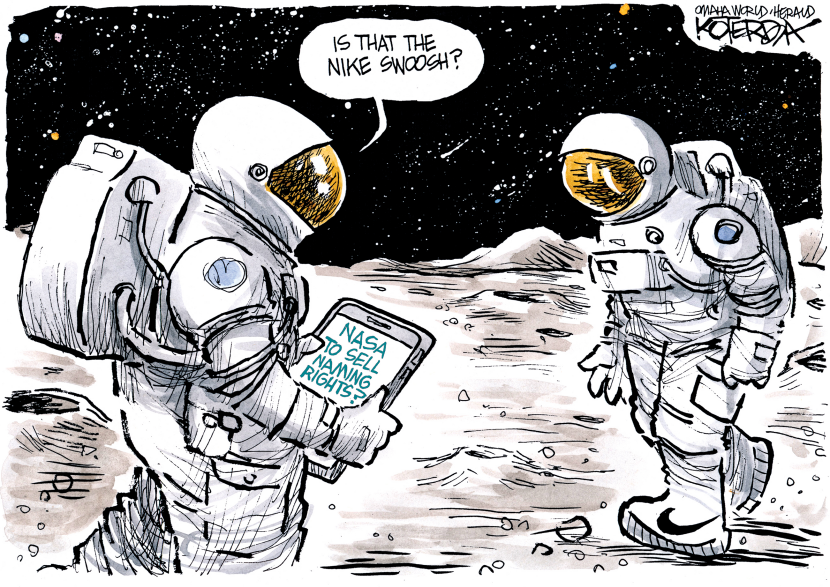
But while colors keep changing, a constant is the Nike Swoosh logo that now adorns jerseys in all three major sports. As long as lucrative equipment contracts stay in place, it’s unlikely Nike will be designing alternates for that.
–
Copyright 2021 Peter Funt distributed by Cagle Cartoons newspaper syndicate.
Peter Funt’s new memoir, “Self-Amused,” is now available at CandidCamera.com.
