Subscribers Only Content
High resolution image downloads are available to subscribers only.
Not a subscriber? Try one of the following options:
OUR SERVICES VISIT CAGLE.COMFREE TRIAL
Get A Free 30 Day Trial.
No Obligation. No Automatic Rebilling. No Risk.
AMES, Iowa – In “The Music Man” which, happily, returns to Broadway this fall, there’s a tune called “Iowa Stubborn,” written in 1957 by Mason City native Meredith Willson. It muses that folks in the Hawkeye state “could stand touchin’ noses for a week at a time and never see eye to eye.”
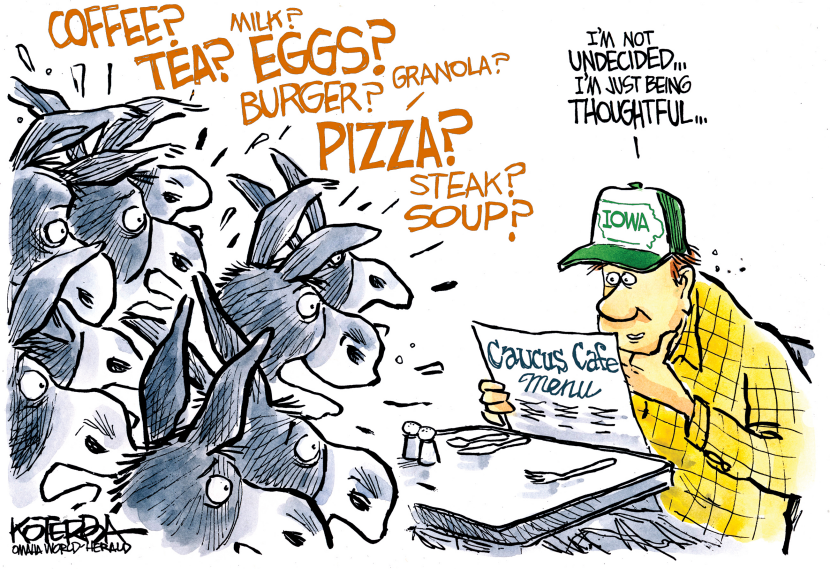
There’s a “chip on the shoulder attitude,” the song says, perfectly describing how Iowans feel about their Feb. 3 presidential caucus. It also explains why, after more than a year of unparalleled opportunity to evaluate candidates up close and personal, the outcome among Democrats remains difficult to predict.
“I’m trying to decide between (Elizabeth) Warren and Bernie (Sanders),” said Ria Keinert, a physical therapist, as she waited for a Sanders rally to begin. “I’ve seen most of the candidates; Bernie three times. But I’m still not sure who I’m caucusing for.”
According to this month’s Des Moines Register/CNN Iowa poll, 45 percent of Democrats said they could still be persuaded in the closing weeks to pick a different candidate. The latest New York Times poll similarly showed 40 percent willing to shift their support.
The last four Register surveys confirmed the volatility. Last summer, former Vice President Joe Biden held a commanding lead. In September, Massachusetts Sen. Elizabeth Warren climbed to the top. Two months later, now-former South Bend, Indiana mayor Pete Buttigieg was number one, but this month Vermont Sen. Bernie Sanders vaulted to the lead.
In Iowa’s land of retail presidential politics most voters take their responsibility seriously. It’s difficult for other Americans – especially those outside of early-voting states like Iowa, New Hampshire, Nevada and South Carolina – to fully comprehend what Iowans mean when they tell you they won’t caucus for a presidential candidate they haven’t spoken with personally. Personally! To a resident of, say, midtown Manhattan, that’s surreal.
During my visit to Iowa last summer, I wrote that the state’s mostly white and largely rural population might not make it the best place to conduct what is unquestionably the nation’s most lengthy presidential screening test. That remains true. But there’s more to it, and it becomes clear in speaking with Iowans as their big day draws near.
Colin Burczek, a clerk at the Des Moines Hilton, said he has narrowed his choice to Minnesota Sen. Amy Klobuchar and businessman Tom Steyer. Burczek has met most of the Democrats, and the metrics he and many Iowans use to pick a candidate differs from what most Americans are able to glean from cable-TV and social media.
“You get a vibe,” Burczek said. “You get to see who they are as an actual person.”
Karen Kellogg of Ames told me at the Sanders rally that she had spoken personally with Biden and was planning to see Klobuchar in the morning. “It’s a privilege to participate in the Iowa caucus,” she said, “and Iowans have a responsibility to know the candidates.”
Iowans put stock in the broadness of a smile and a the firmness of a handshake, but there’s another factor complicating things in the caucuses. A candidate must reach a 15 percent threshold in a precinct in order to be awarded any delegates to the national nominating convention. Supporters of candidates who fall short will shift to someone else on subsequent ballots, creating a form of ranked voting in which second choices are important.
On that score, my anecdotal evidence reveals something interesting about Sen. Klobuchar: She’s not often cited as a first choice, but she’s frequently mentioned as number two. Does that make her a future vice president? Time, and months more of grueling campaigning will tell.
What’s decided in Iowa is nationally significant, but it’s conducted with an unmistakably local approach – what Meredith Willson called being stubborn.
I asked Kurt Paeper, a volunteer at a Buttigieg town hall in Fort Dodge, about that. “I don’t think we’re all stubborn,” he said, sounding rather stubborn about it. “I just know we’re fortunate to be able to look these candidates in the eye.”
–
A list of Peter Funt’s upcoming live appearances is available at www.CandidCamera.com.
Peter Funt is a writer and speaker. His book, “Cautiously Optimistic,” is available at Amazon.com and CandidCamera.com. © 2020 Peter Funt. Columns distributed exclusively by Cagle Cartoons, Inc., newspaper syndicate.
