Subscribers Only Content
High resolution image downloads are available to subscribers only.
Not a subscriber? Try one of the following options:
OUR SERVICES VISIT CAGLE.COMFREE TRIAL
Get A Free 30 Day Trial.
No Obligation. No Automatic Rebilling. No Risk.
California Gov. Gavin Newsom, father of four young children, has signed a landmark bill that should serve as a wake-up call for educators and lawmakers across the nation.
The measure addresses sleep deprivation among youngsters by forbidding high schools from starting classes before 8:30 a.m., and middle schools before 8.
Inadequate sleep among students is a serious global problem. California lawmakers responded to data from the American Academy of Pediatrics and the Centers for Disease Control showing that later start times for secondary students not only improve learning, but decrease health challenges like obesity and mental illness.
California’s first-in-the-nation legislation puts student sleep requirements alongside a growing array of issues – such as children’s vaccinations – for which settled science isn’t as persuasive for many Americans as it ought to be.
Newsom’s predecessor Jerry Brown vetoed a similar bill, calling it a “one size fits all approach.” He said school schedules were better left up to local school districts, thus dodging a matter so divisive in California that the state’s Parent Teacher Association supports the law while the Teachers Association opposes it.
Critics of the bill, which takes effect in 2022, tend to focus on non-medical concerns, such as commuting schedules for parents and disruption of after-school sports. They also cite the costs local school districts could face in adjusting teachers’ hours and modifying bus schedules.
However, “Early start times are having detrimental and adverse effects on our students’ health, stifling academic performance and putting our children in serious risks,” wrote State Sen. Anthony Portantino, the Democrat behind the bill. He added that suicides and car accidents are reduced when school start times are shifted later.
When I interviewed a nationally renowned expert on sleep, Dr. James Maas, at his home in Fort Worth, Texas, he explained that for full alertness a high school student requires 9.25 hours of sleep a night. Anything less has immediate and easily measurable consequences. Maas and colleagues at Cornell University found a significant correlation between total amount of sleep and academic performance.
At Harvard University, Dr. Charles Czeisler has outlined how the teenage brain is biologically wired to fall asleep between 2 and 3 a.m., and to awaken sometime after 11 a.m. This, he notes, is why 80 percent of teens are sleep deprived and why 43 percent say they feel sleepy all day.
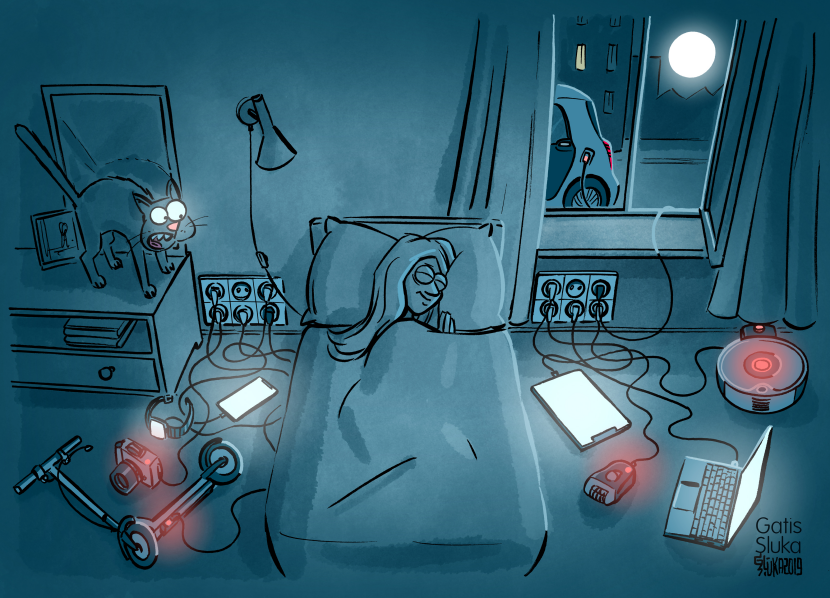
The increased use by teens of blue light-emitting screens – tablets, smartphones, TVs, etc. – compounds the problem. The light temporarily cuts down the body’s release of melatonin, the hormone that signals it’s time to sleep.
In China, a report by the nation’s Sleep Research Society warned of serious medical risks to Chinese youngsters, especially those between ages 13 and 17. Eighty-one percent of students in that group get fewer than 8 hours of sleep a day – part of a global trend over the past decade.
The American Academy of Pediatrics recommends that middle and high school students begin classes no earlier than 8:30 a.m. However, according to the most recent federal figures, published in 2014, 93 percent of U.S. high schools failed to meet that standard.
As Dr. Maas ticks off the factors relating to sleep, it’s hard to imagine why any responsible school system would insist that students report at 7 a.m. and, in a few locales, even earlier. “Alertness, concentration, memory, productivity, perception and the ability to think critically are all impacted by lack of sleep,” Maas explains.
California’s government, controlled by Democrats, is often in the vanguard of progressive legislation. Sleep deprivation might not be as well publicized as, say, climate change, or as urgent as gun control, but it’s critical to the well-being of millions of teens.
I find it baffling that some otherwise responsible adults balk at having their children vaccinated, fail to demand better protection for student athletes on the football field, or downplay the risks of sleep deprivation. What’s with them? Were they asleep during science class?
–
A list of Peter Funt’s upcoming live appearances is available at www.CandidCamera.com.
Peter Funt is a writer and speaker. His book, “Cautiously Optimistic,” is available at Amazon.com and CandidCamera.com. © 2019 Peter Funt. Columns distributed exclusively by Cagle Cartoons, Inc., newspaper syndicate.
