Subscribers Only Content
High resolution image downloads are available to subscribers only.
Not a subscriber? Try one of the following options:
OUR SERVICES PAY-PER-USE LICENSINGFREE TRIAL
Get A Free 30 Day Trial.
No Obligation. No Automatic Rebilling. No Risk.
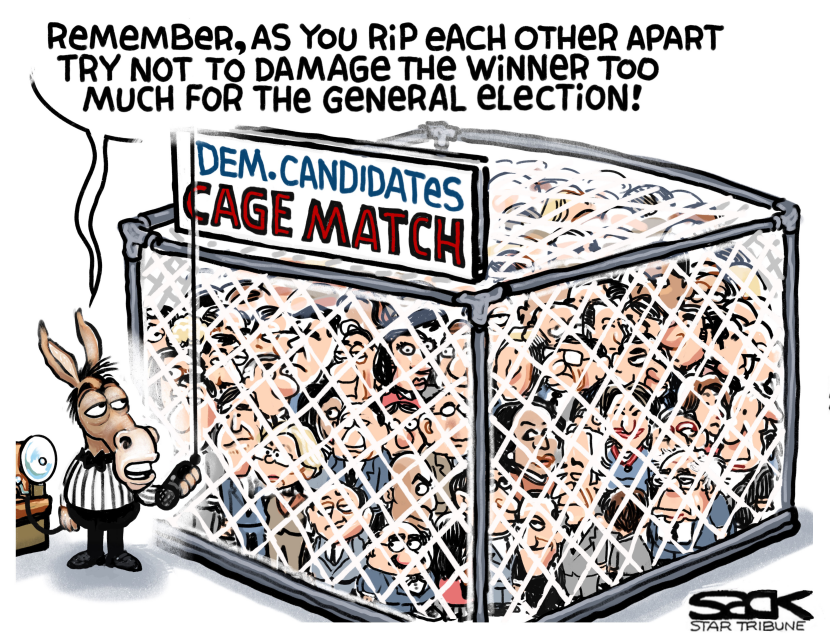
With a luxury of riches in the crowded presidential field, Democrats find themselves in a quandary: How far should they go in probing differences among the candidates without damaging their overarching goal of winning in 2020?
Some voters and party leaders are so concerned that they’re embracing phrases such as “circular firing squad” and “eating their own” to describe intraparty debate.
Speaking recently in Berlin, former President Barack Obama said he worries about “a certain kind of rigidity” among progressives. He cautioned against creating a circular firing squad in which “you start shooting at your allies because one of them is straying from purity on the issues.” The risk, he said, is that “the overall effort and movement weakens.”
Next month Democrats will begin head-to-head debates, with 17 candidates already qualified to take part under the party’s ground rules. How will they manage to stand out? And what direction will moderators from NBC News take to aid that process?
Is it reasonable to ask Elizabeth Warren about her Native American roots? Joe Biden about age? Bernie Sanders about becoming a millionaire? Amy Klobuchar about being tough with her staff? Pete Buttigieg about his sexuality?
Each of these questions has been asked numerous times on the campaign trail. Yet many people, myself among them, believe they are not appropriate in a national debate that should focus on issues directly affecting our future.
One such issue is climate. If, for instance, moderators ask about the Green New Deal, they invite general agreement about the problem and vagueness about solutions. Perhaps they should be more specific, by asking about, say, nuclear power, which remains a controversial part of the climate debate. But if candidates agree there is a climate crisis yet differ on nuclear are they eating their own?
What about reparations? Every candidate wants to do something, even if it’s just having a committee study the matter. So is it appropriate to demand greater specificity – such as making one-time cash payments to all black Americans?
On immigration, there are only so many ways Democrats can say, “strengthen the border without a wall and also create a path to citizenship for 11 million undocumented people already living here.” In separating 17 well-intentioned candidates, there’s no there there.
Bernie Sanders cooked up a tasty opportunity for Democrats to eat their own when he spoke recently about allowing prison inmates to vote. Most progressives are sympathetic on that issue, but Sanders was cornered at a CNN town hall when asked if he would allow the Boston Marathon bomber to vote. Determined to stand on principle, he said “yes.” Other Democrats later distanced themselves from Sanders, but the topic is not one that would move the needle in a debate.
As next month’s event is likely to show, the 2020 Democratic candidates have strikingly similar views on most major issues. But if voters conclude that this bumper crop of candidates is essentially all the same, what’s left? Women supporting women? Blacks supporting blacks? Midwesterners supporting Midwesterners?
Democrats have no choice but to drill down to find meaningful policy disagreements. They should do it respectfully. And, lest they devour their own, they should ignore distinctions without a difference.
–
A list of Peter Funt’s upcoming live appearances is available at www.CandidCamera.com.
Peter Funt is a writer and speaker. His book, “Cautiously Optimistic,” is available at Amazon.com and CandidCamera.com. © 2019 Peter Funt. Columns distributed exclusively by Cagle Cartoons, Inc., newspaper syndicate.
