Subscribers Only Content
High resolution image downloads are available to subscribers only.
Not a subscriber? Try one of the following options:
OUR SERVICES VISIT CAGLE.COMFREE TRIAL
Get A Free 30 Day Trial.
No Obligation. No Automatic Rebilling. No Risk.
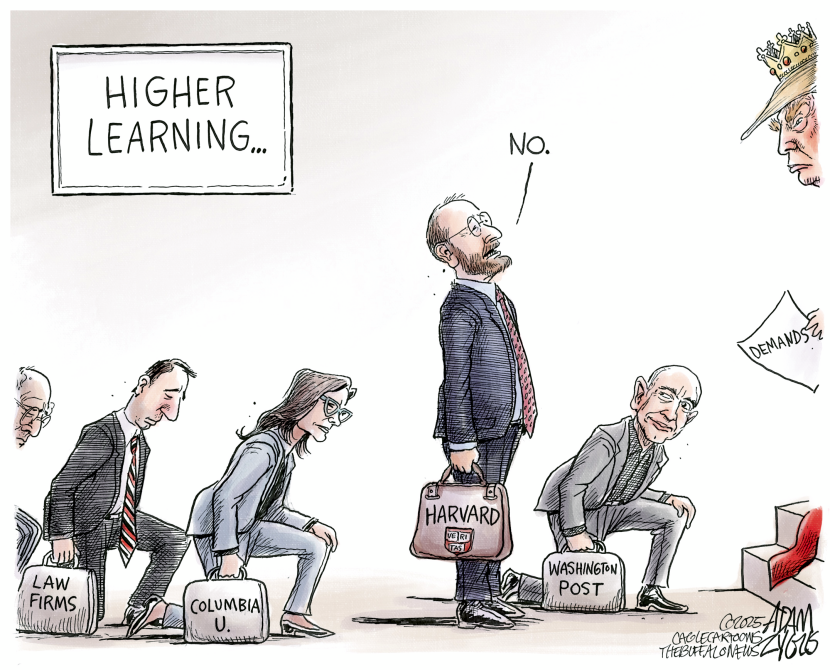
Ample sighs of unrestrained relief frantically cascaded throughout the higher education community upon Harvard University’s refusal to capitulate to the Trump administration.
Last week, Harvard defied Trump’s threat to cut federal funding aid and announced it would not surrender its independence or relinquish its constitutional rights. Harvard President Alan M. Garber wrote, “Neither Harvard nor any other private university can allow itself to be taken over by the federal government. The University will not surrender its independence or its constitutional rights.”
Hallelujah was the word of choice among more than a few people across many professions.
Notably, Princeton President Christopher Eisgruber stated he would refuse to surrender to the administration. Michael Roth, president of Wesleyan University and a perennial outspoken critic of the Trump administration’s directives to colleges, applauded Harvard’s position.
“Federal funding for universities must not depend on a loyalty oath,” Roth said in a statement.
Stanford is also prepared not to comply. The faculty council at Indiana University has organized other Midwestern universities to refuse, as has the University of Massachusetts with land-grant universities. Harvard sounded the alarm, and the results have become a growing chorus of opposition picking up considerable amounts of steam.
Claire Shipman, Columbia University’s interim president, has signaled the institution may refuse to accede to any demands it believes compromises its integrity and autonomy. Interestingly, as of this column, Columbia has yet to see any of its funds returned. Now Trump is considering whether to seek a federal consent decree to ratify any negotiated agreement with the school.
In a sad, pathetic effort to save face, two Trump administration sources told the New York Times an April 11 letter to Harvard President Alan Garber and signed by three federal officials was “unauthorized” and should not have been sent. Needless to say, the university balked at such assertions. Harvard refused to eliminate diversity, equity, and inclusion programs, ban masks at campus protests, enact merit-based hiring and admissions reforms, and reduce the power of faculty and administrators the Republican administration has called “more committed to activism than scholarship.”
Apparently, the university’s ultimate decision to resist wasn’t the initial one. It simply became the end result after the White House sent a list of demands so detailed, draconian, humiliating, and blatantly anti-intellectual that Harvard was left with no option but to reject it.
Hundreds of Harvard students, faculty, and staff members protested earlier this month, demanding the university administration not give in to Trump. A previous public letter with a similar sentiment was signed by 600 university educators, who expressed fear the school would follow Columbia University’s actions. Spitefully, the Trump administration responded by revoking $2.2 billion in federal funds and $60 million in contracts. President Trump has also suggested the institution should forfeit its tax-exempt status. In response, the university filed a lawsuit against the administration on April 21st.
Many if not most universities are relieved by Harvard’s actions. Nonetheless, the truth is Harvard has a $50 billion endowment, numerous wealthy alumni, and multiple other resources at its disposal. Institutions with a fraction of such resources may feel much more pressure to adhere to administration demands and redefine their policies.
Such a reality could certainly pertain to smaller, regional state institutions and lesser-known small colleges. Historically Black Colleges and Universities (HBCUs) would be specifically vulnerable to such callous bullying. Some have millions of dollars in federal contracts. A number of HBCUs barely treading water are particularly in danger of being subjected to the intense pressure this administration could or would apply.
Conservatives’ war on academia has been decades in the making, and Trump is eagerly amplifying the battle. However, regardless of their reputation, financial situation, or stature, universities shouldn’t allow themselves to become educational doormats.
This current political climate provides higher education with the ability to demonstrate the diversity of resources they offer to the public and broaden their appeal. Such efforts would likely go a long way in rehabilitating and reaffirming higher education’s value to more than just an increasingly narrow elite segment of society. Words for thought.
–
Copyright 2025 Elwood Watson, distributed by Cagle Cartoons newspaper syndicate
Elwood Watson is a professor of history, Black studies, and gender and sexuality studies at East Tennessee State University. He is also an author and public speaker.