Subscribers Only Content
High resolution image downloads are available to subscribers only.
Not a subscriber? Try one of the following options:
OUR SERVICES VISIT CAGLE.COMFREE TRIAL
Get A Free 30 Day Trial.
No Obligation. No Automatic Rebilling. No Risk.
Debates over free speech, cultural appropriation, intolerance, and other controversies covered by the umbrella term “cancel culture” have woven themselves firmly into the fabric of our current culture over the past few years.
By now, most Americans are aware of the case of Mahmoud Khalil, a graduate student at Columbia University with permanent residency in the U.S. who is in the middle of a deportation fight with the Trump administration for being a pro-Palestinian activist.
“This is the first arrest of many to come,” Donald Trump posted on Truth Social. “We know there are more students at Columbia and other Universities across the Country who have engaged in pro-terrorist, anti-Semitic, anti-American activity, and the Trump Administration will not tolerate it.”
Khalil’s arrest comes against the backdrop of the administration’s decision to pull some $400 million in support from Columbia because of its supposed anti-Semitism, which includes much-needed funding for Jewish researchers doing medical research. It also comes as the Office of Civil Rights sent a letter to some 60 colleges and universities, informing them they are under investigation for not doing enough to combat anti-Semitism on campus.
I’m inclined to agree with nationally-syndicated columnist Susan Estrich, who is Jewish, who thinks the Trump administration is disingenuously exploiting anti-Semitism in an effort to further enact a right-wing agenda largely characterized by… anti-Semitism.
“I sympathize with Jewish students who, especially last year, felt vulnerable and unprotected on their campuses. Many colleges should have done better. They did not enforce their own rules guaranteeing students secure access to classes and activities,” Estrich wrote. “But we don’t need ICE to solve that problem.”
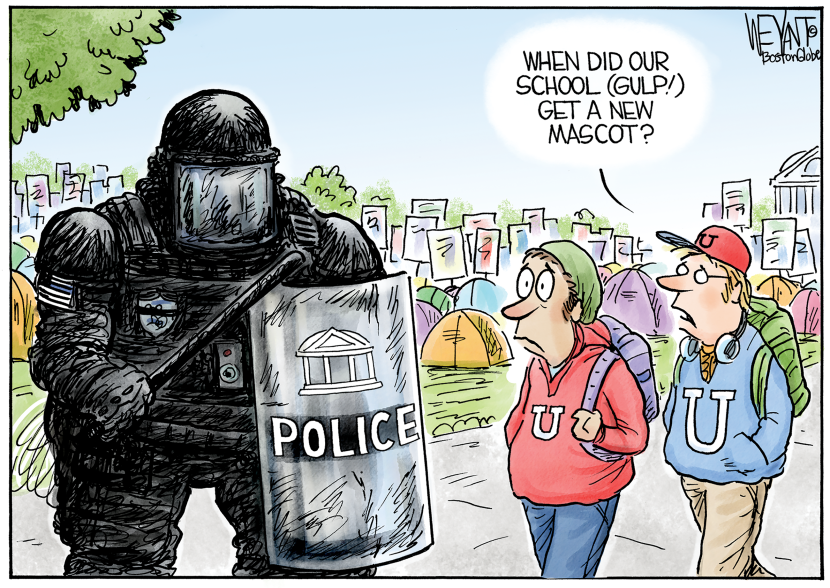
Even as Republicans have declared themselves to be the arbiters of free speech, Trump is stating in no uncertain terms anyone who disagrees with him will be silenced. This includes college students who protested the war in Gaza. In a Truth Social post on March 11, Trump threatened to pull federal funding from universities that allow “illegal protests” and vowed to arrest, expel, and deport so-called agitators.
Student protests, like other forms of expression, are crucial to American democracy. Young college students have the right to express their feelings about issues, and we should be shuddering about the potential negative results for our first amendment rights if institutions of higher education give in to Trump’s draconian demands. People are allowed to disagree with the federal government’s manner of doing things and to protest wars (and anything else) they don’t support.
College campuses are supposed to be citadels for the rational examination and exchange of ideas among people with diverse views. In these important spaces, individuals can become immersed in various forms of inquiry. This intellectual universe is deeply embedded in the American social and cultural imagination. However, the current Middle East conflict has resulted in numerous universities morphing into battlegrounds, where politics and ideas have been weaponized in an acrimonious manner, leading to an increasingly bellicose inquisition.
Certain politicians (including President Trump), pundits, academics, and other provocateurs across the political spectrum find themselves in an echo chamber where they must rabidly denounce, dissect, and discredit their opponents. Each fiery exchange provides them with ample ammunition to vilify their opponents and entities whom they despise and, in some cases, fear and view with a jaundiced eye as the “other.”
Such drama is occurring during a tenure when public opinion of higher education — routinely ambiguous at best, especially among conservatives — has reached new depths. There is no doubt such a dramatic drop in popularity is the result of a constant barrage of criticism regarding the increasing cost of a college education, as well as merciless right-wing attacks.
Free speech is crucial to our democracy. Either you have it, or you don’t. It is important to remember that when you attempt to curtail the civil rights of others, it may be only a matter of time before yours are stifled in turn. Denying others the right to voice their opinions is a misguided and dangerous activity that can result in dramatic and disastrous consequences for all.
The scorched-earth approach that many purveyors of so-called cancel culture often engage in is a malignant form of dictatorial behavior that cannot be condoned or tolerated in a society that prides itself on liberty, freedom, and justice for all.
–
Copyright 2025 Elwood Watson, distributed by Cagle Cartoons newspaper syndicate
Elwood Watson is a professor of history, Black studies, and gender and sexuality studies at East Tennessee State University. He is also an author and public speaker.