How PBS and NPR can go commercial

“The public broadcasting people are too snooty to run traditional advertisements,” I said to a giddy media consultant.

“The Trump-backed bill rescinded more than $1 billion in public broadcasting funds,” said the consultant. “That’s about 1 percent of NPR’s budget — and 15 percent for PBS — but they’ll still beg consultants like me to tailor their ads.”

“What do you have in mind?”

“Pfizer would pay a fortune for this one: 75-year-old Norm Abram, from ‘This Old House,’ stands in front of a construction project as he says, ‘At my age, erections aren’t getting any easier. That brings us to today’s sponsor …’”

“You can’t do that!” I said.

“Big Food is under pressure as Robert F. Kennedy Jr. cracks down on artificial additives. They’d pay millions for a spot featuring Cookie Monster eating a cherry confection, as he says, ‘Me love Red Dye No. 40!’”

“Oh. My. God!”

“One beer maker could win back blue-collar customers with an ad featuring Oscar the Grouch, who says, ‘I’m grumpy no more thanks to my favorite new can — a 24-ounce Bud Light tallboy!’”

“No!” I said.

“I know of another sponsor that would pay big for PBS to rename ‘All Creatures Great and Small’ to ‘All Creatures Great and Tasty.’”

“Let me guess — Weber Grills?”

“That’s right,” said the consultant. “How about a Big Bird spot where he says, ‘I finally reached my lofty goal of overcoming depression — with Zoloft!’”

“That’s outrageous!” I said.

“Gambling addiction has opened up huge revenue opportunities. How about this ‘Morning Edition’ ad: ‘With new partner DraftKings, we’re taking wagers on whether our hosts say “climate crisis” or “right-wing extremist” first!’”

“Unbelievable.”

“We’ll drive up ratings — and ad rates — by leaking a few scandals,” said the consultant. “Did you know Kermit’s been pressuring interns to join him for after-hours trysts at his lily pad?”

“Kermit would never! Look, it’s true that NPR editor Uri Berliner said in 2024 that NPR had ‘lost the public’s trust’ by becoming ideologically one-sided. Former NPR CEO Ken Stern reached the same conclusion after spending a year talking to people in red states. He wrote about it in his book, ‘Republican Like Me.’”

“Appealing only to bicoastal elites is no way to grow an audience,” said the consultant.

“It’s true that NPR pushed the now-debunked Steele dossier and Russia collusion narrative, while suppressing the Hunter Biden laptop story. NPR treated the COVID lab-leak theory like a conspiracy — even as U.S. intelligence agencies now say it’s the most likely explanation.”

“We recommend NPR change its afternoon news broadcast to ‘Most Things Left Unconsidered,’” said the consultant.

“And it’s true that in 1967, when public broadcasting began, there were only three major TV networks,” I said. “With podcasts, YouTube and streaming everywhere, it’s hard to justify funding a media outlet that doesn’t serve most Americans.”

“Well,” said the consultant. “Public broadcasting sold out to the left for years — thanks, in part, to generous government handouts. With that funding disrupted, you may be surprised how fast they sell out again — this time to the highest bidder!”

“With the help of consultants like you?” I said.

“That’s right. I know one sponsor who will give NPR a blank check for renaming ‘Fresh Air’ to ‘Who Needs Fresh Air, Anyway?’”

“Let me guess — ExxonMobil!”

Copyright 2025 Tom Purcell, distributed exclusively by Cagle Cartoons newspaper syndicate.

Find Tom Purcell’s syndicated column, humor books and funny videos of his dog, Thurber, at TomPurcell.com. Email him at [email protected].

Comments Off on How PBS and NPR can go commercial

Covering Uncle Sam’s debt

My hat goes off to them.

I speak of the wonderful people who give their own money to Washington in hopes of reducing the national debt.

Since 1961, the U.S. Treasury Department has accepted these “gifts” — though by law, they can’t be used to pay down the total debt. They can only reduce how much the government needs to borrow during the year the gift is received.

Donations peaked in 2012, topping $3 million, but by 2022 they had plunged to just $180,300 — a 94% drop in a decade.

People willing to sacrifice their hard-earned money for national debt relief are vanishing — and who can blame them with our $37 trillion debt?

There was a bright spot last month: The federal government posted a rare $27 billion surplus — largely due to a $20 billion year-over-year surge in tariff collections.

President Donald Trump’s Department of Government Efficiency targeted big savings, but independent estimates say the result is closer to a $20 billion reduction in annual spending.

The Trump-backed Big Beautiful Bill included $1.2 trillion in spending reductions. According to the Congressional Budget Office, it would reduce the projected 2025 deficit by about $300 billion compared to President Joe Biden’s plan.

Still, the deficit will clock in at roughly $1.6 trillion for the fiscal year — and Trump’s plan will still add more than $3 trillion in new debt over the next 10 years.

That debt is largely caused by mandatory entitlements — Social Security, Medicare and Medicaid — that already consume more than 60% of the budget and are projected to keep rising as Baby Boomers retire, live longer and as health care costs explode.

Politicians in both parties lack the will to tackle that massive challenge.

It makes sense, then, that fewer people see any reason to gift their money to the federal government.

Yet some still do.

A representative at the U.S. Treasury’s Bureau of the Fiscal Service told me the bureau keeps no records of the people who donate, but she did recall some memorable donors.

There was one man who mailed in $10 to $20 every payday for years — no note, no explanation, just quiet consistency.

One woman sent in a small money order each month, purchased from her local convenience store.

One teacher collected dimes and nickels in a large jar after teaching her students about the debt in her civics class. She mailed in their contributions.

Others simply signed over their tax refunds.

The largest gift came in 1994: $12 million, sent anonymously.

Are these gifts symbolic? Of course.

Even if there was no new borrowing or interest on our current debt — and even if an annual $12 million gift was permitted to pay the debt down — it would still take more than 3,083,333 years to pay off $37 trillion.

Here’s what’s worse: While the debt keeps growing, the cost to service it also soars.

The annual federal budget is about $7 trillion. About $1 trillion of that is now required just to service the interest on the $37 trillion we owe — that’s more than the government spends on either national defense or Medicaid.

These gifts from citizens say something — more than mere generosity.

They’re not just acts of generosity — they’re acts of defiance.

In the face of runaway deficits and leaders who promise more of everything with no plan to pay for it, these incredible donors quietly push back.

As I said, my hat goes off to them.

Copyright 2025 Tom Purcell, distributed exclusively by Cagle Cartoons newspaper syndicate.

See Tom Purcell’s syndicated column, humor books and funny videos featuring his dog, Thurber, at TomPurcell.com. Email him at [email protected].

Comments Off on Covering Uncle Sam’s debt

Hail the heroic hot dog

July is National Hot Dog Month, a time to honor one of America’s most beloved, misunderstood and delicious foods.

On July 4 alone, Americans consumed an estimated 150 million hot dogs, according to the National Hot Dog and Sausage Council — and that was just in my backyard!

The origin of the hot dog goes way back. Sausages were mentioned in Homer’s Odyssey. The Germans perfected them, bringing frankfurters and wieners to America in the 1800s.

Early sausages were called “dachshund sausages,” due to their resemblance to the long-bodied pup.

As the story goes, a cartoonist at a 1901 baseball game couldn’t spell “dachshund” and labeled them “hot dogs” in his cartoon instead.

The hot dog became iconic at Coney Island in 1871, when German immigrant Charles Feltman began selling sausages in buns from a cart. He eventually built an upscale, full-service restaurant.

It was a former employee of that restaurant, Nathan Handwerker, who truly revolutionized the dog.

In 1916 Nathan opened a humble stand on the boardwalk and sold all-beef, kosher-style hot dogs for a nickel.

Customers were suspicious of their low cost — cheap hot dogs had a reputation for being unsanitary — so Nathan hired men in white coats to pose as doctors to “vouch” for their health benefits.

That stand became Nathan’s Famous.

Nathan’s is now a national brand and home to the world-famous July 4 Hot Dog Eating Contest, where Joey “Jaws” Chestnut just reclaimed his mustard belt by downing 70.5 hot dogs in 10 minutes.

Is there anything more American than “athletes” competing to see who can stuff more food down their gullet?

Nathan changed the hot dog’s reputation, and its popularity blossomed from there.

Between Memorial Day and Labor Day, Americans will consume more than 7 billion hot dogs — about 50,000 every minute.

But no beloved American food can exist without some Americans using their First Amendment rights to attack it.

Nutritionists warn us about nitrates, sodium and saturated fat — and claim one hot dog might take 36 minutes off your life.

Fact check: It’s not that you gain 36 minutes every time you don’t eat a hot dog — your life just seems longer!

Food activists — particularly PETA — claim hot dogs are made with “mystery meat,” such as snouts, lips, hearts and other unmentionables.

PETA also claims they may contain “glass, plastic, metal, bone, rodents and other miscellaneous ingredients.”

That sounds like a Harry Potter recipe — and a very tasty one, so long as the dog is grilled to perfection, slathered with mustard and washed down with an ice-cold beer.

Look, the American hot dog is the working-class hero of summer food.

It’s portable, cheap and brings people together at ballparks, cookouts and roadside diners.

It was an affordable way for people to feed their families during the high inflation of the past four years.

In these partisan times, we can’t agree on much. But here’s one thing we should agree on: Americans should never put ketchup on their hot dogs!

The great Chicago newspaper columnist Mike Royko, writing from America’s hot dog capital, made that point loud and clear.

To paraphrase Royko, putting ketchup on a hot dog is disgusting and perverted — hey, why not use toenail clippings and cat hair while you’re at it?

Well said, Mike.

Now if you’ll excuse me, I have a couple of dachshund sausages to tend to on my Weber grill!

Copyright 2025 Tom Purcell, distributed exclusively by Cagle Cartoons newspaper syndicate.

Find Tom Purcell’s syndicated column, humor books and funny videos of his dog, Thurber, at TomPurcell.com. Email him at [email protected].

Comments Off on Hail the heroic hot dog

Celebrating our republic — if we can keep it

Burgers on the grill, big-box store discounts and fireworks that rattle your windows — those are some great reasons why Americans love the Fourth of July.

But let’s not forget the primary reason we celebrate the Fourth: It’s the day our country declared its independence from a monarchy and began one of the greatest experiments in self-government the world has ever seen.

That experiment wasn’t a given. It was risky, radical and uncertain. As legend has it, when Benjamin Franklin exited the Constitutional Convention in 1787, a woman asked him what kind of government the delegates had created. Franklin famously replied, “A republic, if you can keep it.”

We celebrate the Fourth of July because on that date in 1776, the Continental Congress adopted the Declaration of Independence — a document that didn’t establish our government, but instead laid out the principles that would define it: that all people are created equal, that they are endowed by their Creator with certain unalienable rights, and that governments derive their just powers from the consent of the governed.

This was a stunning break from the idea that rights are granted by kings or governments. The founders believed that our rights come from God, not from any man-made authority — and that the proper role of government is to protect those rights, not limit them.
But the Declaration was only the beginning.

Eleven years later, the Constitution gave form to those ideals by establishing a new kind of government — a constitutional republic. In this system, the people don’t rule directly, as in a pure democracy, but elect representatives who govern on their behalf, all within the strict limits set by the Constitution.

Our republic was built with checks and balances, federalism and separation of powers, precisely because the founders knew the dangers of concentrated authority. They had lived under tyranny. They knew that liberty is fragile — and that it can disappear quickly if citizens forget the purpose and limits of government.

Unfortunately, that understanding is slipping. A 2023 survey by the Annenberg Public Policy Center found that only 22 percent of Americans could name all three branches of government. Many didn’t know what a republic is.

In any event, let’s enjoy the parades, the cookouts and the fireworks that are a cherished part of the Fourth.

John Adams once wrote that Independence Day should be celebrated “with pomp and parade … bonfires and illuminations from one end of this continent to the other.”

And many of our communities produce incredibly beautiful fireworks displays.

But amid the celebrations, we must remember what we’re truly honoring: the birth of a nation grounded in God-given rights, limited government and the radical idea that we the people are in charge.

This country didn’t happen by accident. It was fought for, debated fiercely and built by brilliant minds who knew what was at stake — and who warned that it could all be lost if future generations failed to understand it and protect it.

So enjoy your hot dogs and your fireworks. But as the sky lights up this week, take a moment to reflect on Franklin’s challenge.
Remember how rare and remarkable our republic truly is.

And pray that we remain wise enough — and informed enough — to keep it.

Copyright 2025 Tom Purcell, distributed exclusively by Cagle Cartoons newspaper syndicate.

See Tom Purcell’s syndicated column, humor books and funny videos featuring his dog, Thurber, at TomPurcell.com. Email him at [email protected].
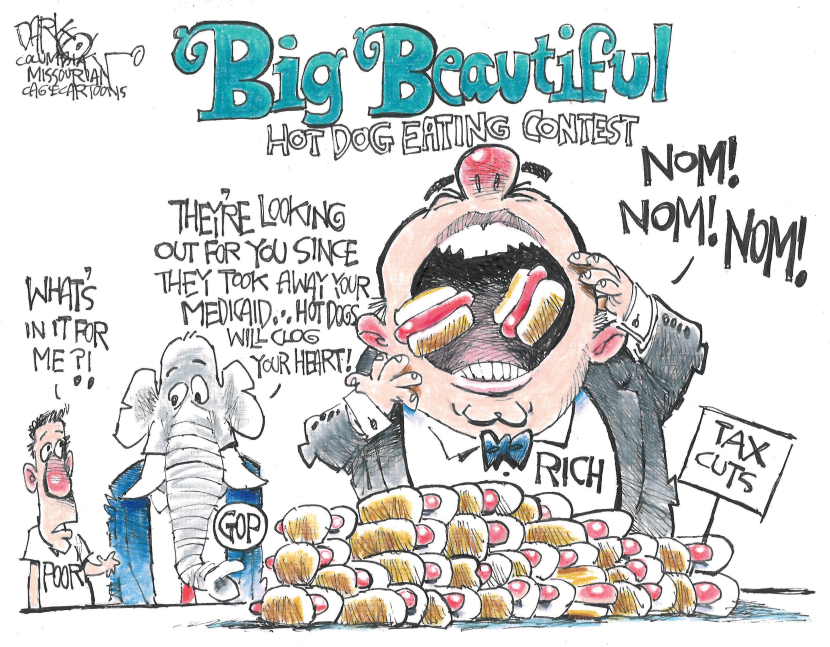
Comments Off on Celebrating our republic — if we can keep it

Zero tolerance summer camp

Dear Mom and Dad,

It’s only been a few days since you dropped me off, but you better come get me.

I’m writing to you with a pencil I swiped from the office, because the camp director confiscated my iPhone for watching funny dog videos during her “Camp Inclusion and Behavioral Expectations” speech.

By the way, what is “unsanctioned screen time aggression”?

Well, after she took my phone, she made me tell everyone my pronouns. When I said I prefer “they,” she asked me why.

I said that by choosing a plural pronoun, I’d have a better shot at getting extra servings of dessert!

Well, that was a surefire way to get my dessert privileges terminated. By the way, she wants to know if Daddy is a Republican.

By then, I was feeling homesick. I found a piece of wood and began carving it with the Swiss Army knife Grandpa gave me — I was carving a flute just the way he showed me.

Well, one of the counselors yelled at me to “freeze.”

He confiscated my knife, then marched me off to the camp director. She said who did I think I was bringing a lethal weapon, a symbol of pain and death, into her camp?

The next day, Billy Johnson and I got bored, so we went into the woods to play army. We turned a couple of branches into guns and made bullet noises as we fought the bad guys.

Sure enough, we were marched off to the director. She said the reason there’s so much war in the world is because boys like us are taught to “celebrate” it from an early age.

At that point, I figured I better keep my head down. But I got into trouble at lunch. Just as I was thanking God for my blessings — just as I whispered “Grace” to myself — I was carted off to the director again.

She wanted to know who I thought I was to impose my religious beliefs on others. She said my actions showed how “ignorant” and “insensitive” Americans are to other cultures.

Believe it or not, things got even worse from there. The next day we were weaving baskets. I was sitting next to Mary Allison, the prettiest girl I ever saw.

“Mary,” I said, “you’re so pretty you make me smile from ear to ear.”

Sure enough, that got me another trip to the director’s office. The director said I really crossed the line this time. She said my behavior was not only “boorish,” but against the law.

By the way, who is Harvey Weinstein?

I was really uptight by that point. But I was able to forget about it the next day when we played kickball. I kicked the ball really far and I got a grand slam. I was so happy, I said, “We win! We win!”

This time the director said I hurt the “self-esteem” of the players on the other team — that there’s no place in the world anymore for reckless, aggressive boys like me.

By the way, what is Ritalin?

Anyhow, you better come get me. We’re going to go on a hike in the woods this afternoon, and I already picked some flowers to give to Mary Allison.

Your son,

Tommy

Copyright 2025 Tom Purcell, distributed exclusively by Cagle Cartoons newspaper syndicate.

See Tom Purcell’s syndicated column, humor books and funny videos featuring his dog, Thurber, at TomPurcell.com. Email him at [email protected].

Comments Off on Zero tolerance summer camp

Let’s return to comfort food

My favorite summer comfort food is the fried chicken and potato salad dinner my mother made throughout my childhood — one I’ve spent three years trying to reinvent.

It turns out I’m not alone.

According to a 2025 study by the Food Institute and Nestlé USA, more Americans — citing increased food costs, health concerns and a longing for emotional calm — are recreating the meatloaf, stews and other family meals they enjoyed as children.

But they’re not just copying old recipes — they’re reinventing them with bold new flavors and creative techniques, a trend called “new-stalgia.”

Though I’ve been experimenting with my mother’s fried chicken and potato salad recipes, I’ve not yet come close to improving them.

She’s 88 now and no longer makes meals to feed her large clan, but I was wise enough to capture her recipes and techniques on video.

Her fried chicken started with a very large family pack of thighs and breasts. She mixed some eggs and water in a bowl for the egg wash, then poured inexpensive, store-bought Italian bread crumbs into another bowl for the dredge.

The Italian mix included a blend of flour, onion and garlic powder, parsley, sea salt, paprika and white and black pepper — all tasty stuff.

She’d brown the bread-coated chicken in our ancient cast-iron skillet, then finish it off in an oven pan for 45 minutes more.

Her potato salad started by cleaning and then boiling 10 large Idaho potatoes. Once they cooled, and my father helped peel them, she cut the potatoes into cubes.

She boiled a dozen eggs, cut up celery and onions into very small pieces, then mixed her simple but incredibly special dressing — a cup or so of Hellmann’s mayonnaise, a few spoonfuls of regular sugar, an orange juice glass of condensed milk and a touch of white vinegar.

Her sweet, vinegary, watery potato salad is a one-of-a-kind creation — just as every family’s potato salad is!

My greatest fried chicken and potato salad memory as a kid involves my community’s “Kennywood Day,” when we spent the whole day at the Kennywood Amusement Park.

My father would pack our old green cooler full of ice, then stuff in my mother’s pans filled with the chicken, potato salad and a six-pack of his cherished Pabst Blue Ribbon.

We’d arrive at the picnic pavilion in the morning and set our provisions at the same picnic table every year — every family knew which was theirs.

We kids would meet up with our friends and hit the rides and roller coasters all day.

Then we’d return to the pavilion, absolutely famished, for dinner at 5 p.m. The chicken and potato salad were ice cold and devouring them was — and will always be — the most satisfying gastronomic experience I’ve ever known.

That’s why I’m having a blast trying different approaches and flavors — add some cayenne pepper to the chicken dredge or maybe some brown mustard and scallions to the potato dressing? — to make my mother’s creations even better.

Hey, maybe a little new-stalgia can calm all of us down — because food has a special way of bringing us together.

By sharing our creative takes on our most cherished comfort meals — by breaking bread together — I’m confident we’ll realize our passions, hopes and beliefs are far more common than they are different.

Especially if the meal involves my mother’s incredibly delicious fried chicken and potato salad!

Copyright 2025 Tom Purcell, distributed exclusively by Cagle Cartoons newspaper syndicate.

See Tom Purcell’s syndicated column, humor books and funny videos featuring his dog, Thurber, at TomPurcell.com. Email him at [email protected].

Comments Off on Let’s return to comfort food

Father’s Day: Why I still sleep with my window fans

I fell asleep every summer night to the wobbling sound of a window fan — and I still do.

I grew up in a modest two-story home typical of the 1960s and 1970s — red brick on the bottom, white aluminum siding on the top. There were four bedrooms upstairs and a master bedroom downstairs (my parents’ bedroom, which they added onto the back of our house in 1972).

Only one house in our neighborhood had air conditioning back then. It was locked up tighter than Fort Knox.

As I explain in my book “Misadventures of a 1970s Childhood,” most houses were wide open all summer. This allowed the outside sounds to come in and the inside sounds to go out.

And no sound was more prevalent in the evening than the wobbling hum of window fans sitting on window ledges throughout the neighborhood.

My father was a master at driving the hot, stale air from our house. He installed an industrial fan in the upstairs hallway that sucked the cool evening air into our bedrooms and pushed the hot air upward through a roof vent.

It took him years to perfect his method, but by closing some windows and doors and adjusting others to varying degrees of openness — and by placing some window fans to bring cool air in and others to push hot air out — he tuned our house like a fine violin. He could drive down the temperature by 15 degrees or more in a matter of minutes.

I remember coming home on summer nights when I was in college. I’d open the front door and be greeted by a burst of cool air. Sometimes my father would be in the kitchen, leaning on the countertop with his elbows as he ate his favorite snack — peanut butter crackers and ice-cold milk.

He’d hand me the peanut-butter-coated knife and I’d smear a couple of crackers. As we chomped away, we’d mumble through a conversation about college or the Pittsburgh Pirates or a variety of other topics sons discussed with their dads in the kitchen on such nights.

Other times, my father and mother would be lying in bed in the back room, the lights off, the television flickering as Johnny Carson delivered his monologue, the window fan humming. We’d chat for a spell before I headed up to bed.

A few years ago, I installed an industrial fan in my hallway ceiling. I bought a couple of window fans — one that blows hot summer air outside and another that pulls in the cool evening air.

The fans remind me of the constant presence of my father, who spent years tweaking and perfecting our house to make life better for his kids.

He was an old-school dad. He lacked skill at articulating his love with words, but he was a master at showing it through endless actions.

We lost my dad three years ago, but his presence is strong in us still. He gave us order where chaos and emptiness would have been. His love permeated every nook and cranny of our home and our lives. It guides us still.

That’s why I shut off the air conditioning most summer nights and run my fans instead. Their wobbling hum fills me with peacefulness and calm — and reminds me how blessed I was to have such a dad.

Copyright 2025 Tom Purcell, distributed exclusively by Cagle Cartoons newspaper syndicate.

See Tom Purcell’s syndicated column, humor books and funny videos featuring his dog, Thurber, at TomPurcell.com. Email him at [email protected].

Comments Off on Father’s Day: Why I still sleep with my window fans

Why Flag Day matters

Flag Day, celebrated every June 14, is one of America’s lesser-known holidays, but my father never forgot it.

June 14 marks the day in 1777 when the Continental Congress officially adopted the Stars and Stripes as our national flag. Though President Woodrow Wilson established Flag Day by proclamation in 1916, it wasn’t made permanent until 1949, when President Harry S. Truman signed it into law.

For my father, born during the Great Depression, Flag Day was never just a footnote.

We got him a tall flagpole for his 65th birthday, shortly after he and my mother moved into a new house. He mounted it in concrete at the center of his long front yard. He maintained many flags over the years, replacing them as needed — until three years ago, when, at 89, he passed away.

As a boy, he grew up in a country rallying to defeat mighty foes in World War II. Drafted at the tail end of the Korean War, he served for two years. When he returned home, America was a place full of optimism and promise.

He and my mother married and raised six children. He worked hard for decades at the phone company and retired just shy of 60.

He ended up enjoying retirement for more than 30 years — something he never imagined. He once told me he didn’t expect to live past 70, let alone nearly 90. And he never expected to enjoy all of the material blessings he had.

He loved his country not because it was perfect — we’ve made many missteps in our history — but because it was always striving to improve. To my dad, the flag was a symbol of our constant striving.

In his view, America is exceptional because its people are free to speak, worship, create and build as they pursue their own happiness.

But somewhere along the line, the flag has become divisive in some circles — as though honoring it means ignoring our flaws or endorsing a particular political agenda.

My father knew that the opposite was true. He knew that preserving our freedoms requires vigilance and respect from every generation.

When he was young, people stood still when the national anthem played. Hats came off. Hands covered hearts. Nobody giggled through it. Nobody scrolled.

Now, too often, people are distracted — unaware of what the flag truly symbolizes.

In today’s divided times, we could use more subtle reminders of what unites us. The flag should be one of those reminders — not of politics, but of principles: freedom, responsibility, shared purpose and a continuous desire to improve.

I admit I never thought much about the flag when I was younger. It was just there — something I saluted by rote in school or saw at parades.

But over the years, as I watched my father quietly care for his flagpole and replace each worn flag with reverence, I began to understand what it meant.

My father taught me that patriotism isn’t about loud declarations — it’s about quiet gratitude, responsibility and doing your small part.

I am 63, nearly the age he was when we gave him that flagpole. It’s my turn to carry on.

I’m going to mix some concrete this weekend to erect a flagpole in my front yard — a pole that will proudly display the flag I inherited from my father three years ago.

Copyright 2025 Tom Purcell, distributed exclusively by Cagle Cartoons newspaper syndicate.

See Tom Purcell’s syndicated column, humor books and funny videos featuring his dog, Thurber, at TomPurcell.com. Email him at [email protected].
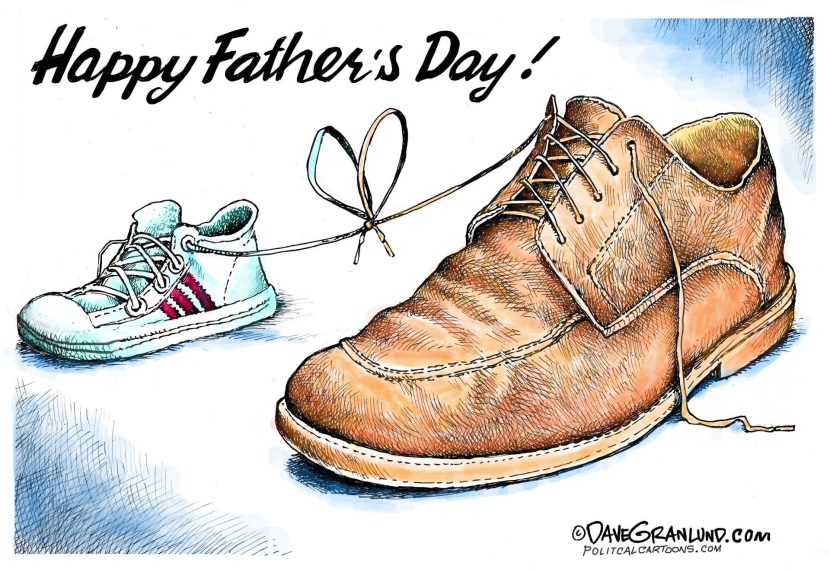
Comments Off on Why Flag Day matters

Let’s bring back the sounds of summer

Summer sounded better in the ’70s.

I woke every morning to the birds chirping outside my window screen, a dewy chill in the air. I’d smell my father’s pipe, which he smoked while he read the paper downstairs. I’d go down to greet him. He’d make scrambled eggs and toast covered with butter, and we’d eat while the birds kept on singing.

The evening sounds were equally powerful: a dog barking; a motorcycle downshifting on some faraway hill; people out on their porches listening to the Pirates play on the radio; a baby crying; a couple talking; children laughing; a window fan humming.

As I explain in my book “Misadventures of a 1970s Childhood,” we kids spent our days out in the hills roaming and exploring.

We collected scrap wood and built shacks. We dammed up the creek and caught minnows and crayfish. One summer, we built a motorized go-kart with some scrap items from a junked riding mower and a couple of two-by-fours. It was one of the great engineering feats in my neighborhood’s history.

Occasionally, we’d fib to our mothers and ride our bikes 20 miles farther than we said we would. Or we’d pluck some baby pears off a tree by Horning Road and whip them at cars.

Every now and then, a car would screech to a stop, and we’d sprint through a creek aqueduct that ran 200 feet beneath the neighborhood.

There was only one major rule a kid had to abide by: You’d better be home in time for supper.

Every kid had a unique sound to call him home.

One family used a riot horn. The piercing “hrmmpppphhhhhh!” could be heard for miles.

My father went with a deep, booming, “Tom, dinner! Tom, dinner!”

When moms did the calling, they always used full names. They always sang, too, as my Aunt Jane did: “Miiiiiikkkeeelllll, Keeeeevvvviiiiiinnnnn, suuuuuppppppeeerrrr!”

The Givens boys, up on the hill across the railroad tracks, were called home by a large bell. The clanging sounded off at 6 p.m. every night, giving us the sense that a riverboat was making its way up the Mississippi or a chow wagon was calling in the cowhands for grub.

I later learned that several families timed their dinners around the Givens’ 6 o’clock bell!

These mystical sounds have been gone a long time now. How wonderful it would be to bring them back.

Today, childhood is often lived indoors. We shuttle kids from one adult-run activity to the next, as their screen time climbs and their time in nature shrinks. Experts call it “nature-deficit disorder” — a term for what happens when kids lose contact with the natural world and the freedom that once came with it.

At least one month every summer, why don’t we cease every structured activity for our children, cancel every tournament, and end every adult-run event?

Let’s turn off the television and computer. Let’s shut down the air conditioner and unshutter the windows and doors.

Let’s allow our kids to go out into the hills to roam and play and discover all day long. That will require us to call them home at dinner.
And our shouts and chants and bells will breathe much-needed music into the sweet summer air.

Copyright 2025 Tom Purcell, distributed exclusively by Cagle Cartoons newspaper syndicate.

See Tom Purcell’s syndicated column, humor books and funny videos featuring his dog, Thurber, at TomPurcell.com. Email him at [email protected].

Comments Off on Let’s bring back the sounds of summer

Numerous reasons to honor our veterans

More than 43 million Americans have served or are currently serving their country — and more than 1.3 million gave the ultimate sacrifice.

According to the U.S. Census Bureau, there are approximately 15.8 million U.S. veterans living today — about 6.1 percent of the adult population. Roughly half are age 65 or older and nearly 2 million are under 35.

Our older veterans served in World War II, Korea, and Vietnam. The younger veterans primarily served in Iraq and Afghanistan after the 9/11 attacks.

World War II veterans are dying at a rapid pace. According to the U.S. Department of Veterans Affairs, fewer than 100,000 are still living, down from 16 million who served.

Of the 5.7 million Americans who served in the Korean War, approximately 767,000 are still alive. My father, who served during the Korean War, left us nearly three years ago at the age of 89.

As for Vietnam, around 5.6 million of the 8.7 million Americans who served in that war are still living.

To round out the numbers, more than 8.4 million veterans have served during the Gulf War era, which spans from 1990 to the present. Additionally, approximately 4.4 million served during peacetime.

Some living veterans served across multiple war periods. Nearly 63,000 served during the Vietnam War and both Gulf War eras — from August 1990 through August 2001 and again from September 2001 onward.

More impressively, nearly 37,000 living veterans served in World War II, the Korean War, and the Vietnam War.

Many Americans confuse Memorial Day with Veterans Day. While Veterans Day honors all who have served — living or dead — Memorial Day is specifically for those who died in service.

It began after the Civil War as “Decoration Day,” a time to decorate the graves of fallen soldiers. Today, it’s a day of national mourning, and rightly so.

To date, more than 1.3 million Americans have died in military service. About 4,500 died during the American Revolution. In the Civil War, around 370,000 Union soldiers and an estimated 260,000 Confederate soldiers lost their lives.

We lost 116,516 in World War I and nearly 405,000 in World War II. The Korean War claimed 36,574 lives; the Vietnam War, 58,220.
Modern warfare has led to fewer battlefield deaths — a silver lining of improved medical care and technology.

Of the Americans who served in Iraq and Afghanistan, more than 7,000 died. Nearly 50,000 were wounded and many still suffering from their injuries.

Many of today’s veterans face challenges well beyond the battlefield. Many struggle with PTSD, physical injuries, job placement and endless health challenges.

In any event, each veteran who gave the ultimate sacrifice represents a life cut short — young men and women who never came home, never started a family, never got to see the freedoms they died to protect.

Their families carry that loss forever. Their sacrifice is not just national — it’s heartbreakingly personal.

Yes, the purpose of Memorial Day is to honor the men and women who gave the ultimate sacrifice for their country.

While we kick off this summer, let’s take some time to remember, thank and honor them for their service.

While we do so, let’s also pay homage to all of the many men and women who have served, or are serving, our country.

Copyright 2025 Tom Purcell, distributed exclusively by Cagle Cartoons newspaper syndicate.

See Tom Purcell’s syndicated column, humor books and funny videos featuring his dog, Thurber, at TomPurcell.com. Email him at [email protected].
Comments Off on Numerous reasons to honor our veterans