Our wild debt party is over

Gosh, I hate debt.

I’ve been in and out of debt from time to time. When I was younger I took out a car loan for a nice set of wheels that I really couldn’t afford.

I borrowed money I didn’t have to buy a really nice stereo system, too.

A few years after becoming self-employed, I had to get a line of credit to pay my income taxes.

Few things are less pleasant than taking on debt to pay your debt.

Being saddled with debt, therefore, is something I’ve worked hard to avoid throughout my life.

Borrowing isn’t always wrong, for sure. Borrowing for a home or to buy rental properties has worked out very well for me.

But reckless borrowing never works out well, and I cannot avoid the Mt. Everest of debt my government has taken on through a variety of spending policies that I consider reckless.

The federal government now holds a record $31 trillion in debt.

How much is a mind-boggling sum like $31 trillion?

According to one calculator, it is 31,000 billion or 31 billion thousand.

Here’s a number that may make a little more sense to you if you’re not Janet Yellen.

MSN.com reports that $31 trillion translates into more than $93,000 of debt for every person in the country.

Our political leaders haven’t worried much about our massive national debt because, for years, inflation rates were low and the interest rates on borrowed money also remained low.

Now inflation is going through the roof and the Federal Reserve hopes to tame it by increasing interest rates.

High interest rates are painful.

Consider: Not even a year ago, you could get a 3% mortgage. Now, the average is closer to 7%.

A 3% mortgage on $100,000 borrowed is about $420 a month for 30 years.

A 7% mortgage on $100,000 borrowed is about $665 a month for 30 years — a $245 increase in cost.

Well, unfortunately for all of us taxpayers, the same pain is happening with the federal debt.

When interest rates were very low, servicing our national debt was manageable.

But now interest payments are climbing fast and Fox Business says they are already projected “to be the fastest-growing part of the federal budget in fiscal year 2022, according to the Congressional Budget Office.”

How big?

This year the cost of servicing the debt will be about $400 billion, says the CBO. But within 10 years we’ll be paying $1.2 trillion.

We’ll be spending more on debt than many of our major government programs.

In other words, we’ll need to borrow more money we don’t have to pay interest on the money that we borrowed because we didn’t have it.

I may be an English major, but I’ve been worried about such a reckoning for a long time.

Consider that five years ago the federal debt was $21 trillion — and it’s grown $10 trillion in that short period of time.

Consider that 20 years ago it was a piddling $6 trillion.

These monstrous debt numbers have long been unsustainable and lots of people have been warning us what was coming. Heck, even I knew that historically low interest rates couldn’t last forever.

And now the bill for our drunken debt party is coming due — and our national pain has begun.

Copyright 2022 Tom Purcell, distributed exclusively by Cagle Cartoons newspaper syndicate.

Tom Purcell, creator of the infotainment site ThurbersTail.com, is a Pittsburgh Tribune-Review humor columnist. Email him at [email protected].

Comments Off on Our wild debt party is over

Hung up on rudeness

Changing communications technology is one of life’s never-ending annoyances, and now we have a new agitation: voice messaging.

Voice messaging allows smartphone owners to record their voice and send the recording to others as they would a text or a chat.

According to the Wall Street Journal, some people consider the technique bothersome and rude — a camp I am clearly in, and I’ll happily explain why.

I’ve experienced a lot of phone-technology changes in my life.

When I was a kid in the ‘70s and the phone rang, it was always a surprise and you’d hurry to find out who was calling our house.

Hard as it is for some to imagine, we had no caller ID.

We had no call-waiting, either — if you were on the line talking and someone called you, that person would be greeted by a busy signal.

Worse yet, if you needed a ride home after football practice, good luck getting through to my house.

My five sisters and my mom kept our single phone line occupied throughout the day. I spent half of my high school years redialing a pay phone.

The truth is, we actually wanted to answer the phone back then to learn who was calling.

Nothing was more disappointing than getting to a ringing phone too late and having the mystery caller hang up.

That began to change in the ‘70s when answering machines became affordable and many people began using them to screen their calls — behavior that was considered rude by many.

Here’s what was even ruder: For whatever reason, some people refuse to leave messages on answering machines. Getting home to hear a hang-up click on the answering machine was awfully agitating.

Until the invention of “*69.”

Punching those three keys into the phone would provide the number of the dirty rotten person who had the audacity to call your home and not leave a message.

This gave us the ability to call the rude person back, wait for his answering machine to play, then hang up!

And so it was that technology enabled rudeness began to proliferate.

Now, when our smartphones ring, we look to see who the rude person calling is, and think, before letting it go to voicemail, “Why couldn’t the idiot text me like a normal person?”

Which brings us to voice messaging.

As a highly impatient person, I’m far too busy to listen to other humans use spoken words to convey human thoughts to me.

The inflexions and changing tones they use to illustrate their points may seem more human and nuanced to them, but they only make me grumpier.

Look, I am a master procrastinator who wastes time all day long — but I resent when others waste my time for me by sending me voice chats that I have to spend precious seconds listening to.

For goodness sakes, email me or text me and give me words to read.

I’ll email you or text back some nice words you can read, and then the both of us can go on our merry way promoting the rudeness, grumpiness and incivility that we have allowed our technology to make a regrettable reality in modern life.

I leave you with this warning:

Keep voice messaging me and I swear to goodness I will buy a cheap cell phone that does not trace back to me and I’ll call your home phone — then hang up on your answering machine!

Copyright 2022 Tom Purcell, distributed exclusively by Cagle Cartoons newspaper syndicate.

Tom Purcell, creator of the infotainment site ThurbersTail.com, is a Pittsburgh Tribune-Review humor columnist. Email him at [email protected].

Comments Off on Hung up on rudeness

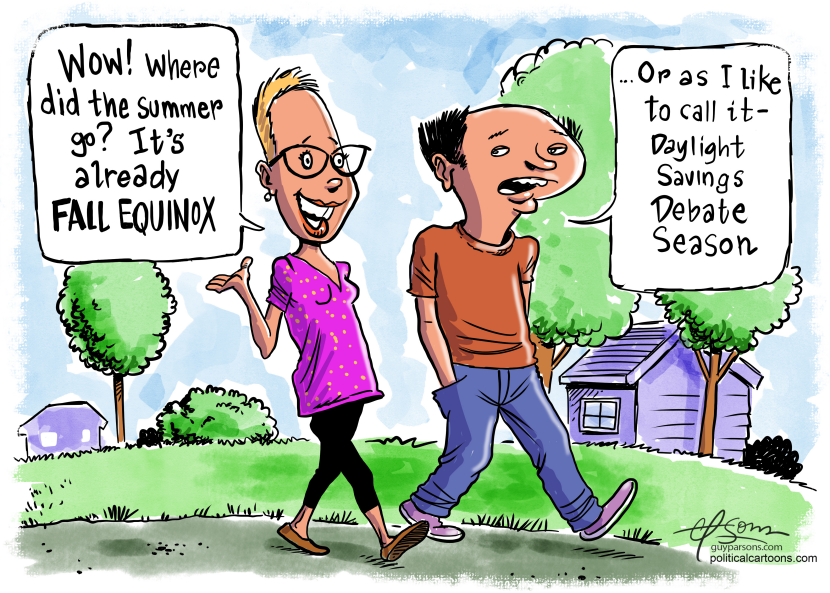
Hey, Congress, stop fiddling with our clocks

With the “fall back” clock change coming soon, one thing makes me especially grumpy and confused.

Last March, the Senate passed a bill that would make daylight saving time a year-round standard and end the “fall back” and “spring forward” clock changes that make Americans even groggier and crabbier than we usually are.

But the bill has not advanced.

Daylight saving time (DST), which ends Nov. 6, has been agitating me every fall and spring for my entire life.

First tried for seven months in 1918, says wikipedia, DST was used for a full year for the first time during World War II. It was used again in 1973 in a bid to reduce energy usage because of an oil embargo, then repealed a year later.

As I reported a year ago, the jarring shift to our daily sleep patterns and routines each fall and spring is linked to an increase in heart attacks, strokes or automobile accidents.

In March, when our clocks “spring forward,” hospitals report a 24% spike in heart attack visits around the U.S.

The reverse happens in the fall when clocks are set back. Heart attack visits to hospitals drop by 21% — but pedestrian deaths increase because it gets dark earlier.

Finally, last March, some of our political leaders in the Senate took a break from spending money we don’t have to do something about an actual issue that matters.

The Senate passed the Sunshine Protection Act to “make daylight saving time permanent starting in 2023, ending the twice-annual changing of clocks in a move promoted by supporters advocating brighter afternoons and more economic activity,” according to Reuters.

You’d think the House and the president would jump on such a concept since ending the clock change is something 71% of Americans agree upon.

The trouble is, there is little agreement on how to end the clock change.

CNN cites a poll from late 2019 that found three things:

• 31% of Americans prefer daylight saving time so that we have more light later in the day at the expense of darker mornings — which is apparently bad for our biological circadian clock, according to Universal Sci, and that will cause us to get less healthy sleep.

• 40% prefer standard time so that we have more sun in the morning, at the expense of the sun going down earlier in the evenings, which Universal Sci says is much better for restful sleeping.

• 28% prefer we keep changing our clocks back and forth, as these self-serving people are clearly in the coffee or auto-body repair business.

Frankly, I’m not sure if I prefer 12 months of DST or standard time, just so long as we don’t have to change clocks twice a year.

Because while we humans may finally adjust to the forced time changes each year, my dog, Thurber, never will. (If you want to see a talking dog, Thurber explains why at www.ThurbersTail.com!)

Our household is built upon his Labradorian clock, which demands he is fed breakfast and let out to do No. 1 and No. 2 at the very same time every single morning — or my carpet may be at risk of an unpleasant experience.

When I try to explain to Thurber why human beings think they can manipulate time and light, he looks at me like the human race is clearly less sensible than a typical canine.

And he’s right.

If dogs ran Congress, we wouldn’t have to switch our clocks every spring and autumn.

Copyright 2022 Tom Purcell, distributed exclusively by Cagle Cartoons newspaper syndicate.

Tom Purcell, creator of the infotainment site ThurbersTail.com, is a Pittsburgh Tribune-Review humor columnist. Email him at [email protected].
Comments Off on Hey, Congress, stop fiddling with our clocks

An extension of tax grief

I used to love the first weekend of autumn. Now I loathe it.

Maybe I better explain.

I used to wait until the nicest week in spring to organize my taxes, but now I wait until the nicest week in autumn.

Autumn officially begins this Friday, Sept. 23, which is when I will begin the agonizing process of digging through my big box of income statements and expense receipts from 2021.

I organized the mess of paper somewhat in the spring, so that my CPA could file an extension.

But the only thing that did was extend the ordeal of sorting through the box to find every tax deduction that is due me.

I still had to pay any 2021 income taxes I owed by April 18 or face penalties “that can reach up to 25% of the total unpaid taxes, with some exceptions,” says the Wall Street Journal.

Now my tax return for 2021 must be filed by Oct. 17 or steep penalties could kick in.

The Journal says 19 million taxpayers asked the IRS for more time to file this year — a record number.

“A variety of factors is to blame beyond just procrastination, tax preparers say: shifting due dates, Covid-related tax law changes, late forms, the IRS backlog and taxpayer burnout,” reports the Journal.

Taxpayer burnout? I’ve been suffering that since I filed my first adult return.

Now that I have more than one source of income — writer, communications work, rental properties, real estate sales, etc. — I have to provide detailed reports to my CPA on what revenue comes in and what goes out for expenses.

The resulting return is many pages long. There would be fewer felons if they knew their punishment would be to read it.

I wonder whatever happened to all those brave reform ideas to make income taxes fairer or flatter or so simple to file you could complete them in minutes with a single piece of paper and an unsharpened pencil.

2017 was the last time the IRS changed its laws to allegedly help businesses with things like deductions, depreciation, expensing and tax credits.

You might be able to understand the benefits of the Tax Cuts and Jobs Act— if you’re an accountant —but not me.

To make filing my taxes easier for me my CPA set up a Quicken account so I can record in real time every check that comes in and every expense that goes out.

But I don’t use that convenient tool as I should.

That’s why late this Friday afternoon I’ll get out my big box of receipts, organize them into expense folders, load the details into the Quicken app and then pray I don’t owe more tax than I already paid in April.

The weather will be beautiful.

Autumn will have arrived in all its glory. Friends will be sitting around bonfires and sipping hot apple cider during the crisp gorgeous evenings.

But I cannot join them. I cannot talk on the phone, watch television or even listen to lively music.

All I’ll be able to do is focus intensely on my receipts, so my CPA can file my tax return by Oct. 17.

So enjoy your hot toddies, my friends who didn’t file an extension this year.

But if you don’t hear from me by next Wednesday, please make sure I wasn’t crushed to death under my big box of receipts.

Copyright 2022 Tom Purcell, distributed exclusively by Cagle Cartoons newspaper syndicate.

Tom Purcell, creator of the infotainment site ThurbersTail.com, is a Pittsburgh Tribune-Review humor columnist. Email him at [email protected].

Comments Off on An extension of tax grief

Thank you for being mannerly

“No problem.”

That is how I used to reply to people who thanked me for holding the door open for them or for offering some other small gesture.

I don’t know where I got into the habit of saying this to people, but I do not say it anymore.

My mannerly response of choice now is the one my mother taught me over and over again as a child: “You’re welcome.”

You may see no difference between the modern, slangy reply “no problem” and “you’re welcome,” but there is one, slight though it may be.

So why not make the change back to the traditional response?

After all, any time you are more polite to your fellow human beings you spread the desire for them to be more polite to others.

Politeness is infectious — almost as infectious as rudeness is.

Consider: If someone cuts you off in traffic, then gives you a very rude gesture with his middle finger, are you not filled with instant anger and aggression?

Are you then more likely to be rude to some other stranger?

“Incivility is a virus,” says Christine Porath, a Georgetown professor and author of “Mastering Civility: A Manifesto for the Workplace.”

She explains to NBC News that rude reactions tend to create more rude behavior, creating a big negative spiral and a negative culture.

Being mannerly is especially important now. We live in a time of increasing rudeness — thanks in no small part to the way we treat each other on social media.

Social media has resulted in more group-think — whereby we are certain that we and our friends are 100% correct about any particular issue and those with whom we disagree are not only wrong but are stupid and evil.

Group-think has given us license to lash out at others without restraint.

Thirty years ago if you said some of the things to a stranger that some people say all the time to others on
Facebook, you’d likely get punched in the face.

But the days in which there were consequences for such rudeness are long over.

Psychology Today says there is one key reason why people are so much ruder today: a lack of eye contact.

We behave differently hiding behind a fictitious online name when we do not have to make face-to-face contact with whomever we are verbally criticizing or attacking.

One solution: let’s be more mindful of being mannerly — online and off.

As a kid, I had it drummed into my head to say “please” and “thank you.”

Now, when I phone the electric company or a client, I always ask, “How are you today?”

It throws people off. Most of the time, they reply, “I’m great. How are you?”

And off we go, with a touch of civility established, to tend to our business.

I have to work hard at being polite — particularly in traffic — because I do have a temper and I do respond with aggression if someone gives me the middle-finger gesture after cutting me off.

A better way to respond, my wise mother keeps telling me, is to smile and wave — gestures that suggest “my bad” even though I did nothing wrong.

Truth be told, I’ve only managed to do this once. But boy, does it instantly confuse and disarm rude people.

Polite behavior always does.

Copyright 2022 Tom Purcell, distributed exclusively by Cagle Cartoons newspaper syndicate.

Tom Purcell, creator of the infotainment site ThurbersTail.com, is a Pittsburgh Tribune-Review humor columnist. Email him at [email protected].

Comments Off on Thank you for being mannerly

Health care confusion

I’m confused.

I got the flu a few months ago, the worst flu I’d ever had. It wasn’t COVID — I have never tested positive for COVID — but it was a humdinger.

For more than a week, I was a lump on a bed, completely unable to move or do anything.

To make sure I wasn’t going to perish, I paid a visit to the hospital emergency room. They tested me for all kinds of things and, five hours later, said I had the flu and that I could go home.

It was nice to be assured that all I had to do was let my immune system wage a mighty battle for the rest of the week.

It wasn’t so nice when the bills started coming in, which totaled more than $7,000 — from what I can gather.

I have a decent health insurance policy through my corporate client that has temporarily brought me on as an employee to support a big project, so, after deductibles are met, I owed $2,500 or thereabouts — from what I can gather.

Months later I am still in a state of total confusion and know it will take me hours to figure out how much I owe and to whom.

And I am not alone. Millions of Americans are befuddled by their health insurance policies and the convoluted bills they receive when, God forbid, they need to get health care.

According to the Portland Press Herald News, there are lots of hidden fees in medical bills that jack up the cost of services, and there is no continuity among providers.

One hospital may charge $750 for an MRI and another may charge $3,000 or more for the identical service.

Healthcare.com conducted a survey that found more than one in four Americans are befuddled by unexpected medical bills.

Don’t understand the difference between co-pays and deductibles or in-network and out-of-network providers?

Well, get in line, because you have a lot of company — but there may be hope for us all yet.

In January 2022 the No Surprises Act went into effect. It requires hospitals and health care providers to make the fees they charge for services public, according to MarketWatch.

The intent of this act is to prevent patients from getting crushed by surprise bills, such as “balance billing,” which healthinsurance.org explains well.

Balance billing occurs when providers bill a patient for the difference between the “retail price” they charge and the amount that the patient’s insurance pays — which is almost always less. When some providers bill the patient for the difference, or balance, it’s called “balance billing.”

In other words, if you have an emergency and you get care from a provider outside of your network, you will get a big fat bill.

But under the No Surprises Act patients are liable only for their in-network fees.

That’s a nice start, but the real problem is that our health care system is a confusing mess. It needs reform from top to bottom.

If a person does not have a decent health insurance policy — and decent policies are costlier now — he’s still at the mercy of receiving massive bills for needed care.

Now, if you’ll excuse me, I have to figure out who and how much I owe for coming down with the worst flu of my life.

Copyright 2022 Tom Purcell, distributed exclusively by Cagle Cartoons newspaper syndicate.

Tom Purcell, creator of the infotainment site ThurbersTail.com, is a Pittsburgh Tribune-Review humor columnist. Email him at [email protected].

Comments Off on Health care confusion

The elephant in the college classroom

“Half of that goes to the bank for your college fund!”

That’s what my father told me in the 8th grade, when I got my first paycheck for waking up at 5:30 a.m. to ride my bike a few miles to Cool Springs Driving Range before school, where I plucked golf balls for a dollar an hour.

My dad had six kids to feed on a single income, after all. Paying my full college tuition bill was never going to be an option.

There was only one option for me: work.

When I got a little older I started mowing lawns to make more money than the driving range could ever pay.

When I got my driver’s license at 16, I decided I’d become a stone mason. Retaining walls were all over the place in hilly Pittsburgh. I hit the motherlode with that entrepreneurial decision and by the time I was 17 I had four people working for me.

The “young man saving for college” line resonated with customers, and I was able to fund almost all of my first-year college costs with the money my back-breaking labor was able to net.

Money was still tight, though.

After paying for my first year of college, I needed to borrow some money for the next three years — and I was grateful that those government-backed funds from banks were available to me.

But to keep my borrowing to the bare minimum I worked all year while in college.

I worked in the Penn State cafeteria, waking early to help prepare breakfast, then clean dirty plates.

I sold my plasma twice a week — a money-making enterprise that nearly killed me and terrified my mother.

During my senior year, I became manager of a creepy rooming house.

It was dank and old, but it was cheap and, in addition to the free rent, the owner paid me to shovel coal into the auger, maintain the lawn and make frequent household repairs.

The high point of my college-work career was becoming a bouncer at Penn State’s legendary Rathskellar bar — still the coolest thing I ever did.

I see now I was lucky to attend college in the early 1980s.

Myelearningworld.com reports that in the last 50 years college tuition costs have risen five times the inflation rate.

If tuitions had kept pace with inflation, public universities would be charging an average of about $20,000 a year — HALF of what they are charging today.

Why have college costs grown so rapidly?

The simple answer: Easy money.

As the borrowing limits of government-backed and direct government college loans have increased, so have tuitions.

The $1.7 trillion in student debt held by millions of young people today is in large part due to tuition inflation. Colleges took full advantage of all that easy loan money students were getting and jacked up their prices.

Now President Biden wants to forgive $10,000 in college-loan debt for millions of kids who willingly took it on — even though college grads, over time, eventually earn more than most of those who did not attend college.

The trouble is, debt cannot simply be “forgiven” — especially when it amounts to more than $300 billion.

It can only be transferred to taxpayers like me who scrimped and saved and took on a dozen crummy jobs to avoid taking on student-loan debt.

That’s the big, fat elephant in the college classroom.

Here’s another certainty:

Repaying other peoples’ debt obligations is going to be as fun as plucking golf balls off dew-covered grass at 5:30 a.m. every morning.

Copyright 2022 Tom Purcell, distributed exclusively by Cagle Cartoons newspaper syndicate.

Tom Purcell, creator of the infotainment site ThurbersTail.com, is a Pittsburgh Tribune-Review humor columnist. Email him at [email protected].

Comments Off on The elephant in the college classroom

When it comes to boys, schools are flunking

I trekked to St. Germaine School every morning in my sturdy Buster Brown shoes.

Designed for rough-and-tumble boys, these heavy-duty shoes could take a scuffing and, with a good polishing, keep on shining — pretty much the way rambunctious kids like me were able to do in our elementary school years.

The good sisters who ran St. Germaine in the 1970s weren’t especially sensitive to boys like me who spent more time fidgeting and looking out the window daydreaming than following their lessons.

In those days, most restless, indifferent boys like me somehow made it through school without dropping out, but today study after study shows that increasing numbers of boys are doing just that.

In USA Today Christopher Brueningsen, head of the Kiski School, explores why boys are failing to graduate from high school on time at higher rates than girls (82% vs. 88%).

He notes that whereas 60% of girls go on to college today, only 40% of boys do, according to statistics from the National Student Clearinghouse.

“College enrollment in the United States has declined by 1.5 million students over the past five years, with men accounting for 71% of that drop,” he writes.

According to Yahoo News, the COVID pandemic made things even worse for boys.

School closings set back the educational achievements of Chicago’s black and Latino boys significantly — as measured by grading and attendance — whereas girls held their own.

So why are boys doing so much worse in school than girls?

Brueningsen points to the lack of male role models in schools. As of 2018, only 24% of all K-12 teachers were men, according to the National Center for Education Statistics.

He says data from a major 2015 study shows that the typical school environment may be “more attuned to feminine-typed personalities, making it generally easier for girls to achieve better grades in school.”

He cites a 2016 report from the American Sociological Association that found that boys are punished for their rough-and-tumble tendencies and the punishment makes for a negative learning experience.

Boys are much more likely to hear common teacher criticisms, as I did, that include: “Stop fidgeting! Pay attention! Put that down! Clean that off! Your desk is a mess, Tommy!”

Sister Mary “Brass Knuckles” whacked my knuckles with a metal ruler many times, but I was eventually able to overcome this negative experience and become a professional writer (which would shock her if she weren’t in Heaven).

We need every boy and girl in school today to overcome their challenges.

Our modern economy needs every single school in America to produce well-rounded students who can go on to trade schools or college or can be trained directly by companies in desperate need of skilled workers.

Yet some 1.2 million kids drop out of high school every year, reports DoSomething.org — and most of those dropouts are boys.

This is a real crisis our country faces today that requires real changes in classrooms across America, but it is not new.

Author and Education Reformer Richard Whitmire has been writing for more than a decade that key forces in our entrenched educational system — including teachers unions and school administrators — have little interest or incentive in addressing the problem with boys.
He says that the problem has long been well known, yet still little changes.

What is needed are some swift kicks to the shins — by a couple of Buster Brown shoes — of the people holding change back.

Anyone know where I can find a pair in size 11½?

Copyright 2022 Tom Purcell, distributed exclusively by Cagle Cartoons newspaper syndicate.

Tom Purcell, creator of the infotainment site ThurbersTail.com, is a Pittsburgh Tribune-Review humor columnist. Email him at [email protected].

Comments Off on When it comes to boys, schools are flunking

End-of-life challenges in modern times

A long time ago I watched a documentary about poet Emily Dickenson’s life and writings.

One thing that I never forgot about that film is that she lived at a time when death was regrettably common — and therefore the subject of many of her poems.

“How are you doing?” is a polite way of introducing ourselves to each other now.

But as I learned in that documentary, this greeting during Dickinson’s times meant, “Are you healthy and well and going to be with us tomorrow?”

Until modern times, dying commonly affected all age groups.

Women died during child birth. Children died from a variety of maladies.

The rich as well as the poor suffered tragedy and loss almost equally.

Haider Warraich, the doctor who wrote “Modern Death: How Medicine Has Changed End of Life,” explained in an interview that in the 1800s in Boston or London people died mostly of three things: injuries, infections, or some type of nutritional deficiencies.

“Really,” he said, “death was a very binary event — and it was very sudden.

“For example, before the advent of medical technology, if someone had a heart attack or if someone had some type of abnormal heart rhythm such as ventricular tachycardia, they would almost certainly die, in many cases instantaneously, sometimes even in their sleep.”

Warraich said that dying today is no longer an “instantaneous flash event,” but a “phase of our life.”

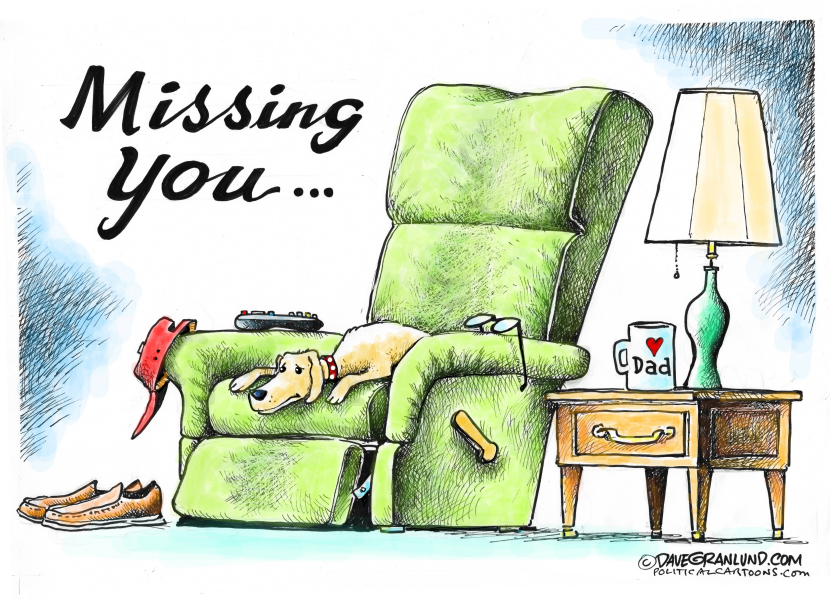
New technologies enable people to live longer even if they have chronic diseases, so they are in and out of hospitals — as my dad was the past five months.

Today we’ve become disconnected from death, Warraich said.

We’ve moved death from our homes and communities to hospitals and nursing homes – where four of five Americans now die.

When my father’s father died at only 34 in 1937, he died in his own bed of streptococcus, now easily cured with penicillin, and was laid out in the parlor of his house.

We’d hoped my father would meet his end peacefully in his own home.

After repeated visits to the hospital and skilled nursing facilities, we brought him home and hired our own care.

We celebrated his 89th birthday at his home a few weeks ago in epic fashion. A glorious event, it was attended by the large extended family he and my mother produced.

When his time finally came, he was back in the hospital, but he was surrounded by his family and his wife of nearly 66 years.

As advances in technology change the way we live and die we are becoming fearful of death — yet it’s something every one of us is going to experience.

I’m honored to say that my sisters and mother and I fully embraced my dad’s life and supported him with everything we had in his last painful months.

Knowing he’s at peace now quells the hurt of watching him suffer so much for so long.

I believe he is in Heaven now, reunited with his parents, and I believe I will see him again.

I will wait patiently for that grand reunion.

“How are you doing?” is the question of the moment.

I wish you the very best if you are in your end stage of life now or caring for someone you love who is — as you navigate the challenges of dying in modern times.

Copyright 2022 Tom Purcell, distributed exclusively by Cagle Cartoons newspaper syndicate.

Tom Purcell, creator of the infotainment site ThurbersTail.com, is a Pittsburgh Tribune-Review humor columnist. Email him at [email protected].
Comments Off on End-of-life challenges in modern times

On Winning the Lottery

I bought my first lottery ticket recently.

It was a $20 scratch-off that paid me a $40 prize.

Winning produced a nice little thrill, so I bought another $20 ticket right away. And lost.

I put out $40 to win $40 that day.

I’ve bought three $20 scratch-offs since then and won nothing.

To date, I’ve paid out $100 to win $40.

The house always wins in the end.

Still, some people enjoy big paydays playing the state-sponsored lotteries.

I know a fellow who hit twice for over $100,000 or so. That would be a nice little bump, to be sure.

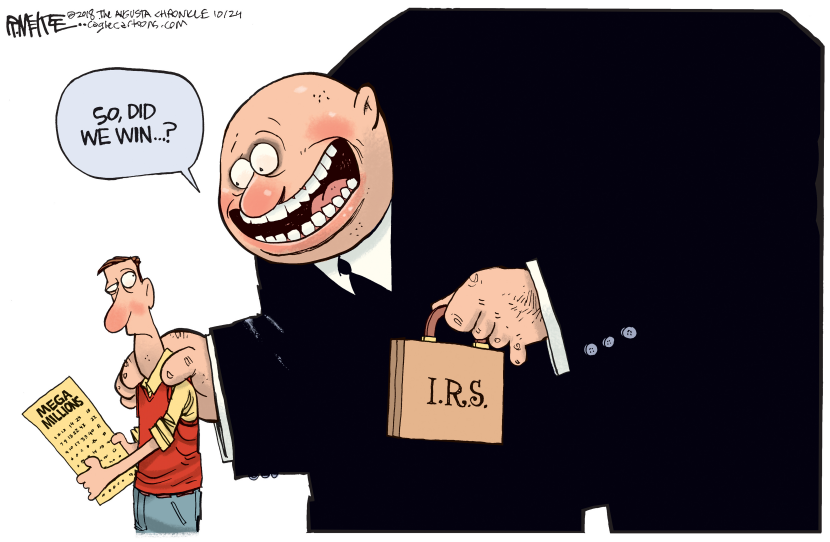
Of course, winning $100,000 offers a teachable moment for many who have no idea how high our taxes really are.

According to one lottery-tax-calculation website, I’d have to pay about $33,000 in state and federal taxes right off the bat.

However, the feds take only 24% out of the initial lottery payment. I’d still owe more taxes, as that $100,000 would put me into much higher tax bracket.

I’d probably get to keep about $60,000 of that $100,000 and the government would get $40,000.

The house always wins in the end!

Then there is the dark side of government-sponsored gambling that isn’t talked about enough. A fair bit of the revenue generated by the lotto is generated by people with addiction issues, according to Florida Council of Compulsive Gambling.

When big payoffs hit the news, as has been the case in recent weeks, there is a surge of people spending money they don’t have to buy lotto tickets.

And the lotto has announced some big winners in recent weeks.

One poor human being holds the winning ticket in Illinois for a $1.28 billion payout.

I say “poor human being” because if that person has neighbors or relatives he’s been trying to avoid, he’d better plan on spending lots of time with them, as they’ll be pounding on his front door at all hours begging for a handout.

One had better be prepared to manage the massive burden all that money will soon visit on him — and better hire a skilled accountant and attorney for starters.

If he manages that massive payoff well, he can do a lot of good for the world — support a lot of legitimate charities — and maintain a comfortable lifestyle for the rest of his days.

Or that money will be the root of all evil in his life, as no small number of past lottery winners have experienced.

Yahoo Finance tells the stories of 23 lottery winners whose lives spiraled out of control after winning big payouts, some of whom ended up broke or worse.

In any event, one thing that fascinates me about money is that we don’t need so much of it as we think.

As I’ve written before, once a person has enough money to pay the bills and enjoy going out to dinner now and then, massive increases in wealth do not necessarily correspond with greater increases in happiness or life satisfaction.

The key to human happiness is spending time with people we love, who love us back — people who value our presence even though we’re not million-dollar-lotto winners.

In my case, I suppose a few scratch-off tickets does no great harm every now and then — and funds some good programs for those in need.

Just so long as I remember that the house always wins in the end!

Copyright 2022 Tom Purcell, distributed exclusively by Cagle Cartoons newspaper syndicate.

Tom Purcell, creator of the infotainment site ThurbersTail.com, is a Pittsburgh Tribune-Review humor columnist. Email him at [email protected].
Comments Off on On Winning the Lottery