Take our daughters and sons to grandma’s

“Take Our Daughters and Sons to Work Day” is on April 25th, and I think we should try something different this year: Let’s take our daughters and sons to grandma’s.

The Take Our Daughters and Sons to Work Day Foundation says that April 25th is designed to be more than just a career day — more than the practice of “shadowing” an adult in the workplace.

It’s equally important to show children “the value of their education, helping them discover the power and possibilities of work and family life…”

It’s about “providing boys and girls a chance to share how they envision the future, and allowing them to begin steps toward their goals in a hands-on and interactive environment…”

I couldn’t agree more. That’s why we need to take our kids to grandma’s this year.

Look, it’s important to prepare our children for their work future, so they may make good livings to provide for themselves and their families — people without skills that are valuable to employers are especially struggling right now as food and housing costs continue to soar.

But let’s remember that work is not everything and that having a career in a big corporation is not all it is cracked up to be — not when you factor in corporate politics, the occasional nasty person who makes everyone else’s working life unpleasant, and that your corporate employer will happily drop you in your peak middle-aged earning years in favor of someone younger, who will work for half the cost.

The truth is, the most important lessons about becoming a successful adult are best taught by grandma.

Grandma will take her grandchildren for a nice walk in the woods in the sweet spring air, showing them different plants and flowers and how to steer clear of poison ivy.

She’ll tell them stories about colorful and cherished family members who have passed on — especially grandpa, who she made a wonderful life with during 66 years of marriage.

She’ll tell them what life was like when she was a child, long before there was a smartphone in every pocket — long before noise and chaos were wreaking havoc on the minds of today’s children.

She’ll tell them how simple childhood used to be. That a child’s job is to play — to nurture the imagination and grow and develop the mind.

Grandma, after all, is the only person on earth who knows the difference between what is and isn’t really important in this fleeting life, and she knows that nobody ever left this world wishing they’d spent more time at the office.

Yes, developing marketable skills is important and children should be taught such lessons.

But as our culture becomes increasingly rude and so many hearts are becoming so rigid and hard, it’s equally important to teach kindness, compassion, manners and how all of us should treat others the way we wish to be treated.

Grandma can teach these life skills better than anyone.

Now that I think of it, maybe we should make “Take Your Daughters and Sons to Grandma’s” its own special day every spring!

Copyright 2024 Tom Purcell, distributed exclusively by Cagle Cartoons newspaper syndicate.

See Tom Purcell’s syndicated column, humor books and funny videos featuring his dog, Thurber, at TomPurcell.com. Email him at [email protected].

Comments Off on Take our daughters and sons to grandma’s

A good month to prevent distracted driving

“It wasn’t my fault the car in front of me hit me. I glanced at my text message for only a second when our bumpers collided.”

“How could the car in front of you hit you?”

“The idiot stopped to let a deer cross the street — and dented my front bumper with his rear bumper. Yet the cops wrote me up for texting while driving!”

“It’s because of people like you that April has become National Distracted Driving Awareness Month! Safety advocates are urging drivers like you to avoid texting or watching streaming video on their phones, while behind the wheel of their cars!”

“A whole month to make people aware of the risks of distracted driving?”

“That’s right. The National Highway Traffic Safety Administration says 3,522 people were killed in traffic crashes involving a distracted driver in 2021, and an estimated 362,415 people were injured.”

“Look, I’m in sales and on the road a lot. I’ve gotten pretty good at talking, eating, texting and driving. It wasn’t my fault some idiot front-ended me.”

“That’s simply not true. According to The New York Times, a Michigan professor found that when someone tries to multitask, important neural regions in the brain must switch back and forth. This opens up opportunities for serious mistakes behind the wheel.”

“But it’s not my fault my wife wants immediate answers when she texts me!”

“Look, our roadways have changed significantly over the years. For starters, many of our cars are so comfortable and quiet, people forget they’re operating a two-ton hunk of steel. They’re able to zone out to music or yap on the phone, oblivious to the millions of things that could go wrong.”

“But I invested a lot of dough in my sound system. It would be a waste not to blast the speakers!”

“To make matters more challenging, there are lots more cars on the road. According to Forbes, more than 97% of American households have one car and nearly 23% have three or more!”

“So we’re a rich country. What’s wrong with that?”

“It only means that there are lots more drivers on the road — drivers of every age and experience level. We know, for instance, that teen drivers are distracted more easily than older drivers — especially when their peers are in the car with them.”

“My wife and I solved that problem. We got our daughter a ’76 Pacer. She never leaves the house.”

“That’s funny. The point is, the more distracted drivers there are on the road, the greater the opportunity for accidents. And add to that challenge a mix of ever-changing technologies — smartphones, iPads, laptops and GPS devices — and you have a recipe for disaster.”

“You make some good points.”

“Look, many people are wary of the government intervening in our lives, but there is wide agreement that this is one area where the government needs to intervene. Many states have implemented distracted driving laws and with good reason.”

“OK, I agree with you and I’ll stop texting while driving. But please know that my driving skills are widely admired by other drivers. They even praise me when I cut them off!”

“They do?”

“Why else would they keep giving me the ‘You’re No. 1’ finger gesture?”

Copyright 2024 Tom Purcell, distributed exclusively by Cagle Cartoons newspaper syndicate.

See Tom Purcell’s syndicated column, humor books and funny videos featuring his dog, Thurber, at TomPurcell.com. Email him at [email protected].

Comments Off on A good month to prevent distracted driving

Insights from great minds on Taxes

Wise and witty thoughts are the only things that bring me any solace during tax-filing season — thoughts, such as these:

“The best way to teach your kids about taxes is by eating 30% of their ice cream.” (Bill Murray)

“What is the difference between a taxidermist and a tax collector? The taxidermist takes only your skin.” (Mark Twain)

“It’s fitting that April 14 is National Pecan Day, because it is the day we recognize nuts, and April 15 is the day we pay our taxes to support them.” (Craig Ferguson)

Billy, that’s a great idea. Mark, let’s not forget that the tax collector also skins our wallets. And, Craig, you explain well why our tax system is nutty.

Our country’s founders had plenty to say about taxes:

“What at first was plunder assumed the softer name of revenue.” (Thomas Paine)

“I cannot lay my finger on that article of the Constitution which granted a right to Congress of expending, on objects of benevolence, the money of their constituents.” (James Madison)

“It would be a hard government that should tax its people one-tenth part of their income.” (Ben Franklin)

Hey, Tom, Jim and Ben, you’d be shocked at the level of plunder, “benevolence” and taxation that’s going on. The only Americans who enjoy an income tax around 10 percent these days are those who moved to Russia.

The great leaders of the 20th century — the century that brought us the 16th Amendment and the income tax — have different takes on taxation:

“We contend that for a nation to try to tax itself into prosperity is like a man standing in a bucket and trying to lift himself up by the handle.” (Winston Churchill)

“Government’s view of the economy could be summed up in a few short phrases: If it moves, tax it. If it keeps moving, regulate it. And if it stops moving, subsidize it.” (Ronald Reagan)

“Taxes, after all, are dues that we pay for the privileges of membership in an organized society.” (Franklin Delano Roosevelt)

Hey, Frankie, I prefer fewer taxes, as Churchill and Reagan did. I don’t mind paying my dues for organized society, but any thoughts on when we might get one?

Here are more quotes that remind me of our slick-talking politicians:

“Congress can raise taxes because it can persuade a sizable fraction of the populace that somebody else will pay.” (Milton Friedman)

“Did you ever notice that when you put the words ‘the’ and ‘IRS’ together, it spells “THEIRS?” (Unknown)

“We must care for each other more, and tax each other less.” (Bill Archer)

Well, Bill some of our politicians think the way to care for each other more is to tax us more. And because some Americans fail to understand that there aren’t enough “rich” to tax and that “tax the rich” is code for “tax everyone more,” our taxes shall go up — and our government will get a bigger share of “theirs.”

Ah, well, there’s little to do the next few weeks except commiserate with others who are suffering tax woes. This quote perfectly sums up how millions are feeling right now:

“The wages of sin are death, but after they take the taxes out, it’s more like a tired feeling.” (Paula Poundstone)

Copyright 2024 Tom Purcell, distributed exclusively by Cagle Cartoons newspaper syndicate.

Learn more about Tom’s syndicated column, humor books and funny videos with his dog, Thurber, at TomPurcell.com. Email him at [email protected].

Comments Off on Insights from great minds on Taxes

Message for my digital goddaughter

My 13-year-old goddaughter still can’t understand how telephone busy signals used to work.

She can’t help it.

At 13, she’s a member of the Gen Alpha generation, kids born between 2010 and 2024, which is the first generation to NOT know what life was like before social media and artificial intelligence were everywhere.

I tried to explain that before call waiting was commonplace in the mid-1980s, a caller would get a busy signal if a phone line was being used.

When I was in high school, I told her, we only had one telephone line. My father, a Bell Telephone man, installed five heavy-duty phones in our house, but all of them were connected to a single landline.

When someone called us, the ringing brass bells created such a hullabaloo, it sounded like someone was breaking into the Fort Knox Bullion Depository.

But the bells didn’t ring often, because, between my mother and five sisters, somebody was always tying up the line.

When I needed a ride home after football practice, I placed a dime into the pay phone, turned the rotary dial with my finger and was then greeted by an annoyingly loud buzzer that suggested: Loser! Try again!

This silly story illustrates the stark contrast between the innocent childhood I experienced as a tail-end Baby Boomer and the all-digitized childhood she is experiencing as a Gen Alpha.

Modern childhood is fraught with digital landmines.

According to The American Academy of Child and Adolescent Psychiatry, children between 8 and 12 spend 4 to 6 hours a day using digital devices, such as smartphones, while teens spend up to 9 hours.

AACAP says unmonitored children are likely to be exposed and influenced by risk-taking behaviors, sexual content, substance use, negative stereotypes, misinformation and advertising aimed at motivating a child to buy or act.

It’s no wonder, according to AACAP, that children exposed to too much screen time suffer things like sleep problems, lower self-esteem, too little face-to-face social interaction with family and friends and less time outdoors enjoying physical activity.

Research psychologist Dr. Jean Twenge says that a surge in Gen Z mental health issues is the direct result of the rise of smartphones and social media, which began in earnest in 2012.

“Happiness started to decline, life satisfaction declined, expectations went down,” Dr. Twenge told the New York Post. “Depression went up, and this pessimism really took root among young people.”

She says the hyper-connectivity of social media proved to be an unmitigated experiment for Gen Z — and also an unmitigated disaster for nurturing our most anxious and unhappy generation yet.

Twenge and others argue that all parents need to unite and make sure their kids are not exposed to social media too early.

Parents also need better tools to monitor and regulate their kids’ social media usage and she says the government must play a bigger role, giving them more robust tools to monitor and restrict the content children are able to access.

The debate around regulating social media and, now, AI, is going to be robust, as it should be – especially since we already know that unfettered social media has damaged one generation.

I called my goddaughter to warn her about the perils of social media, but she never answers.

Apparently, talking on the phone is something only a “pre-millennial” dork would attempt to do.

Copyright 2024 Tom Purcell, distributed exclusively by Cagle Cartoons newspaper syndicate.

Purcell, creator of the infotainment site ThurbersTail.com, which features pet advice he’s learning from his beloved Labrador, Thurber, is a Pittsburgh Tribune-Review humor columnist. Email him at [email protected].
Comments Off on Message for my digital goddaughter

Still living the American dream

A growing number of Americans think the American Dream is out of reach, but I think they are wrong.

According to a recent Wall Street Journal poll, only 36% of voters said the American Dream still exists, way fewer than the 53% who believed so in 2012.

Half of the poll’s respondents believed that America’s economic and political systems are “stacked against people like me.”

These are troubling findings, but I think more of our native-born non-believers need to start dreaming — and acting — like American immigrants.

Many immigrants still believe hard work will help them get ahead in America and ensure that their kids will have the opportunity to really flourish in the land of the free.

I met many such wonderful people while living in Washington, D.C.

I knew one fellow, who came to America from a small Irish village to work as a butler. He married and started a family.

To improve his income, he began selling insurance. By his 40th birthday, he had raised enough capital to start his own highly successful Irish pub — one that afforded him a fantastic living.

I knew two brothers from India who owned a convenience store and sandwich shop. The older brother had been a professor at a technical school in his homeland.

But because his English was not yet strong, he had trouble finding similar academic work in America.

He didn’t complain. He took whatever job he could — busboy, cook, janitor — and saved every penny. He used his savings to bring his wife here, and then, one at a time, his five siblings.

He and his brother eventually saved enough to buy a convenience store, then a motel. He was in his late 50s when I met him. Last time I saw him a decade ago, he’d been offered $6 million for the land upon which his convenience store sat.

But here’s how he really achieved his American dream: Both of his American-born sons became doctors.

I rented an apartment from another fellow who had been born in Beirut, Lebanon, where his father had two businesses and his family was well off. Then civil war tore their country apart. His family lived in a bombed-out building for three years before they were able to make their way to America.

We were the same age, and our childhoods could not have been more different. When we were both 14, I was enjoying long bike hikes in the quiet suburbs — and he was dragging dead bodies into a pile to burn them, because the stench was unbearable.

When his family was finally able to escape to America, they were broke. He took a job as a janitor. His siblings took on menial work. The family saved $20,000 and used the money to open a bakery. He is now the president of a bakery that, last I checked, employs more than 150 people.

Look, despite inflation, high interest rates and anti-entrepreneurial regulations, the American Dream is still alive and well for anyone willing to work for it.

In fact, the Washington Post says more Americans than ever are starting their own businesses.

I’m one of those dreamers, who, at 61, just started another business creating humorous cybersecurity learning content. This is on top of another thriving business in the short-term apartment business and, of course, the column- and book-writing business.

Business is good. And my American Dream is alive and well.

Copyright 2024 Tom Purcell, distributed exclusively by Cagle Cartoons newspaper syndicate.

Purcell, creator of the infotainment site ThurbersTail.com, which features pet advice he’s learning from his beloved Labrador, Thurber, is a Pittsburgh Tribune-Review humor columnist. Email him at [email protected].

Comments Off on Still living the American dream

Missing my Irish ancestors

Piglet! My Irish surname means piglet!

Like millions of Americans, I’ve been poking into my heritage using ancestry sites, such as FamilySearch.com.

That’s how I learned that “Purcell” is an occupational name of Norman origin for “swineherd.”

My name derives from the Norman-French word “pourcel,” which comes from the Latin word “porus,” which means piglet!

I always thought my heritage was mostly Irish and German, but I’ve just learned I’m part British, French and Scandinavian?

OK. Now I understand why I love jokes that begin like this: “An Englishman, a Frenchman and a Scandinavian walk into a bar…”

Until I started my research, all I knew about my heritage was that my great grandfather, Thomas James Purcell, came over from Ireland in about 1885.

He got a laborer job in the steel mills and met his bride, Jane Shappey, at a saloon near the mills that her family ran.

Jane’s family had also immigrated to Pittsburgh around the 1880s. They came from Alsace-Lorraine when she was a child, and the Shappeys proudly considered themselves French, not German.

Jane and Thomas’s union produced eight children, seven daughters and one son, my grandfather, also named Thomas James Purcell.

Jane suffered much grief in her 79 years. She lost three daughters, one as a child and two in their 20s, a young grandson and her husband.

She also lost her only son, my grandfather, who died from strep throat in 1937 when she was 65 and he was only 33.

Despite the significant losses, Jane — better known as “Grandma Purcell” — was a live wire and her house was always full of laughter.

During the Great Depression, several adult family members and their children lived together in her big house on Orchlee Street.

They made their own hooch in a bathtub distillery, and her grandchildren would tell me years later how they played for hours in the large fruit cellar in the basement.

I never got to meet Grandma Jane Purcell or any of her children, with the exception of her last surviving daughter, Helen, who doted on me when I was a boy, because I must have reminded her of her little brother, my grandfather.

Helen had two sons, Jack and Tom, who threw magnificent family parties over the years — Christmas gatherings, graduation parties, family reunions, weddings and other events.

It was there I got to mingle with my large extended clan, each of us owing our very existence to our immigrant ancestors, Thomas and Jane.

What a mix of salt of the earth characters and excellent citizens, neighbors and family caretakers did Thomas and Jane produce!

All of their wonderful children and grandchildren are gone now, with the exception of Judy, the daughter of Thomas and Jane’s youngest daughter, Eugenia.

I get wistful every year around St. Patrick’s Day, as I miss so many beloved family members who have departed.

I get especially wistful about the love story of my dad, also named Thomas James Purcell, and his bride, Elizabeth, who had five daughters and one son, yet another Thomas James Purcell (that would be me!) — as well as 17 grandchildren and 10 great grandchildren and counting.

My mother is the current holder of the “Grandma Purcell” title and her house has long been a place of incredible laughter and joy for the wonderful cast of characters she and my father produced.

Her reign, too, will one day pass, but I’m filled with joy to know that younger generations will pick up her mantel.

That means only one thing will agitate me as I muse about my heritage every year: My surname means piglet!

Happy St. Patrick’s Day!

Copyright 2024 Tom Purcell, distributed exclusively by Cagle Cartoons newspaper syndicate.

Purcell, creator of the infotainment site ThurbersTail.com, which features pet advice he’s learning from his beloved Labrador, Thurber, is a Pittsburgh Tribune-Review humor columnist. Email him at [email protected].

Comments Off on Missing my Irish ancestors

No brainer

Get this: Men and women’s brains are different.

Using a powerful, first-of-its-kind artificial intelligence model, Stanford Medicine was able to determine with a 90% success rate whether or not an MRI scan of human brain activity was coming from a male brain or a female brain.

“The findings, the investigators suggest, help to resolve a longstanding controversy about whether reliable sex differences exist in the human brain,” reports Genetic Engineering & Biotechnology News.

Controversy?

I grew up an only boy with five sisters. My father and I figured out more than half a century ago that men and women have innately different brains.

However, prior to about 20 years ago, according to Stanford Medicine Magazine, the neuroscience community thought the difference in male and female brains was due to cultural influences.

You know, the old argument that boys like toy trucks because toy trucks are pushed on them as children and little girls like dolls because dolls are pushed on them.

But in the early 2000s those claims were disabused by a variety of studies, according to Psychology Today that, put simply, showed the circuitry in male and female brains is wired differently and these innate differences result in different behavior.

It’s not to say a male brain is better than a female brain, or vice versa.

But Stanford Medicine Magazine says that women generally have greater reading and writing abilities than men.

They’re also better at retrieving information from their long-term memory — especially everything we’ve done wrong since the moment we met them.

A 2014 University of Pennsylvania study found that females routinely use both sides of their brains in a highly coordinated manner, whereas men often use only one.

Women would be shocked if they knew how many things we use only half a brain to do.

For example, one study found that the male brain doesn’t pick up as many sensory cues as a woman’s.

When a man walks into his home, for example, he isn’t likely to notice dust — which, I’m told, consists of fine, dry particles that settle on furniture.

That’s one reason men do one-third as much housework as women, according to Fast Company — and also why, according to the great humorist P.J. O’Rourke, we clean our place about once every girlfriend.

The male brain also has superior visual-spatial awareness. We’re better at navigation, creating and using tools or understanding abstract concepts, such as geometry.

Our noggins are wired for larger spaces, such as the garage, the backyard, the golf course, or, some ancient time ago, hunting wooly mammoths out in the wild with our buddies.

Sure, some men are neat freaks and homebodies and some women are sloppy and couldn’t care less about the inside of their homes.

But on average, where biology is concerned, it’s clear male and female brains are different.

For instance, notes Stanford Medicine, why are women more prone to suffering depression, while men are twice as likely to have issues with drugs and alcohol and 10 times more likely to suffer dyslexia?

Personally, I think a man is at his best when he finds a lifelong companion whose female brain is strong in multiple ways in which his is weak.

Look, surely we can all agree we don’t need an MRI to know that men and women have different ways of thinking.

To borrow from legendary humorist Dave Barry, we all know which parent is more likely to drive off from the supermarket with the baby still in the baby seat he had set on the roof of the car.

Copyright 2024 Tom Purcell, distributed exclusively by Cagle Cartoons newspaper syndicate.

Purcell, creator of the infotainment site ThurbersTail.com, which features pet advice he’s learning from his beloved Labrador, Thurber, is a Pittsburgh Tribune-Review humor columnist. Email him at [email protected].

Comments Off on No brainer

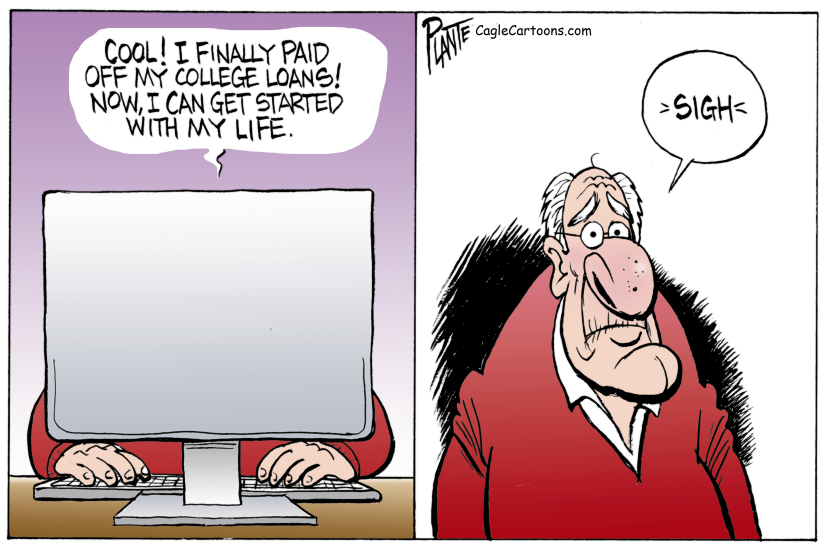
Will forgiving college debt win or lose votes?

President Biden recently sent an email to 153,000 student-loan borrowers reminding them to vote for him this autumn.

Actually, his email said that he is going to put America into even more hock to repay the college loans they had willingly taken out years ago.

Putting it bluntly, his email said that the millions of Americans who repaid their student loans, or worked two or three jobs to minimize their college borrowing, or who never went to college at all, must cover the debt of 153,000 people who did.

As it goes, last summer, the Supreme Court said Biden’s ambitious $20,000-per-student college loan-forgiveness plan — which would have cost the rest of us $420 billion — was unconstitutional.

Not to worry, Biden’s staff quickly went to work looking for other avenues to relieve student-loan debt.

They looked for wiggle room in a law that was passed nearly 60 years ago, the Higher Education Act, that they said gives the Secretary of Education the ability to waive student-loan debt.

That bureaucratic trick gave them the authority to forgive debt for the 153,000 people enrolled in the income-driven SAVE program — Saving on a Valuable Education — who originally borrowed $12,000 or less and have made payments for at least 10 years.

Of course, the program doesn’t “save” anything. It simply transfers the bill for about $1.2 billion to the rest of us.

To date Biden boasts he has “saved” $138 billion for 3.9 million borrowers.

But those savings are tacked right onto our $34 trillion national debt that, thanks to the reckless spending of both parties in Washington, is on track to hit $54 trillion in 10 years.

Which brings us back to the student-loan situation.

The New York Times shares the story of Biden visiting the home of one student-loan borrower, 49-year-old educator Eric Fitts.

The middle-aged elementary school principal, who still owed $125,000 in college loans, told Biden “how much of a burden it was and how much of a barrier it was for certain things and opportunities,” reports the Times.

I feel for Fitts. Debt is unpleasant. But why didn’t he consider the consequences of all that debt BEFORE he willingly signed the paperwork to borrow it and promise to pay it back?

Why didn’t millions of other young Americans – or their parents — think things through before they took on a cumulative $1.7 trillion in student-loan debt?

I’m not sure how this student-loan situation is going to play out come voting time.

On one hand, no small number of able-bodied young people feel it is not their responsibility to pay off the college debt they willingly took on. They will vote for the candidates who promise them more forgiveness.

On the other hand, I’m betting a lot more people who did make great sacrifices to repay their college debts are not only angered at being forced to repay other people’s loans, they’re worried about this country’s financial future.

They’re worried that millions of Americans feel no shame about letting others relieve them of their financial responsibilities — and that millions couldn’t care less about America’s runaway spending and debt.

They’ll likely vote against candidates like Biden who are trying to buy their votes with their own taxpayer contributions.

Then, again…

Hey, Joe, if you cut me a check for the $15,000 in student loans and interest I paid back years ago, I’ll consider giving you my vote!

Copyright 2024 Tom Purcell, distributed exclusively by Cagle Cartoons newspaper syndicate.

Purcell, creator of the infotainment site ThurbersTail.com, which features pet advice he’s learning from his beloved Labrador, Thurber, is a Pittsburgh Tribune-Review humor columnist. Email him at [email protected].

Comments Off on Will forgiving college debt win or lose votes?

Reading more books is good for America

When I read about the “silent book club” trend, it filled me with instant calm and hope.

As it goes, in 2012, two friends in San Francisco came up with the idea for a non-formal social event in which book lovers can gather at a coffee house or pub, then read together in silence for an hour or so, after which they may discuss any thoughts about what they are reading and socialize.

There is something very special about being immersed in a great work of fiction or nonfiction that brings about a peacefulness and enrichment that few other activities can bring.

A deep dive into someone’s life story, economics, history, the cosmos or so many other curiosities in our incredibly rich world not only makes us calmer, but it improves our ability to think and concentrate and become wiser and more open to the thoughts of others.

Goodness knows we need more free-thinking in these highly-agitated and partisan times.

Book reading has been in decline for a long time because it must compete with other forms of entertainment.

I remember seeing author Kurt Vonnegut, whose colorful writings are still enjoyable, talking about this challenge to book reading with other now-deceased authors on a talk-show clip on YouTube that must be 40 years old.

He said that until radio came along, books were the only form of entertainment for most people, particularly in the winters when there was nothing else to do in the evening but read.

Radio and TV offered alternatives to reading. And now social media, streaming TV, podcasts and so much more have really put a dent into our book reading.

According to a 2022 Gallup survey, the average American reads about 12 books a year, two or three books fewer than 20 years prior.

However, the steepest decline, according to Gallup, is among people who had been the most avid readers — college graduates but also women and older Americans.

“College graduates,” Gallup found, “read an average of about six fewer books in 2021 than they did between 2002 and 2016, 14.6 versus 21.1.”

To me this is concerning because book reading improves your ability to concentrate and focus — skills that especially need to be nurtured at a time when attention spans are also in steep decline, as millions jump from one short TikTok or Instagram video to another.

Why is this concerning?

Because concentration and intelligence go hand-in-hand.

The ability to evaluate ideas and delineate between ideas that are silly and false and ideas that are effective and true is important in any democracy.

If we lose the ability to see through bunk, we are at risk of electing officials who put their personal gain before the good of the republic.

Concentration and clear thinking are also important to engaging in thoughtful conversation with others who hold different ideas than our own — and books can nurture our ability to get back to more thoughtful discussions.

Gathering together to read, talk and socialize is as good an idea as I’ve heard in a long time. I am hungry for such camaraderie.

Besides, I’ve got a stack of classic books I’ve been meaning to get to that include Mark Twain, O’Henry, James Michener and Mary Shelley.

Did you know Shelley wrote her famous Frankenstein work when she was only 18?

Now there’s an anecdote to share at a silent book club gathering.

Copyright 2024 Tom Purcell, distributed exclusively by Cagle Cartoons newspaper syndicate.

Purcell, creator of the infotainment site ThurbersTail.com, which features pet advice he’s learning from his beloved Labrador, Thurber, is a Pittsburgh Tribune-Review humor columnist. Email him at [email protected].

Comments Off on Reading more books is good for America

The loveless state of modern romance

With all the changes modern life is bringing us, here’s one that makes me sad: romance is dying.

Here are some interesting romance trends, as reported in CNN health:

– The percentage of Americans who don’t have a steady partner is up 50% since 1986.

– Americans are less likely to have sex than at any point since 1989.

– Fewer Americans are celebrating Valentine’s Day now than they did at the end of the 2000s.

Psychology Today reports that millennials between the age of 27 and 42 are “resisting entering into serious relationships because they may involve love.”

“With many millennials up to their ears in college debt and children of divorced parents, love is often perceived by members of that generation as a luxury they cannot afford, or as a foolish enterprise on which to embark,” says Psychology Today.

It’s heartbreaking to see so many people so cynical at such a young age. Their lack of hopefulness is costing them so many opportunities, including the opportunity to experience lasting love.

Pursuing lasting love is risky. It means you must open yourself up to the possibility of tremendous hurt.

But as the great poet Tennyson wrote, “Tis better to have loved and lost than never to have loved at all.”

Love is one of the strongest feelings or emotions a human can know, yet strong feelings have been on the outs since the early 1970s, according to Manhattan Institute scholar Kay S. Hymowitz.

A Wall Street Journal article she wrote in 1995, notes Psychology Today, argues that strong feelings, such as love, became frowned upon as far back as the early 1970s, partly as a result of the feminist movement.

Terms such as “boyfriend,” “girlfriend,” “dating” and “commitment” started losing favor, as they limited one’s personal freedom.

Fast forward to 2024 and the “rigid” past in which couples courted with the end goal of marriage has given way to a meaningless hookup culture that robs individuals of experiencing a deep, lasting, highly-satisfying connection with another human being.

We need only examine modern love songs to see how well the hookup culture is working out.

Consider the lyrics to Dean Martin’s 1953 hit song, “That’s Amore.”

When the moon hits your eye like a big pizza pie
That’s amore
When the world seems to shine like you’ve had too much wine
That’s amore

The longing for an innocent, romantic love was very strong in 1953, when my mother and father were courting — their love story still fills their offspring with tremendous joy and satisfaction.

How do Dino’s innocent, hopeful lyrics compare with those of modern love songs? Let’s take a look at Billboard’s top three “Hot 100 Songs” for 2023:

Number 1: “Last Night,” by Morgan Wallen, shares the details of a whiskey-fueled argument a fellow had with his girlfriend, who slammed the door in his face on the way out.

Number 2: “Flowers,” by Miley Cyrus, is about a woman who leaves her man and convinces herself she doesn’t need him because she can hold her own hand and love herself better than he can.

Number 3: In “Kill Bill,” by SZA, a woman plots to kill her ex and vows that his new girlfriend is going to be next!

Well, there you have it.

Modern love songs capture well the sorry state of romance in 2024.

And now you know why the death of romance is making me so sad.

Copyright 2024 Tom Purcell, distributed exclusively by Cagle Cartoons newspaper syndicate.

Purcell, creator of the infotainment site ThurbersTail.com, which features pet advice he’s learning from his beloved Labrador, Thurber, is a Pittsburgh Tribune-Review humor columnist. Email him at [email protected].

Comments Off on The loveless state of modern romance