Maybe the Real Fredo Wasn’t So Dumb After All

“Fredo has a good heart but he is weak…and stupid.” – Michael Corleone

Poor Fredo. Poor, poor Fredo.

First, he’s talked into double-crossing his own brother.

“I know it was you, Fredo. You broke my heart. You broke my heart.”

Then his brother disowns him.

“Fredo, you’re nothing to me now. You’re not a brother. You’re not a friend. When you see our mother, I wanna know a day in advance so I won’t be there.”

And then he goes on a one-way fishing trip.

“I ordered the death of my brother. He injured me. I killed my mother’s son. I killed my father’s son.”

Now, his very name is being misinterpreted as a racial/ethnic slur.

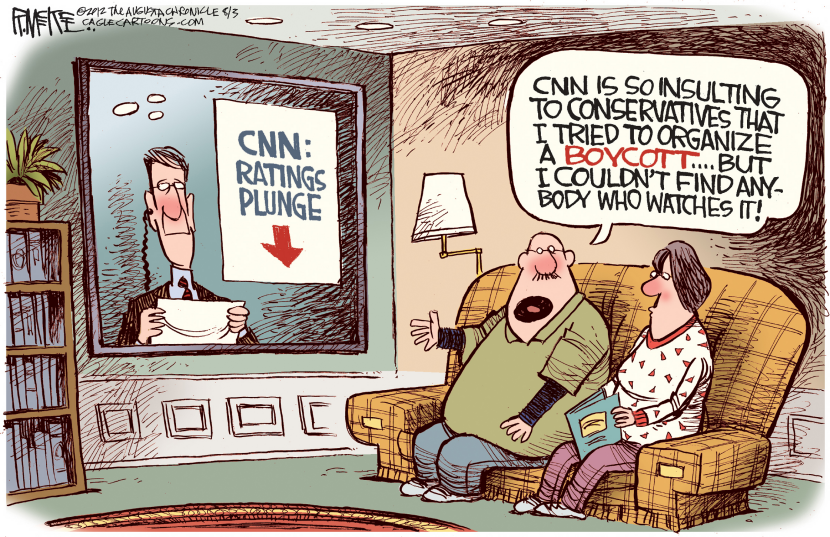
Someone with a camera saw CNN anchor Chris – “Are you talking to me?”- Cuomo at a New York bar and called the younger brother of New York Governor Andrew Cuomo, “Fredo,” Michael Corleone’s simple, younger brother in The Godfather.

The video went viral, not because of the “Fredo” reference but because of Cuomo’s reaction. The newsman didn’t exactly dismiss the insult as if he were shooing away an annoying fly.

“No, punk-ass b–es from the right call me ‘Fredo.’ My name is Chris Cuomo. I’m an anchor on CNN,” Cuomo responded. “‘Fredo’ was from ‘The Godfather.’ He was a weak brother and they use that as an Italian slur — are any of you Italian?… It’s a f—ing insult to your people. It’s an insult to your f–kin’ people. It’s like the N-word for us. Is that a cool f—ing thing?”

Chris – paison, bubula (I’m one-quarter Jewish so I’m covered) – take it easy. I know we Italians are known for our passion and quick temper, but your blood pressure, son!

“Fredo” is not a racial or ethnic slur. If it is, it’s news to me. I just think it means, as Donald Trump Jr. pointed out, that you’re the meathead younger brother. That’s all. No need to get all worked up. Even the real Fredo understood that much.

“I can handle things. I’m smart. Not like everybody says, like dumb.”

I’ve never been called “Fredo” probably only because I don’t have an older brother. But I have been called a moron and an idiot, among other things, on a fairly regular basis. It’s not so bad.

Years ago, when I was working as a reporter for the Fox TV station in Philadelphia, some guy I had never seen before called me a “pompass a– dago. Now, that’s an ethnic slur.

In this case, Cuomo was giving the guy with the camera exactly what he wanted so he continued to taunt him.

“You’re a much more reasonable guy in person than you seem to be on television,” he said to Cuomo.

“If you want to play, we’ll f—ing play,” the anchorman responded. “If you’ve got something to say about what I do on television, then say it, but you don’t have to call me a f—in’ insult.”

A little later, he threatened to throw the guy down the stairs.

I think I speak for most, if not all Italians, that if someone called me Fredo, I would assume he meant that I’m a dope. Not sure why Cuomo went with the racial/ethnic defense right out of the box.

Yes, the outburst was over the top. But maybe he got caught in an unguarded moment, with his family, some jerk is trying to trigger an outburst and Cuomo takes the bait. The video, by the way, had more than 3.4 million views by Tuesday.

And, of course, Twitter erupted, with President Donald J. Trump, who never passes on bait, leading the chorus.

“I think what Chris Cuomo did was horrible. His language was horrible, he looked like a total out-of-control animal. He lost it, and frankly, I don’t think anybody should defend him because he spews lies every night.”

Trump can’t stand Cuomo because of his politics and Cuomo hammers Trump on CNN night after night. These two won’t be ordering a margarita with two straws.

So, to recap, we have some guy with a phone trying, and succeeding, to get under the skin of a network news anchor, who responds with a profanity-laced tirade, to which the president of the United States responds by calling the news anchor an “animal.”

Of all the characters in this whole drama, the real Fredo is starting to look pretty sharp.

Rich Manieri is a Philadelphia-born journalist and author. He is currently a professor of journalism at Asbury University in Kentucky. His book, “We Burn on Friday: A Memoir of My Father and Me” is available at amazon.com. You can reach him at [email protected].

Comments Off on Maybe the Real Fredo Wasn’t So Dumb After All
Self- Examination Would Be a Good Start in Response to Mass Shootings

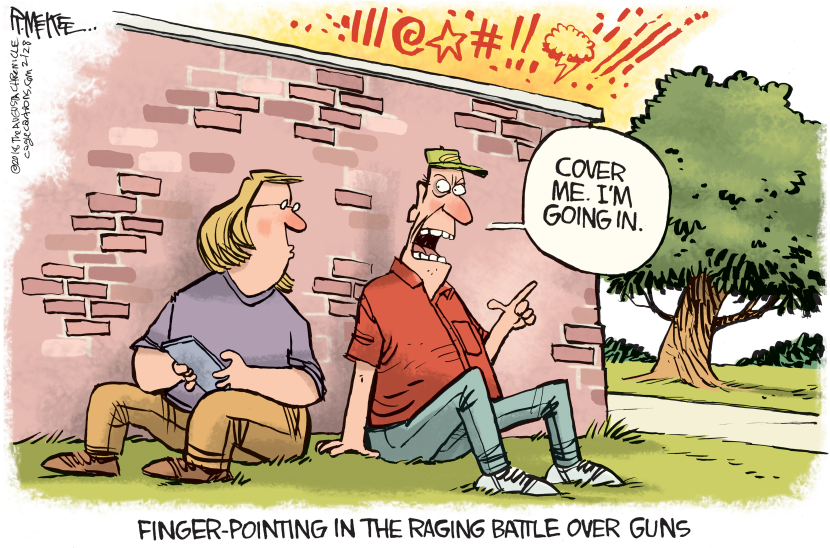
If the circumstances weren’t so awful, the predictability of the response would almost be laughable.

Every mass shooting inspires new calls for gun control, as politicians and pundits retreat to their partisan bunkers and lob blame where they believe it will do the most damage.

I believe in the Constitution, though I don’t view every piece of legislation designed to keep firearms out of the hands of criminals or the unstable as a slippery slope toward repeal of the Second Amendment.

It seems pretty naive to think that someone bent on mass murder is going to forget the whole thing because he can’t get his hands on a particular weapon. Criminals tend to be resourceful. Timothy McVeigh killed 168 people in Oklahoma City and never fired a shot.

“Assault weapon” is a made-up political term designed to expand the list of firearms that gun control proponents believe should be banned. The AR-15, which is a hunting rifle, falls into this category. It fires one round at a time, like a pistol or a revolver. It can fire about 50 rounds in a minute as opposed to a fully automatic, military issue carbine which fires about 1,000 rounds per minute. The U.S. banned the sale of new, fully automatic weapons in 1986.

You want to ban the AR-15? Fine. There are tens of millions of legally-owned AR-15s in the U.S. And keep in the mind that the man responsible for the deadliest school shooting in American history – Virginia Tech in 2007 – used two handguns.

So-called “red flag” laws, which President Trump supports, and more expansive background checks make sense. Seventeen states already have a red flag laws, which allows for a court order to prevent someone deemed a danger to himself or others from having access to a firearm.

That’s a start, though it will be difficult to move forward, mostly because of the shameful politicization of the issue. Within minutes of the shooting in El Paso, Democratic presidential candidates were blaming the president.

If that’s the case then perhaps we should blame the left for the Dayton shooter who, according to published reports, was a socialist, gun control advocate and Elizabeth Warren supporter. We can also blame the left for the man who shot up a Washington D.C. baseball field and tried to kill several Republican members of Congress in 2017. The shooter once worked for Bernie Sanders. Or maybe we can blame President Obama and his criticism of police for inspiring a gunman to kill five cops in Dallas in 2016.

I don’t buy it.

And the reality is that while mass shootings understandably generate the most attention, we’re killing each other in ways and places that inspire a conspicuous lack of outrage.

Since the infamous clock tower shooting on the University of Texas campus in 1966, there have been 165 mass shootings in the U.S., according to an analysis by the Washington Post. For purposes of the analysis, a mass shooting is defined as one in which four or more people are killed by a single shooter. The analysis does not include domestic or gang-related incidents.

Using the Post’s criteria, 1,196 people in the U.S. have been killed in mass shootings since 1966.

In 2018, the number of homicides – by firearms or otherwise – in Chicago, Philadelphia and Baltimore totaled 1,223.

Over the weekend in Chicago, 53 people were shot, seven killed. You probably haven’t heard much about it.

I’m more interested in why we’re killing each other wholesale, on a daily basis, rather than how we’re doing it.

Perhaps we need to look deeper than the simplistic explanations – political rhetoric, social media, video games, the availability of firearms – and consider a society in which people are willing to take lives without considering the impact or the consequences.

We dismiss the presence of evil in the world until a massacre reveals it in neon. And soon after, we dismiss it again.

We foster a culture of victimhood, where our dissatisfaction with life is always someone else’s fault.

We lack empathy for those who disagree with us.

We value revenge over forgiveness.

We talk about diversity only as it relates to physical characteristics; never diversity of thought or opinion.

We allow our children to retreat into the isolation of virtual world, devoid of genuine human interaction.

We fight the rule of law and wonder why our young people don’t respect authority.

We dethrone God and exalt ourselves.

As Christians, we do a great job of telling people what they shouldn’t be doing and a lousy job of showing them Jesus.

Yes, the one who pulled the trigger is ultimately responsible and accountable.

Maybe the rest of us need to look in the mirror.

Copyright 2019 Rich Manieri, distributed by Cagle Cartoons newspaper syndicate.

Rich Manieri is a Philadelphia-born journalist and author. He is currently a professor of journalism at Asbury University in Kentucky. His book, “We Burn on Friday: A Memoir of My Father and Me” is available at amazon.com. You can reach him at [email protected].
Comments Off on Self- Examination Would Be a Good Start in Response to Mass Shootings

Ultra-Progressivism Leading Dems Down the ‘Maintenance Hole’

I have a long history of dumb ideas.

It was my idea buy a used, 1999 diesel Volkswagen Beetle. There’s a reason you don’t see many of them on the road today.

It was my idea, as a boy, to play darts near our old gas furnace. How was I supposed to know a dart could puncture a gas line? The fire department was wondering the same thing.

And it was my idea to put a pan of burning oil under a running faucet. The little mushroom cloud that followed generated a surprising amount of black smoke.

Expect for the dart incident – for which half the block was evacuated – my dumb ideas have been generally victimless, unless I count myself as a victim.

When governments come up with dumb ideas and create laws to support them, the consequences can range from insignificant to far-reaching.

For example, in the city of Wells, Maine, it’s illegal to advertise on your tombstone. Fortunately, someone had the foresight to see that cemeteries would eventually be an untapped marketing resource.

Neither Republicans nor Democrats have the market cornered on bad and/or dumb ideas. American history is replete with legislation aimed at scoring political points with various constituencies.

But lately, progressives have been outdoing themselves.

One of my favorite wacky proposals is the “Freedom Dividend,” courtesy of tech mogul and Democratic presidential candidate Andrew Yang. He wants to give every American between the ages of 18-64 $1,000.00 a month for doing absolutely nothing. It’s a massive, wealth-redistribution proposal that would be paid for by – surprise – raising taxes, including a 10 percent Value Added Tax (VAT) on just about all goods and services.

As part of her Green New Deal, Rep. Alexandria Ocasio-Cortez has also promised economic security for anyone “unable or unwilling” to work. The “unwilling to work” line was on her website until she walked back the verbiage and took it down. She still wants to give away money for nothing but she’s just calling it something else.

Ocasio-Cortez’s Democratic colleague, Rep. Rashida Tlaib, has proposed that the federal minimum wage be raised to $20 per hour. Why stop there? Why not just raise it to $50? The result will be the same – scores of small business will either go under or be forced to lay off employees.

And in a moment that might have raised the bar for political pandering to new heights, New York City mayor and Democratic presidential candidate Bill DeBlasio – while attending the parade for the U.S. women’s national soccer team – promised to sign an executive order requiring equal pay for male and female athletes. That sounds great as a platform talking point but it’s much more complicated than proponents would have you believe. For starters, the men’s World Cup generated $6 billion last year. This year’s women’s World Cup took in about $131 million. Thus, the disparity in prize money.

But for a real-life glimpse at ultra-progressivism, I take you to Berkeley, California, a city that bills itself as a bastion of free thought, at least until someone with an unpopular opinion shows up and trash cans start flying through windows.

The Berkeley City Council recently voted to eliminate gender-specific language from its municipal codes. The measure passed unanimously.

Among other things, this means that the word “manhole” will be replaced with “maintenance hole.” “Manpower” is now “human effort.” A “pregnant woman” is a “pregnant employee.” Sororities and fraternities are now “Collegiate Greek system residence.”

We can have a long discussion about gender neutrality versus the obvious uniqueness of men and women. The movement by progressives to eliminate gender-specific language is a lot of things – disturbing, unnecessary, perhaps even dangerous. It’s also incredibly silly.

Surely there are Democrats out there who find this kind of stuff equally silly, though they’re very quiet about it.

And as long as they remain silent while the party’s hijacking to socialism continues, it’s going to become increasingly difficult to convince voters – especially independents – that the Democrats are a viable alternative to the status quo.

What will this ultimately mean to the Democrats’ chances of winning the White House in 2020?

Yes, right down the maintenance hole.

Copyright 2019 Rich Manieri, distributed by Cagle Cartoons newspaper syndicate.

Rich Manieri is a Philadelphia-born journalist and author. He is currently a professor of journalism at Asbury University in Kentucky. His book, “We Burn on Friday: A Memoir of My Father and Me” is available at amazon.com. You can reach him at [email protected].
Comments Off on Ultra-Progressivism Leading Dems Down the ‘Maintenance Hole’

If Only President Trump Would Channel George Costanza

My father once told me, “Sometimes, doing nothing is doing something.”

It’s a little Yogi Berraesque, but it makes a lot of sense when you really think about it.

This, of course, is not President Donald Trump’s philosophy of life.

He’s more of a tweet-tweet-and-tweet-some-more kind of a guy.

Trump sees social media, Twitter in particular, as a way to deliver his unfiltered thoughts directly to the masses without dealing with what he believes – and correctly so – is a media establishment that can’t stand the sight of him. Not a bad strategy if the person tweeting doesn’t have the temper of Yosemite Sam.

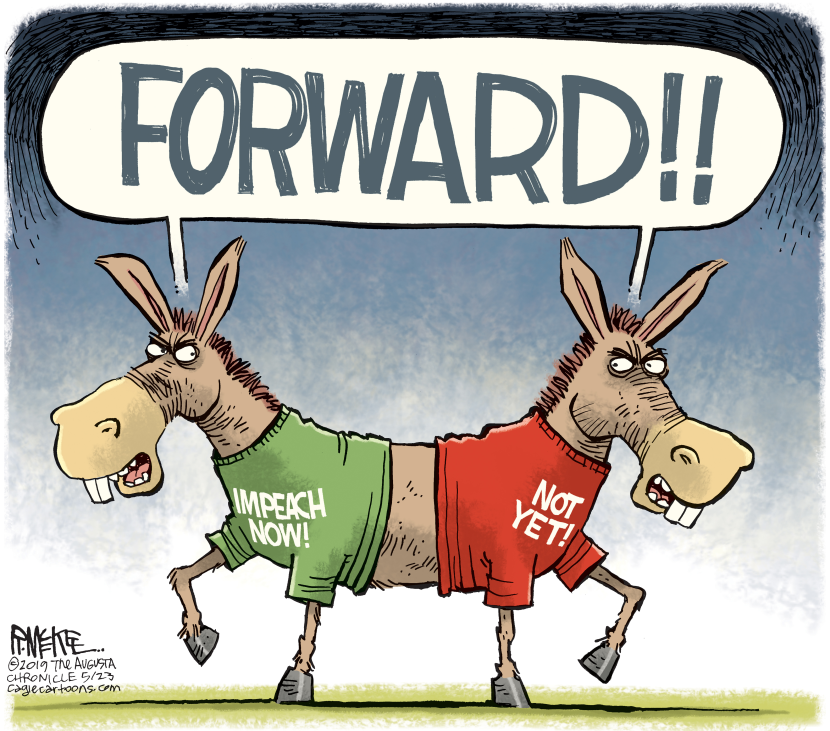
Last week, the Democrats were taking turns poking each other in the eye. It was great theater and the beauty for Trump and the Republicans was they didn’t have to do anything other than sit back and watch the Democrats unravel.

By way of background, four progressive/socialist congresswomen without any truly serious ideas, a group the media calls “The Squad” – Reps. Alexandria Ocasio-Cortez, Rashida Tlaib, Ilhan Omar and Ayanna Pressley – are fighting with House Speaker Nancy Pelosi for control.

The Squad appears hell-bent on taking the party farther and farther to the left until eventually doing a Thelma and Louise off the precipice.

If only the president would channel George Costanza.

“Everybody’s doing something. We’ll do nothing!”

Instead, while the Democrats were sowing chaos, and thereby doing everything possible to ensure another Trump victory in 2020, Trump fired off one of his trademark Sabbath tweets, apparently aimed at The Squad.

“So interesting to see “Progressive” Democrat Congresswomen, who originally came from countries whose governments are a complete and total catastrophe, the worst, most corrupt and inept anywhere in the world (if they even have a functioning government at all), now loudly.and viciously telling the people of the United States, the greatest and most powerful Nation on earth, how our government is to be run. Why don’t they go back and help fix the totally broken and crime infested places from which they came.”

There are a lot of things wrong with the tweet, not the least of which is three of the congresswomen, with the exception of Omar, who was born in Somalia, “originally came from” the United States.

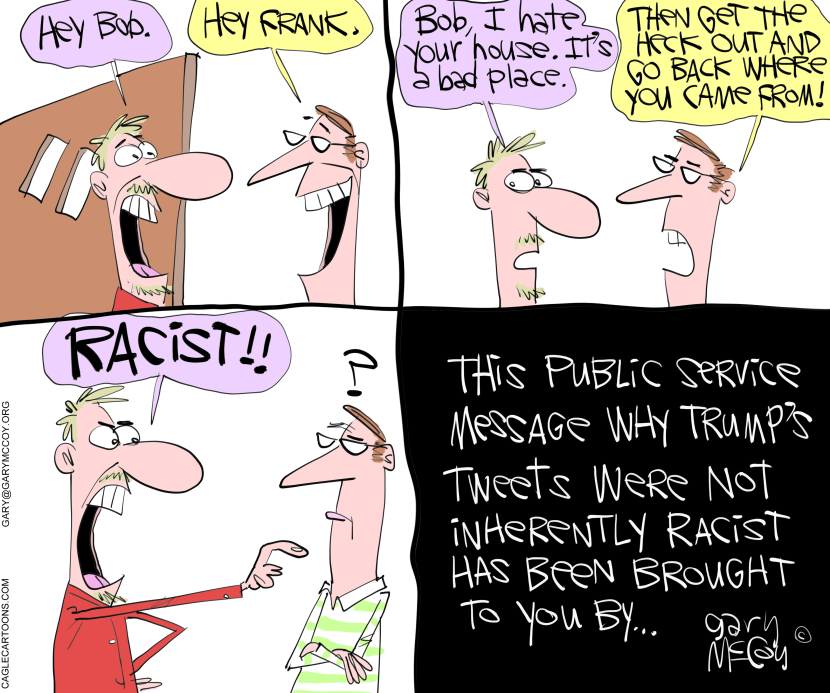
The media have spent the last few days referring to Trump’s “racist tweets.”

There’s a difference between racist and dumb, as Andrew McCarthy wrote this week in National Review.

“Is it ‘racist’ to tell people who have contempt for the country – who abhor the common culture that makes us American – that they ought to go back to where they came from?” wrote McCarthy. “It has nativist and reactionary overtones, but I don’t think it is racist.”

Nevertheless, the tweets seemed a gift to the Democrats, courtesy of their nemesis in the White House.

The tweets did bring Democrats together, united them against a common foe – for about half an hour.

By Tuesday, The Squad and Pelosi were making fists at each other once again.

In an interview with CBS, Tlaib called out Pelosi to “acknowledge the fact that we are women of color…” insinuating that Pelosi’s criticism of The Squad was somehow racially motivated.

The reality is that Pelosi has enough sense to know that if the progressive/socialist wing of the Democratic Party continues to gain traction, Trump will win re-election in a walk.

We know that Trump will never be content to simply observe while the Democrats destroy themselves. Trump is not apologizing for his Sunday tweets and we know there will be more tweets and, in response, more selective, moral outrage.

In the midst of all of this bickering about who’s the bigger racist, we long for a voice of reason.

Is there someone out there who can restore order? Who can bring decorum back to our political discourse?

Joe Biden. Yes, that Joe Biden.

On Tuesday, the former vice president and current presidential candidate challenged Trump to a push-up contest. Biden appeared to be joking but who really knows anymore.

Either way, it’s a fantastic idea.

Who doesn’t want to see two major political figures, in their seventies, stripped down to their skivvies, trying to max out?

No, this wouldn’t prove anything, would be a complete waste of time and would ultimately amount to nothing.

Count me in.

Copyright 2019 Rich Manieri, distributed by Cagle Cartoons newspaper syndicate.

Rich Manieri is a Philadelphia-born journalist and author. He is currently a professor of journalism at Asbury University in Kentucky. His book, “We Burn on Friday: A Memoir of My Father and Me” is available at amazon.com. You can reach him at [email protected].
Comments Off on If Only President Trump Would Channel George Costanza

The Dismantling of Joe Biden

I don’t know Joe Biden personally. I do know a lot of people who move in the same circles as the former vice president and by all accounts, Biden is a decent person; genuine, affable, earnest.

I disagree with Biden on most political issues and I wouldn’t vote for him at gunpoint,but I don’t believe he is a lech, a racist or a homophobe.

Yes, he does have a gaffe habit that is killing is presidential candidacy, one misspoken phrase at a time, but he deserves better from his own party and from a media that have decided he’s no longer a horse worth backing.

Biden is the closest thing that passes for a moderate among a phalanx of Democrats who want to turn the U.S. into Sweden, Finland, Cuba or any place where the words “personal liberty” are about as elusive as the Loch Ness monster.

Biden has stepped in it twice recently. Actually, he’s stepped in it more than that but let’s look at a couple of examples.

At Pride fundraiser last weekend, Biden was trying to tout progress on gay rights when he said how, just five years ago, “it was acceptable to make fun of a gay waiter.”

And then in a Rainbow PUSH Coalition event Biden, talking about race relations, said, “That kid wearing a hoodie may very well be the next poet laureate and not a gangbanger.”

Awkward? Yes. Unartful? Absolutely. I’ll even give you cringeworthy. There are times when watching Biden in a public forum is like watching a stand-up comedian bomb on stage. You might not like the act but you can’t help but feel compassion for the guy. He’s dying up there!

Of course, compassion is rationed with an eye-dropper in politics. Biden’s opponents in the presidential race, who knew full well what the former vice president was trying to say, quickly pounced on his comments.

During last week’s televised debate, California Sen. Kamala Harris said to Biden, who has also been chastised for his past position against busing desegregation when he served in the Senate in the 1970s, “It was hurtful to hear you talk about the reputations of two United States senators who built their reputations and career on the segregation of race in this country.”

Harris also reminded Biden that she had been bused to school as part of an integration program.

About the hoodie comment, New Jersey Sen. Cory Booker told NBC’s “Meet the Press,” that Biden “is causing a lot of frustration and even pain with his words.”

The “let’s-get-Joe-out-of-the-way” strategy seems to be working.

As of July 1, Biden’s lead against the Democrats’ cast of thousands had shrunk to only five points. We know what polls are worth 16 months before an election and a lot of this is just plain old political eye-gouging.

But I think it also reveals a broader issue.

If you don’t agree that Biden is a moderate because there is no such being among Democrats, I can’t come up with much of a defense. However, among the rest of the Democratic presidential candidates in the 2020 field, Biden is the outlier.

He served in the Senate in another era, when bipartisanship still existed and civility, even in politics, was more than some ethereal notion.

Biden’s opponents, who want to take the country farther to the left than it has ever been, realize that his moderate tendencies make him more electable. He is a threat. Therefore, he must be silenced, marginalized, and eventually destroyed.

Yes, Biden is often his own worst enemy. His history of gaffes goes back four decades. Just do a Google search and you’ll find several highlight reels of Biden’s best, or worst, “foot-in-mouth” and malaprop moments.

Remember this classic from 2006?

“You cannot go to a 7-Eleven or a Dunkin’ Donuts unless you have a slight Indian accent. I’m not joking.”

Like I said, cringeworthy. But mean-spirited or destructive? No, nor do such comments reflect how he might lead the country.

But there’s no room in today’s Democratic party for a moderate. Biden shouldn’t feel bad about that. There’d be no room today for J.F.K. or Harry Truman either.

Democrats like to call this “progress.” But whether you like Biden or not, destroying someone who has spent 45 years in public service doesn’t seem very progressive.

Copyright 2019 Rich Manieri, distributed by Cagle Cartoons newspaper syndicate.

Rich Manieri is a Philadelphia-born journalist and author. He is currently a professor of journalism at Asbury University in Kentucky. His book, “We Burn on Friday: A Memoir of My Father and Me” is available at amazon.com. You can reach him at [email protected].

Comments Off on The Dismantling of Joe Biden

It’s Moving Day Again

There’s something about the sound of an empty house.

You walk room to room and your footsteps seem to echo as you take inventory of each vacant space.

I did it again, just last week.

I counted and it was the fourteenth move of my adult life. That’s a lot.

Because we are in the midst of the busiest moving season of the calendar year, I thought it appropriate to raise some universal truths about moving, not the least of which is that everyone hates it.

I have yet to speak to anyone who has recently gone through a move and said, “You know, that was really fun. I hope to do it again soon.”

Moving is always a grueling emotional and physical exercise. And something always goes wrong, usually several things but always at least one thing.

It started early this time. I had rented a small trailer to haul all of my worldly belongs. When I went get the trailer, the manager tested the lights after he hooked it to my vehicle.

“Left turn signal!” he shouted, as I flicked levers and pushed buttons.

“Hazard lights!”

Nothing.

“Hazard lights!” he yelled again.

The hazard lights on the trailer weren’t working for some reason.

“Come back into the office and we’ll redo your contract.”

For a second, that sounded kind of intriguing. I thought that maybe I was getting a raise or something. As it turned out, my new contract was the same information on a different piece of paper because I needed another trailer.

The office was packed with other do-it-yourselfers renting trailers and vans. It has always struck me as odd that any schmo – and I’m including myself – can walk into one of these rental places, show a driver’s license, a drive away in a 26-foot truck. Shouldn’t there be some kind of competency test or something?

As an aside, I am blessed to be able to afford to hire movers. I simply choose not to. I come by this tendency naturally.

For example, my father refused to pay for parking, not because he couldn’t afford it but because he didn’t believe that parking should be a monetary transaction. My old man would walk seven miles in a hurricane before he’d pay five bucks to park.

Thus, as long as I’m able to carry stuff without really hurting myself, I’ll go it alone.

But faulty hazard lights are small potatoes compared to some of my past moving complications.

Once, the day before a move, my car was stolen from in front of my house.

Another time, a friend of mine and I were moving a dresser up a winding staircase when it got stuck between the second and third floors.

I was helping that same friend move out of his apartment a few months later and we were moving an enormous, marble tabletop down the stairs. Since it was round and, after all, like a wheel, we thought we would just kind of roll it down the steps. Of course, this approach ignored the laws of physics and once that massive, marble top collected some momentum, there was no stopping it from rolling right through the wall.

One time, a couple of days before a move, my neck went out.I was working in TV news at the time and a colleague and I were driving to a story when I suddenly couldn’t turn my head.

The colleague with whom I was riding that day is a gifted videographer and friend I’ve known for 30 years. I’ve since helped Brad with a move and he showed up to move me out of my house a few days ago. We pay each other in cheesesteaks.

As self-appointed foreman of this most recent operation, Brad had license to comment on some of the items he found boxed and bagged for transport.

A package of ramen noodles, for example. Several boxes of tea that belonged to my daughter, who recently moved to Colorado.

“Since when to do you drink tea?” he asked. I don’t.

And a catcher’s mitt.

“Why in the world do you need a catcher’s mitt?”

A fair question and one to which I didn’t have a good answer. I don’t need one but that catcher’s mitt has made all of my fourteen moves and I’m not letting it go now.

Funny thing is, I really don’t collect anything. I’m kind of a minimalist. I don’t like clutter.

But there’s something about moving that makes you want to hang onto little pieces, no matter how insignificant they might seem.

I suppose that’s why I walk room to room whenever I leave a place for the last time.

I want to remember what each room looked like, who was there, the conversations.

And as I walk, I hear the echoes. Always the echoes.

Copyright 2019 Rich Manieri, distributed by Cagle Cartoons newspaper syndicate.

Rich Manieri is a Philadelphia-born journalist and author. He is currently a professor of journalism at Asbury University in Kentucky. His book, “We Burn on Friday: A Memoir of My Father and Me” is available at amazon.com. You can reach him at [email protected].

Comments Off on It’s Moving Day Again

Magic Mushrooms and Pay Raises

What’s the correlation between hallucinogens and a proposed pay raise for members of Congress? I think we all know the answer to that, but let’s review.

Rep. Alexandria Ocasio-Cortez (D-N.Y.) wants to spend taxpayer money to make it easier for researchers to study the benefits of psychedelic drugs, including magic mushrooms, peyote and anything else that could potentially have therapeutic value.

It’s not the worst idea I’ve heard, though that bar is pretty low, or high, as the case may be.

To be sure, there are valid reasons to explore the use of what the government labels “Schedule I” drugs – including marijuana – in the treatment of PTSD, chronic pain and end of life care. Of course, as soon as illegal substances are deemed legal for therapeutic purposes, it’s only a matter of time until the push to make them legal for recreational use. In fact, it has already happened. Oakland and Denver recently decriminalized the use of psychedelic mushrooms. Recreational use of marijuana is now legal in 11 states.

For those not familiar with the side effects of hallucinogenic shrooms – the only mushrooms I use are in pasta sauce – we might want to pause before moving forward any further.

In a May 10 opinion piece in The New York Times, Michael Pollan, who has written books on the uses of psychedelic drugs as is largely a proponent, issues a warning.

“Someone on a high dose of psilocybin (mushrooms) is apt to have badly impaired judgment and, unsupervised, can do something reckless.”

Getting into an automobile comes to mind.

Politics are also at play here. Surprise. Legalization plays well on the left and there is a fairly sizable constituency out there that really doesn’t care very much about the therapeutic use of psychedelic drugs and will support any candidate who makes it easier for those so inclined to get loaded.

But we can debate the moral and practical implications of further anesthetizing our population some other time.

For now, I’ll do you one better.

Let’s start the research immediately, in Congress, with the compulsory serving of a course of magic mushrooms at the opening of each session.

We’ve already tried this sober.How much worse can stoned be?

Perhaps some mind-altering fungi would mellow everyone out. Maybe the next time one of our lawmakers – pick one, on either side – starts shrieking about some hot-button issue – pick one – some lightly toasted legislator in opposition will defuse the angry discourse.

“Dude. Relax. Have a mushroom. Just enjoy the pretty colors.”

Think about it. Mitch McConnell shows up for work wearing a tie-die shirt and a headband. Nancy Pelosi is playing the sitar. Groovy.

You could make the argument that Ocasio-Cortez has already visited a shroom shop or two based on her recent proposal to raise pay for members of Congress.

House Democrats, realizing that any inkling they are even considering giving themselves a raise will be as popular as poison ivy, tabled the issue pending further discussion.

“It may be politically convenient, and it may make you look good in the short term for saying, ‘Oh we’re not voting for pay increases,’ but we should be fighting for pay increases for every American worker,” Ocasio-Cortez said.

Members of Congress make about $174,000 a year. Senior members earn more.

Say what you want about Ocasio-Cortez but she’s not short on ideas. Sure, her ideas are mostly awful but at least she’s trying.

As long as we’re talking about ideas that have gone nowhere, about a year ago, Rep. Clay Higgins (R-La.) proposed a resolution that would allow for random drug testing for members of Congress. Another less-than-terrible idea.

“I have observed some behavior that would cause one to wonder,”, Higgins told USA Today.

It would be perversely comforting to dismiss political dysfunction in Washington as simply a matter of spiked brownies in the break room, or if the Senate Judiciary Committee meeting room looked like a scene from “Up in Smoke.”

However, we have to face the reality that our lawmakers have been at their tea-totaling, clear-headed, stone-cold sober best while bringing us to this state of government inertia.

I’m not sure what to say about that other than pass the mushrooms.

Copyright 2019 Rich Manieri, distributed by Cagle Cartoons newspaper syndicate.

Rich Manieri is a Philadelphia-born journalist and author. He is currently a professor of journalism at Asbury University in Kentucky. His book, “We Burn on Friday: A Memoir of My Father and Me” is available at amazon.com. You can reach him at [email protected].

Comments Off on Magic Mushrooms and Pay Raises

Bill Buckner: One Moment Didn’t Make the Man

Bill Buckner was a terrific baseball player.

He played 20 years in the Major Leagues, collected 2,715 hits, hit for an average of .289 and won a batting title.

The most money Buckner ever earned in a year, according to Baseball Reference, was $785,000. That’s walking-around money for a player with similar credentials today.

And, by all accounts, Buckner was a good man; self-effacing, honest, hard-working.

Yet, when Buckner died this week at the age of 69, after battling Lewy body dementia, you couldn’t read or watch a story that didn’t focus on the single mistake by which many have tried to define him. At the same time, in the great irony of ironies, the same news media that spent the remainder of Buckner’s life using his name as a synonym for failure, released a spate of stories pointing out the injustice of defining the man by one World Series gaffe.

If only more of these stories had been produced while Buckner was still alive.

Buckner did not cost the Boston Red Sox the World Series in 1986. Yes, a grounder rolled through his legs in Game Six to allow the New York Mets to score the winning run. There was still a Game Seven, but the Red Sox couldn’t pull themselves out of the fallout from the previous night’s meltdown, most of which had nothing to do with Buckner. And most of which no one outside of Boston remembers.

Boston took a 5-3 lead into the bottom of the tenth inning and was one out away from its first World Series championship. Three singles and a wild pitch later, Buckner’s moment came.

“I’ll have to live with this,” Buckner said after the game. “I was having a lot of fun until that. Great game tonight. I haven’t let many get through me like that. Can’t remember the last game I lost that way. I wish it hadn’t been a World Series game.”

Had Boston rallied and won the following day, no one would have remembered Buckner’s gaffe. Instead, the play dogged Buckner. We wouldn’t let him forget or move on. The unrelenting replays, the discussions, the questions.

To a certain extent, this is what professional athletes and entertainers sign up for. Failure and scrutiny are part of the job. That’s fair.

What wasn’t fair was accusing Bucker of singlehandedly losing the World Series and worse, making him a symbol of ineptitude for the next three decades.

Until the Red Sox finally won their first World Series in 2004, Buckner became an easy target for an angry Boston media that associated him with failure and the so-called “Curse of the Bambino,” a silly superstition with roots going back to 1919 when the Red Sox traded Babe Ruth (nicknamed “The Bambino”) to the Yankees.

While the media haranguing bothered him, Buckner never ran from his error. In fact, he even found a way to laugh about it and to make others laugh with him.

Buckner appeared in an episode of Larry David’s “Curb Your Enthusiasm” in 2011. In the episode, Buckner comforts David, who let a ball go through his legs during a championship softball game. Later, Buckner makes a diving catch of a baby tossed out of the window of a burning building.

“Very sweet, kind man,” David told Mike Lupica in a May 27 story for mlb.com. “There was something about him that made me feel for the guy. What an awful thing to go through.”

We all have our bad moments. The difference between Buckner and the rest of us is that we don’t have to watch our worst moment over and over again, and hear it discussed and debated by strangers for the next 30 years.

What we do have in common with Buckner, however, is the same choice. What do we do with our worst moments? Do they make us angry or bitter? Do we allow them to define us? Or, do they make us better?

“In my heart, I had to forgive the media for what they put me and my family through,” Buckner said in 2008. “I’ve done that. I’m over that. I just try to think of the positives, the happy things, the friendships.”

Buckner made his peace with the media and the fans. He threw out the first pitch for the Red Sox season opener in 2008 and received a two-minute standing ovation.

Buckner refused to let one play on a baseball diamond define his life or measure his worth. He suffered unjustly for his error. But in its aftermath came his greatest victory.

Copyright 2019 Rich Manieri, distributed by Cagle Cartoons newspaper syndicate.

Rich Manieri is a Philadelphia-born journalist and author. He is currently a professor of journalism at Asbury University in Kentucky. His book, “We Burn on Friday: A Memoir of My Father and Me” is available at amazon.com. You can reach him at [email protected].
Comments Off on Bill Buckner: One Moment Didn’t Make the Man

For ‘Frankie Smacks’ and the Friends He Lost

They called him “Frankie Smacks.”

I didn’t know why until the first time he gave me a haircut.

After Frank was finished cutting your hair, he’d snatch the towel from around your neck, give you a playful but hard smack on the back of the head and say, “OK, get outta here!”

I think Frank liked me right way because I was Italian. Frank was all Italian.,He was short – 5’5″ maybe – but stock and sturdy, always tan in the summer, and bald, save for patches of gray on his temples. Frank looked like every old man from the South Philly neighborhoods where my mother and father grew up.

His wife’s name was Mary; his “best girl.” She called the shop frequently and Frank talked about her even more frequently. The secret to a good marriage, he said, is “Don’t be an idiot!’

I first met Frank in the early 1990s when he was running his barber shop in the Chestnut Hill section of Philadelphia. Frank told me – and everyone else who would listen – that he bought the place for 50 bucks in 1940 when he was just 18. He only had $35 at the time so he had to borrow the rest.

But the young barber put his business, and everything else, on hold in 1942. That’s when Frank joined the Marines.

Frank was not reluctant to talk about his experiences in World War II. Frequently, when I came in for a haircut, I would ask him questions about the war because history, and the people who were part of it, interest me.

Frank told me he was part of the fourth Marine division, that he fought on Iwo Jima, that he was wounded, that he had seen things he wouldn’t and couldn’t forget. But he told me these things generally without emotion. He was a tough son of a gun, just telling stories.

At the time, I was a reporter for the local Fox affiliate. I decided to interview Frank for a special report on the 50th anniversary of the end of World War II.

On a summer afternoon in 1995, I showed up with my videographer, Jackie, at Frank’s barber shop, which happened to be empty, except for Frank and a shoebox full of photos.

He gave us the big, Frank welcome, which he gave me every time I came into the shop.

“You need a haircut!” he said to me. “You don’t want to look like a jadrool!” Jadrool is an Italian word for bum. This drew several chuckles from Jackie, who got a kick out of Frank. Frank teased her and she laughed some more.

We set up for the interview, then Frank and I sat down and began to talk.

At first, it was just background information. Then, Frank began to volunteer more about his experiences on “Iwo” as he called it. That’s when he opened the box.

With our camera rolling, he showed me some of the photos he had taken on Iwo, some of the most horrific photos you could ever imagine – dead Americans, dead Japanese, rotting corpses, the smoldering, post-apocalyptic landscape.

He then told me how he was twice wounded, by shrapnel in the chest and by a bullet that went through his leg. He pulled up his pant leg and showed me where the hole had been.

“I could stick my finger right through it,” he said with a grin. Frank received two purple hearts, four Combat Stars, two Presidential citations and a Bronze Star.

Then, I asked him a question. Something like, “Fifty years later, what should we remember about the war?”

Frank looked at me and said nothing for a few seconds. His eyes filled and his voice trembled.

“There were a lot of young guys, like me, who never came home to their families. I lived another 50 years. I’m the luckiest guy in the world.”

Frank ran his barber shop for almost 75 years. He retired in 2013. He died a year later at 91. His beloved Mary had passed in 2001.

As Memorial Day approaches, I always think of Frank, the friends he left on Iwo Jima, and the only time I had ever seen him cry. And I will always remember how we ended our interview.

As tears rolled down his cheeks, he pulled out a handkerchief and blew his nose. He put the photos back in the shoebox and put the lid back on. It was over.

“What else do you need?” he asked.

“That’s all, Frank,” I said. “That’s all.”

Copyright 2019 Rich Manieri, distributed by Cagle Cartoons newspaper syndicate.

Rich Manieri is a Philadelphia-born journalist and author. He is currently a professor of journalism at Asbury University in Kentucky. His book, “We Burn on Friday: A Memoir of My Father and Me” is available at amazon.com. You can reach him at [email protected].
Comments Off on For ‘Frankie Smacks’ and the Friends He Lost

Medal of Honor Recipient’s Legacy Must Survive

Just when I think I’m doing something really important and feeling indispensable, I’m jolted back to reality.

This week, Robert Maxwell provided this service.

Maxwell was a retired auto mechanic with a high school education from Bend, Oregon. He didn’t actually get his high school diploma until 2000. He taught auto shop at a local community college. Maxwell died Saturday. He was 98.

I wonder how many people in Bend, who saw Maxwell in the grocery store or at the gas station, knew his story. I’m sure that by the time he died, a lot of people knew. In fact, he was probably something of a local celebrity.

But outside of Bend, I wonder who knew that, 75 years ago, Maxwell threw himself on a grenade.

He was Corporal Maxwell back then, serving in France for the U.S. Army as a technician who strung telephone wires in battle zones during World War II.

On Sept. 7, 1944, in Besancon, France, Maxwell and his unit were pinned down by heavy machine-gun fire. The Germans, who had closed to within 10 yards of Maxwell’s position, began tossing grenades over a stone fence that Maxwell and his mates were using for cover.

“I could hear it fall right near my feet,” Maxwell said years later in an interview with a local TV station. “I didn’t know for sure where it was. This was between 1 and 2 in the morning. I groped to find it and throw it back, but I knew it was too late to do that. I was already crouched down, but I did have my blanket, shoved it down on my chest and dropped where I was.”

Maxwell was severely injured. He spent the rest of his life without part of his foot.

Maxwell was awarded the Congressional Medal of Honor. There are now only three Medal of Honor recipients from World War II who are still alive. Maxwell was the oldest.

I read a story like Maxwell’s and wonder if I would have fallen on that grenade. I like to think I would have but that’s easy to say knowing I’ll never be in that position.

“Surely what a man does when he is taken off his guard is the best evidence for what sort of a man he is,” C.S. Lewis wrote in “Mere Christianity.”

If who we are is evident by our immediate reactions, we should be ashamed of ourselves.

We have entire media platforms (see Twitter) that allow us to react, lash out, and destroy before collecting our thoughts, much less ourselves.

“If there are rats in a cellar you are most likely to see them if you go in very suddenly. But the suddenness does not create the rats: it only prevents them from hiding,” Lewis wrote.

It’s difficult to have an apolitical discussion about character in America. But if we’re really honest with ourselves, we’ll agree that no political ideology has the market cornered on virtue. If we’re still looking to our elected representatives to restore our collective morality and teach us to be more empathetic, we’re going to be really, really disappointed. And if we’re looking to future generations, we might be looking in the wrong place.

A University of Michigan study in 2011 of 14,000 college students found that “students’ self-reported empathy has declined since 1980, with an especially steep drop in the past 10 years.” The study also indicated that self-reported narcissism was at an all-time high. And that was eight years ago.

And this is why we would do well to remember Robert Maxwell who, whether he realized it at the time or not, demonstrated the “greater love” about which the apostle John writes in his gospel; “to lay down one’s life for one’s friends.”

Maxwell was 24 when he threw himself on that German potato masher. He didn’t have time to think or do much of anything, other than grab a blanket to cushion the explosion. He knew the grenade was going to blow.

In an era of self-glorification, polarization and hyper partisanship, we should consider who we are – before the lights go on in our cellar – and who we want to be.

The memory of a retired auto mechanic from Oregon is a good place to start.

Copyright 2019 Rich Manieri, distributed by Cagle Cartoons newspaper syndicate.

Rich Manieri is a Philadelphia-born journalist and author. He is currently a professor of journalism at Asbury University in Kentucky. His book, “We Burn on Friday: A Memoir of My Father and Me” is available at amazon.com. You can reach him at [email protected].

Comments Off on Medal of Honor Recipient’s Legacy Must Survive