Nanny Bloomberg Wants to Tax the World’s Poor

While erstwhile Republican mayor Mike Bloomberg’s pledge to spend $80 million this year to elect Democrats has garnered headlines, another paternalistic effort of his is less noticed but likely more consequential. Fresh off an embarrassing defeat in Chicagoland, where Cook County repealed a Bloomberg-backed soda tax just weeks after it took effect, the former New York City mayor is going global with his push for regressive soda taxes, with a full-court press aimed at an upcoming September meeting of the United Nations General Assembly.

On June 1, the World Health Organization’s High-Level Commission on Noncommunicable Diseases called for higher alcohol and tobacco taxes, but not soda taxes.Bloomberg, who won’t take “No Tax” for an answer, reacted by creating his own private panel led by former Obama economic adviser Larry Summers and stacked with politicians from around the world who have taxed or heavily regulated soda.Bloomberg’spanel will issue its own report supporting soda taxes to compete with the official UN report when the General Assembly meets to discuss the issue in the fall.

Bloomberg recently made his case for steep, regressive soda taxes in an interview with IMF president Christine Lagarde at the IMF’s spring meetings.

“Some people say, well, taxes are regressive,” Bloomberg said. “Yes they are. That’s the good thing about them because the problem is in people that don’t have a lot of money. And so, higher taxes should have a bigger impact on their behavior.”

“So it’s regressive; it is good,” Lagarde responded. “There are lots of tax experts in the room. And fiscal experts, and I’m very pleased that they hear you say that.”

Bloomberg is so convinced that he knows what’s best for middle and lower income people that he wants to put a painful, punitive tax on soda to, supposedly, save us from obesity.But the actual facts suggest soda is much less responsible for rising obesity than Nanny Mike thinks.

Calories in the average American diet from added sugars in soda are down 39 percent since 2000, and sales of non-diet soda are down 17 percent.Total soft drink calories shipped to schools dropped 90 percent from 2004 to 2010.But obesity rates continued to rise.

————–

On a longer timescale, the USDA found that as the average American increased calorie consumption from 2,024 in 1970 to 2,481 in 2010, 88 percent of the increase came from fat and starch while increased sugar consumption – from all sources – accounted for just 40 calories.

And of course, even though Bloomberg rationalizes that he is taxing the little people for their own good, the economic consequences are no less painful.The tax hits those who can least afford it the hardest, cripples neighborhood stores, and might actually push people to less healthy choices – in Philadelphia, the soda tax made soda more expensive than beer.

Moreover, while the pitch to the public is that soda taxes are a public health measure, the pitch to politicians is something else entirely – that this is a new, attractive source of revenue for government spending.

In fact, one taxpayer-funded study by Harvard and Tufts professors advocating soda taxes noted “tax advocates must take care to match their message with the process… when the process is a ballot issue, success is more likely with a health framing than a budget framing… The politics changes with a city council vote, where more revenue to spend is highly attractive.”

Taxes are always about the money.

Self-styled public health advocates could do a lot more good investing in educating parents, promoting healthier lifestyles, and managing portion sizes than telling people they are incapable of making their own decisions and will be forced to stop drinking soda through steep, regressive taxes.Even if Bloomberg succeeds in getting the United Nations to endorse his soda taxes, that won’t make them any less economically and politically poisonous.

Copyright 2018 Phil Kerpen, distributed by Cagle Cartoons newspaper syndicate.

Mr. Kerpen is the president of American Commitment and the author of “Democracy Denied.” Kerpen can be reached at [email protected].

Comments Off on Nanny Bloomberg Wants to Tax the World’s Poor

Democrat Net Neutrality Plan is Really About Raising Taxes

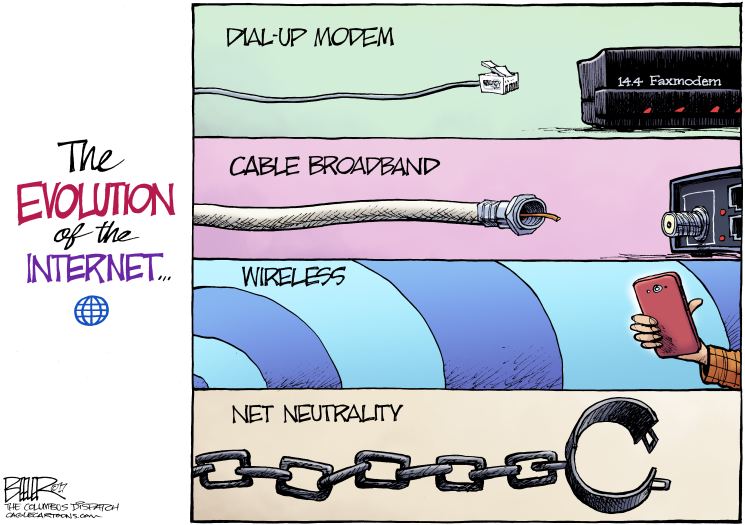
The 2015 Obama FCC order reducing the Internet to a regulated public utility under Title II of the 1934 Communications Act was marketed as protecting net neutrality – even though the DC Circuit Court of Appeals expressly held that any ISP that blocked or filtered web traffic would be completely exempt from the rules.The apocalyptic claims from the left that the repeal of Title II – which took effect on June 11 – would herald the end of net neutrality and the destruction of the Internet are therefore obviously absurd hyperbole.Especially considering that we have simply returned to the same regulatory framework that applied while the Internet grew and thrived for decades until 2015.

So what are the real stakes as Congress considers a partisan Democratic effort to re-impose the Obama public utility order?Taxes and fees.A lot of them. Internet services are protected by federal law from state, local, and federal taxes, but the Title II order reclassified broadband Internet as a phone service which enjoys no such protection. And there is overwhelming evidence that Democrats were waiting until Hillary Clinton won the election (oops) to spring the Title II tax trap.

Current FCC Chairman Ajit Pai explained it in testimony to the Senate back in 2016, when he was a dissenting member of a Democrat-controlled FCC.

“The FCC has already decided to boost E-Rate spending by $1.5 billion per year (conveniently, right after the November 2014 elections),” Pai said. “And it will soon dramatically expand the Lifeline program to subsidize broadband.”

“The money to fund this spending spree will come from a broadband tax.The only question is when,” he continued. “One might reasonably suspect that this decision is conveniently being put off until after the November elections.After all, making people pay more to access the Internet isn’t going to be popular.”

How much would Democratic broadband taxes cost if Title II were restored and a future Democratic FCC moved forward with this plan?

The current universal service fund assessment – which only applies to phone bills – sits at 18.4 percent.It would start as somewhat less than that if the assessment were spread over broadband bills, but over time it would creep up as demands for spending increased – perhaps sharply as public utility regulation would depress private investment, increasing pressure for taxpayer dollars to pick up the slack.

And that’s just the federal component.As a legal matter, the Title II reclassification could also trigger major increases in taxes and fees for cash hungry state and local governments too.The center-left think tank Progressive Policy Institute estimated that reimposing the Obama order would hit wired Internet users with an average annual state and local charge of $67 and wireless users with $72 – and of course most people have both home and wireless Internet, so they would pay both.

Republicans, led by South Dakota Senator John Thune and Oregon Congressman Greg Walden, have offered Democrats what they claim to want in the net neutrality debate – a permanent, legislative solution that prohibits blocking and throttling of Internet traffic.

But their legislation would also prohibit public utility regulation – and the massive taxes and fees that Democrats appear to really be after.Every Senate Democrat has voted to reimpose the Obama order and House Democrats are overwhelmingly lining up to follow suit.

Voters should keep in mind what this is really about if they don’t want to wake up one day to a bunch of expensive new Democratic Internet taxes.And Republican members of Congress who might be tempted to cave to the dishonest net neutrality noise machine should be more worried about what constituents will think when they see how much it ends up costing them.

Copyright 2018 Phil Kerpen, distributed by Cagle Cartoons newspaper syndicate.

Mr. Kerpen is the president of American Commitment and the author of “Democracy Denied.” Kerpen can be reached at [email protected].
Comments Off on Democrat Net Neutrality Plan is Really About Raising Taxes

Farm Bill Should Reform More Than Food Stamps

Republicans are set to move landmark welfare reform in this year’s farm bill, which includes language requiring able-bodied adults to work or participate in a job training program to be eligible for food stamps.Democrats in Congress, however, have decided to litmus test opposition to work requirements and have therefore walked away en masse from supporting the usually bipartisan farm bill.That gives conservatives leverage to push for free-market reforms to the other 20 percent of the bill – and they should.

The food stamp program accounts for about 80 percent of the cost of the farm bill, and work requirements are overwhelmingly popular with the public. They enjoy a robust 82 percent approval among all voters and are supported by even 71 percent of Democrats according to a recent poll commissioned by the Foundation for Government Accountability.

If the farm bill accomplished nothing else, it would be worth supporting for this popular, critical reform that would incentivize Americans to reenter the workforce and get back on the ladder of economic opportunity – while helping grow an economy that is being held back by chronic shortages of workers in many industries.

But a farm bill that reforms the food stamp program while reauthorizing farm welfare programs without reforms – and in some cases even with expansions – is an unnecessary political gift to Democrats, who can spin their opposition to sensible work requirements by accusing Republicans of hypocrisy.

The bill loosens the loophole that allows non-farmers to collect agricultural subsidies of up to $125,000 per year.Current law allows immediate family members of farmers to collect even if they don’t live on the farm – the proposed farm bill expands the definition to include urban-dwelling cousins, nieces, and nephews.And they aren’t required to work to collect the money.And commodity support programs are available for couples making up to $1.8 million per year – hardly the needy – rather than following the much more sensible proposal in President Trump’s budget to cap eligibility at $500,000.

The bill also reauthorizes the Soviet-style sugar program, which the great anti-cronyism writer Tim Carney has accurately identified as a test of whether Republicans “understand the distinction between pro-business and pro-market.”The sugar program is a hidden tax of $2.4 to $4 billion per year according to an analysis by the American Enterprise Institute – and it pushes candy companies to move to Mexico so they can buy sugar at the much lower world price.Census Bureau estimates show the sugar program has destroyed about 123,000 American jobs.But it continues because the sugar industry is politically powerful, especially in the key state of Florida.There might be enough votes in the House to reform the sugar program, but we won’t find out unless leadership allows a vote.

Ultimately, conservatives may find it impossible to resist voting for a bill with a key policy reform (work requirements) applied to the single program (food stamps) that accounts for 80 percent of farm bill spending.But if they can use the leverage gained from Democrats walking away from the table to force reforms on the farm side of the bill they will achieve an even bigger victory while saving leadership from an obvious political vulnerability created by the current bill.

Copyright 2018 Phil Kerpen, distributed by Cagle Cartoons newspaper syndicate.

Mr. Kerpen is the president of American Commitment and the author of “Democracy Denied.” Kerpen can be reached at [email protected].

Comments Off on Farm Bill Should Reform More Than Food Stamps

Democrats Exploit McCain Absence for Stunt Vote

Rather than waiting until summer as originally expected, Democrats now say that on May 9 they will file a discharge petition to force a Senate vote on Massachusetts Senator Ed Markey’s Congressional Review Act (CRA) resolution that would re-impose Obama-era public utility regulations on the Internet.The rush is for one reason only: to exploit the medical absence of Arizona Senator John McCain.——–

With expected lockstep support among Democrats, the measure should require support from two Republicans to command a majority.But there is only one Republican, Maine’s Susan Collins, expected to line up with Democrats – so Democrats are hoping to pass the CRA 50-49 before Senator McCain is healthy enough to return to Washington.

In a letter to constituents, McCain made it clear he opposes the Markey CRA, and for good reason.

“Over the last two decades, the Internet has flourished under limited government oversight,” McCain wrote. “I continue to believe in a hands-off approach to the internet, and support the decision to roll back that action. Allowing the internet to thrive without burdensome regulations is the best stimulus for our economy.

He is exactly right.

These regulations – widely misreported as protecting net neutrality, despite the fact the D.C. Circuit Court of Appeals found the rules expressly allow blocking and filtering of web traffic – were designed by a highly politicized “shadow FCC” inside the Obama White House and forced through the FCC over the objections of the agency’s own experts. The FCC chief economist at the time, Tim Brennan, called them “an economics-free zone.”

The Obama regulations imposed a 1930s public utility regulatory model on the Internet Service Providers (ISPs) that subjects every new product, service, and business arrangement to regulation and potential prohibition by the FCC Enforcement Bureau subject to an undefined so-called Internet Conduct Standard – while completely exempting the edge providers, Google and Facebook.The principal effect of the Obama regulations therefore, beyond depressing investment, was to insulate the biggest Internet companies – which are also massive Democratic campaign contributors – from potential competition from ISPs in their core advertising business.

Despite apocalyptic predictions about the end of the Internet if we went back to the regulatory approach that existed from 1996 to 2015, it’s hard to identify any ill effects since the Obama rules came off the books.

If a new law is needed, it should be done the right way.As McCain concludes in his constituent letter:

“With this in mind, it is important to recognize the need for an open Internet. In order to enjoy the freedoms an open internet affords us, I believe Congress must introduce a bipartisan legislative solution. I am encouraged by past attempts by the Senate Commerce Committee to draft legislation that ensures consumer protections while also encouraging an innovative Internet. Legislation that supports a free and open Internet is a matter for Congress to carefully consider.”

But that careful consideration cannot even begin if the Democrats succeed in exploiting McCain’s medical absence to muscle their CRA through the Senate – because Silicon Valley tech giants and liberal interest groups will pour a fortune into efforts to score political points by pressing House Republicans on the CRA, even though it is unlikely to even be voted on in the House.And Democrats will refuse to even negotiate on a real bill while that political play goes on.

There are 50 senators who support the Markey CRA, but are all 50 of them willing to exploit John McCain’s medical absence by going along with the rushed timing of the vote?

Delaware Senator Chris Coons was widely praised when, as a courtesy to an absent senator, he abstained on Mike Pompeo’s confirmation vote in committee.If one Democratic senator or Susan Collins has the decency to abstain for McCain, the CRA spectacle can end and Congress can finally get to work on resolving the net neutrality issue.

Copyright 2018 Phil Kerpen, distributed by Cagle Cartoons newspaper syndicate.

Mr. Kerpen is the president of American Commitment and the author of “Democracy Denied.” Kerpen can be reached at [email protected].

Comments Off on Democrats Exploit McCain Absence for Stunt Vote