White House Sees Border Policy Failure as Success

Getting a dinner reservation at Per Se, New York’s restaurant of choice for the city’s royalty, is more difficult than entering the U.S. illegally.

The wait for Per Se, the Thomas Keller Restaurant Group dining experience, can exceed three months, but border crossers just walk right on in to the U.S. without a reservation or identification. Actually, illegal aliens have it better than Per Se diners. Border surgers don’t have to pay a $2,000 tab, including wine and tax, for dinner for two. Just the opposite for aliens. The free ride begins once they step inside the U.S.

To get their new-in-America lives started, the aliens only have to peacefully surrender to immigration border officials. Although the agents are highly trained to defend and protect the U.S. border, the new normal under Department of Homeland Security Secretary Alejandro Mayorkas is for aliens to turn themselves in to Customs and Border Protection agents who process and release them into the American interior. Then, they become the responsibility of federal, state and local taxpayers who foot the bill for a bountiful array of affirmative benefits.

An extraordinary example of how the Biden administration has abdicated its border responsibilities occurred January 22 when federally charted buses dropped off dozens of illegal aliens in Brownsville, Texas, where they were seen getting into taxis headed for the airport to travel to Miami, Atlanta and Houston. No one has the slightest idea who they are. The only certain thing is the taxpayers, who have no vote in federal immigration policy, are funding their trips.

In December 2020, agents reported more than 178,000 encounters at the southern border, the highest December on record. Convicted sex offenders and other criminals were among the 2 million worldwide migrants who illegally entered in 2021.

Several think tanks, each doing independent research, calculated that taxpayers subsidize illegal immigrant health care costs annually to the tune of $18.5 billion, and public education at $60 billion. Unaccompanied minors crossing the border in record numbers from Mexico, and the Northern Triangle countries of Guatemala, Honduras and El Salvador, have created a budget-draining cost to public schools in the form of Limited English Proficiency classes the schools are federally mandated to offer.

Illegal immigration, the unprecedented Biden-style 2022 version, can be analyzed two ways. Beyond the first, the dollar burden on taxpayers, lays the long-term negative consequences to U.S. sovereignty. Some analysts argue that illegal immigration helps the U.S. economy because the migrant workers are motivated and responsive to the country’s always-shifting needs – in agriculture, construction and hospitality.

Those who benefit the most from illegal immigration, however, are the cheap labor-addicted employers who hire them, and the aliens who have relocated, often with spouses and children in tow. Except for corporate profiteers, Americans gain little.

The second and much less discussed consequence of illegal immigration is the dissolution of national sovereignty. Arguments about illegal immigration, good or bad, have persisted for decades. But never before has an administration been so brazenly craven in welcoming and catering to aliens. Of the 2 million illegal immigrants who entered last year, 45,000 were clandestinely flown from the border into the interior with some using their arrest warrants as identification to board commercial aircraft.

Mayorkas openly admits that his agency has “fundamentally changed,” meaning that he’s gutted Immigration and Customs Enforcement, and proudly eliminated worksite enforcement. Even though only Congress can make immigration law, Mayorkas also boasted that in the Biden administration illegal presence is no longer considered a criminal offense.

Texas U.S. Representatives Chip Roy and Michael Cloud have called for Mayorkas’ immediate impeachment. Roy and Cloud allege that Mayorkas has violated many laws in letter and spirit, and he has “undermined the rule of law, violated the Constitution, and placed the lives and inalienable rights of Americans in danger.”

Because Biden and his administration view the border calamity as a thundering success, Mayorkas may remain in office for as long as the president is in office, something that sovereign America cannot withstand if the historic nation is to survive. Mayorkas’ impeachment is the best solution.

Copyright 2022 Joe Guzzardi, distributed by Cagle Cartoons newspaper syndicate.

Joe Guzzardi is a Progressives for Immigration Reform analyst who has written about immigration for more than 30 years. Contact him at [email protected].

Comments Off on White House Sees Border Policy Failure as Success

Congressional Black Caucus ignores wage gap solutions

The Martin Luther King, Jr. holiday came and went, as it always does, without a peep from the Congressional Black Caucus about how the influential U.S. representatives could most help African-Americans.

If the powerful caucus, 58 members strong, would demand an immigration pause, Black Americans could close the earnings gap between them and other ethnic groups, mostly whites, that has plagued them for at least seven decades.

Economists at the Federal Reserve Bank of Minneapolis found that: “No progress has been made in reducing income and wealth inequalities between Black and white households over the past 70 years.” Similar research from the Federal Reserve’s Survey of Consumer Finances showed that the median net worth of Black households in 2016 was $17,150, while the same statistic at the same time period for white families was $171,000, nearly ten times as high.

More employment-authorized immigration weakens labor markets and puts downward pressure on wages – the supply and demand law at its most basic. Unchecked immigration also gives cheap, labor-addicted corporations license to under-pay immigrants who need jobs but have limited skills.

In a Chicago Tribune Op-Ed published on Jan. 10, Frank Morris noted that when the Congressional Black Caucus votes in unison to expand immigration and to authorize more guest worker employment-based visas, they’re rejecting the counsel of earlier Black heroes.

Morris, drawing in part from Roy Beck’s recently published book, “Back of the Hiring Line,” wrote that during the decades following the Civil War, Black leaders – including social reformer Frederick Douglass, civil rights champion W.E.B. Du Bois, activist Marcus Garvey, and labor unionist A. Philip Randolph who, in 1925, organized and led the Brotherhood of Sleeping Car Porters, the first successful African-American led labor union – all favored restricting immigration to help free enslaved people and their descendants. As Du Bois said, in words that ring as true today as they did then, stopping the importation of cheap labor “on any terms has been the economic salvation of American Black labor.”

Not only have Blacks in Congress, as well as state and local governments’ Black elected officials, turned a deaf ear to historically prominent figures like Douglass, Du Bois, Garvey and Randolph, but they’ve also ignored Coretta Scott King, Martin’s widow who is often referred to as “The First Lady of the Civil Rights Movement.” In 1991, after the 1986 Immigration Reform and Control Act passed with employer sanctions that penalized hiring illegal immigrants, the Senate began drafting provisions that would weaken those sanctions, and dilute interior enforcement. King and other Black community leaders wrote to then-U.S. Sen. Orin Hatch (R- Utah) to urge that he postpone the introduction of his employer sanctions repeal legislation.

The group wanted an opportunity to prove to the Senate that a repeal would have a devastating effect on the economic livelihood of low-skilled workers, a disproportionate percentage of whom were African-American and Hispanic. King’s efforts to persuade Hatch were unsuccessful. For more than 30 years, illegal immigrant labor has, just as King feared, severely affected Blacks, Hispanics and other minorities, and has denied them an opportunity to move up and into the middle class.

The Congressional Black Caucus has abandoned its constituency, choosing to support foreign nationals. The caucus accepts without criticism the current illegal alien border surge which will eventually loosen the labor market when the aliens are paroled with work permits.

The caucus votes as a block in favor of immigration-expansion legislation including amnesty for millions, and it promotes paths to citizenship for deferred action and temporary protected status holders. American Blacks are excluded from its progressive agenda which guarantees that, for years to come, the wage gap between African-Americans and whites will remain unchanged.

Copyright 2022 Joe Guzzardi, distributed by Cagle Cartoons newspaper syndicate.

Joe Guzzardi is a Progressives for Immigration Reform analyst who has written about immigration for more than 30 years. Contact him at [email protected].

Comments Off on Congressional Black Caucus ignores wage gap solutions

MLB Lockout: Billionaires versus multimillionaires

Major League Baseball’s player lockout had no sooner begun than commissioner Rob Manfred sent a letter to fans attempting to assuage ire about the possibility of another partial season – the sixth in 50 years – or even no season at all.

Fans can read through Manfred’s letter, but cutting through its tedious gobbledygook, the bottom line is that the billionaire owners, who preside over a multibillion-dollar industry, want to keep as much of their fortune as possible. The players, many of them already multi-millionaires, want to earn oodles more even sooner. MLB has at least ten billionaire owners; four of them have a net worth that exceeds $2 billion. The New York Yankees are the wealthiest team, valued at $5.25 billion.

From a list of the 20 richest players that includes the active, the retired and the disgraced, their net worth ranges from a low of $80 million – CC Sabathia – to the highest – Alex Rodriguez – $350 million. In 2021, the average player’s salary was $4.2 million, nearly a two-fold increase since 2003, while the 2019 median household income was $69,000. The minimum MLB salary for an eight-month work schedule is $570,000. Fans have no rooting interest in the confrontation between owners and players; a pox on both their houses is a commonly heard rebuttal to clashes between the billionaires and the millionaires.

Baseball is in trouble, not a news flash, but an indisputable fact that should grow more worrisome to the commissioner, the owners and the players.

On the field, a single game illustrates baseball’s woes. In game seven of the 1960 World Series between the Pittsburgh Pirates against the New York Yankees, the two teams combined for 19 runs and 26 hits, but the game wrapped up in a tidy 2 hours 36 minutes.

Today’s fans, especially the younger ones that baseball desperately needs as it plods forward, find the games too long and too boring. The average length of nine-inning games in 2021 was a record 3 hours 10 minutes, compared to about 2 hours 30 minutes in the 1970s. Games in the 2021 postseason were even longer. The average length of a nine-inning game was 3 hours 37 minutes, with nine of the 36 games grinding endlessly on four hours or longer.

The major culprit is the number of pitchers used in a game. The 2020 rule which requires that a pitcher must face a minimum of three batters or complete an inning before he can be removed is ineffective. In the 2021 regular season teams used a record 3.4 relief pitchers per game. In the postseason, nearly half the starting pitchers were yanked before the sixth inning which boosted the average number of relievers summoned in a nine-inning game to 4.3. No surprise then that last 30 World Series games have all ended past 11 p.m. EDT. Back in 1960, the Pirates finished off the Yankees at 3:36 p.m.

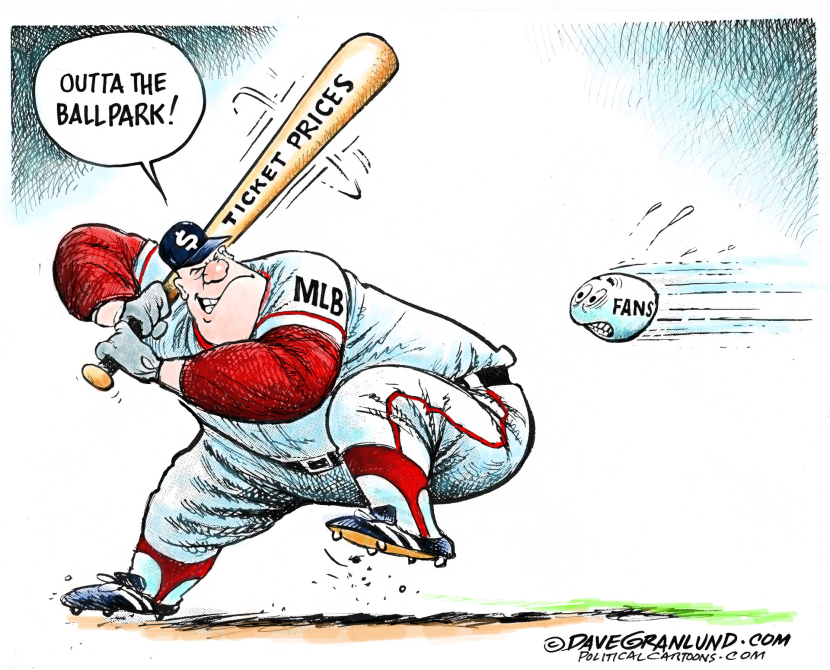
Today, MLB has more in common with Apple than it does with what was once reverently referred to as the national pastime. Immediately endangered is Spring Training which, in the dead of winter, fans eagerly anticipate – sunny skies, swaying palm trees, green grass and fastballs. Assuming the games are played, bring your wallet. The well-heeled Yankees charge $100 for standing room tickets.

Dinosaur fans remember a happier era when the months leading up to Spring Training were about baseball, not lockouts. No fans had the months between February and April better than Brooklyn Dodgers’ rooters who visited Dodgertown, in Vero Beach, Fla.

In his book, “Dodgertown,” author Mark Langill described how the camp became the fruition of team executive Branch Rickey’s long-time dream to bring his players together in a single, top-notch training facility so that all the Dodgers – regulars and minor leaguers – could be evaluated at the same time. Vero Beach, with its vacant, post-World War II Naval facility, was the perfect place. Dodgertown provided dozens of batting cages, two mechanical pitchers, an electric eye umpire that also measured the velocity of each pitch, a sliding pit and a track coach. Some of those baseball-oriented features were Rickey’s innovations. Off the field, the Dodgers kept their players occupied and happy by providing jukeboxes, shuffleboard, horseshoes, croquet and pinball machines. Food was readily and abundantly available. “Take all you want, but eat all you take,” read the cafeteria sign.

But just as the Dodgers left Brooklyn in 1957 for Los Angeles’ lucre, they abandoned Vero Beach in 2009 for the more profitable Camelback Ranch. The Arizona facility offers tourists more than 150 Dodgers caps for sums that range up to $65.00.

Those lordly prices help explain why the Dodgers franchise has $3.6 billion value, and why baseball fans are turned off.

Copyright 2022 Joe Guzzardi, distributed by Cagle Cartoons newspaper syndicate.

Joe Guzzardi is a Society for American Baseball Research and Internet Baseball Writers’ Association member. Contact him at [email protected].

Comments Off on MLB Lockout: Billionaires versus multimillionaires

Harry Reid once championed pro-American immigration reform

On Wednesday, former Senate Majority Leader Harry Reid will lie in state at the Capitol Rotunda, joining a long and growing list once limited to former presidents and military leaders.

Shortly after Reid’s death, legislators from both sides of the aisle sung the Nevada Democrat’s praises. South Carolina Sen. Lindsey Graham said that Reid would be in his prayers, that he was “a good man” who fought hard for his causes, and that he will be missed. Chuck Schumer, who holds Reid’s old job in the Senate, said that his friend always “looked out for people.”

Schumer’s praise for his old friend and mentor is more insightful than he might have imagined. Reid once championed meaningful immigration reform that would have benefited Americans, especially blue-collar workers. Eventually, Reid drifted over to the extreme left, and supported illegal immigrant amnesties as well as more employment-based visas.

In 1993, about six years after Nevada voters promoted him from the House of Representative to the Senate, Reid introduced a far-reaching comprehensive immigration reform bill that Democrats, especially former President Barack Obama and Schumer, would prefer to forget about. As per a press release issued from his office, Reid outlined what he called “the first and only comprehensive immigration reform bill in Congress,” the Immigration Stabilization Act of 1993.

The first item of business the press release addressed was to overhaul the nation’s immigration laws and begin “a massive scale-down of immigrants allowed into the country from approximately 800,000 to 300,000.” Legal immigration reduction groups have been lobbying for similar reductions for years. The current 1 million-plus annual lawful permanent residents is an unsustainable level since chain migration eventually converts the initial 1 million immigrants into about 3 million. A Princeton University study found that, on average, each immigrant petitions slightly more than three family members to join him in the U.S.

Another long-sought change reductionists have favored for decades is ending birthright citizenship. Reid wanted it clarified that a U.S.-born child to an alien mother who is not a lawful resident should not be considered a U.S. citizen. If ISA were approved, Reid said the incentive for pregnant alien women to enter illegally, often at risk to mother and child, for the purpose of acquiring citizenship for the child and to then receive federal benefits would be eliminated.

Other Reid recommendations have a familiar ring: a “crack down” – Reid’s wording – on illegal immigration, then an estimated 3.3 million, ending asylum fraud along with the “phony” claims that allow unqualified aliens to enter, excluding aliens who cannot financially support themselves without assistance, and beefing up border security.

For a period, too short as things turned out, Reid was committed to rational immigration. In his 1994 Los Angeles Times op-ed, Reid scorned his colleagues for their failure to reduce legal immigration, and he urged lawmakers to reject “unfounded” racism charges to act “quickly” to pass ISA. He concluded that the “real injustice to future Americans would be to do nothing [to reduce immigration].”

Reid was a spot-on prognosticator. Congress did nothing, and in the three decades that have passed, the illegal immigrant population has quadrupled from 3 million to nearly 12 million. The border that Reid wanted to reinforce is a horror show as officials predict that 2 million aliens will cross illegally this year.

In his official statement about Reid’s death, President Joe Biden praised him “for his power to do right for the people.” Reid was, Biden concluded, a “giant.” Had Reid stuck to his 1993 immigration wish list, he would have done “right for the people,” and could truly be remembered as a giant.

Instead, Reid dropped the ball and – platitudes being heaped on him aside – was just another politician whose views shifted with the Capitol Hill winds.

Copyright 2022 Joe Guzzardi, distributed by Cagle Cartoons newspaper syndicate.

Joe Guzzardi is a Progressives for Immigration Reform analyst who has written about immigration for more than 30 years. Contact him at [email protected].
Comments Off on Harry Reid once championed pro-American immigration reform

Forecasting 2022 at the Border

Since the Biden administration hasn’t indicated that it will shift in its Southwest border policy, the U.S. can expect the surge of illegal crossers to continue throughout 2022.

If change is coming, it will take the direction of even more illegal immigrants entering, and being released – clandestinely in some cases – into the interior.

During 2021’s last days, a border report revealed that the commonly cited illegal immigrant encounters of 1.7 million, the highest total since at least 1960, may be significantly understated. Border patrol agents assigned to the nine Southwest sectors said that they apprehended more than 1.9 million migrants who illegally crossed the shared border with Mexico between ports of entry during 2021. Many if not most of the 1.9 million surrendered to agents and were released, a practice known as catch and release. Another estimated 500,000 aliens avoided apprehension, the so-called “got-aways,” and snuck into the U.S. interior.

Biden and Department of Homeland Security Secretary Alejandro Mayorkas sanction the worst imaginable human and drug traffickers, who ply their billion-dollar trades with few consequences.

In December, agents came upon a stolen commercial tractor-trailer perilously overloaded with 52 people from Mexico, Honduras, Guatemala and El Salvador who had illegally crossed into the U.S. and were headed north. Other Customs and Border Protection encounters involved an SUV with seven Mexicans, and another vehicle with 12 Mexicans and Guatemalans inside, all being trafficked north from the southern border. Two days before Christmas, Eagle Pass Station agents arrested a Honduran national convicted in 2018 of sexual assault of a child, and sentenced to four years in prison. After serving only two years, the Honduran was deported, but reentered illegally. Agents said that their interactions with dangerous criminals occur daily.

Assuming the status quo – and there’s every reason to expect Biden and Mayorkas will continue their unconstitutional border agenda exactly as they did in 2021 – by the time Biden’s first term ends in 2025, nearly 10 million released illegal immigrants and 2 million got-aways will have merged into the general population. That’s millions of newcomers who will need to be provided for in a nation that has nearly 40 million Americans, about 11.4 percent of the total population, who live below the $26,695 poverty line for a four-person family.

The border is a mess, and no one knows better than Mustafa Joseph, a ten-year veteran agent who recently resigned in disgust. In his letter to Border Patrol Chief Raul Ortiz, Joseph called out the Supreme Court, “in disarray,” on constitutional clarity issues, presumably regarding immigration.

Summing up his conclusion that most Americans came to months ago, Joseph wrote: “The undocumented have gone from a fear of infringing the law to brazenly inquiring about what’s taking so long with their right to unconditional assimilation. Have we become ‘Handmaids’ to their cause? Incomprehensible… Particularly as the concept of ‘law’ becomes an increasingly nebulous moving target.”

To Joseph, his job, and the U.S. government in general, is unrecognizable. In closing, Joseph wished his former boss, Ortiz, good luck dealing with the “deck of cards” he’s been dealt.

Americans who value sovereignty are rooting for Ortiz and all dedicated border patrol agents. A Rasmussen poll taken in December found that most rated 2021 as the worst year ever, and are ready to move on to better times. The nation’s collective hope is that the White House shares citizens’ disappointment with 2021’s failures, and will take giant steps forward to make 2022 a better year.

Enforcing immigration laws at the border is a good place to start.

Copyright 2021 Joe Guzzardi, distributed by Cagle Cartoons newspaper syndicate.

Joe Guzzardi is a Progressives for Immigration Reform analyst who has written about immigration for more than 30 years. Contact him at [email protected].

Comments Off on Forecasting 2022 at the Border

The Mounting Cost of Afghan Resettlement

As with many immigration-related matters, too much information is purposely hidden from public view.

We just witnessed an excellent example of the Biden administration’s immigration subterfuge. The must-pass continuing resolution bill to fund the federal government at its current level, and therefore avoid a government shutdown, included a completely unrelated $7 billion to help resettle evacuated Afghan nationals, mostly unvetted or, at best, superficially screened.

The breakout of how the $7 billion will be spent was kept secret from the public. As former Illinois Sen. Everett Dirksen said, perhaps apocryphally, “A billion here, a billion there, and pretty soon, you’re talking real money.”

Americans know as confirmed fact that the arriving Afghans are unvetted because Department of Homeland Security Secretary Alejandro Mayorkas, contradicting his earlier claim, sheepishly admitted to the Senate Judiciary Committee that he had no idea how many evacuees had been vetted.

Pressed by Republican Sen. Lindsey Graham, Mayorkas confessed: “We are not conducting in-person, full refugee interviews of 100 percent” of Afghan evacuees. Moreover, Mayorkas couldn’t provide specific data for how many Afghans went through full interviews. Mayorkas’ testimony exposes White House Press Secretary Jen Psaki’s deceptive statement assuring that “no one” has entered the U.S. without “a thorough screening and background check process.”

The federal government’s failure to properly protect Americans has already, just weeks after the Afghan evacuation, had serious consequences. In September in New Mexico, the FBI began an investigation into a small group of male Afghans who, temporarily housed at the Doña Ana Complex, allegedly sexually assaulted a female U.S. soldier. Also in September, at Ft. McCoy, Wisconsin, two evacuees were charged, separately, with the alleged sexual assault of a minor using force, and spousal assault by strangulation and suffocation.

The individuals identified in these crimes hardly sound like they belong as part of “Operation Allies Welcome,” most of whom arrived on the six-week long airlift known as “Operation Allies Refuge” that moved 124,000 individuals out of Afghanistan, placing them around the country. Some of their destinations will be in areas that are struggling to recover from the pandemic, and have other long-standing societal woes ingrained in their fabric before the evacuees’ arrival.

State Department data for the Afghan Placement and Assistance program obtained by the Associated Pressed showed that California is expected to accept more Afghan evacuees than any state, 5,200. Three months ago, California Gov. Gavin Newsom and the state’s legislative leaders requested $16.7 million in taxpayer funding to help resettle refugees.

Contradictory, the State Department promised to resettle Afghans in states with affordable housing. Yet California’s officials have for years bemoaned the shortage of that exact commodity. California is also plagued by high average gas prices, $4.68, and above-average state and local taxes at 10.9 percent of adjusted personal income. California’s income inequality level is among the five worst states, and the state’s K-12 public school system struggles with overcrowded classrooms that hamper teachers’ ability to effectively educate their students.

For Afghans starting a new life in California, they’ll face many obstacles before they can hope to get on their feet.

For Americans keeping score on the dollar cost of the Afghanistan resettlement, here’s a partial tally. The 20-year war cost $2.3 trillion, with the estimated interest payments on that sum coming in at $925 billion. By 2030, estimated interest costs will ratchet up to $2 trillion, and by 2050, $6.5 trillion. Military equipment worth billions more dollars was abandoned during the hasty and incompetent U.S. retreat from Afghanistan. Those are painfully high sums. But no dollar amount can be attached to the loss of 2,400 American lives, the lives of 3,800 U.S. contractors and the thousands left behind to face an uncertain and possibly deadly future.

Now Americans will be required to finance Afghan evacuees’ U.S. resettlement, the $7 billion in the continuing resolution, plus mounting federal, state and local costs. The Center for Immigration Studies estimated that in their first five years of U.S. residency, each Middle Eastern refugee costs taxpayers $64,370, or 12 times what the U.N. estimates would be the cost to care for one refugee in a country close to his home.

Regional resettlement never occurred to the Biden administration. There’s no reason it should when it has U.S. taxpayers to rely on.

Copyright 2021 Joe Guzzardi, distributed by Cagle Cartoons newspaper syndicate.

Joe Guzzardi is a Progressives for Immigration Reform analyst who has written about immigration for more than 30 years. Contact him at [email protected].

Comments Off on The Mounting Cost of Afghan Resettlement

Elon Musk’s Uninformed Plea for More Babies

At The Wall Street Journal’s annual Chief Executive Officers’ council, Elon Musk, the world’s richest man whose net worth is an estimated $290 billion, sounded an alarm. If people don’t start procreating at an accelerated level, civilization will crumble, Musk trumpeted.

Musk worries about what he identified as the “low birth rate and the rapidly declining birth rate,” which he attributes to COVID-19 and economic apprehension among the young.

Elites, of which Musk is a ranking member, have promoted the “we need more people” meme for decades. Consumer goods manufacturers, retailers, developers, the ethnic identity lobby and Congress are united in their urgent pleas for more people. Domestically, cars can’t be sold, soda pop can’t be consumed, houses can’t be built, cheap labor can’t be hired and new voters can’t be created as long as potential buyers remain in Mexico, the Northern Triangle, Asia and the Caribbean. Immigrants’ search for a better life means that they come to the U.S. to become consumers, a mostly glossed-over fact in the immigration debate.

Musk’s concern was sparked by a Division of Vital Statistics report which found that the U.S. birth rate fell by 4 percent from 2019 to 2020, the sharpest single-year decline in nearly 50 years and the lowest number of births since 1979. But if Musk looked at the macro population picture, he could relax. Since 1979, an isolated point in time, the U.S. has boomed from 227 million to 334 million, a 107 million population explosion that historically high in-migration helped create.

More people are on the way. By 2050, the Census Bureau estimates that U.S. population will hit, assuming the low net migration projection, 423 million. A further point of interest for globalist Musk to ponder is that, by 2100, the world’s population will be closing in on 11 billion people, a 3 billion increase during the next 80 years.

Furthermore, if Musk is worried about stagnant population, he should take a trip to the U.S. Southwest border. Musk won’t need his SpaceX rocket to travel to Del Rio, Texas. The illegal immigrant border surge, more than 2 million and counting, exceeds the total population of these 10 states, individually: Alaska, Montana, Wyoming, North or South Dakota, Vermont, New Hampshire, Maine, Rhode Island and Delaware.

Neither President Joe Biden nor Department of Homeland Security Secretary Alejandro Mayorkas have given any indication that they will implement measures to control or stop the surge – good news for Musk and other “we need more people” advocates. Remember that the illegal alien totals, whatever they ultimately may be, are preliminary vis-à-vis the eventual totalities they represent. Princeton University estimated that the average immigrant petitions 3.1 family members, and many will begin new families, migration multipliers that should delight Musk.

In November, the Center for Immigration Studies published a report which found that between September 2020 and September 2021, the foreign-born population, as defined by legal and illegal immigrants, increased by 1.6 million, attributable in part to the Biden’s nonenforcement border policy. The total foreign-born population in the U.S. as of September 2021 is 45.4 million.

The goal of growing the population, either through more natural births or immigration, is inconsistent with Americans’ views on how they want to live, and what kind of world they aspire to for their families. To lecture middle-class Americans about how many children they should bring into the world is the apex of arrogance, and compelling, indisputable proof that they have completely lost touch with the mainstream, most of whom are struggling in a hyper-inflationary era to meet their monthly obligations. Paying his bills isn’t a problem for Musk. His $269 billion net worth leaves him, his six children and future Musk generations worry-free when it comes to finances.

Polling consistently shows that Americans want less immigration. They also want government to enact sustainable immigration policy that enhances their lives, policies that the Biden administration has summarily rejected. A Harvard CAPS-Harris poll taken in late June had findings consistent with other recent polling: voters reject Biden’s open borders and long for the enforcement that President Trump’s administration implemented.

The question that population stabilization activists want Musk to answer is: Can we fairly and compassionately accommodate the arriving millions, let alone the millions more he wants to welcome, when the nation’s natural and fiscal resources are already over-taxed? Maybe Musk’s aerospace company will indeed find a way to colonize Mars and ease Earth’s population burden. In the unlikely event that might occur, it will be decades or possibly centuries away.

The overpopulation challenge in the U.S. is immediate, and adding more people would exacerbate the existing, very real and growing problem.

Copyright 2021 Joe Guzzardi, distributed by Cagle Cartoons newspaper syndicate.

Joe Guzzardi is a Progressives for Immigration Reform analyst who has written about immigration for more than 30 years. Contact him at [email protected].

Comments Off on Elon Musk’s Uninformed Plea for More Babies

GOP Searches for a Lone Democrat ‘Nay’

Washington, D.C.’s political class is focused on West Virginia Sen. Joe Manchin and which way he’ll vote on President Joe Biden’s Build Back Better agenda.

Manchin, who in the past has hinted that he’s on the verge of caucusing with the GOP, might be in a bind. Although he’s not up for re-election until 2024, and the sitting senator is dodging questions about whether he’ll defend his seat, Manchin is a career Democrat who will be campaigning in a state that President Donald Trump won by nearly 30 points.

Manchin has two years of breathing room, but three other swing-state Democratic senators aren’t as lucky, and will face voters in 2022. During a period of acute inflation, how constituents will feel if their senators vote in favor of adding nearly $3 trillion to the federal debt total (the estimate that two independent analysts made in early December) and granting amnesty to 6.5 million illegal immigrants will be pivotal.

In left-leaning New Hampshire, the “Live Free or Die” state, Sen. Maggie Hassan has a disastrous 33 percent approval rate, precariously low since in 2016 she displaced Republican incumbent Kelly Ayotte by a razor-thin 1,017 ballots. Hassan’s fate could depend on how effectively her as-yet-unknown opponent makes the case against her.

Polling indicates that whoever Hassan’s challenger is, possibly Ayotte now that GOP Gov. Chris Sununu announced he won’t enter the race, will be well-positioned to defeat her. Hassan will have to defend the Biden administration’s failure in Afghanistan, especially since evacuees are, controversially to many Granite State residents, being resettled in New Hampshire.

Two purple state U.S. senators may face longer re-election odds than Hassan. Georgia’s vulnerable Raphael Warnock is a prime GOP target. Warnock scored a special election win over Kelly Loeffler, Gov. Brian Kemp’s appointee after Republican Sen. Johnny Isakson retired in 2019.

The Democrats’ hold on the Peach State is tenuous, at best. President Donald Trump carried Georgia in 2016 and in 2020, and Georgia had been reliably Republican until 2020. Warnock’s probable opponent is former University of Georgia Bulldog and Dallas Cowboys running back Herschel Walker. In the latest poll, the football hero and immensely popular Walker leads Warnock by five points, 46-41.

The steepest uphill climb to survive the 2022 mid-terms may be in Arizona where another Democratic special election winner, Mark Kelly, will most certainly be pressed to defend Biden’s wide-open border policy. Arizona has been the state most adversely effected by the refusal of Biden and Homeland Security Secretary Alejandro Mayorkas to enforce immigration laws.

The Yuma Sector border crisis now dwarfs the more widely publicized Del Rio Sector immigration catastrophe. Yuma’s illegal immigrant border surge is 2,400 percent higher than last year, a direct result of Biden’s indifference to enforcement. Sector Chief Patrol Agent Chris T. Clem has been using social media to get the word out about the devastation in Arizona. In early October, agents captured a convicted child rapist. And as recently as late September, agents were encountering 1,000 illegal immigrants a day during the week.

Republican Gov. Doug Ducey said that “Arizona is a border state. We faced this [illegal immigrant surges] before, but we’ve never faced a crisis this large in 21 years.” Ducey may be understating Arizona’s problem. During the last fiscal year, illegal immigrants whose aggregate number is nearly equal to Yuma’s total population have unlawfully crossed the border. Kelly’s most likely challengers include Attorney General Mark Brnovich who, with attorneys general from Ohio and Montana, has filed suit against the Biden administration over its immigration policy.

Senate Minority Leader Mitch McConnell hopes that one of the four – Manchin, Hassen, Warnock or Kelly – will defy Majority Leader Chuck Schumer and vote against Biden’s bill and thereby limit debt, deny rewarding illegal immigrants with a path to citizenship, and protect their political futures.

Optimists hope that a Build Back Better vote will be called before the winter recess. More realistically, negotiations over the bill’s land mines will drag into next year.

Copyright 2021 Joe Guzzardi, distributed by Cagle Cartoons newspaper syndicate.

Joe Guzzardi is a Society for American Baseball Research and Internet Baseball Writers’ Association member. Contact him at [email protected].

Comments Off on GOP Searches for a Lone Democrat ‘Nay’

Pearl Harbor Day and the Pineapple World Series

During World War II, after the death and destruction from Japanese attack on Pearl Harbor on Dec. 7, 1941, the highest-level baseball was played on Hawaii, reaching it’s apex during the 1944 Army-Navy Pineapple World Series.

To provide as much entertainment as possible, and to boost morale for their fellow servicemen and the Hawaiian community, the teams agreed in advance to play every game in the best-of-seven series, even if the outcome had been decided earlier. An additional four games were later added, making the series an 11-tilt affair.

In 1944, the Army and Navy squads had more than 60 players who were either on or would be on major league rosters. By 1945, the total grew to 150. Eventual Hall of Famers on the Army and Navy teams included Pee Wee Reese, Phil Rizzuto, Hank Greenberg, Johnny Mize, Joe DiMaggio, Stan Musial and Ted Williams. Pittsburgh Pirates’ seven-time home run leader Ralph Kiner’s baseball playing time was limited, because his duties piloting a PBM patrol bomber flying boat out of Naval Station Kaneohe kept him off the diamond.

Patriotism motivated some players like Kiner and Greenberg. DiMaggio, however, intensely resented the war. In his book, “Joe DiMaggio, a Biography,” author David Jones wrote that although the great Yankee Clipper never came within a thousand miles of a battlefield, the war robbed him of his prime baseball years.

When he first donned his Army uniform, DiMaggio was a 28-year-old superstar. Discharged three years later, DiMaggio was 31, underweight, malnourished, divorced and bitter. His three lost World War II years robbed DiMaggio of peak earnings and a chance to add to his already Hall of Fame statistics.

As Gary Bedingfield chronicled in his wonderful book, “Baseball in Hawaii during World War II,” for both native Hawaiians and American service men, baseball was a way of life. In the New York Mirror, sports reporter Bob Considine wrote: “There’s probably more sports played here per capita than anywhere on the mainland.” Considine commented on the “bewildering number of leagues ranging through sandlot, schools, industrials, semi-pro, racial, etc.”

The Hawaii League, which dated back to 1920, included teams like the All-Chinese, the Asahi Rising Suns, and the All-Haole or Caucasian Wanderers. Plantation baseball was intensely competitive with pineapple, sugar cane and coconut growers fielding teams, and giving players days off to prepare. Winning could result in celebratory days off, but bosses viewed losing as an intolerable embarrassment.

The Pineapple World Series was the logical culmination of a Hawaii passionate about baseball, an abundance of available top-flight players, and the historic Army-Navy rivalry that dates back to the two academies’ football game first played in 1890.

On September 22, 1944, at historic Furlong Field with its wooden bleachers and swaying palm trees, 20,000 fans and thousands more listening over Armed Forces Radio waited with anticipation as the Detroit Tigers’ Virgil “Fire” Trucks took the mound for Navy.

Williams had named Trucks as one of the five pitchers he most hated to bat against. Trucks pitched a 4-hit, complete game shutout, 5-0, and gave Navy a 1-0, series lead. Navy reeled off five more consecutive wins, and took a commanding 6-0 Series lead. Once 11 games were in the history book, Navy had dominated, 9-2-1. Trucks later recalled that the Army was initially thought to be the superior team, but Admiral Chester Nimitz recruited Navy superstars from the mainland, and those players provided the sailors with the winning edge.

When peace at last came to Hawaii, baseball continued to thrive; military leagues survived into the mid-1970s. The Lopat All-Stars arrived in 1946, and the Yankees, Brooklyn Dodgers and St. Louis Cardinals played exhibition games that thrilled locals. The Pacific Coast League Sacramento Solons, transferred to Hawaii, became the Hawaii Islanders, and enjoyed huge popularity for their 18 seasons even though they played their home games at the dilapidated but lovingly named the “Termite Palace.” Found to be “severely termite-damaged” and unsafe, the Stadium closed after the 1973 Hula Bowl game.

Although the circumstances under which World War II baseball was played were tragic – more than a million Americans killed, wounded or captured – the entertainment value it provided the soldiers, the players and fans provided ongoing comfort during a period of deep trial and tribulation.

Copyright 2021 Joe Guzzardi, distributed by Cagle Cartoons newspaper syndicate.

Joe Guzzardi is a Society for American Baseball Research and Internet Baseball Writers’ Association member. Contact him at [email protected].

Comments Off on Pearl Harbor Day and the Pineapple World Series

Enemies Among Us

Only the most willfully obtuse on Capitol Hill would deny that the Biden administration’s neglect of wide-open borders might lead to a national security crisis.

Estimates vary on how many foreign nationals from numerous countries have unlawfully crossed the U.S. borders, but the independent news agency Axios put the total at 160. Distance isn’t a deterrent. Many of those nations are avowed U.S. enemies like Yemen, Cuba, Venezuela and Afghanistan. Facebook airlifted some Afghans to Mexico with the probable intent to enable them to enter unvetted.

In testimony to Congress earlier this year, Customs and Border Protection confirmed that four apprehended individuals match names on the FBI’s Terrorist Screening Database. The watchlist is extensive and includes people “known to be or reasonably suspected of being involved in terrorist activities.” About 450 Chinese nationals also surged the border.

The Biden administration’s sanctioned border fiasco has been well documented, but the willy-nilly visa handout system, mostly unreported, also leaves the nation exposed to malfeasance.

To date, there have been at least three incidents where foreign nationals from unfriendly nations and with dubious intentions, specifically espionage, have accessed the highest levels of federal government.

The most infamous is suspected Chinese spy Fang Fang, California Rep. Eric Swalwell’s campaign donations bundler and suspected lover. Fang entered on a student visa and connived her way to social acceptance with California U.S. representatives Judy Chu and Mike Honda, as well as other Midwestern government officials. When the honey pot spy’s subversive purposes were under FBI investigation, she fled to China and took whatever confidential information she may have collected with her. Despite his well-known associations with a suspected Chinese agent, Swalwell is on the House Homeland Security, Judiciary and Intelligence committees.

Swalwell isn’t Congress’ only dupe. California Sen. Dianne Feinstein employed a Chinese national for two decades as her personnel chauffer that the FBI suspected of being a spy. At the time, Feinstein was chair of the Senate Intelligence Committee.

As with the Swalwell case, Feinstein’s office insisted that the driver, promptly fired when the truth emerged, never gained access to top secrets. The driver may be small potatoes in the Chinese Ministry of State Security’s long-range plans, but in June 2015, Chinese hackers stole sensitive personal data of 20 million Americans. This included Social Security numbers, addresses and more when they breached the servers of the Office of Personnel Management. That data treasure trove provided Beijing with countless opportunities to access military secrets and take advantage of unsuspecting citizens, or possibly blackmail them.

A Washington Examiner story about Feinstein and the breach pointed out that U.S. university campuses are “host to scores of Chinese assets and operatives.” As of the academic year 2018-2019, nearly 400,000 Chinese students were enrolled in American universities, a total that tripled over the last decade, and raised concerns about intellectual property theft. The 400,000 total is exclusive of Chinese students who completed, either officially or informally, their course work but haven’t returned home.

In February 2021, the CATO Institute published its study titled, “Espionage, Espionage-Related Crimes, and Immigration, a Risk Analysis, 1990-2021.” Cato concluded that although suspected Chinese spies had a significant presence during the period studied, restricting immigration or visa issuance would be more harmful to U.S. prosperity than helpful to national security. Congress’ goal for Chinese migration, and all other immigration matters, should be to strike a compromise solution with the primary purpose of advancing America and her interests without unduly restricting vetted, potential contributors.

Last summer, Arkansas Sen. Tom Cotton set off a firestorm of criticism when he suggested that Chinese students be banned from studying science, technology, math and engineering to protect against those disciplines ultimately being used against America. Cotton didn’t propose ending student visa issuance to Chinese nationals or even limiting the visa totals, but simply making sure that potential enemies didn’t take unfair advantage of U.S. immigration generosity to undermine America when they return home or to prevent recent American citizen graduates from getting white-collar jobs.

The Bureau of Labor Statistics estimates that 300,000 foreign STEM and related non-STEM workers are in the economy performing jobs that should be American-held. But like other rational immigration recommendations that put Americans first, proposed but ignored in past years, Cotton’s idea went nowhere.

Obviously, the U.S. must do more than tighten student visa oversight to protect the homeland; border enforcement where illegal immigrants continue to arrive in historic numbers, and may reach 2 million during the current fiscal year, would be an excellent place to begin.

Abundantly clear ten months into Biden’s presidency is that neither he nor anyone in his administration has the slightest interest in national sovereignty or in advancing America, incomprehensible to most voters, but undeniable, nonetheless.

Copyright 2021 Joe Guzzardi, distributed by Cagle Cartoons newspaper syndicate.

Joe Guzzardi is a Progressives for Immigration Reform analyst who has written about immigration for more than 30 years. Contact him at [email protected].

Comments Off on Enemies Among Us