Pam Bondi’s authoritarian outburst defies the constitution

The horrific assassination of Turning Point USA founder Charlie Kirk has unleashed all sorts of cascading emotions, and has apparently resulted in Attorney General Pam Bondi having a mental meltdown.

Earlier this week, she appeared on the Katie Miller Podcast and declared federal law enforcement will “go after” Americans for hate speech.

Visibly and publicly outraged by certain “vulgar” (her term) expressions of contempt for Kirk’s legacy in the media, she vowed to take revenge: “We will absolutely target you, go after you, if you are targeting anyone with hate speech. There’s free speech, and then there’s hate speech. And there is no place — especially now, especially after what happened to Charlie — [for that] in our society,” Bondi said.

There is no hate-speech exception to the First Amendment.

This is not some random, disgruntled plain Jane or average Joe spewing such alarming rhetoric. These comes from the mouth of America’s highest-ranking law enforcement official. Not surprisingly, after a torrent of criticism from across the political spectrum, Bondi clarified her remarks, arguing she only stated “hate speech” accompanied by “calls to violence” would be prosecuted.

Bondi’s words are constitutionally illogical and counterfeit. She promised to target certain individuals for hate speech, a term that is resoundingly subjective and potentially ambiguous. “There is no unprotected category of speech in the constitution or in the case law called ‘hate speech,’” said Heidi Kitrosser, a Northwestern University law professor. “By being so vague and by talking about speech that doesn’t fit into any legal category, she is basically opening the door for taking action against anyone who engages in speech that the president or the Department of Justice or Stephen Miller doesn’t like.”

Similar outrage was directed toward Bondi from right-wing supporters normally aligned with the Trump administration.

“Get rid of her. Today,” wrote conservative pundit Matt Walsh. “This is insane. Conservatives have fought for decades for the right to refuse service to anyone. We won that fight. Now Pam Bondi wants to roll it all back for no reason.”

Erick Erickson, a conservative commentator, called Bondi “a moron,” while longtime Fox News political analyst Brit Hume wrote on social media, “Someone needs to explain to Ms. Bondi that so-called ‘hate speech,’ repulsive though it may be, is protected by the First Amendment. She should know this.”

A number of her critics pointedly pounced on a May 2024 social media post by Kirk himself, laying out clearly hate speech “does not exist legally in America.”

“There’s ugly speech. There’s gross speech. There’s evil speech. And ALL of it is protected by the First Amendment,” Kirk wrote.

It’s difficult to listen to rhetoric from others who in some cases dehumanize your right to exist as a human being. Moreover, when you are in your late teens and early adulthood (although it appears to be the case for many middle-aged and older adults as well), your emotions are often tender, reactionary, and fertile. You are inclined to react irrationally if you feel you are being disrespected and discounted, or your sensibilities confronted or challenged. Personal feelings aside, the answer is not to prohibit others with whom you disagree from expressing their viewpoints. The more appropriate and effective response to challenge morally indefensible speech is to produce concrete facts and logic that can or will effectively dispel it.

Free speech is a crucial and vital ingredient in our democracy. Either you have it or you don’t. It is important to remember that when you attempt to curtail free speech, it may only be a matter of time before your voice can be reciprocally stifled or silenced. Denying others the right to express their opinions is a misguided and dangerous activity that can result in dramatic and disastrous consequences for all.

To quote former Supreme Court Justice Louis Brandeis, “sunlight is said to be the best of disinfectants.” Dictatorial behavior, irrespective of its political source or direction, cannot be condoned or tolerated in a democracy.

Copyright 2025 Elwood Watson, distributed by Cagle Cartoons newspaper syndicate

Elwood Watson is a professor of history, Black studies, and gender and sexuality studies at East Tennessee State University. He is also an author and public speaker.

Comments Off on Pam Bondi’s authoritarian outburst defies the constitution

Black America’s compassionate response to Charlie Kirk’s assassination

The assassination of Charlie Kirk is a tragedy and part of a horrifying wave of political violence in America.

Kirk was a husband and father of two small children. He was revered by numerous conservative college students. One could be hard pressed to name many conservative political personalities in America who were more well-known or popular on the right, especially among younger people.

When I first heard the news, I was shocked. This is a person who was not a family member, relative, close, personal friend, or anyone whom I knew personally. Yet, I was psychologically depleted by the news of his assassination. Perhaps some of my deep emotional state was related to the fact that Kirk’s death coincided with the death of my own mother, who also passed away on September 10th, decades earlier.

Witnessing his wife, Erika Kirk, deliver her heartfelt tribute, I ached with emotion as I witnessed and felt the pain of a beautiful young widow trying to process life for herself, her children, and the nation after the death of her husband. May God be with her, her family, and loved ones.

Many people assumed a culturally polarizing figure like Kirk — infamous for his cringeworthy anti-Black, anti-LGBTQIA+, and pro-gun beliefs — would have inspired considerable division and derision among large segments of Black people upon his demise. Rather, and appropriately, in my opinion, Black democratic politicians, celebrities, and left-wing activists overwhelmingly condemned the assassination and engaged in thorough, empathetic commentary.

Cultural commentator Van Lathan emphasized he felt “terrible” about his death despite all of the man’s offensive words. “There is no way I’m going to see that video of Charlie Kirk being shot and feel anything other than terrible. I’m aware of all of it, the rhetoric, the hatefulness, all of it from him, but I can’t be robbed of my compassion; that was awful, and we have to try to be better.”

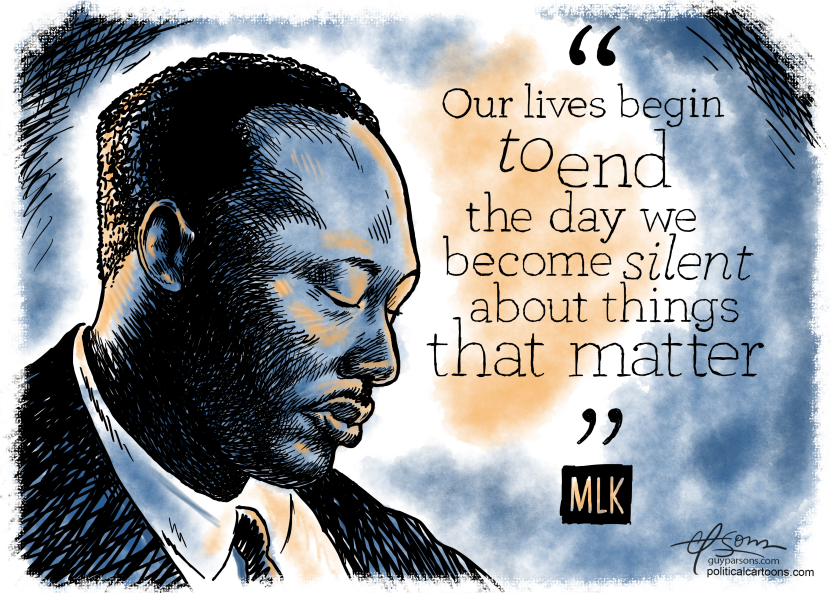
Former President Barack Obama and former Vice President Kamala Harris both spoke against political violence in light of Kirk’s death. And Black Christians around the country have expressed their sympathies and prayers for Kirk’s family, his supporters, and the hundreds of attendees who witnessed the violent killing on September 10. The late Dr. Martin Luther King Jr.’s own children also displayed compassion and called on others to do the same. Bernice A. King took to social media to say, “No child anywhere should lose a parent in such a hateful, callous way.” She added, “It will require much more than quoting my father for the United States to evolve from our current conundrum of multifaceted violence, tragic apathy, and degrading policies.”

King’s decision to take the high road is notable, given Kirk was a strident critic of Martin Luther King Jr. In response to Kirk’s death, Martin Luther King III said, “While I strongly disagree with Charlie Kirk on most issues, especially his comments about my father, we all agree that political violence is inexcusable.” He added, “Disagreements must be addressed through civil conversations and free, fair elections.”

Such acts and gestures demonstrate the often-forgiving nature of Black people. We have seen this act of forgiveness time and time again, from the relatives who lost loved ones at the hands of an unhinged, die-hard white supremacist in the Charleston AME Church massacre of June 2015 to the Buffalo supermarket shooting in May 2022. In both instances, we saw the victims’ families’ acts of forgiveness towards individuals who had brutally and savagely murdered their loved ones.

We cannot ignore the undeniable reality Kirk was a high-intentioned provocateur whose acerbic rhetoric engaged in and often relied on racist falsehoods. His ideology was divisive, arguably opportunistic and perversely rooted in racism. His cruel and inhumane assassination does not erase or absolve such grim realities.

Kirk was a larger-than-life figure. In his all-too-short life, he managed to accomplish feats that many people spend a lifetime attempting to achieve. He leaves his many devotees, detractors, and those who fell into neither category asking why nor how such a terrible tragedy could befall anyone. May he rest in peace.

Copyright 2025 Elwood Watson, distributed by Cagle Cartoons newspaper syndicate

Elwood Watson is a professor of history, Black studies, and gender and sexuality studies at East Tennessee State University. He is also an author and public speaker.

Comments Off on Black America’s compassionate response to Charlie Kirk’s assassination

Celebrating the anniversary of the Voting Rights Act… before it’s gone

This year marks the 60th anniversary of the ratification of the Voting Rights Act of 1965 — one of the most consequential laws in the nation’s history.

Signed after the Selma-to-Montgomery marches, the act augmented the 15th Amendment’s promise that no American could be prohibited access to the ballot box because of their race. Towns and counties where Black voter registration had previously been less than 10% witnessed registrations surge. Black citizens who had long been denied access to participation in the political process acquired representation on school boards and in town halls, state legislatures, and Congress.

The Voting Rights Act provided solid evidence when the federal government enforces equality, diversity, and inclusion, democracy becomes stronger.

Over the next several decades, the act was extended and expanded. Then, however, in Shelby County v. Holder (2013), the Supreme Court struck down a section of the act as unconstitutional because it violated states’ power to implement and control elections. The court ruled that the section was outdated and not responsive to current conditions. The decision had an immediate effect and led to states employing strict photo ID laws and voter roll purges.

Questions about the Voting Rights Act’s constitutionality have simmered underneath the surface at the Supreme Court. However, last month, in an order expanding a Louisiana redistricting case, the court decided to revisit the issue.

With arguments scheduled to take place Oct. 15, there is considerable concern what remains of the 1965 law after its brutal evisceration in the Shelby County case will be dramatically weakened, if not legally revoked in its entirety, by the conclusion of the court’s next term.

At the center of this drama is Donald Trump — an individual whose reputation as president is marred by rampant voter disenfranchisement, who perceives voting as virtually a popularity contest and is terrified of being defeated. This was why he challenged the integrity of our democratic mechanisms in 2020 after being defeated by Joe Biden instead of maturely conceding that several million more Americans voted for the latter.

Trump’s ruthless efforts against voting rights soldiers on as he steadily populates the courts with right-wing judges who continue to chip away at civil rights laws. Increased barriers to voting and the alarmingly minimal level of resistance from those still able to exercise their right to cast a ballot has empowered him to run roughshod over media conglomerates and prompt corporations to abandon diversity, equity, and inclusion programs. Unbounded by any resistance from his own party and, regrettably, a sizable segment of feckless Democratic leaders, Trump has unleashed a full political blitzkrieg on the civil rights movement’s storied legacy — going so far as to open files on Dr Martin Luther King Jr in an effort to distract attention from his own political problems.

The memories of March 7, 1965, are indelibly seared into the history books. It was a time when the horrific violence unleashed on marchers rattled the nation. Images of a young John Lewis and dozens of peaceful protesters getting their heads cracked open by Alabama state troopers on the Edmund Pettus Bridge spread across the nation. That was the price Lewis and his peers paid for attempting to exercise their First Amendment rights to free speech and to march. The scenes of bodily carnage became known as Bloody Sunday.

Later that evening, several television networks interrupted their regularly scheduled programming to inform the public of the bloodbath that had occurred earlier that day in Selma, Alabama. Public outrage was immediate, and one week later, on March 15, 1965, President Lyndon Johnson addressed a joint session of congress urging passage of the Voting Rights Act.

Intense public pressure culminated in Congress passing the act and President Johnson signing it into law on August 6, 1965. Had it not been for civil rights champions like Lewis, it would have taken much longer for Blacks, particularly in the South, to gain protections for their voting rights.

More than 60 years later, the national outrage of Bloody Sunday, which sparked mobilization toward passage of the Voting Rights Act, has been replaced by a numbness to Immigration and Customs Enforcement raids, the arrests of elected officials, and the snipping of social safety nets.

This is why the anniversary of the Voting Rights Act is of such enormous importance. The anniversary should be remembered not just for nostalgic reasons, but for the act’s future implications. Will the legal promise of equal representation be retained? Will disingenuous legal theories perversely designed as “color blindness” arise? Will sinister and draconian legislation sharply diminish protections that generations of Americans of all races and ethnicities marched, bled, and died for to secure?

The stakes could not be higher. Will the nation continue to honor the hard-won protections of the Voting Rights Act or allow them to be erased under the guise of “constitutional purity” — meaning White supremacy.

Copyright 2025 Elwood Watson, distributed by Cagle Cartoons newspaper syndicate

Elwood Watson is a professor of history, Black studies, and gender and sexuality studies at East Tennessee State University. He is also an author and public speaker.

Comments Off on Celebrating the anniversary of the Voting Rights Act… before it’s gone

On to the next school scooting

Another school year, another mass shooting.

A shooter opened fire at a Catholic parish school in Minneapolis last month as children were attending Mass. The shooter fired through the church’s stained-glass windows, killing two children and injuring more than 17 before perishing from a self-inflicted gunshot.

Once again, the horror of school shootings — and mass murders in general — has reemerged at the forefront of American society: Columbine, Colo. (1999); Virginia Tech (2005); Sandy Hook, Conn. (2012); the Navy Yard in Washington (2013); Oregon (2015); the Pulse nightclub in Orlando (2016); Sutherland Springs in Texas (2017); Parkland, Fla. (2018); El Paso, Texas (2019); Uvalde and Buffalo (2022); Lewiston, Maine, and Monterey Park, Calif. (2023); and Jacksonville (2025).

Through them all, we find ourselves circling back, pondering the same questions and harboring the same emotions.

Mass shootings are hardly news. In August 1966, Charles Whitman murdered 17 people after locking himself down in the central clock tower at the University of Texas at Austin, targeting random individuals from the 28th-floor observation deck. A decade later, a string of horrific school shootings commenced. In 1976, Charles Edward Allaway killed seven people at California State University, Fullerton. More than a decade later, in 1989, Patrick Purdy killed five children in Stockton, California. In 1991, graduate student Gang Lu killed three faculty members at the University of Iowa, while one year later Eric Houston killed three students and a teacher at Lindhurst High School in Olivehurst, Calif.

It’s therefore not accurate to state the trend of mass shootings began with the terrible events at Columbine High School in 1999.

Certain conservative activists have attempted to weaponize Westman’s gender identity to define transgender people as prone to violence or mental illness. Law enforcement officials provided no motive for the attack, but Westman’s sprawling social media history portrayed a colossal litany of hostility and grievance.

Numerous videos she posted indicated an obsession with guns, violence, and school shooters. She displayed her own cache of weapons, bullets, and what appeared to be explosive devices. She harbored white-nationalist views espousing vile attitudes toward Blacks, Latinos, and Jews – “the shooter appeared to hate all of us,” said Joe Thompson, acting U.S. attorney for the District of Minnesota. President Donald Trump earned her ire as well. Videos revealed excerpts from her diary, with lengthy entries detailing self-hatred, violence toward children, and a desire to inflict self-harm.

Disingenuous agitation over Westman’s gender mirrored the reaction to the 2023 mass shooting at The Covenant School in Nashville, Tennessee, where a former student who identified as transgender killed three children and three adults.

Like many fellow mass shooters, Westman was part of a sordid online community of secret dark web groups, influenced by much of the blatantly callous, acidic rhetoric steadily emanating from the current fractured political environment. Much of it comes from the depths of the political and cultural right-wing echo chamber.

As has been the case with preceding tragedies, we hear the same routine, obligatory commentary from politicians across the political spectrum: “Guns don’t kill people, people do,” “We need to address the issue of mental health,” “We must harden our schools,” “We cannot trample on the Second Amendment,” and so on. In essence, the same gun violence cultivates the same response: denounce the killings and then offer our thoughts and prayers to the dead victims’ families, the brokenhearted, and the emotionally devastated.

With regard to donating resources to mental health, I concur with such an effort. But the vast majority of people who suffer from mental health issues are not murderers. Rational Americans are getting sick and tired of the constant and redundant commentary from gun manufacturers, right-wing politicians, and others who continue to look for scapegoats instead of confronting the issue head-on.

The motives behind such shootings do indeed matter, despite well-meaning yet misguided rhetoric from individuals saying they don’t or shouldn’t. Most rational people can distinguish the moral difference between an unfortunate tragedy that culminates in death and an act of malicious, intentional violence. Yes, family members whose loved ones were victims are grieving, but there is indeed a stark distinction in the cause of their loved ones’ demise.

The Second Amendment guarantees the right to bear arms, but it does not give gun users, owners, sellers, or manufacturers the freedom to absolve themselves from their responsibility if doing everything possible to ensure we establish a society as free from gun violence as possible.

Copyright 2025 Elwood Watson, distributed by Cagle Cartoons newspaper syndicate

Elwood Watson is a professor of history, Black studies, and gender and sexuality studies at East Tennessee State University. He is also an author and public speaker.

Comments Off on On to the next school scooting

Whitewashing history, one museum exhibit at a time

Slavery is the latest issue that has drawn Trump’s ire.

“The Smithsonian is OUT OF CONTROL, where everything discussed is how horrible our Country is, how bad Slavery was, and how unaccomplished the downtrodden have been — Nothing about Success, nothing about Brightness, nothing about the Future,” Trump ranted in a social media post. “This Country cannot be WOKE, because WOKE IS BROKE. We have the ‘HOTTEST’ Country in the World, and we want people to talk about it, including in our museums.”

Yes, you read that correctly. Thankfully, a number of historians, journalists, and legal scholars rapidly contested such intellectually dishonest commentary.

“It’s the epitome of dumbness to criticize the Smithsonian for dealing with the reality of slavery in America,” said Douglas Brinkley, a presidential historian. Annette Gordon-Reed, professor of history at Harvard University, president of the Organization of American Historians, and a Pulitzer Prize award-winning author, said on Democracy Now!, “It’s an attempt to play down or downplay what happened in the United States with slavery . . . This is a whitewashing of history.”

CNN host Abby Phillip delivered a lavishly eloquent and passionate argument, deftly detailing the immense impact that slavery has had from the nation’s birth to today. Even after the Thirteenth Amendment officially abolished slavery in 1865, approximately 700,000 Americans died as a result of such a horrid practice, not to mention the havoc it caused to the country’s then four million freedmen and freedwomen that continues to manifest itself today.

Trump’s attitude towards slavery is reminiscent of the behavior of Scott Terry, an attendee at the Conservative Political Action Conference who argued the inhuman practice wasn’t all that bad because it provided Black people with food, clothing, shelter, and other essentials. The right-wing media company PragerU promoted an animated cartoon of Christopher Columbus dismissing slavery’s severity: “Being taken as a slave is better than being killed, no?”

Needless to say, such disingenuous rhetoric is nothing short of obscene.

According to Trump and his right-wing sycophants, supposedly “true history” museum exhibits and history books of the future will demonstrate slavery never existed, discrimination never occurred, and the slaughter of the indigenous population was brief and minimal at best. They assert there was never a time when hard-working, law-abiding immigrant families were separated, whereas current estimates put the number at 80,000 people — most of them entirely innocent — who were imprisoned, abducted, and deported from a country they had labored so diligently to benefit. Precise and real history will be forbidden, lest we allow unpatriotic ideologues to tarnish American exceptionalism.

Such rhetoric dramatically contrasts with remarks Trump made in 2017 praising the Smithsonian’s efforts to showcase the positive and negative aspects of our nation’s history. “It’s amazing to see,” Trump said, following a tour of the museum. “I’m deeply proud that we now have a museum that honors the millions of African American men and women who built our national heritage, especially when it comes to faith, culture, and the unbreakable American spirit.”

When Trump argues that our history focuses too much on how atrocious slavery was (and it was), he downplays the realities of human bondage and advocates for a world in which Black people should allow white men to lead them and be grateful for such leadership. Upscale enslavers prior to the Civil War espoused similar arguments to defend their demolition of democracy in an effort to establish an oligarch class. When Trump urges Republicans to slash voting rights to prohibit socialism and retain power, he employs identical arguments former Confederates espoused after the war to deprive from voting those who would utilize the government for the public good.

Since taking office for his second term, Trump has spearheaded a ruthlessly aggressive effort to eradicate DEI policies from the federal government and has harassed and investigated institutions that have embraced such inclusive policies. He has tried to redefine the nation’s sordid past by attempting to absolve the chronic and perennial racism and discrimination that have largely defined America by mitigating and obscuring such history, preferring to promote a pristine and utopian vision of America.

History provides context for the present. Failing to acknowledge American history makes it nearly impossible to arrive at a fundamental understanding of how we arrived at our present predicament.

The fact is that slavery was violent, responsible for the deaths of millions of people, destroyed families, economically decimated entire populations, and robbed them of their religion and cultural heritage. There was nothing positive about it.

White men such as Donald Trump, Dennis Prager, and others who feel compelled to justify slavery as a benign institution should consider placing themselves in chains, be taken to an unknown territory, allow themselves to be sold to the highest bidder, and let things play out from there.

Better yet, they should take a long, deep, hard look in the mirror of their souls and ask themselves: “Am I defending what I would want for myself?”

I can pretty much anticipate their answer.

Copyright 2025 Elwood Watson, distributed by Cagle Cartoons newspaper syndicate

Elwood Watson is a professor of history, Black studies, and gender and sexuality studies at East Tennessee State University. He is also an author and public speaker.

Comments Off on Whitewashing history, one museum exhibit at a time

The crisis among American men

Men in America are in a state of crisis.

Numerous factors are to blame, and typically, the left and right have targeted opposing factors. Liberals have highlighted toxic masculinity, while conservatives point to feminism and wokeness. But both sides increasingly agree something is awry and amiss, and that male despair and isolation have been amplified because of radical social, cultural, and economic transformations in society, leaving many feeling frantically disoriented, isolated, and worthless.

Things are far from gloom and doom. Men make up more than 70% of law firm partners, 72% of Congress, 86% of tech founders, 90% of Fortune 500 CEOs, and every president America has had. Men are much more likely than women to occupy the highest-paying professions in the United States, including doctors, dentists, and attorneys, despite the fact women have been securing advanced degrees in such fields in comparative or greater numbers. Men without college degrees outearn women with the same educational attainment. Women obtain more college degrees than men, but men with college degrees outearn women with the same degrees.

So yes, it’s still largely a man’s world.

Despite those numbers, a notable segment of men is enduring considerable challenges. They are in less robust health than their female counterparts, regardless of employment status. This is largely because men are more inclined to drug and alcohol addiction, and they are less inclined to pursue medical help. As a result, they tend to die earlier. More than one out 10 working-age men in America are not in the labor force or even pursuing gainful employment. When combined with the 3.5% of men who are unemployed, roughly 12.5% of American men between the ages of 25 and 54 are not working.

Suicide has become an epidemic among young people, and it is more commonplace among men than women. In 2023, the suicide rate for males ages 15 to 24 was 21 per 100,000, a more than 10% increase since the late 1960s, according to an analysis of CDC data by the American Institute for Boys and Men. The suicide rate for young women was five per 100,000.

Among men aged 25 to 34, 19% still live with their parents, up from 14% in 1983, according to census data. Regarding women, 13% live with their parents, up from 11% four decades ago. “The data is clear. Men aren’t super healthy,” said Matt Englar-Carlson, a professor and founder of the Center for Boys and Men at Cal State Fullerton. “Young people in general are taking longer to reach the traditional milestones of adulthood; it’s particularly true of young men.”

Interestingly, men in rural America’s red states tend to struggle even more than those who reside in the bluest ones. Deaths of despair, for example, are worse in rural America, despite the fact it is hardly affected by the “wokeness poison” the right-wing shock jocks and blogosphere love to hate. Men in these states are dying by suicide at rates much greater than women.

Historically, this is hardly a new phenomenon. In the inaugural years of the 20th century, America had what was referred to as a “boy problem.” Boys on the street, making trouble. Boys getting caught up in crime. The problem spread across the United States amid the disruptions caused by technological change, immigration, and growing socioeconomic inequality. Policymakers intervened with, among other things, universal public schooling. The public reaction to such efforts was inspiring. Within a decade, the majority of today’s major child-serving organizations were established: Big Brothers (1904), the Federated Boys’ Clubs (1906), Boy Scouts (1910), Girl Scouts (1912) and 4-H (1912).

A century later, boys and men are once again struggling in a nation challenged by technological transformations, immigration, widening inequality, and other problems.

The crisis facing men is legitimate and deserves serious and genuine attention. The “manosphere” is saturated with opportunists vying to be the next Joe Rogan or the next Tate brothers. We need to work feverishly to combat, shame, and call out the fraudsters and charlatans who are all too willing to prey upon men’s need for connection by promoting and selling bravado that is as deficient and disingenuous as their moral values.

Onward soldiers, onward.

Copyright 2025 Elwood Watson, distributed by Cagle Cartoons newspaper syndicate

Elwood Watson is a professor of history, Black studies, and gender and sexuality studies at East Tennessee State University. He is also an author and public speaker.
Comments Off on The crisis among American men

Democrats still have an age problem

Grandma and grandpa are running Congress.

That certainly appears to be the case if you are a Democrat. When data for House members of the 118th Congress were released in 2023, the average age of Democratic representatives was 72, while the average age for Republican representatives was 48. That is a 24-year age difference, meaning the average Democrat was old enough to be a parent of their Republican counterpart.

The Democratic Party clearly has an age issue. Many people have referred to it as a gerontocracy crisis.

Immediately following their defeat in the 2024 election, the party decided to continue business as usual, resisting conventional policy and maintaining gerontocracy by electing 74-year-old Gerry Conolly (1950–2025) to serve as ranking member of the House Oversight Committee. Most members concluded 35-year-old Alexandria Ocasio Cortez was too radical and supported too many policies in sync with most Americans. In essence, they adhered to an “older is better” and an “with age comes wisdom” philosophy. The elder guard made sure that Connolly had their backing.

The dramatic chapter that crippled former President Joe Biden and handcuffed former Vice President Kamala Harris was either lost on or willfully disregarded by many party elders. Biden’s age is an indelible reminder about the vital impact this issue played in the 2024 election, reflected in pundits Alex Thompson and Jake Tapper co-authored book about his decision to run for re-election despite being in his 80s.

A recent Reuters poll demonstrates party leaders are facing an arduous battle in recruiting candidates for Congress next year — and for the White House in 2028. Some 62% of self-identified Democrats in the poll agreed with a statement that “the leadership of the Democratic Party should be replaced with new people.” Only 24% disagreed, and the rest said they weren’t sure or didn’t answer. Conversely, only 30% of Republicans polled held such sentiments about their party leadership. Former House leadership members Nancy Pelosi, Stenny Hoyer, and Jim Clyburn were well into senior years then and are now well into their 80s and show no signs of retiring. In fact, Clyburn frantically remarked, “Do you want me to commit suicide?”

Speaking of death and demise, in addition to Connolly, Rep. Bill Pascrell (D-N.J.) died in office last year at age 87. Longtime Rep. Sheila Jackson Lee (D-Texas) died in office in July 2024 at 74. Her successor, Rep. Sylvester Turner (D-Texas), 70, died in office this past March. Rep. Raúl Grijalva (D-Ariz.), 77, and died this year following a lengthy illness.

Earlier this year, David Hogg, the controversial vice chair of the Democratic National Committee, aroused considerable ire and resentment by telling Bill Maher, “There’ve been a few members that have come out, that have said, ‘if I retire my life is effectively over.’… Get over yourself. This isn’t about you.”

After Hogg made this statement, he became the victim of fierce attacks from various quarters of the party. James Carville referred to him as a little twerp. Not long after, Hogg resigned from his position as co-deputy chair of the Democratic Party. It appears to be easier for party elders to ignore legitimate concerns as opposed to addressing the larger symptoms.

The undeniable truth is the current Democratic Party is in shambles. The Republican Party is far from vibrant, but for different reasons, but nonetheless controls all three branches of government. In spite of its problems the Republican Party currently remains more popular than the Democratic Party. Last November, the party made notable, impressive inroads with many traditionally Democratic constituencies, including Black and Latino men, as well as young voters.

Some critics of younger members, including Alexandria Ocasio Cortez, Maxwell Frost, and Zohran Mamdani, and others argue they are “too aggressive” or should “wait for their turn” to pursue certain positions. The fact is they are members of the Millennial and Gen Z generations who are being directly affected by the current state of affairs. They are well aware of the fact that the nation is heading in a downward slope that is having a disproportionate negative impact on their generations.

We do not want Clyburn or anyone else to “commit suicide”, but we do want and need you and others your age to understand what is at stake. Young, energetic, vibrant and talented democratic leaders are ready to move in, move up and begin doing the massive amount of work that needs to be done. They cannot afford to “wait” and the “turn” that is needed is a sharp, decibel-screeching U-turn to turn the nation around — now!

Copyright 2025 Elwood Watson, distributed by Cagle Cartoons newspaper syndicate

Elwood Watson is a professor of history, Black studies, and gender and sexuality studies at East Tennessee State University. He is also an author and public speaker.

Comments Off on Democrats still have an age problem

Epstein chatter is also overshadowing MLK files

The formidable attention dedicated to the controversy surrounding the Epstein files has overshadowed the release of the files of the late Dr. Martin Luther King Jr and the complexities of his life past and present.

The files were released by the National Archives last month, and most scholars and historians have argued there is little new information within the nearly quarter million pages that reconstruct the previous concrete narrative of James Earl Ray’s pleading guilty to King’s murder in 1969.

Previously, in January 2025, National Archives officials had released over 6,000 documents in accordance with an executive order signed by President Donald Trump over the staunch opposition from members of the King family.

Everyone, including historians (like myself) and the public at large, has been told the official story that King was assassinated on the balcony outside his motel room in Memphis, Tennessee, on April 4, 1968, where he had stepped outside to get some fresh air and chat with his buddies after a long day of business. Ray, a 40-year-old escaped fugitive, later confessed to the crime and was given a life sentence (99 years) in prison.

As time passed, Ray retracted his confession, stating he was the fall guy for a man named Raoul. Up until his death in 1998, Ray steadfastly maintained his innocence. His revoked confession and the FBI’s often sordid managerial style under the notorious J. Edgar Hoover, who once branded King as “enemy No. 1,” have sparked a plethora of varied conspiracy theories over who really killed the civil rights icon. King’s children have publicly declared that they are not convinced that James Earl Ray was the person who had assassinated their father, leading them to contest the Justice Department’s conclusion that it “found nothing to disturb the 1969 judicial determination that James Earl Ray murdered Dr. King.”

Coretta Scott King, his widow, requested the probe into King’s death be reopened, and in 1998, then-Attorney General Janet Reno directed the Civil Rights Division of the U.S. Justice Department to do so. They concurred with the findings of a 1999 wrongful death lawsuit in which it was found that King was the victim of a broad conspiracy that involved government agents.

His son, Dexter King, who died in 2024, met with Ray in prison in 1997, saying afterward that he believed Ray’s claims of innocence. With the endorsement of the King family, a civil trial in state court was held in Memphis in 1999 against Loyd Jowers, an individual who supposedly harbored information about a conspiracy to assassinate King. Several dozen witnesses testified, and the jury concluded that Jowers, who died in 2000, and unnamed others, including government agencies, had participated in a conspiracy to assassinate King.

King has been dead for almost 60 years, and people tend to forget the progressive messages he attempted to convey. He was an ardent champion of economic justice, a fierce anti-militarist, and a tireless proponent for revolutionary and systematic transformation that confronted racism, anti-Semitism, poverty, and war. Unlike many so-called leaders of today, King was willing to contest standard orthodoxies of the status quo and endure personal consequences for his beliefs.

Despite that, the right has selectively quoted King in an attempt to disassemble the very progressive legacy he avidly pursued. More than a few conservatives salaciously invoke the speech in which he stated that his hope was that children “will not be judged by the color of their skin but by the content of their character” to denounce DEI and programs designed to help historically marginalized groups. Such disingenuous interpretations falsely promote the manner in which King thought about race.

He believed race was a pertinent issue in American life and must be aggressively confronted. King’s daughter, Bernice King, commented in a statement after the release of her father’s files that “a 1967 poll reflected that he was one of the most hated men in America.” She added that “many who quote him now and evoke him to deter justice today would likely hate, and may already hate, the authentic King.” I totally concur with this assessment.

Since the 1980s Reagan era, right-wing social movements have sinisterly co opted King’s legacy, declaring themselves as the new minorities who are under siege. These right-wing groups argue white Christians are the real victims of multicultural democracy and, in fact, are “the new Blacks.” This delusional and dishonest version of social reality has transcended into the “great replacement theory,” the far-right conspiracy theory that white people are being demographically and culturally replaced with minorities.

Up until his assassination, King directly dealt with all of the unrelenting adversity that came his way. His legacy, revered by many, denounced by some, and complex to others, will continue to be the subject of fierce debate long into the future, though his role in history will not.

Copyright 2025 Elwood Watson, distributed by Cagle Cartoons newspaper syndicate

Elwood Watson is a professor of history, Black studies, and gender and sexuality studies at East Tennessee State University. He is also an author and public speaker.

Comments Off on Epstein chatter is also overshadowing MLK files

Another day, another Black man attacked by police

Violence toward Black people at the hands of law enforcement has become so commonplace and routine many of us have become simultaneously outraged and psychologically numb.

Over the last few decades, from Rodney King to Sandra Bland to Breonna Taylor to George Floyd to Atatiana Jefferson to Tyre Nichols, we have become front-row spectators to often graphic footage of police officers engaged in horrific levels of violent behavior toward people of African descent.

We can now add William McNeil Jr., to the growing list of victims. While he fortunately did not lose his life, the Black college student, shown on video being punched and dragged out of his car by Florida law enforcement officers during a traffic stop, faces a long road to recovery from the physical and emotional trauma he encountered.

McNeil is a biology major who played in the marching band at Livingstone College, a historically Black Christian college in Salisbury, North Carolina. According to his attorneys, McNeil endured a concussion, a punctured lip, the loss of one tooth, and other injuries.

Video of the incident shows McNeil sitting in the driver’s seat and requesting to speak to the officers’ supervisor. The officers then break McNeil’s window, punch him in the face, pull him out of the vehicle, punch him again, and throw him to the ground before proceeding to deliver six closed-fist punches to the hamstring of his right thigh.

During a news conference in Jacksonville, the 22-year-old student briefly and quietly commented on his encounter as his family and civil rights attorneys stood by his side. “That day I just really wanted to know why I was getting pulled over and why I needed to step out of the car,” he said. “I knew I didn’t do anything wrong. I was really just scared.”

Predictably, many on the right rushed to the police officers’ defense. At a July 23 meeting with the press, Florida Governor Ron DeSantis defended the officers and insinuated the video was posted to advance a “narrative” and attract attention on social media. “That’s what happens in so many of these things,” DeSantis said. “There’s a rush to judgment. There’s a desire to try to get views and clicks by creating division.”

At the time of commenting on the fracas, DeSantis admitted he had not reviewed the viral video of the police encounter. Perhaps the governor was clairvoyant.

An added wrinkle to this incident is it involves a Black police chief who has steadfastly supported his rogue officers. T. K. Waters, chief of the Jacksonville Sheriff’s Office, presides over a police department that has routinely come under fire for its hostile treatment of Black citizens. Interestingly, though hardly surprisingly, Waters’ stance has provided many white conservatives the green light to jump on the “I’m not a racist because the Black police chief agrees with me” bandwagon. Well, guess what: Black people, including Black cops, can be racist against Black people. In fact, individuals of every race can harbor racism toward one another. Intra-racial prejudice and nativism exist.

Black law enforcement has had a particularly adversarial relationship with Black communities — in particular, lower income and working-class Black communities. In his iconic and critically acclaimed 1991 film “Boyz n the Hood,” late director John Singleton closely depicts what he sees as the deep level of animus Black law enforcement displayed toward their fellow Black brethren. In his Pulitzer Prize winning book, “Crime and Punishment in Black America,” James Forman Jr., the J. Skelly Wright Professor of Law at Yale Law School, details how Black police officers are just as inclined to harbor anti-Black bias as white officers.

Forman is not alone. In one of his numerous essays, mid-20th century intellectual extraordinaire James Baldwin echoes similar sentiments: “‘If you must call a cop,’ we said in those days, ‘for God’s sake, make sure it’s a white one.’ We did not feel that the cops were protecting us, for we knew too much about the reasons for the kinds of crimes committed in the ghetto; but we feared black cops even more than white cops, because the black cop had to work so much harder  —  on your head  —  to prove to himself and his colleagues that he was not like all the other n–.”

Since stepping foot on America’s shores, Black lives and bodies have been routinely scrutinized, objectified, sexualized, and racialized. All too often, we have been seen as primitive men and women invisible and deprived of any degree of humane acknowledgment from mainstream society.

White supremacy is complex and endemic. Regrettably, particularly in our current era of heightened bigotry and xenophobia, such reductive and repressive attitudes and antics are bound to continue.

Copyright 2025 Elwood Watson, distributed by Cagle Cartoons newspaper syndicate

Elwood Watson is a professor of history, Black studies, and gender and sexuality studies at East Tennessee State University. He is also an author and public speaker.

Comments Off on Another day, another Black man attacked by police

American pride has plunged

Given all the political drama that has perennially saturated the nation for the better part of a decade, it should hardly come as a revelation pride among many Americans has plunged.

In a recently released Gallup poll, just 58% of Americans said they were “extremely proud” or “very proud” to be Americans. This was the lowest percentage recorded since Gallup first asked this question in January 2001, when 87% of those polled described themselves as “extremely” or “very proud.” Additionally, 19% said they were “moderately” proud, 11% said they were “only a little” proud, and 9% said they were “not at all” proud. The combined 20% on the lower end of the pride scale is nearly tied with the record 21% measured in 2020.

Until 2018, less than 10% of U.S. adults had consistently said they had little or no national pride.

Such findings were based on the degree of pride that different generational groups have espoused over recurring five-year periods since 2001. The resulting statistical data allowed for vibrant comparisons at various time intervals among specific age groups as well as examinations of differences over time. There was a generational aspect of American pride, in that each successive generation was markedly less inclined than the preceding one to declare it was intensely or very proud to be an American.

In the Gallup poll, the youngest two generations, millennials (1980–1997) and Generation Z (1998–2012), were most distinct. Since 2021, only 41% of adults who belonged to Generation Z considered themselves “extremely” or “very proud” to be Americans, as opposed to 58% of millennials. The level of pride gradually augmented among older age demographics: 71% of Generation X, (1965–1980), 75% of baby boomers (1946–1964), and 83% of the Silent Generation (1925–1945) polled expressed satisfaction with the national climate.

Generational pride aside, every single age demographic from millennials through the Silent Generation revealed declines of 10 or more percentage points since the beginning of the 21st century.

Political affiliation revealed dramatic distinctions. Democrats of all age groups were more inclined to feel less content with the current state of affairs. Democrats in each birth demographic decreased by at least 10 percentage points, with considerable drops of 21 points for Gen X Democrats and 32 points for millennial Democrats. In the previous poll conducted, 44% of millennial Democrats and 56% of Gen X Democrats were “extremely” or “very proud” to be American as opposed to 24% of Gen Z Democrats.

Republicans, by contrast, tended to be highly satisfied with the state of the nation. In the poll, 92% said they were either “extremely” or “very proud” to be American, a 7% increase from 85% last year.

Republican pride has remained persistently strong at more than 90%, save for 2016 and 2020–2024. During much of this tenure, the nation was under Democratic presidential administrations. Republicans in the older generations harbored the same intense pride they did in the earliest years of the century. Gen Z Republicans were considerably less inclined to express such pride. Nonetheless, they were still much more likely to express appreciation for America than Gen Z Democrats and independents.

In 1984, when the Reagan campaign ran the “Morning again in America” advertisement and country music star Lee Greenwood sang “I’m Proud to be an American,” there was no doubt that patriotism had permeated large segments of the American public. It was a form of patriotism that was deeply suffused with jingoism and nationalism as well as tinged with racism, xenophobia, anti-Semitism, and misogyny.

Not surprisingly, many Republicans have lauded the current landscape. However, the GOP is not securing the majority of voters. Admittedly, the GOP’s reductive immigration policies were one factor, among others, in Donald Trump’s victory in 2024. Since then, however, Gestapo-like ICE raids and the eager embracing of unabashed and overtly racist eugenicists and hardline Christian nationalists who advocate for White supremacy have repulsed a considerable segment of the voting electorate — in particular, Democrats and independents.

Over the past decade, there have been considerable apprehension and ambiguity about young people’s future prospects, widespread discontent with America’s current condition, alarm over the increasing levels of friction between both political parties, and dissatisfaction and an unprecedentedly negative perception of both parties.

There is agreement — in fact, a bipartisan consensus — that much of the national discord has occurred during the Trump presidencies. This is largely the correct view.

Copyright 2025 Elwood Watson, distributed by Cagle Cartoons newspaper syndicate

Elwood Watson is a professor of history, Black studies, and gender and sexuality studies at East Tennessee State University. He is also an author and public speaker.

Comments Off on American pride has plunged